Timestamp #253: Into the Dalek

A fantastic innerspace voyage.

A pilot and her wounded co-pilot desperately fly away from an attacking Dalek ship. The pilot, Journey Blue, calls for help but her ship explodes around her. She awakens in the TARDIS console room and pulls a gun on the Doctor. He tries to explain that he saved her life by materializing the TARDIS around her at the moment of her death, and he waits for her to ask nicely before taking her back to her command ship.

The vessel was once a hospital ship, but the Doctor does not receive a warm welcome when he emerges on the hangar deck. Journey Blue saves his life when she tells her shipmates that the visitor is a doctor. The crew takes the Doctor to his new patient. Unfortunately, it is a Dalek.

Back on Earth, Danny Pink trains the Coal Hill Cadet Squad before returning to his duties as a mathematics instructor. He’s quite the bit of eye-candy for the women at the school and an object of intrigue for the students since he served as a soldier in the army. The kids are curious if he’s ever killed anyone and if he’s ever killed someone who was not a soldier.

Danny eventually meets Clara, but he turns down an opportunity to join her for a drink. When he later verbally berates himself (supposedly in private), Clara offers again and he accepts. Clara leaves Danny and enters a supply closet to find the Doctor and the TARDIS. The Doctor offers some coffee, which he was supposed to fetch three weeks ago, and asks her for advice.

The Doctor wants to know if he is a good man.

Since Clara isn’t familiar with this Doctor, she replies that she doesn’t know the answer. Sadly, neither does he, and he sets a course for Aristotle. It turns out that the Dalek has asked for help and has offered to destroy its own kind, and the Doctor cannot quite wrap his head around the concept. Once they return to the command ship, they realize that they have to get into the Dalek’s head. Luckily, Aristotle has a gizmo that will shrink people.

The Doctor, Clara, Journey, and soldiers Ross and Gretchen are miniaturized and injected into the Dalek’s eyestalk. The soldiers are there to kill the travelers if they turn out to be Dalek spies. The team encounters the Dalek’s artificial memory drive which filters out good memories and reinforces bad ones, essentially refining evil. They are also attacked by antibodies when the soldiers attach grappling hooks to the Dalek’s internals. Ross is killed, but the Doctor is able to track his remains to a place of relevant safety. Unfortunately, that’s a pool of protein that feeds the Dalek, which the Doctor has named Rusty.

The team escapes through a hot tunnel to an irradiated battery room. The radiation is affecting Rusty’s memory core and allowing his morality to leak through. The damage is related to Rusty watching a star being born, an event that spoke of beauty and divine perfection. It also reinforced that life prevails and resistance to that is futile.

The Doctor fixes the battery leak, but that causes Rusty to revert to his murderous ways. He then breaks free of his restraints and begins exterminating the ship’s crew. Rusty opens a communication channel to the Dalek ship and reveals Aristotle‘s secret location.

The Doctor uses this as evidence that there is no such thing as a good Dalek, but Clara is not satisfied with the result and slaps him back into sense. Following Clara’s inspiration, the Doctor instructs her, Gretchen, and Journey to make their way back to the memory drive and try to restore Rusty’s memories of the star while he reasons with Rusty.

Gretchen sacrifices herself to get Clara and Journey to the memory core. When the antibodies kill Gretchen, she ends up meeting Missy in the garden called Heaven. Meanwhile, Rusty continues his rampage as the Daleks reach Aristotle.

The Doctor meets Rusty eye to eye, facing off against the organic creature at the heart of the Dalekanium shell. As the Doctor forms a psychic link with the Dalek, Clara crawls through its core and restores the hidden memories. The plan is mostly successful but falters when Rusty finds the Doctor’s intense hatred of the Daleks. Despite the Doctor pleading with Rusty to look beyond that hatred, the Dalek uses it to fuel a mission of destruction against his own kind.

Rusty destroys the rest of the Daleks on the ship and the team is restored to their proper size. Rusty leaves to join his own kind, promising to work against them from within. He also shakes the Doctor to his core by proclaiming that the Time Lord is the good Dalek that he was searching for. As the travelers prepare to leave, Journey asks to travel with the Doctor but he refuses because she was a soldier.

Clara changes clothes for her date as he takes her home. She tells him that she doesn’t know if he is a good man, but she does give him credit for trying to be one. She then leaves for her date with Danny, trying not to adopt the Time Lord’s policy against soldiers.


Welcome to the origin of the “Don’t be lasagna” meme. It’s such a funny example of this Doctor’s quest to find his bearings, reflecting the whimsy of the Ninth and Tenth Doctors. His ruthlessness also reflects the Ninth and Tenth Doctors – note that he’s not bloodthirsty, but he is direct – and his views on the military reach back to the Third and Fourth Doctor eras.

Importantly, the military stereotypes get subverted with the reinforcement that people can evolve beyond their roles and/or training.

The Doctor’s hatred of the Daleks is generally universal, but it is amplified by the events of The Day of the Doctor. This level of hatred reminds me of the Ninth Doctor in Dalek – another time when the Doctor would make a good Dalek – though I do appreciate the attempt at defusing the hatred while persuading Rusty. The imagery used in that persuasion comes from The Stolen Earth/Journey’s End.

There are obviously elements of the classic “go inside the body” films Innerspace and Fantastic Voyage. We also have a callback to another shrunken Doctor adventure in Planet of Giants. I also love the breaking out of a morgue callback to the TV movie.

But it is the exploration of the Doctor at this point after his regeneration in the face of his greatest enemy that intrigues me, followed closely by Clara using the Doctor’s lessons learned in her own life outside the TARDIS. It’s a good journey into his personality during an otherwise straightforward narrative.

Rating: 4/5 – “Would you care for a jelly baby?”


UP NEXT – Doctor Who: Robot of Sherwood

cc-break

The Timestamps Project is an adventure through the televised universe of Doctor Who, story by story, from the beginning of the franchise. For more reviews like this one, please visit the project’s page at Creative Criticality.

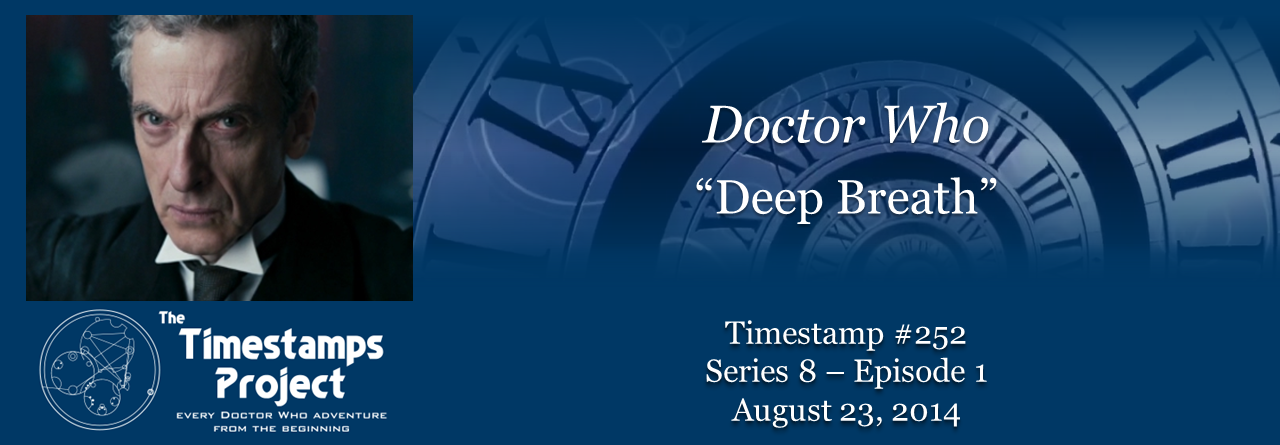
Timestamp #252: Deep Breath

The last chance for the Paternoster Gang to play Sherlock Holmes.

A tyrannosaurus rex stomps through London as the Paternoster Gang responds to investigate. Madame Vastra assumes that the dinosaur traveled through time, a suspicion that is confirmed when she coughs up the TARDIS. The blue box, which Police Inspector Gregson mistakes for an egg, lands on the bank of the Thames.

Vastra orders the inspector to place sonic lanterns along the river’s banks to confine the tyrannosaur while the Paternosters make contact with the Doctor. Strax knocks on the door and briefly meets the Twelfth Doctor. The Time Lord, still dressed in his predecessor’s clothes, is experiencing confusion and memory issues after his difficult regeneration.

With a bong of the cloister bell, the Doctor collapses on the river bank as Vastra remarks, “Here we go again.

Everyone moves to Vastra’s house where the Doctor is overstimulated by the concept of a bedroom. He also remarks that the mirror looks “absolutely furious”. When the Doctor reacts to typical British accents, Vastra adopts a Scottish accent like the Doctor’s new persona and uses his telepathy to put him to sleep. When Clara demands to know how to change the Doctor back, Vastra retires to her study with a request for her veil. After all, she realizes, there is a stranger in the house.

As the Doctor sleeps, he murmurs translations of the dinosaur’s moans. The tyrannosaur is alone and laments the lost world. Clara leaves the Doctor’s side as Strax arrives to escort her to Vastra’s study.

On the streets below, people look upon the dinosaur as a man named Alf wonders if it is a government conspiracy. He chats with a mysterious clockwork man who admires Alf’s eyes to the point of taking them.

Vastra interviews Clara about the events of and following Trenzalore. Vastra challenges the companion about her impressions of the Doctor, alluding to her veil as an analogy for the Doctor’s faces: She wears it to be accepted among those who wouldn’t understand her life and values otherwise. She also suggests that the veil is a judgment upon the character of those she meets. The Doctor trusted Clara enough to regenerate in her presence, showing her his weakest side and moment, and this revelation spins Clara into a fury. Vastra is amused by the anger, and explains that the Doctor needs all of them – especially Clara – to anchor himself as he finds his identity again. In the exchange, Vastra has removed her veil, remarking that it disappeared when Clara stopped seeing it.

The Doctor wakes up and finds a piece of chalk. He then proceeds to write Gallifreyan calculations around the room. He scrambles onto the roof and promises to return the dinosaur home, but the tyrannosaur spontaneously combusts and collapses into the river. The Doctor leaps from the roof and liberates a horse from its carriage before riding off into the night. The Paternoster Gang pursues him to the river’s edge.

The Doctor is apologetic toward the dinosaur’s remains and furious at everyone else around him, but his detective mind raises questions. First, have there been any similar murders? Second, who is the one man not gawking at the spectacle? The Doctor dives into the river with a mind to investigate.

The next morning, Strax has the TARDIS delivered to Vastra’s home. Clara dresses in Victorian fashion after being knocked out by a newspaper thrown by Strax and meets up with Jenny. It seems that Madame Vastra is having the Camberwell child poisoner for dinner… after interrogating him, of course. Strax gives Clara a medical examination as a prelude to her joining the Paternosters in case the Doctor never returns.

The Doctor is wandering about in an alley, obviously freezing in his wet state. He finds a homeless man and asks about his own face, musing about how it seems familiar, including the “attack eyebrows”. He wonders who did the frowning to wrinkle his new face so. He is delighted by his Scottish accent and how it relates to his cross-looking face.

He then remembers reading about a case of spontaneous combustion in the newspaper. Vastra is also following the leads as Jenny inexplicably poses in her underclothes. The Silurian remarks that burning the bodies would be a great way to hide what was missing from them, but this train of thought is derailed when Clara enters to show them an advertisement in the paper addressed to the Impossible Girl. After some puzzle-solving, Clara figures out that she should meet the Doctor at Mancini’s Family Restaurant.

When Clara arrives at the restaurant, she is confronted by a terrible smell. It is the Doctor, who soon joins her at a table in a coat he pawned off a homeless man. They discuss Clara’s reaction to his regeneration through his response to her advert in the paper. They soon realize that they’ve both been tricked into coming to the restaurant.

The Doctor measures the air disturbance using one of Clara’s hairs. They watch the other patrons and realize that they’re not actually eating. They’re also not breathing. When the duo stands to leave, the other patrons rise to block their exit. The Doctor and Clara sit down again and the patrons follow suit.

They are soon met by a clockwork waiter who categorizes the organs that the newcomers have to offer. The Doctor rips off the waiter’s face, noting that an automaton lies beneath, and the duo is locked into their chairs and lowered into a tunnel below. The Doctor notes that it appears to be a larder and, after some cooperative hijinks, is able to free them with the sonic screwdriver.

The Doctor and Clara tour the larder and find the Half-Faced Man – the eye thief from before – recharging in a chair. The automatons are stealing body parts to appear more human piece by piece. The cases of spontaneous combustion hide the butchery conducted upon the victims.

The Half-Faced Man begins to wake up, so the Doctor and Clara attempt to escape. The Doctor thinks that he’s seen something like this before, but the escape is thwarted as a door slides between the duo. The Doctor leaves Clara behind and she evades the automatons for a little while by holding her breath. As she walks to the exit, she’s confronted by a memory from the past and collapses as her body rebels.

Captured by the automatons, she awakens to the sight of the Half-Faced Man. Clara refuses to tell him where the Doctor is, calling the automaton’s bluff. After all, killing her will leave him without information, which is the same place he is now. Instead, she offers an information exchange, question for question, and finds out that the automatons killed the dinosaur specifically for parts so that they can reach the Promised Land. They have been working toward this goal for millions of years.

When the Half-Faced Man threatens to torture Clara for information, Clara declares that the Doctor will always have her back. Sure enough, he has been hiding as an automaton, and with a keyword – Geronimo! – the Paternoster Gang arrives as backup.

He also determines that the Half-Faced Man did not post the advert summoning the travelers to the restaurant.

The Half-Faced Man retreats upstairs with the Doctor in pursuit, attempting to leave via an escape capsule. Vastra had summoned the police, but the automaton chases them out and leaves an opportunity for the Doctor to pour two drinks for a discussion. He now remembers that the automatons are from the 51st century and continues to extract information as the escape capsule is deployed. It is powered by a hot-air balloon made from human skin.

The Doctor examines a control button and finds that the pod belonged to the SS Marie Antoinette, sister ship to the SS Madame de Pompadour. The ship fell through time and crashed into England millions of years earlier. The only survivors, the service robots, began their cycle of repairing themselves over and over again. The Doctor assures the Half-Faced Man that humans are never small to him. That he will always fight for them.

As they struggle, Clara and the Paternosters finally defeat the robotic warriors in the larder by holding their breath as Clara uses the sonic screwdriver to open the door. Meanwhile, the Doctor and the Half-Faced Man reach an impasse. Suicide is against the automaton’s programming, but murder is against the Doctor’s nature.

Only one of them is lying, and they both know who it is. In the end, the automaton falls from the capsule and dies impaled upon the spire of the Clock Tower.

Clara and the Paternoster Gang return to Vastra’s home only to find the Doctor and the TARDIS are gone. Clara offers to join the household, but Vastra points out that Clara has already dressed in her modern-era clothing in preparation for continuing her travels. Sure enough, the TARDIS returns and Clara joins the Doctor in a revamped console room.

The Doctor tells her that he’s not a boyfriend, noting that it was his mistake to lead her on in his previous life. He’s also made many mistakes over two thousand years and is keen to do something about them. He places the TARDIS in flight and asks about the advert in the paper. The Doctor ties it back to the strange woman who originally gave Clara the TARDIS’s phone number as a computer help line, deciding that someone really wants the two of them to travel together.

The TARDIS lands at Clara’s home time, and she expresses regret that she doesn’t know who the Doctor is anymore. At that moment, Clara’s mobile rings, and she steps out to head the Eleventh Doctor in the line. He leaves her a message from Trenzalore – before she found the exterior phone dangling – imploring her to put aside her fear in order to help the Doctor find his way. With that, the Eleventh Doctor says goodbye.

Clara returns to the Twelfth Doctor’s side. The Time Lord asks her to look beyond the appearance and just see him. Clara examines him before giving him a hug, thanking him for the guidance. This Doctor’s not a hugger, but he offers to go for chips and coffee. They’ll work through the change together.

The Half-Faced Man awakens in a mysterious garden. He is greeted by a woman named Missy who refers to the Doctor as her boyfriend. She tells the automaton that he has reached his goal. He is in the Promised Land.

Paradise.

Heaven?


This episode is a rough start to a new era, but it plays well because it reflects the rough regeneration and the turmoil in the relationship between the Doctor and Clara.

On its face, Clara’s reaction to regeneration doesn’t seem reasonable. One could argue that she doesn’t remember her fragmented trip into the Doctor’s timeline in The Name of the Doctor, however, she readily recognized the War Doctor in The Day of the Doctor and remembered the salvation of Gallifrey during The Time of the Doctor. Therefore, she obviously knows about regeneration having directly interacted with three distinct incarnations of the Doctor during her travels.

Her confusion, therefore, seems to be linked to how the Doctor appears after regeneration, which makes her appear shallow. This is an unfortunate change of character for Clara that only gets a bit of smoothing over by suggesting that the Eleventh Doctor led her to believe that their relationship was more romantic and/or intimate. There is a point to be made here, of course, because the Eleventh Doctor was pretty obsessive over Clara’s “Impossible Girl” mystery, but her knowledge of regeneration should have overridden that.

The smoothing at the end of the episode also gives a bit of promise to the new somewhat antagonistic dynamic between the Doctor and Clara. She has been requested specifically by the old Doctor to help the new Doctor find his footing, and I can get on board with that as long as the transition doesn’t take too long. I am eager to have a Doctor that doesn’t have romantic entanglements with his companions.

The roughness of this episode also results from smashing elements of three previous adventures into one: Invasion of the Dinosaurs, The Snowmen, and The Girl in the Fireplace. To that end, it plays as a “greatest hits” story in the background of this Doctor’s character introduction. It works, but it is awkward, especially with some of the more slapstick comedy elements like the boing effect when the Doctor is put to sleep, the car alarm on the Paternoster carriage, and the strange underwear modeling by Jenny while Vastra works. These comedic beats fell flat for me.

On the upside, I love this Doctor’s outfit and mannerisms once he returns to pick up Clara. Between these elements and Vastra’s “here we go again”, Steven Moffat is obviously trying to tie the Twelfth Doctor to the Third Doctor.

Speaking of the Doctor’s return, this is typically seen as the moment where the Twelfth Doctor joined the Siege of Gallifrey.

Peter Capaldi’s eyebrow cameo in The Day of the Doctor has never been explicitly placed within his run on the show, but the visual clues point to this moment. The console room in the cameo clearly shows the Series 7 console room coloring (which has changed upon the Doctor’s return here) and Capaldi has his shorter haircut. The piece that seals it for me is the chalk equations, which aren’t explained within the story but make sense if he’s still processing the plan put in place by the Tenth, Eleventh, and War Doctors.

There is a possibility that the Twelfth Doctor’s inclusion in the Siege of Gallifrey is a paradox that takes place outside of time, which typically happens when multiple Doctors appear in the same story – see The Five Doctors and Time Crash for prime examples – but the effects of The Day of the Doctor have shown to be pretty significant, so I’m keen to side with the theory that the Twelfth Doctor’s role in the 50th anniversary special happened here.

Finally, this episode brings us the final appearance (to date) of the Paternoster Gang, and Steven Moffat really hammed up the Sherlock Holmes connections (which we started seeing in The Snowmen). Inspector Gregson, “the game is afoot!”, the Conk-Singleton forgery case, the Camberwell poisoning case, and Vastra’s use of the agony column are all significant in the universe created by Sir Arthur Conan Doyle.

(Though I did learn that “the game is afoot” originated with Shakespeare’s Henry V.)

While this story was rough and awkward, it was far more engaging than The Time of the Doctor and lays some groundwork for the adventures to come. Recall that, per the rules of the Timestamps Project, regeneration episodes pick up an extra point. That pushes Deep Breath from above average to top marks.

Rating: 5/5 – “Fantastic!”


UP NEXT – Doctor Who: Into the Dalek

cc-break

The Timestamps Project is an adventure through the televised universe of Doctor Who, story by story, from the beginning of the franchise. For more reviews like this one, please visit the project’s page at Creative Criticality.

Timestamp #251: The Time of the Doctor

Doctor Who: The Time of the Doctor
(1 episode, Christmas Special, 2013)

Timestamp 251 Time of the Doctor

Death and birth in Christmas.

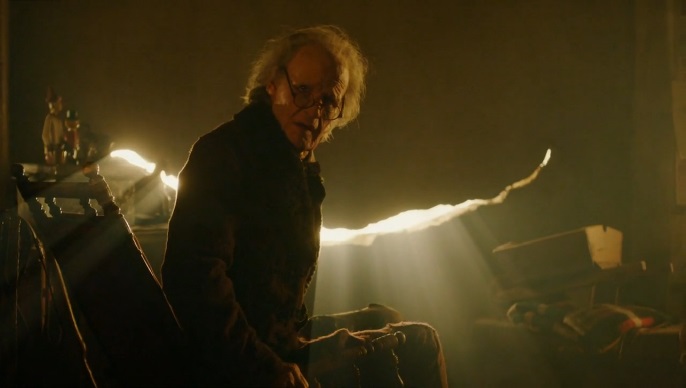
A fleet of ships respond to a tri-tone signal echoing in the cosmos from a seemingly unimportant planet. The Doctor is among the respondents and transports aboard a Dalek ship. When they start shooting, he transports back and scolds a disembodied Cyberman head named Handles.

His rant is interrupted by a ringing telephone. Unfortunately, it is routed to the handset on the outside of the TARDIS, but fortunately, the caller is Clara. She invented an imaginary boyfriend and needs the Doctor to pose as him at Christmas dinner. He materializes the TARDIS on a newly arrived ship, this time a Cyberman ship, and then scampers off as Clara calls again.

Clara’s trying her best to host Christmas dinner, but she’s having difficulty with the turkey and her family. When the TARDIS arrives, she runs down to meet the Doctor but finds him naked. It seems that he’s going to church. He puts on some holographic clothes and runs up to meet the family, but failed to extend the holographic projection to the family. Clara explains her issues with the turkey and the Doctor takes her to the TARDIS to cook it in the temporal engine.

Meanwhile, Handles has calculated the planet’s identity: Gallifrey. The Doctor refuses to believe the analysis even though he has recently saved his homeworld. His thoughts are interrupted by the arrival of Mother Superious Tasha Lem and the Papal Mainframe. Clara dons holographic clothing – nudity is the order of the day at church – and the pair board the new ship.

Tasha is pleased with the Doctor’s new body and offers a private consultation while Clara waits outside the chapel. While Tasha and the Doctor confer, Clara encounters the Silence, repeatedly forgetting the confessors once she looks away from them. She interrupts Tasha and the Doctor in a panic, forgetting why she did, and then joins the Doctor as he teleports to the planet surface. Tasha demands the TARDIS key so he can’t summon the time capsule and requests that he return in one hour.

Once the travelers arrive on the surface, they find a group of Weeping Angels buried in the snow. The Doctor summons the TARDIS by removing a surprise wig and revealing a key hidden beneath. The TARDIS materializes in a nearby village where the freshly re-dressed travelers meet the residents and a field that forces people to tell the truth.

The town, by the way, is called Christmas.

As the Doctor and Clara explore, they find a glowing crack in the wall, something he hasn’t seen for some time. The Doctor detects evidence that someone is trying to break through this weak point, and Handles suggests that it is Gallifreyan in nature. The truth field and the signal are coming from the Time Lords, and the signal is a question being transmitted through time and space.

It is the oldest question. You know, that inside joke about the show’s title. If he answers the question with his name, the Time Lords will know that it will be safe to return. Unfortunately, that means that everyone in orbit will open fire to destroy their enemy. The Time War will begin again.

The Doctor sends Clara to the TARDIS as Tasha reveals the true name of the planet. Turns out that Christmas is on Trenzalore. As the Doctor negotiates the problem with Tasha, the TARDIS returns Clara home. The Doctor places the planet under his protection, forcing Tasha to begin the Siege of Trenzalore and order the Doctor’s silence to fall.

The Doctor defends against Sontarans, Weeping Angels, and even wooden Cybermen as the years march onward and begin to show on the Time Lord’s body. The town celebrates every victory and comes to love the man who stayed for Christmas.

Eventually, the TARDIS returns to Trenzalore. It has been gone for 300 years, but it has returned Clara as she clung to the outer shell through the temporal vortex. They yell at each other and then embrace. Clara learns about the Doctor’s exploits and joins him for sunrise. Sadly, it is the last sunrise for Handles as the Cyberman head has developed a fault over time and succumbs to inevitability. The Doctor and Clara discuss the nature of his work on Trenzalore. Everyone gets stuck somewhere eventually. Everything ends.

The Doctor also reveals that he’s out of regenerations. Eleven Doctors, the War Doctor, and the Tenth Doctor’s vanity regeneration mean that this regeneration is the end of the line, but every life saved is a victory for him. His musings are interrupted by a request for a parley from Tasha. The Doctor and Clara take the TARDIS to Papal Mainframe. As Tasha and the Doctor negotiate, she reveals that everyone aboard has been replaced by Dalek puppets in order to snare their greatest enemy. The Daleks also know who the Doctor is thanks to information downloaded from the mainframe.

The Daleks try to use Clara as a bargaining chip, but he’s able to restore Tasha’s memories so she can fight back. The Doctor and Clara take the transmat back to the TARDIS. The turkey is finally done and Clara forces the Doctor to promise that he’ll never send her away again. Of course, the Doctor lies – rule number one, right? – and he tricks Clara into returning home while he stays on Trenzalore.

The years continue on as the fleets above continue the siege and the Doctor continues the fight. On Earth, Clara’s family consoles her as they celebrate Christmas. She hears the TARDIS returning and rushes to meet it. Inside, she finds Tasha, who then returns her to Trenzalore so the Doctor doesn’t die alone.

Clara returns to the room with the crack, marveling at the Doctor’s exploits and advanced age. They share a Christmas cracker and find a poignant message inside. The moment is broken by the arrival of the Daleks, and the Doctor ascends the belltower to make his last stand. This is how it ends.

Clara promises to remain behind as the Doctor bids her farewell. She turns to the crack and begs the Time Lords for assistance, offering the Doctor’s reputation as proof of who they seek. They respond by sealing the crack.

The Doctor faces the Dalek ship from the belltower. He admits that he has nothing left to offer, but the Dalek assault is disrupted by the crack opening in the sky. A burst of regeneration energy floats down to the Doctor and he begins to glow in a familiar golden light.

A bit of advice: Never ever tell the Doctor the rules. Regeneration number thirteen begins as the Time Lord uses the power rushing through his body to tear through the Dalek forces and Clara shepherds the villagers to safety.

After the battle, Clara returns to the TARDIS as she searches for the Doctor. She hangs up the phone and enters the time capsule to find the Doctor’s clothes on the floor and a bowl of fish custard on the console. He appears to her with his restored face, claiming that this is the reset. He sets the TARDIS in motion as he prepares to regenerate.

He talks to Clara as he begins to glow, seeing visions of Amelia Pond running around the TARDIS. He promises never to forget when the Doctor was him, then says farewell to a vision of Amy Pond.

He drops his bow tie, which he donned on his first day, then regenerates in a snap. As the new Doctor – an older Scottish man with familiar attack eyebrows – muses about the color of his kidneys, the TARDIS begins to spin out of control. Unfortunately, he doesn’t remember how to fly it.


This story bounces all over the map, and that is truly unfortunate. It was an attempt to tie everything off for Matt Smith’s era, including the Silence, the cracks in time, Trenzalore, and the fate of Gallifrey, but it was just too much and the sheer volume of concurrent story elements made for a muddled send-off for the Eleventh Doctor.

The mystery of the time crack was pretty well wrapped up back in Series 5, and the Silence arc came to a suitable end in Series 6. Bringing both of these elements back for this story seemed more of vain conceits than meaningful plot threads, particularly trying to redeem the Silence as religious confessors when they previously served as murderous foot soldiers.

The fate of Gallifrey was handled quite well in The Day of the Doctor, and while their minor influence here was welcome, I feel like the ending wasn’t quite earned. It’s Clara who begs the Time Lords for help, and historically the Time Lords have looked down on the Doctor’s interference in universal affairs. They even forced him to regenerate as punishment at one point, remember?

Sure, he saved them from utter annihilation, but is that enough to look the other way? I don’t know. The stakes seem awfully high since they’re perfectly safe in the pocket dimension… unless the goal is to ensure that the Doctor is indebted to them and obligated to free them.

The final element – the Doctor’s regeneration limit – takes a few turns here. This story firmly establishes that the limit is purely arbitrary, dictated at a whim by a higher power. Similar to the Master’s offer in The Five Doctors and the brand new set of regenerations gifted to him before The Sound of Drums, the Doctor’s potential is unleashed by the Time Lords with a snap.

The regeneration limit itself was mentioned three times before this point – The Deadly AssassinMawdryn Undead, and the TV movie – and given how regenerations are treated by other Time Lords like Runcible (The Deadly Assassin), the Council (The War Games, wherein the Time Lords didn’t even bat an eye at what was effectively capital punishment), and Romana (Destiny of the Daleks), I have long considered the limit to be very flexible if not completely artificial. The Doctor and the Master may believe it (at this point in the series progression), but others have shown us that the limits of regeneration are capricious at best. They are a way for the Council to keep the lesser Time Lords in line.

By extension, this also adds more credence to the Morbius faces being those of the Doctor before the First Doctor, but we’ll get there soon enough. (Breaking the Timestamps Project timeline, this story is exactly why I didn’t have an issue with the Timeless Child revelation during the Thirteenth Doctor’s run.)

It seems that this regeneration was the first in a whole new set of twelve, provided that the Eleventh Doctor didn’t burn all of them off with that over-the-top light show. It also offers a reset, so in that way, it was suitable for Steven Moffat to tie everything off in a sloppy bow. I have already talked about how this whole regeneration limit discussion could have been pushed into the next era by replacing the War Doctor with the Eighth Doctor, but again, Moffat and vanity conceits.

Taking a look at other elements of series mythology, we saw a nice list of “guest” aliens in orbit of Trenzalore, including the Judoon, the Silurians, the Terileptils, and the Raxacoricofallapatorians. In the Doctor’s hall of fame, there is also evidence that the Sycorax, the Monoids, the Racnoss, the Pyrovile, the Ood, and the Adipose also came to play.

It’s one hell of a finale for this era of Doctor Who. I only wish it was better. The ending was emotional, but the rest of the story was uneven. It definitely needs to take advantage of the Timestamps Project’s +1 handicap for regeneration episodes.

Rating: 4/5 – “Would you care for a jelly baby?”


UP NEXT – Doctor Who: Series Seven, Specials, and Eleventh Doctor Summary

cc-break

The Timestamps Project is an adventure through the televised universe of Doctor Who, story by story, from the beginning of the franchise. For more reviews like this one, please visit the project’s page at Creative Criticality.

Timestamp #250: The Day of the Doctor

Doctor Who: The Day of the Doctor
(1 episode, 50th Anniversary Special, 2013)

Timestamp 250 Day of the Doctor

The big event in a cup-a-soup.

The Last Day

A soldier opens his eyes to find someone standing over him. The soldier is part of the army on Gallifrey and has been fitted with a headcam. The man explains the headcam’s use and function, including how the frightening images that keep popping up are hallucinations, not premonitions. The headcams are installed into the brain and record everything for the official record. The recording is censored, with violence and language deemed unsuitable for the soldiers’ families cut out, and anything particularly graphic gets tinted red.

These soldiers proceed to Arcadia, the safest place on Gallifrey due to the impenetrable sky trenches. If even one Dalek did get through, the city could be destroyed, so the soldier has to remain vigilant in his scans. As he is trained on the scanner’s use, he detects a Dalek.

That Dalek leads to many more. As the Daleks open fire, the soldier’s headcam goes blank. The last sound heard in the background is a chilling death cry of anguish.

Thus begins the Fall of Arcadia.

The Day of the Doctor

After opening on a familiar theme, we see a police constable patrolling near I. M. Foreman’s scrap yard and Coal Hill School. Inside the school, Clara finishes a lesson for her class as the bell rings. She gets a note to meet “her doctor” at an address on an open patch of road. There she spots the TARDIS and races toward it on her motorcycle.

The TARDIS lets her in without complaint and she snaps her fingers to close the doors. After a cheerful reunion with the Doctor, she jumps as the TARDIS shudders. A helicopter hauls the box away. The Doctor calls Kate Stewart at UNIT headquarters only to find out that she’s bringing the TARDIS. She had no idea that he was still inside.

She has the TARDIS taken directly to the National Gallery where she presents instructions directly from Queen Elizabeth I. The Doctor and Clara meet UNIT scientist Petronella Osgood – she has a nice scarf – and proceed into the gallery. There they find a Time Lord painting known as both No More and Gallifrey Falls. It depicts the Fall of Arcadia and appears in three dimensions. The Doctor is shaken by what he remembers upon seeing the painting, recounting the day that the previously unknown Doctor ended the Time War.

Inside the image, we find the last day of the Last Great Time War. As the Daleks rage and innocents die, the War Doctor takes a gun from a lone soldier. With that weapon, he carves a message into a wall near the TARDIS.

It reads “NO MORE”.

The Doctor escapes by plowing the TARDIS through a wall and a gathering of Daleks. As he flees, the High Commanders gather in the War Room to plan their next move. The Eleventh General dismisses the High Council’s plans since “they have already failed” and ponders the Doctor’s message. He also learns that there has been a breach in the Omega Arsenal of the Time Vaults. Among all of the forbidden weapons – many of which have already been used in vain against the Daleks – the Moment has been taken.

The Moment was the final work of the ancients of Gallifrey. It is a weapon so advanced that it developed a conscience to stand in judgment of the user. The General muses that only the Doctor would be mad enough to use such a weapon.

Sure enough, the Doctor issues a final warning as he walks the empty desert toward an abandoned farmhouse: “Time Lords of Gallifrey, Daleks of Skaro, I serve notice on you all. Too long I have stayed my hand. No more. Today you leave me no choice. Today, this war will end. No more. No more…” He uncovers a complex box that ticks and whirs, lamenting the lack of a big red button to activate it. He hears a rustling sound and investigates, returning to find a woman sitting on the box.

This woman appears to be Rose Tyler, a face that this incarnation does not recognize, but she eventually identifies as Bad Wolf, an avatar of the Moment. She mocks the Doctor in her judgment, wondering why he left the TARDIS so far away. Perhaps so the TARDIS couldn’t witness what he’s about to do. Meanwhile, the Time Lord refuses the right to be called Doctor. Even though the name resides in his head, he no longer feels worthy of it. The suffering of the universe is too great, and he must end it even though it means his death. The Moment decides that his fate and punishment will be to survive the holocaust and live with the consequences, counting the dead for the rest of his lives.

They are interrupted by a fissure that opens overhead. A fez falls out.

In the 21st century, the Eleventh Doctor opens the queen’s letter.

“My dearest love: I hope the painting known as Gallifrey Falls will serve as proof that it is your Elizabeth that writes to you now. You will recall that you pledged yourself to the safety of my kingdom. In that capacity, I have appointed you Curator of the Under Gallery, where deadly danger to England is locked away. Should any disturbance occur within its walls, it is my wish that you should be summoned. Godspeed, gentle husband.”

Kate leads the Doctor and Clara away to show them the next piece of the puzzle. As they leave, UNIT scientist McGillop takes a mysterious phone call and questions why he should move the painting.

The Doctor, Clara, and Kate arrive at a painting of Queen Elizabeth I and the Tenth Doctor, leading the scene to England, 1562. There, the Tenth Doctor and Queen Elizabeth I ride a horse out of the TARDIS where he presumably just gave her a tour of the time capsule. They later share a picnic, and after she remarks on the face that has seen war, he proposes marriage.

It’s a ruse to uncover a Zygon invasion of Earth. Unfortunately, even with his tracking device that goes ding, he misidentifies the queen as a Zygon. When the horse changes shape, the duo runs from the threat. They end up separated, and while the queen gets attacked, the Doctor threatens a rabbit before realizing that it is truly just a rabbit.

The Doctor finds the queen once again, as well as a doppelgänger. While he tries to figure out which queen is the real one, a time fissure opens and a fez falls out.

In the 21t century, Kate leads her group into the Under Gallery where the Eleventh Doctor is fascinated by stone dust. Kate orders Osgood to analyze it while they proceed deeper. The Doctor pulls a fez from a display case before coming to the reason why Kate called him here. Several 3-D paintings that used to show figures have had their glass broken out from the inside. The figures are missing.

The time fissure opens and the Eleventh Doctor faintly recalls seeing it before. He tosses the fez through before jumping across, landing at the Tenth Doctor’s feet. The two Time Lords realize who each other are, compare sonic screwdrivers, and bicker a bit before the time fissure crackles.

The Tenth Doctor sends the queens away with a pair of kisses as Clara communicates with the Doctors through the fissure. The Eleventh Doctor tries to send the fez back, but it never arrives in the Under Gallery. Instead, it lands at the War Doctor’s feet.

Kate leaves Clara in the Under Gallery as she calls her office to request the Cromier file – invoking a nod toward the “UNIT dating controversy” – unaware of the Zygon lurking behind her.

The Tenth and Eleventh Doctors attempt to analyze the fissure, canceling each other’s reversal of the polarity with their sonics. After a moment, the War Doctor jumps through and meets his successors, mistaking them at first for companions instead of Time Lords.

He also chastises them for pointing their sonic screwdrivers like water pistols.

The meeting is interrupted by the queen’s royal guard. The Eleventh Doctor tries to get Clara to pose as a witch through the fissure, but the guards and the War Doctor are not impressed. The Queen arrives and threatens to toss the Doctors in the Tower of London, which serves as Kate’s office in the future.

Once there, the Eleventh Doctor sets to work scratching at a pillar while the Tenth Doctor questions the War Doctor. Meanwhile, in the future, Osgood puts the pieces together and realizes that the statues are Zygons. She’s too late, however, and both she and McGillop are copied. Osgood is able to escape in short order.

Kate leads Clara to the Black Archive, a space where the deepest secrets are kept and everyone’s memories of visiting it are wiped. The archive is TARDIS-proofed to keep the Doctor out since he wouldn’t approve of the collection within. Kate shows Clara a vortex manipulator gifted to the archive by Captain Jack Harkness. The access code has been carved into a pillar.

Clara also finds out that Kate, Osgood, and McGillop are Zygons. In that confusion, Clara steals Kate’s phone and uses the access code to teleport away with the vortex manipulator.

In 1562, the War Doctor muses that he could program his sonic screwdriver to disintegrate the door, but the calculations would take centuries. He suggests starting on them while questioning the dread on the faces of his future selves. They discuss the Last Day of the Great Time War, and the Moment – only visible to the War Doctor – prompts him to ask about the children.

The Eleventh Doctor can’t remember the number of children on Gallifrey, but the Tenth Doctor can. There were 2.47 billion children, and the fact that the Eleventh Doctor doesn’t want to remember angers – no, infuriates – the Tenth Doctor.

The Moment fills in the blanks for the War Doctor: The Tenth Doctor is the man who regrets and the Eleventh Doctor is the man who forgets. She also points out that they all have the same sonic screwdriver at heart with different cases.

If the War Doctor can scan the door, then the Eleventh Doctor’s screwdriver could calculate the method of breaking the door. They confirm it but are amazed when Clara bursts through the door and claims that it wasn’t locked. The queen is right behind her, confirming that she was curious about what they would do.

In the modern day, the real Osgood skulks about the Under Gallery and finds Kate in Zygon stasis. In 1562, the queen shows her visitors what is going on, including how she implanted the Zygons in the Gallifreyan paintings using stasis cubes. They also learn that the woman is the real Queen Elizabeth I and that she killed her impostor in the forest.

After the Tenth Doctor and Queen Elizabeth I are married, the three Time Lords and Clara board the Tenth Doctor’s TARDIS. Detecting a potential paradox, the TARDIS compensates by shifting the desktops around a bit before Clara notifies the trio that they should head for the Black Archive.

The Zygons in the Black Archive are joined by their human counterparts, and Kate informs them that the Archive’s self-destruct mechanism has been activated. In five minutes, the nuclear warhead beneath them will detonate. The Doctors try to land the TARDIS in the Archive and fail, so the War Doctor suggests using the stasis cube instead.

When McGillop takes his call near the first painting, he gets an order to take the painting to the Black Archive. Once there, the Doctors emerge from the Fall of Arcadia and enter the Black Archive. They then use the memory modifiers to confuse everybody as to whether they are human or Zygon. If the participants stop the detonation and create a peace treaty – which is sure to be incredibly fair since the negotiators can’t remember which side they’re on – they will have their memories restored.

The countdown is stopped and the negotiations begin. The Osgoods figure each other out only by the nature of asthma. Meanwhile, Clara talks to the War Doctor about the Last Day, discovering that he hasn’t used the Moment. She expresses the Doctor’s regret about what he did that day, and the War Doctor makes his decision.

The Moment takes him back to the barn in the desert and presents him with a big red button.

He knows now that his successors are extraordinary men, but that they will only become so if he follows through. The Moment talks to him about the wheezing and groaning of the TARDIS, a sound that brings hope wherever it goes. At the same time, two TARDISes materialize behind him and his successors arrive.

They were able to arrive in this time-locked space because the Moment allowed it.

The two Time Lords talk about how they’ve treated their memory of the War Doctor. They explain that he was the Doctor on the day that it was impossible to get things right, and they offer to help him push the button today. Not out of fear or hatred, but because there is no other way. In the name of the lives that they cannot save.

The Eleventh Doctor stays his hand at Clara’s face. She could never imagine him destroying his own people. The Moment shows them the Fall of Arcadia, adding a moment of conscience to the act. Clara judges them: The Warrior, the Hero, and… what is the Eleventh?

She reminds him of the promise of the Doctor – “Never cowardly or cruel. Never give up; never give in.” – and tells her Doctor what to do. They have enough warriors, and any old idiot can be a hero. He should be a Doctor.

The Eleventh Doctor disarms the Moment and explains. He’s had lifetimes to think about this, and these three have a stasis cube. While the War Doctor thanks the “Bad Wolf girl” – the Tenth Doctor is taken aback – the Time Lords put their plan into action.

On the Last Day of the Great Time War, the Doctors send a message to Gallifrey High Command: GALLIFREY STANDS. They explain their plan to the Eleventh General, and even though the general finds the idea absurd, the Doctors explain that they’ve been working on it all their lives.

In an extraordinary moment, the three Doctors are joined by their other ten incarnations, including the one they will eventually become. The thirteen TARDISes take position as the Daleks intensify their firepower. The general tells the Doctor to go ahead. The planet Gallifrey disappears into a pocket dimension and the Daleks destroy each other in the crossfire. A single Dalek pod spins off into the void, foreshadowing their eventual return as the Cult of Skaro.

Gallifrey stands.

Back in the National Gallery, the Doctors muse on whether or not they succeeded. The mysterious painting remains an enigma, but they agree that it was better to have failed having done the right thing than succeeding in doing the wrong. The War Doctor bids farewell to his successors with a special nod to Clara, and they address him as Doctor, fully worthy of the title. He won’t remember this adventure, however, because the timestreams are a mess, but the Eleventh Doctor and Clara will. His legacy is safe with them.

As the War Doctor departs, he begins to regenerate after surviving the Time War. He hopes that the ears will be less conspicuous before transforming into the Ninth Doctor.

The Tenth Doctor takes his leave, asking the Eleventh Doctor where he’s going next. The Eleventh Doctor relents and reveals that they are destined to die in battle on Trenzalore. The Tenth Doctor is glad that his future is in safe hands, but expresses a desire to change their final destination. After all, he doesn’t want to go.

Clara leaves the Eleventh Doctor to sit and look at the painting for a little while. As she steps into the TARDIS, she mentions that the gallery’s curator was looking for him. He muses that he would be a great curator, and a deep voice agrees with him. The Doctor is astonished to see a very familiar face as the Curator arrives, looking very much like the Fourth Doctor.

The Curator suggests that the Doctor may revisit a few of his old faces before turning to the painting. He points out that everyone screws up the title of the painting: It is neither Gallifrey Falls nor No More, but rather Gallifrey Falls No More.

Gallifrey survived, and now the Doctor is tasked with finding it. The mission is now returning it and all its people to the universe.

Later on, the Doctor speaks of his dreams. In a vision, he walks through the TARDIS doors to join his previous incarnations as they stare at the planet Gallifrey above. He is destined to go home, even if it takes him the long way around.


First and foremost, I adore this episode. It is littered with nods to the franchise’s mythology, but more salient, it tackles some important concepts with the Doctor’s character.

During the revival era, the Last Great Time War has hung over the Doctor’s head. The Ninth Doctor was fresh from that conflict and obviously suffered from post-traumatic stress disorder from the magnitude of his choices. The Tenth Doctor and the Eleventh Doctor carried this weight as shown in this story.

The beauty of this story is that it retains the show’s history – the Doctor’s incarnations before now do not remember saving Gallifrey, so none of the motivations or choices made have changed – but absolution and redemption are offered for everyone involved, especially the Eleventh Doctor. Even though it is temporary, the senses of forgiveness and relief are important for the War Doctor and the Tenth Doctor and definitely shed a different light on the episodes we’ve seen to this point.

I love how the destruction of Gallifrey was driven by Clara, thus allowing a sense of humanity to temper the decisions of the Time Lord. This has been a constant over Doctor Who‘s history and was used to great effect here.

I do question how every incarnation of the Doctor knew to calculate the salvation of Gallifrey. Earlier, the sonic screwdrivers drove the point that the shell may change but the software remains the same, but those calculations were started by the War Doctor and matured with the Eleventh Doctor. In reverse, the idea to save Gallifrey seems to propagate from Eleven to War to Ten, a path that is far from linear. In fact, it’s wibbly-wobbly, which describes the Doctor to a tee.

Speaking of, I am so glad that the writers were able to give the War Doctor such brilliant insights into the revival era’s use of sonic screwdrivers. They’re not magic wands or water pistols, and the Doctor’s not going to assemble a cabinet at an enemy. I love his view on these scientific instruments.


Shifting gears, as much as I love the War Doctor and John Hurt, I really wish that Steven Moffat hadn’t needed to introduce him.

I get the reasons why: Christopher Eccleston did not want to return after how he was treated in the role, and he was less than impressed with the script when it was sent to him. What I don’t understand is why Paul McGann couldn’t have filled the same role.

Yes, I also love The Night of the Doctor, but it was developed as part of this whole story arc. Realistically, the Eighth Doctor could have been the incarnation that engaged in the Time War after seeing how Cass Fermazzi was willing to sacrifice her own life to avoid traveling with a Time Lord. This would effectively avoid the Stuffed into the Fridge trope (since Cass isn’t a loved one being used to motivate the hero) and could give us far more screen time for Paul McGann than just a TV movie and a webcast short.

It would have avoided the thirteen lives complications that developed from introducing another Doctor (which we’ll obviously cover during The Time of the Doctor) and would have still avoided the need for Christopher Eccelston’s involvement.

Everything else in The Day of the Doctor could have remained the same.

As much as I adore John Hurt and his performance here, the War Doctor needlessly complicated things, which apparently stemmed from Steven Moffat’s desire to have a “complete set” of regenerations before his departure. From what I can tell, that’s a rumor, but… yeah.


No look at the fiftieth anniversary special would be complete without a look at the mythology.

I have linked a good number of the mythological callbacks, but there are still quite a few favorites that jumped out in the course of this celebration. One of them is the set design, particularly the roundels (“the round things”) in the War Doctor’s TARDIS and in the Curator’s gallery. The War Doctor’s TARDIS design is a fun mix between the classic era (not counting the TV movie) and the coral motif that kicked off the revival era. The Curator’s gallery adds the hexagons to the roundels, tying the classic and revival eras together.

The Brigadier’s space-time telegraph made a notable appearance in the Black Archive. It was prominently featured in Revenge of the Cybermen and Terror of the Zygons, the latter of which was our last meeting with the Zygons. That portion of the story also showcased one of my favorite Osgood moments as she and her doppelgänger share their identities over her asthma inhaler.

The Day of the Doctor marks the last salvo fired in the Last Great Time War, a confrontation that began in Genesis of the Daleks. Russell T Davies stated in an episode of Doctor Who Confidential that the origins of the war that he envisioned began when the Time Lords struck first – the attempted genocide of the Daleks – in the Fourth Doctor’s era. This idea was repeated by RTD in Doctor Who Annual 2006, and was adapted in Hunters of the Burning Stone, a 2013 comic story published in Doctor Who Magazine as part of the 50th-anniversary celebration. The comic was written by Scott Gray and served as a sequel to An Unearthly Child, though it was the Eleventh Doctor in the lead with Ian and Barbara.

The Black Archive pinboards hold tons of photo references to the franchise’s history, including: Susan Foreman; Barbara Wright & Ian Chesterton; Vicki Pallister; Katarina & Sara Kingdom; Steven Taylor; Dodo Chaplet; Ben Jackson & Polly Wright; Victoria Waterfield; Zoe Heriot; Liz Shaw; Captain Mike Yates; Harry Sullivan & Warrant Officer John Benton; Leela; Romana I; Romana II; Adric; Nyssa; Tegan Jovanka; Kamelion & Vislor Turlough; Jamie McCrimmon; Peri Brown; Melanie Bush; Brigadier Winifred Bambera; Ace McShane; Grace Holloway; Adam Mitchell (why?); K-9 Mark III; Lieutenant General Sanchez; Brigadier Alistair Gordon Lethbridge-Stewart; UNIT Captain Erisa Magambo; Donna Noble, Martha Jones, Mickey Smith, Rose Tyler, & Wilfred Mott; Jo Grant; Jack Harkness; Craig Owens (again, why?); Sarah Jane Smith;
Amy Pond & Rory Williams; River Song; Kate Stewart; and Clara Oswald.

Finally, that moment. The all thirteen moment. The moment that made me jump out of my seat and cheer. The moment that makes me grin from ear to ear every time I see it.

It was amazing to see all of the Doctors on screen, interacting with each other to save their home. Since many of them are no longer with us, it was also fun to see exactly where the producers sourced the footage to bring this moment together.

  • The First Doctor’s footage came from The Daleks (specifically “The Dead Planet”), and his voice was newly recorded audio by John Guilor (who also voiced the First Doctor in the reconstruction of Planet of Giants).
  • The Second Doctor’s footage came from The Tomb of the Cybermen and The Mind Robber, and his audio came from The Seeds of Death.
  • The Third Doctor’s footage came from Colony in Space – the re-used footage was flipped from the original – and the audio came from The Green Death.
  • The Fourth Doctor’s footage came from Planet of Evil – again, the re-used footage was flipped – but the audio (“Ready.”) has yet to be identified.
  • The Fifth Doctor’s footage was sourced from Frontios and the audio came from The Five Doctors.
  • The Sixth Doctor’s footage and audio were sourced from the same story: Attack of the Cybermen.
  • The Seventh Doctor’s (flipped) footage and audio came from Battlefield, but the producers also used some footage from the TV movie.
  • The Eighth Doctor’s footage came from the TV movie. The audio (“Commencing calculations.”) hasn’t been identified.
  • Finally, the Ninth Doctor’s footage came from Rose and The Parting of the Ways (“And for my next trick…”), along with some footage from Aliens of London.

The sheer amount of work and research required to make this climactic scene come to life amazes me.


Finally, I want to take a look at three smaller items before closing this out.

First, The Last Day: It was a quick and easy prequel story. The biggest thing that came from it was a desire to know more about the soldiers and the headcams.

Second, the visual salute to Christopher Eccleston’s legacy in the regeneration. Steven Moffat didn’t want to include an image of Eccleston in the regeneration sequence because it would have been “crossing the line” by implying that he had been on set. So, there are hints as John Hurt morphs into Christopher Eccleston, but the camera cuts away just in time to give us the impression of what comes next. Of course, as implied by the novelization of this story, the Ninth Doctor broke every mirror in the TARDIS just after regeneration because he couldn’t face himself. That adds a new dimension to his first glance in the mirror in Rose.

The last is the novelization of The Day of the Doctor. If you haven’t had a chance to read it, pick it up. It tells the story of the TV episode but breaks the chapters into narratives by the War Doctor, the Tenth Doctor, the Eleventh Doctor, Petronella Osgood and the Zygons, the Twelfth Doctor, and even the Thirteenth Doctor. It expands a lot of the characters and scenes, and it also adds a few additional insights and inside gags, including some time with Peter Cushing’s Dr. Who. While I don’t generally lean on the expanded media for information, this is written by Steven Moffat so I consider it a bit more authoritative. Chapter 9 (“The Truth of the Doctor”) is a hoot.

It’s a quick read and well worth the time.

Rating: 5/5 – “Fantastic!”


UP NEXT – The Five(ish) Doctors Reboot

cc-break

The Timestamps Project is an adventure through the televised universe of Doctor Who, story by story, from the beginning of the franchise. For more reviews like this one, please visit the project’s page at Creative Criticality.

Culture on My Mind – Fortnight Philosophy: June 5, 2017

Culture on My Mind

Culture on My Mind
Fortnight Philosophy
June 5, 2017


cc-break

Culture on My Mind is inspired by the weekly Can’t Let It Go segment on the NPR Politics Podcast where each host brings one thing to the table that they just can’t stop thinking about.

For more creativity with a critical eye, visit Creative Criticality.