Culture on My Mind – SUBSAFE

Culture on My Mind

Culture on My Mind
SUBSAFE
July 24, 2023

On June 18, 2023, the submersible Titan imploded during an excursion to the wreck of the Titanic in the Atlantic Ocean. The submersible was owned and operated by OceanGate CEO Stockton Rush, and the incident claimed the lives of Rush, French deep-sea explorer and Titanic expert Paul-Henri Nargeolet, British billionaire Hamish Harding, Pakistani-British billionaire Shahzada Dawood, and Dawood’s son Suleman.

I watched as the internet exploded in memes and mockery over this event. I get the reasoning behind it: According to the 2022 Global Wealth Report from Credit Suisse, nearly half of the world’s wealth – 47.8%, or 221.7 trillion in US dollars – is controlled by 1.2% of the world’s population. Over half of the world’s population has a wealth of less than $10,000, and one-third of the population lives in the $10,000-$100,000 range. 

This year, Forbes reported that there are 2,640 billionaires on the planet. They are collectively worth $12.2 trillion. That’s 2.6% of the world’s wealth controlled by a tiny fraction of the world’s population, and they are concentrated in the United States, China, India, and Germany.

I’m not here today to adjudicate that. It’s merely the motive behind the reaction of the masses as one billionaire’s hubris killed four other people. And while it’s possible that those four passengers may have known about the submersible’s shortcomings, it’s not likely in my opinion.

I look at skydiving, scuba diving, bungee jumping, rollercoasters, and other such thrill-seeking experiences that people enjoy. Most of them are taken with the assumption that some higher authority has oversight… that the attraction has a safety record and someone would have shut them down if it wasn’t safe to an acceptable degree of risk.

OceanGate has been transporting paying customers on submersible trips since 2010, including several trips to other shipwrecks. On its face, 13 years without significant incidents is a pretty good track record. Most people in search of a thrill-seeking experience would stop looking for problems at that point and sign the requisite waivers.

I don’t engage in the internet’s mockery of the Titan implosion because I can reasonably assume that those four passengers made the same risk calculations. But what came out after the Titan implosion is what really bothered me as a former submariner. 

In a 2019 Smithsonian Magazine article, Rush was referred to as a “daredevil inventor” who believed that the U.S. Passenger Vessel Safety Act of 1993 “needlessly prioritized passenger safety over commercial innovation”. He later admitted that he broke rules with “logic and good engineering” behind those decisions. He described safety as a “pure waste” and suggested that people should do nothing in life if they want to remain safe.

The OceanGate submersible had multiple engineering issues which Rush ignored based on faulty assumptions and questionable engineering experience. Rush also ignored dissenting opinions from David Lochridge and Rob McCallum, even to the point of firing dissenters and pursuing legal action against them.

But, most importantly to what I want to discuss here, he openly stated in a now deleted video meeting with Teledyne Marine that he bucked the trend of hiring submarine veterans – “50-year-old white guys” – because he wanted his team to be younger and more inspirational.

The thing is that the talent that he kicked aside because he wanted to “make expeditions to the Titanic more enjoyable for his customers” could have potentially saved those customers on June 18, 2023. Submarine veterans (like me) know about the history of the USS Thresher and the quality assurance program that was developed as a result.

On April 10, 1963, the USS Thresher (SSN-593) was lost at sea with all hands. She was a Permit-class nuclear submarine, the fastest and quietest of the day, and designed to hunt and kill Soviet submarines during the Cold War. Thresher was launched in 1960 and conducted her sea trials over the next couple of years to thoroughly evaluate her new and complex technological systems. After a series of operations, she entered Portsmouth Shipyard in July 1962 for a post-shakedown availability to examine and repair systems, and as typical for first-of-class boats, the availability took longer than expected. Thresher was finally certified for sea and undocked on April 8, 1963.

The crew began post-overhaul sea trials the next day, and everything seemed to be okay until the deep-dive tests on April 10th. Thresher slowly dove deeper while making circles under her surface support ship, Skylark, pausing every 100 feet of depth to perform a shipwide integrity check. As the submarine neared test depth, Skylark received a garbled communication indicating “…minor difficulties, have positive up angle, attempting to blow”.

That “blow” would be an emergency blow of the main ballast tanks, which means rapidly filling the large tanks with high-pressure air and making the ship overwhelmingly positively buoyant. You’ve probably seen the stock footage in movies and television, particularly during The Hunt for Red October.

There was one more even more garbled message from the deep and Skylark‘s crew knew that something was wrong. An extensive search was conducted and Thresher‘s families were notified that night. Chief of Naval Operations Admiral George W. Anderson Jr. held a press conference to announce that the submarine was lost with all hands.

After an investigation, the root cause of the disaster was determined to be a failure of the saltwater piping system. Specifically, there was a joint that relied on silver brazing instead of welding, and that failure would have potentially shorted out an electrical panel, shut down the reactor, and caused a loss of propulsion. There was also some concern over excessive moisture in the high-pressure air system which would have frozen during an emergency blow and plugged up the piping. The Navy made several modifications to systems to prevent these failures in the future. 

They also instituted the Submarine Safety Program, better known as SUBSAFE, which is a quality assurance program specifically designed to provide maximum reasonable assurance that submarine hulls will remain watertight and can recover from unanticipated flooding. The program’s scope includes every system exposed to sea pressure or critical to recovery during a flood. Any work on those systems is tightly controlled to ensure that materials, assembly, maintenance, and testing are perfect, including certifications with traceable quality evidence from point of manufacture to point of installation.

The track record speaks for itself: From 1915 to 1963, the United States Navy lost 16 submarines through non-combat-related causes. After SUBSAFE was introduced in 1963, the only submarine lost in similar causes was the USS Scorpion (SSN-589), and she was not SUBSAFE certified.

It’s an expensive program, but the cost of failure is much higher, and it’s a program that could have prevented the Titan disaster had some “50-year-old white guys” been consulted. SUBSAFE is embedded in the DNA of pretty much anyone who has earned a set of submarine dolphins. The regulations are written in blood.

The story of Stockton Rush and the Titan should serve as a cautionary tale. Safety and engineering may not be sexy and edgy, but it is a necessary part of pushing the limits of knowledge and understanding. The ocean’s depths are perhaps the largest unexplored frontier on Earth, and while I personally think that we should leave the Titanic graveyard alone, we should definitely continue to research the sea. 

But we should never willingly throw away experience and wisdom in the process, otherwise, we invite hubris, ignorance, and ultimately disaster.


cc-break

Culture on My Mind is inspired by the weekly Can’t Let It Go segment on the NPR Politics Podcast where each host brings one thing to the table that they just can’t stop thinking about.

For more creativity with a critical eye, visit Creative Criticality.

Schedule Update: The Timestamps Project (WGA/SAG-AFTRA Strike Edition)

Schedule Update: The Timestamps Project
WGA/SAG-AFTRA Strike Edition

Timestamps

The Timestamps Project is on hiatus in solidarity with the Writers Guild of America.

I recognize that Doctor Who is guided primarily by Equity UK, formerly known as the British Actors’ Equity Association, but the show also holds a production number with the Screen Actors Guild because they pay pension and healthcare contributions for any SAG members of the cast. Technically, Doctor Who is a SAG signatory. But that’s not important to this discussion.

I stand with the WGA and SAG-AFTRA because I am a writer and creative. I come from a family of creatives. Many members of my close-knit geek family are creatives, some of whom make their livings in film and television because of their passion for telling stories that mean something to all of us. Creativity lives in us, and it deserves to thrive with us.

I’m not being asked to do this. In fact, the strike rules don’t apply to me because I’m not a member of the unions and Creative Criticality falls more under the journalism rules than anything else. I am choosing this action because I feel that strongly about it.

The WGA strike started on May 2, 2023, and is based on the evolution of the streaming environment. The WGA has minimums for writers, but unlike the normal American worker who is nominally employed on a permanent basis, a writer works 35-40 weeks a year on a standard network show and 20-24 weeks a year in the streaming environment (where seasons are far shorter). In a city like Los Angeles, writers are fighting with the incredibly high cost of living and inflation. To compete against that, writers need a raise of about 10 percent.

Along with increased minimum compensation across all media, writers are also looking for increased residuals (which have been notoriously tough with streamers), appropriate compensations for writing television series across all stages of production, larger contributions to pension and health plans, the strengthening of professional standards and the overall protections for writers, and other terms.

Writers have talked about toxic environments in production, and it’s pretty obvious from the plans by studio execs to wait out the strike until writers “go broke“. These studio execs are on display as embodiments of late-stage capitalism: Success being defined by how much wealth can be banked while paying those who create the actual products as little as possible. They’d rather see crews destitute on the street rather than pay more in fair compensation and cut into their million- and billion-dollar comforts. It’s despicable, and it’s part of a pattern in corporate America of continually undervaluing the creative class.

It’s also pretty obvious on the SAG-AFTRA front. Consider the proposal that background actors – the lowest paid in the industry – get scanned for a single day’s pay with the intent of using their likenesses for any project at any time in perpetuity. It’s actually funny when you look at the Hollywood anti-piracy efforts over the last couple of decades that focused on how wrong it was to pay for something, transform it from the original format, and then share it over and over without due compensation.

As a producer friend of mine told me, this action would eliminate most working actors, the ones who never “make it” but still pay the bills just fine. It would domino across the industry: Current rules dictate one assistant director per every 100 background actors, so as background actor jobs diminish, jobs for ADs are eliminated. That cascades by eliminating jobs among all of the guilds.

All of it so that studio executives can pocket more cash as the industry burns around them.

During my lifetime, I have watched time and again as creatives have been treated like garbage. They’re treated like they don’t have real jobs or that their work is in the public domain because it exists in the internet era. Creatives aren’t valued until they don’t produce, and then they are replaced as if they were ultimately disposable.

Creatives are the lifeblood of the entertainment industry and the history of human storytelling, from film and television to books, video games, comics, art, podcasts, and beyond. Without creatives, we have nothing for actors, directors, producers, and publishers to translate to their chosen media. In turn, the studio executives have nothing without the hard work of all those people.

I stand with creatives. I stand against the continued devaluing of creatives and hard-working individuals. It’s not because I’m some sort of influencer (though, wouldn’t it be nice to have that many eyes on my work?), but because it’s the right thing to do when creators more powerful than me are fighting for what they believe in.

The Timestamps Project will remain on hiatus until the strike has ended. I hope you understand.

WGA-SAG-AFTRA-2023

cc-break

The Timestamps Project is an adventure through the televised universe of Doctor Who, story by story, from the beginning of the franchise. For more reviews like this one, please visit the project’s page at Creative Criticality.

Timestamp #285: Rosa

A powerful historical story.

Montgomery, Alabama – 1943: A seamstress named Rosa Parks boards a bus on her way home from work. She pays the fee and heads to the back where “colored people” are forced to sit. The driver tells her that she must disembark and enter the bus through the back door. When she tries to reason with the driver, he forcibly removes her. In the process, she drops her purse and briefly sits in the “whites” section to retrieve it. The driver is furious, prompting Rosa to tell him not to hit her. She leaves the bus and heads for the back door, but the driver maliciously drives away, leaving Rosa stranded in the middle of the street.

Montgomery, Alabama – 1955: The Doctor and her companions land in an alleyway. She’s dismayed that they didn’t land in Sheffield, and she chastizes the TARDIS for failing to take the humans home for the ninth time. Graham remarks that it was the fourteenth attempt, but he’s interested in meeting Elvis Presley. The Doctor discovers high amounts of artron energy in the area, which might be why the TARDIS chose this time and place, so they decide to investigate.

As they walk, Ryan notices that a woman has dropped her glove. When he tries to return it, the woman’s husband rewards him with a slap to the face. As the TARDIS team tries to work through the assault, Rosa Parks steps in to smooth things over. When the white couple walks away, Rosa turns on the team and lectures them on the Emmett Till situation before introducing herself. The team is starstruck, and the Doctor finds traces of artron energy all around Rosa.

Meanwhile, a mysterious man in a leather jacket finds the TARDIS. He tries to break in with an energy weapon but the capsule’s shields deflect it.

The Doctor and her companions convene at Slim’s Bar. Ryan and Yaz discuss their lessons about Rosa Parks from school, awed by the fact that she refused to give up her seat on a bus on December 1, 1955. The event (and her subsequent arrest) led to the Montgomery Bus Boycott and the end of racial segregation on public buses in America. That event will happen tomorrow.

Graham notes how quiet the bar has become. A waitress confronts them, stating that they don’t serve “negroes” or Mexicans (in reference to Yaz), and forces them to leave. Ryan is disgusted that he has traveled to the one time and place where he is hated most. The team decides to track down the artron energy and follows the readings to a nearby warehouse with copious padlocks.

Elsewhere, the mysterious man creeps on Rosa Parks. He returns to the warehouse where the team has discovered a suitcase hidden by a perception filter. The suitcase is filled with worn futuristic tech, including a charger. The mystery man fires on them, pushing the team into the yard outside. The Doctor confronts him, recognizing his weapon as a temporal displacement device that sends things to other times. She also notes that he’s carrying a vortex manipulator. He threatens to kill the team. She tells him not to threaten her. She takes a scan of his tech before the team leaves.

Their next stop is whites-only Sahara Springs Motel. The Doctor and Graham secure a room and sneak Ryan and Yaz in through a back window. They brainstorm about their situation and use a wall as a markerboard until a police officer knocks at the door. The Doctor erases the writing with her sonic screwdriver before answering the door, admitting the officer who searches the room. Luckily, Yaz and Ryan have escaped through the bathroom window and hidden behind a nearby dumpster. The officer departs with a warning that the Doctor and Graham should leave town soon.

Yaz and Ryan discuss their situation, irritated that things haven’t truly evolved between 1955 and their home time. Ryan relates how he is stopped while driving more often than his white friends, and Yaz explains how she’s seen as a “Paki” and a terrorist for going to a mosque. They return to the room and continue to work.

The team collects bus schedules and (thanks to Grace) narrows down their target to a bus driven by James Blake. They take a ride on the bus, disgusted by the seating situation, and end up at Rosa’s workplace. They eventually find Rosa on the bus and ask her about her riding habits, but she prompts the Doctor to move to maintain the racial status quo. Ryan volunteers to follow Rosa home while the rest of the team makes plans.

Rosa confronts Ryan for following her, but Ryan offers to help her with the fight. She eventually invites him to join her Youth Council, consisting of her husband, Fred Gray, and Martin Luther King. Ryan explains that his grandmother loved King and makes coffee for the meeting. He talks with Rosa later and shares his hopes that things will get better in the future.

The Doctor confronts the mysterious time traveler, tricking him into sending his own equipment to the 79th century. She identifies him as a prisoner of Stormcage, the same location where River Song was imprisoned. His name is Krasko, and he was imprisoned for murdering 2000 people, but he can’t kill the Doctor or Rosa due to a neural restrictor. The Doctor tests this by destroying his vortex manipulator and stranding him in time. Krasko wants to change history starting with the point where everything started to go wrong, and the Doctor warns him to go somewhere else. Krasko refuses.

Meanwhile, Yaz and Graham continue their research. Graham returns to Slim’s Bar and finds James Blake, but Graham is surprised to hear that Blake is taking a day off (orchestrated by Krasko). Graham returns to the motel room where the team is surprised by the news, prompting them to get James Blake back on duty.

Yaz and the Doctor pose as raffle officials, congratulating Elias Griffin Jr. on winning an all-expenses paid trip to Las Vegas to meet Frank Sinatra. The catch is that he has to leave now so he’ll have to miss his shift. Graham and Ryan find James Blake fishing on Mill Creek and convince him that a group of Black passengers are planning a sit-in protest across all of the bus routes. Furious, Blake packs up his gear and goes back to work.

Finally, the Doctor deliberately tears her coat and contracts Rosa to fix it as soon as possible. Yaz offers to wait for it.

Blake finds that his bus has been wrecked. A disguised Krasko tells him to head home, so the Doctor sends Ryan to game the bus system while Graham finds a replacement bus for Blake to drive. As Blake starts his route, Yaz talks to Rosa about their lives. Rosa is surprised that Yaz is a police officer. Rosa finishes the coat in time to catch the bus.

Ryan discovers that Krasko has blocked the road. After a confrontation about Ryan’s “kind” staying “in their place”, Ryan sends Krasko back in time as far as the time traveler’s gadget will allow. He makes it back to the bus just in time, placing all of the key players in the right spots.

As events play out, Graham ends up being the fulcrum that forces Rosa to occupy a white seat. When Blake demands that she move, she refuses, even if means being arrested. Blake calls for the police, and as Rosa is taken away she nods to the travelers. It’s obvious that she won’t forget them.

The team returns to the TARDIS and the Doctor explains how history plays out. The boycotts occur, and segregation on buses ends on December 21, 1956. Life was still hard, but Rosa was recognized for her brave fight in June 1999 by President Bill Clinton when she received the Congressional Gold Medal.

She was also remembered well into the future. The Doctor opens the TARDIS doors to reveal Asteroid 284996. It is named Rosaparks.


This was a hard episode to watch. It is also a necessary one in the mission of science fiction.

As someone who has lived in Georgia for over a decade and has spent most of his professional life in the American South, I have studied a lot about the history of the places I’ve called home. Cases like the murder of Emmett Till – a 14-year-old boy who was abducted, tortured, and lynched on the mere accusation of offending a white woman – are heartbreaking and woven throughout the fabric of society.

The details are sometimes lost to time as the system whitewashes them (leading to the importance of educational places like the National Center for Civil and Human Rights and the Martin Luther King, Jr. National Historical Park, both in Atlanta, Georgia) and sometimes they are celebrated by those who support oppression (after an all-white jury found the perpetrators not guilty of Till’s murder and thus immune to double jeopardy, they sold the story of how they tortured and murdered Till to a popular magazine for the world to see).

In the nearly 250-year-long history of the United States, racial segregation has only been illegal for about 60 years. Even though it was banned by the Civil Rights Act of 1964, segregation remained for many years as jurisdictions dragged their feet toward compliance and enforcement.

Even with that considered, racism and discrimination aren’t dead, leading to the importance of this particular episode in the science fiction genre. One of my favorite quotes about the genre comes from Stargate SG-1‘s episode “200”, in which a character addresses the camera and states:

Science fiction is an existential metaphor that allows us to tell stories about the human condition. Isaac Asimov once said, “Individual science fiction stories may seem as trivial as ever to the blinded critics and philosophers of today, but the core of science fiction, its essence, has become crucial to our salvation, if we are to be saved at all.”

Science fiction is a mirror to reflect upon ourselves. The messages are timeless, but in the moment it has the power to show a receptive audience where their society stands. As such, it has the power to enlighten and offend, and the response says a lot about the viewer and how the message resonates.

The hope is that the audience takes the opportunity for self-reflection and self-improvement.

The writing takes some creative liberties, but the message delivered by this story, sadly, is still relevant today.

It also breaks some important ground in the history of Doctor Who since it was co-written by Malorie Blackman, the first woman of color to write for the series. She joins Vinay Patel, who penned the upcoming Demons of the Punjab, as the first writers of color to work on Doctor Who. They follow in Noel Clarke’s footsteps after he wrote Combat for Torchwood.

Further, the episode was directed by Mark Tonderai, the first Black director for Doctor Who. We previously saw his work on The Ghost Monument, and he follows in the footsteps of Waris Hussein, the first person of color to direct for the series. Hussein, of course, directed An Unearthly Child and the majority of Marco Polo.

The episode joins an elite pair by not featuring the series theme over the end credits. Here, the episode ends with “Rise Up” by Andra Day. It joins the finale of Earthshock, though that story ended with silence.

The racial tensions mirror concerns shared by Martha and Bill, though the tensions are brought fully into the spotlight here by the necessity of the story. I will say that the character of Krasko was written with a heavy hand, and his demise continues a (perhaps inadvertent) bloodthirsty trend of dispatching villains in this run.

I liked seeing a nod to The Chase as our heroes watch historical events on the Time-Space Visualizer (or something similar). Krasko’s meddling is reminiscent of the Meddling Monk‘s schemes, and I also found Graham’s constant use of the name “Doc” amusing. Apparently, the Thirteenth Doctor doesn’t share the First, Sixth, and Tenth Doctor’s dislike of the nickname.

Finally, we once again see the Doctor and companions becoming part of history – Donna and the Tenth Doctor were part of the events at Pompeii – and it makes me wonder if they were always there, thus creating another bootstrap paradox.

Rating: 5/5 – “Fantastic!”


UP NEXT – Doctor Who: Arachnids in the UK

cc-break

The Timestamps Project is an adventure through the televised universe of Doctor Who, story by story, from the beginning of the franchise. For more reviews like this one, please visit the project’s page at Creative Criticality.

Timestamp #284: The Ghost Monument

A new family looking for an old friend.

Floating in the vacuum of deep space, the terror sets in as Ryan loses consciousness. A spacecraft arrives and the next thing that he knows is waking up in a pod with Graham watching over him. The spacecraft is being piloted by a woman named Angstrom who is suspicious of the two men. Despite the mutual misgivings, Angstrom drives the ship toward the “final” planet, which wasn’t where it was supposed to be.

Yaz and the Doctor are on a different ship, this one piloted by a man named Epzo. The “final” planet is named Desolation, and Epzo’s ship – which is falling apart around the trio – is crashing toward it. The Doctor recommends ejecting the back half of the ship, and while Epzo doesn’t like the idea, he has no choice.

Ryan, Graham, and Angstrom land on Desolation. The pilot scans the area while the two men revel in the fact that they’re on an alien planet. That joy soon evaporates as Epzo’s ship burns into the atmosphere above them and crashes pretty much on top of them.

The bright spot on the planet with three suns: The fam is back together.

The group makes their way across the desert as the pilots talk about their statuses as the last participants. An alarm echoing across the sands draws them to a large tent. Inside that tent, they find a man named Ilin and the lavish ephemera related to the final Rally of the Twelve Galaxies. The Doctor immediately recognizes all of it as a holographic projection.

The pilots have to survive the dangers of the planet without sabotage, injuries, or murder as they find a site called the Ghost Monument. The winner will receive 3.2 trillion Krin – is that a lot? – and will be taken off-planet, but the loser will be left to rot in desolation. Angstrom and Epzo are the last two participants in a field of 4000 who signed up for the ultimate test of survival and stamina.

The pilots are sent on their way, and the Doctor is treated to a holographic view of the Ghost Monument, which was named by the planet’s ancient settlers because it appears in the same place every 1000 rotations.

The Ghost Monument is the TARDIS. Its engines are stuck in a loop, leaving it to phase in and out on the planet. The Doctor and her crew set out after the pilots to get her ship back. They catch up to Angstrom and Epzo as the pilots fight over a single boat to cross a lake. Epzo threatens Angstom with a gun and the Doctor disarms him with Venusian Aikido. Ryan and Graham take a look at the broken engine while the Doctor and Yaz discover that the water is infested with flesh-eating microbes.

Graham tries to talk to Ryan about Grace, but Ryan shows him the cold shoulder. They do have a breakthrough about the engine, which is actually a solar battery. Meanwhile, Yaz and Angstrom bond for a short time until the boat is fixed.

The Doctor is puzzled by the empty planet, and Epzo shares a story about how his mother taught him a lesson about trust when she failed to catch him as he fell from a tree. Later, Angstrom explains the rally and how she entered to return home and bring her family back together again. Eventually, the travelers get some sleep while the Doctor watches over them.

When the boat lands, the group makes their way to some nearby ruins. Epzo and Angstrom split up while the Doctor and her companions enter the ruins. Epzo trips a sensor and activates a batch of sniper robots, and when he shoots at one, it shoots back. Both are struck, but the entire murderous group is activated. The Doctor’s group takes refuge in a shooting range, but when Ryan opts to fight back, the Doctor chastises him. Ryan goes all Call of Duty but returns when he can’t reload, bringing the snipers with him. The Doctor uses a fallen robot to rig an EMP, but this only gives them a short window to escape.

The Doctor’s group finds Angstrom and Epzo. After hacking into Angstrom’s tracker, the Doctor finds a hatch leading to an underground tunnel. They all take refuge in a large laboratory, taking heed of Ilin’s warning to not travel at night. Of course, Epzo wanders off to take a nap while everyone else explores the lab.

After syncing Angstrom’s tracker to the facility’s computer, they find a map of the tunnel system and a direct route to the Ghost Monument. Yaz and Ryan realize that the robots have found the hatch while the Doctor finds writing from the scientists who ran the facility. They were forced to work on weapons of mass destruction, and they opted to destroy the planet rather than let the weaponry fall into the hands of the Stenza. Angstrom reveals that the Stenza destroyed her planet and murdered millions, forcing her family into hiding.

Meanwhile, remnants of the scientists’ experiments attack Enzo, presenting as semi-sentient cloth strips. The group runs into the tunnels as the sniperbots shut down the life support systems. The group has no choice but to leave the tunnels, emerging into a field of acetylene. The Doctor takes a moment to praise Ryan for his courage as he climbs the ladder, and Ryan remembers that acetylene is lighter than air. The group digs into the sands as the cloth creatures whisper to them, even piquing the Doctor’s interest with something known as the Timeless Child. The Doctor and Graham use one of Enzo’s auto-igniting cigars to set the fields ablaze, destroying the cloth creatures.

As the suns rise, the group arrives at the tent marking the finish line. As Epzo and Angstrom debate who should win, the Doctor suggests that they enter the tent at the same time. Ilin is displeased but concedes the victory. He refuses, however, to take the Doctor and her fam off-world.

The Doctor is despondent and apologizes for failing to save her companions. The companions buoy her up as the sounds of the TARDIS echo around them. The Doctor uses her sonic screwdriver to summon and stabilize the TARDIS, and she is overjoyed when the time capsule materializes.

The ship has had a minor makeover on the outside, and it even opens the door for her. The inside has also been redecorated, and while it is a much darker control room, it does reflect the Doctor’s trip thus far with an orange crystal motif. The companions are astounded to see that the police box is bigger on the inside, and the Doctor is pleased to see that the console dispenses custard creams.

The Doctor works the controls and the TARDIS vanishes from Desolation.


The TARDIS has redecorated… and it’s okay. I’m not a fan of the dark and limited console room, but the designs on the walls and the eccentric console intrigue me. The crystal motif doesn’t pique my interest one way or the other, but it only makes sense when tying back into the Doctor’s homemade sonic screwdriver. The exterior is a nice callback to the Tom Baker era with the “pull to open” sign flipping the colors to white text on black.

The one choice that I really like is making the main entrance reflect the exterior design of the police box. It’s almost as if the Doctor and the companions have to step through the box to enter the extra-dimensional space.

I also like how Chris Chibnall paid attention to translation, specifically how the TARDIS’s translation field wouldn’t play into this story since the ship was missing. Enter the universal translators implanted by the medical pods as a nice touch.

I’m not a fan of the sonic screwdriver being used as a magic wand here. It’s a standard trope in the revival era, but there’s no reason why the team couldn’t spin the handwheel and open the hatch on their own. It was unnecessary to sonic it open.

I do like the new title sequence and the new theme. They take a creative spin on the usual while defining this era as its own.

The story itself is a standard quest line as our heroes get from point A to point B with some encounters along the way. That said, that bog-standard story is buoyed up by the characters as they get to know each other and the alien that they’re traveling with. The Doctor herself doesn’t present as some kind of superpowered deus ex machina, instead allowing the companions to solve the puzzles while encouraging them along the way. That helps to elevate an otherwise average adventure.

Rating: 4/5 – “Would you care for a jelly baby?”


UP NEXT – Doctor Who: Rosa

cc-break

The Timestamps Project is an adventure through the televised universe of Doctor Who, story by story, from the beginning of the franchise. For more reviews like this one, please visit the project’s page at Creative Criticality.

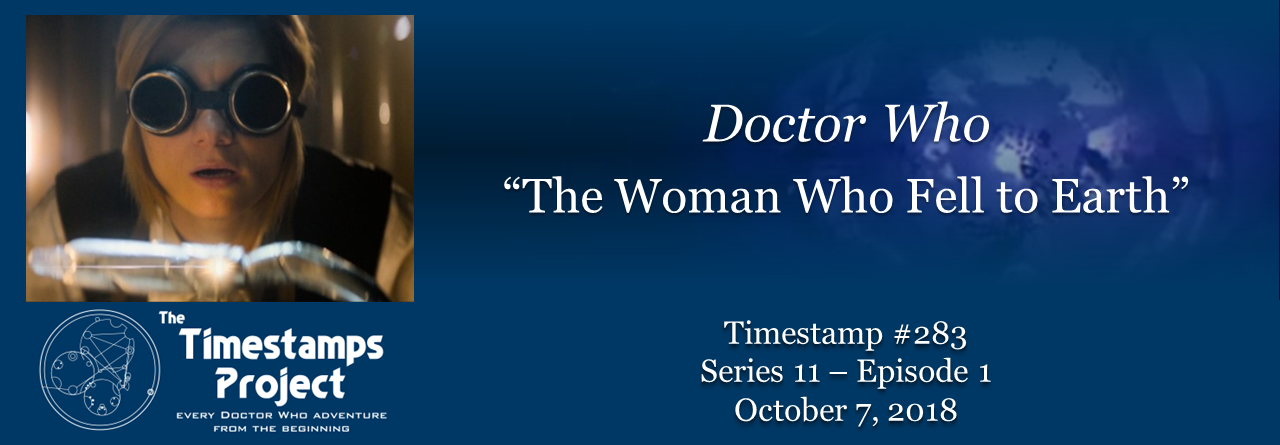
Timestamp #283: The Woman Who Fell to Earth

These new teeth are definitely weird.

Ryan Sinclair records a YouTube video and decides to talk about the greatest woman he ever met. He recounts trying to ride a bicycle with his grandmother Grace and her husband Graham O’Brien. It’s a challenge for him since Ryan struggles with dyspraxia, and when he falls off, he angrily throws the bike over a cliff. Grace and Graham try to console him but have to leave for their train home, so Ryan is left alone to retrieve the bike. He finds it trapped in a tree, then encounters a strange set of floating glowing golden lines. He touches one of them and watches as a purple plant-like pod emerges. It’s then that he calls the police.

We next meet Yasmin Khan, a probationary police officer who is settling a petty dispute between two women. She calls her supervisor, asking for something more challenging, and he gives her Ryan’s case. When Yaz meets with Ryan, she thinks that he’s pulling a prank on her, but their relationship warms up when they realize that they went to school together.

Grace and Graham are on their way home when a ball of energy collides with the train. The lights all go out, leaving the train shrouded in moonlight, and Grace investigates the disturbance. The couple soon encounters an erratic and electrified tentacle creature, and when they call Ryan and Yaz, the phones go dead. As the creature approaches, a woman falls through the train roof.

The Doctor springs into action and shorts out the electrified creature, but she cannot open the doors because she lost her sonic screwdriver. Yaz and Ryan arrive and the creature scans a bystander named Karl before briefly shocking everyone and flying away.

The Doctor takes charge but comes up short as Yaz asks who she is. The Doctor is perplexed by Yaz’s choice of address, recalling that she herself was a white-haired Scotsman half an hour before. She tells Ryan that she’s looking for a doctor before finding the train’s driver. Yaz thinks that the driver was murdered, but the Doctor says that she died of shock. The Doctor convinces Yaz and Ryan to join her, then meets Graham and Grace while mourning the loss of her TARDIS. Graham declares that there aren’t any aliens on trains in Sheffield, and the Doctor corrects him since she’s an alien.

Yaz takes contact information for a passenger named Karl and Ryan tells the Doctor about the pod. The team of Ryan, Yaz, Graham, and Grace go to the site but the pod is missing. In fact, it has been taken by a man named Andy for delivery to another man named Rahul. After paying Andy for his services, Rahul sets up several cameras to record the pod before sitting down to watch it.

The team, who the Doctor has started calling her “fam,” decides to check with their networks about anything out of the ordinary. Meanwhile, the Doctor collapses, prompting Ryan and Grace to take her to Ryan’s home. As the Doctor recovers, she glows with regeneration energy. Grace is astounded to find two separate pulses.

In Rahul’s shop, the pod cracks open. The energy awakens the electrical being and the Doctor simultaneously, and the Doctor discovers DNA bombs lodged in everyone’s collarbones. The Doctor tries to muddle through since her regeneration is not yet complete, but she recognizes the bombs as a way to get rid of witnesses. She reformats Ryan’s phone and uses it as a tracking device.

An armored figure emerges from the pod. Rahul demands to know where his sister is located and the being kills him and takes part of the corpse. The fam arrives soon after, watching as the creature leaves the shop. The creature escapes so the team investigates the shop. The creature has taken a single tooth from Rahul, and as Grace covers the body, Ryan finds the opened pod. The Doctor questions why the pod has come and Ryan admits to touching the golden lines.

The tracking signal, which was correlated to the electrical creature, has gone erratic. The Doctor decides to build her own sonic screwdriver so she can properly analyze the data. Meanwhile, Ryan and Yaz find a video file from Rahul, meant to be played upon his death. Rahul’s sister Asha was taken and he took it upon himself to find the truth.

The Doctor scans the pod with her fancy new sonic screwdriver and finds a recall circuit. She infers that the pod alien and the electrical alien are at war and looking to scrap it out on Earth. Graham gets a call about an alien’s location as the Doctor gathers some equipment. Meanwhile, the pod alien kills a drunk man who tosses salad at it and extracts another tooth. It then spots the electrical alien and heads toward it.

The Doctor’s team arrives first and shorts out the electrical alien. The Doctor scans it and finds a mass of gathering coils, a species that collects and correlates data. That data points back to Karl, the other passenger on the train. They are interrupted by the armored alien who demands to know who the Doctor is. When she can’t come up with the answer, she asks who the alien is.

The creature removes its helmet and identifies himself as Tzim-Sha (“Tim Shaw”) of the Stenza warrior race. He collects trophies from each kill and embeds them into his body, and he has been sent to hunt a randomly selected human without technology or assistance so he can become his people’s leader. Yaz and Ryan recognize that Asha was a previous victim of the hunt and that Ryan granted permission for the hunt by touching the golden lines. The Doctor declares that Tzim-Sha is cheating by using the gathering coils, and it turns out that he’s a double-cheat because he uses a short-range teleporter to escape after downloading the target’s info.

Tzim-Sha tracks Karl to his job as a crane operator at a building site. Following behind, the Doctor tasks Graham and Grace with evacuating the site while she, Yaz, and Ryan start climbing another crane. Despite his disability, Ryan takes on the task. Meanwhile, the Doctor formulates a plan to evacuate Karl by moving two cranes together. Karl tries to make the jump, but he’s stopped by Tzim-Sha, so the Doctor decides to jump across to confront the hunter herself.

She also takes a moment to curse her shorter legs.

Meanwhile, the Gathering Coil has recovered and is attacking the cranes. Grace decides to electrocute it with power from the site’s main power.

The Doctor confronts Tzim-Sha and threatens to destroy his recall device. She asks what he does with his trophies and is offended to learn that they are kept in stasis on the edge of death forever. Tzim-Sha threatens to detonate the DNA bombs, leaving the two at a standoff. Finally, the hunter asks his opponent who she is.

She’s glad he asked because she is the Doctor, sorting out fair play throughout the universe. She asks him to leave the planet and he decides to detonate the bombs, but she moved them to the Gathering Coil. The pain of the explosions transfers to Tzim-Sha and he’s stunned, leaving an opportunity for Karl to kick him off the crane. Tzim-Sha snags the recall device and uses it to teleport away as he falls.

Grace successfully runs the cables to the Gathering Coil, but when the electricity shorts out the creature, the energy discharge knocks her from the crane. She dies in Graham’s arms as the rest of the team arrives.

Ryan later pays tribute to Grace, the greatest woman he has ever known, on his YouTube channel. He continues trying to ride the bike in her honor as the Doctor watches from a distance. At Grace’s funeral, Ryan waits for his father but gives up after two hours. Later on, Graham gives a heartfelt speech about how he met Grace during his cancer treatments and how he has cherished their three years together.

After the funeral, the Doctor discusses her family and how she lost them a long time ago. She carries them with her as memories during her travels. She remembers that she needs to find her TARDIS and decides that she’s stayed too long. Yaz tells her that she really needs to change clothes.

Yaz, Ryan, and the Doctor go shopping at a charity store, eventually landing on a very colorful outfit. She then assembles a rudimentary teleportation device out of Tzim-Sha’s technology that will track the artron energy from the TARDIS. The device activates…

…and teleports all four of them into deep space.


This episode marks a major tonal shift in the franchise. It marks the debut of the first official female Doctor – I love Curse of Fatal Death but it really doesn’t count – and the introduction of the largest all-new regular cast since Terminus. On top of all of that, this story premiered with the biggest crew shift since The Eleventh Hour, marking a near-effective reboot of the show.

It’s not a reboot, mind you, but it certainly feels like it from direction and music to cinematography.

The companions are quite engaging as they learn about this whole new world, and I found the large cast to be used well in this story. I loved how authentic they were with each other, even to the point of Graham being upset about touching the “permission slip” symbol, Grace chastizing him for that, and the Doctor admitting that she would have done exactly what Ryan did.

The loss of Grace was tragic and I do wish that she would have remained to travel with the Doctor because the chemistry was great, but the cast is really too large for revival-era standard hour-long adventures. The last time that the Doctor traveled with three companions, the show thrived on stories broadcast over multiple hours per adventure. I don’t think there’s enough time in a single episode to give everyone their dues.

Of those companions, we’ve seen one of them before as a different character: Bradley Walsh played the Pied Piper in The Day of the Clown.

The Thirteenth Doctor is another tonal shift, taking us from the acerbic Twelfth Doctor back to a more whimsical Time Lord. She’s more soft-spoken, but there is tremendous power behind the cover. There’s also a lot of Doctor Who oddness, like using her (unreliable) nose to tell time.

There’s not a lot in the trivia department, but of note is that this is the tenth story not to feature the TARDIS. It joins Mission to the Unknown, Doctor Who and the Silurians, The Mind of Evil, The Dæmons, The Sea Devils, The Sontaran Experiment, Genesis of the Daleks, Midnight, and The Lie of the Land. It’s also the first time since The Faceless Ones that we have two male companions traveling with the Doctor.

I’m interested as to where the previous sonic screwdriver and the sonic sunglasses ended up, especially since humans are keen on reverse engineering alien technology. One hopes that UNIT was hovering around and snapped those pieces up for the Black Archive or something.

I enjoyed watching this again for the Timestamps Project. It’s probably the third or fourth time that I have seen this episode, and I find it to be a strong presentation (even as a regeneration episode). I saw it live with Mike Faber at a viewing party hosted by Battle & Brew. Every time I see it, I’m reminded of a bunch of fans crowded around a bunch of television sets and wondering what the future of Doctor Who had to offer.

I’m eager to see how this era has held up as I move through it once again.

Rating: 5/5 – “Fantastic!”


UP NEXT – Doctor Who: The Ghost Monument

cc-break

The Timestamps Project is an adventure through the televised universe of Doctor Who, story by story, from the beginning of the franchise. For more reviews like this one, please visit the project’s page at Creative Criticality.

Timestamp: Series Ten and Twelfth Doctor Summary

Timestamp - Series Ten Twelfth Doctor Summary

Peter Capaldi’s final run was nearly on par with his last set.

This group of stories kept up with Series Nine‘s continuing mission to analyze the human condition in the science fiction tradition. Series Ten focused less on vengeance but kept a focus on the consequences of what came before. In a beautiful narrative loop, we found the Twelfth Doctor suffering from the loss of Clara and River, finding hope in Missy and Bill, and then coming right back to the top of the clock with the intent of giving up so he didn’t lose anyone else again. Thankfully, he faced his fear (with a little help from his friends) and decided to carry on with brave hearts.

The big miss in an otherwise strong thematic season was the Monk trilogy – Extremis & The Pyramid at the End of the World & The Lie of the Land – which took a strange sideways adventure that didn’t really have any consequences aside from opening the door on Missy’s vault. It also brought to bear several questions about regeneration after the big reset in The Time of the Doctor, including why the Doctor chose not to spend a little energy to restore his eyesight.

Bill and Nardole were amazing as the Doctor’s combined conscience, almost acting in the same style as the classic Star Trek Kirk-Spock-McCoy pathos-logos-ethos triumvirate. I absolutely adored Bill’s wide-eyed innocence when it came to the Doctor’s adventures, and her growth was evident when she saved his life and then told him point-blank to move on. She’s probably one of my favorite modern companions.

Overall, Series Ten comes in with a solid 4.0 score. That ties with the classic Twelfth Season, and places this set at fifteenth among the thirty-eight seasons (so far) in the scope of the Timestamps Project. That’s not too bad at all, particularly for a group of stories that I wouldn’t mind visiting again in the future (with the exception of the Monk Trilogy).

The Return of Doctor Mysterio – 4
The Pilot – 5
Smile – 4
Thin Ice – 4
Knock Knock – 4
Oxygen
– 3
Extremis & The Pyramid at the End of the World & The Lie of the Land
– 2
Empress of Mars
– 4
The Eaters of Light
– 4
World Enough and Time & The Doctor Falls – 5
Twice Upon a Time – 5

Series Ten Average Rating: 4.0/5


Timestamps Twelfth Doctor

Following tradition…

The First Doctor was a wise grandfather, the Second a sly jester, the Third a secret agent scientist, the Fourth an inquisitive idealist, the Fifth an honorable humanitarian, the Sixth a squandered cynic, the Seventh a curious schemer, the Eighth a classical romantic, the Ninth a hopeful healing veteran, the Tenth a bargaining humanitarian, the Eleventh an irascible runner…

…and the Twelfth Doctor is a principled warrior.

It’s evident that this Doctor grew over his lifetime, and while he faced a lot of loss in this lifetime and his previous regenerations, he faced the threats before him with a hard line drawn at his feet. He stood as a sentinel to protect the innocent, the memories of the Last Great Time War fresh in his mind, and he kept his fury close to the surface as a warning to any who would challenge him. He cared for his companions to a fault, and those losses hurt him, but in the end he knew that he needed to soldier on for the sake of the universe at large.

While it’s easy to find a place for the Twelfth Doctor based on the scores I have assigned over three series, it was far more difficult to weigh out how I feel about him as a character. That took a lot of thought, and while the rankings are very close among the top ten in the “by character” list, I feel like that ranking is true to how I feel. I’d watch any episode with those Doctors on a whim.


Series Scores
Series 8 – 3.6
Series 9 – 4.1
Series 10 – 4.0

Twelfth Doctor’s Weighted Average Rating: 3.87

Ranking (by score)
1 – Eighth (4.50)
2 – Tenth (4.34)
3 – Ninth (4.30)
4 – Eleventh (4.17)
5 – Third (4.00)
6 – Twelfth (3.87)
7 – Second (3.67)
8 – Fourth (3.67)
9 – Seventh (3.54)
10 – First (3.41)
11 – Fifth (3.20)
12 – Sixth (2.73)
N/A – War (No score)

Ranking (by character)
1 – Tenth Doctor
2 – Second Doctor
3 – Ninth Doctor
4 – Eighth Doctor
5 – Third Doctor
6 – Fourth Doctor
7 – Twelfth Doctor
8 – War Doctor
9 – Eleventh Doctor
10 – Seventh Doctor
11 – First Doctor
12 – Fifth Doctor
13 – Sixth Doctor

As I’ve mentioned before, the top ten spaces on the character ranking are really, really, really close. I’m always tempted to simply rank them all as a first-place tie, but I find the real challenge to be actually thinking it through and placing them.


Next up, the Timestamps Project continues to the Thirteenth Doctor’s era. Without any spinoffs on the docket, it’s a straight shot from here through her journey to the franchise’s sixtieth anniversary.

UP NEXT – Doctor Who: The Woman Who Fell to Earthcc-break

The Timestamps Project is an adventure through the televised universe of Doctor Who, story by story, from the beginning of the franchise. For more reviews like this one, please visit the project’s page at Creative Criticality.

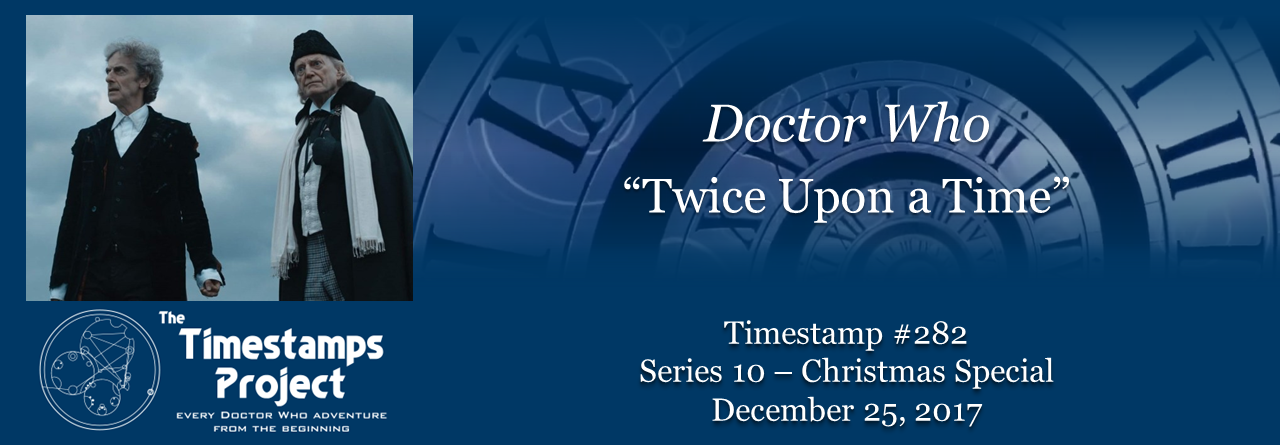
Timestamp #282: Twice Upon a Time

Timestamp 282 - Twice Upon a Time

The (other) two Doctors.

709 episodes ago, the First Doctor faced the Cybermen. After the threat was over, the Doctor walked through the snow storms of the South Pole to his TARDIS. There he found someone claiming to be the Doctor.

He found the Twelfth Doctor.

The First Doctor is obviously confused by the new Time Lord and the confusing proportions of the TARDIS. The Twelfth Doctor realizes that the First Doctor is refusing to regenerate, and as he outlines the problems with that idea, time stops around them. They are soon greeted by a British soldier from World War I.

This soldier comes from Ypres 1914 where he was engaged in a standoff with a German soldier. Both hold the other at gunpoint inside a bomb crater and the British captain is startled when time freezes. He takes in the bizarre battlefield before encountering a glass avatar that deposits him half a world away with the two Doctors. When he greets them, the glass avatar appears and the Doctors approach it. When the Twelfth Doctor declares that the planet is protected, the avatar disappears and the First Doctor invites everyone inside the TARDIS for protection.

The First Doctor is astounded because he thought that this TARDIS was his TARDIS. Meanwhile, the Twelfth Doctor mentions that the British captain is from the First World War, which shocks him since he only knows of the War to End All Wars (which it obviously did not). As the captain tries to understand the wonders around him, the two Doctors come to terms with their mutual situation. The Doctors offer the captain some brandy to calm his nerves and the Twelfth is astounded by the First’s lack of decorum toward gender roles.

The discussions all halt when the TARDIS is pulled into an overhead spacecraft that holds the Chamber of the Dead. The First Doctor exits the TARDIS to face the chamber as the captain and the Twelfth Doctor watch from the console. The First Doctor doesn’t understand being called the “Doctor of War.” Meanwhile, when Bill Potts arrives from a portal, the Twelfth Doctor rushes to meet her before realizing that this being is not the Bill that he knew. In fact, she is a duplicate and his Bill is dead.

The Doctors wonder who has been stealing the faces of the dead and investigate the chamber. They find the glass avatar who explains that they chronicle the lives of beings in the moments before their deaths, becoming a living testimony. They explain that they tried to capture the captain’s testimony but a timeline error caused him to become misplaced. The captain offers to take Bill’s place, but the Twelfth Doctor proposes taking both Bill and the captain. The First Doctor demands to know who the Twelfth thinks he is, and the First is astounded to find out just how his future will play out as the avatar reveals his legacy. It is recorded as one of battles and bloodshed.

Technically, what the Testimony shows him is accurate. It’s just missing context.

The Twelfth Doctor opens the airlock and everyone jumps, holding onto the chains restraining the TARDIS as it drops to the surface. The Testimony retrieves the Twelfth Doctor’s TARDIS and the four travelers escape Earth in the First Doctor’s ship instead. As they run, Bill figures out how the two Time Lords are related.

The Doctors realize that the glass avatar’s face is asymmetrical, and they decide that they need to find a database to figure out who she represents. The Twelfth Doctor considers the Matrix on Gallifrey, but instead decides to visit Villengard at the center of the universe. There is a database there, but it wants to kill him. Unfortunately, the area is swarming with Kaled mutants.

The Twelfth Doctor insists that Bill wait in the TARDIS with the captain and the First Doctor, but Bill stands defiant as her Doctor considers her nothing more than a doppelgänger. The tension is broken when the First Doctor chastises her for bad language. With a laugh and the hope that she and the Twelfth Doctor can joke about this for years, she joins the captain while the First Doctor explores the surface with his future self.

They discuss their mutual decision not to regenerate. The First Doctor admits his fear of the future, but when he asks about the Twelfth’s rationale, the answer is pre-empted by weapons fire. The Twelfth Doctor stands in the open and demands that their assailant scan him. When the truth of the Doctor’s pending doom is revealed, the sniper allows the Time Lords to enter the tower.

In the meantime, Bill and the captain talk about his fate. The captain recognizes that he must die, but he’s no longer ready to do so. He’s shocked when Bill reveals herself as a glass avatar.

The First Doctor remains at the tower entrance for his safety as the Twelfth Doctor climbs to meet his assailant. The shooter is revealed to be the Dalek named Rusty. They come to a truce as Rusty tears off his own gunstick, and the Twelfth Doctor finds out that the glass avatars and their ship, the Testimony, were created on New Earth. This comes from the Dalek programmed to hate Daleks and his connection to the Dalek hive mind. Rusty agrees to provide the information since helping the Doctor harms the Daleks.

Bill’s glass avatar meets up with the First Doctor as he finds Dalek parts nearby. She talks to the Doctor, probing his past and his motivations, asking what he’s running toward. She declares that the Doctor is amazing and thanks him for his efforts. When he realizes that she’s a glass avatar, he comes to understand her motives as an agent of Testimony.

Bill and the First Doctor ascend the tower and time stops again. The Doctors realize that there is no evil to fight, and while Bill is an avatar, she reminds the Doctor that reality is merely a function of memories. The Twelfth Doctor tells her that he’s tired of losing people, hence the reason why he doesn’t want to regenerate. He decides to return the captain to his proper time as he considers how their decisions not to regenerate caused the timeline error that displaced the officer.

En route, he has a revelation and changes course, dropping the captain at the start of the famous Christmas Truce, ensuring that his life will be spared. The captain will not be able to remember his adventure and won’t be able to see the Doctors or Bill once his timeline restarts. He asks them to check on his family from time to time, introducing himself as Archibald Hamish Lethbridge-Stewart, an ancestor of the Brigadier. The Doctor is overjoyed at the prospect.

When time starts again, Captain Lethbridge-Stewart and the German soldier nearly pull their triggers, but they stop as both sides begin to sing Christmas carols. The truce was a miracle, a one-of-a-kind, but one that allowed everyone to stop fighting and be kind for a short time.

The First Doctor is happy to see how the “Doctor of War” solved the problem, to which the Twelfth responds that their place is to help when the universe isn’t a fairy tale. The Doctors decide that they are both ready to go on living and they part ways.

The First Doctor returns to the South Pole as the Twelfth bids farewell to Captain Lethbridge-Stewart. Ben and Polly find their Doctor on the TARDIS floor as he regenerates into the Second Doctor. Meanwhile, the Twelfth Doctor asks Bill if she’d like to take one last trip in the TARDIS. She tells him that the hardest thing about knowing him is letting him go then gives him a goodbye present as she kisses his cheek and turns into Clara.

The Doctor is overjoyed to remember her, as is the memory of his former companion. He also gets to say goodbye to Nardole, who encourages him not to die since it would mean that the universe would go cold. The Doctor refuses to offer his testimony to the avatars, stating that he must be left alone to face his fate. He thanks them for what they have offered and they agree with a hug.

The Doctor boards the TARDIS again, ready to leave the battlefield. As he engages the TARDIS, he gazes upon the universe and concedes that one more lifetime won’t kill anyone. Well, except him. He relays some advice to his future self in a powerful speech before falling to the floor. He picks himself up and utters his final words: “Doctor… I let you go.”

The regeneration process is so violent that it rips into every corner of the console room. As smoke fills the room, his ring falls from his hand and his face transforms into a younger version. As the smoke clears, the Doctor’s new face is visible in a reflection.

The Thirteenth Doctor is a woman. Oh, brilliant.

She smiles broadly for just a moment until the TARDIS suffers a catastrophic systems failure. The ship tilts to one side as the console room explodes around her. The doors fly open, and even though she holds on as tight as she can, she eventually falls out of the TARDIS as it hovers thousands of feet above Earth.

The Doctor can only watch in horror as the TARDIS is engulfed in flames and dematerializes, leaving her to plummet toward the planet below.


Starting with the good stuff, I adore this multi-Doctor special because the threat isn’t really a threat at all. Fans have been conditioned since 2005 to expect a monster of some sort each week, and this fake-out driven by that assumption is a nice change of pace. I also like how the story was carved out of a space in The Tenth Planet‘s finale, drawing a parallel between the two Doctors as they ponder their futures. The classical romanticism and vulnerability are touching.

The setup also ties off a narrative thread started in The Pilot, which showed us a Doctor fresh off losing two people close to him. The thread has run across this series and comes to a beautiful conclusion here as the Doctor faces the loss of three people in The Doctor Falls. In a sense, both Doctors share a fear of the future.

It doesn’t hurt that I have a soft spot for the Christmas Truce. The truce was not unique in general – World War I had quite a few “live and let live” moments like this where soldiers would stop hostilities and fraternize – but this was one of the largest and most memorable.

The biggest failing of this adventure was the writing for the First Doctor. This story treats the character as a sexist dinosaur, but it seems like Steven Moffat’s target was the 1960s in general and he used the First Doctor as an avatar for his grievances. Certainly, the era didn’t treat women fairly, but Doctor Who stood apart with more well-rounded characters in comparison to some of the portrayals and dialogue found in later decades. Yes, the First Doctor was the character who let a caveman die until Ian stepped in, threatened a “jolly good smacked bottom” for Susan after her clumsiness inconvenienced him, was generally irascible and cranky, and even said a few things in The Five Doctors that made his successors squeamish, but this representation betrays the progressive heart that this show has had since birth.

Don’t get me wrong: David Bradley’s performance is amazing. It’s Steven Moffat and his meta-commentary that failed here because his research into the character seems to have stopped at the First Doctor’s first adventure, which is a far cry from the character’s nature in his final adventure.

That huge downside is unfortunate because there’s so much to love here, from the regeneration being a good narrative cover for the change in actors, the First Doctor’s treatment of sonic technology, the transitions from 1966 archive footage to modern imagery and back, and the fantastic rebuild of the First Doctor’s TARDIS. I also didn’t notice that Bill’s wardrobe constantly changes throughout the episode, perhaps as a tip of the hand to her true nature.

Not bad at all for an episode that was supposed to be Jodie Whittaker’s first adventure. That would have been a sight to see.

Finally, the regeneration is probably one of my favorites of the modern era. I was visiting family on the other side of the country when this episode first aired and I stayed up late at my brother-in-law’s house after everyone else had gone to bed. Peter Capaldi’s final speech was perfect and brought me to tears then, as it still does today.

Even with the imperfect writing, this story still does it for me.

Rating: 5/5 – “Fantastic!”


UP NEXT – Series Ten Summary

cc-break

The Timestamps Project is an adventure through the televised universe of Doctor Who, story by story, from the beginning of the franchise. For more reviews like this one, please visit the project’s page at Creative Criticality.

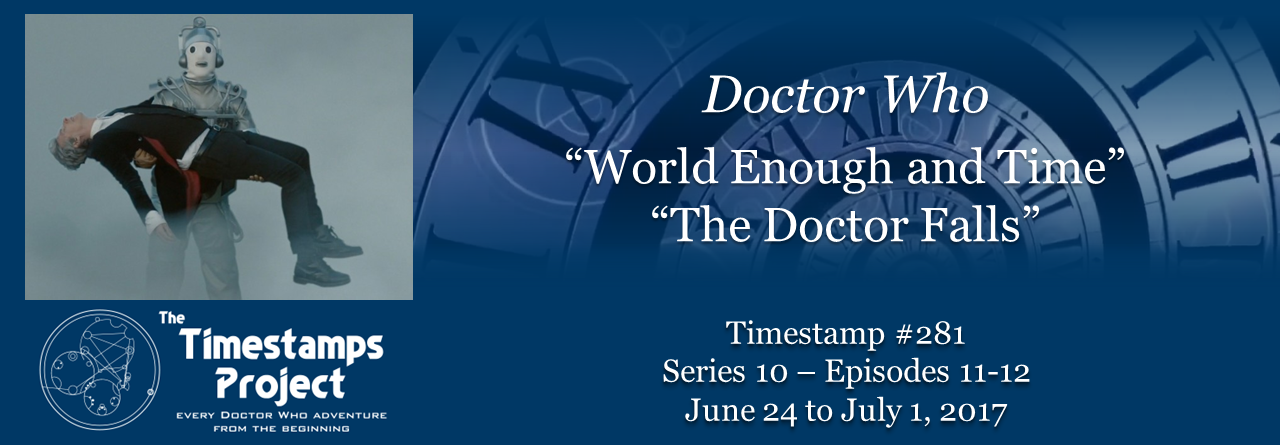
Timestamp #281: World Enough and Time & The Doctor Falls

Timestamp 281 - World Enough Doctor Falls

Powerful, surprising, and heartbreaking: A Doctor Who triple threat.

World Enough and Time

Upon a snowy landscape, the Doctor stumbles from the TARDIS and repeats the word “no” as he begins to regenerate. He falls to his knees as the energy overtakes him…

…and we flash back to a long cylindrical spaceship hovering at the edge of a black hole’s event horizon. The TARDIS materializes in the control room at the closest point to the phenomenon and Missy emerges. She describes herself as “Doctor Who” and introduces her companions. As alarms sound, we find out that this is a test of Missy’s resolve to be good. The Doctor watches from the TARDIS as Missy, Bill, and Nardole work through the puzzle and make contact with a blue-skinned humanoid named Jorj.

Jorj arrives at the control room with a gun and demands to know which of them is human. As three lifts race toward the control room, the Doctor emerges from the TARDIS and Bill admits to being human. Jorj declares that she is why the lifts are coming and shoots Bill, mortally wounding her. Figures with bandaged faces emerge from the lifts and take Bill, claiming they will fix her but will not return. The Doctor decides to trust them and leaves a psychic message for Bill to wait for him when she wakes.

Before the trip, Bill had disagreed with the Doctor about the rehabilitation test. The Doctor wanted Missy to be good, but Bill didn’t know if it was possible. They later had a discussion about the Doctor, the Master, and Time Lords and their flexible approaches to gender. Bill confided that Missy scared her, and the Doctor told Bill that he would do his best to not let her die.

This pressure now weighs on the Doctor. He let his companion die on his watch.

The Doctor tries to scan the lift with his sonic screwdriver, and when Jorj threatens him, he warns Jorj not to make him angry. The Doctor is borderline furious. Nardole finds thousands of life signs in the lower levels of the ship, leading the Doctor to understand that the different levels of the ship are moving at different times due to relativity.

On one of those lower levels, Bill wakes up in a medical facility with a cybernetic heart in her chest. She gets the message from the Doctor and meets a caretaker named Mr. Razor. She also hears a cybernetic voice calling out in pain. She finds the patient as screens show the time differential between Floor 0000 and Floor 1056. She can’t stop the voice from chanting “pain” over and over, and a nurse merely mutes the voice instead of tending to the pain. Bill finds that the others are also chanting about their pain but their voices are also muted.

Mr. Razor finds Bill and takes her to his room for tea. He explains that they are curing the people in the surgical  (conversion theater) suites and that she was saved from death with her new “shiny” cybernetic heart. She’s been on this level for months and passes the time watching the live feed of Level 0000. The Doctor literally takes a week to raise his eyebrow. Bill eventually recovers enough to work as a cleaner as she continues to wait. Meanwhile, the Doctor uses Venusian aikido to knock out Jorj and make his way to Bill.

Bill also cannot leave the hospital. Her heart will supposedly cease to function and the patients will raise the alarm. Mr. Razor explains that the people are being converted to survive Operation Exodus, a necessity since the human lifespan cannot survive the trip back to the top of the ship. Mr. Razor takes Bill outside one day, and sure enough, after a brief walk, her heart begins to fail.

The years pass and Bill continues to wait. She watches as the Doctor, Missy, and Nardole board a lift. They cannot take the TARDIS because the black hole with mess with navigation. Mr. Razor tricks Bill into one of the conversion theaters and condemns her to a full conversion. After all, people usually scream when they find out the real reason for surgery. They fit her for a headpiece that will inhibit emotion.

When the Doctor, Missy, and Nardole arrive on the bottom floor, Missy is left to explore the ship’s computer history. She soon meets Mr. Razor who is enamored with her and seems to know who she is. On separate paths, the travelers learn the truth: The ship’s origin was Mondas, the twin planet of Earth, and the conversions are the genesis of the Cybermen.

More shocking, Mr. Razor reveals that he is Missy’s predecessor, the Saxon Master. With that revelation in mind, Missy reverts to her cruel nature.

Even more shocking, this trip has turned upside down. The Cyberman standing before the Doctor is Bill Potts, and the former companion cries beneath the mask as she tells the Doctor that she waited for him.

The Doctor Falls

On Floor 0507, farmers and families face off against the scarecrows – the prototype Cybermen from Floor 1056 – shooting them at night and restraining them on wooden crosses by the light of day. One of those days, the relative peace is broken when a shuttle crashes through the ground near a girl named Alit. From the wreckage emerges a Cyberman carrying the unconscious form of the Doctor.

We flash back to the Doctor restrained to a wheelchair on the roof of the hospital on 1056. He was subdued by Missy and the Master, dancing and flirting as they discuss the Doctor’s deaths and how many regenerations he has left to spend. Notably, Missy cannot remember what happened that forced her regeneration. The Doctor ponders what happened in the Master’s life since he vanished while blasting Rassilon with his life energy.

Upon returning to Gallifrey, the Time Lords showed their gratitude for the Master’s help in preventing Rassilon from executing the Ultimate Sanction by restoring his body and kicking him off the planet. The Master stole a TARDIS and landed on the Mondasian colony ship where he lived like a king and killed at his leisure. When the colonist overthrew him and he attempted to run, he found that his TARDIS was burned out from being too close to the event horizon.

While they gloat, the Masters are shocked to find that the Cybermen are advancing on them. When the Masters attacked the Doctor, he was able to change the coding for humanity to read two hearts instead of one. With the Cybermen marching to convert the Time Lords, Missy knocks the Master unconscious and rescues the Doctor. She frees the Doctor and he calls for Nardole, who has successfully stolen a shuttle.

As the Masters and the Doctor try to board the shuttle, a Cyberman attacks the Doctor with an electrical shock. Bill kills the Cyberman but the Masters take over the shuttle as the Doctor falls. Bill stops the craft from taking off and ensures that the Doctor boards the shuttle.

That same shuttle has since crashed into 0507, leaving the entire group stranded. Two weeks pass as the Doctor recovers and Nardole prepares the families for war. Bill has been resigned to the barn since she frightens the children, and while she believes that she is still human, everyone else sees her as a Cyberman. Alit comes to her side with a mirror and Bill is shocked to see her true self. When the Doctor arrives, he rewards Alit for being kind to Bill. They have a brief discussion about Cybermen and what she’s become, Bill’s anger and grief boil over as she accidentally destroys the barn’s door.

The Doctor is amazed by Bill’s resiliency against the Cyberman programming. When Bill sheds a tear because everyone is afraid of her, he wipes it away and notes that she shouldn’t be able to cry. They meet with the Master, who mocks Bill and tells the Doctor about a plan that he and Missy have been working on. As they all walk across the farmland, the Doctor limps and stifles regeneration energy in his hand, revealing that his electrocution was fatal. When Bill worries about him and her future, he tells her that “where there’s tears, there’s hope.”

They reach the forest where the Master and Missy theorize that they’re out of temporal sync so they can’t retain their memories of these events. Missy reveals that the forest around them is a holographic wall disguising the lifts. Missy calls for one, not remembering that it is coming from the bottom floor and not empty. The lift reveals an evolved Cyberman, and despite killing it, the trio of Time Lords knows that the Cybermen now know where they are.

They cannot run because time is running faster on the lower levels. The Cyberman invasion would easily catch up to them. They have no choice but to fight as the Cybermen begin punching through the various floors. Nardole uses the fuel piping on Floor 0508 as weaponry and the Doctor finds a service duct that can be used to evacuate the children. Meanwhile, the Masters discuss running for their TARDIS on the bottom floor. After all, Missy once (now) threatened her former self into carrying a spare dematerialization circuit.

As night falls, the first wave of Cybermen appears. Nardole tricks them into believing that a single apple can destroy them all. When the Masters decide to leave, the Doctor delivers an emotional and passionate speech on why he helps people. It’s not easy and doesn’t always work, but it’s the right and kind thing to do. The Master ridicules the Doctor and continues on, but Missy is somewhat moved. She agrees that being the Doctor’s friend was what she always wanted, but she goes with her predecessor anyway. Within minutes, the two Masters arrive at the lift where the younger tricks the elder by fatally stabbing him and leaving just enough time to reach his TARDIS before regenerating. Unfortunately, the Master fires his laser screwdriver at Missy and mortally wounds her.

By all appearances, Missy dies. Her last intention was to return to the Doctor’s side.

The next wave of Cybermen arrives and Nardole’s tricks force them to retreat and develop a new plan. The Doctor downloads the plans for the floor into his sonic screwdriver and sends Nardole to escort the children to the service ducts. The Doctor convinces Nardole to leave despite the latter’s protests. After all, the Doctor is treating this like a suicide mission and Nardole owes him too much. The Doctor convinces Nardole that this will be penance for his crimes from before the Doctor rescued him. Bill stands beside the Doctor and Nardole admits that he’ll never be able to find the words for their sacrifice.

Now alone on Floor 0507, the Doctor and Bill prepare for a last stand by saying their farewells. They move to opposite sides of the floor and engage the Cybermen. The Doctor cites his numerous victories over them – Mondas, Telos, Earth, Planet 14, Marinus, Voga, Canary Wharf, and the Moon – before falling to several laser blasts. He nearly regenerates, but holds it back as he ignites the piping below the floor and engulfs the forest in fiery destruction. The Cybermen are destroyed.

As Nardole and his charges reach Floor 0502, he holds out hope that Bill and the Doctor will return. Alit convinces him to move on and focus on living with them instead.

Amongst the wasteland that is Floor 0507, Bill finds the wounded Doctor. She’s barely functioning, but her personality is nearly restored, and she mourns over the Time Lord’s body. She is surprised to find Heather emerging from a nearby puddle and learns that she’s real through a passionate kiss. Heather changed Bill into a being like her, and together they take the Doctor’s body back to the TARDIS. Heather sets the controls for a new location and offers Bill the choice to return to her old life or live a new one at her side as she travels the universe.

Bill chooses the latter, shedding a tear over her friend and telling him that “where there’s tears, there’s hope.” The two women depart as the TARDIS flies on and the Doctor heals, dreaming of Bill, Nardole, Rose Tyler, Martha Jones, Captain Jack, Donna Noble, Madame Vastra, Jenny Flint, Sarah Jane, Amy Pond, Clara Oswald, and River Song as they each call his name. The last voice is Missy’s, one which awakens the Doctor as he mutters some words of his former lives. He yells that he can’t keep being someone else and suppresses his regeneration as the TARDIS lands.

The Doctor is defiant, telling the TARDIS that he would listen to the lesson it’s trying to teach him, and steps into an arctic landscape. He screams into the snow and stifles his regeneration, pledging not to change as he hears a voice that echoes his concerns. When he demands to know who the other person is, he’s surprised to find the Doctor in the snowstorm. The original, you might say.

He finds the First Doctor.


Before this point, the televised history of the Cybermen was pretty simple: There were the Mondasian Cybermen from this universe and the Cybus Cybermen from Pete’s World. This pair of episodes complicate the evolution by introducing various origins for the Cybermen of this universe.

After Mondas was ejected from Earth’s orbit, the Mondasians were split into two groups based on the desire to fully embrace cyber conversion. The so-called Faction left Mondas to find their destiny in The Wheel in SpaceThe Invasion, and The War Games (with a cameo in Carnival of Monsters and brief nods in Dalek and Death in Heaven). The remaining Mondans would evolve into Cybermen in this episode – and in the audio drama Spare Parts and the comics The World Shapers and The Cybermen, if you count those – before proceeding to The Tenth Planet. It’s worth noting that the Cybermen in The Tenth Planet arrived with their rogue planet, so these Cybermen might not be those Cybermen.

Apparently, every other version of the Cybermen evolved independently and on parallel trajectories across time and space. At least, that’s how the story goes as of right now since Doctor Who‘s continuity is perpetually fluid.

As if that wasn’t enough, we get a quasi-confirmation that “Doctor Who” is a legitimate variation of the Doctor’s name. These days, fans will point to all sorts of sources to justify the character’s moniker of “The Doctor,” but there are several sources that also make “Doctor Who” just as legitimate: The computer WOTAN repeatedly called for “Doctor Who” in The War Machines; The Second Doctor used the alias “Doktor von Wer” – literally, “Doctor [of] Who” – in The Highlanders; The Second Doctor signed a note as “Dr W” in The Underwater Menace; Bessie’s license plate was WHO 1 and WHO 7; and Miss Hawthorne referred to him as “the great wizard Qui Quae Quod” – literally “Who Who Who” in Latin – in The Dæmons.

What about the show’s credits, you might ask. The character was credited as “Doctor Who” from An Unearthly Child all the way through Logopolis, spanning 18 seasons of stories. Starting with Castrovalva and the Fifth Doctor’s run, the character was credited as “The Doctor” through the TV movie (which also credited the Seventh Doctor as “The Old Doctor”). The name changed again to “Doctor Who” for the Ninth Doctor‘s run before returning to “The Doctor” in The Christmas Invasion. Rose also featured a website entitled “Doctor Who?”.

All that to say that either name is legitimate, really. Sure, Missy lies… a lot… but her lies always have a kernel of truth within. In recent years, the title has referred more to an ethos and mission statement rather than an actual name.

Considering the stories at hand, the horror film feeling of these episodes is amazing. The first half is edge-of-your-seat tension mixed with copious amounts of body horror, and the second half blunts the body horror for more battlefield tension. The tension follows the lighting, leading to more empathic storytelling in daylight and ratcheting tension during the night. The Doctor’s impassioned speech is truly a last-stand Hail Mary pass, and it serves up more tension before the final battle. The moment that truly sent shivers down my spine was “pain, pain, pain,” cueing the audience to just how monstrous the Mondasians were.

Another shocker was the identity of Mr. Razor, but this is only because I didn’t the “coming soon” teaser at the end of The Eaters of Light when this series was in first-run. If I had known that John Simm was returning, I probably would have seen right through the Mr. Razor disguise. Since I didn’t know at the time, it blew me away back in 2017.

As someone who earned a degree in physics, I love when science fiction shows play around with the subject and can explain it to the home audience. Gravitational time dilation is a real phenomenon related to special relativity that has been observed on Earth. Scientists placed identical atomic clocks at different altitudes (which relates to the pull of gravity) and noted significant differences in time between them. In this case, “significant” is on the order of nanoseconds, but imagine scaling that up beyond the fragile envelope of our atmosphere to a really long spaceship parked longitudinally on the event horizon of a black hole. That difference in gravity is pretty big.

I did have a question about fridging the black woman in this story – a terrible trio of tropes! – but Bill doesn’t really die and she’s not put in peril by the villain simply as a means to motivate the hero, so I dismissed the idea.

The video of Level 0000 looks like a paused classic black-and-white episode of the show. It added to the feeling of tension and was a nice callback to the era that this story and its cliffhanger were meant to evoke.

The two Masters working side-by-side in this story was pure joy. Notably, this is the first televised story to feature multiple Masters. It was also the third finale of the three in Capaldi’s run to feature the Cybermen.

In the end, I’m left in awe of the Twelfth Doctor’s resolve and strength. He survived all of that and still had the fortitude to hold back one of the character’s most primal forces, setting the stage for Peter Capaldi’s swan song in the next adventure.

Rating: 5/5 – “Fantastic!”


UP NEXT – Doctor Who: Twice Upon a Time

cc-break

The Timestamps Project is an adventure through the televised universe of Doctor Who, story by story, from the beginning of the franchise. For more reviews like this one, please visit the project’s page at Creative Criticality.

Timestamp #280: The Eaters of Light

Timestamp 280 - Eaters of Light

Last stand in Scotland.

In the present day near Devil’s Cairn, Scotland, little Judy tells her brother that she wants to hear the ghosts. Her brother warns that there are ghosts, but Judy hears music and defies his request for her to leave. A crow lands nearby a carving of the TARDIS on the stones, calling “Doc-tor!” into the cloudy day.

In Aberdeen, Scotland, circa 2nd century AD, the TARDIS materializes with the Doctor, Bill, and Nardole as they ponder the disappearance of the lost Ninth Roman Legion. The Doctor touts his experience amongst the Romans, including his credentials as a Vestal Virgin Second Class. Eager to prove herself and her research, Bill splits off and encounters a Pictish girl. She falls into an underground pit and (at swordpoint) finds a Roman soldier.

The Doctor and Nardole find a crow that says “dark” repeatedly, which the Doctor explains away as that crows can speak in the future, but humans are too daft to understand it. The crow is warning them of danger as the sun goes down, a fact reinforced by the discovery of the dead Ninth Legion, slain by extraterrestrial means that looks like a complete lack of sunlight. The pair is soon taken hostage by a group of Picts.

Bill introduces herself to the soldier and is amazed that the TARDIS is able to translate her words into Latin. The soldier she found is from the missing legion, and together they escape the pit. They encounter a being that attacks the soldier, but he is able to tell her where the Roman survivors are hiding. She races to the cave and narrowly escapes the monster, though not before the creature attacks her. Bill passes out amongst a group of Ninth Legion Romans.

The Doctor and Nardole meet the Keeper of the Gate, a woman named Kar. Nardole attempts to charm the Picts with popcorn but the Doctor loses his patience with the group. He is soon introduced to Kar, the woman who attacked Bill and claims that she defeated the Roman legion. Kar considers the Romans imperial plunderers who will steal and slaughter across the land. The Doctor is skeptical that Kar could kill 5,000 soldiers and points to the gatekeeper’s gateway weaponry. Using the popcorn, the Doctor stages a diversion, and he and Nardole escape.

The Doctor and Nardole return to the cairn while looking for Bill. The Doctor watches as a gate opens and reveals several hostile creatures. As he recoils, the gate closes, and Nardole tells him that he was away for two days. The cairn is an interdimensional temporal rift. Nardole also reports that he was unable to find Bill.

In the cave, Bill is awakened by a soldier named Lucius. He moves her into a beam of sunlight to burn off the creature’s slime and has a bite to eat. Bill decides to leave and find the Doctor, but Lucius asks her to stay. They have a frank discussion about sexuality, to which Bill is surprised by Roman progressiveness.

The Doctor and Nardole find Kar and ask if she knows what’s inside the portal. She calls the creature the “eater of light” and says that each generation elects a warrior to hold it back. The battle takes decades in the real world. Unfortunately, it got out and killed the Ninth Legion, but Kar thinks that it will die soon. The Doctor argues with her, but they both turn as a scream cuts the air. They find a slain Pict girl and the Doctor explains that the monster won’t stop until it decimates the world.

Bill tells the Romans about the Doctor. She also explains that being scared is human, but it isn’t cowardice. They develop a plan to find the Doctor. They use a passage to sneak past the beast and find a ladder. Meanwhile, the Doctor and Kar devise a plan of their own based on the mirrors that the Picts carry. They consider how the portal periodically opens, likening it to an oil gush that relieves pressure periodically. The Doctor does what he can to rally Kar and her people to action.

The ladder from the cave system leads into the space where the Doctor, Nardole, and the Picts are hiding. After some tense moments, Bill and the Doctor are able to negotiate a truce based on the TARDIS’s translation circuits. The Doctor chides the lot, demanding that they “grow the hell up” and stop the beast before it consumes the entire universe.

The plan is to use the creature’s desires against it. They lure it with light and music, then use mirrors (which poison the light) to hold it at bay and push it back into the portal. The gate has to be guarded, and the Doctor volunteers to guard it with his relatively infinite lifespan. Bill and Kar disagree, telling him that he has gates of his own to guard. Kar and the Ninth Legion survivors stand before him as Nardole knocks him on the head. Kar and the soldiers advance into the gate and the cairn begins to fall apart due to the strain. When the cairn collapses, the portal is closed forever.

Nardole urges the Doctor to not hold a grudge as Kar’s brother tells the crows to spread the word about who saved the world. A crow flies off screaming “KAR” into the cloudy sky. The Doctor admits that he was wrong about the Ninth Legion, and Bill does as well. They weren’t missing or killed but instead were always here.

As the trio enters the TARDIS, Nardole is surprised to find Missy in the TARDIS. The Doctor let her out to do maintenance on the engines, but he’s locked her out of every major function on the time capsule. She can’t even leave the ship. Later, she cries as she hears bagpipe music, presumably from the warriors in the cairn, and suggests that it’s time to rebuild their relationship. The Doctor remains skeptical, stating that it’s not the right time during her rehabilitation.


The writer of this phenomenal tale was Rona Munro. She was also responsible for Survival, which she also novelized, and therefore took the record for the longest gap between two Doctor Who television stories by the same writer. That gap was approximately 27 and a half years.

It’s understandable why this episode has the lowest ratings (to date) of the revival era. It is a dark episode, both in content and overall lighting. So much of the story is portrayed by firelight or in dark woods, and even the daylight scenes end up shadowed by mostly cloudy skies. But, it also helps to drive the claustrophobic and defeated mood that permeates the plot, and I think it adds quite a bit overall.

Missy’s redemption(?) arc remains shrouded in mystery, but the ongoing thread of human sexuality continues with better, more respectful discussions about the topic through history. There’s a nod to a “long story” about the Doctor being a Vestal Virgin Second Class – ‘twould be an interesting story to see since the Vestal Virgins were priestesses who vowed to remain virginal between the ages of 10 and 40, which makes me wonder how the Doctor pulled this off in a world (spoilers) pre-Thirteenth and pre-Timeless Child – and I smiled about Lucius being called “granddad” since he was the oldest soldier in the legion. That’s quite the thumb at the confluence of youth and war.

It may not be a popular episode, but I really enjoyed it.

Rating: 4/5 – “Would you care for a jelly baby?”


UP NEXT – Doctor Who: World Enough and Time & Doctor Who: The Doctor Falls

cc-break

The Timestamps Project is an adventure through the televised universe of Doctor Who, story by story, from the beginning of the franchise. For more reviews like this one, please visit the project’s page at Creative Criticality.

Culture on My Mind – Twenty

Culture on My Mind

Culture on My Mind
Twenty
May 10, 2023

Despite growing up in Utah, I’m not particularly religious, but I do have a favorite section from the Bible. Today seems like a great day to share it.

Twenty years ago, I married my friend. Over the last two decades, we have lived in seven states, have provided loving homes for four pets, earned five academic degrees, and faced several life-changing challenges. The constant over them all has been each other.

There isn’t really a secret to success in relationships. Every one of them has different chemistry and dynamics that wouldn’t work in other scenarios. But if I had to pick one key, it would be communication. It sounds trite, but we talk about (almost) everything. The only secrets that we keep from each other are pleasant surprises (like gifts) or work-related requirements (like client confidentiality or things I may or may not have done in the Navy). We don’t engage in “bitch sessions” with friends about one another. We don’t talk about each other behind our backs. If we have problems with each other, we talk to each other about them.

We are a team challenging the world. We have faith in each other, hope for our continued journey, and love to bind it together. Always and forever.

If I speak in the tongues of men or of angels, but do not have love, I am only a resounding gong or a clanging cymbal. If I have the gift of prophecy and can fathom all mysteries and all knowledge, and if I have a faith that can move mountains, but do not have love, I am nothing. If I give all I possess to the poor and give over my body to hardship that I may boast, but do not have love, I gain nothing.

Love is patient, love is kind. It does not envy, it does not boast, it is not proud. It does not dishonor others, it is not self-seeking, it is not easily angered, it keeps no record of wrongs. Love does not delight in evil but rejoices with the truth. It always protects, always trusts, always hopes, always perseveres.

Love never fails. But where there are prophecies, they will cease; where there are tongues, they will be stilled; where there is knowledge, it will pass away. For we know in part and we prophesy in part, but when completeness comes, what is in part disappears. When I was a child, I talked like a child, I thought like a child, I reasoned like a child. When I became a man, I put the ways of childhood behind me. For now we see only a reflection as in a mirror; then we shall see face to face. Now I know in part; then I shall know fully, even as I am fully known.

And now these three remain: faith, hope, and love. But the greatest of these is love.

—1 Corinthians 13

Here’s to the decades to come.


cc-break

Culture on My Mind is inspired by the weekly Can’t Let It Go segment on the NPR Politics Podcast where each host brings one thing to the table that they just can’t stop thinking about.

For more creativity with a critical eye, visit Creative Criticality.