

Doctor Who: The Day of the Doctor
(1 episode, 50th Anniversary Special, 2013)

The big event in a cup-a-soup.
The Last Day
A soldier opens his eyes to find someone standing over him. The soldier is part of the army on Gallifrey and has been fitted with a headcam. The man explains the headcam’s use and function, including how the frightening images that keep popping up are hallucinations, not premonitions. The headcams are installed into the brain and record everything for the official record. The recording is censored, with violence and language deemed unsuitable for the soldiers’ families cut out, and anything particularly graphic gets tinted red.
These soldiers proceed to Arcadia, the safest place on Gallifrey due to the impenetrable sky trenches. If even one Dalek did get through, the city could be destroyed, so the soldier has to remain vigilant in his scans. As he is trained on the scanner’s use, he detects a Dalek.
That Dalek leads to many more. As the Daleks open fire, the soldier’s headcam goes blank. The last sound heard in the background is a chilling death cry of anguish.
Thus begins the Fall of Arcadia.
The Day of the Doctor
After opening on a familiar theme, we see a police constable patrolling near I. M. Foreman’s scrap yard and Coal Hill School. Inside the school, Clara finishes a lesson for her class as the bell rings. She gets a note to meet “her doctor” at an address on an open patch of road. There she spots the TARDIS and races toward it on her motorcycle.
The TARDIS lets her in without complaint and she snaps her fingers to close the doors. After a cheerful reunion with the Doctor, she jumps as the TARDIS shudders. A helicopter hauls the box away. The Doctor calls Kate Stewart at UNIT headquarters only to find out that she’s bringing the TARDIS. She had no idea that he was still inside.
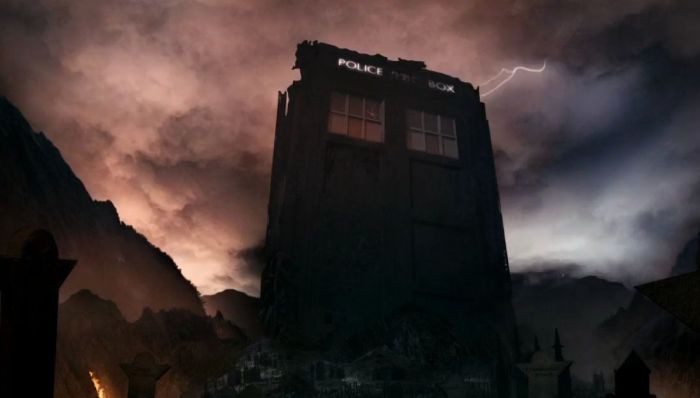
She has the TARDIS taken directly to the National Gallery where she presents instructions directly from Queen Elizabeth I. The Doctor and Clara meet UNIT scientist Petronella Osgood – she has a nice scarf – and proceed into the gallery. There they find a Time Lord painting known as both No More and Gallifrey Falls. It depicts the Fall of Arcadia and appears in three dimensions. The Doctor is shaken by what he remembers upon seeing the painting, recounting the day that the previously unknown Doctor ended the Time War.
Inside the image, we find the last day of the Last Great Time War. As the Daleks rage and innocents die, the War Doctor takes a gun from a lone soldier. With that weapon, he carves a message into a wall near the TARDIS.
It reads “NO MORE”.
The Doctor escapes by plowing the TARDIS through a wall and a gathering of Daleks. As he flees, the High Commanders gather in the War Room to plan their next move. The Eleventh General dismisses the High Council’s plans since “they have already failed” and ponders the Doctor’s message. He also learns that there has been a breach in the Omega Arsenal of the Time Vaults. Among all of the forbidden weapons – many of which have already been used in vain against the Daleks – the Moment has been taken.
The Moment was the final work of the ancients of Gallifrey. It is a weapon so advanced that it developed a conscience to stand in judgment of the user. The General muses that only the Doctor would be mad enough to use such a weapon.
Sure enough, the Doctor issues a final warning as he walks the empty desert toward an abandoned farmhouse: “Time Lords of Gallifrey, Daleks of Skaro, I serve notice on you all. Too long I have stayed my hand. No more. Today you leave me no choice. Today, this war will end. No more. No more…” He uncovers a complex box that ticks and whirs, lamenting the lack of a big red button to activate it. He hears a rustling sound and investigates, returning to find a woman sitting on the box.
This woman appears to be Rose Tyler, a face that this incarnation does not recognize, but she eventually identifies as Bad Wolf, an avatar of the Moment. She mocks the Doctor in her judgment, wondering why he left the TARDIS so far away. Perhaps so the TARDIS couldn’t witness what he’s about to do. Meanwhile, the Time Lord refuses the right to be called Doctor. Even though the name resides in his head, he no longer feels worthy of it. The suffering of the universe is too great, and he must end it even though it means his death. The Moment decides that his fate and punishment will be to survive the holocaust and live with the consequences, counting the dead for the rest of his lives.
They are interrupted by a fissure that opens overhead. A fez falls out.
In the 21st century, the Eleventh Doctor opens the queen’s letter.
“My dearest love: I hope the painting known as Gallifrey Falls will serve as proof that it is your Elizabeth that writes to you now. You will recall that you pledged yourself to the safety of my kingdom. In that capacity, I have appointed you Curator of the Under Gallery, where deadly danger to England is locked away. Should any disturbance occur within its walls, it is my wish that you should be summoned. Godspeed, gentle husband.”
Kate leads the Doctor and Clara away to show them the next piece of the puzzle. As they leave, UNIT scientist McGillop takes a mysterious phone call and questions why he should move the painting.
The Doctor, Clara, and Kate arrive at a painting of Queen Elizabeth I and the Tenth Doctor, leading the scene to England, 1562. There, the Tenth Doctor and Queen Elizabeth I ride a horse out of the TARDIS where he presumably just gave her a tour of the time capsule. They later share a picnic, and after she remarks on the face that has seen war, he proposes marriage.
It’s a ruse to uncover a Zygon invasion of Earth. Unfortunately, even with his tracking device that goes ding, he misidentifies the queen as a Zygon. When the horse changes shape, the duo runs from the threat. They end up separated, and while the queen gets attacked, the Doctor threatens a rabbit before realizing that it is truly just a rabbit.
The Doctor finds the queen once again, as well as a doppelgänger. While he tries to figure out which queen is the real one, a time fissure opens and a fez falls out.
In the 21t century, Kate leads her group into the Under Gallery where the Eleventh Doctor is fascinated by stone dust. Kate orders Osgood to analyze it while they proceed deeper. The Doctor pulls a fez from a display case before coming to the reason why Kate called him here. Several 3-D paintings that used to show figures have had their glass broken out from the inside. The figures are missing.
The time fissure opens and the Eleventh Doctor faintly recalls seeing it before. He tosses the fez through before jumping across, landing at the Tenth Doctor’s feet. The two Time Lords realize who each other are, compare sonic screwdrivers, and bicker a bit before the time fissure crackles.
The Tenth Doctor sends the queens away with a pair of kisses as Clara communicates with the Doctors through the fissure. The Eleventh Doctor tries to send the fez back, but it never arrives in the Under Gallery. Instead, it lands at the War Doctor’s feet.
Kate leaves Clara in the Under Gallery as she calls her office to request the Cromier file – invoking a nod toward the “UNIT dating controversy” – unaware of the Zygon lurking behind her.
The Tenth and Eleventh Doctors attempt to analyze the fissure, canceling each other’s reversal of the polarity with their sonics. After a moment, the War Doctor jumps through and meets his successors, mistaking them at first for companions instead of Time Lords.
He also chastises them for pointing their sonic screwdrivers like water pistols.
The meeting is interrupted by the queen’s royal guard. The Eleventh Doctor tries to get Clara to pose as a witch through the fissure, but the guards and the War Doctor are not impressed. The Queen arrives and threatens to toss the Doctors in the Tower of London, which serves as Kate’s office in the future.
Once there, the Eleventh Doctor sets to work scratching at a pillar while the Tenth Doctor questions the War Doctor. Meanwhile, in the future, Osgood puts the pieces together and realizes that the statues are Zygons. She’s too late, however, and both she and McGillop are copied. Osgood is able to escape in short order.
Kate leads Clara to the Black Archive, a space where the deepest secrets are kept and everyone’s memories of visiting it are wiped. The archive is TARDIS-proofed to keep the Doctor out since he wouldn’t approve of the collection within. Kate shows Clara a vortex manipulator gifted to the archive by Captain Jack Harkness. The access code has been carved into a pillar.
Clara also finds out that Kate, Osgood, and McGillop are Zygons. In that confusion, Clara steals Kate’s phone and uses the access code to teleport away with the vortex manipulator.
In 1562, the War Doctor muses that he could program his sonic screwdriver to disintegrate the door, but the calculations would take centuries. He suggests starting on them while questioning the dread on the faces of his future selves. They discuss the Last Day of the Great Time War, and the Moment – only visible to the War Doctor – prompts him to ask about the children.
The Eleventh Doctor can’t remember the number of children on Gallifrey, but the Tenth Doctor can. There were 2.47 billion children, and the fact that the Eleventh Doctor doesn’t want to remember angers – no, infuriates – the Tenth Doctor.
The Moment fills in the blanks for the War Doctor: The Tenth Doctor is the man who regrets and the Eleventh Doctor is the man who forgets. She also points out that they all have the same sonic screwdriver at heart with different cases.
If the War Doctor can scan the door, then the Eleventh Doctor’s screwdriver could calculate the method of breaking the door. They confirm it but are amazed when Clara bursts through the door and claims that it wasn’t locked. The queen is right behind her, confirming that she was curious about what they would do.
In the modern day, the real Osgood skulks about the Under Gallery and finds Kate in Zygon stasis. In 1562, the queen shows her visitors what is going on, including how she implanted the Zygons in the Gallifreyan paintings using stasis cubes. They also learn that the woman is the real Queen Elizabeth I and that she killed her impostor in the forest.
After the Tenth Doctor and Queen Elizabeth I are married, the three Time Lords and Clara board the Tenth Doctor’s TARDIS. Detecting a potential paradox, the TARDIS compensates by shifting the desktops around a bit before Clara notifies the trio that they should head for the Black Archive.
The Zygons in the Black Archive are joined by their human counterparts, and Kate informs them that the Archive’s self-destruct mechanism has been activated. In five minutes, the nuclear warhead beneath them will detonate. The Doctors try to land the TARDIS in the Archive and fail, so the War Doctor suggests using the stasis cube instead.
When McGillop takes his call near the first painting, he gets an order to take the painting to the Black Archive. Once there, the Doctors emerge from the Fall of Arcadia and enter the Black Archive. They then use the memory modifiers to confuse everybody as to whether they are human or Zygon. If the participants stop the detonation and create a peace treaty – which is sure to be incredibly fair since the negotiators can’t remember which side they’re on – they will have their memories restored.
The countdown is stopped and the negotiations begin. The Osgoods figure each other out only by the nature of asthma. Meanwhile, Clara talks to the War Doctor about the Last Day, discovering that he hasn’t used the Moment. She expresses the Doctor’s regret about what he did that day, and the War Doctor makes his decision.
The Moment takes him back to the barn in the desert and presents him with a big red button.
He knows now that his successors are extraordinary men, but that they will only become so if he follows through. The Moment talks to him about the wheezing and groaning of the TARDIS, a sound that brings hope wherever it goes. At the same time, two TARDISes materialize behind him and his successors arrive.
They were able to arrive in this time-locked space because the Moment allowed it.
The two Time Lords talk about how they’ve treated their memory of the War Doctor. They explain that he was the Doctor on the day that it was impossible to get things right, and they offer to help him push the button today. Not out of fear or hatred, but because there is no other way. In the name of the lives that they cannot save.
The Eleventh Doctor stays his hand at Clara’s face. She could never imagine him destroying his own people. The Moment shows them the Fall of Arcadia, adding a moment of conscience to the act. Clara judges them: The Warrior, the Hero, and… what is the Eleventh?
She reminds him of the promise of the Doctor – “Never cowardly or cruel. Never give up; never give in.” – and tells her Doctor what to do. They have enough warriors, and any old idiot can be a hero. He should be a Doctor.
The Eleventh Doctor disarms the Moment and explains. He’s had lifetimes to think about this, and these three have a stasis cube. While the War Doctor thanks the “Bad Wolf girl” – the Tenth Doctor is taken aback – the Time Lords put their plan into action.
On the Last Day of the Great Time War, the Doctors send a message to Gallifrey High Command: GALLIFREY STANDS. They explain their plan to the Eleventh General, and even though the general finds the idea absurd, the Doctors explain that they’ve been working on it all their lives.
In an extraordinary moment, the three Doctors are joined by their other ten incarnations, including the one they will eventually become. The thirteen TARDISes take position as the Daleks intensify their firepower. The general tells the Doctor to go ahead. The planet Gallifrey disappears into a pocket dimension and the Daleks destroy each other in the crossfire. A single Dalek pod spins off into the void, foreshadowing their eventual return as the Cult of Skaro.
Gallifrey stands.
Back in the National Gallery, the Doctors muse on whether or not they succeeded. The mysterious painting remains an enigma, but they agree that it was better to have failed having done the right thing than succeeding in doing the wrong. The War Doctor bids farewell to his successors with a special nod to Clara, and they address him as Doctor, fully worthy of the title. He won’t remember this adventure, however, because the timestreams are a mess, but the Eleventh Doctor and Clara will. His legacy is safe with them.
As the War Doctor departs, he begins to regenerate after surviving the Time War. He hopes that the ears will be less conspicuous before transforming into the Ninth Doctor.
The Tenth Doctor takes his leave, asking the Eleventh Doctor where he’s going next. The Eleventh Doctor relents and reveals that they are destined to die in battle on Trenzalore. The Tenth Doctor is glad that his future is in safe hands, but expresses a desire to change their final destination. After all, he doesn’t want to go.
Clara leaves the Eleventh Doctor to sit and look at the painting for a little while. As she steps into the TARDIS, she mentions that the gallery’s curator was looking for him. He muses that he would be a great curator, and a deep voice agrees with him. The Doctor is astonished to see a very familiar face as the Curator arrives, looking very much like the Fourth Doctor.
The Curator suggests that the Doctor may revisit a few of his old faces before turning to the painting. He points out that everyone screws up the title of the painting: It is neither Gallifrey Falls nor No More, but rather Gallifrey Falls No More.
Gallifrey survived, and now the Doctor is tasked with finding it. The mission is now returning it and all its people to the universe.
Later on, the Doctor speaks of his dreams. In a vision, he walks through the TARDIS doors to join his previous incarnations as they stare at the planet Gallifrey above. He is destined to go home, even if it takes him the long way around.
First and foremost, I adore this episode. It is littered with nods to the franchise’s mythology, but more salient, it tackles some important concepts with the Doctor’s character.
During the revival era, the Last Great Time War has hung over the Doctor’s head. The Ninth Doctor was fresh from that conflict and obviously suffered from post-traumatic stress disorder from the magnitude of his choices. The Tenth Doctor and the Eleventh Doctor carried this weight as shown in this story.
The beauty of this story is that it retains the show’s history – the Doctor’s incarnations before now do not remember saving Gallifrey, so none of the motivations or choices made have changed – but absolution and redemption are offered for everyone involved, especially the Eleventh Doctor. Even though it is temporary, the senses of forgiveness and relief are important for the War Doctor and the Tenth Doctor and definitely shed a different light on the episodes we’ve seen to this point.
I love how the destruction of Gallifrey was driven by Clara, thus allowing a sense of humanity to temper the decisions of the Time Lord. This has been a constant over Doctor Who‘s history and was used to great effect here.
I do question how every incarnation of the Doctor knew to calculate the salvation of Gallifrey. Earlier, the sonic screwdrivers drove the point that the shell may change but the software remains the same, but those calculations were started by the War Doctor and matured with the Eleventh Doctor. In reverse, the idea to save Gallifrey seems to propagate from Eleven to War to Ten, a path that is far from linear. In fact, it’s wibbly-wobbly, which describes the Doctor to a tee.
Speaking of, I am so glad that the writers were able to give the War Doctor such brilliant insights into the revival era’s use of sonic screwdrivers. They’re not magic wands or water pistols, and the Doctor’s not going to assemble a cabinet at an enemy. I love his view on these scientific instruments.
Shifting gears, as much as I love the War Doctor and John Hurt, I really wish that Steven Moffat hadn’t needed to introduce him.
I get the reasons why: Christopher Eccleston did not want to return after how he was treated in the role, and he was less than impressed with the script when it was sent to him. What I don’t understand is why Paul McGann couldn’t have filled the same role.
Yes, I also love The Night of the Doctor, but it was developed as part of this whole story arc. Realistically, the Eighth Doctor could have been the incarnation that engaged in the Time War after seeing how Cass Fermazzi was willing to sacrifice her own life to avoid traveling with a Time Lord. This would effectively avoid the Stuffed into the Fridge trope (since Cass isn’t a loved one being used to motivate the hero) and could give us far more screen time for Paul McGann than just a TV movie and a webcast short.
It would have avoided the thirteen lives complications that developed from introducing another Doctor (which we’ll obviously cover during The Time of the Doctor) and would have still avoided the need for Christopher Eccelston’s involvement.
Everything else in The Day of the Doctor could have remained the same.
As much as I adore John Hurt and his performance here, the War Doctor needlessly complicated things, which apparently stemmed from Steven Moffat’s desire to have a “complete set” of regenerations before his departure. From what I can tell, that’s a rumor, but… yeah.
No look at the fiftieth anniversary special would be complete without a look at the mythology.
I have linked a good number of the mythological callbacks, but there are still quite a few favorites that jumped out in the course of this celebration. One of them is the set design, particularly the roundels (“the round things”) in the War Doctor’s TARDIS and in the Curator’s gallery. The War Doctor’s TARDIS design is a fun mix between the classic era (not counting the TV movie) and the coral motif that kicked off the revival era. The Curator’s gallery adds the hexagons to the roundels, tying the classic and revival eras together.
The Brigadier’s space-time telegraph made a notable appearance in the Black Archive. It was prominently featured in Revenge of the Cybermen and Terror of the Zygons, the latter of which was our last meeting with the Zygons. That portion of the story also showcased one of my favorite Osgood moments as she and her doppelgänger share their identities over her asthma inhaler.
The Day of the Doctor marks the last salvo fired in the Last Great Time War, a confrontation that began in Genesis of the Daleks. Russell T Davies stated in an episode of Doctor Who Confidential that the origins of the war that he envisioned began when the Time Lords struck first – the attempted genocide of the Daleks – in the Fourth Doctor’s era. This idea was repeated by RTD in Doctor Who Annual 2006, and was adapted in Hunters of the Burning Stone, a 2013 comic story published in Doctor Who Magazine as part of the 50th-anniversary celebration. The comic was written by Scott Gray and served as a sequel to An Unearthly Child, though it was the Eleventh Doctor in the lead with Ian and Barbara.
The Black Archive pinboards hold tons of photo references to the franchise’s history, including: Susan Foreman; Barbara Wright & Ian Chesterton; Vicki Pallister; Katarina & Sara Kingdom; Steven Taylor; Dodo Chaplet; Ben Jackson & Polly Wright; Victoria Waterfield; Zoe Heriot; Liz Shaw; Captain Mike Yates; Harry Sullivan & Warrant Officer John Benton; Leela; Romana I; Romana II; Adric; Nyssa; Tegan Jovanka; Kamelion & Vislor Turlough; Jamie McCrimmon; Peri Brown; Melanie Bush; Brigadier Winifred Bambera; Ace McShane; Grace Holloway; Adam Mitchell (why?); K-9 Mark III; Lieutenant General Sanchez; Brigadier Alistair Gordon Lethbridge-Stewart; UNIT Captain Erisa Magambo; Donna Noble, Martha Jones, Mickey Smith, Rose Tyler, & Wilfred Mott; Jo Grant; Jack Harkness; Craig Owens (again, why?); Sarah Jane Smith;
Amy Pond & Rory Williams; River Song; Kate Stewart; and Clara Oswald.
Finally, that moment. The all thirteen moment. The moment that made me jump out of my seat and cheer. The moment that makes me grin from ear to ear every time I see it.
It was amazing to see all of the Doctors on screen, interacting with each other to save their home. Since many of them are no longer with us, it was also fun to see exactly where the producers sourced the footage to bring this moment together.
- The First Doctor’s footage came from The Daleks (specifically “The Dead Planet”), and his voice was newly recorded audio by John Guilor (who also voiced the First Doctor in the reconstruction of Planet of Giants).
- The Second Doctor’s footage came from The Tomb of the Cybermen and The Mind Robber, and his audio came from The Seeds of Death.
- The Third Doctor’s footage came from Colony in Space – the re-used footage was flipped from the original – and the audio came from The Green Death.
- The Fourth Doctor’s footage came from Planet of Evil – again, the re-used footage was flipped – but the audio (“Ready.”) has yet to be identified.
- The Fifth Doctor’s footage was sourced from Frontios and the audio came from The Five Doctors.
- The Sixth Doctor’s footage and audio were sourced from the same story: Attack of the Cybermen.
- The Seventh Doctor’s (flipped) footage and audio came from Battlefield, but the producers also used some footage from the TV movie.
- The Eighth Doctor’s footage came from the TV movie. The audio (“Commencing calculations.”) hasn’t been identified.
- Finally, the Ninth Doctor’s footage came from Rose and The Parting of the Ways (“And for my next trick…”), along with some footage from Aliens of London.
The sheer amount of work and research required to make this climactic scene come to life amazes me.
Finally, I want to take a look at three smaller items before closing this out.
First, The Last Day: It was a quick and easy prequel story. The biggest thing that came from it was a desire to know more about the soldiers and the headcams.
Second, the visual salute to Christopher Eccleston’s legacy in the regeneration. Steven Moffat didn’t want to include an image of Eccleston in the regeneration sequence because it would have been “crossing the line” by implying that he had been on set. So, there are hints as John Hurt morphs into Christopher Eccleston, but the camera cuts away just in time to give us the impression of what comes next. Of course, as implied by the novelization of this story, the Ninth Doctor broke every mirror in the TARDIS just after regeneration because he couldn’t face himself. That adds a new dimension to his first glance in the mirror in Rose.
The last is the novelization of The Day of the Doctor. If you haven’t had a chance to read it, pick it up. It tells the story of the TV episode but breaks the chapters into narratives by the War Doctor, the Tenth Doctor, the Eleventh Doctor, Petronella Osgood and the Zygons, the Twelfth Doctor, and even the Thirteenth Doctor. It expands a lot of the characters and scenes, and it also adds a few additional insights and inside gags, including some time with Peter Cushing’s Dr. Who. While I don’t generally lean on the expanded media for information, this is written by Steven Moffat so I consider it a bit more authoritative. Chapter 9 (“The Truth of the Doctor”) is a hoot.
It’s a quick read and well worth the time.
Rating: 5/5 – “Fantastic!”
UP NEXT – The Five(ish) Doctors Reboot

The Timestamps Project is an adventure through the televised universe of Doctor Who, story by story, from the beginning of the franchise. For more reviews like this one, please visit the project’s page at Creative Criticality.

 Creative Criticality