Debrief: ATL Comic Convention + Fandemic World Tour Atlanta 2022

Debrief: ATL Comic Convention + Fandemic World Tour Atlanta 2022
Atlanta, GA – March 18 through March 20, 2022
ACCFandemic

Atlanta Comic Con was (shall we say?) interesting.

As mentioned in my announcement post, Atlanta Comic Con joined up with the Fandemic World Tour to create an earlier and larger event. It’s typically been a smaller affair with various celebrities and fan panels, but linking up with Fandemic brought a bit more star power to bear.

Honestly, I think that it dampened some of the spirit. More on that in a minute.

I teamed up with Mike Faber and Michael Gordon of The ESO Network for three panels – Doctor Who, the Marvel Cinematic Universe, and Podcasting 101 – and took some time around those events to take in what this new convention experience had to offer. In fact, that’s what Fandemic offers on their website: Fandemic Tour – A New Comic Convention Experience.

ACC 2022 Panels

The panels were pretty awesome. The Podcasting 101 panel was very interactive and well-attended for the size of this convention. We had a lot of input from the audience and spent some time afterward chatting with people who wanted to learn more.

Mike Faber and I have been doing these 101-style panels and classes for a while, and my metric for success has always been that if even one person learns something new, then we’ve done our jobs well. The Atlanta Comic Con panel went above and beyond that measure.

The Doctor Who panel was also pretty engaging with a lot of questions and speculation, and the hour pretty much flew by. The MCU panel was quite a bit less engaging, and a lot of that can be attributed to the timing. When we did a similar panel at Atlanta Comic Con, it was right after Infinity War so there was a lot to talk about. If we had done this in July as planned, we’d also have a lot to talk about, but doing this panel right now leaves us in the infancy of the MCU’s Phase Four with a whole lot of questions and not much else.

But, overall, the panels were fun.

So, the rest of the convention…

The rest of the convention is where I feel like the spirit of Atlanta Comic Con has been lost. Fandemic is geared toward the fans and genre of The Walking Dead, and that does not lend itself to a general sci-fi/fantasy kind of event like Atlanta Comic Con has been.

The vendor booths were geared more toward the genre and toward the general fan. There were very few comic and book booths and very few specialized toy booths. There were a lot of vendors who specialize in Funko Pops, but even the offering they brought leaned heavily into the Fandemic genre. In fact, it’s disappointing to note that I wasn’t tempted by a lot of the offerings.

There were a handful of artists with tables, but they weren’t engaged with attendees. In fact, one interaction that I saw was telling: The artist physically walked someone through his portfolio because the name was familar in passing but the attendee had no idea who he was beyond that.

This felt like a convention for people at the 30,000-foot view. Fans who have a general idea of what’s out there, but aren’t specific on any one thing. Don’t get me wrong: That level of fandom is perfectly okay, but it didn’t feel like there was much engagement for anyone on a deeper level.

It’s also a celebrity-heavy event with a ton of space dedicated to photos and autographs, but only for the genre. Lines for photos and signatures were packed, which is good for fans who dig that, but I certainly missed the old-school/retro caliber of guests that Atlanta Comic Con used to attract. 2019’s show brought a variety of actors and talent – Cam Clarke, Kevin Conroy, Val Kilmer, Rob Paulsen, James Arnold Taylor, and Bonnie Wright, just to name a few – and I expected this variety to be mixed into the Fandemic attractions a bit more. Instead, it was all pretty much Walking Dead and similar.

It felt like Atlanta Comic Con was completely replaced by Fandemic.

The entrance fees for normal attendees were a bit shocking: $50 or $60 per day on the weekend and $85 for a three-day pass. That’s not something that attracts someone who’s interested for the day. I don’t have historic information for Atlanta’s show, but the similar convention in Tampa Bay runs $20-30 per day with a $45 three-day pass, and that’s with guest lists similar to Atlanta Comic Con’s previous offerings.

I was also surprised that there was no program of events being distributed. Atlanta Comic Con used to offer a poster with a schedule of events. On that note, the schedule of events wasn’t even solidified until a couple of days before the show, which is something I’d expect from an extremely large five-day event like Dragon Con, but not from a three-day lightly attended event like this.

I don’t want to see Atlanta Comic Con become absorbed into something else.

With the loss of so many smaller conventions in the area due to money and staffing concerns, we need conventions and events for people who want to get together and celebrate pop culture.  If this was truly a merger instead of a takeover, I’m hoping that 2022 was simply growing pains leading to something bigger and better.

I don’t want to lose Atlanta Comic Con’s unique voice in the process.

cc-break

Timestamp #245: Journey to the Centre of the TARDIS

Doctor Who: Journey to the Centre of the TARDIS
(1 episode, s07e10, 2013)

Timestamp 245 Journey Centre TARDIS

If the TARDIS gets illegally salvaged but no one remembers, did it actually happen?

In the depths of space, a Van Baalen Bros. salvage ship cruises as brothers Bram and Gregor sleep and android Tricky works. The proximity alert sounds as the ship detects nearby salvage, and after a brief debate over the salvage’s value, they decide to suit up and check it out.

Meanwhile, the Doctor and Clara argue over her bonding with the TARDIS. The Doctor decides to put the time capsule in basic mode to make it easier on her, but the TARDIS loses power and shields just as the salvage crew latches onto her. Sparks fly and Clara burns herself on a rolling metal object before the capsule is pulled into the salvage bay.

The salvage crew attempt to break into the TARDIS but fail. Tricky realizes that the ship is potentially alive and crewed, and as the crew attempts to cover their tracks, the Doctor pops up and greets them. He presents them with the metal object, an illegal Magno-grab remote, and then realizes that Clara is still inside the TARDIS.

Oops.

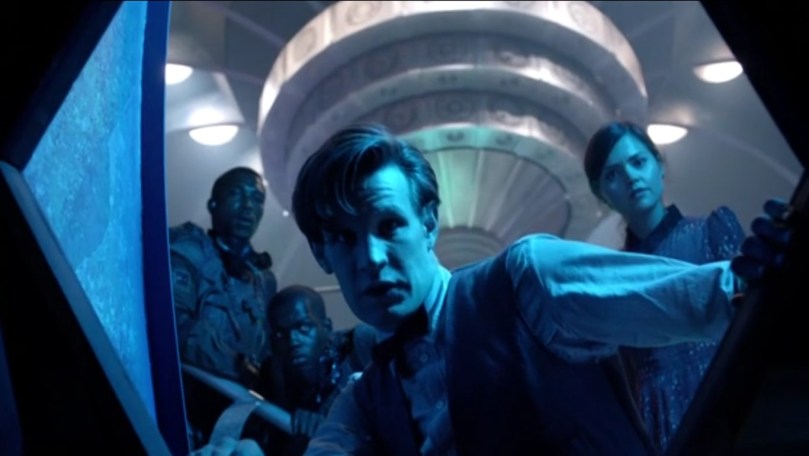
Clara awakens to the sound of the Cloister Bell in the middle of a debris-strewn corridor. She comes to a door with a red light and decides to open it. She then runs from the fireball behind it. She hears a growling noise and continues on, looking for the console room but eventually taking refuge in a storage room with a baby’s cot, a small model of the TARDIS, and the Seventh Doctor‘s umbrella. She soon runs when the creature appears.

The Doctor leads the salvage crew into the TARDIS. While they marvel at the space within, the Doctor evacuates the toxic atmosphere from a fuel leak and gives them one hour to find Clara. Why one hour? Because he’s just set the self-destruct sequence.

When the salvagers protest, he adjusts the timer to thirty minutes. He is that dead set on finding Clara.

Clara runs past the observatory and the swimming pool as she tries to avoid the growling, eventually finding the expansive library. Meanwhile, Bram returns to the console room and starts stripping the place, but stops when he hears a cacophony of voices. Gregor scouts and finds the architectural reconfiguration system. The Doctor prevents him from tearing it apart, but when Gregor steals one of the circuits, the TARDIS begins to rebel.

Clara investigates a tome called The History of the Time War, marveling over the mention of someone before hiding from the growling creature once again. She knocks over a bottle/volume of the Encyclopedia Gallifreya, releasing a cloud of spoken words, before running into the corridor once again.

The Doctor, Gregor, and Tricky continue their search but the TARDIS keeps running them in circles. Meanwhile, Bram descends into the console as Clara enters the console room but determines that it is a fake. Bram burns himself on the time rotor and falls to the deck below before being attacked by the creature. The Doctor and the remaining salvagers evade the creature as Gregor splits off on his own.

Clara continues looking for the real console room and gets frustrated. The Doctor and Tricky enter one of the console room echoes – the TARDIS rewarded Tricky for trying to get her circuit back – and determine that they are in the same space as Clara but are just out of phase. Clara inadvertently allows the creature into the echo room as Gregor returns, and the Doctor uses Gregor’s scanner to isolate and rescue Clara.

The Doctor reveals that there is no self-destruct sequence, so they’re safe except for the monster and the TARDIS realigning the internal geometry. Well, that and the pending engine overload from previously undetected damage.

To fix it, they must descend into the center of the TARDIS. And there’s the title!

The team runs through the corridors and Clara is separated. She sees echoes throughout her travels and words appearing in the burns on her hand, but eventually reunites with the Doctor. He tells her that there is a time leak due to the engine damage, so recent past and future are flowing around them. They run from the creature and the rods from the overloading engine.

When Tricky is impaled by one of these engine rods, Gregor is forced to reveal that Tricky is really a human – his own brother – that they modified to look like an android as a cruel joke. After rescuing Tricky, the group arrives at the Eye of Harmony, an exploding star on the verge of becoming a black hole. The Doctor rushes in while the humans wait and the brothers hash things out. The brothers almost come to blows before the Doctor reminds Tricky that Gregor has at least one shred of decency left.

They all try to navigate the chamber containing the Eye of Harmony but end up trapped by the creatures. Gregor scans them and discovers that the creatures are burned, future versions of them. The Doctor confesses his remorse about Clara’s pending death and her previous deaths, confusing her as he lets the creatures invade the chamber in an attempt to break the temporal loop. The brothers succeed in knocking the creatures into the Eye of Harmony, but when Gregor saves Tricky from falling, time reasserts itself and the brothers become a new creature.

Clara and the Doctor rush into the engine room, which presents a vast canyon, and the Doctor confronts Clara over her nature. Clara has no idea what he’s talking about, a concept that relieves the Doctor. He then realizes the image of a canyon is a defense mechanism and convinces Clara to jump over the side with him. They land in a stark white chamber filled with the engine explosion in progress. When he glances at Clara’s hand – it says “BIG FRIENDLY BUTTON” – he realizes what he needs to do.

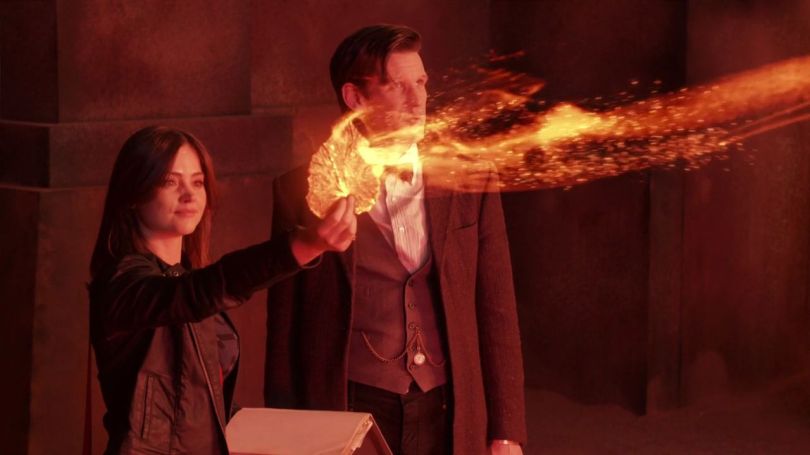
They return to the console room where the Doctor inscribes the message on the Magno-grab remote. The Doctor tells Clara that she won’t remember any of this adventure if he’s successful, including finding his name in the big book, and launches into the rift in the console room wall. He throws the remote to his past self, who laughs as he smacks the big friendly button.

Time resets to the moment before the salvagers caught the TARDIS, but this time they ignore it. Their family relations are also significantly better. Meanwhile, the Doctor is concerned about Clara’s feeling of safety. She tells him that everything is fine and urges him to push the button and take them to their next stop.


The birth of this story is what happens when fans take control of production. Steven Moffat was disappointed in how the TARDIS interiors looked when he saw The Invasion of Time as a child, so he challenge this episode’s writer, Steve Thompson, to make it better. Mission accomplished on so many levels, taking viewers on a whirlwind tour of the library, the observatory, the swimming pool, the Arch-Recon (architectural reconfiguration system), and the Eye of Harmony. We also get to see just how many treasures the Doctor holds in his time capsule, including knowledge in liquid form and the history of the Time War.

I’d really love a copy of that prop. It appears to be based around a late 19th-century leather-bound Bible with brass clasps. Copies of that book run into the hundreds of dollars as of this writing.

I really liked how the TARDIS wounds translated into time leaks, creating bubbles of tangible potential timelines that could only interact with each other in very special circumstances. The TARDIS’s memories that flooded her control room came from An Unearthly Child (twice), Colony in SpaceThe Doctor’s WifeThe Robots of DeathRoseSmith and JonesThe Beast Below, and Time Crash.

This leakage also played into another core Doctor Who trope: Being kind reaches across time and space. The “joke” that the brothers played on Tricky was cruel and unnecessary, but the Doctor’s admonishment of Gregor that questioned the human’s decency stuck with the family through the time reset.

Oh, and that self-destruct hoax? If a good gag works, why change? (See Attack of the Cybermen and Victory of the Daleks.)

In the end, the Doctor finally puts the mystery of Clara being a bad agent of some sort to bed. Even if Clara doesn’t remember the discussion, it’s good to know that the Doctor can finally move on from the who to the why.

Rating: 4/5 – “Would you care for a jelly baby?”


UP NEXT – Doctor Who: The Crimson Horror

cc-break

The Timestamps Project is an adventure through the televised universe of Doctor Who, story by story, from the beginning of the franchise. For more reviews like this one, please visit the project’s page at Creative Criticality.

Timestamp #244: Hide

Doctor Who: Hide
(1 episode, s07e09, 2013)

Timestamp 244 Hide

A ghost story?

The mystery begins at Caliburn House. It is November 25, 1974, and is the fourth night of Professor Alec Palmer’s attempt to contact an apparition with his psychic assistant Emma Grayling. As they make another attempt, they are interrupted by a knocking at the door. When they answer, they find the Doctor and Clara who claim to be Ghostbusters.

The Doctor poses as an agent of “the Ministry” and claims to know who Alec (a secret war veteran) and Emma are. Photographs by the professor show the same figure in the same pose throughout the history of Caliburn House. The travelers tour the house and get to know the investigators. They also examine the history of the “Witch of the Well” and encounter the ghost.

The Doctor talks with Alec while Clara and Emma share a drink. Alec researches ghosts to avoid the horrors he experienced in wartime, while Clara suggests that Emma and Alec could have a relationship.

After the encounter, the Doctor and Clara return to the TARDIS – She’s like a cat: A bit slow to trust – and take a series of photographs of the ghost throughout Earth’s timeline. Clara laments that she is nothing more than a ghost herself in the Doctor’s eyes, asking what humans are to him. He tells Clara that human beings (or maybe Clara herself?) are the only mystery worth solving.

The Doctor returns them to 1974 and analyzes the series of photographs and Emma consoles Clara, who is disturbed by seeing the end of the world. The Doctor speculates that the ghost is really a time traveler – Hila Tacorien – who is trapped in a pocket universe. Unfortunately, the pocket universe is collapsing and Hila is being chased by an unknown creature.

The Doctor tells Emma that she is the beacon that will lead Hila home. He uses a crystal from Metebelis III connected to a subset of the Eye of Harmony to enhance Emma’s abilities and create a doorway to the pocket universe. The Doctor dives into the pocket universe and locates Hila. He’s able to send her home but ends up trapped himself.

Alec has been apprehensive about Emma’s role in this affair, but to rescue the Doctor he encourages her to try one more time, finally admitting that he loves her. Emma tries to open the portal as Clara rushes to the TARDIS – the time machine sounds the Cloister Bell in alarm – and argues with the voice interface.

She’s annoyed that the voice interface looks just like her, but she soon convinces the TARDIS to break into the pocket universe and rescue the Doctor.

With the crisis abated, the Doctor reveals that he brought Clara to Caliburn House to see Emma, curious about what the psychic senses about his companion. Emma can’t detect anything strange about Clara. The Doctor doesn’t seem entirely pleased with the answer, but he decides that it’s time to move on.

As he and Clara are about to depart, the Doctor reveals that Hila is Emma and Alec’s future descendant. Hila can’t return home since history says that she’s gone missing, but she can remain with Emma and Alec. When he suggests that the two lovebirds hold hands and never let go, he realizes that the creature in the pocket dimension has been trying to reunite with another creature in the house.

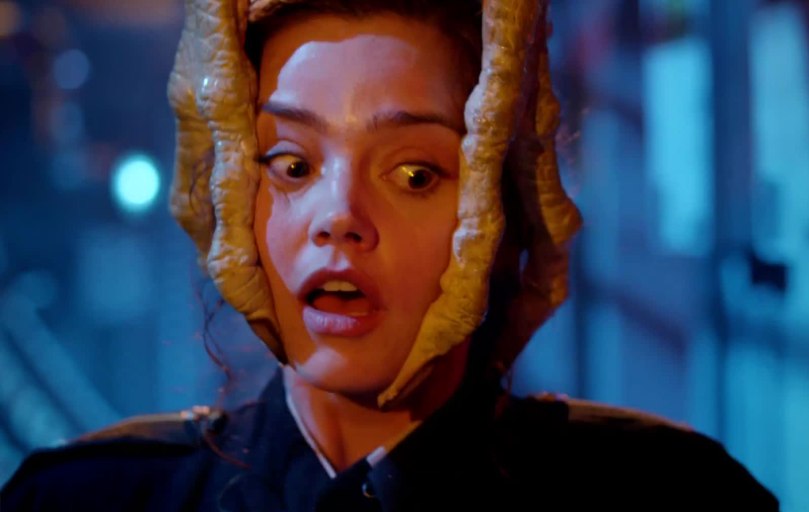
After another brief trip to the pocket dimension, the Doctor reunites the creatures and promises to take them to a safe place. It seems, in the end, this was not a ghost story.

It was a love story.


I really like the story overall. We get another discussion of jumping from one universe to another, as well as a refresher on entropy draining the TARDIS power supply. Circle back to the Pete’s World trip for that connection. I also liked the twist, making us think once again about whether or not every creature is an enemy.

The parallels to Ghost Light, The Eternity Trap, and The Talons of Weng-Chiang were a nice touch, as was the decorative headgear: The device used to connect Emma to the Eye of Harmony is very close in design to the one that the Second Doctor used to show his thoughts to Zoe in The Wheel in Space.

We get another dose of star power with Dougray Scott, a man who has been all over the place and was fantastic here, even if I didn’t recognize him at first. It must be the Clark Kent effect with the glasses.

Hila’s fate was a fun bit of timey-wimey business, but it ends up as an after-thought when the true reason for the Doctor’s stop is revealed. This is where this story falls down in my opinion. The Doctor tricks Clara into being a Caliburn House so that he can use Emma’s skills to divine Clara’s secrets, the plot of which feels squicky. It couldn’t be a simple ghost/love story, but instead had to be another chapter in the Doctor’s quest to unravel the Impossible Girl.

That part of the twist just doesn’t sit right with me.

Rating: 3/5 – “Reverse the polarity of the neutron flow.”


UP NEXT – Doctor Who: Journey to the Centre of the TARDIS

cc-break

The Timestamps Project is an adventure through the televised universe of Doctor Who, story by story, from the beginning of the franchise. For more reviews like this one, please visit the project’s page at Creative Criticality.

Timestamp #243: Cold War

Doctor Who: Cold War
(1 episode, s07e08, 2013)

Timestamp 243 Cold War

Hungry like a wolf.

North Pole, 1983: In the frigid depths, a Soviet submarine conducts an ICBM launch drill. They are interrupted by Professor Grisenko, a man who has secured a certain specimen during this voyage. Captain Zhukov and Lieutenant Stepashin face pressure from NATO exercises on the military front, but thanks to a crewman below decks, they now face a new threat as something emerges from the ice.

Havoc erupts on the submarine as the green armored figure rampages through the boat. As the submarine flails, the TARDIS materializes and the Doctor and Clara rush into the control room looking for Las Vegas. The crew decide to trust the newcomers for the moment as the submarine grounds out on the ocean floor, 700 meters below the surface.

The crew then apprehend the travelers and search the Doctor’s pockets, unveiling all sorts of artifacts. The submarine takes another jolt, knocking Clara unconscious as the TARDIS spontaneously dematerializes. When Clara comes to, the Doctor and the captain are arguing. They stop when the being appears in the control room.

Welcome back, Ice Warriors!

The Doctor informs them that the Ice Warriors are soldiers that demand respect, pleading with the Soviets to stop attacking it. He wagers that the Ice Warrior is confused due to being frozen for 5,000 years and asks its name. The Doctor is shocked to hear that this Ice Warrior is the legendary Grand Marshall Skaldak.

The exchange is stopped when Stepashin knocks the grand marshall down with an electrical charge. After chastizing the lieutenant, the Doctor recommends that Skaldak be locked up. He then explains who the Ice Warriors are to the captain, unaware that Skaldak is signaling his people to save him.

Stepashin wonders if the travelers are western spies, prompting Clara to learn about the TARDIS translation circuits. Captain Zhukov dismisses the lieutenant’s concerns and tasks him to lead damage control efforts. He then talks with the Doctor about the war his lieutenant just declared on the Ice Warriors. In the end, Clara volunteers to act as ambassador to negotiate peace.

The Doctor coaches her through an audio link as Clara talks with the general, but Clara soon discovers that the armor is empty. Skaldak is free and wandering the ship, swearing to retaliate against his enemies. The Doctor recognizes that leaving its armor is one of the most dishonorable things an Ice Warrior can do, therefore the general is now incredibly dangerous. The Doctor retrieves Clara – she is ecstatic over this encounter – and then tries to impress the pressure of the situation on the captain.

The submarine slips on the seamount, adding even more danger to the situation. Meanwhile, the Ice Warrior finds Stepashin and extracts knowledge of the Cold War and the theory of mutually assured destruction from his mind.

Captain Zhukov gives the heroic speech to his crew: The reactor is down, they only have battery power, and they’re running out of air. All of that aside, they still have a mission to stop the Grand Marshall before he gains control of any of the nuclear missiles. They are all that stands between him and the destruction of the world.

Clara and the Doctor talk about the nature of time, realizing that history can be changed and rewritten, so world destruction is still a possibility. The Doctor agrees to help the captain search for Skaldak, happy to have his sonic screwdriver returned. Clara teams up with Professor Grisenko – the professor has a cattle prod to ward off polar bears and a wants to sing Hungry Like the Wolf – as the Doctor tinkers ahead of them. This team rushes when they hear screaming, coming across the bodies of two crewmen who were dismembered as Skaldak tests human weaknesses.

The Doctor gets a fix on Skaldak and orders Clara to stay put. He’s surprised that she doesn’t argue, leaving her to chat with the professor as he moves on. Clara admits that she was bothered by the bodies and the deaths.

The chase continues through the submarine. As the professor and Clara exchange small talk, Skaldak doubles back and grabs Clara. When Grisenko shoots the Ice Warrior, he shifts to the professor and declares his intent to destroy humanity. Since they fired on him first, he has every right under Martian law to obliterate them.

As Skaldak signals his armor through sonic signal, the Doctor attempts to negotiate. The grand marshall enters his armor when it arrives and heads for the control room. There he begins the launch sequence for the warheads, but the Doctor pleads with him, appealing in the name of mercy. When Skaldak doesn’t yield, the Doctor threatens to destroy the submarine in order to stop him.

In the face of mutually assured destruction, Skaldak faces the Doctor and opens his helmet, wondering who will blink first. Clara steps in and pleads for compassion. Her case is won when the submarine is snared by a spaceship that raises it to the surface. The Doctor asks him to leave in peace, but is worried when the Ice Warrior is transported away while the warheads are still armed.

The situation ends when the launch systems are remotely disarmed, prompting a celebratory hug from Clara to the Doctor.

The Doctor, Captain Zhukov, the professor, and Clara go to the bridge to gaze upon the Martian ship. Clara asks the Doctor what happened to the TARDIS, of which the Doctor confesses that he reactivated the Hostile Action Displacement System (HADS). Even though he hasn’t used it for a while, he knows that it will pop up eventually. On cue, the sonic reports that the TARDIS has fled to the South Pole.

Embarrassed, he asks the captain for a lift and they all laugh. The Doctor offers a salutes the Ice Warrior ship as it flies away.


As a former submariner, I tend to keep an eye on certain things while watching submarine-based works like this. I was pretty impressed with the technical accuracy in this one with one exception.

The Firebird initially looked like a Typhoon-class ballistic missile sub, which is usually what one thinks of with respect to Cold War Soviet boats. I mean, look no further than The Hunt for Red October (both the novel and the film). But the Firebird was actually a Soviet Delta – either a Delta II (Project 667BD Murena-M) or a Delta III (Project 667BDR Kalmar) depending on which source you look at – a class of boats that was introduced in 1973 and are still in service under their third and fourth designs today.

The technical exception was the maximum depth of the Delta hull. The Firebird grounded out at around 700 meters (3000 feet), but the Delta can only go to 400 meters (1300 feet) as far as we know. From experience, the depth in this story is really deep and unrealistic for a nuclear-powered submarine.

(I was also impressed with the crew accuracy. At this point in submarine history, the silent service was still a “boy’s club”, so Clara was rightfully the only woman in the episode. We haven’t seen that in Doctor Who since The Power of Kroll.)

Also, this point in history was a hot one for a cold war. The Able Archer 83 exercises, which simulated a DEFCON 1 status and a coordinated worldwide nuclear attack, terrified the already paranoid Soviet Union. They honestly believed that the simulation was obscuring a real attack so they placed the East German and Polish forces on alert. There were other close calls throughout the year, including one famous incident where the world should have been destroyed except for one cool-headed Soviet radar operator who correctly interpreted a missile on his screen as an equipment malfunction.

The paranoia in the story was reality.

Technical stuff aside, this story played well with that paranoia and was a well-crafted suspense thriller that balanced body count against a very tightly focused plot. Let’s face it: Not much really happened in this story, but it still adequately filled the runtime.

It was also chock full of powerful guest stars. I know Liam Cunningham best from Game of Thrones, David Warner from Star Trek IV: The Undiscovered Country, Star Trek: The Next Generation, Batman: The Animated Series, and TRON (and, of course, Dreamland), and Tobias Menzies from The Crown, Outlander, and Star Wars: Rebels, but all three of these men have extensive histories in film and television.

That’s not even mentioning Spencer Wilding (The God Complex and The Doctor, the Widow and the Wardrobe) and Nicholas Briggs (pretty much every revival era Dalek, Judoon, Cyberman, and Zygon, as well as various creatures, having been around since Rose).

That powerhouse cast really propelled this story beyond its thin plot to a fun time overall.

It’s good to see the Ice Warriors back. At this point, they’d been absent for 39 years. Amusingly, theplot device of thawing out a Martian was also used in the debut of the Ice Warriors. It was fun to expand on them a bit with the armor mythology, which also served to boost Clara’s character as she negotiated with Skaldak.

I also really liked the threat of extermination in this story. Time is not concrete and this incident was not a fixed point in time, so if the Doctor and Clara had failed then the Earth would have been destroyed. I dig the fact that they have worldwide stakes to deal with.

I just hope that someone told the Doctor that he and Clara are sailing for another 10 to 20 days. They’re definitely going to need fresh clothes and a shower when they get where they’re going.

Rating: 4/5 – “Would you care for a jelly baby?”


UP NEXT – Doctor Who: Hide

cc-break

The Timestamps Project is an adventure through the televised universe of Doctor Who, story by story, from the beginning of the franchise. For more reviews like this one, please visit the project’s page at Creative Criticality.

Timestamp #242: The Rings of Akhaten

Doctor Who: The Rings of Akhaten
(1 episode, s07e07, 2013)

Timestamp 242 The Rings of Akhaten

Dining on infinity.

A brisk wind blows the autumn leaves, particularly one large red leaf that flies into a man’s face. As the man stumbles into the street, a woman saves him from being run over. The pair begin a relationship around that leaf — the most important leaf in human history — and eventually have a child named Clara Oswald.

That girl later mourns her mother who died on March 5, 2005. The Doctor, who has been watching Clara through all of these events, laments that she cannot be possible.

Back in 2013, Clara is sitting with her book and waits for the Doctor. When he arrives, she rushes to meet him and asks about the nature of time, space, and travel in both. When asked, she decides that she wants to see something awesome.

So, he takes her to the rings of Akhaten. Among those rings is a pyramid, a holy site for the Sun-singers of Akhet, a people of this seven-world system that believe that all life in the universe originated on Akhaten. The Doctor tells Clara that it’s a nice story they believe, but indulges her wish to take a closer look.

In the market near the pyramid, the Doctor introduces Clara to Pan-Babylonians, a Lugalirakush, some Eukanians, a Hooloovoo, and an Ultramanta. He does a ritual greeting with a Terraberserker of the Cadonian Belt, then mentions that he forgot how much he liked it there. After all, he’s been there once before while traveling with his granddaughter.

Clara is shocked. She runs after him and samples a glowing blue fruit, but isn’t impressed with the flavor. She also encounters Dor’een, a being that barks to communicate. It’s odd that the TARDIS translation circuits haven’t kicked in fully for Clara, but the Doctor helps by translating that Dor’een wants to rent Clara a moped. The cost is a sentimental object, using payment through psychometry. Clara doesn’t like the idea of giving up something important in trade, but it’s not much different than exchanging valuable bits of paper.

Clara turns her back for a moment, losing the Doctor but running into a little girl in crimson robes. When the girl runs off, two men in similar attire approach and ask if she’s seen the Queen of Years. Clara is confused and pursues the girl to a junkyard. After a spell, the two cross paths again. The girl says that she’s hiding but Clara just wants to help. She offers to take Merry Galel to the TARDIS as masked creatures continue to search for her.

The TARDIS refuse to open for Clara, prompting her to think that the box doesn’t like her. The duo take refuge behind the TARDIS and Merry explains that she is the Queen of Years. She was chosen for the role as a baby when the previous Queen died. She knows every story, poem, legend, and song of their culture. She’s scared because she has to sing a special song to their god to keep him from waking. Clara consoles her about fear, telling the queen that she’ll get the song right before taking her back to the men in red robes that were looking for her.

The Doctor finally finds Clara, asking what she’s been up to while munching on one of the blue fruits. Clara tells him that she’s been exploring. They then go see Merry sing her song, a duet with a man in red robes at the pyramid who sings before a mummy-like being. The Doctor reads the program and tells her that it is the Long Song, a song to keep the Old God, also known as the Grandfather, asleep. Members of the audience hold up offerings of sentimental value to feed the Old God, and the Doctor joins in the song.

The Chorister in the pyramid falters and a golden energy seizes Merry, pulling her toward the pyramid. The Doctor leaves the scene, which Clara interprets as running away before the Doctor corrects her, and rents a moped with Clara’s mother’s ring. Together, they race into the rings to save Merry, but they barely miss her before touching down at the pyramid.

The Doctor is unable to unlock the doorway right away. Inside the pyramid, the Old God begins to awaken, but the Doctor finally breaks the lock’s code and raises the door. Merry refuses to leave, believing that her failure is her fault. The Old God feeds on souls, and Merry believes that it wants hers.

The Doctor releases the door and enters the pyramid. The Chorister flees, claiming that the Long Song ended with him, and the Old God awakens. The Doctor tells Merry that they didn’t wake him. Instead, the being woke because it was time to wake up. Merry is as a sacrifice, and if she’s going to be so voluntarily, he wants her to know why: Every time the Old God threatens to waken, the Queen of Years is offered as a sacrifice to put him back to sleep as it feeds on her story.

He explains: “Souls are made up of stories. People we lost. People we found against all odds.” He calms Merry by telling a story that she doesn’t know. She is unique in the universe and there won’t be another person like her. If Merry doesn’t offer herself, everything will be fine.

The Old God begins to crack the glass case around it and the masked beings arrive to secure Merry for the sacrifice. The Doctor is able to use his sonic screwdriver to overcome the guards while Clara asks Merry to sing the door open. Merry and Clara run for the moped as the Doctor holds the guards at bay, but as the being breaks the glass, the Doctor realizes that he’s made an error.

The beast was an alarm clock. The real Old God Akhaten is inside the star, and now that it’s awake it is hungry. Very hungry.

The Doctor decides to fight Akhaten as Clara returns Merry to the platform. He faces down the star as Merry sings and he begins to tell it a new story. The story of his own experiences over all of his known lives.

“I walked away from the last great time war. I marked the passing of the Time Lords. I saw the birth of the universe and I watched as time ran out. Moment by moment until nothing remained, no time, no space, just me! I walked in universes where the laws of physics were devised by the mind of a mad man! And I watched universes freeze and creations burn! I have seen things you wouldn’t believe! I have lost things you will never understand! And I know things, secrets that must never be told, knowledge that must never be spoken! Knowledge that would make parasite gods blaze! SO COME ON THEN! TAKE IT! TAKE IT ALL, BABY! HAVE IT! YOU HAVE IT ALL!

Akhaten feeds on these experiences, and as the beast appears to return to slumber, the Doctor collapses. Unfortuantely, Akhaten isn’t quite sated. Clara recalls her mother’s words and returns to the Doctor’s side, offering the red leaf. The most important leaf in human history, full of her mother’s lost life and a future that never happened. Akhaten feeds on the infinite potential of that leaf, eventually falling asleep for good.

The Doctor returns Clara to her home, at which point Clara realizes that she saw the Doctor at her mother’s funeral. He tells her that she reminds him of someone he knew who died, but Clara tells him that she shouldn’t see her as a replacement.

The Doctor agrees, returning her mother’s ring. The people she saved wanted her to have it back. As Clara returns home, the Doctor looks on after her with a grim expression.


During this first adventure in the TARDIS to an alien planet, we find out that Clara’s mother died on March 5, 2005, the same day as the Auton invasion of Earth. It’s possible that she was a victim of that invasion, but not established.

What I really like about this story centers on the costume and set design, which exemplify this era of wonder and exploration in Doctor Who. Just look at all of the alien creatures in the bazaar! I also enjoy Clara’s sincerity, empathy, and innocence at this point in her journeys.

This is the first time in a while (either The Girl Who Waited or Asylum of the Daleks, depending on how you count the undercover Dalek puppets) that a story didn’t include an extensive cast of human characters and didn’t really link back to Earth. Clara is pretty much the only human in the story, and Earth only appears in establishing bookends instead of being the story’s setting. It’s refreshing.

I also like the Long Song – Emilia Jones has a beautiful singing voice – and the solution to feeding the beast of Ahkaten. The story falls apart though in Clara’s sacrifice: I’m not a big fan of her having to give up something so incredibly precious to travel with the Doctor, despite the obvious callback to the beginning of the tale. It’s almost like she’s being required to give up the core of who she is for the privilege.

That said, it can also be looked at as being pushed to grow beyond her self-established boundaries.

Either way, I guess that’s what gives the story so much power. It’s inducing strong emotions in the telling and the analysis, which is one measure of good storytelling.

Rating: 4/5 – “Would you care for a jelly baby?”


UP NEXT – Doctor Who: Cold War

cc-break

The Timestamps Project is an adventure through the televised universe of Doctor Who, story by story, from the beginning of the franchise. For more reviews like this one, please visit the project’s page at Creative Criticality.

ATL Comic Convention + Fandemic World Tour Atlanta 2022

ATL Comic Convention + Fandemic World Tour Atlanta 2022
Atlanta, GA – March 18 through March 20, 2022
ACCFandemic

Thanks to the COVID-19 pandemic, it’s been a few years since I have visited Atlanta Comic Con. It’s one of Atlanta’s smaller conventions but it’s also a fun escape in the middle of the summer before Dragon Con rolls in.

This year, Atlanta Comic Con changed course, moving from their typical mid-July schedule to something a little closer to the Vernal Equinox.

Hey ATL friends,
July was too far away and we couldn’t wait that long to see all our amazing ATL Comic Convention attendees, so we joined forces with our friends at Fandemic World Tour Atlanta to bring you an even BIGGER and BETTER show! Fandemic is happening March 18-20, 2022 at the Georgia World Congress Center Building B.

So, next week, you can find me at the Georgia World Congress Center on the Saturday and Sunday of the event. I don’t have a definite schedule yet, but I plan to be there on panels with Mike Faber and Michael Gordon of The ESO Network as we talk about Doctor Who, the Marvel Cinematic Universe, and Podcasting 101.

UPDATE (3/18/22): The tentative programming schedule has been added to the website. 

So You Want to Start a Podcast? – Saturday 1:30PM – 2:15PM, Room B203

Doctor Who: Out With the Old, In With the New – Sunday 12:30PM – 1:15PM, B203 [Recorded for Earth Station Who]

The MCU: What Now? – Sunday 2:30PM – 3:15PM, B203 [Recorded for Earth Station One]

The convention will also have quite a few celebrity guests, including Sebastian Stan, Norman Reedus, Michael Rooker, James Marsters, John Barrowman, Jeffery Dean Morgan, Pom Klementieff, and more. More information, including ticketing information, can be found on their website.

I hope to see you there!

cc-break

Timestamp #241: The Bells of Saint John

Doctor Who: The Bells of Saint John
(1 episode, s07e06, 2013)

Timestamp 241 The Bells of Saint John

The clever boy rides.

Prequel

A little girl finds the Doctor sitting on a swing in a playground. The Doctor is sad because he can’t find his “friend”, but the girl is friendly despite her mother’s warning not to talk to strange men. The little girl offers some advice about finding lost items before returning to her mother.

The girl’s mother scolds her for talking to a stranger. It turns out that the little girl is none other than Clara Oswald.

The Bells of Saint John

A man warns the world against attaching to strange public wifi networks. Which, you know, is wise advice under any circumstance. But this warning also adds a little bit of The Ring to the story: Within 24 hours of connecting to the strange network, a user’s soul is extracted into the internet where it screams in the cybernetic void.

The man knows what he speaks. He is one of the lost souls.

Shifting to Cumbria in 1207, a monk sends warning that the bells of Saint John are ringing. The Abbot informs the “mad monk”, the man known as the Doctor who asks for a horse. As the Doctor prepares, the Abbot looks upon a painting of “the woman twice dead”, remarking that if the Doctor is mad, the mystery around the woman is his madness.

In London, circa 2013, Clara Oswald has trouble connecting to the internet. George is leaving with a boy named Artie while Clara keeps track of Angie. She also remarks on Artie’s choice of reading material – Summer Falls by Amelia Williams – noting that Chapter Eleven is the best because it makes the reader cry.

Back in Cumbria, the Doctor and the monks arrive in a cave where the TARDIS is parked. The exterior phone is ringing, which isn’t supposed to happen, and it connects the Doctor to Clara through the help line that a “woman in the shop” gave her. The help line is supposed to be the best in the universe, after all. When Clara tries to connect to the Maitland family wifi, she asks Angie for the password. It is “RYCBAR123”, remembered by the mnemonic “Run you clever boy and remember.”

Of course, the Doctor remembers the phrase and startles Clara. Clara inadvertently connects to the strange network, starting her twenty-four hour clock before running to answer the door. There she finds the Doctor, dressed in monk robes, pounding on the door and excited to meet her.

On the other side of the strange network, an analyst named Alexei remarks that Clara is “borderline,” being clever without much computer skill. His boss, Rosemary Kizlet, his superior, orders him to upload Clara anyway and supplement her with a computer skills package. With the promise that Alexei will activate the “Spoonheads”, Kizlet returns to her office and discusses Alexei with a man named Mahler. They agree to kill the analyst after he returns from holiday, then discuss Mahler’s worry that they’re uploading too many people too quickly. Kizlet tries to comfort him while manipulating his senses of conscience, paranoia, obedience, and IQ. After Mahler leaves to carry out Kizlet’s orders, she raises his obedience level to the maxmum.

At the house, Clara is unconvinced to let the robe-clad stranger in. As she turns to go back upstairs, a little girl comes down to meet her. This strange girl is the same girl from the Summer Falls book cover, and she also has a spoon-shaded indent in the back of her head. Clara backs away in fear.

The Doctor returns to the TARDIS for a change of clothes, donning a purple cashmere coat and matching bow tie. He rushes back to the house to find Clara unconscious with her screaming voice trapped in the Spoonhead. The Doctor uses his sonic screwdriver to analyze the robotic base station before using Clara’s laptop to reverse the connection and restore Clara’s consciousness.

He also leaves a message for Alexei, Mahler, and Kizlet: “UNDER MY PROTECTION – The Doctor”. Kizlet immediately contacts her client with news that the Doctor has arrived.

The Doctor tidies up while Clara rests, even adding a plate of Jammie Dodgers nearby. He flips through a book of hers and finds a dried red maple leaf, then steps outside to guard her while she sleeps. Clara joins him some time later and the Doctor recounts everything that she missed: Angie is staying with her friend Nina, Clara’s father called to complain about the government, he fixed the washing machine, optimized the photosynthesises of the plants, organized the food pantry, and reassembled a broken Quadricycle. Okay, that last one? He invented the Quadricycle.

He also promises to stand watch while Clara sleeps, but she decides to come downstairs to him. While she gathers a cup of tea and a folding chair, Kizlet’s team watches them and plots. The Doctor explains the internet eating souls to Clara, which she equates to Twitter – she’s not wrong – and the pair realize that Clara has gained a greater knowledge of computers from being partially uploaded. The Doctor spots a Spoonhead and the lights around the neighborhood switching on. There’s also an airplane plummeting down on their position. Kizlet is intent on removing the Doctor and Clara from the equation.

Against her wishes, the Doctor rushes Clara into the TARDIS. She’s amazed as the Doctor makes a short hop through space into the falling airplane. The passengers and crew are switched off through the wifi, so the Doctor manages to pull the plane out of the nosedive and revive the people onboard. As the Doctor and Clara return to the TARDIS, Kizlet demands that her team locate the blue box.

The Doctor promises to explain everything over breakfast, dropping the TARDIS into a group of people who cheer the materialization as performance art while the Doctor retrieves his motorcycle from the garage. The pair ride to a café for breakfast as Kizlet’s team processes cell phone photos for the TARDIS, the Doctor, and Clara.

The Doctor and Clara use the laptop to hack the webcams at Kizlet’s office and cross-reference the imagery through various social networks to find their adversary’s location: They work at the Shard.

The Doctor leaves to get more coffee, talking to several people who are being controlled remotely along the way. Kizlet explains that her client feeds of the neural energy of humanity, similar to a farmer slaughtering cattle for harvest. She notes that Clara is not as safe as he thinks, and he soon discovers that Clara has been uploaded by a Spoonhead duplicate of the Doctor.

Furious, the Doctor rides his motorcycle to the Shard, using an anti-gravity feature to ride up the side of the Shard and literally break into Kizlet’s office. He demands that Kizlet restore Clara and the entire data cloud into their bodies. For those who no longer have a body, their deaths would ensure release from the living virtual hell.

Oh, and the Doctor? He’s still at the café. He sent his Spoonhead duplicate which has now uploaded Kizlet as motivation to restore everyone to the living world. The Spoonhead uses Kizlet’s tablet to boost Mahler’s obedience and he follows her demand to be released by emptying the entire cloud.

Clara wakes up at the café, but the Doctor has gone. Meanwhile, as UNIT storms the Shard, Kizlet reports her failure to her client. As the Great Intelligence bids her farewell, it orders Kizlet to reset herself and every one of her co-workers to their “factory settings”. Everyone is restored to who they were before the Great Intelligence’s plot began, including Kizlet who is now a scared child.

This plot has been going on for some time.

Back at the Maitland residence, Clara sees the TARDIS outside and goes to see the Doctor. He invites her to travel with him. She declines, telling him to come back the next day and ask her again because she might say yes. After she leaves, the Doctor returns to the console, dialing up the next day as he declares that it’s time to find out who she is.


As mid-season returns go, this one is a great season premiere. It pushes a soft-reset while giving the new companion a bright spotlight in which to play. This version of Clara is a bit less flirty than her predecessors (wibbly-wobbly-timey-wimey) but still definitely herself in the end. You know, despite the fact that she has no idea who Oswin or Clara Oswin are.

The return of the Great Intelligence was a neat trick, as was the allusion that this plot was long-reaching.  I especially liked the story and its connection to modern technology and our obsession with it. The plot itself is reminiscent of The Idiot’s Lantern. It’s also quite fun when real-life landmarks like the Shard are used in the plot.

The rapid-fire introduction of Clara to the TARDIS as they saved the nosediving airplane was a heart-pounding ride. Of course, I have to ignore the basic logisitics of that save since there is no place neither wide nor tall enough to park the TARDIS on a Boeing 737.

The switcheroo with the Doctor and the Spoonhead was a nice nod to The Android Invasion. The “short hop” discussion was a fun callback to the other times that such trips were difficult, such as The Seeds of DeathState of DecayArmy of Ghosts, and (most recently) Dinosaurs on a Spaceship

Overall, a good time and a fun start to the next run of adventures.

Rating: 5/5 – “Fantastic!”


UP NEXT – Doctor Who: The Rings of Akhaten

cc-break

The Timestamps Project is an adventure through the televised universe of Doctor Who, story by story, from the beginning of the franchise. For more reviews like this one, please visit the project’s page at Creative Criticality.

Timestamp #240: The Snowmen

Doctor Who: The Snowmen
(1 episode, Christmas Special, 2012)

Timestamp 240 The Snowmen

The cold birth of a great intelligence.

Prequel: The Great Detective

In Victorian London, the Paternoster Gang – Madame Vastra, her maid Jenny Flint, and their Sontaran servant Strax – meet with the Doctor as they pursue strange happenings. The Doctor shows no interest in their cases as he has since retired from investigating such matters.

Prequel: Vastra Investigates

Since the Doctor is unwilling to help, the Paternoster Gang strike out on their own. After they solve a case, Inspector Gregson of Scotland Yard talks with them about their adventures and membership. He’s confused about Vastra’s skin and Strax’s build, unable to grasp that they are both aliens. Vastra perpelexes him futher by talking freely about her love for Jenny.

As the carriage pulls away, Vastra and Jenny discuss the Doctor’s heartbreak, a deep emotion that has isolated the Time Lord in his TARDIS. They’re also confused about the continuing snowfall from a cloudless sky.

The Snowmen

Winter, 1842: Children are playing outside but one boy builds a snowman by himself. He laments how the other children are silly and the snowman repeats his words. As the boy starts to run away, the snowman offers to help him.

Fifty years later, the boy has grown up and oversees the sampling of snowmen. This man, Walter Simeon, deposits the samples into a giant snowglobe before sacrificing the men who gathered the samples to the snowmen.

At an inn called the Rose & Crown, a familiar looking barmaid walks outside with a tray and spots a creepy snowman. She asks a passing man, the Doctor, about the snowman. He inspects it and asks the woman’s name. He think’s Clara’s name is a nice one and that she should keep it. As he leaves with his somber attitude, Clara gives chase and jumps onto the back of his carriage.

The Doctor calls Vastra on his carriage phone. Vastra is amused that he’s back in an investigatory mood, but the Doctor denies it. He’s sure that Clara will not be able to find him again since she doesn’t even know the name “Doctor”. On cue, Clara drops down from the carriage roof and asks, “Doctor who?”

Dr. Simeon pays a visit to Captain Latimer to muse about the pond where the captain’s governess died. The pond has frozen and Simeon wants the ice, declaring himself to be part of the Great Intelligence Institute. As Simeon departs, he is confronted by Jenny and Vastra. The doctor doesn’t find them threatening, and even taunts the duo as the inspiration for Dr. Doyle’s detective stories. Simeon states that no one can stop his plan, but Vastra knows differently.

The Doctor and Strax investigate the snow, leading Strax to express his discontent over the Time Lord’s apathy. The Doctor believes that the universe doesn’t care, then turns his attention to Clara. He tries to use something called the memory worm to erase her memory, but Strax botches the whole thing. The Doctor is fascinated by the fact that Clara hasn’t run during the whole affair.

They then face a group of snowmen as Clara thinks about them, triggering the telepathic nature of the alien snow. The Doctor has Strax take Clara back to the inn as he heads to a local common area. Clara follows him and finds the ladder that he’s hidden behind a perception filter. She uses the ladder to ascend into the sky where she finds a sprial staircase and the TARDIS resting on a cloud.

She knocks on the door of the TARDIS and then hides, rushing back down the staircase. The Doctor finds a scrap of her dress and knows it was her, but remains determined to stay out of Earth’s affairs. The next morning, Christmas Eve, Clara heads to her second job as governess to Captain Latimer’s children. She operates here as Miss Montague under a more posh accent.

Clara attends to the children, Francesca and Digby, amusing them with her “secret voice” which is her real accent. The children prefer her over the previous governess, the woman who drown in the frozen pond. Clara understands that the children think about the former governess often, and making the link about the telepathic snow, she rushes to the park to find the Doctor. She finds the ladder disabled but also finds an ally in Jenny who takes her before Madame Vastra.

Vastra offers her an audience, but is restrained to single word responses to Vastra’s queries. After all, the truth can be said in one word while lies are said with a string of them. Vastra tells Clara that the Doctor once saved many lives, but when he suffered a great loss, he chose to reture. She also sees a chance to reawaken the Doctor’s former sense of adventure, so she offers Clara a test: She must give her a message to pass onto Doctor; warning him of the danger, but she must do it in one word.

The word she chooses is “pond”.

The Doctor visits Simeon’s institute, an act that causes some discomfort to the Intelligence in the snowglobe. The Doctor recognizes the Intelligence and the danger it poses by inhabiting the former governess, but is forced to flee when Simeon calls for help. The Doctor investigates the frozen pond while denying such to Strax, but finds himself enthralled by Clara as she watches from a window.

Clara later tucks the children in with a story about the Doctor, but they are interrupted by the reanimated ice form of the dead governess. The ice governess chases Clara and the children to the nearby play room where the Doctor appears and shatters her with the sonic screwdriver.

Meanwhile, Simeon activates a snow machine in the front yard as the Doctor admires his bow tie, unaware that he had even put it on. As the ice governess reincorporates, the group rushes downstairs to find Captain Latimer and the Paternoster Gang. Jenny restrains the ice governess with a force field while the team works out the problem, realizing that the Intelligence needs the governess to create an army of unstoppable ice creatures.

The Doctor orders everyone to stay in the study but Clara disobeys, giving the Doctor a kiss before Simeon arrives with an ultimatum. The Doctor arms Clara with an umbrella, disables the force field, and rushes the pair upstairs. Clara pulls the Doctor along as the pair end up on the roof, using the umbrella to snag the ladder and lead them (and the governess) to the TARDIS.

It is here that Clara is introduced to the TARDIS – “It’s smaller on the outside!” – and its beautiful new console room. The Doctor is reminded of another woman, Oswin, when Clara talks about her love of soufflés. He gives Clara a key to the TARDIS, effectively accepting her as his companion.

Unfortunately, the governess has ascended the staircase and drags Clara out of the TARDIS. The pair fall to Earth. The Doctor moves the TARDIS to the courtyard, but he’s too late to save Clara. Even though Strax can revive her for a little while, she will succumb to her injuries.

Unfortunately, the Doctor thinks that she’s going to live, believing that the universe owes him for all the times he has saved it. He sincerely believes that if he saves the world, the universe will allow Clara to live.

The Doctor confrons Simeon, presenting a piece of the shattered governess in a 1967 London Underground-themed lunchbox. Alongside Vastra, he discovers that the snowglobe contains Simeon’s darkest thoughts and feelings, a reflection of the man as a boy. Simeon is shocked by this revelation, but still grabs the box. However, it does not contain the governess.

It contains the memory worm.

The worm bites Simeon, erasing all of the memories from his adult life. Without the link, the Intelligence seems to die but surges back to life. The dream has outlived the dreamer. The Intelligence inserts itself into Simeon, defeats Vastra, and then attacks the Doctor.

At that moment, Clara begins to die with a single tear dropping from her eyes. The snow mirrors the emotions and transforms into salty rain, effectively disincorporating the Intelligence as the Latimer family mourns Clara. The Doctor rushes to her side, listening as she utters her final words: “Run you clever boy. And remember.”

The Doctor attends Clara’s funeral and discusses the Intelligence with Jenny and Vastra. He remembers the name, but can’t quite remember when he met the Great Intelligence. He is also shocked to learn Clara’s full name – Clara Oswin Oswald – and rushes off as he realizes that there is another version of her somewhere that he might meet again for the first time.

She is an impossible girl.

In the present day, the cemetery is overgrown with weeds. A woman and her friend walk through the neglected graveyard and observe the headstone. This woman is Clara.


The story overall is a good one, bringing the Doctor back from the depths of his mourning to a newly-restored sense of adventure and moral justice. There is an element of fridging involved with Clara’s death, but there’s also a great deal of heroism leading to it. Clara’s death was also anger-inducing since the Doctor let his guard down to wow her with his world.

To say that it’s complicated is an understatement.

What’s also complicated is the Doctor’s memory of the Great Intelligence. We’ve seen it twice on television – The Abominable Snowmen and The Web of Fear – and the Doctor was definitely cognizant of what and who the Intelligence was. But here, the Doctor is far more cagey about the being, almost like he’s forgotten. That’s entirey possible, given that the altercations were nine or ten incarnations and several hundred years ago.

I do love the dynamic that Clara brings to the show: She’s flirty like Amy was, but she’s more inquisitive and takes more initiative than her predecessor. We saw this in Oswin’s appearance and in this Clara’s debut, and her personality will carry through the coming stories. I also like this idea of fragments as a unique approach to a new companion.

One more thing that I like that the Doctor is hiding in 1890s London, right under Queen Victoria’s nose. Despite the royal banishment initiated in Tooth and Claw, the recent change of face may be his saving grace.

The new title sequence and theme are my favorites of the Matt Smith era. The flash of the lead actor’s face is also a nice callback to the classic era, an element that we haven’t seen since 1989’s Survival.

Another neat callback is the Eleventh Doctor donning the Fourth Doctor’s Sherlock Holmes outfit – a fitting piece to the story’s theme – which we last saw in The Talons of Weng-Chiang. Surprisingly, the amount of Sherlock Holmes references in the televised side of Doctor Who is sparse, but the audio and prose side more than makes up for it.

Rating: 4/5 – “Would you care for a jelly baby?”


UP NEXT – Doctor Who: The Bells of Saint John

cc-break

The Timestamps Project is an adventure through the televised universe of Doctor Who, story by story, from the beginning of the franchise. For more reviews like this one, please visit the project’s page at Creative Criticality.

Culture on My Mind – The Book of Boba Fett

Culture on My Mind

Culture on My Mind
The Book of Boba Fett
February 21, 2022

The Book of Boba Fett has just recently ended on Disney+ and it is on my mind.

When the series was announced in a surprise stinger to The Mandalorian‘s second season finale, I was immediately struck by the name. The Book of conjured imagery of religious texts – particularly Christian, based on my upbringing – and unreliable narrators, which has been a theme of The Mandalorian‘s unique cult-like sect of wandering warriors. To that end, I expected The Book of Boba Fett to be the story of the resurrection and rebirth of the title character.

It’s a theme in keeping with the rest of Star Wars, which really is a collection of legendary tales. It is our modern mythology.

I have a complicated history with the character of Boba Fett. He debuted in the animated interlude of The Star Wars Holiday Special, returned for his best-known appearances in The Empire Strikes Back and Return of the Jedi, and then popped up in the Droids animated series for a single episode. He was also peppered throughout the early comics. He was originally conceived as a member of some elite “super trooper” squadron, but was rewritten as a solitary bounty hunter. His air of mystery during a handful of movie minutes made him iconic to Gen X Star Wars fans, but I found the character boring because there was nothing substantial to him. I prefer characters with some amount of body and, sadly, Boba didn’t have that.

I got excited during the former Expanded Universe’s heyday when various authors tried to explore Boba’s history, but it all ended up being a dumpster fire of hand-waving, smoke, and mirrors. His return in Dark Empire was a highlight of that story, but from Jaster Mereel of Concord Dawn to is-he-or-isn’t-he-a-real-Mandalorian, I found all of Boba’s EU story to be frustrating.

When we got to the revised origin from Attack of the Clones, I finally found my hook. An unaltered clone of Jango Fett, the very template of the clone army that served and destroyed the Republic, Boba finally had some something interesting. His father was more interesting – we named our hound Jango, after all – but the potential in Boba was evident. It only expanded as The Clone Wars progressed, the Expanded Universe was transformed into Legends, and the overall canon was pseudo-reset.

Boba’s appearances in The Mandalorian finally made me care about him. The Book of Boba Fett gave me the promise of how he escaped death in the Sarlacc and would return to his father’s core belief as a simple man trying to make his way in the universe. I have been mostly pleased with what I have seen.

Boba Fett reminds me of a cowboy, and not just because of the spur sounds when he walks. To explain that, I have to give you some of my backstory. My parents both competed in the Utah rodeo circuits – my mother was a barrel racer and my father was bullrider and bullfighter – and I grew up surrounded by cowboys. I actually competed for a little while before bull riders that I knew were killed and I decided that it wasn’t the life I wanted to pursue.

My dad turned away from competing and performing as it took a toll on his body, but he never relinquished his core. He honed his craft as a professional photographer and my parents sold that skill and their experience to local rodeo circuits. Mom would help with timing and coordinating events while Dad was in the dirt getting the good shots but using his knowledge to stay out of harm’s way. They also both helped mentor the next generation.

It was during these trips that I met Charles Sampson. He was the first African American cowboy to win a world championship in professional rodeo, he was inducted into the ProRodeo Hall of Fame in 1996, and he was one of the people behind a circuit that we followed. Charlie rode for nearly 20 years, including 11 trips to the National Finals Rodeo, and is well-known for his many injuries. Notably, his left calf has 17 pins and two metal plates, he has broken every bone in his face, and even lost an ear when a bull ran him over in 1988. He literally shattered his face during a riding accident in front of President Ronald Reagan. He retired from riding and turned to helping a younger generation through his expertise.

Boba Fett reminds me of these two cowboys. The Book of Boba Fett shows us how the bounty hunter has changed from the quiet menace we met in the original trilogy. He undergoes a change during the miniseries, growing from a solitary hunter to a member of a community. He learns a new way of looking at the world while retaining his core experience and expertise. He can still move and fight as necessary, but he still wants to make his way through the galaxy as a simple man.

To that end, he has eschewed the methods that made him famous, using the knowledge he’s gained to bring about order with minimal bloodshed within the community. Much like how Charlie and my father remained cowboys but changed how they interacted with rodeo, Boba Fett still thrives in the Outer Rim while teaching the people who suffered under Jabba corruption how to thrive together.

Boba takes the title of daimyo, a title inspired from the Japanese feudal lords of the 10th to 19th century. Daimyo ruled hereditary land holdings and led clans, often guarding their holdings through samurai that were paid in land or food. Both land and food were used as payment for Fett’s own samurai throughout this show.

Boba has learned to rule through compassion and compromise, not through fear and absolutism. He has learned that there are better ways to resolve conflict than just shooting someone. It’s easy to kill an opponent, but it takes a stronger character to change minds and avoid taking lives. He’s learned this after his vengeance-fueled childhood and his years as a violent bounty hunter.

It’s actually disturbing to me that, based on the hot takes in social media, so many fans in my generation think that Boba’s compassion is a weakness. Of course, Boba’s attitude in this miniseries – injustice against anyone should not be tolerated, no matter how close or far from you it takes place – parallels the attitudes that these same Gen-Xers classify as the “social justice warrior” mindset, so maybe I shouldn’t be so surprised.

The Book of Boba Fett, which was billed as “Season 2.5” of The Mandalorian, is a side story that tells the legend of Boba Fett’s resurrection and rebirth through the style of the unreliable narrator. It highlights his reconciliation with his past, both the vengeful orphan and the “no disintegrations” violent hunter, as he evolves into a different kind of force. The season reminds me of the small spinoffs that happen in comics, offering an amplifying story to the big events that don’t necessarily fit in the main arc.

The flashback sequences of his survival and rise on the Dune Sea are his own dreams while he tries to regain his own physical strength. Those dreams are subjective by nature, part of the legend or the myth. For me, that also lent itself to the “modern day” sequences as possibly being told like the Armorer’s superstitious stylings of the purge of Mandalore.

This “legend of” story also explains why Boba Fett isn’t in every episode (even though the only one that he wasn’t in was the fifth episode, primarily a Din Djarin chapter, despite what the social media meme-makers think). The meme-makers have fun with this story because it is very different from the normal television method. Boba’s name on the tin, but he’s not in frame for twenty-five to thirty percent of the series.

Carrying the Biblical parallels forward, the New Testament is about the life and teachings of Jesus Christ and the progression of Christianity, but Jesus only appears in four of the twenty-seven books. Notably, those four all tell essentially the same story from different points of view. The remaining twenty-three books muse about the legacy and the legend.

The salvation of Tatooine is turned into gospel by Boba Fett’s ultimatum to the Pyke Syndicate. It is written and anyone within earshot will carry that legend to the ends of the galaxy.

I, Boba Fett, speaking as daimyo of the Tatooine territories formerly held by Jabba the Hutt, present the following offer: Nothing.

You will leave this planet and your spice trade. If you refuse these terms, the arid sands of Tatooine will once again flourish with flowering fields fertilized with the bodies of your dead.

At the end of The Book of Boba Fett, these Tatooine territories are free from the corruption and oppression of the Hutts, the Pykes, and the “curse” of the criminal element. The show called back several times to the ancient oceans of the desert planet, and I think that’s Boba’s vision of the future. It’s a restoration of balance to the planet by returning it to the people, both the Tuskens and the homesteaders. It also lights a beacon for the healing of another society as Din Djarin heads toward the ruins of Mandalore.

The Book of Boba Fett also fills some important gaps in the modern media landscape. First, we have the story of a sixty-year-old actor, Temuera Morrison, playing a middle-aged man in the second or third phase of his life. We also have an actress of similar age, Ming-Na Wen, playing Fett’s enforcer. Both characters are taking charge and getting results, living new and distinct phases of their lives. So much of what we see in Hollywood is focused on coming-of-age stories, tales of young and sexy CW archetypes battling angst, or even mid-life redemption stories portrayed by middle-aged actors. In the industry, older actors (especially women) aren’t even considered for action-hero roles. This is a refreshing change.

The second change is also refreshing: We have a single man and a single woman working together and they’re not romantically involved. There is no unresolved sexual tension, no will-they-won’t-they Moonlighting bantha poodoo, and not even a hint of attraction between them. The relationship is professional and asexual, and I am on board for all of it.

The Book of Boba Fett is not without problems, of course. The parallels to Dune are more than obvious, as are elements of the White Savior/White Man’s Burden, Magical Negro, Going Native, Mighty Whitey, and Disposable Vagrant tropes. The heartless elimination of the Tusken Raiders – the Tatooine natives – is deeply problematic because it treats them as props in Boba Fett’s ascension/resurrection. So, add Stuffed into the Fridge to the list of this story’s sins, which is a sad development since I really loved the added depth for the Tusken Raiders in this miniseries.

While I admired the storytelling style, I would have written the miniseries in a more linear fashion, presenting the flashbacks as the first few episodes, then building into the modern day story as Boba brings order to the towns under his purview. I would have spread the wealth of Episode 5’s Din Djarin story through Boba Fett’s story, following more of the A-plot/B-plot style of other television series. The present-day story stumbles in light of the flashbacks because there is no meat to it before the finale.

I would have also spent a bit more time polishing the disjointed action sequences that Robert Rodiguez directed because they are too narrowly focused. While the action occurs in frame, the rest of players stand around waiting for the lens to swing toward them. It breaks believability, especially in the finale.

But, those drawbacks considered, The Book of Boba Fett strikes me as the dogmatic material that inspired its name: A story told by an outside and biased observer trying to capture the epic scope and reputation but needing to embellish it here and there each time it comes ’round.

It’s not really a story about the man. It’s a story about his legend. Just like cowboy stories, both classic and modern.

We have a story about the legend of Boba Fett. All we need now is a campfire, a clear night, and a halfway decent pot of coffee on the Dune Sea.


Edited on February 24

cover_medium

I also joined the Earth Station One podcast to discuss the series with Mike Faber, Michael Gordon, and Ashley Pauls. You can find this discussion on the Earth Station One podcast’s website and wherever fine podcasts are fed. You can also find the ESO Network on Facebook, Twitter, and Instagram


cc-break

Culture on My Mind is inspired by the weekly Can’t Let It Go segment on the NPR Politics Podcast where each host brings one thing to the table that they just can’t stop thinking about.

For more creativity with a critical eye, visit Creative Criticality.

Timestamp #239: The Angels Take Manhattan

Doctor Who: The Angels Take Manhattan
(1 episode, s07e05, 2012)

Timestamp 239 The Angels Take Manhattan

Goodbye, Ponds.

The Angels Take Manhattan

Julius Grayle, an art collector and mob boss, hires private detective Sam Garner to investigate statues that move in the dark. Garner thinks that Grayle is crazy, but the mob boss knows that the threat is real. Garner follows his instructions to Winter Quay, an apartment complex with familiar weeping angels out front.

When he enters the building, he goes up to a room on the seventh floor where he finds his name on the door. He enters, unwittingly avoiding the Angels as he goes, and finds artifacts from his own life. He also finds an old man who claims to be him. The old man dies after warning Garner that tonight is the night he gets sent back.

He tries to run, eventually ending up on the roof, but is cornered by an Angel. An Angel in the form of the Statue of Liberty.

[Insert facepalm here.]

Moving forward to New York City, 2012, the Doctor and the Ponds are enjoying a picnic in Central Park. The Doctor is reading aloud from a pulp novel, Melody Malone: Private Detective in Old New York Town, a habit that drives Amy mad. He pokes fun at her use of reading glasses and then the wrinkles around her eyes. Rory tries to dodge the situation by going for coffee, but Amy defuses the whole affair with a kiss. The Doctor borrows her glasses for fun and Amy asks him to read to her. He rips out the last page and sets it aside – a habit he’s formed because he doesn’t like endings – and begins to read.

Rory heads back with the coffee, hearing cherubic laughing as a small statue under Angel of the Waters disappears and rattles around in the shadows. As the Doctor narrates, he realizes that he’s reading a tale about River Song and that Rory has somehow traveled back in time. Amy and the Doctor use the TARDIS to travel back to April 3, 1938, as the story continues. As Melody Malone, River tells Rory that the city is full of time distortions and will prevent the TARDIS from landing. She only arrived by use of a vortex manipulator.

After the TARDIS bounces off of 1938, it lands in a 2012 graveyard. As the Doctor uses a fire extinguisher on the TARDIS, he stops Amy from reading the book because once she reads from it, history will be written in stone. It will become a fixed point.

What they don’t see is a headstone nearby that reads “In Loving Memory: Rory Arthur Williams”.

Back in 1938, River and Rory are taken to Grayle’s mansion. River remarks on the mob boss’s affinity for Qin artifacts and the number of locks on his doors. Rory is taken to the basement to wait with “the babies”, a box of matches as his companion.

Once the Doctor knows about Grayle’s affinity for Qin artwork, the Doctor sets a course for China, 221 BC, and has a special vase made. In 1938, River notices the vase and translates the symbols through residual TARDIS energy: It reads “Yowza!”, prompting River to utter a trademark “Hello, Sweetie.”

River uncovers a chained Angel in Grayle’s office, then transmits the “Yowza” as landing lights for the TARDIS, offering the Doctor coordinates to lock onto. Grayle has damaged the Angel, which prompts River to tell him that the Angel is screaming. Grayle uses it as an interrogation device, flashing the lights to drive it closer to intended targets.

Down in the basement, Rory is being tormented by the smaller statues. The whole house shakes as the Doctor arrives, punching through the interference and literally spinning the TARDIS into place. Amy searches for Rory as the Doctor reunites with River in a humorous exchange about The Wedding of River Song.

The Doctor knows that River can only be freed from the Angel by breaking her own wrist. Amy has the idea to use the novel, but only to use the chapter titles instead of the actual contents. Through them, the Doctor finds out that Rory is in the basement, but he also finds out that Amy is due for a final farewell. This angers him because it’s now a fixed point, and he demands that River figure her own way out while he tends to Amy and Rory.

Unfortunately, Rory is missing. The Doctor and Amy surmise that he’s been taken by the Angels, but River deduces that he’s only been moved in space. The Doctor notes that River has escaped, but soon finds out that it was because she followed the future as written. He has Amy track Rory while he patches things up with River by transferring a bit of regeneration energy into her broken wrist.

River doesn’t take that well and storms out. Amy follows and has a heart-to-heart with her daughter about endings.

The trio makes their way to Winter Quay, leaving Grayle behind, unaware that the mob boss is trapped by the statues. Rory has been exploring the building and the trio reunites with him near a smiling Angel. The door nearby reads “R. Williams” and behind it lies an elderly Rory on his deathbed. It is the Death at Winter Quay forecasted by novel’s chapter.

The building is a battery farm for the Weeping Angels. They keep their victims imprisoned and send them back in time repeatedly. The elderly Rory’s death means that Rory is destined to remain there, and Amy won’t be with him because of how eager the elderly Rory was to see her. If Rory doesn’t remain, the Angels will chase him forever. River realizes that if Rory escapes, the subsequent negation of the timeline will cause a paradox that will poison the time energy the Angels feed on and kill them, but the Doctor is unsure because of the power that it would take.

The stomping of the Statue of Liberty Angel grows closer, prompting Amy and Rory to run. The Doctor and River are trapped behind but eventually catch up via the fire escape, reuniting with the Ponds on the rooftop. Rory considers jumping off the roof to cause the paradox. After some discussion, Amy joins him, jumping just as the Doctor and River arrive.

The companions embrace as they fall. Their deaths traumatize the Doctor but disrupt the timeline as the paradox takes effect. All four of them escape the collapsing timeline and awaken in the 2012 graveyard with the TARDIS nearby.

Rory is drawn to the nearby gravestone, puzzled by his name being engraved upon it. He’s suddenly touched by an Angel and disappears. Amy cries out and the Doctor determines that it is a survivor of the paradox.

Amy sees the headstone and realizes the truth. They cannot use the TARDIS to travel back and get Rory because any additional paradoxes would destroy New York City. The timelines are scrambled enough already. The only alternative that Amy sees is to join Rory, assuming that she’ll be deposited there with him.

She says her farewells and then turns her back on the Angel. The headstone tells the tale. Amy survived and created a fixed point. The Doctor can never see her again.

The Doctor and River take off in the TARDIS, and she makes him promise in his grief to never travel alone. They discuss the novel and River promises to make Amy write an afterword for him. He runs back to the park and pulls out the last page. He puts on Amy’s glasses and reads it.

Afterword, by Amelia Williams.

Hello, old friend, and here we are. You and me, on the last page. By the time you read these words, Rory and I will be long gone, so know that we lived well, and were very happy. And, above all else, know that we will love you, always. Sometimes, I do worry about you though; I think, once we’re gone, you won’t be coming back here for a while, and you might be alone, which you should never be. Don’t be alone, Doctor.

And do one more thing for me: there’s a little girl, waiting in a garden; she’s going to wait a long while, so she’s going to need a lot of hope. Go to her. Tell her a story. Tell her that, if she’s patient, the days are coming that she’ll never forget. Tell her she’ll go to sea and fight pirates, she’ll fall in love with a man who’ll wait two thousand years to keep her safe. Tell her she’ll give hope to the greatest painter who ever lived, and save a whale in outer space.

Tell her: This is the story of Amelia Pond — and this is how it ends.

The TARDIS is heard as young Amelia sits on her luggage in her garden. The Doctor honors Amy’s last request.

P.S.

Picking up directly after The Power of Three, the Doctor leaves with Amy and Rory after having dinner with Brian.

A week later, Brian answers a knock at the door. His visitor is an American man named Anthony, a sixty-year-old holding a letter addressed to Dad. The visitor waits in the hall while Brian reads the letter. It is from Rory.

The letter tells the story of how Amy and Rory were permanently trapped in the past in New York City. Rory assures his father that they lived happily together for the rest of their lives. In 1946, they adopted a son named Anthony, who is the man that delivered the letter. Rory tells Brian that he misses him and loves him, and he understands how weird it must be to have a grandson who is older than he is.

Brian returns to the hall to see Anthony. Anthony offers a handshake, but Brian hugs him instead.


Starting with the good stuff, I really love how this story plays with the notions of fixed points and temporal paradoxes. Fixed points are a narrative tool developed for the post-Rose revival era in an attempt to deal with things that shouldn’t be changed despite the inherent power of time travel. We’ve seen how violating fixed points can break the universe (Father’s Day), delay the inevitable (The Waters of Mars), and assist our heroes in creating loopholes for victory (The Wedding of River Song).

The concept plays around with the First Doctor’s imperative in The Aztecs: “You can’t rewrite history. Not one line!” It turns out that a time traveler can rewrite history, but it’s complicated.

In this story, our travelers play around with the rules of fixed points and paradoxes, exercising them a bit to play a “will they, won’t they” game with the fate of the Ponds. The end result is a victory for the Weeping Angels and a tragic blow to the Doctor as his faithful companions are locked away from him forever by powers beyond his control. The first paradox that destroyed the Winter Quay battery farm – since it never existed, they never traveled there in the first place… even though they remember everything about the trip – prohibits the Doctor from traveling to that exact time and space again to rescue the Ponds.

What stops him from parking the TARDIS in New Jersey and crossing the Hudson River to Manhattan? I guess it depends on the Doctor’s intent or something. The Doctor has yet to travel (on television, anyway) to 1930s/1940s New York City since. It’s a complicated conceit to lock the Ponds away permanently without killing them off. I give Steven Moffat credit for the effort.

I also give him credit for a tearjerker of an ending that finally makes me believe that Amy actually cares about Rory. I’ve talked many times about how selfish and poorly communicative Amy is with respect to the Pond relationship, but here she twice displays how important Rory is in her life.

I also give a ton of credit to Chris Chibnall for his follow-up that ties off the thread for Brian Williams that was laid down in The Power of Three. The Doctor kept his promise and the Ponds technically survived.

One conceit nearly ruins this whole affair for me: The Statue of Liberty as a Weeping Angel. The concept is just dumb from both the writing and in-universe logistics. In the Doctor Who universe, who isn’t going to notice a series of stomping earthquakes as the most popular local statue leaves Bedloe’s Island/Liberty Island and maneuvers through a tightly packed city? In our universe, it’s a pretty bad example of making enemies bigger in an attempt to make them badder. It’s just terrible.

The Doctor once again uses excess regeneration energy to affect the world around him. Here he heals River’s wrist, while previously he recharged the TARDIS in Rise of the Cybermen. One presumes that it’s a leftover from Let’s Kill Hitler, because (within the timeline to this point) this is the Doctor’s final regeneration. Even though he doesn’t remember the War Doctor at this time, he shouldn’t have physically been able to muster the power unless it came from somewhere outside himself.

River has been pardoned since she never killed the Doctor, though this does wreak a little havoc with the opposing timelines nature of their relationship. This phase of their lives may be somewhere in the middle of the two converging timelines.

This story also prevents a crux by which to explore the alternative theory presented in The Power of Three, specifically how that story and A Town Called Mercy take place after the Doctor loses the Ponds, giving him one more adventure with his dear friends as he tries to overcome his grief. Thanks again to Jennifer Hartshorn and Mike Faber for that discussion.

The Statue of Liberty aside, I find this story to be an engaging and emotional mind-bender well worth watching again. I’m not sure that I’ll miss the Ponds, though. It was time for them to go.

Rating: 4/5 – “Would you care for a jelly baby?”


UP NEXT – Doctor Who: The Snowmen

cc-break

The Timestamps Project is an adventure through the televised universe of Doctor Who, story by story, from the beginning of the franchise. For more reviews like this one, please visit the project’s page at Creative Criticality.