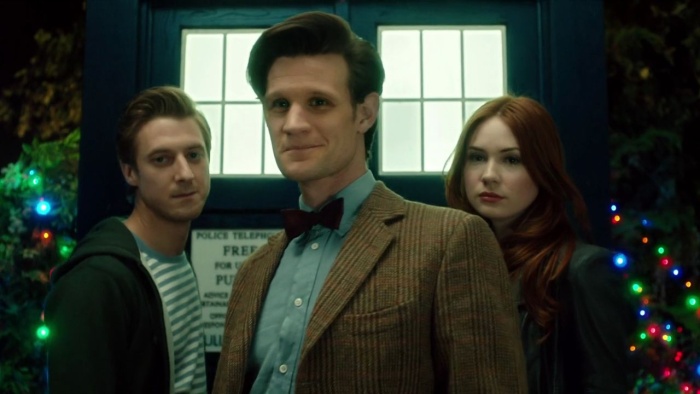
ATL Comic Convention + Fandemic World Tour Atlanta 2022

ATL Comic Convention + Fandemic World Tour Atlanta 2022
Atlanta, GA – March 18 through March 20, 2022
ACCFandemic

Thanks to the COVID-19 pandemic, it’s been a few years since I have visited Atlanta Comic Con. It’s one of Atlanta’s smaller conventions but it’s also a fun escape in the middle of the summer before Dragon Con rolls in.

This year, Atlanta Comic Con changed course, moving from their typical mid-July schedule to something a little closer to the Vernal Equinox.

Hey ATL friends,
July was too far away and we couldn’t wait that long to see all our amazing ATL Comic Convention attendees, so we joined forces with our friends at Fandemic World Tour Atlanta to bring you an even BIGGER and BETTER show! Fandemic is happening March 18-20, 2022 at the Georgia World Congress Center Building B.

So, next week, you can find me at the Georgia World Congress Center on the Saturday and Sunday of the event. I don’t have a definite schedule yet, but I plan to be there on panels with Mike Faber and Michael Gordon of The ESO Network as we talk about Doctor Who, the Marvel Cinematic Universe, and Podcasting 101.

UPDATE (3/18/22): The tentative programming schedule has been added to the website. 

So You Want to Start a Podcast? – Saturday 1:30PM – 2:15PM, Room B203

Doctor Who: Out With the Old, In With the New – Sunday 12:30PM – 1:15PM, B203 [Recorded for Earth Station Who]

The MCU: What Now? – Sunday 2:30PM – 3:15PM, B203 [Recorded for Earth Station One]

The convention will also have quite a few celebrity guests, including Sebastian Stan, Norman Reedus, Michael Rooker, James Marsters, John Barrowman, Jeffery Dean Morgan, Pom Klementieff, and more. More information, including ticketing information, can be found on their website.

I hope to see you there!

cc-break

Timestamp #241: The Bells of Saint John

Doctor Who: The Bells of Saint John
(1 episode, s07e06, 2013)

Timestamp 241 The Bells of Saint John

The clever boy rides.

Prequel

A little girl finds the Doctor sitting on a swing in a playground. The Doctor is sad because he can’t find his “friend”, but the girl is friendly despite her mother’s warning not to talk to strange men. The little girl offers some advice about finding lost items before returning to her mother.

The girl’s mother scolds her for talking to a stranger. It turns out that the little girl is none other than Clara Oswald.

The Bells of Saint John

A man warns the world against attaching to strange public wifi networks. Which, you know, is wise advice under any circumstance. But this warning also adds a little bit of The Ring to the story: Within 24 hours of connecting to the strange network, a user’s soul is extracted into the internet where it screams in the cybernetic void.

The man knows what he speaks. He is one of the lost souls.

Shifting to Cumbria in 1207, a monk sends warning that the bells of Saint John are ringing. The Abbot informs the “mad monk”, the man known as the Doctor who asks for a horse. As the Doctor prepares, the Abbot looks upon a painting of “the woman twice dead”, remarking that if the Doctor is mad, the mystery around the woman is his madness.

In London, circa 2013, Clara Oswald has trouble connecting to the internet. George is leaving with a boy named Artie while Clara keeps track of Angie. She also remarks on Artie’s choice of reading material – Summer Falls by Amelia Williams – noting that Chapter Eleven is the best because it makes the reader cry.

Back in Cumbria, the Doctor and the monks arrive in a cave where the TARDIS is parked. The exterior phone is ringing, which isn’t supposed to happen, and it connects the Doctor to Clara through the help line that a “woman in the shop” gave her. The help line is supposed to be the best in the universe, after all. When Clara tries to connect to the Maitland family wifi, she asks Angie for the password. It is “RYCBAR123”, remembered by the mnemonic “Run you clever boy and remember.”

Of course, the Doctor remembers the phrase and startles Clara. Clara inadvertently connects to the strange network, starting her twenty-four hour clock before running to answer the door. There she finds the Doctor, dressed in monk robes, pounding on the door and excited to meet her.

On the other side of the strange network, an analyst named Alexei remarks that Clara is “borderline,” being clever without much computer skill. His boss, Rosemary Kizlet, his superior, orders him to upload Clara anyway and supplement her with a computer skills package. With the promise that Alexei will activate the “Spoonheads”, Kizlet returns to her office and discusses Alexei with a man named Mahler. They agree to kill the analyst after he returns from holiday, then discuss Mahler’s worry that they’re uploading too many people too quickly. Kizlet tries to comfort him while manipulating his senses of conscience, paranoia, obedience, and IQ. After Mahler leaves to carry out Kizlet’s orders, she raises his obedience level to the maxmum.

At the house, Clara is unconvinced to let the robe-clad stranger in. As she turns to go back upstairs, a little girl comes down to meet her. This strange girl is the same girl from the Summer Falls book cover, and she also has a spoon-shaded indent in the back of her head. Clara backs away in fear.

The Doctor returns to the TARDIS for a change of clothes, donning a purple cashmere coat and matching bow tie. He rushes back to the house to find Clara unconscious with her screaming voice trapped in the Spoonhead. The Doctor uses his sonic screwdriver to analyze the robotic base station before using Clara’s laptop to reverse the connection and restore Clara’s consciousness.

He also leaves a message for Alexei, Mahler, and Kizlet: “UNDER MY PROTECTION – The Doctor”. Kizlet immediately contacts her client with news that the Doctor has arrived.

The Doctor tidies up while Clara rests, even adding a plate of Jammie Dodgers nearby. He flips through a book of hers and finds a dried red maple leaf, then steps outside to guard her while she sleeps. Clara joins him some time later and the Doctor recounts everything that she missed: Angie is staying with her friend Nina, Clara’s father called to complain about the government, he fixed the washing machine, optimized the photosynthesises of the plants, organized the food pantry, and reassembled a broken Quadricycle. Okay, that last one? He invented the Quadricycle.

He also promises to stand watch while Clara sleeps, but she decides to come downstairs to him. While she gathers a cup of tea and a folding chair, Kizlet’s team watches them and plots. The Doctor explains the internet eating souls to Clara, which she equates to Twitter – she’s not wrong – and the pair realize that Clara has gained a greater knowledge of computers from being partially uploaded. The Doctor spots a Spoonhead and the lights around the neighborhood switching on. There’s also an airplane plummeting down on their position. Kizlet is intent on removing the Doctor and Clara from the equation.

Against her wishes, the Doctor rushes Clara into the TARDIS. She’s amazed as the Doctor makes a short hop through space into the falling airplane. The passengers and crew are switched off through the wifi, so the Doctor manages to pull the plane out of the nosedive and revive the people onboard. As the Doctor and Clara return to the TARDIS, Kizlet demands that her team locate the blue box.

The Doctor promises to explain everything over breakfast, dropping the TARDIS into a group of people who cheer the materialization as performance art while the Doctor retrieves his motorcycle from the garage. The pair ride to a café for breakfast as Kizlet’s team processes cell phone photos for the TARDIS, the Doctor, and Clara.

The Doctor and Clara use the laptop to hack the webcams at Kizlet’s office and cross-reference the imagery through various social networks to find their adversary’s location: They work at the Shard.

The Doctor leaves to get more coffee, talking to several people who are being controlled remotely along the way. Kizlet explains that her client feeds of the neural energy of humanity, similar to a farmer slaughtering cattle for harvest. She notes that Clara is not as safe as he thinks, and he soon discovers that Clara has been uploaded by a Spoonhead duplicate of the Doctor.

Furious, the Doctor rides his motorcycle to the Shard, using an anti-gravity feature to ride up the side of the Shard and literally break into Kizlet’s office. He demands that Kizlet restore Clara and the entire data cloud into their bodies. For those who no longer have a body, their deaths would ensure release from the living virtual hell.

Oh, and the Doctor? He’s still at the café. He sent his Spoonhead duplicate which has now uploaded Kizlet as motivation to restore everyone to the living world. The Spoonhead uses Kizlet’s tablet to boost Mahler’s obedience and he follows her demand to be released by emptying the entire cloud.

Clara wakes up at the café, but the Doctor has gone. Meanwhile, as UNIT storms the Shard, Kizlet reports her failure to her client. As the Great Intelligence bids her farewell, it orders Kizlet to reset herself and every one of her co-workers to their “factory settings”. Everyone is restored to who they were before the Great Intelligence’s plot began, including Kizlet who is now a scared child.

This plot has been going on for some time.

Back at the Maitland residence, Clara sees the TARDIS outside and goes to see the Doctor. He invites her to travel with him. She declines, telling him to come back the next day and ask her again because she might say yes. After she leaves, the Doctor returns to the console, dialing up the next day as he declares that it’s time to find out who she is.


As mid-season returns go, this one is a great season premiere. It pushes a soft-reset while giving the new companion a bright spotlight in which to play. This version of Clara is a bit less flirty than her predecessors (wibbly-wobbly-timey-wimey) but still definitely herself in the end. You know, despite the fact that she has no idea who Oswin or Clara Oswin are.

The return of the Great Intelligence was a neat trick, as was the allusion that this plot was long-reaching.  I especially liked the story and its connection to modern technology and our obsession with it. The plot itself is reminiscent of The Idiot’s Lantern. It’s also quite fun when real-life landmarks like the Shard are used in the plot.

The rapid-fire introduction of Clara to the TARDIS as they saved the nosediving airplane was a heart-pounding ride. Of course, I have to ignore the basic logisitics of that save since there is no place neither wide nor tall enough to park the TARDIS on a Boeing 737.

The switcheroo with the Doctor and the Spoonhead was a nice nod to The Android Invasion. The “short hop” discussion was a fun callback to the other times that such trips were difficult, such as The Seeds of DeathState of DecayArmy of Ghosts, and (most recently) Dinosaurs on a Spaceship

Overall, a good time and a fun start to the next run of adventures.

Rating: 5/5 – “Fantastic!”


UP NEXT – Doctor Who: The Rings of Akhaten

cc-break

The Timestamps Project is an adventure through the televised universe of Doctor Who, story by story, from the beginning of the franchise. For more reviews like this one, please visit the project’s page at Creative Criticality.

Timestamp #240: The Snowmen

Doctor Who: The Snowmen
(1 episode, Christmas Special, 2012)

Timestamp 240 The Snowmen

The cold birth of a great intelligence.

Prequel: The Great Detective

In Victorian London, the Paternoster Gang – Madame Vastra, her maid Jenny Flint, and their Sontaran servant Strax – meet with the Doctor as they pursue strange happenings. The Doctor shows no interest in their cases as he has since retired from investigating such matters.

Prequel: Vastra Investigates

Since the Doctor is unwilling to help, the Paternoster Gang strike out on their own. After they solve a case, Inspector Gregson of Scotland Yard talks with them about their adventures and membership. He’s confused about Vastra’s skin and Strax’s build, unable to grasp that they are both aliens. Vastra perpelexes him futher by talking freely about her love for Jenny.

As the carriage pulls away, Vastra and Jenny discuss the Doctor’s heartbreak, a deep emotion that has isolated the Time Lord in his TARDIS. They’re also confused about the continuing snowfall from a cloudless sky.

The Snowmen

Winter, 1842: Children are playing outside but one boy builds a snowman by himself. He laments how the other children are silly and the snowman repeats his words. As the boy starts to run away, the snowman offers to help him.

Fifty years later, the boy has grown up and oversees the sampling of snowmen. This man, Walter Simeon, deposits the samples into a giant snowglobe before sacrificing the men who gathered the samples to the snowmen.

At an inn called the Rose & Crown, a familiar looking barmaid walks outside with a tray and spots a creepy snowman. She asks a passing man, the Doctor, about the snowman. He inspects it and asks the woman’s name. He think’s Clara’s name is a nice one and that she should keep it. As he leaves with his somber attitude, Clara gives chase and jumps onto the back of his carriage.

The Doctor calls Vastra on his carriage phone. Vastra is amused that he’s back in an investigatory mood, but the Doctor denies it. He’s sure that Clara will not be able to find him again since she doesn’t even know the name “Doctor”. On cue, Clara drops down from the carriage roof and asks, “Doctor who?”

Dr. Simeon pays a visit to Captain Latimer to muse about the pond where the captain’s governess died. The pond has frozen and Simeon wants the ice, declaring himself to be part of the Great Intelligence Institute. As Simeon departs, he is confronted by Jenny and Vastra. The doctor doesn’t find them threatening, and even taunts the duo as the inspiration for Dr. Doyle’s detective stories. Simeon states that no one can stop his plan, but Vastra knows differently.

The Doctor and Strax investigate the snow, leading Strax to express his discontent over the Time Lord’s apathy. The Doctor believes that the universe doesn’t care, then turns his attention to Clara. He tries to use something called the memory worm to erase her memory, but Strax botches the whole thing. The Doctor is fascinated by the fact that Clara hasn’t run during the whole affair.

They then face a group of snowmen as Clara thinks about them, triggering the telepathic nature of the alien snow. The Doctor has Strax take Clara back to the inn as he heads to a local common area. Clara follows him and finds the ladder that he’s hidden behind a perception filter. She uses the ladder to ascend into the sky where she finds a sprial staircase and the TARDIS resting on a cloud.

She knocks on the door of the TARDIS and then hides, rushing back down the staircase. The Doctor finds a scrap of her dress and knows it was her, but remains determined to stay out of Earth’s affairs. The next morning, Christmas Eve, Clara heads to her second job as governess to Captain Latimer’s children. She operates here as Miss Montague under a more posh accent.

Clara attends to the children, Francesca and Digby, amusing them with her “secret voice” which is her real accent. The children prefer her over the previous governess, the woman who drown in the frozen pond. Clara understands that the children think about the former governess often, and making the link about the telepathic snow, she rushes to the park to find the Doctor. She finds the ladder disabled but also finds an ally in Jenny who takes her before Madame Vastra.

Vastra offers her an audience, but is restrained to single word responses to Vastra’s queries. After all, the truth can be said in one word while lies are said with a string of them. Vastra tells Clara that the Doctor once saved many lives, but when he suffered a great loss, he chose to reture. She also sees a chance to reawaken the Doctor’s former sense of adventure, so she offers Clara a test: She must give her a message to pass onto Doctor; warning him of the danger, but she must do it in one word.

The word she chooses is “pond”.

The Doctor visits Simeon’s institute, an act that causes some discomfort to the Intelligence in the snowglobe. The Doctor recognizes the Intelligence and the danger it poses by inhabiting the former governess, but is forced to flee when Simeon calls for help. The Doctor investigates the frozen pond while denying such to Strax, but finds himself enthralled by Clara as she watches from a window.

Clara later tucks the children in with a story about the Doctor, but they are interrupted by the reanimated ice form of the dead governess. The ice governess chases Clara and the children to the nearby play room where the Doctor appears and shatters her with the sonic screwdriver.

Meanwhile, Simeon activates a snow machine in the front yard as the Doctor admires his bow tie, unaware that he had even put it on. As the ice governess reincorporates, the group rushes downstairs to find Captain Latimer and the Paternoster Gang. Jenny restrains the ice governess with a force field while the team works out the problem, realizing that the Intelligence needs the governess to create an army of unstoppable ice creatures.

The Doctor orders everyone to stay in the study but Clara disobeys, giving the Doctor a kiss before Simeon arrives with an ultimatum. The Doctor arms Clara with an umbrella, disables the force field, and rushes the pair upstairs. Clara pulls the Doctor along as the pair end up on the roof, using the umbrella to snag the ladder and lead them (and the governess) to the TARDIS.

It is here that Clara is introduced to the TARDIS – “It’s smaller on the outside!” – and its beautiful new console room. The Doctor is reminded of another woman, Oswin, when Clara talks about her love of soufflés. He gives Clara a key to the TARDIS, effectively accepting her as his companion.

Unfortunately, the governess has ascended the staircase and drags Clara out of the TARDIS. The pair fall to Earth. The Doctor moves the TARDIS to the courtyard, but he’s too late to save Clara. Even though Strax can revive her for a little while, she will succumb to her injuries.

Unfortunately, the Doctor thinks that she’s going to live, believing that the universe owes him for all the times he has saved it. He sincerely believes that if he saves the world, the universe will allow Clara to live.

The Doctor confrons Simeon, presenting a piece of the shattered governess in a 1967 London Underground-themed lunchbox. Alongside Vastra, he discovers that the snowglobe contains Simeon’s darkest thoughts and feelings, a reflection of the man as a boy. Simeon is shocked by this revelation, but still grabs the box. However, it does not contain the governess.

It contains the memory worm.

The worm bites Simeon, erasing all of the memories from his adult life. Without the link, the Intelligence seems to die but surges back to life. The dream has outlived the dreamer. The Intelligence inserts itself into Simeon, defeats Vastra, and then attacks the Doctor.

At that moment, Clara begins to die with a single tear dropping from her eyes. The snow mirrors the emotions and transforms into salty rain, effectively disincorporating the Intelligence as the Latimer family mourns Clara. The Doctor rushes to her side, listening as she utters her final words: “Run you clever boy. And remember.”

The Doctor attends Clara’s funeral and discusses the Intelligence with Jenny and Vastra. He remembers the name, but can’t quite remember when he met the Great Intelligence. He is also shocked to learn Clara’s full name – Clara Oswin Oswald – and rushes off as he realizes that there is another version of her somewhere that he might meet again for the first time.

She is an impossible girl.

In the present day, the cemetery is overgrown with weeds. A woman and her friend walk through the neglected graveyard and observe the headstone. This woman is Clara.


The story overall is a good one, bringing the Doctor back from the depths of his mourning to a newly-restored sense of adventure and moral justice. There is an element of fridging involved with Clara’s death, but there’s also a great deal of heroism leading to it. Clara’s death was also anger-inducing since the Doctor let his guard down to wow her with his world.

To say that it’s complicated is an understatement.

What’s also complicated is the Doctor’s memory of the Great Intelligence. We’ve seen it twice on television – The Abominable Snowmen and The Web of Fear – and the Doctor was definitely cognizant of what and who the Intelligence was. But here, the Doctor is far more cagey about the being, almost like he’s forgotten. That’s entirey possible, given that the altercations were nine or ten incarnations and several hundred years ago.

I do love the dynamic that Clara brings to the show: She’s flirty like Amy was, but she’s more inquisitive and takes more initiative than her predecessor. We saw this in Oswin’s appearance and in this Clara’s debut, and her personality will carry through the coming stories. I also like this idea of fragments as a unique approach to a new companion.

One more thing that I like that the Doctor is hiding in 1890s London, right under Queen Victoria’s nose. Despite the royal banishment initiated in Tooth and Claw, the recent change of face may be his saving grace.

The new title sequence and theme are my favorites of the Matt Smith era. The flash of the lead actor’s face is also a nice callback to the classic era, an element that we haven’t seen since 1989’s Survival.

Another neat callback is the Eleventh Doctor donning the Fourth Doctor’s Sherlock Holmes outfit – a fitting piece to the story’s theme – which we last saw in The Talons of Weng-Chiang. Surprisingly, the amount of Sherlock Holmes references in the televised side of Doctor Who is sparse, but the audio and prose side more than makes up for it.

Rating: 4/5 – “Would you care for a jelly baby?”


UP NEXT – Doctor Who: The Bells of Saint John

cc-break

The Timestamps Project is an adventure through the televised universe of Doctor Who, story by story, from the beginning of the franchise. For more reviews like this one, please visit the project’s page at Creative Criticality.

Culture on My Mind – The Book of Boba Fett

Culture on My Mind

Culture on My Mind
The Book of Boba Fett
February 21, 2022

The Book of Boba Fett has just recently ended on Disney+ and it is on my mind.

When the series was announced in a surprise stinger to The Mandalorian‘s second season finale, I was immediately struck by the name. The Book of conjured imagery of religious texts – particularly Christian, based on my upbringing – and unreliable narrators, which has been a theme of The Mandalorian‘s unique cult-like sect of wandering warriors. To that end, I expected The Book of Boba Fett to be the story of the resurrection and rebirth of the title character.

It’s a theme in keeping with the rest of Star Wars, which really is a collection of legendary tales. It is our modern mythology.

I have a complicated history with the character of Boba Fett. He debuted in the animated interlude of The Star Wars Holiday Special, returned for his best-known appearances in The Empire Strikes Back and Return of the Jedi, and then popped up in the Droids animated series for a single episode. He was also peppered throughout the early comics. He was originally conceived as a member of some elite “super trooper” squadron, but was rewritten as a solitary bounty hunter. His air of mystery during a handful of movie minutes made him iconic to Gen X Star Wars fans, but I found the character boring because there was nothing substantial to him. I prefer characters with some amount of body and, sadly, Boba didn’t have that.

I got excited during the former Expanded Universe’s heyday when various authors tried to explore Boba’s history, but it all ended up being a dumpster fire of hand-waving, smoke, and mirrors. His return in Dark Empire was a highlight of that story, but from Jaster Mereel of Concord Dawn to is-he-or-isn’t-he-a-real-Mandalorian, I found all of Boba’s EU story to be frustrating.

When we got to the revised origin from Attack of the Clones, I finally found my hook. An unaltered clone of Jango Fett, the very template of the clone army that served and destroyed the Republic, Boba finally had some something interesting. His father was more interesting – we named our hound Jango, after all – but the potential in Boba was evident. It only expanded as The Clone Wars progressed, the Expanded Universe was transformed into Legends, and the overall canon was pseudo-reset.

Boba’s appearances in The Mandalorian finally made me care about him. The Book of Boba Fett gave me the promise of how he escaped death in the Sarlacc and would return to his father’s core belief as a simple man trying to make his way in the universe. I have been mostly pleased with what I have seen.

Boba Fett reminds me of a cowboy, and not just because of the spur sounds when he walks. To explain that, I have to give you some of my backstory. My parents both competed in the Utah rodeo circuits – my mother was a barrel racer and my father was bullrider and bullfighter – and I grew up surrounded by cowboys. I actually competed for a little while before bull riders that I knew were killed and I decided that it wasn’t the life I wanted to pursue.

My dad turned away from competing and performing as it took a toll on his body, but he never relinquished his core. He honed his craft as a professional photographer and my parents sold that skill and their experience to local rodeo circuits. Mom would help with timing and coordinating events while Dad was in the dirt getting the good shots but using his knowledge to stay out of harm’s way. They also both helped mentor the next generation.

It was during these trips that I met Charles Sampson. He was the first African American cowboy to win a world championship in professional rodeo, he was inducted into the ProRodeo Hall of Fame in 1996, and he was one of the people behind a circuit that we followed. Charlie rode for nearly 20 years, including 11 trips to the National Finals Rodeo, and is well-known for his many injuries. Notably, his left calf has 17 pins and two metal plates, he has broken every bone in his face, and even lost an ear when a bull ran him over in 1988. He literally shattered his face during a riding accident in front of President Ronald Reagan. He retired from riding and turned to helping a younger generation through his expertise.

Boba Fett reminds me of these two cowboys. The Book of Boba Fett shows us how the bounty hunter has changed from the quiet menace we met in the original trilogy. He undergoes a change during the miniseries, growing from a solitary hunter to a member of a community. He learns a new way of looking at the world while retaining his core experience and expertise. He can still move and fight as necessary, but he still wants to make his way through the galaxy as a simple man.

To that end, he has eschewed the methods that made him famous, using the knowledge he’s gained to bring about order with minimal bloodshed within the community. Much like how Charlie and my father remained cowboys but changed how they interacted with rodeo, Boba Fett still thrives in the Outer Rim while teaching the people who suffered under Jabba corruption how to thrive together.

Boba takes the title of daimyo, a title inspired from the Japanese feudal lords of the 10th to 19th century. Daimyo ruled hereditary land holdings and led clans, often guarding their holdings through samurai that were paid in land or food. Both land and food were used as payment for Fett’s own samurai throughout this show.

Boba has learned to rule through compassion and compromise, not through fear and absolutism. He has learned that there are better ways to resolve conflict than just shooting someone. It’s easy to kill an opponent, but it takes a stronger character to change minds and avoid taking lives. He’s learned this after his vengeance-fueled childhood and his years as a violent bounty hunter.

It’s actually disturbing to me that, based on the hot takes in social media, so many fans in my generation think that Boba’s compassion is a weakness. Of course, Boba’s attitude in this miniseries – injustice against anyone should not be tolerated, no matter how close or far from you it takes place – parallels the attitudes that these same Gen-Xers classify as the “social justice warrior” mindset, so maybe I shouldn’t be so surprised.

The Book of Boba Fett, which was billed as “Season 2.5” of The Mandalorian, is a side story that tells the legend of Boba Fett’s resurrection and rebirth through the style of the unreliable narrator. It highlights his reconciliation with his past, both the vengeful orphan and the “no disintegrations” violent hunter, as he evolves into a different kind of force. The season reminds me of the small spinoffs that happen in comics, offering an amplifying story to the big events that don’t necessarily fit in the main arc.

The flashback sequences of his survival and rise on the Dune Sea are his own dreams while he tries to regain his own physical strength. Those dreams are subjective by nature, part of the legend or the myth. For me, that also lent itself to the “modern day” sequences as possibly being told like the Armorer’s superstitious stylings of the purge of Mandalore.

This “legend of” story also explains why Boba Fett isn’t in every episode (even though the only one that he wasn’t in was the fifth episode, primarily a Din Djarin chapter, despite what the social media meme-makers think). The meme-makers have fun with this story because it is very different from the normal television method. Boba’s name on the tin, but he’s not in frame for twenty-five to thirty percent of the series.

Carrying the Biblical parallels forward, the New Testament is about the life and teachings of Jesus Christ and the progression of Christianity, but Jesus only appears in four of the twenty-seven books. Notably, those four all tell essentially the same story from different points of view. The remaining twenty-three books muse about the legacy and the legend.

The salvation of Tatooine is turned into gospel by Boba Fett’s ultimatum to the Pyke Syndicate. It is written and anyone within earshot will carry that legend to the ends of the galaxy.

I, Boba Fett, speaking as daimyo of the Tatooine territories formerly held by Jabba the Hutt, present the following offer: Nothing.

You will leave this planet and your spice trade. If you refuse these terms, the arid sands of Tatooine will once again flourish with flowering fields fertilized with the bodies of your dead.

At the end of The Book of Boba Fett, these Tatooine territories are free from the corruption and oppression of the Hutts, the Pykes, and the “curse” of the criminal element. The show called back several times to the ancient oceans of the desert planet, and I think that’s Boba’s vision of the future. It’s a restoration of balance to the planet by returning it to the people, both the Tuskens and the homesteaders. It also lights a beacon for the healing of another society as Din Djarin heads toward the ruins of Mandalore.

The Book of Boba Fett also fills some important gaps in the modern media landscape. First, we have the story of a sixty-year-old actor, Temuera Morrison, playing a middle-aged man in the second or third phase of his life. We also have an actress of similar age, Ming-Na Wen, playing Fett’s enforcer. Both characters are taking charge and getting results, living new and distinct phases of their lives. So much of what we see in Hollywood is focused on coming-of-age stories, tales of young and sexy CW archetypes battling angst, or even mid-life redemption stories portrayed by middle-aged actors. In the industry, older actors (especially women) aren’t even considered for action-hero roles. This is a refreshing change.

The second change is also refreshing: We have a single man and a single woman working together and they’re not romantically involved. There is no unresolved sexual tension, no will-they-won’t-they Moonlighting bantha poodoo, and not even a hint of attraction between them. The relationship is professional and asexual, and I am on board for all of it.

The Book of Boba Fett is not without problems, of course. The parallels to Dune are more than obvious, as are elements of the White Savior/White Man’s Burden, Magical Negro, Going Native, Mighty Whitey, and Disposable Vagrant tropes. The heartless elimination of the Tusken Raiders – the Tatooine natives – is deeply problematic because it treats them as props in Boba Fett’s ascension/resurrection. So, add Stuffed into the Fridge to the list of this story’s sins, which is a sad development since I really loved the added depth for the Tusken Raiders in this miniseries.

While I admired the storytelling style, I would have written the miniseries in a more linear fashion, presenting the flashbacks as the first few episodes, then building into the modern day story as Boba brings order to the towns under his purview. I would have spread the wealth of Episode 5’s Din Djarin story through Boba Fett’s story, following more of the A-plot/B-plot style of other television series. The present-day story stumbles in light of the flashbacks because there is no meat to it before the finale.

I would have also spent a bit more time polishing the disjointed action sequences that Robert Rodiguez directed because they are too narrowly focused. While the action occurs in frame, the rest of players stand around waiting for the lens to swing toward them. It breaks believability, especially in the finale.

But, those drawbacks considered, The Book of Boba Fett strikes me as the dogmatic material that inspired its name: A story told by an outside and biased observer trying to capture the epic scope and reputation but needing to embellish it here and there each time it comes ’round.

It’s not really a story about the man. It’s a story about his legend. Just like cowboy stories, both classic and modern.

We have a story about the legend of Boba Fett. All we need now is a campfire, a clear night, and a halfway decent pot of coffee on the Dune Sea.


Edited on February 24

cover_medium

I also joined the Earth Station One podcast to discuss the series with Mike Faber, Michael Gordon, and Ashley Pauls. You can find this discussion on the Earth Station One podcast’s website and wherever fine podcasts are fed. You can also find the ESO Network on Facebook, Twitter, and Instagram


cc-break

Culture on My Mind is inspired by the weekly Can’t Let It Go segment on the NPR Politics Podcast where each host brings one thing to the table that they just can’t stop thinking about.

For more creativity with a critical eye, visit Creative Criticality.

Timestamp #239: The Angels Take Manhattan

Doctor Who: The Angels Take Manhattan
(1 episode, s07e05, 2012)

Timestamp 239 The Angels Take Manhattan

Goodbye, Ponds.

The Angels Take Manhattan

Julius Grayle, an art collector and mob boss, hires private detective Sam Garner to investigate statues that move in the dark. Garner thinks that Grayle is crazy, but the mob boss knows that the threat is real. Garner follows his instructions to Winter Quay, an apartment complex with familiar weeping angels out front.

When he enters the building, he goes up to a room on the seventh floor where he finds his name on the door. He enters, unwittingly avoiding the Angels as he goes, and finds artifacts from his own life. He also finds an old man who claims to be him. The old man dies after warning Garner that tonight is the night he gets sent back.

He tries to run, eventually ending up on the roof, but is cornered by an Angel. An Angel in the form of the Statue of Liberty.

[Insert facepalm here.]

Moving forward to New York City, 2012, the Doctor and the Ponds are enjoying a picnic in Central Park. The Doctor is reading aloud from a pulp novel, Melody Malone: Private Detective in Old New York Town, a habit that drives Amy mad. He pokes fun at her use of reading glasses and then the wrinkles around her eyes. Rory tries to dodge the situation by going for coffee, but Amy defuses the whole affair with a kiss. The Doctor borrows her glasses for fun and Amy asks him to read to her. He rips out the last page and sets it aside – a habit he’s formed because he doesn’t like endings – and begins to read.

Rory heads back with the coffee, hearing cherubic laughing as a small statue under Angel of the Waters disappears and rattles around in the shadows. As the Doctor narrates, he realizes that he’s reading a tale about River Song and that Rory has somehow traveled back in time. Amy and the Doctor use the TARDIS to travel back to April 3, 1938, as the story continues. As Melody Malone, River tells Rory that the city is full of time distortions and will prevent the TARDIS from landing. She only arrived by use of a vortex manipulator.

After the TARDIS bounces off of 1938, it lands in a 2012 graveyard. As the Doctor uses a fire extinguisher on the TARDIS, he stops Amy from reading the book because once she reads from it, history will be written in stone. It will become a fixed point.

What they don’t see is a headstone nearby that reads “In Loving Memory: Rory Arthur Williams”.

Back in 1938, River and Rory are taken to Grayle’s mansion. River remarks on the mob boss’s affinity for Qin artifacts and the number of locks on his doors. Rory is taken to the basement to wait with “the babies”, a box of matches as his companion.

Once the Doctor knows about Grayle’s affinity for Qin artwork, the Doctor sets a course for China, 221 BC, and has a special vase made. In 1938, River notices the vase and translates the symbols through residual TARDIS energy: It reads “Yowza!”, prompting River to utter a trademark “Hello, Sweetie.”

River uncovers a chained Angel in Grayle’s office, then transmits the “Yowza” as landing lights for the TARDIS, offering the Doctor coordinates to lock onto. Grayle has damaged the Angel, which prompts River to tell him that the Angel is screaming. Grayle uses it as an interrogation device, flashing the lights to drive it closer to intended targets.

Down in the basement, Rory is being tormented by the smaller statues. The whole house shakes as the Doctor arrives, punching through the interference and literally spinning the TARDIS into place. Amy searches for Rory as the Doctor reunites with River in a humorous exchange about The Wedding of River Song.

The Doctor knows that River can only be freed from the Angel by breaking her own wrist. Amy has the idea to use the novel, but only to use the chapter titles instead of the actual contents. Through them, the Doctor finds out that Rory is in the basement, but he also finds out that Amy is due for a final farewell. This angers him because it’s now a fixed point, and he demands that River figure her own way out while he tends to Amy and Rory.

Unfortunately, Rory is missing. The Doctor and Amy surmise that he’s been taken by the Angels, but River deduces that he’s only been moved in space. The Doctor notes that River has escaped, but soon finds out that it was because she followed the future as written. He has Amy track Rory while he patches things up with River by transferring a bit of regeneration energy into her broken wrist.

River doesn’t take that well and storms out. Amy follows and has a heart-to-heart with her daughter about endings.

The trio makes their way to Winter Quay, leaving Grayle behind, unaware that the mob boss is trapped by the statues. Rory has been exploring the building and the trio reunites with him near a smiling Angel. The door nearby reads “R. Williams” and behind it lies an elderly Rory on his deathbed. It is the Death at Winter Quay forecasted by novel’s chapter.

The building is a battery farm for the Weeping Angels. They keep their victims imprisoned and send them back in time repeatedly. The elderly Rory’s death means that Rory is destined to remain there, and Amy won’t be with him because of how eager the elderly Rory was to see her. If Rory doesn’t remain, the Angels will chase him forever. River realizes that if Rory escapes, the subsequent negation of the timeline will cause a paradox that will poison the time energy the Angels feed on and kill them, but the Doctor is unsure because of the power that it would take.

The stomping of the Statue of Liberty Angel grows closer, prompting Amy and Rory to run. The Doctor and River are trapped behind but eventually catch up via the fire escape, reuniting with the Ponds on the rooftop. Rory considers jumping off the roof to cause the paradox. After some discussion, Amy joins him, jumping just as the Doctor and River arrive.

The companions embrace as they fall. Their deaths traumatize the Doctor but disrupt the timeline as the paradox takes effect. All four of them escape the collapsing timeline and awaken in the 2012 graveyard with the TARDIS nearby.

Rory is drawn to the nearby gravestone, puzzled by his name being engraved upon it. He’s suddenly touched by an Angel and disappears. Amy cries out and the Doctor determines that it is a survivor of the paradox.

Amy sees the headstone and realizes the truth. They cannot use the TARDIS to travel back and get Rory because any additional paradoxes would destroy New York City. The timelines are scrambled enough already. The only alternative that Amy sees is to join Rory, assuming that she’ll be deposited there with him.

She says her farewells and then turns her back on the Angel. The headstone tells the tale. Amy survived and created a fixed point. The Doctor can never see her again.

The Doctor and River take off in the TARDIS, and she makes him promise in his grief to never travel alone. They discuss the novel and River promises to make Amy write an afterword for him. He runs back to the park and pulls out the last page. He puts on Amy’s glasses and reads it.

Afterword, by Amelia Williams.

Hello, old friend, and here we are. You and me, on the last page. By the time you read these words, Rory and I will be long gone, so know that we lived well, and were very happy. And, above all else, know that we will love you, always. Sometimes, I do worry about you though; I think, once we’re gone, you won’t be coming back here for a while, and you might be alone, which you should never be. Don’t be alone, Doctor.

And do one more thing for me: there’s a little girl, waiting in a garden; she’s going to wait a long while, so she’s going to need a lot of hope. Go to her. Tell her a story. Tell her that, if she’s patient, the days are coming that she’ll never forget. Tell her she’ll go to sea and fight pirates, she’ll fall in love with a man who’ll wait two thousand years to keep her safe. Tell her she’ll give hope to the greatest painter who ever lived, and save a whale in outer space.

Tell her: This is the story of Amelia Pond — and this is how it ends.

The TARDIS is heard as young Amelia sits on her luggage in her garden. The Doctor honors Amy’s last request.

P.S.

Picking up directly after The Power of Three, the Doctor leaves with Amy and Rory after having dinner with Brian.

A week later, Brian answers a knock at the door. His visitor is an American man named Anthony, a sixty-year-old holding a letter addressed to Dad. The visitor waits in the hall while Brian reads the letter. It is from Rory.

The letter tells the story of how Amy and Rory were permanently trapped in the past in New York City. Rory assures his father that they lived happily together for the rest of their lives. In 1946, they adopted a son named Anthony, who is the man that delivered the letter. Rory tells Brian that he misses him and loves him, and he understands how weird it must be to have a grandson who is older than he is.

Brian returns to the hall to see Anthony. Anthony offers a handshake, but Brian hugs him instead.


Starting with the good stuff, I really love how this story plays with the notions of fixed points and temporal paradoxes. Fixed points are a narrative tool developed for the post-Rose revival era in an attempt to deal with things that shouldn’t be changed despite the inherent power of time travel. We’ve seen how violating fixed points can break the universe (Father’s Day), delay the inevitable (The Waters of Mars), and assist our heroes in creating loopholes for victory (The Wedding of River Song).

The concept plays around with the First Doctor’s imperative in The Aztecs: “You can’t rewrite history. Not one line!” It turns out that a time traveler can rewrite history, but it’s complicated.

In this story, our travelers play around with the rules of fixed points and paradoxes, exercising them a bit to play a “will they, won’t they” game with the fate of the Ponds. The end result is a victory for the Weeping Angels and a tragic blow to the Doctor as his faithful companions are locked away from him forever by powers beyond his control. The first paradox that destroyed the Winter Quay battery farm – since it never existed, they never traveled there in the first place… even though they remember everything about the trip – prohibits the Doctor from traveling to that exact time and space again to rescue the Ponds.

What stops him from parking the TARDIS in New Jersey and crossing the Hudson River to Manhattan? I guess it depends on the Doctor’s intent or something. The Doctor has yet to travel (on television, anyway) to 1930s/1940s New York City since. It’s a complicated conceit to lock the Ponds away permanently without killing them off. I give Steven Moffat credit for the effort.

I also give him credit for a tearjerker of an ending that finally makes me believe that Amy actually cares about Rory. I’ve talked many times about how selfish and poorly communicative Amy is with respect to the Pond relationship, but here she twice displays how important Rory is in her life.

I also give a ton of credit to Chris Chibnall for his follow-up that ties off the thread for Brian Williams that was laid down in The Power of Three. The Doctor kept his promise and the Ponds technically survived.

One conceit nearly ruins this whole affair for me: The Statue of Liberty as a Weeping Angel. The concept is just dumb from both the writing and in-universe logistics. In the Doctor Who universe, who isn’t going to notice a series of stomping earthquakes as the most popular local statue leaves Bedloe’s Island/Liberty Island and maneuvers through a tightly packed city? In our universe, it’s a pretty bad example of making enemies bigger in an attempt to make them badder. It’s just terrible.

The Doctor once again uses excess regeneration energy to affect the world around him. Here he heals River’s wrist, while previously he recharged the TARDIS in Rise of the Cybermen. One presumes that it’s a leftover from Let’s Kill Hitler, because (within the timeline to this point) this is the Doctor’s final regeneration. Even though he doesn’t remember the War Doctor at this time, he shouldn’t have physically been able to muster the power unless it came from somewhere outside himself.

River has been pardoned since she never killed the Doctor, though this does wreak a little havoc with the opposing timelines nature of their relationship. This phase of their lives may be somewhere in the middle of the two converging timelines.

This story also prevents a crux by which to explore the alternative theory presented in The Power of Three, specifically how that story and A Town Called Mercy take place after the Doctor loses the Ponds, giving him one more adventure with his dear friends as he tries to overcome his grief. Thanks again to Jennifer Hartshorn and Mike Faber for that discussion.

The Statue of Liberty aside, I find this story to be an engaging and emotional mind-bender well worth watching again. I’m not sure that I’ll miss the Ponds, though. It was time for them to go.

Rating: 4/5 – “Would you care for a jelly baby?”


UP NEXT – Doctor Who: The Snowmen

cc-break

The Timestamps Project is an adventure through the televised universe of Doctor Who, story by story, from the beginning of the franchise. For more reviews like this one, please visit the project’s page at Creative Criticality.

Timestamp #238: The Power of Three

Doctor Who: The Power of Three
(1 episode, s07e04, 2012)

Timestamp 238 The Power of Three

Pond life redux, but is it entirely linear?

It is July. The Ponds have just returned home from another trip with the Doctor. The laundry is pungent, the food in the fridge has turned multiple times, and the answering machine has 59 messages. The Ponds realize that they lead two lives: The normal everyday and the adventures in time and space. They realize that they have to choose one or the other, but as the TARDIS sound echoes around them, they know that today is not the day to decide.

Every time that Amy and Rory go away with the Doctor, they become a part of his life. He has never stuck around long enough to become a part of theirs… until the cubes arrived.

Thus began the Year of the Slow Invasion.

Brian Williams arrives at the Pond residence early in the morning to alert Amy and Rory to the strange, perfect, identical cubes that have appeared overnight. The Doctor is involved as well, and he appreciates Brian’s thorough analysis of all the possibilities.

The Doctor has moved the TARDIS into the Pond home and uses the kitchen as a makeshift lab. He’s surprised that Amy and Rory have actual jobs – Amy now writes for a travel magazine and Rory works part-time at the hospital – and Amy replies that she can’t hold down a normal job with all of their travels. She calculates that they’ve been traveling with the Doctor (off and on) for approximately ten years.

The moment is broken by a UNIT strike team led by a woman named Kate Stewart, the head of scientific research at the organization. She detected a spike in artron energy and, with all the goings-on, decided to investigate. She also determines the Doctor’s identity and is pleased to meet him. UNIT has been testing the cubes but has no idea what they are. The Doctor decides that observation is the best policy.

He does so for four days and is absolutely bored. He needs to be busy, so Amy and Rory volunteer to watch the cubes while the Doctor does various tasks, including painting the fence, practicing his football skills, mowing the lawn, rewiring the car, and vacuuming the house.

All of that takes about an hour.

The Doctor returns to the TARDIS to find Brian, who has been watching the cubes in the console room for the last four days. The Doctor wants to travel again, but the Ponds refuse to join him because the have lives to lead, so the Doctor takes off alone.

Come October, Amy promises to be her friend’s pending bridesmaid and Rory gets a full-time job offer. This could be the beginning of real life for them. Meanwhile, Brian has spent the last 67 days studying and documenting the cubes.

Then it’s December. Rory tends to a man stuck in a toilet while a series of cubes spontaneously activate at the hospital. A little girl appears possessed by them and an orderly dispatches an elderly man.

Life goes on as the cubes take positions of normalcy in everyday life, from paperweights to knick knacks. As June rolls around, the Ponds celebrate their annivesary with a cookout. Amy leaves a message for the Doctor and he stops by with a special gift. He takes them to the Savoy Hotel’s opening night in 1890, only to stop a Zygon plot to remove their spaceship from underneath the hotel. They go on several other trips, during one of which Amy accidentally marries Henry VIII.

The Doctor returns the Ponds to the moment he took them. Brian worries about what happens to the Doctor’s companions. The Doctor explains with a look of regret that most of them have left willingly or he purposely left them behind, and very few have died. However, he promises Brian that he will do everything within his power to keep Amy and Rory safe.

He then asks Amy if he can stay with the Ponds to watch the cubes.

On the anniversary of the cubes’ arrival, the cubes spin slightly. Brian notes this and tricks the cube by pretending to sleep, finally catching it moving. A cube at the Pond home opens and closes, piquing Rory’s curiosity. Another samples Amy’s hand. The Doctor watches one float by as he’s playing a tennis game on the Wii and realizes the enormity of what’s happening. When he threatens it, the cube shoots a laser at him before running a scan of the planet.

Rory is called to work as the cubes start attacking people. Brian joins him as the Doctor and Amy are paged to the Tower of London. Kate tells them that the cubes are acting randomly and the Doctor starts looking for a signal that controls them.

He also makes the connection: Kate Stewart is the daughter of Brigadier Alistair Gordon Lethbridge-Stewart.

The cubes remain active for 47 minutes and then shutdown. The Doctor leaves the underground base to think, taking the time to ask Amy about her future on the TARDIS. She considers his travels to be “running away”, but the Doctor considers it “running to”, a quest to see whatever the universe holds before it’s gone forever. He comes back to Amy time and time again because her face was the first face his face saw. Its image is seared onto his hearts.

The moment gives him an epiphany: The cubes have scanned everything about humanity in 47 minutes. As the power goes out, the cubes activate a countdown starting at 7. As he tries to figure out what’s happening, the Doctor locks himself in a room with a cube. At zero, the cubes open but contain nothing. The Doctor is perplexed, but suddenly people start going into cardiac arrest, including the Doctor.

Meanwhile, the program he set earlier to find the source of the cubes reveals seven different sources. The closest is the hospital where Rory works. It’s also where Brian has just been kidnapped by aliens and taken to an orbiting spaceship. Rory has chased them there.

The Doctor, Amy, Kate, and UNIT go to the hospital to look for clues. They find the little girl, who turns out to be a surveillance drone, and look for a wormhole. Amy also resets the Doctor’s heart with a defibrillator. They find the wormhole and step through, finding Rory and the others who have been taken. Amy revives Rory and they start rescuing the victims while the Doctor confronts the leader of this threat.

The Doctor finds that the Shakri are behind the plot, who are told of in Gallifreyan legends as the “pest controllers of the universe”. The Shakri consider humanity to be a plague and have set to that task, but the Doctor stands in defense of the people of Earth. The Shakri representative announces that another wave of cubes will be sent to Earth before vanishing, nothing more than a holographic transmission.

The Doctor plays with the controls and rewires the cubes on Earth, reversing the damage with a mass defibrillation. As the humans are revived, the backlash of energy overloads the ship. The Doctor, Amy and Rory escape just as the spaceship is destroyed.

Kate Stewart is impressed and expresses her gratitude as the Doctor flips her a jaunty salute.

That night, the Doctor has dinner with the Pond family before getting ready to leave. Brian encourages Amy and Rory to go with him as full-time companions, travelling to make the universe a better place. Brian offers to stay behind to take care of the house as the trio board the TARDIS and shut the door.


There is an rather interesting theory about this story and the previous one, particularly as they relate to the departure of the Ponds in the next adventure. It was brought to my attention by Mike Faber and Jennifer Hartshorn. The question is whether or not Series 7 is presented in order, particularly if A Town Called Mercy and The Power of Three occur before or after The Angels Take Manhattan.

The big pointer is how the Doctor treats Amy and Rory in both stories, especially when it comes to his heart-to-heart with Amy in this episode.

I’m not running away. But this is one corner in one country in one continent in one planet that’s a corner of a galaxy that is a corner of a universe that is forever growing and shrinking and creating and destroying and never remaining the same for a single millisecond. And this is so much, SO MUCH, to see, Amy. Because it goes so fast. I’m not running away from things. I’m running to them before they flare and fade forever. That’s all right. Our lives would never remain the same. They can’t. One day, soon maybe, you’ll stop. I’ve known for a while. […] I’m running to you and Rory before you… fade from me.

He’s known that they’ll stop traveling with him for a while. He’s running toward them before the fade away from him.

There’s nothing definitive from Steven Moffat or the production team, but there are a lot of hints and clues. We know that A Town Called Mercy and The Power of Three come after Dinosaurs on a Spaceship, but it is possible that those two happen simultaneously and after the Ponds leave the TARDIS.

I actually like that theory a lot.

Back to this story, there’s a lot to like in this expansion on Pond Life. We get the introduction of Kate Stewart, daughter of the Brig, who will play a large role in the series going forward. We get a fun look at the home lives of the Ponds and how much they have loved traveling over the last ten relative years. We get honesty from the Doctor on the fates of his companions.

Some have left him, some have been left behind, and a very few have died. Raise a glass for Katarina and Sara Kingdom (The Daleks’ Master Plan) as well as Adric in Earthshock. If we count the audios, the Eighth Doctor lost three companions in one adventure, namely To the Death.

Finally, the callbacks: The Doctor mused about humans having only one heart in The Shakespeare Code, experienced a defibrillator in the TV movie, and lamented Twitter in The Girl Who Waited.

Overall, this story is filler, but it does so many bold things for this era of change in the Eleventh Doctor’s run.

Rating: 4/5 – “Would you care for a jelly baby?”


UP NEXT – Doctor Who: The Angels Take Manhattan

cc-break

The Timestamps Project is an adventure through the televised universe of Doctor Who, story by story, from the beginning of the franchise. For more reviews like this one, please visit the project’s page at Creative Criticality.

Timestamp #237: A Town Called Mercy

Doctor Who: A Town Called Mercy
(1 episode, s07e03, 2012)

Timestamp 237 A Town Called Mercy

Living in the wild, wild west.

The Making of the Gunslinger

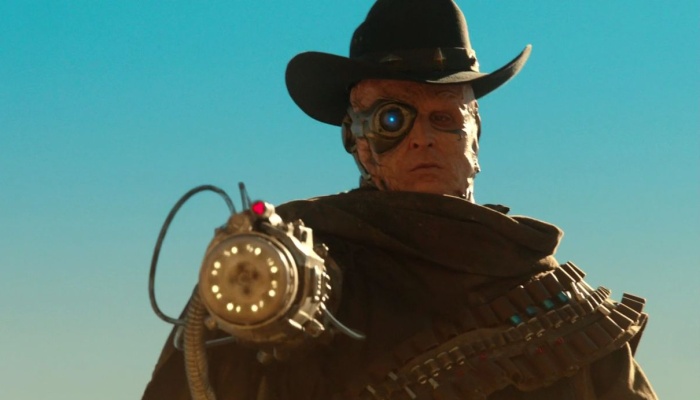
Scientist Kahler-Jex is working in a lab, announcing that “Subject 6”, Kahler-Tek, has been activated. The cyborg raises up his arm weapon and a light emanates from it.

A Town Called Mercy

Against the backdrop of a starry night desert, a narrator with an American western accent narrates a story her great-grandmother told her when she was a girl. It is a story about a man who fell from the stars and was weighed down by the things he had seen.

The Kahler-Tek cyborg shoots down a probe in the desert, then takes aim on an injured man. The man comes from the same place as the cyborg gunslinger. He attempts a last stand and fails, but before he dies, he asks if he is the last one. The cyborg replies that there is one more: “the doctor”.

In the daylight, the Doctor, Amy, and Rory stand outside a perimeter of stones and wood that surrounds the town of Mercy, population 81. They cross the barrier and stroll down the main street. The Doctor notes that the town has electricity, something that is ten years too early for this time. The Doctor is intrigued by the town and heads for the saloon. When he introduces himself, he is promptly measured for a casket by the undertaker.

After he admits to being an alien, he is forcibly removed and thrown over the barrier. The townsfolk all draw their sidearms as the gunslinger approaches the Doctor. As the preacher says the Lord’s Prayer, Isaac, the town marshal, interrupts the festivities and brings the Doctor back across the line.

Turns out that this ain’t the right doctor.

Isaac explains that the gunslinger showed up about three weeks earlier and built the barrier to keep the people of Mercy imprisoned. All he wants is the alien doctor. The Doctor stares at the lights and comes to a conclusion: The marshal’s office is the safest place to be if the townspeople wanted to hand over the doctor.

Sure enough, the right doctor is in the jail cell. His name is Kahler-Jex.

The Doctor is over the moon. The Kahler are one of the most ingenious species in the universe. Jex explains that his ship crashed in the desert and the people of Mercy rescued him. He saved the town from cholera and provided them with electricity, and Isaac defends him since Mercy is a town of second chances. Without Jex, Isaac fears that the town would fall into chaos.

The Doctor decides to use the TARDIS to help Jex escape and evacuate the town. To do that, they must engage in a little sleight of hand to get past the Gunslinger. Isaac (dressed as Jex) and Rory run through the desert in one direction while the Doctor borrows a horse — “He’s called Susan, and he wants you to respect his life choices.” — to ride out to the TARDIS. Meanwhile, Amy sits with Jex. The scientist knows that she’s a mother because of the kindness, sorrow, and love in her eyes. He goes on to say that he’s something of a father himself.

On the way to the TARDIS, the Doctor finds the power cables providing electricity from Jex’s ship. Susan reminds the Doctor that they have a mission, but the Doctor is not one to give up on a mystery. Jex notes the power fluctuations in town and Amy laments the Doctor’s failure to follow a basic plan.

The gunslinger catches up to Issac and Rory after using infrared scanning. When the Doctor scans the ship, it sets off an alarm that distracts the cyborg and draws him away. The Doctor overrides the self-destruct system before finding the personal files detailing Kahler-Jex’s brutal experiments. The gunslinger finds the Doctor and explains that he wants justice. He promises to kill the next person who leaves town.

In town, Jex turns on Amy and uses her as a human shield. The gunslinger will refrain from taking innocent lives unless it is necessary. Luckily, he is stopped by Isaac.

The Doctor confronts Jex over the atrocities he witnessed, barely restraining his rage. He explains Jex’s experiments to Isaac and the Ponds. Jex further explains that he saved millions by sacrificing the few as cyborgs. After the war, they were supposed to be decommissioned, but one escaped and took revenge on those who created him. Jex is the last survivor.

Jex also draws a parallel between himself and the Doctor, forcing the raging Doctor to usher the scientist to the edge of town. The Doctor holds Jex at gunpoint as Amy protests his actions. The Doctor wants to honor the victims, including those who died as a result of his mercy, and Amy points out that this is why he cannot travel alone. The Doctor finally agrees that prosecution outweighs vengeance.

The gunslinger finds Jex and nearly kills him, but Isaac takes the fatal shot instead. With his dying breath, he transfers control of the town to the Doctor, who in turn appoints Amy as his deputy after placing Jex into custody.

The gunslinger gives the town of Mercy an ultimatum: Surrender Jex by noon the next day or he kills everyone in town. Later that night, the preacher stops by to invite the Doctor outside, stopping long enough to warn him that he should be armed. A mob of townsfolk want to take Jex to the gunslinger to protect themselves, but the Doctor cannot do that. The Doctor wonders if the mob leader, a man of barely 18 years, has the courage to pull the trigger. Turns out that he doesn’t, and the situation is defused for now.

The Doctor returns to talk with Jex. The scientist suggests that he be turned over to Tek, but the Doctor is firm in his resolve. It would be easier if Jex was only one thing — mad scientist or benevolent doctor — instead of both, and the Doctor reminds him that Jex doesn’t get to decide how his debt is repaid. Jex explains that he fears death. Kahler religion dictates that the dead must climb a mountain, carrying the souls of all those whom they wronged in life. Isaac will be added to Jex’s load, and the the Doctor sympathises.

But, he also has a plan.

Come noon, the Doctor waits for the gunslinger. Instead of a firearm, he wields his sonic screwdriver, producing a high-pitched frequency that shatters glass and disorients the cyborg. The Doctor runs as the gunslinger fires wildly, taking refuge as the townspeople run about Mercy with simlar marks on their faces to Jex’s own.

The gunslinger searches the town, eventually breaking into the church and frightening the women and children. The Doctor urges Jex to run into the desert in order to save the townsfolk. Meanwhile, the gunslinger switches to manual targeting and locates the Doctor.

Jex reaches his ship and pages Tek, sympathizing about their mutual status as monsters. Jex knows that if he runs, he’ll only place another group of people in danger. Instead, he arms the self-destruct and sacrifices himself, completing Tek’s mission and atoning for his own crimes. The gunslinger sees this as honorable.

Because the Gunslinger sees himself as nothing more than a weapon of war, he prepares to self-destruct a safe distance in the desert. The Doctor changes his mind by telling him that while he may have built as a weapon of war, he can now protect the peace instead.

Later on, the Doctor brings the TARDIS to Mercy to collect all of the anachronistic technology. As the Doctor leaves to take Amy and Rory home, the little girl from the church walks into the desert to gaze upon the gunslinger. She’s the narrator from the introduction, and he is now the town marshal, protecting her and everyone who calls Mercy home.


As the first western-themed story since The Gunfighters, this was a good adventure. I enjoyed the redemption story for Jex and the turn from assassin to guardian for Tek. War creates consequences, most times unintended, and here we explore how those propagate, fester, and hurt the innocent.

The Doctor knows this all too well.

As a big Farscape and Stargate fan, I was overjoyed to see Ben Browder join the Doctor Who family. He nails the role of Isaac and I really wish we could have seen more of him in the future. Perhaps he can return in a different role?

Finally, it was fun to see Matt Smith in a Stetson again. That man looks good in the brand.

Rating: 4/5 – “Would you care for a jelly baby?”


UP NEXT – Doctor Who: The Power of Three

cc-break

The Timestamps Project is an adventure through the televised universe of Doctor Who, story by story, from the beginning of the franchise. For more reviews like this one, please visit the project’s page at Creative Criticality.

Timestamp #236: Dinosaurs on a Spaceship

Doctor Who: Dinosaurs on a Spaceship
(1 episode, s07e02, 2012)

Timestamp 236 Dinosaurs on a Spaceship

Sailing the stars Jurassic-style.

The Doctor did a good thing and saved 1334 BC Egypt from a swarm of locusts. On his way back to the TARDIS, he’s intercepted by Queen Nefertiti who wants to thank him properly for his services… if you know what she means.

Her efforts are interrupted by a message on the psychic paper from the Indian Space Agency. He’s forced to take “Nefi” with him because she forces her way onto the TARDIS, and once he arrives in the 24th century, he’s informed of a non-communicative spaceship approaching Earth. If it gets within ten thousand kilometers – the edge of the Earth’s exosphere – the Indian Space Agency will start shooting missiles.

The Doctor decides that he needs some additional help, so he jets off to Africa in 1902 to convince game hunter John Riddell to join the fun. He then travels to 21st century London. There, Rory and his father Brian are changing a lightbulb. Amy finds things amusing until the Doctor arrives, materializing around the three and immediately setting course for the 24th century.

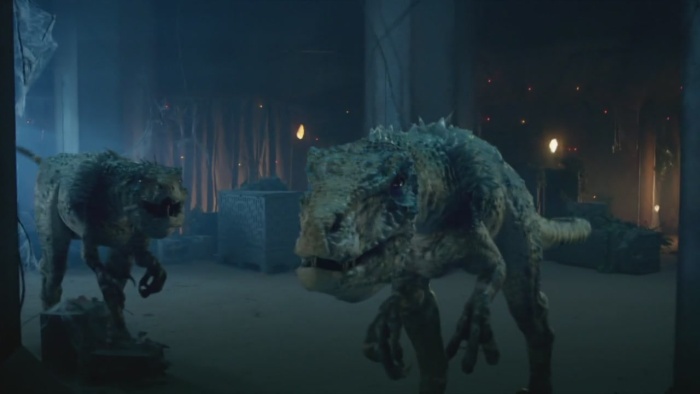
Brian is shell-shocked and the Doctor is confused, but soon enough everything is set in motion as the crew starts exploring amidst the pounding noises around them. When they reach a lift, the doors open to reveal a pair of dinosaurs.

On a spaceship.

*ding* There’s the title!

The group runs for cover from the Ankylosauruses. Riddell claims that he can take one of them alone with his knife, but the Doctor is intrigued by the discovery and wants to preserve them. They find an interactive monitor and the Doctor starts mapping the ship. When he asks for a path to the engines, he, Rory, and Brian are teleported to a foggy beach. Brian loses his mind as he tries to process what’s going on.

The Doctor tastes the air and determines that they are on Earth… sort of. The air is slightly wrong, the ground is humming, and Brian discovers a metal deck under the sand. As Rory calls for the Doctor to show him what they found, a mysterious watcher orders someone to bring the Doctor to him.

Amy, Nefi, and Riddell continue to explore the ship, literally stumbling into a Tyrannosaur nest. Luckily, the tyrant lizard is fast asleep. The trio continues on.

The Doctor finds another monitor and learns that the beach is the engine room. In fact, propulsion and energy are maintained by the waves. The Doctor’s excitement is cut short by the arrival of a flock of pterodactyls. The trio rush for a cave, avoiding the snapping beaks but running right into a pair of stomping robots.

Amy’s team find another monitor and review the ship’s logs. Amy finds out that the ship is Silurian and was a form of ark that was launched when the Silurians feared a cataclysm when the Earth aligned with the Moon. Between the time of launch and now, the population has drastically decreased. Also, the ship has been boarded before.

The Doctor’s team and the accompanying robots run into a triceratops that acts like a puppy, licking Brian’s face and playing fetch with a golf ball. The group is taken to Solomon, a man listening to Fantasia in F minor by Franz Schubert as he tries to recover from a raptor attack. Solomon has mistaken the Time Lord for an actual medical doctor, which isn’t that far from the truth. When the Doctor offers assistance in exchange for information about Solomon’s arrival, the wounded man orders the robots to shoot Brian. The Doctor works on Solomon while Rory tends to his father’s burn, and Brian is surprised that Rory keeps a medical supply pack with him. It’s a family habit to carry tools around, as evidenced by Brian’s convenient trowel.

Amy calls Rory via mobile phone – the TARDIS superphone returns! – to tell him about the Silurians. Meanwhile, the Doctor finds out that Solomon is a trader and is interested in selling the dinosaurs as precious cargo. He is intrigued in how the Doctor doesn’t exist in his database. Solomon explains that the Silurians rescued the trader, and in return he ejected them from their own ship. Unfortunately, Solomon couldn’t control the ship so it automatically set course for Earth.

The Doctor gathers Rory and Brian, set on making sure that Solomon does not control the ark of the Silurians. The trio hops aboard the triceratops – which the Doctor has named Tricey – and they escape from the robots as the dinosaur chases the golf ball down the passageway. When Tricey catches the ball, she bucks her passengers off and sits patiently.

The Indian Space Agency calls the Doctor, warning him that the ship has entered the atmosphere and they have no choice but to open fire. Meanwhile, Amy’s team finds some stun rifles. As Nefi learns that the Doctor is married, Amy watches the Doctor over the security feeds as he tries to figure out how to stop the missiles.

Solomon catches up to the Doctor and makes him an offer: He’ll let everyone go if he surrenders Queen Nefertiti. The Doctor refuses, so Solomon shows that he’s serious by murdering Tricey. Amy’s team uses the teleporter to reach the Doctor, and Nefertiti offers herself willingly. Solomon transports himself, Nefi, and the robots back to his ship.

The Doctor takes everyone else to the control room, explaining that Solomon couldn’t control the ship because the Silurians designed it to require two pilots who share similar DNA. The Doctor magnetically locks Solomon’s ship to the ark as Brian offers to pilot the ship with Rory. The Doctor explains how to control the ship while Riddell stands guard against the roving velociraptors.

The Doctor works on the wiring, chatting with Amy while he works. Amy expresses her fear that his visits are becoming farther and farther apart. One day, he might never show up. The Doctor comforts Amy by explaining that he’ll always come to see them. As the Doctor teleports to Solomon’s ship, Amy joins Riddell on guard duty and fends off the velociraptors.

The Indian Space Agency notes that the ark has changed course, but they still maintain their missile lock.

The Doctor arrives on Solomon’s ship and disables the robots as Nefertiti disables Solomon. The Doctor leaves a green tracking orb on the ship’s bridge and releases the magnetic lock, teleporting back to the ark as the missiles destroy Solomon’s craft.

With the ark back on course for deep space, the Doctor offers to take everyone on an adventure, but Rory suggests that he take everyone home. Before they do, Brian asks for one favor: As the TARDIS orbits the Earth, he sits on the edge of the doorway and sips coffee while staring at his homeworld.

Riddell returns home, though he is now joined by Nefertiti. The Ponds return home as well, but they keep receiving postcards from Brian. It turns out that Rory’s dad – a man who used to be afraid of traveling – has gone traveling with the Doctor, including to Siluria, the new home of the dinosaurs.


David Bradley does his best evil in this story. I mean, it was deliciously evil. He was previously the voice of Shansheeth in Death of the Doctor, and (spoilers) he’ll eventually follow Colin Baker’s and Peter Capaldi’s lead by playing an incarnation of the Doctor after previously holding a role on the show. His demise did strike me as especially brutal: The Doctor literally set him up to die, which differs from the typical tactic of allowing the foe to set themselves up.

Sometimes this particular incarnation scares me.

Brian Williams is so much fun as well, paving a narrative path for Rory to become the only person to travel in the TARDIS with both a parent and a child (though not at the same time). Brian’s excitement nearly leapt off the screen as he tried to figure out what was going on around him and how best to help. His travels at the end of the story made me smile wide.

This story was a great follow-on from Doctor Who and the Silurians, which previously showed us the relationship between the Silurians and dinosaurs. At that time, the Silurians were using a dinosaur to guard their base. It also echoes back to previous stories about arks (The ArkThe Ark in Space), Invasion of the Dinosaurs (wherein the Third Doctor also prioritized preservation of the dinosaurs), and the literal extinction-level event for the dinosaurs (Earthshock).

How many more times can I say dinosaur? I’ll save the most moving instance – the most traumatic, especially as a dog owner – for last. Tricey’s demise was heartbreaking. It serves as a fantastic testament to the writer and production staff since it solidifies Solomon’s despicable nature and makes me stand in awe because I fell in love with a computer-generated dinosaur in a handful of minutes.

That writer, by the way? Chris Chibnall.

Rating: 5/5 – “Fantastic!”


UP NEXT – Doctor Who: A Town Called Mercy

cc-break

The Timestamps Project is an adventure through the televised universe of Doctor Who, story by story, from the beginning of the franchise. For more reviews like this one, please visit the project’s page at Creative Criticality.

Timestamp #235: Asylum of the Daleks

Doctor Who: Asylum of the Daleks
(1 episode, s07e01, 2012)

Timestamp 235 Asylum of the Daleks

Eggs… Eggs… Eggs…

Prequel

The Doctor is enjoying an afternoon tea with scones, cream, and jam when he interrupted by a mysterious hooded figure staring at him. When he looks away, the figure is suddenly sitting at his table.

The hooded figure says that a woman wants to meet him, and when the Doctor tries to brush the figure off, he waves his hand and makes the tea room empty. Everyone is gone.

The Doctor is intrigued, but he can’t get much more from the mysterious figure than a name: Darla von Karlsen. The Doctor says he never heard of her and stands to leave, but he’s instantly in a dark room. The message is a psychic projection. The room is familiar, forcing the Doctor to try waking up. He ends up in a chair on a beach, but the figure tells him that it’s still a dream.

They end up in space. The figure gives him space-time coordinates and explains that Darla wants help saving her daughter. The Doctor is visibly shaken by the coordinates, but refuses to say the name associated with them. The figure pushes until the Doctor wakes up in the console room of the TARDIS. There he whispers the name…

Skaro.

Asylum of the Daleks

On Skaro, the Doctor meets with Darla von Karlsen in the eye of a giant Dalek statue. Darla doesn’t say who told her of the Doctor. She’s also cagey about how she escaped a Dalek prison camp because no one escapes from Dalek prison camps. She’s cold to the touch and the Doctor knows that this is a trap. Sure enough, an eyestalk emerges from Darla’s forehead and a gunstick from her palm. She blasts the Doctor and a Dalek saucer swoops into to take him prisoner.

We then see Amy Pond, supermodel, who refuses a call from her husband because she “no longer has one.” Rory has brought divorce papers to her dressing area and she signs them, only expressing regret when he leaves without a word.

In short order, both Amy and Rory are taken prisoner by the Daleks. They awaken in a cell with a view of Dalek saucers and are soon greeted by the Doctor and his Dalek escorts. Together, they are all taken to a vast circular auditorium filled with Daleks. This is the Parliament of the Daleks.

In view of the captured TARDIS, the Doctor spreads his arms wide, ready to be exterminated. It is Christmas for the Daleks… their greatest wish come true. Except they stun their prisoners with two simple words.

“Save us.”

After a new title sequence, we meet Oswin Oswald. It’s Day 363 of her confinement in a mysterious place besieged by Daleks and she’s having trouble with soufflés.

Back in the Parliament, the Doctor assesses the Daleks and the Ponds and Amy narrates his thought process. When they arrive at the destination, a Dalek in a transparent tube asks the Doctor about the Dalek Asylum. It is a place where outcast Daleks – the insane, the battle-scarred, and the uncontrollable – are exiled. They aren’t killed because the destruction of “Divine Hatred” is offensive to the Daleks, so the outcasts are sent to this automated planet surrounded by an impenetrable shield.

But the Daleks have detected a signal of unknown origin on the planet. Of course, they never considered tracing it to the source, but the signal is “L’amour est un oiseau rebelle” – an aria from Carmen in which the Doctor played the triangle – and it is coming from Oswin’s tiny apartment. Which, in reality, is the remnants of the crashed starliner Alaska upon which she served.

The Daleks plan to send their predator, the Doctor, to the surface to deactivate the planetary shield (which, conveniently, can only be done from the surface) so they can destroy the Oswin’s signal at the source. They send him and his companions on a gravity beam where they are promptly separated.

Amy awakens on a snowy mountainside next to a man named Harvey. She runs off in search of the Doctor and Rory. The Doctor comes to next to a Dalek eye stalk which is linked to Oswin (“soufflé girl”) because she found it easy to hack. Amy and Harvey find the Doctor and search for Rory, leading them to a giant hole in the ground. Rory wakes up inside that hole surrounded by dormant Dalek shells.

Harvey leads the Doctor and Amy to one of the Alaska‘s escape pods. Harvey claims that he’s been on planet for days, but that doesn’t mesh with Oswin’s story. In fact, all of Harvey’s crewmates are long dead. Harvey then remembers that he died out in the snow and that the planet’s nano-cloud transformed him into one of the Dalek puppets like the ones that trapped the Doctor and the Ponds.

The only thing stopping the travelers from transforming is the bracelets that the Daleks provided them.

Unfortunately, the cloud also transforms the dead so now we have Dalek zombies. Joy.

The Doctor and Amy take refuge from the Dalek puppets in the escape pod’s cockpit. Oswin engineers an escape path for them while the Doctor starts working on Amy’s marital problems. Before they descend into the mountain, they realize that the zombies have stolen Amy’s wristband so she’s now vulnerable to the nano particles.

Underground, Rory inadvertantly awakens the dormant Daleks who immediately focus on exterminating the intruder. Oswin opens a door for him and, after he escapes, makes introductions by flirting.

As the Doctor and Amy descend, he explains that the nanocloud will slowly reprogram Amy’s mind. In fact, it’s already started since they’ve repeated the same discussion four times. He encourages her to embrace her fear of what’s happening because Daleks don’t feel fear. Oswin coordinates with the Doctor to reunite him with Rory, but that means leaving Amy for a moment. That presents a moment for Amy to interact with what she things are people but are really the Daleks that Rory faced. Thankfully, they’re decayed enough that they cannot give chase for long. Unfortunately, they can still activate self-destruct.

The Doctor is able to override a Dalek’s motivators and send it back into the chamber with the others. The self-destruct eliminates all of them and the travelers are reunited. The Doctor has a brief conversation with Oswin, musing about how she was able to survive a year alone and where she gets milk for her soufflés.

The Doctor lays out four goals: Neutralize all of the Daleks in the Asylum, rescue Oswin, escape from the planet, and fix the Pond marriage. Luckily they are standing on a teleport pad, so they need to lower the planetary shield and beam out very rapidly. Oswin sends a map of her location to the Doctor, so the Doctor tasks Amy and Rory with keeping Amy from becoming a Dalek while he’s gone.

Rory assumes that he can give Amy his wristband because the transformation will be slower for him. Since the nanocloud transforms love into hate, he would last longer because he always loved her more than she loved him. After all, he spent 2000 years protecting her inside the Pandorica as an Auton. They argue, uncovering that the focal point of their conflict is children. The conflict at Demons Run left Amy sterile: Rory thought Amy kicked him out after deciding she didn’t love him, but she knew that he had always wanted children so she “gave him up” to give him a chance with someone else.

They then realize the Doctor put his bracelet on Amy while she was sleeping. Amy muses that he probably doesn’t need it and he used it to trick them into working out their relationship problems.

The Doctor reaches the Intensive Care area, the home for Daleks defeated in particular battles, all of which occurred during the Doctor’s first, second, and third incarnations. Once he realizes this, the Daleks revive and corner him. Oswin hacks into the Dalek Pathweb and erases all data on him, effectively making them forget the Doctor. The deranged Daleks quietly go back to their cells.

Oswin opens the door and invites the Doctor in, but he hesitates when he sees Oswin’s true form. She dreamed up her situation because the reality was too terrible. She was in the cockpit of the escape pod and climbed down the same ladder that the Doctor and Amy used. The Daleks need her genius, so they converted her in full.

Oswin Oswald is now a full Dalek.

The truth is indeed too much to bear. She asks why the Daleks hate the Doctor. He tells her that he beats them everytime. She says that the Daleks grow stronger in spite of him… because of their fear of him. She tells him to run – “Run, you clever boy, and remember.” – and lowers the planetary shield, ready to die as a human at heart.

The Doctor reaches the Ponds and teleports them to the Dalek Parliament ship just as the Daleks destroy the Asylum. Unfortunately for the Daleks, the Doctor has really good aim with a teleporter. Fortunately, for the Doctor, the Daleks have no idea who he is, so he escapes in the TARDIS as the Daleks scream “Doctor WHO!?” over and over again.

The Doctor drops the Ponds at their doorstep, leaving Rory overjoyed that Amy has welcomed him home. The Doctor flies on, reveling in his new anonymity, as he looks forward to the next adventure.


This story presents a good payoff for the previous season’s shenanigans, offering the “what happens next” scenario for the traumas that our main characters faced with the Silence. It also pays off Pond Life to a degree, answering the question of the rift in the Pond household.

Of course, Amy’s relationship problems still center on a lack of communication and unilateral decision making. It’s been a common theme for her: Despite loving Rory, of which I have no doubt, she still treats him poorly and doesn’t communicate with him until she’s forced to.

I did enjoy the visuals on the Asylum, particularly how the construction was much like the city from The Daleks. The Intensive Care Unit also offers a few nods to history, including SpiridonKembelAridiusVulcan, and Exxilon. The Daleks have asked for help before, leading us back to The Evil of the Daleks.

I’d also be remiss if I didn’t mention the Parliament of the Daleks, which offered a smorgasbord of Dalek history, including:

Really, all we’re missing are the Imperial Daleks from Revelation of the Daleks and/or Resurrection of the Daleks, the disc-backed units in silver-and-black-striped livery from The Dalek Invasion of Earth, the gold-ringed versions from The Chase, the gold units from Day of the Daleks and Frontier in Space, the Supreme Council Dalek from Planet of the Daleks, the “Skittles” units from Victory of the Daleks, the Supreme Red from The Stolen Earth, and (why not?) the variety of unofficial models from both Dr. Who and the Daleks and Daleks’ Invasion Earth: 2150 A.D.

That bit of fun aside, this story also ends on quite the question for the Daleks to ask. It’s a great place to leave everything as the Doctor’s biggest enemy can’t even remember their supreme rival’s name.

Rating: 5/5 – “Fantastic!”


UP NEXT – Doctor Who: Dinosaurs on a Spaceship

cc-break

The Timestamps Project is an adventure through the televised universe of Doctor Who, story by story, from the beginning of the franchise. For more reviews like this one, please visit the project’s page at Creative Criticality.

Timestamp #234: Good as Gold & Pond Life

Doctor Who: Good as Gold
Doctor Who: Pond Life
(6 episodes, pre-Series 7 Specials, 2012)

Timestamp 234 Pond Life

Catching up with the Ponds.

Good as Gold

The Doctor and Amy are traveling in the TARDIS. Amy notes that the Intrepid Universe Traveler Handbook says they need to have at least one adventure per week, so the Doctor turns on the “Adventure Setting” for the TARDIS. In short order, the Cloister Bell sounds and the TARDIS crashes.

After the crash, an athlete runs through the door holding the Olympic Torch. They’ve landed in the middle of the Olympic running track, but it’s a good thing since the athlete was being pursued by a Weeping Angel. The Angel wants to steal the Olympic flame and destroy the Pride of the Olympics, so the Doctor points his sonic screwdriver at the torch and fractures the Angel.

The athlete grabs the torch before it hits the floor, then thanks the Doctor for his assistance by giving him a gold medal before running on to light the 2012 Olympic flame. As the Doctor prepares for the next adventure, the Weeping Angel reappears in the doorway. It is cracked and missing the arm that touched the torch, but it is still inside the TARDIS… a story fragment to probably never be resolved.

Pond Life: April 2012

The Doctor leaves a message on Amy and Rory’s answering machine about his recent adventures. He has fled Sontarans by surfing the firefalls on Florinall 9, had a risqué meeting with Mata Hari in Paris while roasting crumpets, sung the backups for an album, and crashed into ancient Greece due to a fault in the helmic regulator.

It seems that the TARDIS was hit by an arrow at the Battle of Hastings.

Pond Life: May 2012

The Doctor bursts into the Ponds’ house while they sleep. The world is endangered and the Ponds need to save the world! Except that it is the wrong time for them – helmic regulator! – so everything is fine. He wishes them a good night and leaves to find the right Ponds, leaving Rory to remark about how much he hates it when the Doctor does that.

Pond Life: June 2012

Rory steps into the bathroom only to be startled by the unexpected. While Rory collects himself, Amy checks things out. She finds an Ood on the loo who asks, “May I be of any assistance?”

Pond Life: July 2012

The Ood is no longer on the loo, but instead is acting as a butler for Amy and Rory by cleaning their windows, making food, and doing the wash. The Doctor explains that he rescued the Ood from the Androvax conflict and is planning on returning it to the Ood Sphere. Unfortunately, he misplaced the Ood on his last visit but plans to pick him up tonight.

Whenever that is.

Pond Life: August 2012

The Doctor has returned the Ood to the Ood Sphere. While changing the TARDIS light bulb, he recounts his recent adventures on the Ponds’ answering machine, including riding a horse through 11th Century Conventry, having invented pasta, and visiting their home (except that they were out).

He hopes that everything is okay, but he’s unaware that Rory stormed out of the house during a fight with Amy. He decides to delete the message just before Amy returns home. She checks the empty recording, then looks into the distance with a wish on her lips.

“We need you, raggedy man. I need you.”


Good as Gold written by The Children of Ashdene School in the same spirit as Death is the Only Answer. It also links back to the Olympic moments of Fear Her and provides a potential crossing of the Doctor’s timeline.

Good as Gold joins Pond Life to provide some fun filler while the show was away for nine months between the 2011 Christmas Special and the Series 7 premiere, but ultimately they are an average prologue to pass the time.

Even if they did give us “Ood on the loo.”

Rating: 3/5 – “Reverse the polarity of the neutron flow.”


UP NEXT – Doctor Who: Asylum of the Daleks

cc-break

The Timestamps Project is an adventure through the televised universe of Doctor Who, story by story, from the beginning of the franchise. For more reviews like this one, please visit the project’s page at Creative Criticality.