The Thing About Today – April 14

April 14, 2020
Day 105 of 366


April 14th is the 105th day of the year. It would be the first day of Takayama Spring Festival in Takayama, Gifu, Japan.

In the United States, today is “celebrated” as National Dolphin Day, National Ex Spouse Day, National Gardening Day, National Pecan Day, National Reach as High as You Can Day, and Look up at the Sky Day.


Historical items of note:

  • In 43 BC, the Battle of Forum Gallorum occurred. Mark Antony, besieging Caesar’s assassin Decimus Brutus in Mutina, defeated the forces of the consul Pansa. He was then immediately defeated by the army of the other consul, Aulus Hirtius.
  • In 1561, a celestial phenomenon was reported over Nuremberg. It was described as an aerial battle.
  • In 1775, the first abolition society in North America was established. The Society for the Relief of Free Negroes Unlawfully Held in Bondage was organized in Philadelphia, Pennsylvania by Benjamin Franklin and Benjamin Rush.
  • In 1828, Noah Webster copyrighted the first edition of his dictionary.
  • In 1865, United States President Abraham Lincoln was shot in Ford’s Theatre by John Wilkes Booth. He died from his wounds the next day.
  • In 1894, the first-ever commercial motion picture house was opened in New York City using ten Kinetoscopes, a device for peep-show viewing of films.
  • In 1902, James Cash Penney opened his first store in Kemmerer, Wyoming.
  • In 1912, the British passenger liner RMS Titanic struck an iceberg in the North Atlantic. It sank overnight.
  • In 1929, television producer Gerry Anderson was born.
  • In 1939, The Grapes of Wrath, written by John Steinbeck, was first published.
  • In 1949, actor John Shea was born.
  • In 1958, the Soviet satellite Sputnik 2 fell from orbit after 162 days. It was the first spacecraft to carry a living animal, a dog named Laika, but she did not survive the journey.
  • Also in 1958, actor Peter Capaldi was born. He portrayed the Twelfth Doctor in Doctor Who.
  • In 1961, actor Robert Carlyle was born.
  • In 1968, actor Anthony Michael Hall was born.
  • In 1977, actress and producer Sarah Michelle Gellar was born.
  • In 1996, actress Abigal Breslin was born.
  • In 2003, the Human Genome Project was completed with 99% of the human genome sequenced to an accuracy of 99.99%.


April 14th is observed as Pan American Day, a holiday that commemorates the First International Conference of American States. That conference concluded on April 14, 1890, and created the International Union of American Republics, the forerunner to the Organization of American States (OAS). The OAS works toward solidarity and cooperation among states in the Western Hemisphere.

Inspired by the idea of a Panamerica, United States Secretary of State James G. Blane first developed the concept of an International Conference for the Western Hemisphere. The idea took nearly a decade to bear fruit, but the resulting conference covered a large variety of subjects from currency and banking to military and trade.

In 1931, President Herbert Hoover declared the first official National Pan American Day to be observed on April 14th. Before that proclamation, Pan American Day celebrations took place on various days throughout the year and across the country, including cultural events and festivals celebrating the Western Hemisphere and the whole of the North and South American continents.


The Thing About Today is an effort to look at each day of 2020 with respect to its historical context.

For more creativity with a critical eye, visit Creative Criticality.


The Thing About Today – April 13

April 13, 2020
Day 104 of 366


April 13th is the 104th day of the year. It is Teacher’s Day in Ecuador.

In the United States, today is “celebrated” as National Make Lunch Count Day, National Peach Cobbler Day, and National Scrabble Day.


Historical items of note:

  • In 1743, United States Founding Father Thomas Jefferson was born. He was the third President of the United States.
  • In 1870, the New York City Metropolitan Museum of Art was founded.
  • In 1892, Robert Watson-Watt was born. He was the Scottish engineer who invented radar.
  • In 1906, Samuel Beckett was born. He was an Irish novelist, poet, playwright, and Nobel Prize laureate.
  • In 1935, actor Lyle Waggoner was born.
  • In 1942, composer and conductor Bill Conti was born.
  • In 1943, the discovery of mass graves of Polish prisoners of war killed by Soviet forces in the Katyń Forest Massacre during World War II was announced. This caused a diplomatic rift between the Polish government-in-exile in London from the Soviet Union, which denied responsibility.
  • Also in 1943, the Jefferson Memorial was dedicated in Washington, D.C., on the 200th anniversary of President Thomas Jefferson’s birth.
  • In 1950, actor Ron Perlman was born.
  • In 1951, actor Peter Davison was born. He portrayed the Fifth Doctor in Doctor Who.
  • In 1953, Central Intelligence Agency director Allen Dulles launched the mind-control program Project MKUltra.
  • In 1960, the United States launched Transit 1-B, the world’s first satellite navigation system.
  • In 1964, at the Academy Awards, Sidney Poitier became the first African-American male to win the Best Actor award for the 1963 film Lilies of the Field.
  • In 1970, an oxygen tank aboard the Apollo 13 Service Module exploded, putting the crew in great danger and causing major damage to the Apollo command and service module Odyssey while en route to the Moon.
  • In 1972, the Battle of An Lộc began during the Vietnam War. The battle lasted 66 days.
  • In 1976, the United States Treasury Department reintroduced the two-dollar bill as a Federal Reserve Note on Thomas Jefferson’s 233rd birthday as part of the United States Bicentennial celebration.
  • In 1997, Tiger Woods became the youngest golfer to win the Masters Tournament.


In 1742, George Frideric Handel’s oratorio Messiah made its world-premiere in Dublin, Ireland.

Messiah (HWV 56) is an English-language oratorio with a scriptural text compiled by Charles Jennens from the King James Bible and the Coverdale Psalter, the version of the Psalms included with the Book of Common Prayer.

The text is an extended reflection on Jesus as the Messiah called Christ. Part I begins with prophecies by Isaiah and others before moving to the annunciation to the shepherds, the only “scene” taken from the Gospels. Part II concentrates on the Passion and ends with the “Hallelujah” chorus. Part III covers the resurrection of the dead and Christ’s glorification in heaven.

The initial composition was modest, but over time it has been adapted for larger and more powerful orchestras, particularly by Mozart.

After its Dublin premiere, it moved to London nearly a year later. The initial public reception was modest, but the oratorio gained popularity and has become one of the best-known and most frequently performed choral works in Western music.


The Thing About Today is an effort to look at each day of 2020 with respect to its historical context.

For more creativity with a critical eye, visit Creative Criticality.


The Thing About Today – April 12

April 12, 2020
Day 103 of 366


April 12th is the 103rd day of the year. It is Easter Sunday, a Christian holiday commemorating the resurrection of Jesus Christ on the third day following his crucifixion. It is the culmination of the Passion of Jesus, preceded by the 40-day Lenten period of fasting, prayer, and penance.

The holiday is also marked by the coloring and hunting of Easter eggs, the Easter Bunny, gift-giving, and biting the ears off of chocolate rabbits. It was on an Easter Sunday in the early ’90s that I received my first Star Wars novel, and my life hasn’t been the same since.

In the United States, today is “celebrated” as National For Twelves Day, National Big Wind Day, National Colorado Day, National Grilled Cheese Sandwich Day, and National Licorice Day.


Historical items of note:

  • In 1606, The Union Flag was adopted as the flag of English and Scottish ships.
  • In 1916, author Beverly Cleary was born.
  • In 1934, the strongest surface wind gust in the world (at the time) was measured at the summit of Mount Washington, New Hampshire. Wind speed was measured at 231 miles per hour, but has since been surpassed.
  • In 1936, actor Charles Napier was born.
  • In 1945, United States President Franklin D. Roosevelt died in office. Vice President Harry S. Truman became the thirty-third President of the United States upon succession.
  • In 1947, comedian and talk show host David Letterman was born.
  • In 1955, the polio vaccine, developed by Dr. Jonas Salk, was declared safe and effective.
  • In 1971, actress, director, and producer Shannen Doherty was born.
  • Also in 1971, actor Nicholas Brendon was born.
  • In 1979, actress Claire Daines was born.
  • Also in 1979, actress Jennifer Morrison was born.
  • In 1981, the first launch of the Space Shuttle Columbia occurred on mission STS-1.
  • In 1983, Harold Washington was elected as the first black mayor of Chicago.
  • In 1992, the Euro Disney Resort officially opened with its theme park Euro Disneyland. The resort and park names were later changed to Disneyland Paris.
  • In 1994, actress Saoirse Ronan was born.


In 1961, Soviet cosmonaut Yuri Gagarin became the first human to travel into outer space. He performed the first manned orbital flight, Vostok 1.

The flight consisted of a single orbit around the planet, spanning 108 minutes in total. Gagarin returned to the surface after ejecting from his capsule at 23,000 feet.

Gagarin was a Soviet Air Forces pilot who almost failed his initial flight training until his instructor provided him a cushion to help him see better from the cockpit. He expressed interest in the space program after the launch of Luna 3 in October 1959 and was selected in 1960.

In commemoration of his flight, the day is celebrated as Cosmonautics Day in Russia and as both Yuri’s Night and the International Day of Human Space Flight worldwide.


The Thing About Today is an effort to look at each day of 2020 with respect to its historical context.

For more creativity with a critical eye, visit Creative Criticality.


The Thing About Today – April 11

April 11, 2020
Day 102 of 366


April 11th is the 102nd day of the year. It is World Parkinson’s Day, observed in honor of Dr. James Parkinson, the English surgeon, apothecary, geologist, paleontologist, and political activist who first described the symptoms of Parkinson’s disease in his 1817 An Essay on the Shaking Palsy.

In the United States, today is “celebrated” as National Barber Shop Quartet Day, National Cheese Fondue Day, National Eight Track Tape Day, National Pet Day, and National Submarine Day.


Historical items of note:

  • In 1727, Johann Sebastian Bach’s St Matthew Passion BWV 244b premiered at the St. Thomas Church in Leipzig.
  • In 1755, Dr. James Parkinson was born.
  • In 1881, Spelman College was founded in Atlanta, Georgia as the Atlanta Baptist Female Seminary. It was designed as an institute of higher education for African-American women.
  • In 1940, author and screenwriter Thomas Harris was born. His most famous character is Hannibal Lecter.
  • In 1951, The Stone of Scone was found on the site of the altar of Arbroath Abbey. It was the stone upon which Scottish monarchs were traditionally crowned and had been taken by Scottish nationalist students from its place in Westminster Abbey.
  • In 1968, President Lyndon B. Johnson signed the Civil Rights Act of 1968, which prohibited discrimination in the sale, rental, and financing of housing.
  • In 1970, Apollo 13 was launched with astronauts James A. Lovell, Jr., John L. Swigert, Jr., and Fred W. Haise, Jr. aboard. It was meant to be the third manned mission to the lunar surface, but the mission was aborted when an oxygen tank in the service module failed two days into the mission.
  • In 1974, actress Tricia Helfer was born.
  • In 2012, The Avengers premiered in Los Angeles, marking a major milestone for Marvel Studios and superhero cinema.


In 1900, the United States Navy took possession of the first modern submarine, the USS Holland (SS-1).

The first military submarine of the United States fleet was the Turtle from 1775, but the Holland was the first modern commissioned submarine, purchased for $150,000. She was commissioned on October 12, 1900, with Lieutenant Harry H. Caldwell in command. She was propelled by a gasoline engine, an electric motor, and a 66-cell battery with a maximum speed of 6 knots.

The Holland was the fourth submarine to be owned by the Navy, preceded by Alligator, Intelligent Whale, and Plunger. That last one became the namesake for the second commissioned boat, USS Plunger (SS-2).

Most of Holland‘s service life was spent in experimentation and training. She was decommissioned on July 17, 1905, and sold as scrap for $100, but her legacy lives on as she started an unbroken chain of United States submarines that continues to this day. Her success was also instrumental in the founding of the Electric Boat Company, now known as the Electric Boat Division of General Dynamics Corporation.

As a result of the Navy’s purchase of the USS Holland, today is recognized as National Submarine Day by certain circles of veterans. In 1969, Senator Thomas J. Dodd of Connecticut introduced a bill to designate April 11th as National Submarine Day, but no record of a proclamation from President Richard Nixon has been found.


The Thing About Today is an effort to look at each day of 2020 with respect to its historical context.

For more creativity with a critical eye, visit Creative Criticality.


Culture on My Mind – Ten Films of Vivid Memory

Culture on My Mind
Ten Films of Vivid Memory

April 10, 2020

This week’s “can’t let it go” is a Facebook meme.

Let’s face it, most of the “I’m bored so let’s make a list of things” Facebook memes are more than likely (often successful) attempts at social engineering. That data can be compiled over time by the right wrong people to hack accounts and spoof identities.

That said, one popped up on my radar courtesy of Zaki Hasan and Michael Bailey: “Saw this going around and thought it sounded fun. 10 films I vividly remember seeing in the theater pre-college.”

Since I’ve never been asked movie-specific questions as security thresholds, I feel comfortable putting mine out there for public consumption. I’m even going for a bit of extra credit because there are eleven titles encompassing ten experiences on this list.

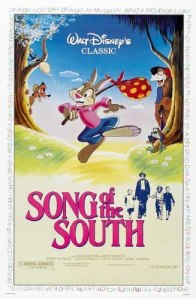
Song of the South (1946)

People consider me strangely when I mention this movie memory. My family remembered this film well, and they took me to the 1986 re-release when I was young. I have little memory of the live-action sequences, but the songs and animated vignettes have stuck with me over the years, even considering the racial insensitivity of the presentation.

The movie is based on the Uncle Remus folktales as compiled by Joel Chandler Harris in 1881. He was a journalist in post-Reconstruction Atlanta, and he wrote the stories to represent the struggle in the Southern United States. He tried to do so by framing the stories in the plantation context, but he also wrote them in a dialect which was his interpretation of Deep South African-American language of the time.

Walt Disney wanted to produce a movie based on these tales, but since its Atlanta premiere at the Fox Theater in November 1946, it has been the subject of controversy for propagating racial stereotypes and representing plantation life as idyllic and glorious. Ironically, Atlanta was still segregated at the time of premiere.

Despite its financial success, it is one film of the Disney catalog that has never received a full release in the United States due to the controversy. However, it does live on at the Disney Parks as the animated characters and their stories are showcased on Splash Mountain.

It was during the 1986 re-release, which commemorated the film’s 40th anniversary and promoted the opening of Splash Mountain, that I saw it. I do want to see it again, nearly 35 years later with the eyes of a knowledgeable adult, but the only way I’ll be able to do so is via bootleg.

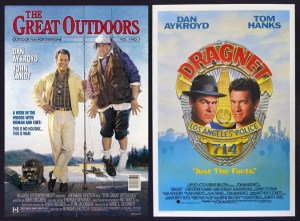
The Great Outdoors (1988) and Dragnet (1987)

My next two movie memories were a Dan Aykroyd double feature. When The Great Outdoors was released in 1988, the (now demolished) Davis Drive-In presented it alongside Dragnet.

I count this as my true introduction to comedy and satire, as well as my interest in drive-in movie theaters. My parents would often show me the pop culture of their childhoods, and the drive-in format was one such gem.

Starting just after dusk, the double feature led with The Great Outdoors, a John Hughes film about two families spending time on vacation in Wisconsin. It starred Dan Aykroyd, John Candy, Stephanie Faracy, and (in her feature film debut) Annette Bening.

From the ghost stories of a bear that was made bald by buckshot to the zany antics of both family and coming of age, this is one film memory that I cherish. The thread of sharing movie memories with my parents would come back ten years later.

The second half of the night was Dragnet, a parody and homage of the long-running police procedural series from radio and television. It starred both Aykroyd and Tom Hanks, as well as Harry Morgan and Alexandra Paul. I knew of Harry Morgan from re-runs of M*A*S*H, which was a staple in my childhood home, and the comedy stuck with me. My most vivid memory is Sgt. Friday’s foot being run over by the car, an act that my parents assured me was fake despite what the Looney Tunes cartoons said otherwise.

Jurassic Park (1993)

I didn’t go to the theater much as a kid. They were expensive trips for a family that didn’t have a lot of money, and most of the movies I saw as a kid were on television. So, it would be five years until the next movie that spurred a vivid cinematic memory, and it was a big one.

I grew up loving dinosaurs, and, behind the Star Wars trilogy, the child-centric films of Steven Spielberg were among my favorites. So it only seemed logical to see how the two would mesh.

Instead of going to the local megaplex, my parents took my sister and me to a classic theater in nearby Riverdale. The Cinedome 70 featured two domed auditoriums, both with 70-foot curved screens.

It was magnificent, from the majesty of the John Williams score to the amazing visuals and pulse-pounding drama. I lost track of time and was surprised when the credits rolled.

It was one of the first movies that prompted me to buy a special anniversary boxset. It’s one that I revisit quite often.

The Last Action Hero (1993)

In the same month as Jurassic Park, my brother invited me to join him for a small birthday celebration. It included a movie that he was very excited about: The Last Action Hero starring Arnold Schwarzenegger.

I remember this experience in disjointed images, but the particular memory that stands out is how this film broke the fourth wall in a way that I had never experienced. Basically, teenager Danny loves the Jack Slater film series, and he ends up magically transported into one of them to have a little adventure.

This is another one that I need to revisit (27 years down the road) to really appreciate, but it stands out because of the time I got to spend with my brother doing something that he enjoyed. That was a rarity of its own in my younger days.

The Three Musketeers (1993)

Given that trips to the movies were a rare treat as a kid, I was overjoyed about winning sneak preview tickets to a new action film. Our local independent television station played the Disney Afternoon lineup every day, and to drive interest in their programming, they had a “kids’ club” with giveaways and contests.

Along with a He-Man Powersword roleplay toy, some foam quarterstaffs, and a Darkwing Duck action figure – none of which do I still possess, unfortunately – I won a pair of tickets to The Three Musketeers.

Starring Charlie Sheen, Kiefer Sutherland, Chris O’Donnell, Oliver Platt, Tim Curry, and Rebecca De Mornay, much of it went over my head on first viewing. The action was fun and the wit was quick, but it took later viewings to fully enjoy the scenery-chewing skill of Tim Curry and the underlying meaning of De Mornay’s “with a flick of my wrist, I could change your religion” repartee.

There are certainly better interpretations of this work by Alexandre Dumas, but this one has a level of cheesy lightheadedness and swashbuckling derring-do that provided a suitable introduction to sword and shield fantasy-adventure.

Besides, who can forget Bryan Adams, Rod Stewart, and Sting teaming with Michael Kamen on “All For Love”? Pure ’90s cheese!

8 Seconds (1994)

When I was a boy, I had dreams of being a rodeo bull rider. My father was a bull rider and a rodeo clown, and my mother was a barrel racer, and while I was growing up, they offered professional photography for local circuits.

I grew up in the shadow of amazing athletes like Charlie Sampson (the first African American cowboy to win a World Title in professional rodeo) and Brazilian bull riding legend Ariano Morães, and I even dabbled in the sport myself. I even had my own riding rope which I used on several occasions.

When 8 Seconds was released, my family eagerly went to the theater to see it. Starring Luke Perry, the movie is a biographical film about rodeo legend and bull riding champion Lane Frost. Frost was the 1987 World Champion of the Professional Rodeo Cowboys Association (PRCA) and the only rider to score qualified rides from the 1987 World Champion and 1990 ProRodeo Hall of Fame bull Red Rock.

He drew a Brahma bull named Takin’ Care of Business at the Cheyenne Frontier Days Rodeo in 1989. After scoring 91 points, he dismounted and landed in the dirt arena. The bull turned and hit him in the back with his horn, breaking several of his ribs and puncturing his heart and lungs. He died at the hospital at the age of 25.

The reception in our audience that night was one of respect for Frost’s legacy and a humbling of some of the younger cocky cowboys who thought themselves invincible. I personally carried that same respect and sense of caution, eventually giving up my dream after cowboys that I personally knew died doing what they loved.

The Star Wars Trilogy: Special Edition (1997)
Star Wars: Episode IV — A New Hope
Star Wars: Episode V — The Empire Strikes Back
Star Wars: Episode VI — Return of the Jedi

This one seems like a no-brainer, but it was a milestone in my life and fandom.

Like so many in my generation, I grew up on pan-and-scan VHS versions of the Star Wars trilogy. The trailer for the special edition releases tapped into the spirit of that ethos, starting with a tiny screen before showing an X-Wing blasting out of its confines to a full theatrical presentation. It was the perfect commercial to sell the idea of seeing these films again for the first time.

The opportunity to see three of my favorite and most influential movies on the big screen was too good to pass up. The Special Editions were my first experience with Star Wars in theaters. More than that, it was my opportunity to pay my parents back for introducing me to those films. I saved up the money to buy opening night tickets for each of the films for the family, and those presentations were heaven for me.

I had seen each of them on worn-out videotapes so many times, but I was enthralled in that January theater. So entranced, in fact, that when Luke fired his proton torpedoes and the Death Star exploded, I cheered. When I realized what I had just done, I found my parents staring at me with grins on their faces.

I know that they’re critiqued now for being too shiny and modernized, but the Special Editions will always hold a place in my heart.

From a certain point of view, they were my step into a much larger universe.

I have written about these films before as part of the Seven Days of Star Wars series in 2015:

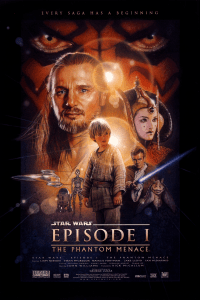
Star Wars: Episode I — The Phantom Menace (1999)

Following on the heels of the Special Editions and my love of the expanded universe of novels and comics, I was overjoyed to see new stories in the Star Wars universe.

It was once again an opening night event for the family and me, and I really enjoyed what I saw with Jedi Knights defending the Republic and paving the way for the trilogy that was a cornerstone of my childhood.

I know that others had buyer’s remorse when it came to this movie and the other two prequels, but I did not. I saw it three or four times on my limited income and found my fandom blossoming from the experience.

There are warts, to be sure, but I had a deep appreciation for what this film represented on the cusp of a new chapter in my life.

I have written about this film before as part of the Seven Days of Star Wars series in 2015: Day Four – The Phantom Menace.
cc-break

Culture on My Mind is inspired by the weekly Can’t Let It Go segment on the NPR Politics Podcast where each host brings one thing to the table that they just can’t stop thinking about.

For more creativity with a critical eye, visit Creative Criticality.

The Thing About Today – April 10

April 10, 2020
Day 101 of 366


April 10th is the 101st day of the year. It is International Siblings Day.

It is also Good Friday, a Christian holiday commemorating the crucifixion of Jesus and his death at Calvary. It is observed during Holy Week, preceding Easter Sunday, and coincides this year with Passover.

In the United States, today is “celebrated” as National Cinnamon Crescent Day, Encourage a Young Writer Day, and National Farm Animals Day.


Historical items of note:

  • In 837, Halley’s Comet made its closest approach to Earth at a distance of 3.2 million miles.
  • In 1710, the Statute of Anne, the first law regulating copyright, came into force in Great Britain.
  • In 1886, the American Society for the Prevention of Cruelty to Animals (ASPCA) was founded in New York City by Henry Bergh.
  • In 1872, the first Arbor Day was celebrated in Nebraska.
  • In 1912, RMS Titanic set sail from Southampton, England on her maiden voyage. It would also be her only voyage.
  • In 1915, actor Harry Morgan was born.
  • In 1925, The Great Gatsby by F. Scott Fitzgerald was first published in New York City.
  • In 1929, actor Max Von Sydow was born.
  • In 1954, actor Peter MacNicol was born.
  • In 1963, the nuclear submarine USS Thresher (SSN-593) was lost at sea. One hundred twenty-nine sailors were lost when key systems failed during deep-diving tests. The incident was the first loss of a nuclear submarine in history, and resulted in the development of the SUBSAFE program, a rigorous submarine safety maintenance standard.
  • In 1970, Paul McCartney announced that he was leaving The Beatles for personal and professional reasons.
  • In 1971, in an attempt to thaw relations with the United States, China hosted the United States table tennis team for a week-long visit.
  • In 1975, actor David Harbour was born.
  • In 1982, actress and singer Chyler Leigh was born.
  • In 1984, actress and singer Mandy Moore was born.
  • In 1988, actor Haley Joel Osment was born.
  • In 1992, actress Daisy Ridley was born.
  • In 1998, the Good Friday Agreement was signed in Northern Ireland. The pair of agreements ended most of the violence of the Troubles, a political conflict in Northern Ireland that had been ongoing since the 1960s.
  • In 2019, scientists from the Event Horizon Telescope project announced the first-ever image of a black hole, located in the center of the M87 galaxy.


This year, April 10th is the National Day of Silence.

National Day of Silence in April is a student-led movement to protest bullying and harassment of LGBTQIA+ students and those who support them. The observance brings awareness and illustrates to schools and colleges how intimidation, name-calling, and general bullying has a silencing effect. Participating students take a day-long vow of silence.

Bullying and harassment come in several forms, from verbal and physical to damage to property, manipulation, intimidation, and long-term micro-aggressions that build over time. Whether it comes in a physical or verbal form, both are harmful and leave lasting damage.

No matter the form, the effects on the individual and surrounding community can be destructive. It behooves us all to fight against bullying and harassment for the safety and health of our communities overall.


The Thing About Today is an effort to look at each day of 2020 with respect to its historical context.

For more creativity with a critical eye, visit Creative Criticality.


The Thing About Today – April 9

April 9, 2020
Day 100 of 366


April 9th is the 100th day of the year. It is National Former Prisoner of War Recognition Day in the United States.

In the United States, today is “celebrated” as National Cherish an Antique Day, National Chinese Almond Cookie Day, National Name Yourself Day, National Unicorn Day, National Winston Churchill Day, and National Alcohol Screening Day. The last one is typically observed on Thursday of the first full week in April.


Historical items of note:

  • In 1784, the Treaty of Paris was ratified by King George III of the Kingdom of Great Britain. It has previously been ratified by the United States Congress on January 14th, and the document formally ended the American Revolutionary War. Copies of the ratified documents would be exchanged on May 12th.
  • In 1860, Édouard-Léon Scott de Martinville made the oldest known recording of an audible human voice on his phonautograph machine.
  • In 1865, Robert E. Lee surrendered the Army of Northern Virginia (nearly 27,000 strong) to Ulysses S. Grant at Appomattox Court House, Virginia. This action effectively ended the American Civil War.
  • In 1937, Canadian screenwriter and producer Marty Krofft was born.
  • In 1945, the United States Atomic Energy Commission was formed.
  • In 1947, the Journey of Reconciliation began through the upper American South. It was the first interracial Freedom Ride and took place in violation of Jim Crow laws. The riders wanted enforcement of the United States Supreme Court’s 1946 Irene Morgan decision that banned racial segregation in interstate travel.
  • In 1959, NASA announced the selection of the United States’ first seven astronauts: Alan Shepard, Gus Grissom, Gordon Cooper, Wally Schirra, Deke Slayton, John Glenn, and Scott Carpenter. They were quickly dubbed as the “Mercury Seven”.
  • In 1979, actress Keshia Knight Pulliam was born.
  • In 1991, Georgia declared independence from the Soviet Union.


In 1939, African-American singer Marian Anderson gave a concert at the Lincoln Memorial after being denied the use of Constitution Hall by the Daughters of the American Revolution.

Anderson became an important figure in the struggle for black artists to overcome racial prejudice in the United States during the mid-twentieth century. In 1939, the Daughters of the American Revolution (DAR) refused permission for Anderson to sing to an integrated audience in Constitution Hall in Washington, DC. At the time, Washington, D.C., was a segregated city and black patrons were upset that they had to sit at the back of Constitution Hall. The venue also did not have the segregated public bathrooms required by DC law at the time for such events. The District of Columbia Board of Education also declined a request to use the auditorium of a white public high school.

The incident thrust her into the spotlight of the international community on a level unusual for a classical musician.

Charles Edward Russell, a co-founder of the National Association for the Advancement of Colored People (NAACP) and chair of the DC citywide Inter-Racial Committee, convened a meeting the next day and formed the Marian Anderson Citizens Committee (MACC) composed of several dozen organizations, church leaders and individual activists in the city. The committee elected Charles Hamilton Houston as its chairman and on February 20, the group picketed the board of education, collected signatures on petitions, and planned a mass protest at the next board of education meeting.

As a result of the ensuing furor, thousands of DAR members, including First Lady Eleanor Roosevelt, resigned from the organization. Roosevelt wrote: “I am in complete disagreement with the attitude taken in refusing Constitution Hall to a great artist … You had an opportunity to lead in an enlightened way and it seems to me that your organization has failed.”

With the aid of the First Lady and President Franklin D. Roosevelt, Anderson performed a critically acclaimed open-air concert on Easter Sunday, April 9, 1939, on the steps of the Lincoln Memorial in the capital. She sang before an integrated crowd of more than 75,000 people and a radio audience in the millions.

Two months later, in conjunction with the 30th NAACP conference in Richmond, Virginia, Eleanor Roosevelt gave a speech on national radio and presented Anderson with the 1939 Spingarn Medal for distinguished achievement.

Anderson continued to break barriers for black artists in the United States, becoming the first black person, American or otherwise, to perform at the Metropolitan Opera in New York City on January 7, 1955. Her performance as Ulrica in Giuseppe Verdi’s Un ballo in maschera at the Met was the only time she sang an opera role on stage.

She worked for several years as a delegate to the United Nations Human Rights Committee and as a “goodwill ambassadress” for the United States Department of State. She participated in the civil rights movement in the 1960s, singing at the March on Washington for Jobs and Freedom in 1963. Among her various awards and honors, she was awarded the Presidential Medal of Freedom in 1963, the Congressional Gold Medal in 1977, the Kennedy Center Honors in 1978, the National Medal of Arts in 1986, and a Grammy Lifetime Achievement Award in 1991.

She died on April 8, 1993, at the age of 96.


The Thing About Today is an effort to look at each day of 2020 with respect to its historical context.

For more creativity with a critical eye, visit Creative Criticality.


Timestamp #198: The Sontaran Stratagem and The Poison Sky

Doctor Who: The Sontaran Stratagem
Doctor Who: The Poison Sky
(2 episodes, s04e04-e05, 2008)
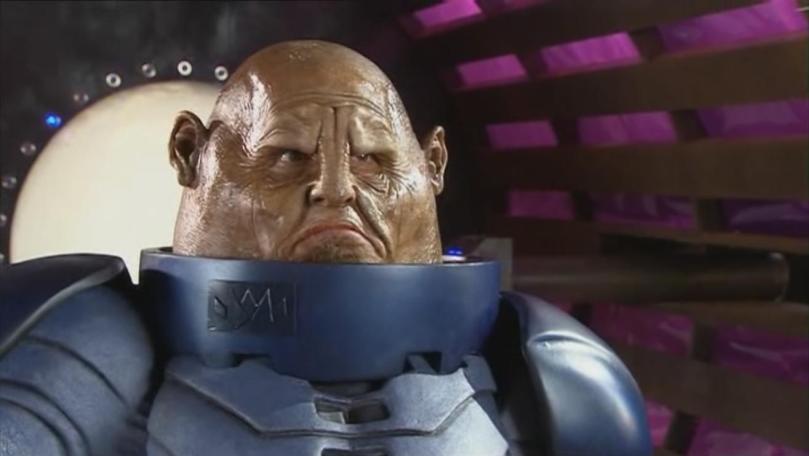
 

The Undefeated meets his match on Earth.


The Sontaran Strategem

Reporter Jo Nakashima is physically thrown out of Rattigan Academy by Luke Rattigan and his students. Jo threatens to find someone who will listen to her about the threat posed by the ATMOS system, which is installed on her car and others around the globe. As she drives to UNIT Headquarters, Rattigan recommends to a hidden boss that she be terminated.

Sure enough, the ATMOS system leads Jo to her final destination: A body of water where her sealed car drives itself into the depths.

Meanwhile, in the depths of space and time, Donna is driving the TARDIS and trying to avoid putting a dent in the 1980s. The Doctor receives a call on a special mobile phone only to find Martha Jones on the other end. She’s bringing him back to Earth.

The TARDIS materializes in an alley near Martha. The Doctor and Martha embrace each other, check in on her family, and discuss her engagement to Tom Milligan. Martha and Donna hit things off right away, and Marth introduces the Doctor to her new job at UNIT as they storm an ATMOS during Operation Blue Sky.

A familiar three-fingered figure watches the festivities from a remote location.

Martha takes the Doctor and Donna to meet her boss, Colonel Mace. Mace salutes the Doctor, impressed by what he’s read in the files of the Time Lord’s service in the ’70s – or was it the ’80s? – but Donna likens it to how the Americans run the prison at Guantanamo Bay. Mace tells the Doctor of fifty-two simultaneous deaths worldwide, all linked to ATMOS. Since UNIT can’t figure out how the system killed so many people at once, they called in their expert scientific adviser on the hunch that it might be alien tech.

In the depths of the factory, two UNIT soldiers find themselves in a restricted area. When they investigate further, they find mysterious technology and a humanoid creature in a crypt-like box. The soldiers investigate the embryonic form before being introduced to a Sontaran.

The cordolaine signal in the room renders their weapons useless. The soldiers are disabled and sent for processing. Their assailant is General Staal of the Tenth Sontaran Battle Fleet, better known as Staal the Undefeated.

Well, there’s a bit of foreshadowing if I ever saw one.

The Doctor takes the ATMOS system apart and investigates it piece by piece, impressed by Martha Jones but warning off the UNIT troops and their guns. Donna finds the HR files on ATMOS personnel sick leave, or rather specifically how none of the workers ever take time off.

While Donna and Martha look into the personnel issues, the Doctor learns about Luke Rattigan, the child prodigy developer of the ATMOS system. Martha talks to Donna about family matters and how she needs to be careful with them and her travels.

The Doctor gears up to visit Luke Rattigan, but Donna wants to go visit her family. The Doctor misunderstands, thinking that she’s leaving him forever, giving her a good laugh. As they depart with a UNIT escort named Ross Jenkins, Martha examines a factory worker named Trepper with strange results.

The UNIT soldiers, Privates Harris and Gray, are hypnotically programmed to further the Sontaran stratagem before Staal returns to his ship via transmat. Harris and Gray watch the Doctor and Donna leave before escorting Martha to what she thinks is a meeting with Colonel Mace. Instead, she’s locked away in one of the Sontaran cloning vats.

Donna returns home, thinking over her adventures so far with the Doctor, before sharing an embrace with her grandfather Wilfred. Donna tells him all about the Doctor, but she refuses to tell her mother about the experiences.

The Doctor and Jenkins arrive at Rattigan Academy, scoffing at ATMOS the whole way there. Rattigan gives them a tour, and while the Doctor is impressed at the science lab he is skeptical about the technology’s origins. He recognizes that it’s been a long time since anyone has told the boy no, but he also recognizes the teleport pod in Rattigan’s office. It takes him to the Sontaran ship and back, and he’s followed by Staal before he disables the teleport with a wave of the sonic.

Jenkins refers to the general as a baked potato in armor, but the Doctor displays the Sontaran’s weakness by ricocheting a racquetball into the armor’s probic vent. While the Doctor and Jenkins run, Skaal and Rattigan repair the teleport and return to the ship. Skaal orders Commander Skorr to begin the invasion of Earth, which involves visiting Martha Jones and the cloning vat.

Sure enough, he’s breeding a clone of Martha.

Rattigan suggests using ATMOS to kill the Doctor, and Skaal links the name to the survivor of the Last Great Time War. He relishes the thought of killing the last of the Time Lords. Sure enough, the UNIT jeep drives itself to the river, but the Doctor uses a logic trap to stop the jeep and blow the UNIT in a not-so-spectacular pop of sparks.

The Doctor finds himself on Donna’s doorstep. As he examines Donna’s car, he meets Wilf for the second time (but the first time proper) and tries to warn Martha, unknowingly calling the clone instead. Martha’s mother, Sylvia, recognizes the Doctor from Donna’s wedding as he unlocks the ATMOS unit. This triggers a Sontaran battle group to head for Earth as the travelers figure out that ATMOS means to poison everyone on Earth.

Wilf ends up locked in the car as every ATMOS vehicle starts gassing the planet. The car is sonic-proof, the planet is choking, and the Sontarans are chanting.

It’s a perfect place for a cliffhanger.


The Poison Sky

Sylvia saves Wilf using a totally low-tech option: An axe through the windshield!

UNIT is on high alert, unaware of the mole in their midst as the Martha clone accesses the NATO defense system. She transmits the information to the Sontaran ship as Donna rushes off with the Doctor and Jenkins to fight the Sontarans.

The travelers return to the UNIT mobile headquarters, and the Doctor hands Donna a key to the TARDIS as he rushes off. Donna finds fresh air in the time ship, the Doctor beckons Clone-Martha to follow him, and the mole dispatches Harris and Gray to steal the TARDIS and transmat it to the Sontaran ship.

Donna figures out her predicament as Rattigan returns to Earth and the Doctor figures out that his TARDIS has been stolen. He laments being trapped on Earth (again) before returning to the command center. The UNIT forces find the Sontaran ship and the Doctor makes contact with them. Donna rushes to the monitor, just missing Rose, to catch the transmission as the Doctor handles the Sontarans and ruffles their feathers about the war with the Rutan Host. He also sends a secret message to Donna, asking her to contact him, but she doesn’t know how yet.

She calls home instead to check in with her family. She promises that the Doctor will save them. The Doctor has his own problems as he puzzles over the gas and UNIT spools up the world’s nuclear arsenal to attack the Sontarans. Even though the nuclear missiles wouldn’t even dent the ship, they stop the launch, and the Doctor begins putting the pieces together about Martha’s identity.

The Sontarans storm the factory, killing the UNIT troops in their path including Ross Jenkins. The Doctor is downright furious and Colonel Mace finally starts listening to him. The Time Lord wishes that the Brigadier was there, but Mace states that Sir Alistair is stranded in Peru.

He’s been knighted! Good for him.

Rattigan outlines his plan to take his students off-world and restart the human race. His students are unimpressed with his plan, including his mating program, and they abandon him. He reports back to Staal and finds out that the students would have been sacrificed. Rattigan’s plan was a Sontaran ruse, and the boy returns to Earth to avoid being shot down. The Sontarans lock down the teleport system.

The Doctor borrows a mobile phone and calls Donna, calling her his secret weapon and asking her to go into the ship and re-open the teleport link. He walks her through how to disable a Sontaran with the probic vent and open the ship’s doors before he’s interrupted by Mace’s battle plan.

The Doctor heads outside with a gas mask – “Are you my mummy?” – while ignoring Mace’s briefing. He’s sure that it will not work, after all, but still marvels at the Valiant‘s arrival. After all, he remembers it from a year that never happened even if no one else does.

The UNIT “helicarrier” clears the air with its powerful turbines before attacking the factory. The UNIT troops storm the facility as the Doctor and Clone-Martha follow the signals to the cloning facility. He finds Martha’s body and reveals that he’s known about Clone-Martha all along by her off smell. He removes the memory transfer device from Martha’s head, which disables the clone, and opens communications with Donna again.

While Martha consoles her clone, the Doctor with Donna to fix the teleport. The clone tells Martha that the gas is clone feed, set to convert the planet to a massive cloning facility. Remarking on Martha’s soul brimming with life as the character’s theme takes on a military air, the clone dies.

The Doctor saves Donna by teleporting her and the TARDIS back to Earth. He then teleports Donna and Marth to the Rattigan Academy, throws Luke’s gun from his hands, and uses the boy’s colonization tech to build a device to ignite the planet’s atmosphere.

As the atmosphere burns, the Doctor begs for the plan to work. It’s quite the parallel as his planet burned to death, but the Earth burns to life. The air is clean again and the world rejoices, but the Doctor’s job is not done.

The Sontarans level their weapons on the planet below. The Doctor runs to the teleport and bids farewell to his companions, planning to sacrifice himself to end the Sontaran threat. He heads to the ship to give them a choice: Leave or be destroyed.

The Sontarans refuse to yield. Staal is eager to end the Time Lords and humans once and for all. But the humans get the last laugh as Rattigan swaps places with the Doctor, yells “Sontar-HA!”, and presses the button.

The Sontaran ship is destroyed and the threat is done. Donna heads home to share the moment with her family, and Wilf tearfully tells her to go see the stars. She kisses him goodbye and returns to the TARDIS. Martha is there to say goodbye, but before she can leave the TARDIS slams the doors and takes flight on her own accord.

As the TARDIS rocks, the Doctor’s hand bubbles away happily in the jar.


As I write this in the year 2020, Doctor Who fandom is beset by complaints that the show has become too political and too obsessed with “social justice”. One thing that I’ve learned over the course of the Timestamps Project is just how much Doctor Who has been political and socially conscious since 1963:

  • Unchecked capitalism’s effect on ecology (Planet of the Giants);
  • The rights of indigenous peoples (any story with the Silurians and/or Sea Devils, starting with Doctor Who and the Silurians);
  • The debate over nuclear energy (most notably Inferno) and nuclear war (starting with The Daleks);
  • Peace and war (permeates the entire series, once again starting with The Daleks, but especially The War Games and The Caves of Androzani);
  • The role of the military and the threat of the military-industrial complex (any episode with UNIT, particularly Robot and Battlefield, and while we’re at it, anything to do with the Sontarans);
  • Environmentalism, destruction of resources, and ignoring scientific warnings for personal gain (most notably, Inferno and The Green Death);
  • Membership of the European Economic Community and labor strikes (The Curse of Peladon and The Monster of Peladon);
  • Sexism and feminism (particularly Jo Grant’s and Sarah Jane Smith’s tenures);
  • Genocide (most notably, Genesis of the Daleks);
  • The responsibility and power of the media (The Long Game);
  • Taxation (The Sun Makers);
  • Margaret Thatcher (The Happiness Patrol and The Christmas Invasion);
  • LGBTQIA+ representation (the revival era gets quite a few props for this, but (despite the classic era’s hands-off approach to the topic) give some deep consideration to the queer-coding with The Rani, Ace and Kara in SurvivalThe Happiness Patrol, and The Curse of Fenric)
  • Racism and xenophobia (the entire series as the Doctor relates to every alien species he/she encounters);
  • The threat of technology overtaking humanity (any episode featuring the Cybermen);
  • Nazis, including intolerance, xenophobia, genocide, racial purity, racial supremacy, totalitarianism, and everything that evil regime stands for (literally any episode featuring the Daleks).

And that, without the slightest hint of hyperbole, is just barely scratching the surface. After all, we just tackled assimilation and slavery last week. Let’s face facts: The Doctor has been what is disparagingly known today as a “social justice warrior” since 1963.

And here we are again, tackling ozone depletion, air pollution, and technology to reduce both. Tangentially, this story also hits on carbon emissions and the environment, as well as the social justice implications of detainees and unchecked military power. I mean, Donna’s mention of the prison facility at Guantanamo Bay is square on the nose.

Doctor Who has been politically and socially conscious from day one. The show was even co-created and helmed by a woman, and directed from day one by a gay man of Indian descent. Come for the monsters, stay for the moral at the end of fable.

[Inadvertently (but equally) right in the snout is my watching this end-of-the-world pandemic during the COVID-19 crisis, but I digress.]


On top of all of that – and by the gods, it is a lot to digest – I deeply enjoyed the return of both Martha Jones and the Sontarans. Freema Agyeman is a delight, and the Sontarans are a force of nature. Add to that the emotional depths of Donna’s relationship with Wilf – one of my absolute favorite family members and the embodiment of every child who’s ever looked at the stars and wanted to fly among them – and this story just rocks.


Rating: 5/5 – “Fantastic!”


UP NEXT – Doctor Who: The Doctor’s Daughter


The Timestamps Project is an adventure through the televised universe of Doctor Who, story by story, from the beginning of the franchise. For more reviews like this one, please visit the project’s page at Creative Criticality.




The Thing About Today – April 8

April 8, 2020
Day 99 of 366


April 8th is the ninety-ninth day of the year. It is International Romani Day, which is a day to celebrate Romani culture and raise awareness of the issues facing Romani people.

In the United States, today is “celebrated” as National All is Ours Day, National Empanada Day, and National Zoo Lovers Day.

The Jewish holiday of Passover (or Pesach) begins tonight and runs until the evening of April 16th.


Historical items of note:

  • In 1730, Shearith Israel was dedicated. It was the first synagogue in New York City.
  • In 1820, the Venus de Milo was discovered on the Aegean island of Milos.
  • In 1904, Longacre Square in Midtown Manhattan was renamed Times Square after The New York Times.
  • In 1906, Auguste Deter died. She was the first person to be diagnosed with Alzheimer’s disease.
  • In 1913, The Seventeenth Amendment to the United States Constitution became law. It requires the direct election of Senators rather than relying on the states to nominate their own.
  • In 1955, actor and stuntman Kane Hodder was born. He’s probably best known for his five-time portrayal of Jason Vorhees in the Friday the 13th film franchise.
  • In 1959, a team of computer manufacturers, users, and university people led by Grace Hopper met to discuss the creation of a new programming language. It would come to be called COBOL.
  • In 1960, actor and singer John Schneider was born.
  • In 1966, actor, producer, and director Robin Wright was born.
  • In 1974, Hank Aaron hit his 715th career home run (at Atlanta–Fulton County Stadium) to surpass Babe Ruth’s 39-year-old record.
  • In 1980, actress Katee Sackhoff was born.
  • In 1992, retired tennis great Arthur Ashe announced that he has AIDS, which he acquired from blood transfusions during one of his two heart surgeries.
  • In 2008, the construction of the world’s first skyscraper to integrate wind turbines was completed in Bahrain.


April 8th is celebrated as National All Is Ours Day.

The day takes observers along three views to appreciation.

The first approach can be looked at as a time to reflect on all of the beauty of nature and all the wonderful things in life. It can be as simple as observing the variety of birds that inhabit your local ecosystem or discovering what a local park or trail system has to offer. Basically, taking in your surroundings is the gift.

The second way to celebrate is by appreciating everything we have. This approach encourages thought about what we do have and avoiding thinking about the things we do not have.

The third approach is sharing all that we have. Many of the things that we have gain value by sharing the experiences and the memories associated with them. The greatest times and the greatest things in life are those that are shared.

The origins and creator of this holiday are unknown, but the sentiment is one that I appreciate and enjoy. Despite our current world crisis, we can still find creative ways to celebrate it.


The Thing About Today is an effort to look at each day of 2020 with respect to its historical context.

For more creativity with a critical eye, visit Creative Criticality.


The Thing About Today – April 7

April 7, 2020
Day 98 of 366


April 7th is the ninety-eighth day of the year. It is Genocide Memorial Day in Rwanda, as well as the International Day of Reflection on the 1994 Rwanda Genocide as established by the United Nations. The Rwandan genocide was a mass slaughter of Tutsi, Twa, and moderate Hutu between April 7 and July 15, 1994, during the Rwandan Civil War. The massacre was perpetrated by the Hutu government and related militias, and the attacks were racially motivated. Estimates of those murdered range between 500,000 and 1,074,016.

In the United States, today is “celebrated” as National Beer Day, National Coffee Cake Day, National Girl Me Too Day, and National No Housework Day. It is also recognized as the SAAM Day of Action, a day during Sexual Assault Awareness Month (SAAM) to stop sexual assault, harassment, and abuse before they happen through education. The day is typically observed on the first Tuesday in April.


Historical items of note:

  • In 529, the first draft of the Corpus Juris Civilis – recognized as a fundamental work in jurisprudence – was issued by Eastern Roman Emperor Justinian I.
  • In 1141, Empress Matilda became the first female ruler of England, adopting the title “Lady of the English”.
  • In 1724, Johann Sebastian Bach’s St John Passion, BWV 245, held its premiere performance at St. Nicholas Church, in Leipzig, Germany.
  • In 1805, Ludwig van Beethoven’s Third Symphony premiered at the Theater an der Wien in Vienna, Austria.
  • In 1827, English chemist John Walker sold the first friction match. He had invented the device in the previous year.
  • In 1906, Mount Vesuvius erupted and devastated Naples, Italy.
  • In 1915, singer-songwriter and actress Billie Holliday was born.
  • In 1927, the first long-distance public television broadcast occurred. It was from Washington, D.C., to New York City, and it displayed the image of Commerce Secretary Herbert Hoover.
  • In 1928, actor, singer, and producer James Garner was born.
  • In 1931, activist and author Daniel Ellsberg was born.
  • In 1933, the prohibition on alcohol in the United States was repealed for beer of no more than 3.2% alcohol by weight. Prohibition was a nationwide constitutional ban on the production, importation, transportation, and sale of alcoholic beverages starting in 1920 with the Eighteenth Amendment. The repeal happened eight months before the ratification of the Twenty-First Amendment and is now celebrated as National Beer Day in the United States.
  • Also in 1933, actor Wayne Rogers was born. He played Captain “Trapper” John McIntyre on M*A*S*H.
  • In 1939, director, producer, and screenwriter Francis Ford Coppola was born.
  • In 1940, Booker T. Washington became the first African-American to be depicted on a United States postage stamp.
  • In 1945, the battleship Yamato, one of the two largest ever constructed, was sunk by American aircraft during Operation Ten-Go.
  • In 1946, special effects designer and makeup artist Stan Winston was born.
  • In 1949, the Rodgers and Hammerstein musical South Pacific opened on Broadway. It would run for 1,925 performances and win ten Tony Awards.
  • In 1954, martial artist, actor, stuntman, director, producer, and screenwriter Jackie Chan was born. (No, he doesn’t do all of his own stunts: Look up Mars (Cheung Wing-fat), one of Jackie Chan’s best friends, who was first credited as his stunt double in 1983’s Project A.)
  • In 1955, Winston Churchill resigned as Prime Minister of the United Kingdom amid indications of failing health.
  • In 1964, actor Russell Crowe was born.
  • In 1983, astronauts Story Musgrave and Don Peterson performed the first Space Shuttle spacewalk during Mission STS-6 on Challenger.
  • In 2001, Mars Odyssey was launched.


In 1948, the World Health Organization (WHO) was established by the United Nations. Its main objective is ensuring “the attainment by all peoples of the highest possible level of health.”

The WHO’s broad mandate includes advocating for universal healthcare, monitoring public health risks, coordinating responses to health emergencies, and promoting human health and well being. It provides technical assistance to countries, sets international health standards and guidelines, and collects data on global health issues through the World Health Survey. Its flagship publication, the World Health Report, provides expert assessments of global health topics and health statistics on all nations. The WHO also serves as a forum for summits and discussions on health issues.

World Health Day, the celebration of the organization’s birthdate, is a global health awareness day sponsored by the WHO. The organization brings together international, regional and local events on the day related to a particular theme. World Health Day is acknowledged by various governments and non-governmental organizations with interests in public health issues, who also organize activities and highlight their support in media reports, such as the Global Health Council.

World Health Day is one of eight official global health campaigns marked by WHO, along with World Tuberculosis Day, World Immunization Week, World Malaria Day, World No Tobacco Day, World AIDS Day, World Blood Donor Day, and World Hepatitis Day.

The theme for World Health Day 2020 is the support of nurses and midwives.


The Thing About Today is an effort to look at each day of 2020 with respect to its historical context.

For more creativity with a critical eye, visit Creative Criticality.