Timestamp #275: Thin Ice

Timestamp 275 - Thin Ice

Going ice skating with monsters.

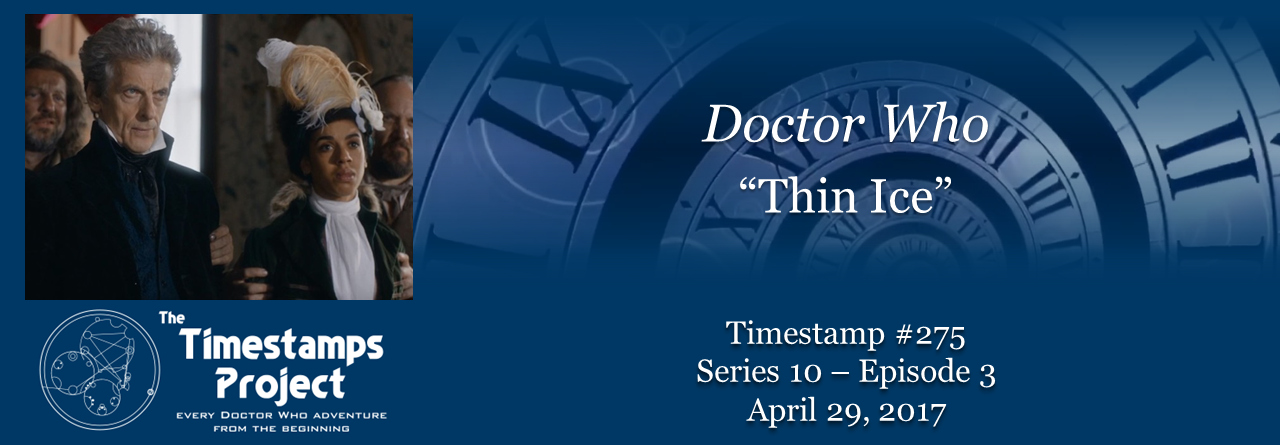
Picking up immediately after the previous adventure, the Doctor and Bill rush back into the TARDIS to discuss their landing on the frozen Thames. They’ve landed at the site of the last great frost fair on February 4, 1814. The TARDIS is steered by reasoning with her, and she has decided that they are needed here.

The Doctor wants to explore but Bill is afraid that she’ll stick out since slavery is still legal. The Doctor points her to the TARDIS wardrobe as a creature rumbles beneath the ice. The travelers, now appropriately dressed, venture into the frost fair while the Doctor teases Bill about temporal causality. Bill has the time of her life trying (most nearly) everything while remarking that Regency London is a lot more racially diverse than she sees in the movies. The Doctor replies “So was Jesus. History’s a whitewash.”

Along the way, Bill notices green lights racing under the ice. To her relief, the Doctor has seen them as well. On the outskirts of the frost fair, those green lights end up leading to the death of a drunk man. Elsewhere, a pickpocket lifts the Doctor’s sonic screwdriver and the travelers give chase until the lights break the ice under the kid’s feet. The sonic is left behind as the ice refreezes, leaving Bill beside herself as the Doctor is unable to save the boy.

Later, Bill asks about the Doctor and his history with death. She learns that the Doctor has killed before, but she doesn’t learn how many lives he’s taken. The discussion is interrupted by one of the pickpockets asking about what’s under the ice. The Doctor and Bill eventually learn that someone is paying the orphaned children to work the fair, and the Doctor feeds them with stolen pies before telling them a story beside a warm fire. They soon learn that the man they’re looking for has a tattoo of a ship on his hand.

After dark, the travelers don diving suits and search for the lights beneath the ice. Soon enough, Bill is taken below and the Doctor dives in after her. They find a giant sea creature chained to the river bottom and return to the surface through a fisherman’s hole. The fisherman was the pie maker, and the pies are made from the angler fish that produce the lights. They get another lead from the pie man and use the psychic paper to gain access to a dredging camp. They eventually come to Lord Sutcliffe after learning that he’s in command of the dredging teams who are excavating the sea creature’s very powerful bodily waste. The Doctor notes that it could be used for interstellar travel.

Visiting the manor of Lord Sutcliffe, the Doctor recommends that he do the talking since Bill is easily angered. Under the guise of Doctor Disco of the Fairford Club, he confronts Sutcliffe but loses his own temper in the face of sexist, classist, and racist remarks. After sucker-punching Sutcliffe and knocking him out, the Doctor determines that he is indeed human. The travelers are captured by Sutcliffe’s minions and learn that the sea creature is a family secret that can freeze the ice. Sutcliffe lures people to the ensuing frost fairs and propels industry by feeding innocent people to the creature. The Doctor chastizes Sutcliffe for not seeing the value in human life, but Sutcliffe decides to accelerate his plans.

Sutcliffe takes his prisoners to the river where he has explosives planted. He plans to blow the ice and feed the creature a veritable buffet, including the elephant. Once the captors leave the tent, the Doctor and Bill try to use the sonic screwdriver to escape. The sonic draws the lantern fish as one of the guards takes it away. The guard is eaten and the travelers are freed.

The Doctor asks Bill to decide the fate of the creature. Bill eventually settles on saving the creature, enlisting the street urchin gang to help clear the frost fair attendees from the river. The Doctor moves the explosives to the chains holding the creature down, and as Sutcliffe triggers the explosives, he falls into the river and is eaten. The creature, now free, heads toward colder climates.

Later on, the Doctor and Bill welcome the street urchins to Sutcliffe’s manor. Bill feeds the kids while the Doctor alters Sutcliffe’s will to make a boy named Perry the next lord of the manor. The travelers return home to be criticized by Nardole for going off-world as Bill reads about their exploits in the newspaper.

The Doctor and Nardole flip a coin to determine if he can continue going off-world. Nardole sulks over losing the flip by checking on the vault. He’s surprised to hear a knocking from inside, but refuses to let the occupant out.


Here we see an adventure that asks the companion to decide the fate of a creature, but it does a much better job of having the Doctor guide the companion to the right answer than stories like Kill the Moon and Cold Blood did. Along the way, Bill gets to learn more about the Doctor and the choices that he has to make in his lives.

This adventure also doesn’t pull any punches regarding classism, sexism, and racism. In fact, it hangs a lampshade on racism within the first few minutes, and it draws a hard line for the Doctor’s tolerance of such atrocious views.

The Doctor Who universe has been pretty progressive in the fight against human racism over the years, notably in stories like Human Nature & The Family of Blood, The Shakespeare Code, Captain Jack Harkness, Lost in Time, Remembrance of the Daleks, Battlefield, and Ghost Light. (It’s worth noting that the Doctor was far more dismissive of Martha’s concerns in The Shakespeare Code than he is here.) By nature, the show is inherently progressive when using aliens as metaphors for racism – the Daleks are the most obvious narrative vehicle – but the show has also stumbled a couple of times as well, most notably in The Talons of Weng-Chiang (yellowface and Asian slurs), The Daleks’ Master Plan (in which the Doctor engages in Orientalism), The Tomb of the Cybermen (in which the only Black character is an intellectually-challenged villain who sacrifices himself), The Evil of the Daleks (in which Kemel mirrors the mute strong Black man trope, but in Turkish), and The Celestial Toymaker (in which a racial slur is quoted in a nursery rhyme and the villain is coded in Orientalism).

Sexism plays a lesser role in Doctor Who history, popping up most notably in The Five Doctors and some of the First Doctor’s attitudes towards Tegan. Otherwise, the fights against sexism and classism are spread throughout the franchise’s history.

We get a few callbacks with this adventure. First, Martha was concerned about the butterfly effect in The Shakespeare Code, which was also a trip to London in the past. Second, parallel universes are mentioned again, nodding to their existence in Inferno and Rise of the Cybermen & Age of Steel. Third, the Doctor reminds us that humans are keen to ignore the bizarre happenings around them, such as with Remembrance of the Daleks and In the Forest of the Night. Last but not least, “Doctor Disco” makes a return, dredging up the off-hand joke from The Zygon Invasion.

What I really like about this adventure is the creature feature aspect with the companion saving the monster from torturous captivity. It’s an exercise in finding the best in humanity, giving us hope for the future that is reinforced by themes that (unfortunately) are still relevant today.

That’s the mark of good science fiction.

Rating: 4/5 – “Would you care for a jelly baby?”


UP NEXT – Doctor Who: Knock Knock

cc-break

The Timestamps Project is an adventure through the televised universe of Doctor Who, story by story, from the beginning of the franchise. For more reviews like this one, please visit the project’s page at Creative Criticality.
Timestamp #274: Smile

Timestamp 274 - Smile

The importance of understanding emotion.

Bill prepares for her first proper trip in the TARDIS, musing about how the seats are too far from the console and how difficult it seems to drive it. She’s impressed that the Doctor stole the TARDIS instead of buying it, and their back-and-forth is interrupted by Nardole who chastizes the Doctor for considering a trip off-world. The Doctor dismisses him by requesting to put the kettle on for tea.

Between the vault and the Doctor’s office, before the kettle boils, the Doctor takes a trip to the future.

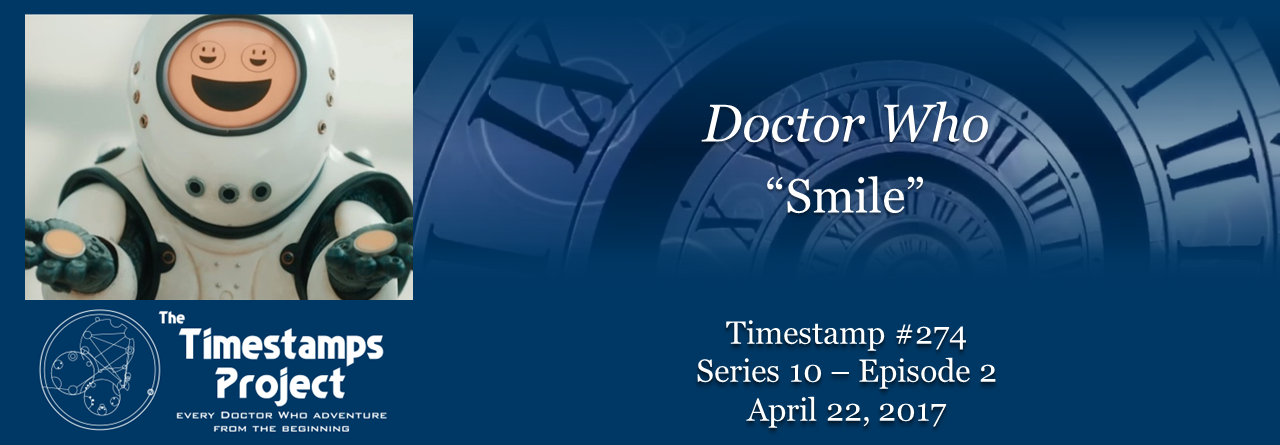
On a planet with vast expanses of wheat, colonists are waging a battle with their robots. If the robots detect emotions other than happiness, they murder the colonists with a wave of tiny drones. Sometime later, the Doctor and Bill arrive and take a self-guided tour of one of Earth’s first off-world colonies. They are fitted with translation devices while the emoji-bots stalk them from the windows above. One of the emoji-bots meets the travelers and offers them badges that reflect the wearer’s emotions. The emotions are not visible to the wearer and are worn on the back to facilitate transparency.

The robot serves Bill a meal of processed algae as she notes how skeptical the Doctor is about the empty city. She’s also amazed by the Doctor’s dual hearts, which he mentions during an excited monologue about how the city was built. He later finds a necklace on the ground and his theory changes regarding the residents of the colony. He verifies it by locating the source of a greenhouse’s calcium-based fertilizer.

The Doctor’s shift in mood is noted by the emoji-bots and they chase the travelers before the Doctor tells Bill to smile. The robots are programmed to ensure the happiness of the colonists and they have done so to a fault. The Doctor and Bill evade the robots and return to the TARDIS. The Doctor plans to leave Bill at the TARDIS while he destroys the death trap that is the city, but she is swayed otherwise by the sign on the TARDIS door: “Advice and assistance obtainable immediately.”

The Doctor is the universe’s helpline.

Bill returns to the Doctor’s side and he explains that the killer insect drones – the Vardy – are the literal bones and flesh of the buildings around them. At its core lies the original ship that the colonists arrived in, just like the Vikings who lived in their ships until they built their cities. As the travelers enter the ship, the Erehwon, the emoji-bots go on alert.

The Doctor navigates to the ship’s engine room with Bill’s help and a good old-fashioned deck plan. As the Doctor enters the engine room, the emoji-bots enter murder mode. Bill remembers that she can photograph the deck plan with her phone before following the Doctor’s path. She moves through stacks of artifacts and finds a room holding the remains of a recently-deceased elderly woman and a digital book filled with images of Earth’s history. She deduces that the colonists were the last humans evacuating from Earth.

Bill decides to rendezvous with the Doctor but finds a human boy. Meanwhile, the Doctor is ambushed by an emoji-bot. The Doctor meets up with Bill and the boy and he decides to disarm his makeshift bomb because the ship is a cryogenic colony ship filled with survivors from Earth. They meet Steadfast, one of the first to awaken, and the Doctor orders him to remain on the ship until told otherwise.

Bill takes the Doctor to the elderly woman whom the Time Lord identifies as a shepherd for this flock. She was the first to die, passing from natural causes, but the grief of her death passed through the colony like a virus. The Vardy identified grief as the enemy of happiness and started a cascade of death to stem the tide. Using the necklace, the Doctor recognizes that the grief cycle will continue, so he assembles the colonists to tell them the story.

The boy has left the ship and the colonists decide to wage war on the Vardy. When they fire on an emoji-bot, it experiences rage, and the Vardy attack the colonists. The Doctor realizes that the Vardy have become self-aware and stuns everyone in the city, effectively resetting the city into a symbiotic relationship where the humans are tenants in the Vardy’s new home.

Bill and the Doctor leave in the TARDIS as she muses about his role as an intergalactic policeman. The Doctor presumes that he can return them to the exact moment that they left, but they materialize in the wrong time as an elephant walks up the frozen Thames.


What starts as a monster-of-the-week story ends up with a Doctor Who twist as the supposed enemy ends up on top because it is simply misunderstood. Couple that with the theme of a new companion’s first real trip in the TARDIS and you have a winner.

The origin of this story makes me laugh: Peter Capaldi and Steven Moffat don’t understand emojis, so they often had trouble understanding texts from Jenna Coleman (who uses a lot of them in her communication). Thus was born a story about miscommunication based around emotions.

The story’s moral, of course, orbits the concepts of miscommunication and toxic positivity and emphasizes the need to read and understand emotions in relationships. The Vardy only understand black and white when it comes to emotions – grief is the enemy of happiness – but humanity exists in shades of grey that are wide open to interpretation and analysis. We can make a lot of headway together by simply talking things through with transparency.

Following on from the wave of comic characters that exist in Doctor Who canon from The Return of Doctor Mysterio, Bill lets us know that Mister Fantastic of Marvel’s first family (The Fantastic Four) is another superhero in this continuity.

The show also returns to classic tropes with human colony ships (The Ark and The Beast Below, for example) and cryogenic suspension (The Ark in Space, for example). It’s also the second time that we’ve seen a human colony where unhappiness was a death sentence (The Happiness Patrol was the first).

I enjoyed the story of The Magic Haddock, which is a story about being careful about what you wish for. That in-universe parable is made up of two different stories: The Tale of the Fisherman and the Fish is the source of the wishes in the haddock story, and The Monkey’s Paw is about an artifact that grants wishes at a deadly expense.

Finally, it’s worth noting that the colony planet was never named. It’s a literal “nowhere” colonized by people who traveled on a ship called Erewhon (“nowhere” spelled backward). (The planet is later called Gliese 581d and Earth 2.7 in different prose stories, but it is not identified in the course of this televised story.)

Rating: 4/5 – “Would you care for a jelly baby?”


UP NEXT – Doctor Who: Thin Ice

cc-break

The Timestamps Project is an adventure through the televised universe of Doctor Who, story by story, from the beginning of the franchise. For more reviews like this one, please visit the project’s page at Creative Criticality.

Timestamp #273: The Pilot

Timestamp 273 - The Pilot

A new companion gets an education.

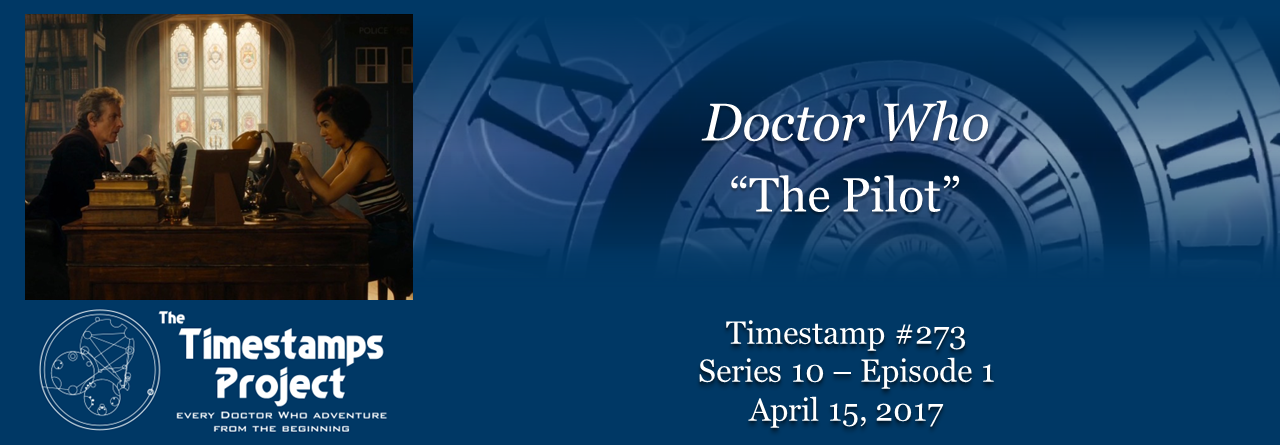
An empty university office soon welcomes Nardole and a woman we will come to know as Bill. The TARDIS stands darkly in the corner of the office, apparently out of order, and photos of River Song and Susan decorate the desk alongside a small jar of sonic screwdrivers. The Doctor makes his entrance with an electric guitar before questioning Bill as to why she’d attend his lectures if she wasn’t a student. Bill tells a story about a girl and fries before asking about the TARDIS.

The Doctor deflects and redirects Bill to the question at hand. He notes that she tends to smile when she doesn’t understand something. She wonders what he actually lectures about. The Doctor offers to tutor her so long as she performs well.

The Doctor lectures about time as Bill works her job in the canteen, and she arrives at his tutoring sessions on time while scoring top marks. Bill’s foster mother Moira wonders about her relationship with the Doctor, but Bill replies under her breath that she’s not interested in men. To wit, she sparks a relationship with a woman in a bar who has a star pattern in her eyes.

One day, Bill follows the Doctor and Nardole to a secret underground chamber. She overhears the pair talking as they work on a large door, but after she knocks over some debris on the floor, she rushes back outside. She soon runs into Heather, the woman from the bar. Heather explains that the star is a defect in her iris but offers to show Bill something that’s bothering her. They sneak into a construction area where Heather shows Bill a puddle that hasn’t evaporated since the rain last week. When Bill looks into it, she notes that the reflection is somehow wrong. Heather walks away without much explanation as a voice inside the puddle proclaims that the pilot has been located.

Christmas eventually rolls around and the Doctor and Bill celebrate with a small gathering. She talks about her mother and wonders about photographs helping ease the pain of loss. Later on, she returns home and looks at some photographs of her mother. She spots the Doctor in one of them and is intrigued.

She sees some other strange things when the new term starts, including evidence that the TARDIS has moved. She finds Heather staring into the puddle but the woman disappears when Bill approaches. Sadly, Heather is trapped in the puddle and identified as the pilot.

Bill tells the Doctor about Heather and he rushes off like a “penguin with his ass on fire” to investigate it. The Doctor soon understands that the problem with their reflections is that they’re being shown the wrong way. Whatever is in the water is mimicking the observer. The Doctor also takes note of the scorch marks around the puddle and then sends Bill home. The puddle pursues, claiming to have found its passenger.

When Bill returns home, she assumes that Moira is in the shower, but a phone call proves that assumption wrong. When Bill investigates the running shower, she finds Heather’s starry eye staring back at her from the drain. Bill rushes back to the university to find the Doctor, but is confronted in the darkness by a sopping wet Heather. Heather is a bit freaky and Bill rushes to the Doctor’s office where he is analyzing a sample of the puddle. The puddle pursues and takes Heather’s shape once again.

The pair takes shelter in the TARDIS where the Doctor is pleased to show off his time capsule. Bill is astounded as most companions are, but she does proclaim that it resembles a kitchen. Nardole appears as the puddle attacks, forcing the Doctor to relocate the TARDIS to the underground vault. As the Doctor and Nardole analyze the vault for any breaches, Bill finally has her “bigger on the inside” moment.

The puddle eventually catches up to them so the trio takes flight to Sydney, Australia. The gravity of what’s happening finally catches up to Bill, and she starts asking the Doctor questions about his life and history. They’re interrupted when Heather catches up to them, so the Doctor takes the TARDIS off the planet and twenty-three million years into the future.

Bill is amazed as Nardole and the Doctor muse about the puddle. They presume that the puddle is a remnant from an alien craft that can take the shape of what it needs. It found Heather, someone who wanted to leave the world around her, and took her on board to leave the planet. The puddle catches up to them and nearly abducts Bill, and the Doctor takes his team to the most dangerous place in time and space. When they arrive, the Doctor tosses a classic sonic screwdriver to Nardole before rushing into a war zone in the past. Nardole tries to distract the Daleks, who are fighting the Movellans, as the Doctor and Bill try to escape the puddle.

Taking a slight detour to the Friend from the Future promo teaser, the Doctor and Bill run from the Daleks. Taking refuge behind a wall, Bill repeatedly questions the Doctor about the Daleks.

The Doctor finds a Dalek and has it scan his sonic screwdriver. It fires on the Doctor, but he dodges so the blast hits Heather. As the travelers run, Heather morphs into a Dalek but the Doctor is not tricked. He does wonder, however, why she didn’t shoot when she had a gun.

Bill realizes that Heather’s last conscious thought was to not leave without her. The pilot has been trying to fulfill that promise since Heather was killed. Bill releases Heather from the promise after briefly bonding with the pilot. The puddle retreats and the traveling trio returns to the TARDIS, though Bill notes that she is now partially connected with Heather.

Back in the university office, Bill regrets leaving Heather and the Doctor decides to wipe her memory in order to protect his undercover disguise while he guards the vault. Bill asks him to imagine what it would feel like if someone did the same to him and the memory of Clara forces him to send Bill away. The TARDIS and the pictures of River and Susan chide him, and he decides to meet Bill downstairs with the time capsule.

It’s a big universe, but maybe one day they’ll find Heather again. Until then it’s time for an adventure in time and space.


This episode’s title does double duty. The obvious meaning is in reference to Heather’s fate, but the other one is this story’s status as a perfect entry point for newcomers. The story tells the viewer everything they need to know about Doctor Who while easing them into the universe and a season-long story arc. Steven Moffat has compared this story (in that regard) to both An Unearthly Child and Rose. To a lesser degree, I’d also include The Eleventh Hour, Spearhead from Space, Terror of the Autons, and Remembrance of the Daleks.

Bill debuts here as a not-the-usual companion. Most companions are enraptured by the magic and fantasy of everything Time Lord, but Bill’s worldview pushes all of that to the backseat as she parses the new world around her. It’s quite refreshing.

We also get the mystery of the vault beneath the university. The Doctor and Nardole have apparently been guarding it for approximately 50 years. Since St. Luke’s University is in Bristol, the Doctor runs the risk of crossing his own timeline since Flatline also took place in Bristol. It’s also across the Bristol Channel – about an hour’s drive or so – from Cardiff, which means possible interactions with the Ninth Doctor, the Tenth Doctor, and Torchwood Three. I mean, none of those things will occur, but I’m honestly surprised that more inadvertent timeline interactions don’t happen given how much time the Doctor spends on the British Isles.

This episode marks the return of the Movellans to Doctor Who, which results in a neat timeline check with the Daleks. They don’t know that the Twelfth Doctor is their nemesis until they scan the sonic screwdriver because they only know about the current incarnation (the Fourth Doctor) who was involved in the Dalek-Movellan war shown in Destiny of the Daleks.

Overall, The Pilot fulfills its mission of serving both newbies and veterans with plenty of explanation and nods to the past interwoven with an engaging story and enjoyable actors. It serves well as a welcome back to the Twelfth Doctor after the complicated drama dance with Clara.

Rating: 5/5 – “Fantastic!”


UP NEXT – Doctor Who: Smile

cc-break

The Timestamps Project is an adventure through the televised universe of Doctor Who, story by story, from the beginning of the franchise. For more reviews like this one, please visit the project’s page at Creative Criticality.

Culture on My Mind – Darren Nowell

Culture on My Mind

Culture on My Mind
Darren Nowell
March 10, 2023

February was a rough month for me. My family had some health scares and my friends were rocked by deaths in their families. Among them was the sudden loss of Darren Nowell on February 21st.

Darren Nowell

Darren was well-known in Dragon Con, local geek, and local podcasting circles. He worked with the ESO Network for a long time, including as a co-host on the Dragon Con Report podcast which is where I met him. His memorial was held last Sunday with a building full of friends and family to honor his legacy.

The ongoing theme as everybody swapped stories about Darren was that he gave of himself unconditionally. If you needed help, he was there for you. He lived his life without disguises, showing the world his true, compassionate, and authentic self at every turn.

More importantly, he encouraged those around him to do the same. To be proud of the skin in which they lived.

I didn’t know Darren long, but he was certainly one of the brightest burning stars of charisma and compassion that I have had the privilege of being around.  He was an amazing example of what humanity can be.

His physical presence will certainly be missed. His legacy will be with us for a very long time.

Thank you, Darren.


Darren Nowell Comics


cc-break

Culture on My Mind is inspired by the weekly Can’t Let It Go segment on the NPR Politics Podcast where each host brings one thing to the table that they just can’t stop thinking about.

For more creativity with a critical eye, visit Creative Criticality.

Timestamp #272: The Return of Doctor Mysterio

Timestamp 272 - Doctor Mysterio

With great fandom comes great tributes to nostalgia.

It’s Christmas Eve in 1990. In New York City, a boy named Grant meets the Doctor in the middle of the night as the Time Lord dangles by his ankles in front of Grant’s window. The Doctor was testing a trap and inadvertently set it off. After some hijinks, the Doctor is finally let in because he is “expected.” Turns out that Grant and his mother believe that the Doctor is Santa Claus.

The Doctor flips through Grant’s Superman comic collection, discovering that Clark Kent and Superman are the same person. The Doctor also learns about Spider-Man before taking Grant to the roof to work on the Doctor’s trap. Grant names the Time Lord “Doctor Mysterio” as he works on the “time distortion equalizer thingy” that will take the edge off of his frequent incursions near the area. It will also help protect a glowing gemstone in the Doctor’s possession. The gemstone is one of four left in the universe and is known as the Hazandra. This “Ghost of Love and Wishes” uses power from a nearby star to make the wisher’s dreams come true.

Unfortunately, Grant swallowed the gemstone after mistaking it for medicine, and now has superpowers. Fast-forwarding to the future, a now-adult Grant works as a nanny. Elsewhere in the city, a man named Brock is hosting a press release at the Harmony Shoal building – which looks a lot like the Daily Planet – and fields questions from a reporter named Lucy Fletcher and Nardole.

Brock later meets with Dr. Sim at midnight, missing the fact that Lucy and Nardole have both independently sneaked back into the building. Sim and Brock enter a vault full of brains and Sim questions where some of the brains came from. Lucy overhears this and meets the Doctor as Brock discovers that Sim and the brains are aliens. The aliens swapped the brain of the real Dr. Sim with an invader, and a surgical team soon does the same to Mr. Brock.

Lucy and the Doctor retreat to the lobby where they meet with Nardole before being discovered by Sim. Sim threatens to kill the intruders but they are interrupted by a superhero knocking on the window of the 100th floor. This superhero is known as the Ghost and he saves the protagonists. The Doctor recognizes Grant as the Ghost before the superhero flies Lucy home.

On the day that Grant swallowed the gemstone, he promised not to use his powers as he waited for the stone to pass naturally. The Doctor tracks Grant back to the apartment where he works as a nanny to confront the hero with a Spider-Man catchphrase. It turns out that Grant is working for Lucy, and when she arrives home she is surprised to find the Doctor and Nardole in her dining room.

The Doctor checked in on Grant from time to time. One of those times was in high school when Grant knew Lucy and had x-ray vision. It was then that the Doctor knew that the stone had bonded with Grant’s DNA. In the modern day, the Doctor chats with Grant before sirens call the hero away and the Doctor meets with Lucy.

Lucy investigates the Doctor while using a Mr. Huffle toy – later sold as a Doctor Who-branded collectible! – to persuade him to tell the truth. The Doctor reveals everything about Harmony Shoal and the brain-swapping operation, and Lucy wants to know how the Ghost is related to the plot. She deduces that the Doctor knows the Ghost’s identity, but she’s oblivious to Grant’s secret. Grant overhears Lucy’s demands and calls her in his Ghost persona. Hilarity ensues as the Ghost agrees to have dinner with Lucy and Grant agrees to watch her daughter for the night.

As Sim and Brock hatch a plot to take over the Ghost’s body, the Doctor confronts them. He figures out the plan to assimilate the world’s leaders and warns the body-swappers as Nadole materializes the TARDIS around him. We learn that the Doctor extracted Nardole from Hydroflax because he was lonely. They travel to the Tokyo branch to search for clues while Grant and Lucy have their dinner on the roof of her apartment building. The Doctor and Nardole track a signal in orbit and find a spaceship.

Brock tracks the Ghost and leads a team to assimilate him while the Doctor and Nardole investigate the ship. The ship has been rewired into a floating bomb and has been targeted toward New York City to stage an attack and lure the world’s leaders. Luckily, Harmony Shoal has been designed as a bunker that can withstand the blast. The Doctor decides to crash the ship into the planet’s atmosphere.

Brock attempts to assimilate the Ghost, but Grant breaks free and returns in his civilian guise to confront the aliens. The Doctor uses his sonic screwdriver to communicate with Grant, asking the hero to use his powers and stop the ship from crashing. Of course, Grant is forced to reveal his true identity to Lucy, but the city is saved from nuclear disaster. The Doctor and Nardole arrive in the TARDIS and confront Brock. Grant and Lucy kiss and fly into the sky with the ship as UNIT arrives to close down Harmony Shoal.

Unfortunately, the brain-swappers escape (as the baddies in the comic pages usually do).

As the Doctor and Nardole say goodbye to Grant and Lucy, they discuss how things end and begin again, alluding to the Doctor’s final night with the woman he loved. Nardole explains as the Doctor returns to the TARDIS. Together they set course for adventures unknown.


In typical Christmas Special fashion, this was a light and fluffy piece with plenty of room for the actors to have fun. Steven Moffat’s love of the Superman comics is on full display, making up most of the homage here. Grant puts off definite Clark Kent and Peter Parker vibes as he dances between his personas, and he acts like Batman with a serious and gravelly voice while in the cape and mask. There are several other elements, particularly from the 1978 Superman film, including the rooftop interview and being contacted on a specific frequency that only their super ears can hear. The x-ray vision sequence in the high school reminded me of the Smallville episode “X-Ray” from 2001, though Clark Kent seemed to enjoy the power a bit more than Grant did.

The Superman comic that the Doctor reads is Superman Vol. 2 #19 from July 1988. In that issue, “The Power that Failed”, the villain Psi-Phon removes Superman’s powers one by one. It’s an ironic choice given how young Grant is shown as gaining his powers sequentially in this episode.

The superhero homage is embellished to the extreme in young Grant’s bedroom, complete with tributes to Superman, the Hulk, Thor, Spider-Man, Wolverine, Silver Surfer, Batman, Wonder Woman, the Flash, Captain America, Iron Man, the Defenders, and more. All of them are apparently canon in the Doctor Who universe, and Batman was previously mentioned in Inferno, The Time Monster, Remembrance of the Daleks (where Ace’s earrings were outstanding!), Sky, and The Curse of Clyde Langer. It’s all capped by the nods to Miss Shuster and Miss Siegel, which pays tribute to Joe Shuster and Jerry Siegel, the parents of Superman’s legacy.

Brain swapping is a storytelling trope with a long history behind it. In fact, the first supervillain in a DC Comics story was the Ultra-Humanite, a mad scientist who tangled with Superman in Action Comics #13 (“Superman vs. the Cab Protective League”) in June 1939, and that ne’er-do-well transplanted his brain into an actress after supposedly dying in battle against the Man of Steel. He transplanted his brain multiple times over the years before settling on the body of an albino gorilla. Doctor Who fans will recognize the trope as part of the story The Brain of Morbius.

A fun bit of trivia that I didn’t know until I started diving into this story relates to the name Doctor Mysterio. When Steven Moffat and Peter Capaldi were doing the Doctor Who World Tour, they fell in love with the show’s Mexican title Doctor Misterio. Peter Capaldi’s delivery of that name in this episode is an impersonation of the announcer’s voice on the overdubbed soundtrack.

Finally, I loved how the Doctor brought snacks to his investigation. I also loved the callback to The Green Death as Lucy disguises herself as a cleaner just like the Doctor did to infiltrate Global Chemicals.

Overall, this ends up as a wholesome fluff story and a lovely tribute to the superhero genre.

Rating: 4/5 – “Would you care for a jelly baby?”


UP NEXT – Doctor Who: The Pilot

cc-break

The Timestamps Project is an adventure through the televised universe of Doctor Who, story by story, from the beginning of the franchise. For more reviews like this one, please visit the project’s page at Creative Criticality.

Culture on My Mind – A Career in a Coffee Mug

Culture on My Mind

Culture on My Mind
A Career in a Coffee Mug
March 3, 2023

The Navy, Marine Corps, and Coast Guard have a tradition.

Well, okay, they have a lot of traditions. Trust me, as a Navy veteran, I know this all too well. But one of the fascinating ones among the senior enlisted and the mustangs (a commissioned officer who began their career as an enlisted service member) centers on their coffee mugs.

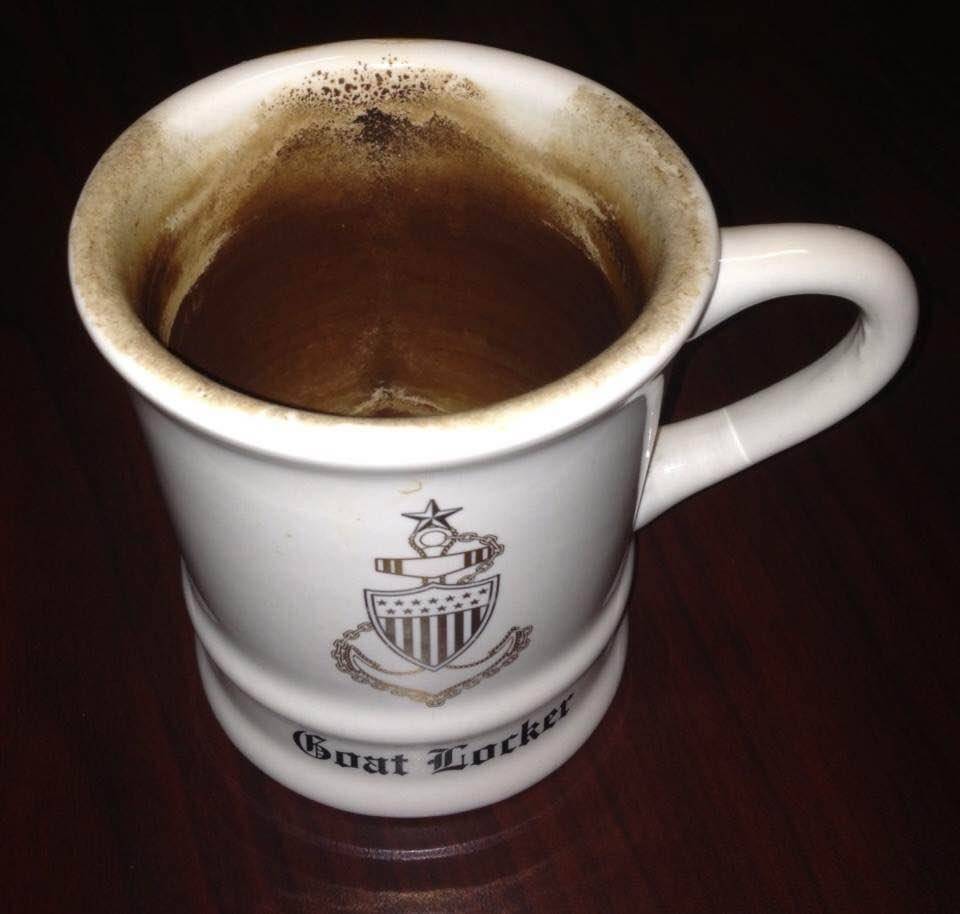
Coffee is life blood in the military. From long hours spent on watch to even longer hours spent performing collateral duties, the cups of caffeine can be just what you need to keep moving. Ships usually have a set of coffee mugs available for use in the coffee mess – the space authorized for preparing and dispensing coffee and assorted accoutrements – but Sailors, Marines, and Guardsmen also have their own personal mugs. The senior enlisted, known as non-commissioned officers (NCOs) in the Marine Corps and Chief Petty Officers (CPOs) in the Navy and Coast Guard, also tend to have special personal mugs. Some of those special mugs come with command iconography and such, leaving no doubt as to whose mug is whose.

The tradition has to do with the seasoning of those mugs. You see, NCOs and Chiefs typically take their coffee black and believe that not washing their mugs is good luck. The coffee stains on the inside of the mug build up over time, effectively telling the history of the mug and its owner. The more sludge in the mug, the more experience the owner has.

One example comes from the Naval Historical Foundation and Coast Guard Senior Chief Darcy Collins, as found on the Navy History Tumblr page.

seasoned mug

Some studies suggest that the practice isn’t that unhealthy so long as you don’t share the mug with anyone and drink the coffee black with neither cream nor sugar. In fact, the Navy Times picked a few suggestions from the fleet for the perfect mug, including drinking coffee black, drinking the entire mug, and even seasoning it with leftover grounds like a cast-iron skillet.

The last suggestion on the list is the most important for any servicemember: Don’t wash the mug. Ever. If the owner washes it, the respect for them goes overboard. If a junior member washes it, even through ignorance or on a dare, there is no end to the harassment that they will endure at that command and beyond.

After all, the fleet talks and reputations have long lives.

I’ve seen my share of deeply seasoned mugs, but my personal mug only had minimal stains. I take my coffee with cream/milk and sugar, and I also prefer to drink from clean vessels. I’m a bit of a germaphobe that way.


cc-break

Culture on My Mind is inspired by the weekly Can’t Let It Go segment on the NPR Politics Podcast where each host brings one thing to the table that they just can’t stop thinking about.

For more creativity with a critical eye, visit Creative Criticality.

Timestamp: Class Summary

Timestamp - Class Summary

Class was far from the strongest entry in the Doctor Who universe.

The concept was a great idea, effectively introducing a Buffy the Vampire Slayer-style ensemble into the mix with a group of classmates fighting evil to defend their school. What we got was a dysfunctional troupe that made the Torchwood team look like the model for lining up ducks.

My core complaint throughout was how the Coal Hill Defenders couldn’t gel as a functional team. Despite having a common enemy and goal, everyone remained selfish and isolated. The writing certainly didn’t help since it was often nebulous – Steven Moffat’s tenure on Doctor Who is no stranger to that – but lacked the magic of the main show’s adventures.

Unfortunately, the lack of a hook in this series robs us of the more interesting threads that would have driven the second series of episodes: The implications and fallout from Charlie’s genocide, April’s new conflicted existence in Corakinus’s body, and the mystery of The Arrival (which would have taken us to the Weeping Angel homeworld and explored a civil war among them).

Maybe these can find a home in the future.

Overall, Class finishes with a 2.7 score. That’s lower than Torchwood: Miracle Day (which scored 2.9) and Series Three of The Sarah Jane Adventures (which scored 3.3). There is only one set of Doctor Who episodes that scored lower (the Twenty-Second Series scored a 2.5), placing this collection at about 36th place (out of 37) compared to the main show.

For Tonight We Might Die – 3
The Coach with the Dragon Tattoo – 2
Nightvisiting – 2
Co-Owner of a Lonely Heart & Brave-ish Heart – 4
Detained – 2
The Metaphysical Engine, or What Quill Did – 3
The Lost – 3

Class Average Rating: 2.7/5


With the spinoffs out of the way, the Timestamps Project will now pick up where it left off with Peter Capaldi, Series Ten, and the Twelfth Doctor’s final adventures. After that, it’s a straight shot through the Thirteenth Doctor’s run. If everything stays on course, the Timestamps Project will catch up to the Doctor Who televised universe around the 60th anniversary later this year.

UP NEXT – Doctor Who: The Return of Doctor Mysteriocc-break

The Timestamps Project is an adventure through the televised universe of Doctor Who, story by story, from the beginning of the franchise. For more reviews like this one, please visit the project’s page at Creative Criticality.
Timestamp #CLS7: The Lost

Timestamp CLS7 - The Lost

From the shadows rises a cliffhanger.

Six days after the detention events, bad omens rise as April debuts her song The Lost on a café stage. The Lost is obviously about the Coal Hill Defenders and their families. Of that group, Ram suffers immediate loss as his father is murdered by Corakinus. As his father disintegrates, Ram is confronted by the former Shadow King who says, “One.”

Matteusz visits Charlie and questions why Miss Quill isn’t restrained. She’s a threat to him if she awakens, but Charlie cannot bring himself to put her back in chains. When Quill awakens, she’s surprised to be pregnant but demands to have her gun. Meanwhile, Ram tells April about his father and she begins to spread the word. The only one who stands apart is Tanya, who immerses herself in her studies until Corakinus murders her mother. Tanya seeks solace with Miss Quill and asks to use the cabinet to seek vengeance.

The deposed Shadow King sets his sights on April’s mother next, holding her as ransom on the condition that April joins him. Charlie and Matteusz arrive with Quill’s gun as Corakinus reveals who he has killed thus far. Corakinus attacks Charlie with shadow, casting it on his heart and linking them together. After Corakinus leaves, Ram chastizes the group for their inaction before storming away. April gives chase but refuses to go with him and leave her mother unprotected.

Charlie and Matteusz petition Dorothea Ames (at gunpoint) for help. Ames takes them to a staff entrance for EverUpwardReach (a foundation of the Governors) but refuses to let them in. She does, however, speak of The Arrival before disappearing inside the mysterious room. She returns with news that they have a problem. The Shadow Kin are coming.

Miss Quill and Tanya take the cabinet to Coal Hill Academy. As Corakinus attacks Tanya’s brothers, April rushes to the school and Quill fights him hand-to-hand. After Corakinus retreats, Quill gives Tanya advice and defense training. April calls Ram and leaves him a message declaring her love for him before paying her respects at the Coal Hill honor board.

Tanya demands that Charlie kill the Shadow Kin, but he knows that doing so will kill April. Corakinus takes Matteusz hostage as April arrives and offers herself in exchange. Charlie is reluctant to let her go, but April convinces him otherwise. As Ram listens to April’s message, the Shadows arrive and begin their assault on Earth.

April reveals that the Shadows will kill everyone regardless as part of the King’s command, and Charlie shoots April to eliminate the Corakinus. Ram arrives in time to catch April as she falls lifeless to the floor. The Shadow Kin stand still as Charlie assumes the role of king and activates the Cabinet of Souls. Matteusz begs Charlie to stop, knowing that this will kill every Shadow Kin including their new king, but Charlie tells him that he’s already dead. Quill and Tanya defend Charlie as he activates the weapon and destroys the Shadows. The act also removes the Shadow from Jackie MacLean’s legs, consumes The Underneath, and resurrects April in Corakinus’s body. Charlie, meanwhile, must live with the sacrifice and his actions.

Because Dorothea Ames was unable to prevent Charlie from using the cabinet, she is sacrificed by the Governors to a Weeping Angel. The head of the organization promises the Angels that they will be ready for The Arrival.


In a somewhat intriguing ending, we find two who are the last of their kind (Charlie and Quill) giving rise to a third (April as Corakinus, the now last of the Shadow Kin) by sacrificing the remnants of the Rhoadian species. It’s powerful stuff, but it’s tainted by the fact that the team still doesn’t fight like a team and the decisions that each member makes are unilateral.

The challenging parts of this story are related to the Governors and the Weeping Angels. We get the revelations that the Governors are driving the space-time tears in support of The Arrival (whatever that is) and the Weeping Angels. Since this particular story thread remains untethered in the time since this episode aired, maybe it is fodder for the Doctor in a future adventure.

Rating: 3/5 – “Reverse the polarity of the neutron flow.”


UP NEXT – Class Summary

cc-break

The Timestamps Project is an adventure through the televised universe of Doctor Who, story by story, from the beginning of the franchise. For more reviews like this one, please visit the project’s page at Creative Criticality.

Culture on My Mind – Willow

Culture on My Mind

Culture on My Mind
Willow
February 13, 2023

At the end of November 2022, the revival series for Willow premiered on Disney+. The original film from 1988 is a cult classic that was originally written by George Lucas, scripted by Bob Dolman (Far and Away, SCTV), directed by the legendary Ron Howard, and starred Warwick Davis, Val Kilmer, and Joanne Whalley. It also showcased the incomparable Jean Marsh as the villainous Queen Bavmorda, and she left no pieces of scenery unchewed in her performance.

The story is a basic sword-and-sorcery plot that has unlikely heroes racing to protect a mythical chosen one from the elements of evil. This film came from a time period saturated with sword-and-sorcery, including the Conan the Barbarian entries, DeathstalkerThe BeastmasterDragonslayerKrull, and so on. In that light, Willow is a tongue-in-cheek love letter that both parodies and celebrates the genre.

The story revolves around the age-old trope of an infant Chosen One, which is addressed by the evil queen executing a toned-down Massacre of the Innocents by imprisoning all of the pregnant women in her domain. When the foretold newborn escapes, she ends up floating down the river – another biblical parallel and fantasy trope – and landing in the arms of Willow Ufgood. The halfling Nelwyn is the heart and soul of this film and ends up taking an epic journey to deliver Elora Danan to her destiny.

Since the Nelwyn are socially secluded, like the Hobbits of Tolkien’s masterworks, Willow’s initial instructions are to travel only long enough to leave the baby with the first Daikini (“tall person”) that he can find. That person is Madmartigan, a mercenary who reluctantly joins the quest in an attempt to keep doing what rogues do. Willow also answers the call of becoming a sorcerer with the help of brownies – an interpretation of the Scottish hobgoblin lore and analogue to fairies – and the fairy queen Cherlindrea.

The tropes keep coming with a cursed enchantress who Willow needs to restore to human form, plenty of fantastic creatures to slay, and a love interest for Val Kilmer (literally, since he later married the actress) in Joanne Whalley’s Sorsha, warrior daughter to evil queen.

No joke: Sorsha finds ultimate redemption by falling in love with Madmartigan. Even Willow isn’t safe from missteps like this.

The movie rockets onward with several more light-hearted fantasy and comedy tropes, including hiding from troops by wearing women’s clothing, a high-speed duel between goons on horseback and our heroes in a rickety cart, a perilous race down a snowy mountainside on a shield (ala Indiana Jones and the Temple of Doom), and a couple of swashbuckling swordfights.

In the end, Willow defeats the evil queen by slight-of-hand and everyone’s happy once again.

All told, the film is a fun romp with a ton of heart and soul. It is effectively a light Dungeons and Dragons campaign. Rather, a corny screwball teenage fantasy where kids could see themselves in the starring roles. It was unique in this regard since most fantasy fare focused on a big shirtless musclebound hero like Schwarzenegger’s Conan, but Willow provided representation for empathic and non-athletic people like me through Willow himself. It’s easy to see why it became a cult favorite, especially considering the easily accessible (and modern for the time) humor spread throughout. Val Kilmer has a major hand in that since he ad-libbed the majority of his lines, effectively carrying his role through the power of charisma.

George Lucas originally conceived of the story in 1972 as a means to present well-known mythological situations to a younger audience, which seems to be a standard for his style. He also tailored it for Warwick Davis after being impressed with the young actor during Return of the Jedi. Davis obviously had a ball in the role, and the only reason that he doesn’t have top billing is studio politics.

The big stumbling block was visual effects technology, which he finally found to match his vision in the mid-1980s. He approached Ron Howard based on their strong relationship and, based on the story, Howard recommended Bob Dolman. Lucas admired Dolman’s style and work on the sitcom WKRP in Cincinnati.

The film itself was rejected by various film studios because fantasy was taking a downward turn according to the performances of KrullLegendDragonslayer, and Labyrinth. Lucas called in a favor with Alan Ladd Jr. at MGM since the studio head was in charge at 20th Century Fox when Lucas pitched Star Wars

Of course, Industrial Light & Magic handled the visual effects, including the first use of digital morphing technology that would later be used in Indiana Jones and the Last CrusadeTerminator 2: Judgment Day, and  Star Trek VI: The Undiscovered Country. The score was written by James Horner, a well-known film music composer in the 1980s (and beyond) who played with metaphors and the spiritual side of mythology and music history. His score was influenced by Leoš Janáček’s Glagolitic Mass, Mozart’s “Requiem”, Béla Bartók’s “The Nine Splendid Stags”, Edvard Grieg’s “Arabian Dance” for Peer Gynt, and the works of Sergei Prokofiev. Most notably, “Willow’s Theme” paraphrases part of the theme of the first movement (“Lebhaft”) of Robert Schumann’s Symphony No. 3, and “Elora Danan’s Theme” references the Bulgarian folk song “Mir Stanke Le”, also known as the “Harvest Song from Thrace”.

The movie was pretty much a melting pot of cultural and technological ideas.

The film was released on May 20, 1988, and premiered at number one, but it fell well short of blockbuster expectations against Crocodile Dundee II, Big, and Rambo III. Critics were also mixed, faulting the pacing and generic story while praising The Princess Bride for doing a similar movie better. They did, however, note that kids may be hooked by it.

Willow was nominated for several awards, including Oscar nominations for Sound Effects Editing and Visual Effects and Golden Raspberry Awards for Worst Screenplay and Worst Supporting Actor. It won a Saturn Award for Best Costume Design. It has been a staple of home entertainment since it was first released to VHS, Betamax, Video 8, and LaserDisc on November 22, 1988.

There have been a few spinoff properties over the years, including a board game, three video games, and a trilogy of sequel novels that Lucas outlined and Chris Claremont wrote. Those novels, the Chronicles of the Shadow War trilogy, have since gone out of print and are allegedly disavowed by George Lucas. In 2005, George Lucas and Warwick Davis started discussing a television series sequel, which finally came to fruition in November 2022 after two years of development with Disney+.

I watched the original film for the first time in a long while before moving directly into the sequel series after the first season was completed. I can safely say that the only difference between the movie and the series is about 35 years.

We’ve gotten older. The story has evolved to meet its target audience. The heart is still the same.

Typical of fantasy tropes, evil avoids being defeated by traveling through generations, leaving a new band of heroes to take up the quest and save the world. Elora Danon is back but has no idea who she truly is. Sorcha has become a queen and had two children, each of which must contend with their lineage. The innocence and gentleness of Willow Ufgood has been transferred to Prince Graydon while Willow himself takes on the mentorship role from Fin Raziel and the High Aldwin. Princess Kit combines her father’s swashbuckling swagger with her mother’s weight-of-the-world worry. The role of jester once inhabited by the Brownies is taken up by a rogue named Thraxus Boorman.

The representation I mentioned before? It takes a new turn with a same-sex relationship, marking the first Disney+ franchise to actually focus on a queer storyline.

Typical to fantasy: Same story, different telling. This story returns to basic sword-and-sorcery stuff, but evolved through three or four decades of high fantasy and urban fantasy fare. There are elements of The Mummy franchise, Merlin, Xena: Warrior Princess, Once Upon a Time, Buffy the Vampire Slayer, and more in the mix. The tongue-in-cheek approach that made Willow a cult classic among fans still exists in the series.

The big difference that I see in the comments is that the fans who fell in love in 1988 don’t see their movie in this series. Comments like “this show resembles the Willow movie in name only”, “the tone, atmosphere and characters are completely different in style”, and “it doesn’t contribute anything unique to the genre” are telling. Neither generation of Willow hides that love is the core of their story. In fact, the sequel wears this value on its sleeve: “Love is the most powerful force in the universe.”

The original Willow fans have grown up, but remember the common thread surrounding that original film? Willow itself is geared by design to the youth of the era.

We’ve talked time and again about how representation matters. The original had its representation with women warriors and atypical heroes, and the sequel emphasizes love between consenting adults in the face of intolerance. Both of them offer representation of chosen family – a staple of Lucas’s works for generations – and the sequel takes it even further for a generation that places significant emphasis on the concept.

Fans of my generation have their Willow, and now new fans 35 years later have their Willow, too.

Modern dialogue is easy to access. Modern plot devices are easy to access. Even the use of modern music – an element of the new series that I don’t like, especially since I can’t find a relevant theme consistent with the song and its respective episode – is something right out of the fantasy properties for this generation. I’m not a fan of today’s vampire and werewolf shows, which are contemporary fantasy vehicles, but I catch enough of their elements when they’re playing in my house. The use of modern music instead of a soaring closing theme is the way of things today in that genre.

The argument that the series doesn’t contribute anything unique to the genre is a non-starter for me. The original Willow was a mash-up of fantasy tropes. It was not original, but it was unique because of its heart. The new series is no different.

The sequel series and the original film are fun pieces of fluff with a ton of heart and representation for days. Neither of them is high art nor my favorite thing in the world, but they are beacons of joy for two distinct generations in the hue and cry of our daily drudgery. If that’s not for you, that’s fine, but don’t stand in the way of that happiness for someone else.

It is for that simple joy and what it brings to people that I appreciate both versions of Willow.


Both Willow (1988) and Willow: Season One are available to stream on Disney+. Willow (1988) is also available on DVD and Blu-Ray wherever fine physical media is sold.


cc-break

Culture on My Mind is inspired by the weekly Can’t Let It Go segment on the NPR Politics Podcast where each host brings one thing to the table that they just can’t stop thinking about.

For more creativity with a critical eye, visit Creative Criticality.

Timestamp #CLS6: The Metaphysical Engine, or What Quill Did

Timestamp CLS6 - Metaphysical Engine

Meanwhile, not in detention…

Miss Quill locks the students in detention and then goes to see Ms. Ames in the school hall. The goal is to remove the arn, but Dorothea Ames warns Quill that the process may kill her. Quill replies with her best “give me liberty or give me death,” and they begin as a man named Ballon arrives. They are miniaturized and transported inside a mysterious device that Ames pulls from her satchel.

In a moment, the trio materializes inside an alien forest. Ames tells Quill to remember her earliest childhood memory while Ballon goes hunting. Ballon returns with a dead animal that he claims is an arn, lured by the bait of Quill’s memories. Extracts from the young arn corpse will help extract the creature from Quill’s head.

Ames adjusts the device again, explaining that it is a metaphysical engine capable of transferring individuals into a thought or belief. In this case, the forest is the idea of heaven for the arn. The trio warps out again as Ames explains that the Governors study the tears in spacetime at Coal Hill. She also reveals that Ballon is a Lorr shapeshifter (who posed as a Zygon before being frozen in one form and apprehended for murder) and Quill’s surgeon. They arrive in the Lorr version of hell and encounter the Lorr devil, from which they must extract blood to free his hands. Ballon overcomes his fear and completes his task with Quill’s help.

The next step in the fetch quest is finding the brain of a Quill so that Ballon can learn anatomy. They travel to Quill heaven – which Miss Quill says shouldn’t exist – to witness the Quill goddess’s birth. Once they find it, Miss Quill attacks the goddess in fury over her people’s genocide. Before the goddess can speak to Quill, Ballon decapitates it to rid Miss Quill of her fear.

The arn begins to pain Miss Quill, indicating that she believes that the surgery will work. The trio returns to Coal Hill and Ballon completes the surgery, having bonded with Quill over their shared sense of exile. The surgery results in an extreme disfigurement to Quill’s face, Ballon uses the flesh of the Lorr devil to heal her, leaving a scar behind. Quill sees this as a mark of honor for a soldier, then celebrates victory by having sex with Ballon.

When the couple rouses from their recreation, they explore the school in search of Ames. They eventually find her standing in a vast desert and she tells them that Coal Hill was an illusion. They are actually standing in the Cabinet of Souls and she is a hologram being projected from the outside world. The Governors only left enough energy for one of them to return to Earth and Ames suggests a fight to the death after giving Quill her trademark gun and Ballon the news of his niece – the only other living member of his species – living on Earth.

Oh, and time flows differently inside the Cabinet, so the time to decide is now.

They decide to fight and Ballon overcomes Quill before taking up the gun. Quill demands that he shoot her with honor, but Ames has left one last surprise: The gun is coded to shoot the person holding it. In the end, Quill buries Ballon’s body in the sand and gazes upon the souls of the Rhodians as they materialize around her. She tells them that she wishes that they were dead.

Quill returns to the real Coal Hill and discovers that several months have passed for her despite being gone for only 45 minutes in real-time. She tells her students about the arn and collapses, revealing that she is now several months pregnant.


It’s a shame that this much mythology comes so late in the game for Class, particularly since the concepts of the Governors and the afterlives visited in the metaphysical engine are so rich. I’m intrigued by the Quill and Rhodian people from before the show, and equally intrigued by the relationship between UNIT and the Governors. Sadly, with one hour left in the series, I feel that we’ll get none of it.

One fun thing was studying the metaphysical engine’s interior. It is obviously a redress of the Twelfth Doctor’s TARDIS console room with greeble-covered partitions to make the scenes more claustrophobic. In fact, the whole production seemed to be right out of the classic Doctor Who alien planet playbook. It’s easier to save money that way.

Rating: 3/5 – “Reverse the polarity of the neutron flow.”


UP NEXT – Class: The Lost

cc-break

The Timestamps Project is an adventure through the televised universe of Doctor Who, story by story, from the beginning of the franchise. For more reviews like this one, please visit the project’s page at Creative Criticality.