The Thing About Today – December 10

December 10, 2020
Day 345 of 366

December 10th is the 345th day of the year. It is Alfred Nobel Day or Nobeldagen in Sweden, a celebration of both the Nobel Prize and the man who bequeathed his fortune to start that prize, Alfred Nobel, on the anniversary of his death in 1896.

In the United States, today is “celebrated” as Dewey Decimal System Day and National Lager Day.

At sunset today, Hanukkah begins. It runs until December 18th.

Historical items of note:

  • In 1684, Isaac Newton’s derivation of Kepler’s laws from his theory of gravity, contained in the paper De motu corporum in gyrum, was read to the Royal Society by Edmond Halley.
  • In 1768, the first edition of the Encyclopædia Britannica was published.
  • In 1815, English mathematician and computer scientist Ada Lovelace was born. She is chiefly known for her work on Charles Babbage’s proposed mechanical general-purpose computer, the Analytical Engine. She is believed by some to be the first to recognize that the machine had applications beyond pure calculation, and to have published the first algorithm intended to be carried out by such a machine. As a result, she is often regarded as the first to recognize the full potential of computers and as one of the first to be a computer programmer.
  • In 1830, poet Emily Dickinson was born.
  • In 1884, Mark Twain’s Adventures of Huckleberry Finn was published.
  • In 1901, the first Nobel Prize ceremony was held in Stockholm on the fifth anniversary of Alfred Nobel’s death.
  • In 1906, United States President Theodore Roosevelt won the Nobel Peace Prize for his role in the mediation of the Russo-Japanese War, becoming the first American to win a Nobel Prize.
  • In 1909, Selma Lagerlöf became the first female writer to win the Nobel Prize in Literature.
  • In 1919, composer Alexander Courage was born.
  • In 1928, Canadian actor John Colicos was born.
  • In 1941, Irish actress and producer Fionnula Flanagan was born.
  • In 1952, actress Susan Dey was born.
  • In 1957, actor Michael Clarke Duncan was born.
  • In 1960, Northern Ireland-born English actor director, producer, and screenwriter Kenneth Branagh was born.
  • In 1978, Superman: The Movie premiered, making us all believe that a man could fly.
  • In 1984, the United Nations General Assembly recognized the Convention against Torture.
  • In 2016, Rogue One: A Star Wars Story premiered. It was the first of the franchise’s anthology films and the first non-episodic live action film in the franchise.

December 10th is Human Rights Day.

The date was chosen to honor the United Nations General Assembly’s adoption and proclamation of the Universal Declaration of Human Rights on December 10, 1948. The declaration was the first global enunciation of human rights and one of the first major achievements of the new United Nations.

The formal establishment of Human Rights Day occurred at the General Assembly on December 4, 1950. The day itself is normally marked both by high-level political conferences and meetings and by cultural events and exhibitions dealing with human rights issues.

It is also, traditionally, on December 10th that the five-yearly United Nations Prize in the Field of Human Rights and Nobel Peace Prize are awarded. Many governmental and non-governmental organizations active in the human rights field also schedule special events to commemorate the day, as do many civil and social-cause organizations.

The Thing About Today is an effort to look at each day of 2020 with respect to its historical context.

For more creativity with a critical eye, visit Creative Criticality.

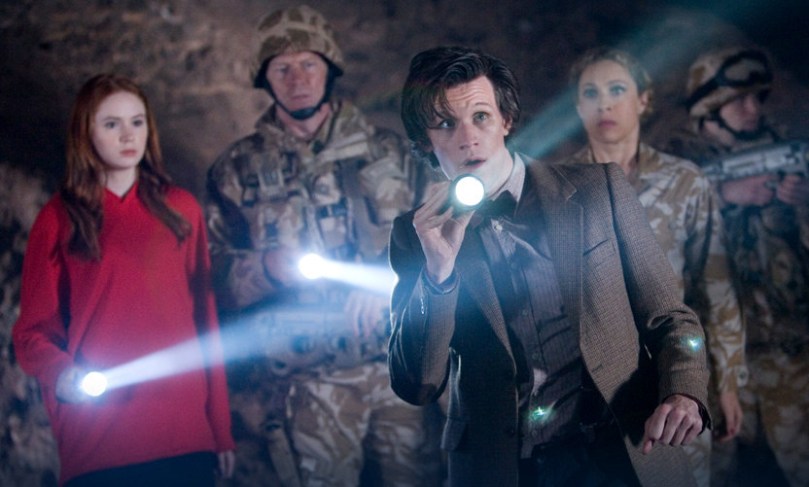
Timestamp #210: The Eleventh Hour

Doctor Who: The Eleventh Hour
(1 episode, s05e01, 2010)

Timestamp 210 The Eleventh Hour

Is this planet protected?

Before we get there, where were we? Oh, yeah…

“Geronimoooooooooooo!”

The TARDIS flies end-over-tea-kettle as the newly regenerated Eleventh Doctor hangs on for dear life. He nearly misses Big Ben before crawling back inside.

In 1996, a young girl named Amelia Pond prays to Santa Claus on Easter about a crack in her wall. When she asks for help to fix it, the TARDIS crash lands on her garden shed. Amelia ventures out to investigate and is surprised when the Doctor pops out of the time capsule with a grappling hook, having just climbed up from the library and now craving an apple.

He has a momentary spasm and breathes out a stream of golden regeneration energy. Despite still “cooking”, he promises to look at the crack in the wall. But first, food.

Apples? No good.

Yogurt? Same result.

Bacon? Nope.

Beans? They’re evil.

Bread and butter? Better as a frisbee.

Carrots? Not even one.

Fish fingers and custard? Perfection.

While the Doctor enjoys his new delicacy, he asks Amelia about her family. She has no parents, but lives with her Aunt Sharon. Her aunt is away and, as the Doctor notes, she’s quite the brave girl.

The Doctor ventures upstairs to look at that crack. Funny thing about that crack is that it would exist even if the wall was removed. It also has a voice, one which repeats “Prisoner Zero has escaped.”

He promises that everything is going to be fine before opening the crack with the sonic screwdriver. What he finds on the other end is a giant eyeball that sends him a message on the psychic paper before sealing the crack again. The Doctor muses about Prisoner Zero escaping through the crack into Amelia’s house, but before he can find it out of the corner of his eye, the Cloister Bell sounds. The Doctor rushes to the TARDIS to stabilize the engines. promising that he’ll just hop five minutes into the future to fix the issue and will be right back.

Amelia doesn’t believe him. Everyone says that they’ll be back, but they don’t come back.

As the TARDIS vanishes, Amelia runs up to her room and packs a bag. She runs downstairs (past the door that wasn’t open a second ago) and waits in the garden for the Doctor to return.

The TARDIS returns, with smoke pouring out of it in the broad daylight. The Doctor rushes in to find Amelia and Prisoner Zero, but instead takes a cricket bat to the face.

At a nearby hospital, nurse Rory Williams summons his supervisor, Dr. Ramsden, to inform her that every patient in the coma ward is asking for her. They all call out in unison: “Doctor!” He also shows her evidence that the coma patients have been walking about the village. She tells him to take some time away, starting now.

The Doctor wakes up chained to a radiator and facing a police officer. He asks the officer about Amelia Pond, but the officer tells him that she moved away six months ago. The officer calls for backup while the Doctor asks her to count the number of rooms on the floor. The officer counts five rooms, but the Doctor proves that there are six. The extra room is guarded by a perception filter, and the officer goes to check it out while the Doctor protests.

He asks her to find his screwdriver, which has now entered the room and jumped up on the table. Prisoner Zero stalks her around the room, but the Doctor tells her not to look at it. Unfortunately, she looks it in the eye and rushes out. The Doctor works on the handcuffs with the sonic screwdriver while the officer reveals that she’s really a “kiss-o-gram”.

The door opens to reveal a man with a dog. The same man is in the coma ward at the hospital. As the Doctor and the woman stall for time, a voice announces that the house is surrounded and will incinerate the house if Prisoner Zero doesn’t surrender.

The Doctor and the woman run for the TARDIS, but the time capsule is still rebuilding. The Doctor spots the garden shed and realizes that he’s not five minutes in Amelia’s future. In fact, he’s twelve years late, and the woman is Amy Pond.

As they move through the village, they find that everything with a speaker is repeating the same message: “Prisoner Zero will vacate the human residence, or the human residence will be incinerated.” They rush into the nearest house, which belongs to Amy’s friend Jeff Angelo and his grandmother. There they discover that the message is being broadcast worldwide in every human language. The Doctor also finds out that Amy has been drawing the Doctor – the raggedy man – since she was a child.

The Doctor deduces that they have about twenty minutes before the Atraxi arrive and destroy the world. Sure enough, there’s a fleet of giant eyeballs in orbit.

The Doctor is not amused when he finds out that he’s effectively trapped in Leadworth. He also notes that he’s still cooking and not yet ready to tackle this emergency. Regardless, as he looks at the villagers all watching the sky change through their mobile phones, he notices Rory taking pictures of Prisoner Zero instead of the sky.

He also proves to Amy that he is the Doctor by handing her the apple with a smiling face that she gave him moments before he left her over a decade (or half an hour, depending on your point of view) prior.

With Amy on his side, the Doctor is introduced to Rory. He learns that Prisoner Zero is using coma patients – its kind needs a psychic link with a dormant mind – and signals the Atraxi with the sonic screwdriver. Unfortunately, the Doctor overloads and destroys the screwdriver before the Atraxi notice, so he’s forced think of another way to solve the problem in the next seventeen minutes.

Meanwhile, Prisoner Zero heads back to the hospital and kills Dr. Ramsden as she tries to rouse the coma patient.

The Doctor returns to Jeff’s house and takes his laptop to break into a conference call among the world’s top scientists. He proves his intellect by producing multiple scientific theories – including the “real” proof of Fermat’s theorem, which is the formula for faster-than-light travel – and a joke, then uses Rory’s phone to write a “slightly intelligent” virus that will turn every digital display in the world to “zero” at the same time. Basically, causing a worldwide inconvenience.

He uploads the virus to the internet, gives Jeff’s grandmother astronomer Patrick Moore’s phone number, and then advises Jeff to erase his internet history before the world notices him.

The Doctor rushes to join Amy and Rory at the hospital. Amy has used her kiss-o-gram police uniform to get past security, but encounters Prisoner Zero in the guise of a mother and twin daughters. The Doctor comes to rescue in a fire engine, breaking the ladder through a window and climbing into the coma ward.

The Doctor faces off against Prisoner Zero, learning that the cracks are spread throughout the universe. The Pandorica will open and silence will fall. Sounds ominous.

The clocks on the wall click to zeroes, sending a message worldwide to the Atraxi that Prisoner Zero is at the source of the computer virus, which is Rory’s phone. The Doctor reveals that he’s uploaded Rory’s photos of the coma patients, so Prisoner Zero shifts into the Doctor’s form with young Amelia through the psychic link with Amy.

The real Amy falls unconscious, and the Doctor speaks to her about the room with the perception filter, asking her to dream about it. When she does, Prisoner Zero’s true form is revealed and the prisoner is captured.

The Doctor then summons the Atraxi, telling them that they violated the Shadow Proclamation by threatening to burn a Level Five planet. He changes clothes, stealing them from the hospital like two of his predecessors, then heads to the roof.

The Doctor confronts the Atraxi as he finishes dressing, asking them a simple question: Is this world a threat?

The answer is no.

Are the people of the world guilty of any crimes under Atraxi law?

No.

Is this world protected?

Yes.

By whom? Oh, hey… it’s the Doctor.

He warns them to run, so they do. After the Atraxi leave, the TARDIS key glows and the Doctor rushes back to his blue box. When he enters he finds a whole new console room. He takes off to break the new time machine in, leaving Amy and Rory in the garden.

He returns as Amy dreams of being abandoned in the garden as a girl. The problem is that he’s been gone two years. She’s been dealing with abandonment issues for fourteen years. Despite that, he asks Amy to join him in the TARDIS to explore time and space.

She declines at first, so he shows her the console room. It’s a bit of a haphazard mess, but it’s still bigger on the inside. Despite still being in her nightie – there are plenty of clothes in the wardrobe – the Girl Who Waited agrees to go with him so long as the Doctor gets her back tomorrow “for stuff”.

Time being relative on the TARDIS, that shouldn’t be a problem, but the Doctor has a long history of missing the target.

The Doctor tells her that he needs a companion because he’s lonely. He also has a new sonic screwdriver (grown or built by the TARDIS, even) and is a Madman With a Box. With the ominous crack appearing on the scopes, the new pair bid farewell to Leadworth and hello to everything.

Oh, and that “stuff” for tomorrow? Yeah… Amy’s getting married. Presumably to Rory.


I love how whimsical young Amelia is, and I especially love how she maintains that whimsy into adulthood. All too often, kids have that wonder and eccentricity beat out of them by the systemic rigors of school, work, and growing up. But in Leadworth, thankfully, that’s simply not the way.

It’s obviously a defense mechanism for her, possibly to shield separation and abandonment anxieties based on how easily she spools out the line about how everyone says that they’ll be back, but they don’t come back. That led to one of the most heartbreaking moments in this entire episode as young Amelia Pond sat on her luggage in the cold garden and waited for her Raggedy Man to return.

The symbolism is not lost on me: Amelia prays (the Doctor is often referred to as a sort of god figure emerging from the TARDIS, a literal deus ex machina) to Santa Claus (a figure known for bestowing gifts and charity upon the deserving, much like the Doctor among those he meets) on Easter (a religious holiday centered on rebirth and resurrection). The fact that she asks for a policeman is just icing on the cake.

The scene that I come back to quite frequently is the “Hello. I’m the Doctor” sequence. The holographic projections of the previous ten (known) incarnations of the Doctor set the stage perfectly, almost like poetry, for Matt Smith to snug up his bow tie and set himself in the name.

I love seeing which images the producers select for scenes like this, but the Doctors flash by very fast. The creatures, on the other hand, include Cybermen, Daleks, a Pyrovile, the Empress of the Racnoss, the Ood,  the Hath, the Sontarans, the Sea Devils, the Sycorax, a Reaper, and a victim of the Vashta Nerada.

Finally, the new title theme was a bit off-putting at first, but I know from experience that it will grow on me. It’s quite the change from the variations from 2005 through 2009.

Even though the rules for the Timestamps Project allow for a +1 handicap for regeneration episodes, this story hardly needs it.

Rating: 5/5 – “Fantastic!”


UP NEXT – Doctor Who: The Beast Below

cc-break

The Timestamps Project is an adventure through the televised universe of Doctor Who, story by story, from the beginning of the franchise. For more reviews like this one, please visit the project’s page at Creative Criticality.

The Thing About Today – December 9

December 9, 2020
Day 344 of 366

December 9th is the 344th day of the year. It is Anna’s Day in Sweden and Finland, marking the day to start the preparation process of the lutefisk to be consumed on Christmas Eve, as well as a Swedish name day that celebrates all people named Anna.

In the United States, today is “celebrated” as National Pastry Day and Weary Willie Day.

I didn’t know that I already knew who Weary Willie was. More on that later.

Historical items of note:

  • In 1793, New York City’s first daily newspaper, the American Minerva, was established by Noah Webster.
  • In 1851, the first YMCA in North America was established in Montreal.
  • In 1868, the first traffic lights were installed outside the Palace of Westminster in London. Resembling railway signals, they used semaphore arms and were illuminated at night by red and green gas lamps.
  • In 1897, activist Marguerite Durand founded the feminist daily newspaper La Fronde in Paris.
  • In 1902, schoolteacher, actress and voice artist Margaret Hamilton was born. She is best known for her portrayal of the Wicked Witch of the West, and her Kansas counterpart Almira Gulch, in The Wizard of Oz from 1939.
  • In 1906, American admiral and computer scientist Grace Hopper was born. Among other computer science revolutions, she designed the COBOL programming language.
  • In 1919, chemist and academic William Lipscomb was born. He was a Nobel Prize-winning inorganic and organic chemist working in nuclear magnetic resonance, theoretical chemistry, boron chemistry, and biochemistry.
  • In 1922, actor Red Foxx was born.
  • In 1928, actor Dick Van Patten was born.
  • In 1934, actress Judi Dench was born.
  • In 1935, the Downtown Athletic Club Trophy, later renamed the Heisman Trophy, was awarded for the first time. The winner was halfback Jay Berwanger of the University of Chicago.
  • In 1941, actor, director, and producer Beau Bridges was born.
  • In 1952, actor and voice artist Michael Dorn was born.
  • In 1960, the first episode of Coronation Street, the world’s longest-running television soap opera, was broadcast in the United Kingdom.
  • In 1962, the Petrified Forest National Park was established in Arizona.
  • In 1965, the Kecksburg UFO incident occurred. A fireball was seen from Michigan to Pennsylvania, and witnesses reported something crashing in the woods near Pittsburgh.
  • Also in 1965, A Charlie Brown Christmas, the first in a series of Peanuts television specials, debuted on CBS.
  • In 1968, Douglas Engelbart gave what became known as “The Mother of All Demos”. He publicly debuted the computer mouse, hypertext, and the bit-mapped graphical user interface using the oN-Line System (NLS).
  • In 1972, actress Reiko Aylesworth was born.
  • In 1979, the eradication of the smallpox virus was certified, making smallpox the first of only two diseases that have been driven to extinction. The second was rinderpest, which was eradicated in 2011.
  • In 1997, the eighteenth James Bond film, Tomorrow Never Dies, premiered.
  • In 2002, the tenth Star Trek film, Star Trek: Nemesis, premiered.
  • In 2017, Star Wars: The Last Jedi, the eighth episode of the Skywalker Saga, premiered.

In 1898, American circus performer Emmett Leo Kelly was born.

Kelly was the performer who created the character of Weary Willie, a clown-like representation of the homeless vagrants of the Great Depression era. The character revolutionized the professional clowning industry by providing a contrast to the typical white-faced, brightly colored clowns.

The Weary Willie makeup is partially derived from the racist minstrel blackface makeup, and the white highlights around the mouth are the only traditional part of the “tramp clown” theme. The rest of the “tramp clown” theme depends on the performer, ranging in emotion from happy to angry and skills from juggling to cycling.

The cultural impact of the character and the man who created it are recognized annually on this date with Weary Willie Day.

The Thing About Today is an effort to look at each day of 2020 with respect to its historical context.

For more creativity with a critical eye, visit Creative Criticality.

The Thing About Today – December 8

December 8, 2020
Day 343 of 366

December 8th is the 343rd day of the year. It is the Day of Finnish Music, commemorating the 1865 birthdate of Jean Sibelius, widely recognized as his country’s greatest composer and, through his music, often credited with having helped Finland to develop a national identity during its struggle for independence from Russia.

In the United States, today is “celebrated” as National Brownie Day and Pretend to Be A Time Traveler Day.

The origins of Pretend to Be a Time Traveler Day are detailed in this Geek USA post.

Historical items of note:

  • In 1660, a woman appeared on an English public stage for the first time, in the role of Desdemona in a production of Shakespeare’s play Othello.
  • In 1813, Beethoven’s Seventh Symphony premiered in Vienna.
  • In 1861, French filmmaker George Méliès was born.
  • In 1863, President Abraham Lincoln issued the Proclamation of Amnesty and Reconstruction, formally establishing the process of Reconstruction.
  • In 1925, actor, singer, and dancer Sammy Davis, Jr. was born.
  • In 1936, actor, director, and producer David Carradine was born.
  • In 1947, astrophysicist, astronomer, and academic Margaret Geller was born. Her work has included pioneering maps of the nearby universe, studies of the relationship between galaxies and their environment, and the development and application of methods for measuring the distribution of matter in the universe.
  • In 1950, actor and makeup artist Rick Baker was born.
  • In 1953, actress Kim Basinger was born.
  • In 1964, actress Teri Hatcher was born.
  • In 1965, actor David Harewood was born.
  • In 1980, former Beatle John Lennon was murdered by Mark David Chapman in front of The Dakota in New York City.
  • In 2010, with the second launch of the Falcon 9 and the first launch of the Dragon, SpaceX became the first private company to successfully launch, orbit, and recover a spacecraft.
  • In 2013, Metallica performed a show in Antarctica, making them the first band to perform on all seven continents.

December 8th is Hari-Kuyō (針供養) in the Kyoto and Kansai regions of Japan.

The event is the Japanese Buddhist and Shinto Festival of Broken Needles, celebrated by women in Japan as a memorial to all the sewing needles broken in their service during the past year, as well as an opportunity to pray for improved skills. It is typically celebrated on February 8th in the Kanto region.

Hari-Kuyō began four hundred years ago as a way for housekeepers and professional needle-workers to acknowledge their work over the past years and respect their tools. In the animist traditions, items as well as humans, animals, plants, and objects are considered to have souls. This festival acknowledged the good given to people by their tools. Practitioners went to Shinto shrines and Buddhist temples to thank their broken needles for their help and service.

The Thing About Today is an effort to look at each day of 2020 with respect to its historical context.

For more creativity with a critical eye, visit Creative Criticality.

The Thing About Today – December 7

December 7, 2020
Day 342 of 366

December 7th is the 342nd day of the year. It is International Civil Aviation Day, a United Nations day to recognize the importance of aviation, especially international air travel, to the social and economic development of the world.

In the United States, today is “celebrated” as National Illinois Day and National Cotton Candy Day.

Historical items of note:

  • In 1732, the Royal Opera House opened at Covent Garden, London, England.
  • In 1787, Delaware became the first state to ratify the United States Constitution.
  • In 1842, the first concert of the New York Philharmonic was performed. It was founded by Ureli Corelli Hill.
  • In 1915, author and screenwriter Leigh Brackett was born. Known for her work on such films as The Big Sleep (1946), Rio Bravo (1959) and The Long Goodbye (1973), she also worked on an early draft of The Empire Strikes Back (1980). Elements of her work remained in the film, but she died before the film went into production. She was the first woman shortlisted for the Hugo Award, and in 2020, she won a Retro Hugo for her novel The Nemesis From Terra, originally published as “Shadow Over Mars” in Startling Stories (Fall 1944).
  • In 1930, W1XAV in Boston, Massachusetts telecasted video from the CBS radio orchestra program, The Fox Trappers. The telecast also included the first television commercial in the United States, an advertisement for I.J. Fox Furriers, who sponsored the radio show.
  • In 1932, German-born Swiss physicist Albert Einstein was granted an American visa.
  • Also in 1932, actress Ellen Burstyn was born.
  • In 1965, actor Jeffrey Wright was born.
  • In 1966, actor, director, producer, and screenwriter C. Thomas Howell was born.
  • In 1972, Apollo 17, the last Apollo moon mission, was launched. The crew took the photograph known as The Blue Marble as they left the Earth.
  • In 1978, actress, director, and producer Shiri Appleby was born.
  • In 1979, Star Trek: The Motion Picture premiered. It marked the transition of the landmark American science fiction television series to the silver screen.
  • In 1989, actor Nicholas Hoult was born.
  • In 1995, the Galileo spacecraft arrived at Jupiter, a little more than six years after it was launched by Space Shuttle Atlantis during Mission STS-34.
  • In 2017, the Marriage Amendment Bill to legally recognize same-sex marriages was passed in Australia’s parliament.

On December 7, 1941, the Imperial Japanese Navy Air Service launched a surprise attack on the naval base at Pearl Harbor, Honolulu, Hawaii.

In total, 353 Imperial Japanese aircraft, including fighters, level and dive bombers, and torpedo bombers were launched in two waves from six aircraft carriers. Eight United States Navy battleships were present and all were damaged. Four of them were sunk, and all but USS Arizona were later raised. Six of the battleships were returned to service and went on to fight in World War II.

The Japanese also sank or damaged three cruisers, three destroyers, an anti-aircraft training ship, and one minelayer. A total of 188 United States aircraft were destroyed, and 2,403 Americans were killed and 1,178 others were wounded. Important base installations were not attacked.

Japanese losses were light in comparison: 29 aircraft and five midget submarines lost, and 64 servicemen killed. Kazuo Sakamaki, the commanding officer of one of the submarines, was captured.

Japan declared war on the United States later in the day, though the declaration was not formally delivered until the following day. On December 8th, the United States declared war on Japan. There were numerous historical precedents for the unannounced military action by Japan, but the lack of any formal warning, particularly while peace negotiations were still apparently ongoing, led President Franklin D. Roosevelt to proclaim the day “a date which will live in infamy”.

Mr. Vice President, Mr. Speaker, members of the Senate and the House of Representatives: Yesterday, December 7th, 1941—a date which will live in infamy—the United States of America was suddenly and deliberately attacked by naval and air forces of the Empire of Japan.

The United States was at peace with that nation, and, at the solicitation of Japan, was still in conversation with its Government and its Emperor looking toward the maintenance of peace in the Pacific. Indeed, one hour after Japanese air squadrons had commenced bombing in the American island of Oahu, the Japanese Ambassador to the United States and his colleague delivered to our Secretary of State a formal reply to a recent American message. And while this reply stated that it seemed useless to continue the existing diplomatic negotiations, it contained no threat or hint of war or of armed attack.

It will be recorded that the distance of Hawaii from Japan makes it obvious that the attack was deliberately planned many days or even weeks ago. During the intervening time the Japanese Government has deliberately sought to deceive the United States by false statements and expressions of hope for continued peace.

The attack yesterday on the Hawaiian Islands has caused severe damage to American naval and military forces. I regret to tell you that very many American lives have been lost. In addition American ships have been reported torpedoed on the high seas between San Francisco and Honolulu.

Yesterday the Japanese Government also launched an attack against Malaya.

Last night Japanese forces attacked Hong Kong.

Last night Japanese forces attacked Guam.

Last night Japanese forces attacked the Philippine Islands.

Last night the Japanese attacked Wake Island.

And this morning the Japanese attacked Midway Island.

Japan has, therefore, undertaken a surprise offensive extending throughout the Pacific area. The facts of yesterday and today speak for themselves. The people of the United States have already formed their opinions and well understand the implications to the very life and safety of our nation.

As Commander-in-Chief of the Army and Navy, I have directed that all measures be taken for our defense.

But always will our whole nation remember the character of the onslaught against us. No matter how long it may take us to overcome this premeditated invasion, the American people in their righteous might will win through to absolute victory.

I believe that I interpret the will of the Congress and of the people when I assert that we will not only defend ourselves to the uttermost but will make it very certain that this form of treachery shall never again endanger us.

Hostilities exist. There is no blinking at the fact that our people, our territory and our interests are in grave danger.

With confidence in our armed forces—with the unbounding determination of our people—we will gain the inevitable triumph—so help us God.

I ask that the Congress declare that since the unprovoked and dastardly attack by Japan on Sunday, December 7th, 1941, a state of war has existed between the United States and the Japanese Empire.


—President Franklin D. Roosevelt addressing a joint session of Congress on December 8, 1941

Because the attack happened without a declaration of war and without explicit warning, the attack on Pearl Harbor was later judged in the Tokyo Trials to be a war crime.

On December 11th, Germany and Italy each declared war on the United States, which responded with a declaration of war against Germany and Italy. Just over two years after World War II began, the United States was forced to engage.

In 1994, the United States Congress designated December 7th of each year as National Pearl Harbor Remembrance Day. The joint resolution was signed by President Bill Clinton on August 23, 1994.

The Thing About Today is an effort to look at each day of 2020 with respect to its historical context.

For more creativity with a critical eye, visit Creative Criticality.

The Thing About Today – December 6

December 6, 2020
Day 341 of 366

December 6th is the 341st day of the year. It is Independence Day in Finland as they celebrate their independence from Russia in 1917.

In the United States, today is “celebrated” as National Pawnbrokers Day, National Microwave Oven Day, National Gazpacho Day, St. Nicholas Day, and Miners’ Day.

Historical items of note:

  • In 1790, the United States Congress moved from New York City to Philadelphia.
  • In 1865, Georgia ratified the Thirteenth Amendment to the United States Constitution, which abolished slavery and involuntary servitude, except as punishment for a crime. Georgia was the last the required 27 of the then 36 states required for ratification.
  • In 1877, the first edition of The Washington Post was published.
  • In 1896, songwriter Ira Gershwin was born.
  • In 1897, London became the world’s first city to host licensed taxicabs.
  • In 1912, the Nefertiti Bust was discovered.
  • In 1921, the Anglo-Irish Treaty was signed in London by British and Irish representatives.
  • In 1922, one year to the day after the signing of the Anglo-Irish Treaty, the Irish Free State came into existence.
  • In 1933, United States federal judge John M. Woolsey ruled that James Joyce’s novel Ulysses was not obscene.
  • In 1947, the Everglades National Park in Florida was dedicated.
  • In 1948, actress JoBeth Williams was born.
  • In 1957, the launchpad explosion of Vanguard TV3 thwarted the first United States attempt to launch a satellite into Earth orbit.
  • In 1969, Canadian actress Torri Higginson was born.
  • In 1975, English actor, director, and screenwriter Noel Clarke was born.
  • In 1991, Star Trek VI: The Undiscovered Country premiered.
  • In 1999, the Recording Industry Association of America sued the peer-to-peer file-sharing service Napster, alleging copyright infringement.
  • In 2006, NASA revealed photographs taken by Mars Global Surveyor suggesting the presence of liquid water on Mars.

December 6th is National Day of Remembrance and Action on Violence Against Women.

Also known as White Ribbon Day, the day is commemorated in Canada on the anniversary of the 1989 École Polytechnique massacre, in which armed student Marc Lépine murdered fourteen women and injured ten others in the name of “fighting feminism”.

The commemoration date was established by the Parliament of Canada in 1991. Canadian flags on all federal buildings, including the Peace Tower on Parliament Hill in Ottawa, Ontario, are flown at half-mast. Canadians are also encouraged to observe a minute of silence and wear white or purple ribbons to share the commitment to end violence against women.

The day is aimed to examine the power dynamics between men and women, and tries to ensure that the National Day of Remembrance and Action on Violence Against Woman stands for more than simply one massacre. Instead, it stands for awareness and change against the violence that occurs to women all around the world at the hands of men. Thirty-five percent of women worldwide have experienced physical and/or sexual intimate partner violence or non-partner sexual violence, according to the United Nations.

This day stands for change and for awareness of the power dynamic existing between men and women all over the world.

The Thing About Today is an effort to look at each day of 2020 with respect to its historical context.

For more creativity with a critical eye, visit Creative Criticality.

The Thing About Today – December 5

December 5, 2020
Day 340 of 366

December 5th is the 340th day of the year. It is World Soil Day, a day to focus attention on the importance of healthy soil and to advocate for the sustainable management of soil resources.

In the United States, today is “celebrated” as National Sacher Torte Day, Bathtub Party Day, International Ninja Day, National Repeal Day, National Rhubarb Vodka Day, and Skywarn Recognition Day. The last two are typically observed on the first Saturday in December.

I didn’t know about Skywarn Recognition Day. It recognizes the vital public service contributions that Amateur Radio operators make during National Weather Service severe weather warning operations. It also strengthens the bond between Amateur Radio operators and the local National Weather Service.

Historical items of note:

  • In 1766, auctioneer James Christie held his first sale in London.
  • In 1831, former United States President John Quincy Adams took his seat in the House of Representatives. He remains the only former President to be elected to the chamber, although John Tyler was elected as a Confederate representative and died before being seated.
  • In 1890, Austrian-American director, producer, and screenwriter Fritz Lang was born.
  • In 1901, animator, director, producer, and screenwriter Walt Disney was born. He co-founded the Walt Disney Company.
  • Also in 1901, German physicist and academic Werner Heisenberg was born. A theoretical physicist and one of the key pioneers of quantum mechanics, he is known for the uncertainty principle, which he published in 1927. He was awarded the 1932 Nobel Prize in Physics “for the creation of quantum mechanics”, and is also known for important contributions to the theories of the hydrodynamics of turbulent flows, the atomic nucleus, ferromagnetism, cosmic rays, and subatomic particles.
  • In 1926, Adetowun Ogunsheye was born. She was the first female Nigerian professor and university dean.
  • In 1932, singer-songwriter, pianist, and actor Little Richard was born.
  • In 1933, the Twenty-First Amendment to the United States Constitution was ratified. It repealed the Eighteenth Amendment to the United States Constitution, which had mandated nationwide prohibition on alcohol.
  • In 1949, English composer and conductor John Altman was born.
  • In 1955, E. D. Nixon and Rosa Parks led the Montgomery bus boycott.
  • In 1958, Subscriber Trunk Dialling (STD) was inaugurated in the United Kingdom by Queen Elizabeth II when she spoke to the Lord Provost in a call from Bristol to Edinburgh.
  • In 1975, actress Paula Patton was born.
  • In 1976, actress Amy Acker was born.
  • In 2004, the Civil Partnership Act came into effect in the United Kingdom, and the first civil partnership was registered as a result.

December 5th is Saint Nicholas’ Eve in Belgium, Czech Republic, Slovakia, the Netherlands, Hungary, Romania, Germany, Poland and the United Kingdom. It is also Krampusnacht in Austria.

Saint Nicholas is the patron saint of children. The legendary figure Sinterklaas is based on Saint Nicholas, and is also known as Sint-Nicolaas, De Sint (“The Saint”), De Goede Sint (“The Good Saint”), and De Goedheiligman (“The Good Holy Man”) in Dutch; Sanikolas in Papiamento; Saint Nicolas in French; Sinteklaas in West Frisian; Sinterklaos in Limburgs; Saint-Nikloi in West Flemish; Kleeschen and Zinniklos in Luxembourgish; Sankt Nikolaus or Nikolaus in German; and Sint Nicholas in Afrikaans. Sinterklaas is also one of the primary sources of the Christmas icon Santa Claus.

The feast of Sinterklaas celebrates the name day of Saint Nicholas on December 6th, and part of that celebration is the giving of gifts on Saint Nicholas’ Eve on December 5th.

December 5th is also Krampusnacht, during which a wicked hairy devil named Krampus sometimes accompanies Saint Nicholas. Saint Nicholas concerns himself only with the good children, while Krampus is responsible for the bad. Nicholas dispenses gifts, while Krampus supplies coal and the Ruten bundles.

The Thing About Today is an effort to look at each day of 2020 with respect to its historical context.

For more creativity with a critical eye, visit Creative Criticality.

The Thing About Today – December 4

December 4, 2020
Day 339 of 366

December 4th is the 339th day of the year. It is Tupou I Day in Tonga, commemorating King George Tupou I’s installation as Tuʻi Kanokupolu in 1845.

In the United States, today is “celebrated” as National Cookie Day, National Dice Day, National Sock Day, Faux Fur Friday, and National Bartender Day. The last two are typically observed on the first Friday in December.

Historical items of note:

  • In 1783, at Fraunces Tavern in New York City, General George Washington bid farewell to his officers.
  • In 1786, Mission Santa Barbara was dedicated in what would become Santa Barbara, California. This happened on the feast day of Saint Barbara.
  • In 1791, the first edition of The Observer, the world’s first Sunday newspaper, was published.
  • In 1872, the crewless American brigantine Mary Celeste, adrift in the Atlantic, was discovered by the Canadian brig Dei Gratia. The ship had been abandoned for nine days but was only slightly damaged. Her master Benjamin Briggs and all nine others known to have been on board were never accounted for.
  • In 1881, the first edition of the Los Angeles Times was published.
  • In 1924, architect John C. Portman, Jr. was born. He designed the Renaissance Center and Tomorrow Square. He also had a particularly large impact on the cityscape of his hometown of Atlanta, with the Peachtree Center complex serving as downtown’s business and tourism anchor from the 1970s onward. The Peachtree Center area includes the Portman-designed Hyatt, Westin, and Marriott hotels, as well as the nearby AmericasMart.
  • In 1925, photographer and film title designer Maurice Binder was born. He is best known for his title credit sequences for the James Bond films.
  • In 1945, by a vote of 65-7, the United States Senate approved United States participation in the United Nations. The UN had been established on October 24th of the same year.
  • In 1949, actor Jeff Bridges was born.
  • In 1954, the first Burger King was opened in Miami, Florida.
  • Also in 1954, actor and producer Tony Todd was born.
  • In 1956, the Million Dollar Quartet of Elvis Presley, Jerry Lee Lewis, Carl Perkins, and Johnny Cash got together at Sun Studio for the first and last time.
  • In 1964, actress Marisa Tomei was born.
  • In 1991, Pan American World Airways (Pan Am) ceased its operations after 64 years.

December 4th is National Cookie Day.

Cookies appear to have come from 7th century AD Persia, rising shortly after the use of sugar became relatively common in the region. They spread to Europe through the Muslim conquest of Spain. By the 14th century, they were common in all levels of society throughout Europe, from royal cuisine to street vendors.

As global travel became more widespread, cookies made a natural travel companion like travel cakes have been throughout history. One of the most popular early cookies, which traveled especially well and became known on every continent by similar names, was the jumble, a relatively hard cookie made largely from nuts, sweetener, and water.

Cookies came to the Americas through the Dutch in New Amsterdam in the late 1620s. The Dutch word “koekje” was Anglicized to “cookie” or cooky. The earliest reference to cookies in what would become the United States was in 1703.

The most common modern cookie, given its style by the creaming of butter and sugar, was not common until the 18th century.

The Thing About Today is an effort to look at each day of 2020 with respect to its historical context.

For more creativity with a critical eye, visit Creative Criticality.

The Thing About Today – December 3

December 3, 2020
Day 338 of 366

December 3rd is the 338th day of the year. It is Doctors’ Day in Cuba.

In the United States, today is “celebrated” as National Roof Over Your Head Day.

Historical items of note:

  • In 1775, USS Alfred became the first vessel to fly the Grand Union Flag, which was the precursor to the Stars and Stripes. The flag was hoisted by John Paul Jones.
  • In 1800, the Presidential Election resulted in an Electoral College tie between Thomas Jefferson and Aaron Burr. The House of Representatives convened a contingent election during which each state delegation cast one vote, and a victory in the contingent election required one candidate to win a majority of the state delegations. Neither candidate was able to win on the first 35 ballots of the contingent election. Most Federalist Congressmen backed Burr and all Democratic-Republican Congressmen backed Jefferson. Alexander Hamilton favored Jefferson over Burr, and he convinced several Federalists to switch their support to Jefferson. This gave Jefferson a victory on the 36th ballot of the contingent election.
  • In 1842, businessman Charles Alfred Pillsbury was born. He founded the Pillsbury Company.
  • In 1857, Polish-born British novelist Joseph Conrad was born. He is regarded as one of the greatest novelists to write in the English language. Though he did not speak English fluently until his twenties, he was considered a master prose stylist who brought a non-English sensibility into English literature.
  • In 1904, the Jovian moon Himalia was discovered by Charles Dillon Perrine at California’s Lick Observatory.
  • In 1910, modern neon lighting was first demonstrated by Georges Claude at the Paris Motor Show.
  • In 1927, Putting Pants on Philip, the first Laurel and Hardy film, was released.
  • In 1960, the musical Camelot debuted at the Majestic Theatre on Broadway. It would become associated with the Kennedy administration.
  • Also in 1960, actress and producer Daryl Hannah was born.
  • Also in 1960, actress and author Julianne Moore was born.
  • In 1968, actor and producer Brendan Fraser was born.
  • In 1973, Pioneer 10 sent back the first close-up images of Jupiter.
  • In 1981, actor Brian Bonsall was born.
  • In 1992, a test engineer for Sema Group used a personal computer to send the world’s first text message via the Vodafone network to the phone of a colleague.
  • In 1994, the PlayStation video game console, developed and marketed by Sony Computer Entertainment, was released in Japan.
  • In 1999, NASA lost radio contact with the Mars Polar Lander moments before the spacecraft entered the Martian atmosphere.
  • In 2005, XCOR Aerospace made the first manned rocket aircraft delivery of U.S. Mail in Kern County, California.
  • In 2014, the Japanese space agency, JAXA, launched the space explorer Hayabusa2 from the Tanegashima Space Center on a six-year round trip mission to an asteroid to collect rock samples.

December 3rd is the International Day of Persons with Disabilities.

It is an international observance promoted by the United Nations since 1992. It has been observed with varying degrees of success around the planet.

The goal is to promote an understanding of disability issues and mobilize support for the dignity, rights, and well-being of persons with disabilities. It also seeks to increase awareness of gains to be derived from the integration of persons with disabilities in every aspect of political, social, economic and cultural life.

It was originally called “International Day of Disabled Persons” until 2007.

The Thing About Today is an effort to look at each day of 2020 with respect to its historical context.

For more creativity with a critical eye, visit Creative Criticality.

Timestamp: Tenth Doctor Specials and Tenth Doctor Summary

Doctor Who: Tenth Doctor Specials and Tenth Doctor Summary

The Tenth Doctor Specials were a great but short run.

The grouping ran from December 2008 to January 2010 – effectively, the year of 2009 – and helped to create David Tennant’s farewell tour. It was accompanied by the Doctor Who Prom (which included a mini-episode called Music of the Spheres) and The Wedding of Sarah Jane Smith.

It was unique for exploring the darker side of the Tenth Doctor, following from the bittersweet victory of Journey’s End and evolving on what started in The Runaway Bride and the concept of the Time Lord’s unrestrained power.

In some fan circles, these episodes are looked down upon because they are so different in spirit from the zany friendly nature of the previous three series. I feel that they perform a great service in terms of a war veteran who is trying to make amends for the things he’s done while trying desperately to avoid any further destruction.

That’s where we are with The Next Doctor and Planet of the Dead. The Doctor has just lost Donna and closed the loop with Rose, and that cuts him to the quick. By the time we reach The Waters of Mars, he’s been traveling for a while without a companion, which we have seen established before as a really bad thing for him. Without the balance of a companion, the Doctor believes that he can solve anything with his power as the last of the Time Lords.

All of this culminates in his temper tantrum at the time of his fatal radiation exposure in The End of Time. He wants to do so much more. In fact, he needs to. It is a primal, emotional necessity to make up for whatever he did in the Time War. He still does the right thing in saving Wilf, and then turns his need on its head by using his remaining time to help those he loves.

In that, the Doctor is redeemed for his flirtations with darkness Time Lord Victorious, and presumably for his role in the Time War. He’s done so much good that maybe, just maybe, he can finally rest.

From that perspective, I love this set of stories with the exceptions that I have previously noted. Particularly with the portrayal of the Master in The End of Time.


The Tenth Doctor Specials collection comes in at an average of 4.4. That’s fourth all-time for the Timestamps Project, coming in behind the classic Ninth Series, the new era’s Series Four, and the Eighth Doctor’s run. It’s just ahead of both Series One and Series Three.

The Next Doctor – 4
Planet of the Dead – 5
The Waters of Mars – 5
Dreamland – 3
The End of Time – 5

Tenth Doctor Specials (Revival Era) Average Rating: 4.4/5


Timestamp Tenth Doctor

Following tradition…

The First Doctor was a wise grandfather, the Second a sly jester, the Third a secret agent scientist, the Fourth an inquisitive idealist, the Fifth an honorable humanitarian, the Sixth a squandered cynic, the Seventh a curious schemer, the Eighth a classical romantic, the Ninth a hopeful healing veteran…

…and the Tenth Doctor is a bargaining humanitarian.

The Tenth Doctor continues the work of the Ninth on Kübler-Ross model of grief. The Ninth worked through Denial and Anger, while the Tenth Doctor picked up with Bargaining and worked into Depression (with added bits of Anger since, let’s face it, this model is not perfectly linear).

He tried to stop the bad things from happening, always looking for a way out. But when those bad things finally happened, he was so very sorry. As mentioned before, he was always looking to even the score for watching Gallifrey burn, and he wanted to do so much more before his death.

We can only hope that the Eleventh Doctor finds Acceptance.

I started watching Doctor Who with the Ninth Doctor back in 2008, but the Tenth was always “my” Doctor. Watching these stories again with the full context of the franchise behind me has been a joy.


Series 2 – 4.1
Series 3 – 4.3
Series 4 – 4.6
Specials – 4.4

Tenth Doctor’s Weighted Average Rating: 4.34

Ranking (by score)
1 – Eighth (4.50)
2 – Tenth (4.34)
3 – Ninth (4.30)
4 – Third (4.00)
5 – Second (3.67)
6 – Fourth (3.67)
7 – Seventh (3.54)
8 – First (3.41)
9 – Fifth (3.20)
10 – Sixth (2.73)

Ranking (by character)
1 – Tenth Doctor
2 – Second Doctor
3 – Ninth Doctor
4 – Eighth Doctor
5 – Third Doctor
6 – Fourth Doctor
7 – Seventh Doctor
8 – First Doctor
9 – Fifth Doctor
10 – Sixth Doctor

I’ve mentioned this before: Those top seven spaces on the character ranking are really, really, really close. I have been tempted to make them a a tie for first place since I would gladly watch any of those stories at any time, but that would be taking the easy way out. It’s far more challenging to actually rank them.


Next up, we change Doctors and showrunners.

UP NEXT – Doctor Who: The Eleventh Hour

cc-break

The Timestamps Project is an adventure through the televised universe of Doctor Who, story by story, from the beginning of the franchise. For more reviews like this one, please visit the project’s page at Creative Criticality.