
Timestamp #205: The Next Doctor

Doctor Who: The Next Doctor
(Christmas Special, 2008)
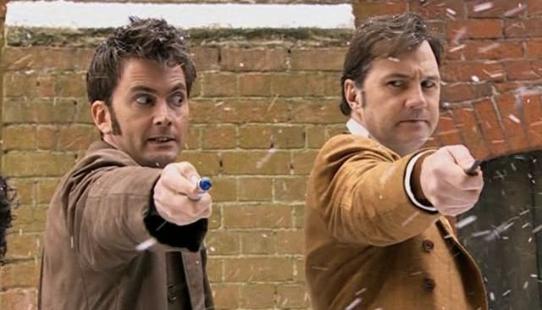
 

The Doctor who wasn’t really the Doctor.

The TARDIS materializes under an archway in a snowstorm. The Doctor strides out with a smile on his face, happy to be in London for Christmas in 1851. His joy is interrupted by someone screaming “Doctor!”, and he finds a growling creature behind a door wearing a copper Cyberman mask, a frantic woman, and a man claiming to be the Doctor.

This other Doctor, armed with his own “sonic” screwdriver, tries to lasso the primitive assimilation as it runs up a wall. The Tenth Doctor grabs on and the pair finds themselves dragged along until companion Rosita cuts the rope with a hatchet. The Doctors laugh about their adventure while Rosita chides them. While she goes to check the traps, the Doctor rambles along, mistakenly believing that the other Doctor is a future regeneration. He soon figures out that the other Doctor has memory loss, something that happened just before the Cybermen arrived.

The Tenth Doctor adopts the John Smith alias as the other Doctor rushes off to a funeral.

The Cybermen, led by a new Cyber Leader and a human ally named Mercy Hartigan, review the Cybershade’s surveillance footage while they prepare for the rise of the Cyber King. These Cybermen are the Pete’s World variety, somehow left behind when the worlds merged.

The other Doctor and Rosita observe the funeral procession of Reverend Aubrey Fairchild before springing into action. Rosita heads to the “TARDIS” while the other Doctor investigates the house of the deceased. He’s joined by Mr. Smith, and he explains that the Cybermen presence is linked to a number of murders and child abductions across the city. The rash of crimes started with the death of a man named Jackson Lake and have led to the reverend’s demise by some advanced form of electrocution.

The pair find a pair of infostamps, one of which contains the history of London from 1066 to 1851. The other Doctor has a flashback to his “regeneration” and memory of another infostamp. They also uncover a Cyberman home invasion and have to run. While they flee, John Smith reveals himself as the real Doctor and the other Doctor bypasses the safeties on the infostamp to overload the pursuing Cybermen.

The other Doctor is troubled by the happenings. The Doctor promises to help him.

At the reverend’s graveside service, Miss Hartigan crashes the proceedings with an admission: The reverend had to die in order to get the mourners in one place. She dispatches the Cybermen to attack them, sparing only a few as the rest are deleted.

The Doctors return to Rosita’s side at their home base. Jackson Lake’s belongings are stacked by the wall, kept as evidence of his disappearance, and the Tenth Doctor finds another infostamp in the luggage. The other Doctor shows off his TARDIS – a gas balloon, fueled by the local gasworks for a substantial fee, long-form called Tethered Aerial Release Developed In Style – and dreams of flying it one day.

The Doctor now knows that this man is not him. He shares the story of the Battle of Canary Wharf, presuming that some of the survivors fell through time and landed in London, 1851. He draws the parallels between Jackson Lake and the man’s memories, even showing him the JL inscription on his fob watch. The man, truly Jackson Lake, was flashed with an infostamp that contained all of the Cybermen’s information the Doctor, thus side-booting his brain with an alternate identity.

There’s still one missing piece that Jackson can’t remember, but the Doctor helps him remember based on the amount of luggage on hand: Jackson remembers how the Cybermen invaded his home and killed his wife Caroline. His fugue state ends as he breaks down in tears.

While Jackson Lake mourns and is consoled by Rosita, the infostamps start to chime. The Doctor finds a whole cache of them and realizes that the Cybermen are on the move. The Doctor rushes out, and Jackson sends Rosita after him.

Miss Hartigan fits her survivors with Cyberman EarPods and uses them to fulfill tasks for her. The Doctor and Rosita find the survivors marching children from their workhouses and orphanages to the River Thames. The procession is guarded by Cybershades and Cybermen, and it ends at the court of the Cyber King.

The Doctor and Rosita are ambushed by Miss Hartigan and the Cybermen. The Cybermen don’t recognize the Doctor because of the corrupted data on the infostamp, but they repair it. The Cybermen march on the Doctor and Rosita, but are stopped by Jackson Lake and his cache of infostamps. The trio run (after Rosita sucker punches Miss Hartigan!) and Jackson reveals that his cellar may be a gateway into their operations.

Miss Hartigan, in it for her own social liberation from this patriarchal society, takes control of the child workforce after killing the EarPod-clad men. Meanwhile, the Doctor’s trio finds a Dimension Vault in Jackson’s cellar. The Cybermen used the Dalek technology to travel through time and escape the Void. They follow the tunnels to the enemy base as the Cybermen attempt to convert Miss Hartigan and provide her liberation (from her anger and rage) as their Cyber King.

Unfortunately for them, she’s too strongwilled for conversion. Her mind is too powerful to control, and she uses her new powers to obliterate the Cyber Leader when it tries to intervene.

The conversion has also moved up the CyberKing’s timetable. Since they’re no longer needed, the Cybermen try to delete the children, but the Doctor and Rosita free them instead. While the children run, Jackson remembers that the Cybermen had also abducted his son, and he finds the boy among the workforce. Unfortunately, Frederic is trapped on a ledge, so the Doctor swashbuckles his way up and rescues him.

As the base ignites around them, the Doctor, Jackson, and Frederic run. Outside, a giant mechanical CyberKing rises from the Thames with Miss Hartigan on the throne, ready to convert millions into Cybermen as it rampages through London. Jackson, Frederic, and Rosita rush to safety.

The Doctor grabs the Dimension Vault and uses the “TARDIS” balloon to look the CyberKing in the eye. He offers Miss Hartigan one last chance at mercy, extending the opportunity for the Cybermen to travel using the Dimension Vault to a place where they can live in peace. She rejects him, so he uses the cache of infostamps against her. The assault breaks the cyber connection and leaves her mind open to see what she’s become. The shock and terror of her reasserted humanity destroys all of the Cybermen, leaving the giant automaton to stumble about until the Doctor uses the Dimension Vault to transport it into the time vortex where it will be disintegrated.

Jackson Lake addresses the onlookers and rallies them to cheer for the Doctor as he drifts above the city. Later on, they discuss the Lake family’s future, including Rosita as Frederic’s new nursemaid. The Doctor offers Jackson a look inside the real TARDIS. Jackson is amazed by the sight, but Jackson has had quite enough adventure. He asks the Doctor about his companions, to which the Doctor turns maudlin.

Jackson offers the Doctor a Christmas dinner in honor of all those that they’ve lost. The Doctor accepts.


I’m of two minds about this story. The Jackson Lake mystery is simultaneously amusing and tragic, adding a compelling throughline to the Cyberman invasion plot. The flip side is that the climax of the Cyberman story – the Pacific Rim-style CyberKing – is utterly ridiculous.

It’s a shame, really, because this story balloon really flies along until the cyber-mech lets the air right out.

There are some good but minor things that help tie things off:

The infostamp memory files of the Doctor’s lives come from The Time Meddler, The Ice Warriors, Terror of the Autons, City of Death, Arc of Infinity, The Mysterious Planet, Time and the Rani, Doctor Who (The Movie), The Parting of the Ways, and The Family of Blood, none of which are actuallyCyberman stories. The War Doctor does not appear in the library files, which makes sense from a production standpoint, but doesn’t quite jive from an internal chronological standpoint.

Finally, I also love the character development as the Tenth Doctor considers that his time may be coming to an end. He’s excited to think that he won’t be the last of his regenerations, and his joy is infectious.

I just wish that the cyber jaeger hadn’t been a thing.


Rating: 4/5 – “Would you care for a jelly baby?”


Keeping in mind that the Timestamps Project is following the franchise chronologically at this point…

UP NEXT – Sarah Jane Adventures: From Raxacoricofallapatorius with Love


The Timestamps Project is an adventure through the televised universe of Doctor Who, story by story, from the beginning of the franchise. For more reviews like this one, please visit the project’s page at Creative Criticality.



The Thing About Today – July 15

July 15, 2020
Day 197 of 366


July 15th is the 197th day of the year. It is the Festival of Santa Rosalia, the patron saint of Palermo in Italy, Camargo, Chihuahua, and three towns in Venezuela: El Hatillo, Zuata, and Anzoátegui. She is especially important internationally as a saint invoked in times of plague (disease), and this year she is being invoked by the citizens of Palermo to protect the city from COVID-19.


In the United States, today is “celebrated” as National Give Something Away Day, National I Love Horses Day, National Tapioca Pudding Day, National Pet Fire Safety Day, and National Gummi Worm Day.


Historical items of note:

  • In 484 BC, the Temple of Castor and Pollux in ancient Rome was dedicated.
  • In 1099, Christian soldiers took the Church of the Holy Sepulchre in Jerusalem during the First Crusade after the final assault of a difficult siege.
  • In 1149, the reconstructed Church of Holy Sepulchre was consecrated in Jerusalem.
  • In 1606, Dutch painter and etcher Rembrandt Harmenszoon van Rijn was born.
  • In 1738, Baruch Laibov and Alexander Voznitzin were burned alive in St. Petersburg, Russia. Vonitzin had converted to Judaism with Laibov’s help, with the consent of Empress Anna Ivanovna.
  • In 1789, Gilbert du Motier, Marquis de Lafayette, was named by acclamation Colonel-General of the new National Guard of Paris.
  • In 1799, the Rosetta Stone was found in the Egyptian village of Rosetta by French Captain Pierre-François Bouchard during Napoleon’s Egyptian Campaign.
  • In 1834, the Spanish Inquisition was officially disbanded after nearly 356 years.
  • In 1838, Ralph Waldo Emerson delivered the Divinity School Address at Harvard Divinity School, discounting Biblical miracles and declaring Jesus a great man, but not God. The Protestant community reacted with outrage.
  • In 1916, William Boeing and George Conrad Westervelt incorporated Pacific Aero Products in Seattle, Washington. It was later renamed Boeing.
  • In 1944, actor Jan-Michael Vincent was born.
  • In 1952, actor Terry O’Quinn was born.
  • In 1961, actor Forest Whitaker was born.
  • In 1963, actress Brigitte Nielsen was born.
  • In 1967, actor and special effects designer Adam Savage was born.
  • In 1974, television news reporter Christine Chubbuck shot herself, becoming the first person to commit suicide in a live television broadcast.
  • In 1975, the Apollo–Soyuz Test Project featured the dual launch of an Apollo spacecraft and a Soyuz spacecraft on the first joint Soviet-United States human-crewed flight. It was both the last launch of an Apollo spacecraft and the Saturn family of rockets.
  • In 1977, actress Lana Parrilla was born.
  • In 1988, Die Hard was released.
  • In 2003, AOL Time Warner disbanded Netscape. The Mozilla Foundation was established on the same day.
  • In 2006, Twitter was publicly launched, later becoming one of the largest social media platforms in the world.


July 15th is the Bon Festival, known as Obon (お盆) or Bon (), a Japanese Buddhist custom to honor the spirits of one’s ancestors.

The Buddhist-Confucian custom has evolved into a family reunion holiday. People have been known to return to ancestral family places and visit and clean their ancestors’ graves when the spirits of ancestors are supposed to revisit the household altars. The custom has been celebrated in Japan for more than 500 years and traditionally includes a dance, known as Bon Odori.

The festival of Obon lasts for three days, but the starting date varies within different regions of Japan. When the lunar calendar was changed to the Gregorian calendar at the beginning of the Meiji era, the localities in Japan responded differently, which resulted in three different times of Obon.

Shichigatsu Bon (Bon in July) is based on the solar calendar and is celebrated in eastern Japan (Kantō region such as Tokyo, Yokohama, and the Tōhoku region). This also coincides with the Ghost Festival Chūgen.

Hachigatsu Bon (Bon in August) is based on the lunar calendar and is celebrated around August 15th. It is the most commonly celebrated time. Kyū Bon (Old Bon) is celebrated on the 15th day of the seventh month of the lunar calendar, thus varying each year between August 8th and September 7th.

One exception was in 2008 and 2019 when the solar and lunar calendars matched, so Hachigatsu Bon and Kyū Bon were celebrated on the same day.

The Buddhist tradition originates from the story of Maha Maudgalyayana (Mokuren), a disciple of the Buddha, who used his supernatural powers to look upon his deceased mother only to discover she had fallen into the Realm of Hungry Ghosts and was suffering. Greatly disturbed, he went to the Buddha and asked how he could release his mother from this realm. Buddha instructed him to make offerings to the many Buddhist monks who had just completed their summer retreat on the fifteenth day of the seventh month. Mokuren did this, securing his mother’s release, but he also began to see the true nature of her past selflessness and the sacrifices she had made for him during her lifetime. The disciple, happy because of his mother’s release from suffering and grateful for her many kindnesses, danced with joy. This gave birth to the Bon Odori or “Bon Dance”, a time during which ancestors and their sacrifices are remembered and appreciated.


The Thing About Today is an effort to look at each day of 2020 with respect to its historical context.

For more creativity with a critical eye, visit Creative Criticality.


The Thing About Today – July 14

July 14, 2020
Day 196 of 366


July 14th is the 196th day of the year. It is Black Country Day in the United Kingdom, which celebrates the area’s role in the Industrial Revolution. The Black Country consists of what traditionalists call “the area where the coal seam comes to the surface”, which tends to encompass “West Bromwich, Coseley, Oldbury, Blackheath, Cradley Heath, Old Hill, Bilston, Dudley, Tipton, Wednesfield, and parts of Halesowen, Wednesbury, and Walsall but not Wolverhampton, Stourbridge and Smethwick or what used to be known as Warley” according to locals.


In the United States, today is “celebrated” as National Grand Marnier Day, National Tape Measure Day, National Nude Day, and National Mac & Cheese Day.


Historical items of note:

  • In 1798, the Sedition Act became law in the United States. The act made it a federal crime to write, publish, or utter false or malicious statements about the United States government. The Sedition Act expired on March 3, 1801.
  • In 1874, the Chicago Fire of 1874 burned down 47 acres of the city, destroying 812 buildings, killing 20, and resulting in the fire insurance industry demanding municipal reforms from Chicago’s city council.
  • In 1877, the Great Railroad Strike of 1877 began in Martinsburg, West Virginia, when wages of Baltimore and Ohio Railroad workers were cut for the third time in a year. The strike was ended on September 4th by local and state militias and federal troops.
  • In 1881, Billy the Kid was shot and killed by Pat Garrett outside Fort Sumner.
  • In 1910, animator, director, producer, and actor William Hanna was born. He co-founded Hanna-Barbera.
  • In 1926, actor Harry Dean Stanton was born.
  • In 1933, all political parties in Germany were outlawed except the Nazi Party. The Nazi eugenics programs began with the proclamation of the Law for the Prevention of Hereditarily Diseased Offspring that called for the compulsory sterilization of any citizen who suffers from alleged genetic disorders.
  • In 1936, astronaut Robert F. Overmeyer was born.
  • In 1943, in Diamond, Missouri, the George Washington Carver National Monument became the first United States National Monument in honor of an African American.
  • In 1960, Jane Goodall arrived at the Gombe Stream Reserve in present-day Tanzania to begin her famous study of chimpanzees in the wild.
  • Also in 1960, actress Jane Lynch was born.
  • In 1976, capital punishment was abolished in Canada.
  • In 1985, actress Phoebe Waller-Bridge was born.
  • In 1992, 386BSD was released by Lynne Jolitz and William Jolitz, thus beginning the Open Source operating system revolution. Linus Torvalds released his Linux soon afterward.
  • In 2015, NASA’s New Horizons probe performed the first flyby of Pluto, thus completing the initial survey of the Solar System.


July 14th is Bastille Day, the national day of France. In French, it is formally called Fête nationale.

The French Revolution was a period of social and political upheaval in both France and its colonies, beginning in 1789 and ending in 1799. The Revolution overthrew the monarchy, established a republic, catalyzed violent periods of political turmoil, and finally culminated in a dictatorship under Napoleon Bonaparte. Napoleon brought many of the revolution’s principles to areas he conquered in Western Europe and beyond.

Inspired by liberal and radical ideas such as equality before the law, the Revolution influenced the decline of absolute monarchies while replacing them with republics and liberal democracies.

It was on this day in 1789 that citizens of Paris stormed the Bastille, a medieval armory, fortress, and political prison that symbolized royal authority in the center of Paris. The fall of the Bastille marked a major turning point in the Revolution, quickly resulting in the abolition of feudalism and the proclamation of the Declaration of the Rights of Man and of the Citizen (Déclaration des Droits de l’Homme et du Citoyen).

One year later, the citizens of Paris celebrated the unity of the French people and the national reconciliation in the Fête de la Fédération, a massive holiday festival. At the time, the first French Constitution was still being drafted, but the spirit of it was understood by everyone. The Marquis de La Fayette, a hero of the American Revolutionary War and key figure in the French Revolution, led the President of the National Assembly and deputies in a solemn oath:

We swear to be forever faithful to the Nation, to the Law and to the King, to uphold with all our might the Constitution as decided by the National Assembly and accepted by the King, and to remain united with all French people by the indissoluble bonds of brotherhood.


The Thing About Today is an effort to look at each day of 2020 with respect to its historical context.

For more creativity with a critical eye, visit Creative Criticality.


The Thing About Today – July 13

July 13, 2020
Day 195 of 366


July 13th is the 195th day of the year. It is Statehood Day in Montenegro, commemorating the day in 1878 on which the Berlin Congress recognized Montenegro as the twenty-seventh independent state in the world.


In the United States, today is “celebrated” as National French Fry Day, National Beans ‘N’ Franks Day, and National Delaware Day.


Historical items of note:

  • In 1793, journalist and French revolutionary Jean-Paul Marat was assassinated in his bathtub by Charlotte Corday, a member of the opposing political faction.
  • In 1814, the Carabinieri, the national gendarmerie of Italy, was established.
  • In 1863, The New York City draft riots began. Opponents of conscription began three days of rioting which will be later regarded as the worst in United States history.
  • In 1919, the British airship R34 landed in Norfolk, England, completing the first airship return journey across the Atlantic in 182 hours of flight.
  • In 1923, the Hollywood Sign was officially dedicated in the hills above Hollywood, Los Angeles, California. It originally read “Hollywoodland” but the four last letters were dropped after renovation in 1949.
  • In 1926, director, producer, and production manager Robert H. Justman was born. He worked on many American TV series including Lassie, The Life of Riley, Adventures of Superman, The Outer Limits, Star Trek, Mission: Impossible, and Then Came Bronson.
  • In 1940, English actor, director, activist, and producer Patrick Stewart was born.
  • In 1942, actor and producer Harrison Ford was born.
  • In 1951, actress and singer Didi Conn was born.
  • In 1956, the Dartmouth workshop commenced, being the first conference on artificial intelligence.
  • In 1977, New York City, amidst a period of financial and social turmoil, experienced an electrical blackout lasting nearly 24 hours that led to widespread fires and looting.
  • Also in 1977, actress Ashley Scott was born.


In 1985, the Live Aid benefit concert took place.

Live Aid was a benefit concert that became an ongoing music-based fundraising initiative. The original event was organized by Bob Geldof and Midge Ure to raise funds for the relief of the ongoing Ethiopian famine. This “global jukebox” event was held simultaneously at Wembley Stadium in London, England (attended by about 72,000 people) and John F. Kennedy Stadium in Philadelphia, Pennsylvania (attended by exactly 89,484 people).

On the same day, concerts inspired by the initiative were held in other countries, such as the Soviet Union, Canada, Japan, Yugoslavia, Austria, Australia, and West Germany. It was one of the largest-scale satellite link-ups and television broadcasts of all time, with an estimated audience of 1.9 billion across 150 nations who watched the live broadcast.

When organizer Bob Geldof was persuading artists to take part in the concert, he promised them that it would be a one-off event and would never be seen again. Therefore, the concert was never recorded in its complete original form and only secondary television broadcasts were recorded. ABC erased its own broadcast tapes, but copies were donated to the Smithsonian Institution before being presumed lost. MTV decided to keep recordings of its broadcast, but many songs in these tapes were cut short by MTV’s ad breaks and presenters.

An official four-disc DVD set of the Live Aid concerts was released in November 2004, using BBC video sources. Videos from the 1985 event can be found on the YouTube Live Aid channel.


The Thing About Today is an effort to look at each day of 2020 with respect to its historical context.

For more creativity with a critical eye, visit Creative Criticality.


The Thing About Today – July 12

July 12, 2020
Day 194 of 366


July 12th is the 194th day of the year. It is Independence Day in Kiribati (which separated from the United Kingdom in 1979) and São Tomé and Príncipe (which separated from Portugal in 1975).


In the United States, today is “celebrated” as National Simplicity Day, National Different Colored Eyes Day National Pecan Pie Day, Paper Bag Day, and Eat Your Jello Day.


Historical items of note:

  • In 100 BC, Roman politician and general Julius Caesar was born.
  • In 1493, Hartmann Schedel’s Nuremberg Chronicle, one of the best-documented early printed books, was published.
  • In 1817, essayist, poet, and philosopher Henry David Thoreau was born.
  • In 1854, George Eastman was born. He founded the Eastman Kodak company.
  • In 1862, the Medal of Honor was authorized by the United States Congress.
  • In 1895, architect and engineer Buckminster Fuller was born. He designed the Montreal Biosphère and published more than 30 books, coining or popularizing terms such as “Spaceship Earth”, “Dymaxion” (applied to a house, car, and map), ephemeralization, synergetic, and “tensegrity”. Since he popularized the widely known geodesic dome, the carbon molecules known as fullerenes were named in his honor for their structural and mathematical resemblance to geodesic spheres.
  • Also in 1895, director, producer, and songwriter Oscar Hammerstein II was born.
  • In 1943, German Wehrmacht and Soviet forces engaged in one of the largest armored engagements of all time, known as the Battle of Prokhorovka.
  • In 1951, actress Cheryl Ladd was born.
  • In 1957, astronaut Rick Husband was born. He was the commander of Space Shuttle Columbia when it disintegrated upon re-entry during mission STS-107.
  • In 1971, the Australian Aboriginal Flag was flown for the first time.


July 12th is The Twelfth, also known as the Glorious Twelfth or Orangemen’s Day, an Ulster Protestant celebration that celebrates the Glorious Revolution of 1688 and the victory of Protestant King William of Orange over Catholic King James II at the Battle of the Boyne in 1690. As noted yesterday, this began the Protestant Ascendancy in Ireland.

The event is celebrated with large parades held by the Orange Order and Ulster loyalist marching bands, and streets are bedecked with British flags and bunting while large towering bonfires are lit. The Twelfth is mainly celebrated in Ulster and is a public holiday in Northern Ireland. The Twelfth involves thousands of participants and spectators.

In Ulster, where about half the population is from a Protestant background and half from a Catholic background, the Twelfth has been accompanied by violence since its inception. Many see the Orange Order and its marches as sectarian, triumphalist, and supremacist, as well as a politically unionist and loyalist organization. This violence related to The Twelfth in Northern Ireland worsened during the 30-year ethno-political conflict known as the Troubles.

This violence is often downplayed as the event is presented as a family-friendly cultural event open to tourists, though small factions still tend to stir up trouble.


The Thing About Today is an effort to look at each day of 2020 with respect to its historical context.

For more creativity with a critical eye, visit Creative Criticality.


The Thing About Today – July 11

July 11, 2020
Day 193 of 366


July 11th is the 193rd day of the year. It is Eleventh Night in Northern Ireland, the night before the Twelfth of July, a yearly Ulster Protestant celebration. Large bonfires are lit to celebrate the Glorious Revolution of 1688 and the victory of Protestant King William of Orange over Catholic King James II at the Battle of the Boyne in 1690, which began the Protestant Ascendancy in Ireland.

It’s also Free Slurpee Day and National 7-Eleven Day at participating 7-Eleven stores in North America. Get yourself some free frozen sugar water!


In the United States, today is “celebrated” as National Cheer Up The Lonely Day, National Rainier Cherry Day, National Blueberry Muffin Day, All American Pet Photo Day, and National Mojito Day.


Historical items of note:

  • In 1274, Scottish king Robert the Bruce was born.
  • In 1302, the Battle of the Golden Spurs – Guldensporenslag in Dutch – in which a coalition around the Flemish cities defeated King Philip IV of France’s royal army. It is commemorated annually as Feestdag van de Vlaamse Gemeenschap, or the Day of the Flemish Community of Belgium.
  • In 1405, Ming admiral Zheng He set sail to explore the world for the first time. His seven maritime expeditions, the Ming treasure voyages, took place between 1405 and 1433.
  • In 1798, the United States Marine Corps was re-established after having been disbanded after the American Revolutionary War.
  • In 1801, French astronomer Jean-Louis Pons made his first comet discovery. Over the next 27 years, he discovered another 36 comets, more than any other person in history.
  • In 1804, Vice President of the United States Aaron Burr mortally wounded former Secretary of the Treasury Alexander Hamilton in a duel.
  • In 1893, the first cultured pearl was obtained by Japanese entrepreneur Kōkichi Mikimoto.
  • In 1895, brothers Auguste and Louis Lumière demonstrated movie film technology to scientists.
  • In 1899, essayist and journalist E. B. White was born. He was the author of several highly popular books for children, including Stuart Little (1945), Charlotte’s Web (1952), and The Trumpet of the Swan (1970), as well as a co-author of The Elements of Style, an English language style guide.
  • In 1919, the eight-hour day and free Sunday became law for workers in the Netherlands.
  • In 1920, Russian actor and dancer Yul Brynner was born.
  • In 1921, former President of the United States William Howard Taft was sworn in as 10th chief justice of the United States Supreme Court, becoming the only person ever to hold both offices.
  • In 1950, actor Bruce McGill was born.
  • In 1956, actress Sela Ward was born.
  • In 1960, To Kill a Mockingbird by Harper Lee was first published in the United States.
  • In 1962, the first transatlantic satellite television transmission took place.
  • In 1966, actor Greg Grunberg was born.
  • In 1973, Varig Flight 820 crashed near Paris, France on approach to Orly Airport, killing 123 of the 134 onboard. In response, the Federal Aviation Administration banned smoking in airplane lavatories.
  • In 1977, Martin Luther King, Jr. was posthumously awarded the Presidential Medal of Freedom.
  • In 1979, America’s first space station, Skylab, was destroyed as it re-entered the Earth’s atmosphere over the Indian Ocean.


July 11th is World Population Day. Established by the United Nations, it’s a day that seeks to raise awareness of population issues, such as the importance of family planning, gender equality, poverty, maternal health, and human rights.

It was inspired by the public interest in Five Billion Day on July 11, 1987, the approximate date on which the world’s population reached five billion people. While press interest and general awareness in the global population surges only at the increments of whole billions of people, the world population increases annually by 100 million approximately every 14 months.

On January 1st, it was estimated at 7,621,019,000 people. Today it is approximately 7,797,200,000. It is estimated that the world population reached one billion for the first time in 1804. 123 years later, in 1927, it reached two billion, but it took only 33 years to reach three billion in 1960. Thereafter, it reached four billion in 1974, five billion in 1987, six billion in 1999, and, according to the United States Census Bureau, seven billion in March 2012.

The United Nations, however, estimated that the world population reached seven billion in October 2011.

According to current projections, the global population will reach eight billion by 2024, and is likely to reach around nine billion by 2042.


The Thing About Today is an effort to look at each day of 2020 with respect to its historical context.

For more creativity with a critical eye, visit Creative Criticality.


The Thing About Today – July 10

July 10, 2020
Day 192 of 366


July 10th is the 192nd day of the year. It is Independence Day in the Bahamas, commemorating their separation from the United Kingdom in 1973.


In the United States, today is “celebrated” as National Clerihew Day, National Kitten Day, National Piña Colada Day, and Collector Car Appreciation Day (which changes annually).


Historical items of note:

  • In 988, the Norse King Glúniairn recognized Máel Sechnaill mac Domnaill, High King of Ireland, and agreed to pay taxes and accept Brehon Law. This is considered to be the founding of the city of Dublin.
  • In 1553, Lady Jane Grey took the throne of England.
  • In 1895, German composer and educator Carl Orff was born.
  • In 1913, the temperature in Death Valley, California, hit 134 °F (57 °C). It is the highest verified temperature ever to be recorded on Earth.
  • In 1920, journalist David Brinkley was born.
  • In 1925, the so-called “Monkey Trial” began in Dayton, Tennessee against John T. Scopes, a young high school science teacher accused of teaching evolution in violation of the Butler Act.
  • In 1926, actor Fred Gwynne was born.
  • In 1943, tennis player and journalist Arthur Ashe was born. In the early 1980s, he is believed to have contracted HIV from a blood transfusion he received during heart bypass surgery. He worked to educate the public about HIV and AIDS, and he founded the Arthur Ashe Foundation for the Defeat of AIDS and the Arthur Ashe Institute for Urban Health before his death from AIDS-related pneumonia at the age of 49 on February 6, 1993.
  • In 1945, actor Ron Glass was born.
  • In 1962, Telstar, the world’s first communications satellite, was launched into orbit.
  • In 1966, the Chicago Freedom Movement, led by Martin Luther King, Jr., held a rally at Soldier Field in Chicago. As many as 60,000 people attended.
  • In 1970, actor John Simm was born.
  • In 1977, actor Chiwetel Ejiofor was born.
  • In 1978, ABC World News Tonight premiered on ABC in the United States. Anchor Max Robinson was the first black anchorman on a network newscast in the country.
  • In 1980, singer-songwriter, actress, and fashion designer Jessica Simpson was born.


In 1856, Nikola Tesla was born.

The Serbian-American inventor, electrical engineer, mechanical engineer, and futurist is best known for his contributions to the design of the modern alternating current (AC) electricity supply system. He’s also a fixture in science fiction, both in the historical and alternate history subgenres.

There is so much to talk about in Nikola Tesla’s life and it’s impossible to cover it all here. I wholeheartedly recommend doing some reading about his life and accomplishments.

His birthday is unofficially celebrated as Tesla Day.


The Thing About Today is an effort to look at each day of 2020 with respect to its historical context.

For more creativity with a critical eye, visit Creative Criticality.


The Thing About Today – July 9

July 9, 2020
Day 191 of 366


July 9th is the 191st day of the year. It is Constitution Day in both Australia and Palau, and it is Independence Day in both Argentina (from Spain as the United Provinces of South America by the Congress of Tucumán in 1816) and South Sudan (from Sudan in 2011).


In the United States, today is “celebrated” as National Sugar Cookie Day. My “cyber-mom” Janis is going to love this one.


Historical items of note:

  • In 1609, Bohemia was granted freedom of religion through the Letter of Majesty by the Holy Roman Emperor, Rudolf II.
  • In 1755, the Braddock Expedition was soundly defeated in the Battle of the Monongahela by a smaller French and Native American force. This was in Braddock’s attempt to capture Fort Duquesne in what is now downtown Pittsburgh.
  • In 1762, Catherine the Great became Empress of Russia following the coup against her husband, Peter III.
  • In 1776, General George Washington ordered the Declaration of Independence to be read out to members of the Continental Army in Manhattan, while thousands of British troops on Staten Island prepared for the Battle of Long Island.
  • In 1793, the Act Against Slavery in Upper Canada banned the importation of slaves. It also freed those who are born into slavery after the passage of the Act at 25 years of age.
  • In 1850, United States President Zachary Taylor died after eating raw fruit and iced milk. Having served only sixteen months as the twelfth President of the United States, he was succeeded in office by Vice President Millard Fillmore.
  • In 1868, the Fourteenth Amendment to the United States Constitution was ratified, guaranteeing African Americans (on paper, at any rate) full citizenship and all persons in the United States due process of law.
  • In 1937, the silent film archives of Fox Film Corporation were destroyed by the 1937 Fox vault fire.
  • In 1938, actor Brian Dennehy was born.
  • In 1945, author and screenwriter Dean Koontz was born.
  • In 1955, actor and producer Jimmy Smits was born.
  • In 1956, Dick Clark made his first appearance as host of American Bandstand.
  • Also in 1956, actor Tom Hanks was born.
  • In 1957, actress Kelly McGillis was born.
  • In 1976, actor, director, and producer Fred Savage was born.
  • In 1978, actress Linda Park was born.


In 1993, the Parliament of Canada passed the Nunavut Act. This led to the creation of Nunavut in 1999, which divided the Northwest Territories into arctic (Inuit) and sub-arctic (Dene) lands based on a plebiscite (essentially, a referendum).

In 2000, “Nunavut Day” was celebrated on April 1, the day that Nunavut became a legally distinct territory. However, the 1993 Nunavut Land Claims Agreement had greater significance to the people of Nunavut, so the holiday was moved to July 9 the following year.

Nunavut comprises a major portion of Northern Canada and most of the Canadian Arctic Archipelago. It is the fifth-largest country subdivision in the world, as well as North America’s second-largest after Greenland. The capital Iqaluit (formerly “Frobisher Bay”), on Baffin Island in the east, was chosen by the 1995 capital plebiscite. Other major communities include the regional centers of Rankin Inlet and Cambridge Bay.

Nunavut also includes Ellesmere Island to the far north, as well as the eastern and southern portions of Victoria Island in the west, and all islands in Hudson, James, and Ungava Bays, including Akimiski Island far to the southeast of the rest of the territory. It is Canada’s only geo-political region that is not connected to the rest of North America by a highway.

Nunavut is the second-least populous of Canada’s provinces and territories and is home to the world’s northernmost permanently inhabited place, Alert.


The Thing About Today is an effort to look at each day of 2020 with respect to its historical context.

For more creativity with a critical eye, visit Creative Criticality.


Timestamp #SJA12: Enemy of the Bane

Sarah Jane Adventures: Enemy of the Bane
(2 episodes, s02e06, 2008)


Double the trouble.

Rani’s mother Gita is working late on a special floral commission. Her mysterious client turns out to be Mrs. Wormwood, who ends up paralyzing Gita in an attempt to draw out Sarah Jane Smith. On Bannerman Road, Luke has been having nightmares about Mrs. Wormwood and his origins.

Sarah Jane consoles Luke about his nightmares, though he counters that he’s never dreamed before. They’re interrupted by Rani and news of Gita’s disappearance, which Sarah Jane decides to investigate despite zero evidence of alien interference. Luke, Clyde, and Sarah Jane visit the flower store and find Mrs. Wormwood’s check, an intentional clue that they take for Mr. Smith to analyze.

The supercomputer unravels an address masked in the check’s account and routing numbers. Sarah Jane leaves to investigate, reluctantly taking Rani with her and providing a history lesson for the teenager. Once they arrive, they find Gita and Mrs. Wormwood. The former Bane operative has extensive knowledge of the Bannerman Road adventures, and she asks for Sarah Jane’s help. Mrs. Wormwood took responsibility for the Bane’s previous failure and they’re hunting her.

The Bane attack and the group runs away, Mrs. Wormwood defending them with her phonic disruptor. Sarah Jane is briefly captured, but Mrs. Wormwood saves her life before they all escape to Bannerman Road. Gita recovers and Rani takes her home. Sarah Jane brings Mrs. Wormwood to her home, shocking Luke and Clyde.

In the attic, Sarah Jane asks Mr. Smith to watch the Bane operative while she explains herself. Mrs. Wormwood tells a tale of an ancient immortal, Horath, that tried to take over the galaxy but was defeated three thousand years ago. Unable to destroy him, Horath’s captors separated his body and consciousness and placed them at opposite ends of the galaxy. The Bane have located Horath’s consciousness, but to find the body, the team needs to find the Tunguska Scroll.

That artifact is located in UNIT’s Black Archive, a secure storehouse of dangerous alien artifacts.

Sarah Jane confines Mrs. Wormwood to a containment field before making contact with an old friend: Retired Brigadier Sir Alistair Gordon Lethbridge-Stewart. Sarah Jane and Rani ask the Brig if he can help them break into the Black Archive. He drives the women to the Black Archive and is intercepted by his UNIT liaison. Once he ditches the major, he gives Rani and Sarah Jane access while he stands watch. In short order, they make a Tooth and Claw joke, steal the scroll, and make a hasty escape despite tripping the alarms.

Clyde remains behind to keep Luke away from Mrs. Wormwood, but Luke’s temptation is too strong. He talks to her about his origins and his social isolation. The Bane attack the house and Luke sets Mrs. Wormwood free so they can escape. The boys are separated from Mrs. Wormwood, and she makes contact with Commander Kaagh. The Sontaran has Horath’s consciousness, and Mrs. Wormwood is overjoyed that her revenge against Sarah Jane Smith is at hand.

Luke and Clyde are surrounded by Bane. To Kaagh’s surprise, Mrs. Wormwood recharges her disruptor and blows the two attackers into goo just as Sarah Jane, Rani, and the Brig arrive. The entire lot takes refuge from UNIT in Gita’s flower shop and Luke’s two mother figures have a small heart-to-heart before tensions rise again.

Mrs. Wormwood summons Kaagh. The Sontaran destroys the sonic lipstick and Sarah Jane deduces that he is holding the consciousness. Mrs. Wormwood takes the scroll, threatening to kill all of them to get it. She also coerces Luke into joining them, using him as leverage to prevent Sarah Jane from interfering. Mrs. Wormwood knocks all of them out with her disruptor before leaving.

Mrs. Wormwood, Kaagh, and Luke arrive at yet another factory – this one shelters the Sontaran’s space pod – and activate the scroll with the consciousness. Mrs. Wormwood reveals that Horath is a cybernetic intelligence instead of a biological being, and suggests that Luke’s intelligence could make him a superior leader of the galaxy. Luke ignores the offer and swipes the scroll, getting only a short distance before being stopped. Kaagh nearly shoots him, but Mrs. Wormwood assumes her Bane form and steps in front of the Sontaran’s gun and stuns the soldier into submission.

Meanwhile, Major Kilburne snoops around Bannerman Road, posing as Sarah Jane’s nephew. The Bannerman Road gang arrives home and attempt to locate Luke and the villains, only to be ambushed by the major. The Brig uses a weapon in his cane to stun the officer, who is now revealed as a Bane agent. Sarah Jane and Clyde use Mr. Smith to track the Bane to a stone circle in Whitebarrow, and they borrow Gita’s van to drive there.

When Mrs. Wormwood and Kaagh arrive at the stone circle, they find it guarded by a force field that blocks offworlders from crossing into it. Mrs. Wormwood uses Luke to breach the perimeter and place the scroll at the heart of the circle. The portal to Horath begins to open, and Mrs. Wormwood attacks Kaagh before offering Luke unlimited power at her side.

The Bannerman Road Gang arrives as the portal opens. Clyde tends to Kaagh as Luke rejects Mrs. Wormwood. As Mrs. Wormwood turns on Sarah Jane and her friends, Kaagh asks Clyde for help to regain his honor. The Sontaran rushes the Bane, plunging them both into the portal as it closes, trapping them. Sarah Jane pulls her spare sonic lipstick and destroys the scroll, ending the threat.

Back at Bannerman Road, the team reflects on how amazing the universe can be as they bid farewell to the Brigadier, once again united as a family.


In one fell swoop, this finale knocks out two major SJA villains, reinforces the major theme of the show, and swings around mythology by bringing back a long-time favorite and adding a major component that will come back in a few years time.

The return of Brigadier Sir Alistair Gordon Lethbridge-Stewart was beautiful and is a great capstone to his forty-year legacy in Doctor Who, from The Web of Fear to Battlefield. Before this episode, it had been nineteen years since his last appearance, and this one is special because it is Nicholas Courtney’s final televised appearance in the role. He died in 2011, roughly two years after this story.

His views on UNIT say a lot about the evolution of the organization, as well as the views on the military and human rights between the 1970s and the early 2000s. Remember, good science fiction serves as a lens on the human condition, and Doctor Who is one of the best in that regard.


Rating: 4/5 – “Would you care for a jelly baby?”


Keeping in mind that the Timestamps Project is following the franchise chronologically at this point…

UP NEXT – Doctor Who: The Next Doctor


The Timestamps Project is an adventure through the televised universe of Doctor Who, story by story, from the beginning of the franchise. For more reviews like this one, please visit the project’s page at Creative Criticality.


The Thing About Today – July 8

July 8, 2020
Day 190 of 366


July 8th is the 190th day of the year. It is Air Force and Air Defense Forces Day in Ukraine.


In the United States, today is “celebrated” as National Freezer Pop Day and National Chocolate with Almonds Day.


Historical items of note:

  • In 1776, church bells (and possibly the Liberty Bell) were rung after John Nixon delivered the first public reading of the Declaration of Independence of the United States.
  • In 1831, John Pemberton, the chemist and pharmacist who invented Coca-Cola, was born.
  • In 1889, the first issue of The Wall Street Journal was published.
  • In 1932, the Dow Jones Industrial Average reached its lowest level of the Great Depression, closing at 41.22.
  • In 1947, reports were broadcast that a UFO crash-landed in Roswell, New Mexico. This would become known as the Roswell UFO incident.
  • In 1948, the United States Air Force accepted its first female recruits into a program called Women in the Air Force (WAF).
  • In 1951, actress and director Anjelica Houston was born.
  • In 1958, actor and musician Kevin Bacon was born. Everyone’s connected to him somehow.
  • In 1959, actor Robert Knepper was born. He’s been in everything.
  • In 1970, Richard Nixon delivered a special congressional message enunciating Native American self-determination as official United States Indian policy, leading to the Indian Self-Determination and Education Assistance Act of 1975.
  • In 2010, Inception premiered.


In 2011, the Space Shuttle Atlantis was launched in STS-135, the final mission of the United States Space Shuttle program.

The mission’s primary cargo was the Multi-Purpose Logistics Module (MPLM) Raffaello and a Lightweight Multi-Purpose Carrier (LMC), which were delivered to the International Space Station (ISS). The flight of Raffaello marked the only time that Atlantis carried an MPLM. The four-person crew, consisting of Christopher Ferguson, Douglas G. Hurley, Sandra Magnus, and Rex J. Walheim, was the smallest of any shuttle mission since STS-6 in April 1983.

The shuttle returned to Earth on July 21, 2011, marking the end of the Space Shuttle program.


The Thing About Today is an effort to look at each day of 2020 with respect to its historical context.

For more creativity with a critical eye, visit Creative Criticality.