
Culture on My Mind – Movie Review: Green Lantern (2011)

Culture on My Mind

Culture on My Mind
Movie Review: Green Lantern (2011)
July 5, 2014

Three years down the road, I finally took a couple of hours to watch the live-action cinematic debut of Green Lantern. I’m not particularly familiar with the character, having only seen the superhero in Green Lantern: First Flight, Green Lantern: Emerald Knights, and select episodes of the Justice League animated series.

Since the movie debuted in June of 2011, I have heard nothing but disdain and hatred for the film. From discussions with fans, I understand that fandom was buzzing with the hope that Green Lantern was the Iron Man of the DC Comics film universe. At this point, DC had primarily put Superman and Batman on the screen in multiple iterations, and had played with characters like Steel, Catwoman, and Supergirl, among others, but DC lacked any degree of cohesiveness or consistency with their cinematic properties. With Marvel’s Cinematic Universe Phase One dominating the playing field – Iron Man, The Incredible Hulk, Iron Man 2, and Thor were released, and Captain America: The First Avenger was right around the corner – the argument makes sense, as does the disappointment.

(As an aside, I own a copy of Supergirl, and while I enjoy the outright cheesy campiness, I recognize that it’s a poor movie. It was very difficult to stay engaged for the last act of the movie. I don’t have any desire to watch Steel or Catwoman.)

That said, I don’t think it was the huge atrocity that the geek community made it out to be.

In the scope of the movie, Ryan Reynolds sold me on this Hal Jordan, a cocky pilot who has to evolve into a man of galactic responsibility. His disbelief at finding Abin Sur, his child-like wonder at the power of the ring, and his astonishment at discovering an entire universe and peace-keeping force beyond the horizon of Earth felt genuine and sincere. The response from the government was also expected, although the facility that was used to examine the remains of Abin Sur was a bit farfetched even for a comic book movie.

Green Lantern‘s downfall for me was two-fold. First, the CGI costume did not work for me. It was a bold gamble, but it was plainly obvious that it was CGI, and made it seem like Reynolds’ head was floating in a bad 1980s blue screen environment while even the alien creatures were more believable than Reynolds’ costume and mask. The rest of the CG work was fantastic and believeable as Jordan’s power was limited only by his imagination, and I think that re-introducing Green Lantern in the Man of Steel franchise might be more manageable now that the studio has mastered a purely animated Superman cape. The second fault of the film was the busy and meandering plot. The movie starts on simple terms, but quickly escalates to Jordan fighting on multiple fronts with an infected Hector Hammond, his training and conflict with the Lantern Corps, and the galactic threat of Parallax. It was just too much to squeeze into a less-than-two-hour origin story, and perhaps was a bit too beholden to the previous origin stories.

Honestly, this seems to be a problem with DC properties in live action cinema. They seem to want too much too soon in an attempt to win everyone instead of just telling a simple understandable story with understandable characters. For me, the beauty of the Christopher Nolan-era films (Batman Begins, The Dark Knight, The Dark Knight Rises, and Man of Steel) was that the filmmakers and studio chose a direction and then committed to it, for better or for worse. Even within the Christopher Reeve and Michael Keaton eras of Superman and Batman, the fandom accepted “good” films lacked a degree of thematic consistency from the first to the second. If Superman Returns is considered, then the Superman line’s themes vary wildly.

(As another aside, I love the first two Reeve Superman films, the two Keaton Batman films, and Superman Returns. I find Superman III, Superman: The Quest for Peace, and Batman Forever a bit less enjoyable but still watchable, and Batman and Robin to be pretty much intolerable after one viewing in 1997. I’m considering revisiting all of them in the future.)

That half-hearted overly-busy approach to Green Lantern made it a watchable movie, but not a fantastic one. I want to see more of Hal Jordan (or even Jon Stewart), but I think the Green Lantern would be better served in the cinematic mindset of the Bale/Nolan Batman films. DC needs to be consistent and committed to a course instead of stumbling about the oceans hoping to find treasure.

My rating: 5.5/10
IMDb rating: 5.7/10

cc-break

Culture on My Mind is inspired by the weekly Can’t Let It Go segment on the NPR Politics Podcast where each host brings one thing to the table that they just can’t stop thinking about.

For more creativity with a critical eye, visit Creative Criticality.

Timestamp #18: Galaxy 4

Doctor Who: Galaxy 4
(4 episodes, s03e01-e04, 1965)

Timestamp 018 Galaxy 4

This one’s a pretty straightforward story about blind obedience. In fact, both sides have armies of machines. The Rill use robots, and the Drahvin use genetically engineered drones. Vicki is quite smart discovering the Chumbley’s weakness. I still like her a lot more than I like Steven.

I liked the return of the non-sonic screwdriver. It makes me smile because my parents own a similar looking set. The ethereal music, composed by the same group that played on The Web Planet. The only downside to that was that the music overpowered the Rill dialogue. The reconstruction’s audio quality was lacking, but I won’t hold that against the serial in my rating.

Other negatives: The twist in who was really the aggressor/antagonist was predictable. Also, the wibbly-wobbly physics of the TARDIS still baffles me: If the explosions didn’t physically move or damage the TARDIS, how did the explosion knock the Doctor and Steven over?


Rating: 3/5 – “Reverse the polarity of the neutron flow.”


UP NEXT – Doctor Who: Mission to the Unknown


The Timestamps Project is an adventure through the televised universe of Doctor Who, story by story, from the beginning of the franchise. For more reviews like this one, please visit the project’s page at Creative Criticality.


Timestamp Special #1: Dr. Who and the Daleks

Dr. Who and the Daleks
(1965)

Timestamp S01 Dr Who and the Daleks

It’s a very basic re-telling of The Daleks, but with a faster pace and a larger budget. In this version, Barbara and Susan are both granddaughters to the Doctor, who is a human inventor called Dr. Who in this interpretation. We never find out his first name, but his surname is Who. Ian Chesterton picks up the role of  comic (often slapstick) relief, giving this an air slightly less silly (and a bit more watchable) than 1967’s Casino Royale in comparison to the James Bond movie franchise.

The Thals are essentially goths with heavy eye shadow and blonde wigs to make them look alien, and the Daleks are… well… the Daleks. In color. With bigger head lamps that don’t actually sync very well with their voices. The Daleks also picked up some home decor tips from the 1960s and 70s, including lava lamps and some very James Bond-inspired control room sets.

It was really good to Peter Cushing in a role other than Grand Moff Tarkin from Star Wars, and this presentation has me on the lookout for other films of his.

Overall, with high production values but low story content, I grade this as an enjoyable interpretation, but with nowhere near the staying power of the source serial.

This rating won’t count toward anything since this isn’t an official Doctor. Onward to Series Three.


Rating for The Daleks: 4/5
Rating for Dr. Who and the Daleks: 3/5


UP NEXT – Doctor Who: Galaxy 4


The Timestamps Project is an adventure through the televised universe of Doctor Who, story by story, from the beginning of the franchise. For more reviews like this one, please visit the project’s page at Creative Criticality.

Timestamp: Second Series Summary

Doctor Who: Second Series Summary

Timestamp Logo First


The second series really stepped up the game in terms of this project. The lineup got mostly fours, and was only brought down by The Web Planet.

Taking a slight detour on my way to the third series, I’m going to take a look at one of the unofficial adventures with Peter Cushing in the role. After that, it’s off to Galaxy 4 and the road to the 12-part return of the Daleks.


Planet of Giants – 4
The Dalek Invasion of Earth  – 5
The Rescue – 4
The Romans – 4
The Web Planet – 1
The Crusade – 4
The Space Museum – 4
The Chase – 4
The Time Meddler – 3

Series Two Average Rating: 3.7


UP NEXT – Special #1: Dr. Who and the Daleks


The Timestamps Project is an adventure through the televised universe of Doctor Who, story by story, from the beginning of the franchise. For more reviews like this one, please visit the project’s page at Creative Criticality.

Timestamp #17: The Time Meddler

Doctor Who: The Time Meddler
(4 episodes, s02e36-e39, 1965)

Timestamp 017 The Time Meddler

To start things off, it still really bothers me how little remorse The Doctor shows over Susan’s departure. It has bothered me since The Dalek Invasion of Earth how much better the Doctor interacts with Vicki than he did with his own granddaughter. Did Susan eat the last of his Werthers or forget to record Matlock? Is the Doctor somehow tempering his sorrow with his promise to return?

Regardless, it brings me to the current companions. I still adore Vicki, but Steven’s a bit of an idiot and an ass. He’s very headstrong and rude. I hope becomes a better member of the team, because right now he’s not showing me much promise.

This wasn’t a bad serial, but I didn’t see it as a great one either. It has some good points, and is essentially a detective story.

The Monk is given away by the fault in his recording and the ton of anachronisms that surround him. I did like seeing another Time Lord, and I liked that the Doctor couldn’t defeat the Monk on 11th century terms, where the latter was deeply immersed, but could readily best him as a Time Lord.

The Doctor deceives once again with the “Winchester” in the Monk’s back, and he shows a little violence in this serial, but again only in self-defense.

The Monk’s newer model TARDIS has an “automatic drift control,” which the Doctor must have installed or fixed at some point. He has no trouble sitting in one spot in deep space in later years.


Rating: 3/5 – “Reverse the polarity of the neutron flow.”


UP NEXT – Second Series Summary


The Timestamps Project is an adventure through the televised universe of Doctor Who, story by story, from the beginning of the franchise. For more reviews like this one, please visit the project’s page at Creative Criticality.


Timestamp #16: The Chase

Doctor Who: The Chase
(6 episodes, s02e30-e35, 1965)

Timestamp 016 The Chase

The serial has an interesting start with the whole Time-Space Visualizer bit, and it is a great plot device to start the whole “chase” part of The Chase, but they spent a lot of time on it. I did enjoy how The Beatles become “classical music” in the future.

My first thought when the TARDIS touched down on Aridius was, “welcome to Tatooine,” twin suns, desert, and all. The reveal with the Dalek rising from the sand is cool, but not as much as the one that emerged from the water in The Dalek Invasion of Earth. Overall, I quite liked the story with the Aridians. It struck me as kind of the reverse of the Atlantis myth. I also liked the birth of the TARDIS’s resistance to Dalek weapons, and the clever trap to escape Aridius.

The New York sequence was humorous, as was the Mary Celeste sequence. There are a lot of Dalek shells littered through history after this serial. I wonder if the BBC used various sets that they had available from other productions. This serial had a lot of various sets and it seems like it would be more expensive than the usual Doctor Who production.

The fabricated duplicate of the Doctor was interesting, and it did lead to a clever Doctor vs Doctor fight. The mutually assured destruction Dalek-Mechonoids face-off was also quite the sight.

I did get a little excited when the Doctor asked for his screwdriver. Alas, it was not a sonic version, but my I think my parents own a set just like it so it was a nice touchstone to my childhood. I also may have missed it, but I did wonder why our heroes even leave the ship until they had a solution to defeat the Daleks? Since the TARDIS is impervious to Dalek weapons, why not arrive, wait for the ship to recharge, then leave again?

Finally, this is where we say goodbye to Ian and Barbara. While it wasn’t as moving a farewell as Susan’s, it was still very touching to see them finally make it home. They seem very happy together, and it was touching to see the Doctor’s reaction to their departure. Under that gruff exterior, he really does care.


Rating: 4/5 – “Would you care for a jelly baby?”


UP NEXT – Doctor Who: The Time Meddler


The Timestamps Project is an adventure through the televised universe of Doctor Who, story by story, from the beginning of the franchise. For more reviews like this one, please visit the project’s page at Creative Criticality.


Culture on My Mind – Book Review: “Gone Girl” by Gillian Flynn

Culture on My Mind

Culture on My Mind
Book Review: “Gone Girl” by Gillian Flynn
May 30, 2014

It’s the story that failed to capture me due to unremarkable and uninteresting characters.

Gone Girl is a tale of tepid unrepentant characters who torture themselves and everyone around them with overwhelming selfishness and bull-headed ignorance. The first-person point-of-view that alternates from chapter to chapter is a unique “he said, she said” style, and the brilliance of the scheming by the antagonist is a big highlight, but none of that can completely overcome the character problem.

The characters are all self-centered and lacking in both empathy and sympathy. More than that, the only characters that weren’t bathing in a toxic mixture of smugness and cynicism were the two detectives. By the time the plot twist that so many other readers are celebrating rolled around, I had lost all interest in the protagonist and his plight. After soldiering through the first half of the book, watching as Nick made stupid mistake after stupid mistake, outright ignoring advice to the contrary from even his most trusted friends and family, I couldn’t dredge up even the slightest amount of interest in his plight. I didn’t care if he made it out, dead, alive, or otherwise.

Does that mean that I celebrated the villain? Only in the depth of how deeply the chess game was framed. Other than that, the villain’s intended plot was derailed based on the most simple of events that emphasized how much the character was lacking in even the basic street smarts one could attain from watching a police procedural on television. The entirety of the protagonist-antagonist relationship is built upon trying to find the way out of an emotional hole by continuing to dig straight down. To drag in the overly clichéd pseudo-quote that haunts every corner of the internet, these people keep doing the same thing over and over, honestly and sincerely expecting a different result each time. They are well beyond insane.

Reading this book became the same exercise in patience and endurance that was reading Twilight. In both cases, popular opinion told me that it was great and wonderful, so I fought to the end looking for that treasure. Alas, I never found the wild goose.

At the end of the day, the big plot twist doesn’t justify a cavalcade of uninteresting and uncaring characters. I just don’t see the draw in this story, and it certainly won’t be enough to draw me to the theater, despite how much as I like Rosamund Pike, when the cinematic adaptation opens in October 2014.

cc-break

Culture on My Mind is inspired by the weekly Can’t Let It Go segment on the NPR Politics Podcast where each host brings one thing to the table that they just can’t stop thinking about.

For more creativity with a critical eye, visit Creative Criticality.

Timestamp #15: The Space Museum

Doctor Who: The Space Museum
(4 episodes, s02e26-e29, 1965)

Timestamp 015 The Space Museum

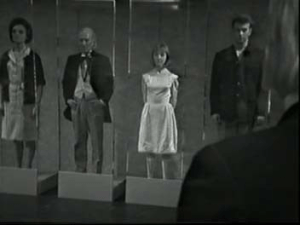
I enjoyed that this serial had a mystery that both the crew and the audience need to figure out. The second episode started into the background, but the first episode effectively roped me in with the question of what was going on.

There were some great moments in this serial. The Doctor gives the admonition to stay close, but then it’s the Doctor who lags behind gets taken by the rebels. Later he hides in a Dalek shell, and his Yoda-like mirth made me laugh. It was really nice to have him fool the mind-reading chair, and an equally nice touch to have the “curator” get rid of him once he’s of no further use. The typical sci-fi tropes would have had the baddie just stick the hero away instead of trying to kill him off.

The action scenes during the whole cat-and-mouse chase were engaging, and Vicki is brilliant in rewiring the armory computer. She’s really climbing the ranks as one of my favorite companions.

The thing that made me scratch my head was that this was apparently all started with yet another faulty component. It seems that the TARDIS is often just one bump short of falling apart at the seams.

Last but not least, there were new Daleks in the lead-in to The Chase. Unfortunately, the head light blinking sequences are way off, and I don’t like the super-shiny collar. It’s very distracting under the studio lights.


Rating: 4/5 – “Would you care for a jelly baby?”


UP NEXT – Doctor Who: The Chase


The Timestamps Project is an adventure through the televised universe of Doctor Who, story by story, from the beginning of the franchise. For more reviews like this one, please visit the project’s page at Creative Criticality.

Timestamp #14: The Crusade

Doctor Who: The Crusade
(4 episodes, s02e22-e25, 1965)

Timestamp 014 The Crusade

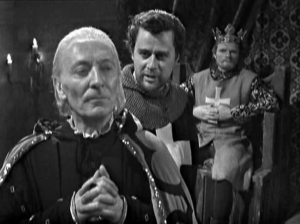
It’s Julian Glover! General Maximillian Veers, Walter Donovan, and Aris Kristatos! Instead of an Imperial soldier, a Nazi, or a Soviet sympathizer, this time he’s a rather petulant King Richard the Lionheart.

Ian gets to use some of the swordfighting skills he’s learned over the last couple of years, and he gets knighted as well. The Doctor gets to display his interesting morals (once stolen clothes are fair to be stolen again), and displays a couple of character traits I’m glad have survived into the modern era (he does not suffer fools and cherishes bravery). The Doctor and Vicki really do have an adorable relationship, but the whole ruse of disguising Vicki as a boy is quite a stretch, especially given the rather conspicuous curves and facial features.

This was a simple story, but engaging and entertaining. The second and fourth episodes I watched were reconstructed from recorded soundtracks and screen caps.


Rating: 4/5 – “Would you care for a jelly baby?”


UP NEXT – Doctor Who: The Space Museum 


The Timestamps Project is an adventure through the televised universe of Doctor Who, story by story, from the beginning of the franchise. For more reviews like this one, please visit the project’s page at Creative Criticality.


Timestamp #13: The Web Planet

Doctor Who: The Web Planet
(6 episodes, s02e16-e21, 1965)

Timestamp 013 The Web Planet

This serial had so much ambition, but so little payoff in six episodes to cover a very threadbare story. The costumes were laughable, and the Zarbi noises grated on me with seconds of hearing them for the first time.

There were some nice moments with Barbara and Vicki comparing notes on eras they were familiar with, and the Doctor is starting to remind me of Yoda with his giggling. From the production side, I’m glad they removed the handicap of losing power to the doors trapping the travellers in the TARDIS over the years. It seems like a silly stumbling block, even though it gave purpose to the Doctor’s rings. It was good of them to acknowledge the thin air, but those jackets made me giggle over the absurdity.

I give the serial extra credit for the enthralled Zarbi called Zombo, but, honestly, I’d rather watch The Sensorites again.


Rating: 1/5 – “EXTERMINATE!”


UP NEXT – Doctor Who: The Crusade


The Timestamps Project is an adventure through the televised universe of Doctor Who, story by story, from the beginning of the franchise. For more reviews like this one, please visit the project’s page at Creative Criticality.