Timestamp #12: The Romans

Doctor Who: The Romans
(4 episodes, s02e12-e15, 1965)

Timestamp 012 The Romans

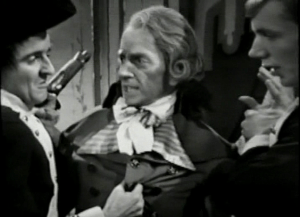
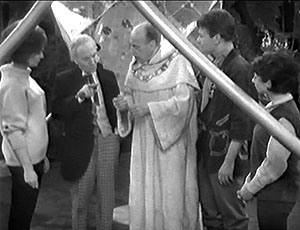
A nice humorous episode balanced with seriousness regarding the Roman slave trade. It was a true tour de force of popular Roman story tropes. The poor TARDIS keeps getting used and abused, this time falling off a cliff and laying in a ditch for a month. I loved Vicki’s energy, and the nice character moments between Ian and Barbara.

I also loved the allegory with The Emperor’s New Clothes.


Rating: 4/5 – “Would you care for a jelly baby?”


UP NEXT – Doctor Who: The Web Planet


The Timestamps Project is an adventure through the televised universe of Doctor Who, story by story, from the beginning of the franchise. For more reviews like this one, please visit the project’s page at Creative Criticality.

Timestamp #11: The Rescue

Doctor Who: The Rescue
(2 episodes, s02e10-e11, 1965)

Timestamp 011 The Rescue

This one was a quick but interesting story to introduce Vicki as a new companion. She seems to be written as a direct replacement for Susan, but the Doctor treats her better. From a production standpoint, the creature designs were pretty cool, and I thought that Sandy was kind of a cute little beastie. I also like how they showed (deliberately or not) some type of TARDIS interior from outside the ship.

The story has a nice twist, but it’s also rather tragic. Overall, it helps further establish the Doctor’s view on preserving life with his anger toward the near genocide of the Dido.

There were two smaller things that grabbed my attention. First, that rocket ship has one strong antenna to survive the crash without breaking. Perhaps they should make the entire ship from that material. I’m kidding of course; they needed to show the audience that the ship was trying to communicate. Second, the TARDIS doesn’t land, but instead materializes.


Rating: 4/5 – “Would you care for a jelly baby?”


UP NEXT – Doctor Who: The Romans


The Timestamps Project is an adventure through the televised universe of Doctor Who, story by story, from the beginning of the franchise. For more reviews like this one, please visit the project’s page at Creative Criticality.

Timestamp #10: The Dalek Invasion of Earth

Doctor Who: The Dalek Invasion of Earth
(6 episodes, s02e04-e09, 1964)

Timestamp 010 The Dalek Invasion of Earth

This was a great episode cover to cover, even with the dubious plot to steal an entire planet. Every one of the characters gets a chance to shine: The Doctor works through the puzzle in the Dalek jail cell, and helps Ian understand it as well; Barbara and Susan contribute to the fight at the Dalek saucer, which speaks volumes considering the lack of empowered women in 1960s science fiction; Barbara displays her intelligence and improv skills in stalling the Daleks by playing on their ignorance of human history; and Susan… oh, Susan.

Once again, Susan is yearning to grow, but is frustrated in trying to figure out how exactly to do so. David seems like a good mentor to help her find an identity and a place to thrive. The Doctor’s grudging respect for him points to this as well, and it was heart-wrenching to see him finally let his granddaughter go. It was interesting how much Susan grew on me in the short time she was on the show. After the credits rolled, I couldn’t press play to start the next serial because I felt like I needed time to say goodbye.

Even among the secondary characters, the development was great. Particularly, I point to the wheelchair-bound scientist’s sacrifice to test his Dalek killing grenade. It was very chilling, since he died in vain.

Some last notes on characters, it was good to see the Doctor back in his signature jacket. This episode also reinforced a couple of things with his character. First, he doesn’t kill unless under a direct threat, which will be interesting to track over this project. Second, he very clearly established that he prefers the name (title?) Doctor, and not the shortened form of Doc.

Finally, William Russell (Ian) sure does like testing the limits of the sets, doesn’t he? He keeps running headlong into set pieces that shouldn’t bend, but do under the power of his spirited no-holds-barred acting style.

Production-wise, this story has a lot of action and explosive effects. The location shoots make the story feel much more open, especially in the transit to the museum. The TARDIS looked rather beat up with the windows out of place. I loved seeing the Dalek coming out of the river at the end of the first episode. That innovative idea was so exciting to me, I can hardly imagine how kids felt when this serial first aired.

The one downside to me was the slyther. It is certainly an interesting creature, though it doesn’t make much sense that the Daleks would keep a pet given their desire to destroy everything not Dalek. But that is a minor quibble in this gem of an episode.


Rating: 5/5 – “Fantastic!”


UP NEXT – Doctor Who: The Rescue


The Timestamps Project is an adventure through the televised universe of Doctor Who, story by story, from the beginning of the franchise. For more reviews like this one, please visit the project’s page at Creative Criticality.

Timestamp #9: Planet of Giants

Doctor Who: Planet of Giants
(3 episodes, s02e01-e03, 1964)

Timestamp 009 Planet of Giants

The companions finally made it home… sort of. Welcome to the obligatory exercise in a science fiction series for the trope of shrinking the cast. I can’t grumble too much because there are some unique elements in this version that keep the idea from being boring repetition (even though it predates many of the modern sci-fi examples I can come up with).

The TARDIS model is back! I also thought it was refreshing for the Doctor to change his wardrobe a bit by exchanging his coat for a cloak. We also find out that bad things apparently happen when the TARDIS doors open during transition.

This one’s essentially an industrial thriller story, and even though it’s not particularly deep one, I still had a lot of fun with it. The effects are the highlight, and you can tell that the cast had fun as well. So did the set designers. But all that plus the character ingenuity can’t overcome a really shallow story.


Rating: 3/5 – “Reverse the polarity of the neutron flow.”


UP NEXT – Doctor Who: The Dalek Invasion of Earth


The Timestamps Project is an adventure through the televised universe of Doctor Who, story by story, from the beginning of the franchise. For more reviews like this one, please visit the project’s page at Creative Criticality.

Timestamp: First Series Summary

Doctor Who: First Series Summary

Timestamp Logo First


A little behind baseball moment on my methodology: For the purposes of this blog, I’ll round the average ratings to one decimal point. Later on, I’ll use a weighted average to determine my overall rating for each Doctor based on the serials in their runs. A weighted average will compensate for the number of serials/episodes for each Doctor’s tenure. A straight average would mean that a couple of stinkers in a small number of serials could sink a Doctor like the Second or Sixth, but would have little effect in the Fourth Doctor’s seven-year run.

This way, the number of serials and tenure of any particular Doctor has a lower worth than the overall entertainment quality of their presentations.


An Unearthly Child – 3
The Daleks  – 4
The Edge of Destruction – 2
Marco Polo – 3
The Keys of Marinus – 4
The Aztecs – 5
The Sensorites – 2
The Reign of Terror – 5

Series One Average Rating: 3.5


UP NEXT – Doctor Who: Planet of Giants


The Timestamps Project is an adventure through the televised universe of Doctor Who, story by story, from the beginning of the franchise. For more reviews like this one, please visit the project’s page at Creative Criticality.

Timestamp #8: The Reign of Terror

Doctor Who: The Reign of Terror
(6 episodes, s01e35-e40, 1964)

Timestamp 008 The Reign of Terror

This was a nice recovery from the drudgery of The Sensorites. I enjoyed that the Doctor was in left in peril, and the fire over the closing credits for the first episode was an especially nice touch. I also liked the location shooting and the use of an actual historical setting, building a beautiful kiss with history in this serial.

The incidental music was great as well. Bursts of La Marseillaise, the French national anthem I know best from Tchaikovsky’s 1812 Overture, helped set the mood. I also believe that I caught riffs of the main title theme in the Doctor’s whimsical walking music.

Addressing the story, it was good to see Hartnell’s duplicitous First Doctor being outwitted, crossed, and played by the people of the era. That makes a ton of sense to me, since the Doctor and his companions, for all their knowledge, are truly the aliens in every serial. It was also good to see that the Doctor and Ian made up after sharing this adventure and proving the relationship amongst this cast.

Episodes four and five are missing in this serial. The animated reconstructions are pretty good, but have a weird fascination with shots of eyes and lips. I won’t hold that against the serial in my final rating.


Rating: 5/5 – “Fantastic!”


UP NEXT – First Series Summary


The Timestamps Project is an adventure through the televised universe of Doctor Who, story by story, from the beginning of the franchise. For more reviews like this one, please visit the project’s page at Creative Criticality.

Timestamp #7: The Sensorites

Doctor Who: The Sensorites
(6 episodes, s01e29-e34, 1964)
Timestamp 007 The Sensorites

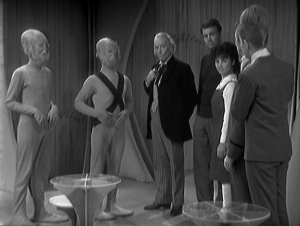
This story is essentially a parable about fear, from humans losing complete control of their autonomy to the Sensorites being afraid of confrontation and the dark. The serial is driven by the Sensorites and their fear of losing their molybdenum (“moly-mol-minerals”; poor William Hartnell) resources through betrayal of their trust in human explorers.

There were some great character building blocks. Susan is developing telepathy, and I wonder if it’s something in the Time Lord DNA. If so, does the Doctor share that skill? I also really enjoyed seeing Susan spread her wings a bit in facing off with her grandfather and demanding some space to run. She’s growing up physically, and yearns to grow emotionally.

I liked that they established the Doctor’s apprehension with weapons. I also enjoyed seeing the origins of the Tenth Doctor’s description of Gallifrey, even though it isn’t called that yet.

Despite those positives, this serial really drags on, and the unfortunate thing about watching something that doesn’t entertain is that you start to really pay attention to all of the flaws. First is that this serial is almost like a blooper reel for the entire first series. There are so many production errors, and they’re very noticeable. The guest stars can’t help distract from the verbal stumbles from Hartnell and Carol Ann Ford because the guests were terrible and single-note.

The second major flaw is costuming. The alien costumes are terrible, even for the 1960s, but they do remind me of the Ood (from the Ninth, Tenth, and Eleventh Doctor eras) with the overall design, transmitters, and telepathy.

Third, I really had an issue with Susan and Ian making fun of the Sensorite “flip-flop” walking style. It flies in the face of the overall mythology I’ve come to expect from the later years, and seems uncharacteristic of characters who were earlier celebrating how much they’ve grown as people.

The writing problems didn’t stop there. I got hung-up with the way that Susan shows momentary interest in the spectrograph, and then rudely interrupts Ian as he’s explaining it. I also had a problem with the Sensorites not being able to tell one another apart by anything more than their rank insignia, but they have no problem making direct telepathic calls to one another or reading text on paper. The removal of the TARDIS lock to prevent the Doctor’s company from leaving also felt weak.

The “creature” in the aqueduct is never really explained. I can infer that the growling was man-made, and that the claw marks in the Doctor’s coat were from the spears, but it would have been nice to have it acknowledged.

I know that I’m beating up on this serial. There are a lot of great ideas and concepts here, but they’re lost in long, drawn-out delivery. It’s not terrible overall, but merely boring and exaggerated with a ton of squandered potential.

It didn’t help any that the Doctor’s anger at the end toward Ian is quite unexpected and makes no sense. Everyone agreed at the start that the voyage has been good for our heroes, but Ian is frustrated in not being able to steer their own course. I wonder if the Doctor is projecting his frustration with Susan’s growth onto Ian.

I certainly hope that The Reign of Terror rings out the first year of Doctor Who on a high note.


Rating: 2/5 – “Mm? What’s that, my boy?”


UP NEXT – Doctor Who: The Reign of Terror


The Timestamps Project is an adventure through the televised universe of Doctor Who, story by story, from the beginning of the franchise. For more reviews like this one, please visit the project’s page at Creative Criticality.

Timestamp #6: The Aztecs

Doctor Who: The Aztecs
(4 episodes, s01e25-e28, 1964)

Timestamp 006 The Aztecs

How delightful! This serial was great, with our heroes having to transition from being reactive to being proactive within the span of four episodes and unpredictable rapid-fire twists and turns. The TARDIS crew shows up, accidentally gets separated from the ship, and gets mistaken for a god and her assistants. As the main villain, Tlotoxl, the High Priest of Sacrifice, keeps throwing every twist and turn he can at the time-travellers in order to usurp the power mistakenly given to them by the other Aztecs.

The beauty of the serial is how the group is forced to shift from dodging Tlotoxl’s efforts to countering his machinations before he even makes a move. The smaller moments (the Doctor gets betrothed, Susan refuses to get married, and Ian fights warriors and discovers the path back to the ship) only add to the delicious point-counterpoint between Barbara and Tlotoxl.

Most importantly, this serial really starts to emphasize the points that I’m familiar with in the Doctor Who mythos. No matter what happens, the timeline must remain intact and certain fixed parts of history cannot be changed. The sacrifices must continue despite Barbara and Susan’s protests, and, amazingly enough, the story ends with a win-win for both the heroes and the villain.

This serial was an elegant dance. I had seen it once before, but within the context of the show, this time I actually experienced it.


Rating: 5/5 – “Fantastic!”


UP NEXT – Doctor Who: The Sensorites


The Timestamps Project is an adventure through the televised universe of Doctor Who, story by story, from the beginning of the franchise. For more reviews like this one, please visit the project’s page at Creative Criticality.

Timestamp #5: The Keys of Marinus

Doctor Who: The Keys of Marinus
(6 episodes, s01e21-e24, 1964)

Timestamp 005 The Keys of Marinus

This is a great serial that is a effectively a series of short stories linked by a common thread. The companions carry the story quite effectively for two episodes while William Hartnell took a much needed vacation. Hartnell’s energy after his return made what was a simplified courtroom/detective procedural sing where it could have otherwise fallen flat. I had some problems with the detective story, but there’s also not a lot of wiggle room for the writers in a somewhat slow-paced 20 minute presentation. These companions are smart, which is something I’m enjoying as this team comes together. The resolution of the arc once the group acquires all the keys was also quite brilliant.

I also give a tip of the hat to the production team for saving money on the TARDIS materialization/dematerialization by using a model. It may not look like much in today’s era, but it was quite well done for what they had available. I almost want a model TARDIS like that one.


Rating: 4/5 – “Would you care for a jelly baby?”


UP NEXT – Doctor Who: The Aztecs


The Timestamps Project is an adventure through the televised universe of Doctor Who, story by story, from the beginning of the franchise. For more reviews like this one, please visit the project’s page at Creative Criticality.

Timestamp #4: Marco Polo

Doctor Who: Marco Polo
(7 episodes, s01e14-e20, 1964)

Timestamp 004 Marco Polo

I watched the Loose Cannon reconstruct for this serial since all of the episodes are currently lost. It is a great story that ran a little long, but did have a decent ending. I particularly loved how the companions drove the story, even though it forced the Doctor into a much smaller role. It was also quite nice to remove the TARDIS from the characters so they couldn’t just jump in and fly away, although the ship does seem to be malfunctioning quite often. In An Unearthly Child, Susan points out that the chameleon circuit isn’t working. In The Daleks, we find out that the fluid link may possibly be a single point of failure for the ship. In The Edge of Destruction, a broken spring in a single switch causes an overload of the power source, nearly destroying the TARDIS. The fallout from that casualty drops the ship into Marco Polo without power, light, or heat. If I didn’t have the background from the Eccleston, Tennant, and Smith years, I’d be worried about how long the TARDIS can hold out.

Is the Doctor incompetent at operating the ship despite the adventures alluded to before the series began? Is the TARDIS intentionally causing some of these problems? Was it just a simple writing crutch in the beginning of the series?

I give Clara one thing: It does make for a more exciting journey.


Rating: 3/5 – “Reverse the polarity of the neutron flow.”


UP NEXT – Doctor Who: The Keys of Marinus


The Timestamps Project is an adventure through the televised universe of Doctor Who, story by story, from the beginning of the franchise. For more reviews like this one, please visit the project’s page at Creative Criticality.