Culture on My Mind Book Review: “Gone Girl” by Gillian Flynn May 30, 2014
It’s the story that failed to capture me due to unremarkable and uninteresting characters.
Gone Girl is a tale of tepid unrepentant characters who torture themselves and everyone around them with overwhelming selfishness and bull-headed ignorance. The first-person point-of-view that alternates from chapter to chapter is a unique “he said, she said” style, and the brilliance of the scheming by the antagonist is a big highlight, but none of that can completely overcome the character problem.
The characters are all self-centered and lacking in both empathy and sympathy. More than that, the only characters that weren’t bathing in a toxic mixture of smugness and cynicism were the two detectives. By the time the plot twist that so many other readers are celebrating rolled around, I had lost all interest in the protagonist and his plight. After soldiering through the first half of the book, watching as Nick made stupid mistake after stupid mistake, outright ignoring advice to the contrary from even his most trusted friends and family, I couldn’t dredge up even the slightest amount of interest in his plight. I didn’t care if he made it out, dead, alive, or otherwise.
Does that mean that I celebrated the villain? Only in the depth of how deeply the chess game was framed. Other than that, the villain’s intended plot was derailed based on the most simple of events that emphasized how much the character was lacking in even the basic street smarts one could attain from watching a police procedural on television. The entirety of the protagonist-antagonist relationship is built upon trying to find the way out of an emotional hole by continuing to dig straight down. To drag in the overly clichéd pseudo-quote that haunts every corner of the internet, these people keep doing the same thing over and over, honestly and sincerely expecting a different result each time. They are well beyond insane.
Reading this book became the same exercise in patience and endurance that was reading Twilight. In both cases, popular opinion told me that it was great and wonderful, so I fought to the end looking for that treasure. Alas, I never found the wild goose.
At the end of the day, the big plot twist doesn’t justify a cavalcade of uninteresting and uncaring characters. I just don’t see the draw in this story, and it certainly won’t be enough to draw me to the theater, despite how much as I like Rosamund Pike, when the cinematic adaptation opens in October 2014.
Culture on My Mind is inspired by the weekly Can’t Let It Go segment on the NPR Politics Podcast where each host brings one thing to the table that they just can’t stop thinking about.
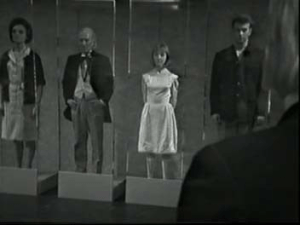
I enjoyed that this serial had a mystery that both the crew and the audience need to figure out. The second episode started into the background, but the first episode effectively roped me in with the question of what was going on.
There were some great moments in this serial. The Doctor gives the admonition to stay close, but then it’s the Doctor who lags behind gets taken by the rebels. Later he hides in a Dalek shell, and his Yoda-like mirth made me laugh. It was really nice to have him fool the mind-reading chair, and an equally nice touch to have the “curator” get rid of him once he’s of no further use. The typical sci-fi tropes would have had the baddie just stick the hero away instead of trying to kill him off.
The action scenes during the whole cat-and-mouse chase were engaging, and Vicki is brilliant in rewiring the armory computer. She’s really climbing the ranks as one of my favorite companions.
The thing that made me scratch my head was that this was apparently all started with yet another faulty component. It seems that the TARDIS is often just one bump short of falling apart at the seams.
Last but not least, there were new Daleks in the lead-in to The Chase. Unfortunately, the head light blinking sequences are way off, and I don’t like the super-shiny collar. It’s very distracting under the studio lights.
The Timestamps Project is an adventure through the televised universe of Doctor Who, story by story, from the beginning of the franchise. For more reviews like this one, please visit the project’s page at Creative Criticality.
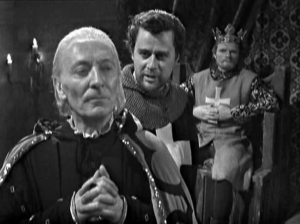
It’s Julian Glover! General Maximillian Veers, Walter Donovan, and Aris Kristatos! Instead of an Imperial soldier, a Nazi, or a Soviet sympathizer, this time he’s a rather petulant King Richard the Lionheart.
Ian gets to use some of the swordfighting skills he’s learned over the last couple of years, and he gets knighted as well. The Doctor gets to display his interesting morals (once stolen clothes are fair to be stolen again), and displays a couple of character traits I’m glad have survived into the modern era (he does not suffer fools and cherishes bravery). The Doctor and Vicki really do have an adorable relationship, but the whole ruse of disguising Vicki as a boy is quite a stretch, especially given the rather conspicuous curves and facial features.
This was a simple story, but engaging and entertaining. The second and fourth episodes I watched were reconstructed from recorded soundtracks and screen caps.
The Timestamps Project is an adventure through the televised universe of Doctor Who, story by story, from the beginning of the franchise. For more reviews like this one, please visit the project’s page at Creative Criticality.
This serial had so much ambition, but so little payoff in six episodes to cover a very threadbare story. The costumes were laughable, and the Zarbi noises grated on me with seconds of hearing them for the first time.
There were some nice moments with Barbara and Vicki comparing notes on eras they were familiar with, and the Doctor is starting to remind me of Yoda with his giggling. From the production side, I’m glad they removed the handicap of losing power to the doors trapping the travellers in the TARDIS over the years. It seems like a silly stumbling block, even though it gave purpose to the Doctor’s rings. It was good of them to acknowledge the thin air, but those jackets made me giggle over the absurdity.
I give the serial extra credit for the enthralled Zarbi called Zombo, but, honestly, I’d rather watch The Sensorites again.
The Timestamps Project is an adventure through the televised universe of Doctor Who, story by story, from the beginning of the franchise. For more reviews like this one, please visit the project’s page at Creative Criticality.
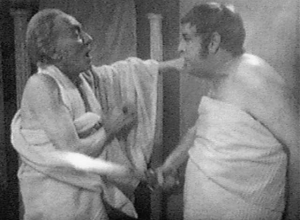
A nice humorous episode balanced with seriousness regarding the Roman slave trade. It was a true tour de force of popular Roman story tropes. The poor TARDIS keeps getting used and abused, this time falling off a cliff and laying in a ditch for a month. I loved Vicki’s energy, and the nice character moments between Ian and Barbara.
I also loved the allegory with The Emperor’s New Clothes.
The Timestamps Project is an adventure through the televised universe of Doctor Who, story by story, from the beginning of the franchise. For more reviews like this one, please visit the project’s page at Creative Criticality.
Culture on My Mind Book Review: “A Children’s Illustrated History of Presidential Assassination” by Bryan Young May 7, 2014
An illustrated history of assassination seems like an odd topic for a children’s book. It seems even stranger when the topic becomes the assassination of the President of the United States. But, let’s face it: In the quest to explore the world around them, kids don’t come equipped with filters for social niceties. Topics that adults consider taboo, such as the death and murder – especially when it applies to the leader of one of the most power nations in the world – are often on a level playing field with the color wheel, multiplication tables, and the alphabet.
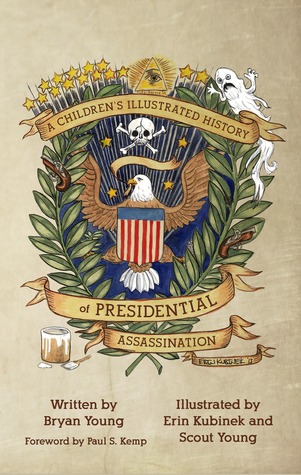
“A Children’s Illustrated History of Presidential Assassination” is a book geared toward those difficult discussions. Author Bryan Young simplifies the topic in prose that explains and educates without talking down or being condescending to the audience. Focusing on each of the presidents who was either assassinated or had an attempt made against them, his prose introduces each leader and places them in both an understandable political and historical context. Shying away from a simple list of names and dates, he makes each history lesson engaging and entertaining.
Accompanying the text are illustrations by two artists. Erin Kubinek provides detailed imagery with a simple and comic flair that illustrates key points while complimenting and enhancing the unfolding stories. Some of the drawings are a little gruesome, but that only helps the audience to understand how messy the topic truly is. The second artist is Scout Young, the author’s daughter, who adds a presidential portrait from the point of view of the book’s intended audience. Her drawings add a degree of whimsy to an interpretation of how she sees the topic, and as one of the inspirations for the book, it’s quite fitting to include her work as a touchstone for children and parents exploring of the darker sides of American history.
As a bonus, the book ends with a short story that provides a taste of the author’s fiction style. As a fan of Young’s “Lost at the Con,” both the short story and the history book were a wonderful display of his versatility and talent.
Bryan Young’s “A Children’s Illustrated History of Presidential Assassination” is a book I highly recommend.
Culture on My Mind is inspired by the weekly Can’t Let It Go segment on the NPR Politics Podcast where each host brings one thing to the table that they just can’t stop thinking about.
Call me ten years late to the party, but after a decade of hearing just how good Veronica Mars was as a series, I finally took the plunge.
I’ll patiently wait here for the inevitable “I told you so.”
Veronica Mars is a detective-style television series focused on the title character, elegantly played by Kristen Bell. The show is set in a fictional beach town named Neptune, which is an oligarchy in microcosm. Veronica is the teenage daughter of the town’s disgraced former sheriff, who was removed from office after accusing one of the town’s most prominent members of murdering his own daughter. Everyone in power (read: upper class) turns their backs on the Mars family, and Veronica’s mother eventually leaves the family. After he hung up his uniform and badge, Keith Mars opened his own private investigation firm, and Veronica has been learning the craft.
Thus begins the tale of a Gen-Y Nancy Drew who solves mysteries while surviving the artificial dramas of high school isolation.
Over three seasons, the homage to 1950s noir plays out as Veronica moves from high school to college, fighting corruption and crime as lives her life in social exile. The character development is top notch, spanning not only Veronica’s close circle of friends, but also among some of the rich snobs that castigated her family earlier. Watching them come to accept Veronica for her skills rather than her social status was nice, but even better was watching Veronica grow up and realize how closely linked consequences and actions truly are.
Seasons one and two are certainly the best of the three, and they dedicate an entire season to a single overarching mystery with smaller cases laced throughout. Fans typically look down on Season Three, which broke the season into several smaller mysteries with tenuous links between them, but I enjoyed it. The only things I didn’t like were the on-again-off-again relationship with Veronica and a certain character (no spoilers here) and the remixed title theme.
This series is far from clean cut, and not everyone gets a happy ending. That is especially true of the follow-up movie, which takes place nine years after the series finale. The movie did a great job of logically advancing the characters of Neptune while explaining exactly why it’s okay that we didn’t see their evolutions on screen. It also finishes off a great character arc for Veronica.
The only downside I found with the movie was with Navy uniforms. While not entirely a deal killer, I had a hard time pulling my eyes away from glaring errors that a few minutes on Wikipedia or with a consultant could have solved.
What I really want to see after watching the movie is a continued Veronica Mars television series. While I like the idea of Veronica on the silver screen, I think the small screen would work best in telling the ongoing stories. Perhaps, in this new era of distribution companies creating content, Rob Thomas would consider Netflix, Amazon, or Hulu as a platform instead of relying on a network. While he’s writing new content in follow-on novels, I really want to see more of this high-caliber work on a screen.
I guess that makes me a “marshmallow.”
Culture on My Mind is inspired by the weekly Can’t Let It Go segment on the NPR Politics Podcast where each host brings one thing to the table that they just can’t stop thinking about.
This one was a quick but interesting story to introduce Vicki as a new companion. She seems to be written as a direct replacement for Susan, but the Doctor treats her better. From a production standpoint, the creature designs were pretty cool, and I thought that Sandy was kind of a cute little beastie. I also like how they showed (deliberately or not) some type of TARDIS interior from outside the ship.
The story has a nice twist, but it’s also rather tragic. Overall, it helps further establish the Doctor’s view on preserving life with his anger toward the near genocide of the Dido.
There were two smaller things that grabbed my attention. First, that rocket ship has one strong antenna to survive the crash without breaking. Perhaps they should make the entire ship from that material. I’m kidding of course; they needed to show the audience that the ship was trying to communicate. Second, the TARDIS doesn’t land, but instead materializes.
The Timestamps Project is an adventure through the televised universe of Doctor Who, story by story, from the beginning of the franchise. For more reviews like this one, please visit the project’s page at Creative Criticality.
Culture on My Mind Shelving the Star Wars Expanded Universe Makes Sense May 4, 2014
I’ve been thinking about the recent shake-up in the Star Wars expanded universe, and it’s taken me some time to really sort out my thoughts both in relation to my emotions and good business sense. I agree with the decision, and believe that it makes sense to do it.
Part I – The Books and Me
It seems fitting that this decision was made public around this time of year. I was introduced to the post-Return of the Jedi adventures of Luke, Leia, Han, and Chewie on Easter Sunday of 1992. My parents surprised me with a paperback copy of the Star Wars Trilogy 10th anniversary omnibus, which combined the novelizations of each of the original films, along with a paperback copy of Timothy Zahn’s Heir to the Empire. They realized that I had a deep attachment to the original trilogy, which I had only seen on well-loved and rewind-worn pan-and-scan VHS tapes at that time, and they fed that passion with what they understood to be the continuing story. They were right on the money, as confirmed by the hardcover version’s inner jacket blurb.
The three Star Wars films form a spectacular saga of bold imaginations and high adventure. But the stories of its characters did not end there. Now for the first time, Lucasfilm Ltd., producer of the Star Wars movies, has authorized the continuation of this beloved story. In an astounding three-book cycle, Timothy Zahn continues the tale of Luke Skywalker, Princess Leia, Han Solo, and the other characters made world famous by Star Wars, as he brilliantly expands upon George Lucas’s stunning vision, “a long time ago in a galaxy far, far away.”
I rapidly devoured the original trilogy omnibus, and relished the differences between the novels and the films. Obi-Wan knew about ducks, Luke’s uncle Owen was really Kenobi’s brother, and Vader was created when Anakin and Obi-Wan battled on the edge of a volcano. It was a wealth of information that expanded beyond the cinematic journey, and it primed me for the more dedicated reading of the continuing saga. I say dedicated, but I don’t mean meticulous; I flew through Heir to the Empire and loved every minute. In June of 1992, I reserved a copy of the second book, Dark Force Rising, at my local library and flew through it as well. It was a long year until The Last Command was released, and after that epic conclusion, I satiated my desire for more Star Wars by reading Brian Daley’s The Han Solo Adventures, L. Neil Smith’s The Lando Calrissian Adventures, and Alan Dean Foster’s Splinter of the Mind’s Eye.
It didn’t matter to me how bad Splinter was because, by the Maker, I had new Star Wars in my hands. The Truce at Bakura, The Courtship of Princess Leia, and Kevin J. Anderson’s Jedi Academy trilogy started me down a path of buying the books and comic trade paperbacks when they came out and enjoying every one of them. My palette has matured a bit since then, and stories like The Crystal Star (ah, Waru) are hardly ever revisited by my eyes, but at the time, they were precious, precious gold.
Despite my love for the franchise, it became apparent to me that the universe was getting too large too fast. At that point, stories in what became the Star Wars Expanded Universe (SWEU) ranged from approximately 5,000 years before to around 20 years after A New Hope. One person at Lucasfilm, Leland Chee, was charged with keeping the chronology straight and smoothing over any conflicts amongst the novels, comics, video games, television series, and movies. He did an admirable job, and it’s one I don’t envy.
By 1994, Lucas Licensing had defined what made up Star Wars canon, and publicized it in issue 23 of Star Wars Insider, the fan club’s magazine.
Gospel, or canon as we refer to it, includes the screenplays, the films, the radio dramas and the novelizations. These works spin out of George Lucas’ original stories, the rest are written by other writers. However, between us, we’ve read everything, and much of it is taken into account in the overall continuity. The entire catalog of published works comprises a vast history—with many off-shoots, variations and tangents—like any other well-developed mythology.
To help sort out the chronology, multiple tiers were established between 1996 and 2000 to solve conflicts between stories. Anything that directly involved George Lucas, such as the films, their novels and radio adaptations, and statements from Lucas himself trumped everything. Under that were the television shows, followed by the combination of novels, comics, and games. As the prequel movies dawned and Lucasfilm started developing The Clone Wars television series, more and more continuity problem started to crop up and it was apparent that something had to give. In the time-honored tradition of the SWEU, George Lucas won.
Part II – The Dawn of a New Era
The decision on April 25th to essentially shelve everything except the six core films and The Clone Wars isn’t a big surprise. In fact, it’s been a long time coming. As much as George Lucas has changed his mind on sequel films – at first it was a twelve-film series, then nine, then six. As recently as May 2008, he told TotalFilm that, “There will definitely be no Episodes VII–IX” – he has been consistent since 2001 that his vision trumps everything else. During an interview on the official site in March 2008, he explained his point of view.
It’s a certain story about Anakin Skywalker and once Anakin Skywalker dies, that’s kind of the end of the story. There is no story about Luke Skywalker, I mean apart from the books. But there’s three worlds: There’s my world that I made up, there’s the licensing world that’s the books, the comics, all that kind of stuff, the games, which is their world, and then there’s the fans’ world, which is also very rich in imagination, but they don’t always mesh. All I’m in charge of is my world. I can’t be in charge of those other people’s world, because I can’t keep up with it.
Fans have been complaining that this move invalidates the established canon, but what really has been canon before now? The Thrawn trilogy was “authorized” as a continuation, and multimedia events like Shadows of the Empire and The Force Unleashed had some direction from George Lucas, but aside from that everything else seems to have been handled by a licensing department.
You know what else fits this pattern? The Star Trek novels. The Marvel Cinematic Universe. 1978’s Superman film. Any of the various DC and Marvel reboots. All of them violate the established “canon” of the material that came before, and yet they exist and are still enjoyed. Just like those examples, and countless other franchise tie-ins, the stories established by the SWEU still exist. Disney and Lucasfilm aren’t burning every copy they can find or raiding public libraries for toilet paper. In fact, the existing SWEU is being republished as the “Star Wars Legends” series to guarantee their availability for the future.
Star Wars fans can learn a very valuable lesson from Star Trek fans, as author Keith R. A. DeCandido explained in his comments on this whole affair.
Two of the most highly regarded Trek novels are Imzadi and Federation. The former novel was heavily contradicted by a TNG episode (“Second Chances”); the latter was totally nuked by the movie First Contact. Yet the two novels continue to be well regarded — and so does that episode and that movie, even though they contradict each other. If you think that contradictory versions of stories in the same universe ruins one of the contradictory ones, then you don’t understand how storytelling works.
I totally get the concept of having a huge personal investment in this franchise. I owned every novel in the series before the Navy lost half of my household goods shipment back in 2005. That incident hurt, but only because of the material loss. My consolation was that the books were still out there, and someone would be selling them when I was ready to rebuild.
More importantly, this move guarantees the future of the Star Wars franchise, which cost Disney over $4 billion. That’s one hell of an investment, and they needed a way to make it accessible to general audiences again, including the newest generation of children who haven’t experience the galaxy far, far away. As much as we cannot expect audiences to read every book between Return of the Jedi and Episode VII, we cannot expect scriptwriters and directors to limit their vision to decades of contradictory stories. Those limitations would only hinder the movie and hurt the investment.
Take the example of Disney’s other major acquisition, the Marvel franchise, and their approach to the Marvel Cinematic Universe. General audiences don’t need to read the comics to get the stories, and if they need to know something, it’s presented to them. If you haven’t had a chance to read the Bloomberg Businessweek article about the MCU, I highly recommend it. There are a lot of parallels between Marvel and Star Wars.
Before this announcement, I was optimistic but skeptical about the sequel movies. There was just too much story to dance around if the EU was left intact, and I wasn’t keen on the movies being cleverly wedged between chapters or pages of a novel just to make a timeline work. This move tells me that Disney is serious about their investment and the vision they want to bring to audiences. By making this story easily accessible to everyone, which means removing the stumbling block of the now Legends stories, Disney and Lucasfilm win. That means that Star Wars fans win.
Disney and Lucasfilm helped reignite the magic of my childhood. Warm up the Falcon, Chewie, and calculate the hyperspace jump to December 2015. I’m ready to believe again. Star Wars truly is forever.
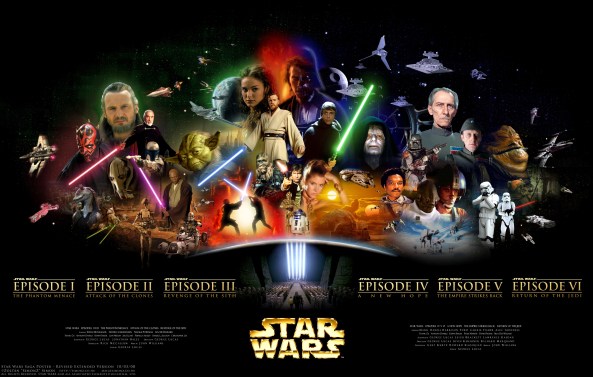
Star Wars Saga Poster by SimonZ
Culture on My Mind is inspired by the weekly Can’t Let It Go segment on the NPR Politics Podcast where each host brings one thing to the table that they just can’t stop thinking about.
This was a great episode cover to cover, even with the dubious plot to steal an entire planet. Every one of the characters gets a chance to shine: The Doctor works through the puzzle in the Dalek jail cell, and helps Ian understand it as well; Barbara and Susan contribute to the fight at the Dalek saucer, which speaks volumes considering the lack of empowered women in 1960s science fiction; Barbara displays her intelligence and improv skills in stalling the Daleks by playing on their ignorance of human history; and Susan… oh, Susan.
Once again, Susan is yearning to grow, but is frustrated in trying to figure out how exactly to do so. David seems like a good mentor to help her find an identity and a place to thrive. The Doctor’s grudging respect for him points to this as well, and it was heart-wrenching to see him finally let his granddaughter go. It was interesting how much Susan grew on me in the short time she was on the show. After the credits rolled, I couldn’t press play to start the next serial because I felt like I needed time to say goodbye.
Even among the secondary characters, the development was great. Particularly, I point to the wheelchair-bound scientist’s sacrifice to test his Dalek killing grenade. It was very chilling, since he died in vain.
Some last notes on characters, it was good to see the Doctor back in his signature jacket. This episode also reinforced a couple of things with his character. First, he doesn’t kill unless under a direct threat, which will be interesting to track over this project. Second, he very clearly established that he prefers the name (title?) Doctor, and not the shortened form of Doc.
Finally, William Russell (Ian) sure does like testing the limits of the sets, doesn’t he? He keeps running headlong into set pieces that shouldn’t bend, but do under the power of his spirited no-holds-barred acting style.
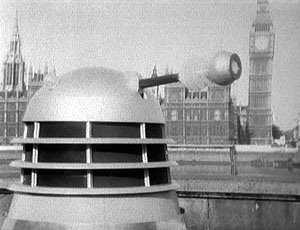
Production-wise, this story has a lot of action and explosive effects. The location shoots make the story feel much more open, especially in the transit to the museum. The TARDIS looked rather beat up with the windows out of place. I loved seeing the Dalek coming out of the river at the end of the first episode. That innovative idea was so exciting to me, I can hardly imagine how kids felt when this serial first aired.
The one downside to me was the slyther. It is certainly an interesting creature, though it doesn’t make much sense that the Daleks would keep a pet given their desire to destroy everything not Dalek. But that is a minor quibble in this gem of an episode.
The Timestamps Project is an adventure through the televised universe of Doctor Who, story by story, from the beginning of the franchise. For more reviews like this one, please visit the project’s page at Creative Criticality.







 Creative Criticality