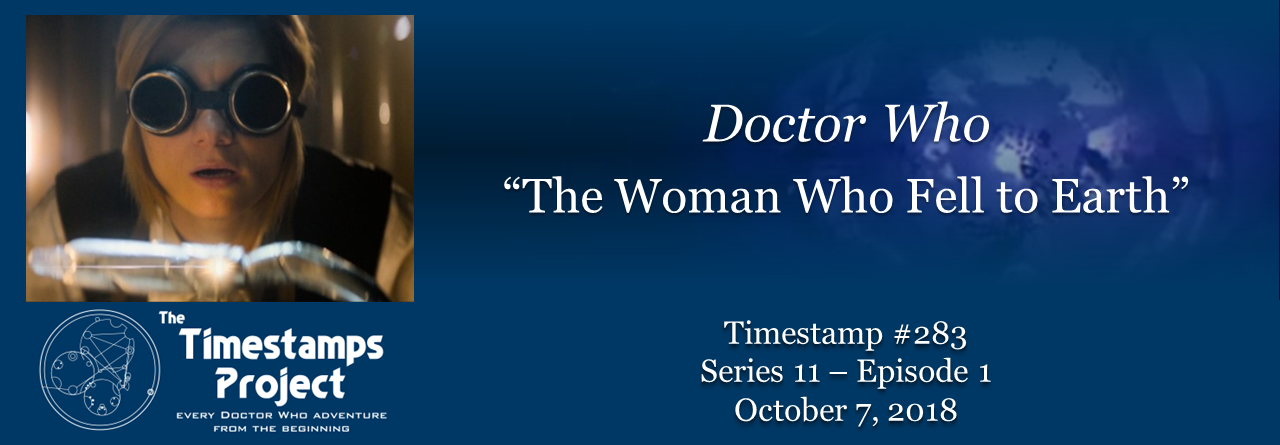
Timestamp #283: The Woman Who Fell to Earth

These new teeth are definitely weird.

Ryan Sinclair records a YouTube video and decides to talk about the greatest woman he ever met. He recounts trying to ride a bicycle with his grandmother Grace and her husband Graham O’Brien. It’s a challenge for him since Ryan struggles with dyspraxia, and when he falls off, he angrily throws the bike over a cliff. Grace and Graham try to console him but have to leave for their train home, so Ryan is left alone to retrieve the bike. He finds it trapped in a tree, then encounters a strange set of floating glowing golden lines. He touches one of them and watches as a purple plant-like pod emerges. It’s then that he calls the police.

We next meet Yasmin Khan, a probationary police officer who is settling a petty dispute between two women. She calls her supervisor, asking for something more challenging, and he gives her Ryan’s case. When Yaz meets with Ryan, she thinks that he’s pulling a prank on her, but their relationship warms up when they realize that they went to school together.

Grace and Graham are on their way home when a ball of energy collides with the train. The lights all go out, leaving the train shrouded in moonlight, and Grace investigates the disturbance. The couple soon encounters an erratic and electrified tentacle creature, and when they call Ryan and Yaz, the phones go dead. As the creature approaches, a woman falls through the train roof.

The Doctor springs into action and shorts out the electrified creature, but she cannot open the doors because she lost her sonic screwdriver. Yaz and Ryan arrive and the creature scans a bystander named Karl before briefly shocking everyone and flying away.

The Doctor takes charge but comes up short as Yaz asks who she is. The Doctor is perplexed by Yaz’s choice of address, recalling that she herself was a white-haired Scotsman half an hour before. She tells Ryan that she’s looking for a doctor before finding the train’s driver. Yaz thinks that the driver was murdered, but the Doctor says that she died of shock. The Doctor convinces Yaz and Ryan to join her, then meets Graham and Grace while mourning the loss of her TARDIS. Graham declares that there aren’t any aliens on trains in Sheffield, and the Doctor corrects him since she’s an alien.

Yaz takes contact information for a passenger named Karl and Ryan tells the Doctor about the pod. The team of Ryan, Yaz, Graham, and Grace go to the site but the pod is missing. In fact, it has been taken by a man named Andy for delivery to another man named Rahul. After paying Andy for his services, Rahul sets up several cameras to record the pod before sitting down to watch it.

The team, who the Doctor has started calling her “fam,” decides to check with their networks about anything out of the ordinary. Meanwhile, the Doctor collapses, prompting Ryan and Grace to take her to Ryan’s home. As the Doctor recovers, she glows with regeneration energy. Grace is astounded to find two separate pulses.

In Rahul’s shop, the pod cracks open. The energy awakens the electrical being and the Doctor simultaneously, and the Doctor discovers DNA bombs lodged in everyone’s collarbones. The Doctor tries to muddle through since her regeneration is not yet complete, but she recognizes the bombs as a way to get rid of witnesses. She reformats Ryan’s phone and uses it as a tracking device.

An armored figure emerges from the pod. Rahul demands to know where his sister is located and the being kills him and takes part of the corpse. The fam arrives soon after, watching as the creature leaves the shop. The creature escapes so the team investigates the shop. The creature has taken a single tooth from Rahul, and as Grace covers the body, Ryan finds the opened pod. The Doctor questions why the pod has come and Ryan admits to touching the golden lines.

The tracking signal, which was correlated to the electrical creature, has gone erratic. The Doctor decides to build her own sonic screwdriver so she can properly analyze the data. Meanwhile, Ryan and Yaz find a video file from Rahul, meant to be played upon his death. Rahul’s sister Asha was taken and he took it upon himself to find the truth.

The Doctor scans the pod with her fancy new sonic screwdriver and finds a recall circuit. She infers that the pod alien and the electrical alien are at war and looking to scrap it out on Earth. Graham gets a call about an alien’s location as the Doctor gathers some equipment. Meanwhile, the pod alien kills a drunk man who tosses salad at it and extracts another tooth. It then spots the electrical alien and heads toward it.

The Doctor’s team arrives first and shorts out the electrical alien. The Doctor scans it and finds a mass of gathering coils, a species that collects and correlates data. That data points back to Karl, the other passenger on the train. They are interrupted by the armored alien who demands to know who the Doctor is. When she can’t come up with the answer, she asks who the alien is.

The creature removes its helmet and identifies himself as Tzim-Sha (“Tim Shaw”) of the Stenza warrior race. He collects trophies from each kill and embeds them into his body, and he has been sent to hunt a randomly selected human without technology or assistance so he can become his people’s leader. Yaz and Ryan recognize that Asha was a previous victim of the hunt and that Ryan granted permission for the hunt by touching the golden lines. The Doctor declares that Tzim-Sha is cheating by using the gathering coils, and it turns out that he’s a double-cheat because he uses a short-range teleporter to escape after downloading the target’s info.

Tzim-Sha tracks Karl to his job as a crane operator at a building site. Following behind, the Doctor tasks Graham and Grace with evacuating the site while she, Yaz, and Ryan start climbing another crane. Despite his disability, Ryan takes on the task. Meanwhile, the Doctor formulates a plan to evacuate Karl by moving two cranes together. Karl tries to make the jump, but he’s stopped by Tzim-Sha, so the Doctor decides to jump across to confront the hunter herself.

She also takes a moment to curse her shorter legs.

Meanwhile, the Gathering Coil has recovered and is attacking the cranes. Grace decides to electrocute it with power from the site’s main power.

The Doctor confronts Tzim-Sha and threatens to destroy his recall device. She asks what he does with his trophies and is offended to learn that they are kept in stasis on the edge of death forever. Tzim-Sha threatens to detonate the DNA bombs, leaving the two at a standoff. Finally, the hunter asks his opponent who she is.

She’s glad he asked because she is the Doctor, sorting out fair play throughout the universe. She asks him to leave the planet and he decides to detonate the bombs, but she moved them to the Gathering Coil. The pain of the explosions transfers to Tzim-Sha and he’s stunned, leaving an opportunity for Karl to kick him off the crane. Tzim-Sha snags the recall device and uses it to teleport away as he falls.

Grace successfully runs the cables to the Gathering Coil, but when the electricity shorts out the creature, the energy discharge knocks her from the crane. She dies in Graham’s arms as the rest of the team arrives.

Ryan later pays tribute to Grace, the greatest woman he has ever known, on his YouTube channel. He continues trying to ride the bike in her honor as the Doctor watches from a distance. At Grace’s funeral, Ryan waits for his father but gives up after two hours. Later on, Graham gives a heartfelt speech about how he met Grace during his cancer treatments and how he has cherished their three years together.

After the funeral, the Doctor discusses her family and how she lost them a long time ago. She carries them with her as memories during her travels. She remembers that she needs to find her TARDIS and decides that she’s stayed too long. Yaz tells her that she really needs to change clothes.

Yaz, Ryan, and the Doctor go shopping at a charity store, eventually landing on a very colorful outfit. She then assembles a rudimentary teleportation device out of Tzim-Sha’s technology that will track the artron energy from the TARDIS. The device activates…

…and teleports all four of them into deep space.


This episode marks a major tonal shift in the franchise. It marks the debut of the first official female Doctor – I love Curse of Fatal Death but it really doesn’t count – and the introduction of the largest all-new regular cast since Terminus. On top of all of that, this story premiered with the biggest crew shift since The Eleventh Hour, marking a near-effective reboot of the show.

It’s not a reboot, mind you, but it certainly feels like it from direction and music to cinematography.

The companions are quite engaging as they learn about this whole new world, and I found the large cast to be used well in this story. I loved how authentic they were with each other, even to the point of Graham being upset about touching the “permission slip” symbol, Grace chastizing him for that, and the Doctor admitting that she would have done exactly what Ryan did.

The loss of Grace was tragic and I do wish that she would have remained to travel with the Doctor because the chemistry was great, but the cast is really too large for revival-era standard hour-long adventures. The last time that the Doctor traveled with three companions, the show thrived on stories broadcast over multiple hours per adventure. I don’t think there’s enough time in a single episode to give everyone their dues.

Of those companions, we’ve seen one of them before as a different character: Bradley Walsh played the Pied Piper in The Day of the Clown.

The Thirteenth Doctor is another tonal shift, taking us from the acerbic Twelfth Doctor back to a more whimsical Time Lord. She’s more soft-spoken, but there is tremendous power behind the cover. There’s also a lot of Doctor Who oddness, like using her (unreliable) nose to tell time.

There’s not a lot in the trivia department, but of note is that this is the tenth story not to feature the TARDIS. It joins Mission to the Unknown, Doctor Who and the Silurians, The Mind of Evil, The Dæmons, The Sea Devils, The Sontaran Experiment, Genesis of the Daleks, Midnight, and The Lie of the Land. It’s also the first time since The Faceless Ones that we have two male companions traveling with the Doctor.

I’m interested as to where the previous sonic screwdriver and the sonic sunglasses ended up, especially since humans are keen on reverse engineering alien technology. One hopes that UNIT was hovering around and snapped those pieces up for the Black Archive or something.

I enjoyed watching this again for the Timestamps Project. It’s probably the third or fourth time that I have seen this episode, and I find it to be a strong presentation (even as a regeneration episode). I saw it live with Mike Faber at a viewing party hosted by Battle & Brew. Every time I see it, I’m reminded of a bunch of fans crowded around a bunch of television sets and wondering what the future of Doctor Who had to offer.

I’m eager to see how this era has held up as I move through it once again.

Rating: 5/5 – “Fantastic!”


UP NEXT – Doctor Who: The Ghost Monument

cc-break

The Timestamps Project is an adventure through the televised universe of Doctor Who, story by story, from the beginning of the franchise. For more reviews like this one, please visit the project’s page at Creative Criticality.
Timestamp Special #4: The Thirteenth Doctor

The Thirteenth Doctor
Announced: July 16, 2017


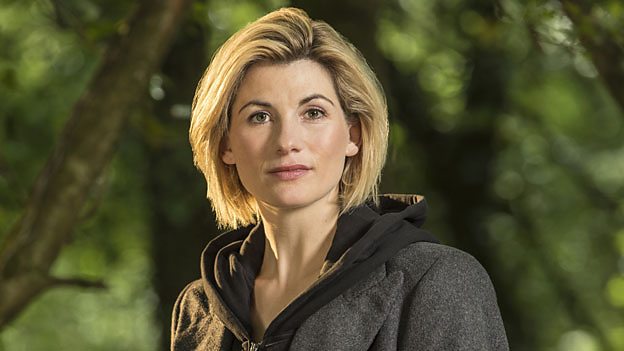
Jodie Whittaker is the Thirteenth Doctor.

Take a moment, consider it, and scream as you see fit. I know I did.

Source: BBC

It should be no surprise that I support this move. If it is, then you really haven’t been reading the Timestamps Project. All throughout my journey with Doctor Who, from every new series episode to the (approximately) 150 distinct reviews and analyses of the classic serials, I have wholeheartedly embraced the morals, messages, and meanings in each, and critiqued how their impact relates to my values and expectations. Because of that journey, encompassing the canon of regeneration, representation in fandom, and the reputation of the character and franchise itself, Jodie Whittaker’s casting is music to my ears, heart, and soul.


Regeneration

At a later stage, Doctor Who would be metamorphosed into a woman. Don’t you agree that this is considerably more worthy of the BBC than Doctor Who’s presently largely socially valueless, escapist schlock? This requires some considerable thought – mainly because I want to avoid a flashy Hollywood ‘Wonder Woman’ because this kind of hero(ine) has no flaws – and a character with no flaws is a bore.

Sydney Newman, creator of Doctor Who


As the concept of regeneration has evolved throughout Doctor Who‘s history, it has been discussed more and more as a lottery.  The Fifth Doctor remarked that the trouble with regeneration was “not knowing what you are going to get.” The Ninth Doctor seemed surprised by his appearance in Rose, and each incarnation since has enthusiastically explored their new teeth, hair, and legs (as did the semi-Time Lord River Song, who apparently needs more jumpers). Even the War Doctor, a critical touchstone between the classic and new eras, lamented the shape of his ears as he moved on.

Throughout the 53-year history of the franchise, we have plenty of evidence that regeneration means more than simply shifting around inside a similar matrix. Most recently, longtime nemesis The Master changed genders into Missy (Series Eight, Series Ten), and in the middle, we had the Gallifreyan General’s regeneration from an old white male to a younger black female (Hell Bent).

Source: BBC

Similarly, we had River Song, who regenerated from a white girl in New York City to Mels, then to River Song (Day of the Moon, Let’s Kill Hitler). Both Maya Glace-Green and Nina Toussaint-White are women of color, which means that Melody Pond/River Song shifted skin colors during regeneration. As far as we know, both of her parents come from white families, so it seems that DNA input has no bearing on a Time Lord’s appearance.

Upon his regeneration from the Tenth Doctor, the Eleventh Doctor was momentarily concerned that he had become a woman, which indicates that gender shifts are possible (The End of Time). But the largest piece of evidence that we have is the Corsair, a Time Lord friend of the Doctor’s whom he had known across several lifetimes, two of which were female (The Doctor’s Wife).

But these are all “nu-Who” examples, so they’re tainted with some kind of twenty-first century social justice warrior progressivism, right?

Not really.

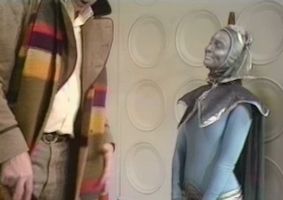
Romana’s regeneration from Mary Tamm to Lalla Ward in Destiny of the Daleks took viewers on a regeneration merry-go-round, including at least one complete “species” shift. She was still a Time Lord underneath, but her blue-silver Fifth Element skin was definitely not human-based. Ergo, Time Lords aren’t limited to human forms. Also, behind the scenes, the concept of a male-to-female regeneration has been discussed since the 1980s by Tom Baker (the Fourth Doctor) and Sydney Newman (the creator of the show).

Source: BBC

Based on the canon evidence, it’s apparent that a gender-change during regeneration is no big deal.


Representation

Because it’s got that cross-generational appeal, which few other things have. It’s not a working-class thing, it’s not a middle-class thing. The competition winner from Doctor Who Magazine was on set today, a 15-year-old girl. When I was a kid, 15-year-old girls didn’t watch Doctor Who.

David Tennant, the Tenth Doctor


Representation matters.

Sure, the Doctor has been a hero to viewers – and, by extension, readers and listeners – of all types for over a half-century. But that doesn’t compare to having a hero who more closely represents you in the spotlight.

Luke and Anakin Skywalker wielded lightsabers for a collective 40 years, but Star Wars: The Force Awakens unconditionally showed girls that they could too with the new hero Rey. In Rogue One: A Star Wars Story, Jyn Erso showed girls that they could save the day without being Jedi. Star Wars: The Clone Wars brought us Ahsoka Tano, a massive fan favorite, and voice actress Ashley Eckstein developed an entire business around the underserved female fan base.

The Star Wars franchise showed minorities that they had a place in the galaxy – with Lando Calrissian, Mace Windu, Finn, Poe Dameron, Cassian Andor, Baze Malbus, Chirrut Îmwe, and Bodhi Rook. The galaxy far far away is still heavy with men, but at least it’s diverse.

Supergirl and Wonder Woman put feminine heroes front and center in a golden age of comic book properties that focused mostly on men. The silver screen’s history with female-led comic book movies in the last thirty years was sparse and disappointing (Supergirl, Elektra, and Catwoman, just to quote the big ones). Marvel also helped with Black Widow’s increased screen presence, but their first movie with a strictly female lead (Captain Marvel) is still years away.

Star Trek put young women in the captain’s chair with Kathryn Janeway, just as it inspired young black men with Benjamin Sisko. Before them was Uhura, who inspired astronaut Mae Jemison and actor Whoopi Goldberg, both of whom are also Star Trek alums.

Just like their male counterparts, women deserve to have role models that they can admire and emulate. At its core, science fiction is all about telling stories about the human condition, through metaphors. It’s about exploring ideas and possibilities, often times from a new point of view. Doctor Who is science fiction, and it adheres to the same Asimov maxim as any other successful sci-fi property: “Individual science fiction stories may seem as trivial as ever to the blinded critics and philosophers of today, but the core of science fiction, its essence, has become crucial to our salvation, if we are to be saved at all.”

Until Jodie Whittaker, the only major female heroes we had seen in Doctor Who were companions. As much as I love seeing them take charge of a situation, they still operate under the protection and guidance of the Doctor, who has been a male character despite the ability to not be. The Doctor leads the charge against evil, goes toe-to-toe against the bad guys, and outwits and outsmarts even the most brilliant traps and plans. Nothing in that description requires the character to be a man. It only needs to speak to us.

As genre fans, we seek stories about the human condition that touch us and inspire us. We seek the messages – the salvation – that they offer. In the case of the Doctor, to paraphrase Steven Moffat, we ask for it through a call box and get it through two hearts.

Both men and women talk about it. Both men and women run fan tracks and conventions about it. Both men and women embrace it.

Salvation isn’t exclusive, just as the Doctor’s love is not exclusive. It must represent us all or we all lose.


Reputation

Tonight’s show is a little different.
Tonight’s show is about a man who’s not really a man.
He’s a doctor, but he’s not really a doctor.
Like Doctor Phil, but awesome.
Most people in the United States of America have not heard of him.
He’s just like me in that regard.
Who is he? He’s The Doctor!

In 1963 the BBC premiered a show about an alien who traveled through space and time to combat the powers of evil.

Sid the Rabbit: He’s a force for good in an otherwise uncertain universe.

You are correct in your summation of his character my profane rabbit friend.

Geoff the Robot Skeleton: Ooh, tell me more!

The show has been running in Britain almost fifty years,
with many different actors in the role of The Doctor.

Wavy Rancheros the Alligator/Crocodile: The Doctor doesn’t die he just regenerates.

The crocodile alligator speaks the truth.
One thing is consistent though and this is why the show is so beloved by geeks and nerds.
It’s all about the triumph of intellect and romance
over brute force and cynicism.
Intellect and romance over brute force and cynicism!

And if there’s any hope for us in this giant explosion in which we inhabit then surely that’s it.
Intellect and romance triumph over brute force and cynicism!

Craig Ferguson, November 2010


Confidence. Bravery. Compassion. Cunning. Curiosity. Intellect.

Those traits have been attributed to the Doctor over the years, from many sources. As Jennifer Hartshorn put it, none of them are gender-specific. But in some corners of Doctor Who fandom, they have become so through tradition. The problem with tradition, however, is that it leads to the argument that the status quo cannot change because it’s the way things have always been.

Speaking from an American point of view, I know how dangerous “it’s the way things have always been” can be. Take a look at any minority and notice how their rights suffer until the outcry drowns out the privilege of clinging to tradition. Pure and simple, saying that the Doctor doesn’t need to be a woman is only a simpler way to state that the Doctor needs to be a man. Based on everything else we’ve discussed here, we know that the Doctor doesn’t need to be a man to showcase the traits and attributes of the character.

I know that change is difficult, but Doctor Who has shown us at least twelve times that change is inevitable. That number is even higher if we count every companion that has come, gone, and even died on the Doctor’s watch. Even the upcoming Christmas Special appears to be dedicated to reminding the Doctor (in two incarnations) that change cannot be stopped.

And it’s not just changing for sake of change. It’s change we’ve seen coming for years. Every time the sci-fi side of this deus ex machinia fairy tale pops up and asks “what if,” it signals that science fiction is fulfilling its mission. The writers correctly asked “what if” years ago, and next year we get the answer.

The biggest problem I see with a female lead on Doctor Who is how writers and producers treat female characters in television. If Chris Chibnall’s team can make it work, Jodie Whittaker’s acting will shine.

Doctor Who will return. The fight against brute force and cynicism will continue. If you choose not to continue the journey, that’s up to you. Fans, like companions, have come and gone, and it’s not the first time that fans have left because the show was “ruined” by a studio decision. If you choose to leave, I will miss you, and I will even forgive you. But I will continue on with the journey and hope that one day you will be back.

But I will carry on with the message in hand. Because it’s what the Doctor would do.


Source: @aroonio on Instagram – follow hyperlink for original image


It’s like when you’re a kid. The first time they tell you that the world’s turning and you just can’t quite believe it ’cause everything looks like it’s standin’ still. I can feel it; the turn of the Earth. The ground beneath our feet is spinnin’ at 1,000 miles an hour and the entire planet is hurtling around the sun at 67,000 miles an hour, and I can feel it. We’re fallin’ through space, you and me, clinging to the skin of this tiny little world, and if we let go…

That’s who I am.

–The Ninth Doctor, Rose (2005)


UP NEXT – Doctor Who: Earthshock


The Timestamps Project is an adventure through the televised universe of Doctor Who, story by story, from the beginning of the franchise. For more reviews like this one, please visit the project’s page at Creative Criticality.