
Timestamp #21: The Daleks’ Master Plan

Doctor Who: The Daleks’ Master Plan
(12 episodes, s03e10-e21, 1965-1966)
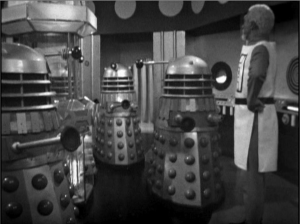
Timestamp 021 The Daleks Master Plan

It’s a fantastic adventure with a lot of intriguing twists and turns that the Doctor and crew stumble into. It nicely capitalized on the thread started in Mission to the Unknown, even if it used the trope of missing an important message due to lack of attention. As a result, one special agent dies and the other almost does, and once again I issue the memo to the future to install annoying ringtones on the communication consoles. If in doubt, ask Nokia.

Meanwhile, Mavic Chen, the Guardian of the Solar System and unfortunate recipient of the yellowface treatment, sides with the Daleks over his own people after preaching about peace and harmony. Politicians never change, I suppose, however I did like how masterful he was in convincing his staff that otherwise faithful agents had betrayed the government.

I did like how Katarina, a girl from ancient Troy, was puzzled over modern medicine. Katarina’s motivations for remaining with the Doctor are unique: She believes that the Doctor is a god who can get her to heaven. It’s quite fitting, given the deus ex machina nature of the Doctor, and particularly chilling in the first-ever companion death in the series. It was an understandable move given how shallow Katarina’s character was, but I was just as shaken as the Doctor and I think it was because of the pure innocence Katarina embodied.

Actually stealing the key from the Doctor was an interesting way to keep TARDIS around, and while I appreciate the creativity in blocking the obvious solution to keeping our heroes out of trouble, I am growing a bit weary of it. The old switcheroo to get the Doctor into the meeting is creative, but how does no one notice the change in his gait or his feet?

I loved Sara Kingdom, a powerful take-charge female character, and her end was chilling as well. It’s a shame that the spin-off series that would have featured her never got off the ground. I also like the footprint effects for the invisible creature, which were impressive for a show of this era and budget.

The re-introduction of the Monk is a bit odd, and it seemed like filler to get the Daleks and Chen in position to chase the TARDIS. Luckily, the writers capitalized on the story point. He did have a suitable end, and as much as I want to see more of the Doctor’s people, I think I’m done with the Monk.

“The Feast of Steven” is an episode that should be excluded from this serial. It doesn’t add to the Dalek story, and the reconstruction doesn’t do it justice. I get what they were trying for since it was broadcast on Christmas Day, but it just doesn’t fit with the plot. On a minor note, the breaking of the fourth wall was a nice touch.

Also, Steven is still an idiot. Why, why, why(!), when he knows that there are Daleks around, would he call attention to himself by yelling for the Doctor? He’s ranking up there as my least favorite long-term companion.

A few minor notes: The cricket pitch scene was humorous, and reminded me of a similar scene in The Hitchhiker’s Guide to the Galaxy; The Doctor’s magic ring is a little too convenient for my tastes; and the final episode is a perfect conclusion to this epic story.

To wrap it up, I finally get the Daleks I know as they betray their allies in their true xenophobic and genocidal fashion.

Rating: 4/5  “Would you care for a jelly baby?”


UP NEXT – Doctor Who: The Massacre of St. Bartholomew’s Eve


The Timestamps Project is an adventure through the televised universe of Doctor Who, story by story, from the beginning of the franchise. For more reviews like this one, please visit the project’s page at Creative Criticality.


An Update on the Timestamps Project

Reports of my surrender are greatly exaggerated. I haven’t given up, nor do I plan on it.

The Timestamps Project was delayed due to an unfortunate hard drive failure that eliminated about half of the content on my media server. Within that data the was consigned to the digital abyss was the Doctor Who collection.

timing

Fear not, as the Timestamps Project will continue. Between efforts to recover the data (apparently, I would need to sell a kidney to afford it) and rebuilding the drives, along with busy season at work, I’ve had to take some time away from the adventures of the Doctor. But that ends tomorrow.

My review of The Dalek’s Master Plan is now in the publishing queue, I have watched The Massacre of St. Bartholomew’s Eve, and will lay eyes on The Ark in the near future. In the rebuilding phase, I have also picked up some backup drives for the server to delay Murphy from visiting again.

This TARDIS is back on track, and I apologize for leaving all of you waiting in the interim. I’m looking forward to getting back to it.

Stay tuned.

Timestamp #20: The Myth Makers

Doctor Who: The Myth Makers
(4 episodes, s03e06-e09, 1965)

Timestamp 020 The Myth Makers

Doctor Who visits the Trojan war. The serial’s opening battle seems almost comical, but does a decent job of establishing the conflict among the plot’s characters. Looking back from 2014 to 1965, the Doctor pretending to be a god in order to more freely explore the setting is a clever meta nod to the deus ex machina that is Doctor Who. With his virtual immortality, changing faces, and supernatural abilities in comparison to the cultures he visits, The Doctor is, quite literally, a god in a machine.

The serial seems rather run of the mill, though the re-interpretation of the stories from myth are quite refreshing to see. It was a fairly clever ruse to rescue Vicki from the Trojans, and it was hard to watch her leave the TARDIS and the Doctor. I will certainly miss her wit and spunk. Her departure seemed rushed but still emotionally touching, and it will be interesting to see how the Doctor will respond. Unfortunately, this leaves us Steven (ugh) and the unknown (but quite limited) variable of Katarina as companions leading into the twelve-part master plan of the Doctor’s most powerful enemies.

As a side note but not a hit to the score for this review, the reconstruction’s music track is pretty bad. It sounds like a warped 45 RPM record, but there’s probably not much they can do about it since this serial is lost. It was distracting, but easy to work around.


Rating: 3/5  “Reverse the polarity of the neutron flow.”


UP NEXT – Doctor Who: The Daleks’ Master Plan


The Timestamps Project is an adventure through the televised universe of Doctor Who, story by story, from the beginning of the franchise. For more reviews like this one, please visit the project’s page at Creative Criticality.
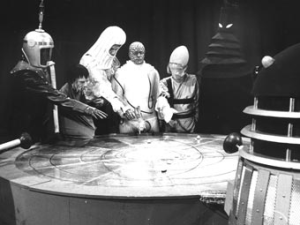
Timestamp #19: Mission to the Unknown

Doctor Who: Mission to the Unknown
(1 episode, s03e05, 1965)

Timestamp 019 Mission to the Unknown

This is a nice interlude that shows the audience a slice of time and space around the Doctor Who mythos in a completely Doctor-less story. In fact, the Doctor passes by the planet at the end of Galaxy 4, totally unaware that this threat is rising to meet him in short order. This is the kind of interweaving mythology and storytelling that I dig.

This episode is pretty much James Bond meets Doctor Who with the Space Security Service and their license to kill. I really want to see the proposed series that this small entry was supposed to springboard, as it would be fun to see the Service as they hunt Daleks across the universe. Since the Doctor usually has trouble defeating them, I really want to know how a group of humans would tackle the Daleks.

By the end, the Daleks are assembling a coalition of the greatest powers across seven galaxies to defeat Earth. It will be interesting to see how this plays out in the twelve-part The Daleks’ Master Plan. The Daleks seem significantly less xenophobic in the early years, but that may just be a ploy in order to destroy everyone all at once.


Rating: 4/5 – “Would you care for a jelly baby?”


UP NEXT – Doctor Who: The Myth Makers


The Timestamps Project is an adventure through the televised universe of Doctor Who, story by story, from the beginning of the franchise. For more reviews like this one, please visit the project’s page at Creative Criticality.


Timestamp #18: Galaxy 4

Doctor Who: Galaxy 4
(4 episodes, s03e01-e04, 1965)

Timestamp 018 Galaxy 4

This one’s a pretty straightforward story about blind obedience. In fact, both sides have armies of machines. The Rill use robots, and the Drahvin use genetically engineered drones. Vicki is quite smart discovering the Chumbley’s weakness. I still like her a lot more than I like Steven.

I liked the return of the non-sonic screwdriver. It makes me smile because my parents own a similar looking set. The ethereal music, composed by the same group that played on The Web Planet. The only downside to that was that the music overpowered the Rill dialogue. The reconstruction’s audio quality was lacking, but I won’t hold that against the serial in my rating.

Other negatives: The twist in who was really the aggressor/antagonist was predictable. Also, the wibbly-wobbly physics of the TARDIS still baffles me: If the explosions didn’t physically move or damage the TARDIS, how did the explosion knock the Doctor and Steven over?


Rating: 3/5 – “Reverse the polarity of the neutron flow.”


UP NEXT – Doctor Who: Mission to the Unknown


The Timestamps Project is an adventure through the televised universe of Doctor Who, story by story, from the beginning of the franchise. For more reviews like this one, please visit the project’s page at Creative Criticality.


Timestamp Special #1: Dr. Who and the Daleks

Dr. Who and the Daleks
(1965)

Timestamp S01 Dr Who and the Daleks

It’s a very basic re-telling of The Daleks, but with a faster pace and a larger budget. In this version, Barbara and Susan are both granddaughters to the Doctor, who is a human inventor called Dr. Who in this interpretation. We never find out his first name, but his surname is Who. Ian Chesterton picks up the role of  comic (often slapstick) relief, giving this an air slightly less silly (and a bit more watchable) than 1967’s Casino Royale in comparison to the James Bond movie franchise.

The Thals are essentially goths with heavy eye shadow and blonde wigs to make them look alien, and the Daleks are… well… the Daleks. In color. With bigger head lamps that don’t actually sync very well with their voices. The Daleks also picked up some home decor tips from the 1960s and 70s, including lava lamps and some very James Bond-inspired control room sets.

It was really good to Peter Cushing in a role other than Grand Moff Tarkin from Star Wars, and this presentation has me on the lookout for other films of his.

Overall, with high production values but low story content, I grade this as an enjoyable interpretation, but with nowhere near the staying power of the source serial.

This rating won’t count toward anything since this isn’t an official Doctor. Onward to Series Three.


Rating for The Daleks: 4/5
Rating for Dr. Who and the Daleks: 3/5


UP NEXT – Doctor Who: Galaxy 4


The Timestamps Project is an adventure through the televised universe of Doctor Who, story by story, from the beginning of the franchise. For more reviews like this one, please visit the project’s page at Creative Criticality.

Timestamp: Second Series Summary

Doctor Who: Second Series Summary

Timestamp Logo First


The second series really stepped up the game in terms of this project. The lineup got mostly fours, and was only brought down by The Web Planet.

Taking a slight detour on my way to the third series, I’m going to take a look at one of the unofficial adventures with Peter Cushing in the role. After that, it’s off to Galaxy 4 and the road to the 12-part return of the Daleks.


Planet of Giants – 4
The Dalek Invasion of Earth  – 5
The Rescue – 4
The Romans – 4
The Web Planet – 1
The Crusade – 4
The Space Museum – 4
The Chase – 4
The Time Meddler – 3

Series Two Average Rating: 3.7


UP NEXT – Special #1: Dr. Who and the Daleks


The Timestamps Project is an adventure through the televised universe of Doctor Who, story by story, from the beginning of the franchise. For more reviews like this one, please visit the project’s page at Creative Criticality.

Timestamp #17: The Time Meddler

Doctor Who: The Time Meddler
(4 episodes, s02e36-e39, 1965)

Timestamp 017 The Time Meddler

To start things off, it still really bothers me how little remorse The Doctor shows over Susan’s departure. It has bothered me since The Dalek Invasion of Earth how much better the Doctor interacts with Vicki than he did with his own granddaughter. Did Susan eat the last of his Werthers or forget to record Matlock? Is the Doctor somehow tempering his sorrow with his promise to return?

Regardless, it brings me to the current companions. I still adore Vicki, but Steven’s a bit of an idiot and an ass. He’s very headstrong and rude. I hope becomes a better member of the team, because right now he’s not showing me much promise.

This wasn’t a bad serial, but I didn’t see it as a great one either. It has some good points, and is essentially a detective story.

The Monk is given away by the fault in his recording and the ton of anachronisms that surround him. I did like seeing another Time Lord, and I liked that the Doctor couldn’t defeat the Monk on 11th century terms, where the latter was deeply immersed, but could readily best him as a Time Lord.

The Doctor deceives once again with the “Winchester” in the Monk’s back, and he shows a little violence in this serial, but again only in self-defense.

The Monk’s newer model TARDIS has an “automatic drift control,” which the Doctor must have installed or fixed at some point. He has no trouble sitting in one spot in deep space in later years.


Rating: 3/5 – “Reverse the polarity of the neutron flow.”


UP NEXT – Second Series Summary


The Timestamps Project is an adventure through the televised universe of Doctor Who, story by story, from the beginning of the franchise. For more reviews like this one, please visit the project’s page at Creative Criticality.


Timestamp #16: The Chase

Doctor Who: The Chase
(6 episodes, s02e30-e35, 1965)

Timestamp 016 The Chase

The serial has an interesting start with the whole Time-Space Visualizer bit, and it is a great plot device to start the whole “chase” part of The Chase, but they spent a lot of time on it. I did enjoy how The Beatles become “classical music” in the future.

My first thought when the TARDIS touched down on Aridius was, “welcome to Tatooine,” twin suns, desert, and all. The reveal with the Dalek rising from the sand is cool, but not as much as the one that emerged from the water in The Dalek Invasion of Earth. Overall, I quite liked the story with the Aridians. It struck me as kind of the reverse of the Atlantis myth. I also liked the birth of the TARDIS’s resistance to Dalek weapons, and the clever trap to escape Aridius.

The New York sequence was humorous, as was the Mary Celeste sequence. There are a lot of Dalek shells littered through history after this serial. I wonder if the BBC used various sets that they had available from other productions. This serial had a lot of various sets and it seems like it would be more expensive than the usual Doctor Who production.

The fabricated duplicate of the Doctor was interesting, and it did lead to a clever Doctor vs Doctor fight. The mutually assured destruction Dalek-Mechonoids face-off was also quite the sight.

I did get a little excited when the Doctor asked for his screwdriver. Alas, it was not a sonic version, but my I think my parents own a set just like it so it was a nice touchstone to my childhood. I also may have missed it, but I did wonder why our heroes even leave the ship until they had a solution to defeat the Daleks? Since the TARDIS is impervious to Dalek weapons, why not arrive, wait for the ship to recharge, then leave again?

Finally, this is where we say goodbye to Ian and Barbara. While it wasn’t as moving a farewell as Susan’s, it was still very touching to see them finally make it home. They seem very happy together, and it was touching to see the Doctor’s reaction to their departure. Under that gruff exterior, he really does care.


Rating: 4/5 – “Would you care for a jelly baby?”


UP NEXT – Doctor Who: The Time Meddler


The Timestamps Project is an adventure through the televised universe of Doctor Who, story by story, from the beginning of the franchise. For more reviews like this one, please visit the project’s page at Creative Criticality.
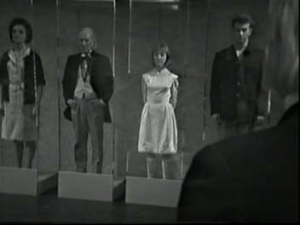


Timestamp #15: The Space Museum

Doctor Who: The Space Museum
(4 episodes, s02e26-e29, 1965)

Timestamp 015 The Space Museum

I enjoyed that this serial had a mystery that both the crew and the audience need to figure out. The second episode started into the background, but the first episode effectively roped me in with the question of what was going on.

There were some great moments in this serial. The Doctor gives the admonition to stay close, but then it’s the Doctor who lags behind gets taken by the rebels. Later he hides in a Dalek shell, and his Yoda-like mirth made me laugh. It was really nice to have him fool the mind-reading chair, and an equally nice touch to have the “curator” get rid of him once he’s of no further use. The typical sci-fi tropes would have had the baddie just stick the hero away instead of trying to kill him off.

The action scenes during the whole cat-and-mouse chase were engaging, and Vicki is brilliant in rewiring the armory computer. She’s really climbing the ranks as one of my favorite companions.

The thing that made me scratch my head was that this was apparently all started with yet another faulty component. It seems that the TARDIS is often just one bump short of falling apart at the seams.

Last but not least, there were new Daleks in the lead-in to The Chase. Unfortunately, the head light blinking sequences are way off, and I don’t like the super-shiny collar. It’s very distracting under the studio lights.


Rating: 4/5 – “Would you care for a jelly baby?”


UP NEXT – Doctor Who: The Chase


The Timestamps Project is an adventure through the televised universe of Doctor Who, story by story, from the beginning of the franchise. For more reviews like this one, please visit the project’s page at Creative Criticality.