


Culture on My Mind
Super Follies and Nuclear Power
April 23, 2021
This week, I have nuclear power technology on my mind. While pop culture and public perception get this wrong all the time, I’m looking at the pilot episode of Superman & Lois in particular since it was one of the most recent offenders.
People who know me might be surprised that I’m not harping on the “reactor is critical” trope again. “Give me time. I’ll get back to that,” he said with a wink.
The premiere episode of Superman & Lois – creatively titled “Pilot” in a long-standing television tradition – debuted on February 23, 2021. (Aside: It’s been two months, and that’s long enough that I’m not including a spoiler warning.) After a quick series of flashbacks to tell this version’s origin story, we spring into action as Superman saves the day by stopping a meltdown at a nuclear reactor near Metropolis. Apparently, someone has sabotaged the site by breaching the reactor, so Superman welds the hold and then drops a giant ice block into the cooling tower. The temperatures immediately plummet, everyone cheers, Superman smiles, end scene.
The show nearly lost me at this point. Less than five minutes into the pilot episode.
I have nearly twenty years of experience in nuclear power between the Navy and the civilian industry (both domestic and international). I’m registered with The Science & Entertainment Exchange through the National Academy of Science. Seriously, Hollywood, I’m available to consult for times like this.
I’ll explain why this scene struck me as wrong and why public perception gets it wrong all the time, with the caveat that I’m approaching this from the United States perspective since (a) it comprises the majority of my nuclear experience, and (b) Metropolis is an American city in the Superman & Lois universe.
I’ll also touch on why I think it matters.
The Story
First, let’s highlight the scene. It’s set at night and punctuated by helicopters, spotlights, and alarms. General Sam Lane arrives, has a discussion with someone who looks all Hollywood-nuclear-official in a hard hat and lab coat, and pages Superman to the casualty.
“How long we got before this thing pops its top?”
“A few minutes, tops.”
“The fallout?”
“As far as Metropolis.”
After Superman hears the page and changes course, we get this:
“The heat exchanger’s offline.”
“Where’s the damn water tanker?”
Superman arrives at the site and dives into the cooling tower. He lands on a walkway which visibly buckles it so it cannot be used until it is fixed. Hopefully it wasn’t important. The heat is noticeable in the wavering air and flying embers reminiscent of last decade’s movie posters as Kal-El surveys the damage. He spots a crack in a large circular component. Inside, something glows orange with heat.
“His cold breath isn’t gonna fix it.”
“We need water back in the reactor vessel, or we’re gonna have a meltdown the size of Fukushima.”
“It’s out of water!”
“Tanks!”
Superman seals the rupture with his heat vision, then rockets off. As he flies toward the nearby body of water, we get a view down the cooling tower. Under a blossom of catwalks, it is glowing like a pool of magma. Superman uses his cold breath to freeze a giant chunk of ice, hoists it up, and drops it into the cooling tower. The temperature drops and the reactor is safe.
Later, we get some dialogue that points to a crack in the cooling tower as the main problem.
That’s the foundation of the story. Now, let’s take a look at the foundation of reality.
Nuclear Plant Design
In general, there are two types of nuclear reactors in the United States: Pressurized Water Reactors (PWRs) and Boiling Water Reactors (BWRs). The operating principles are effectively the same in both types and can be differentiated by when water changes into steam.
Fission of fuel generates heat. That heat is transferred into the reactor coolant, which is water with a specific chemical makeup. That water eventually generates steam – In a BWR, the coolant boils in the reactor vessel, but in a PWR, the coolant transfers its energy to another system in the steam generator – which spins a turbine before being cooled, condensed, and returned to its starting point. The spinning turbine generates electricity which is transmitted to the electric grid.
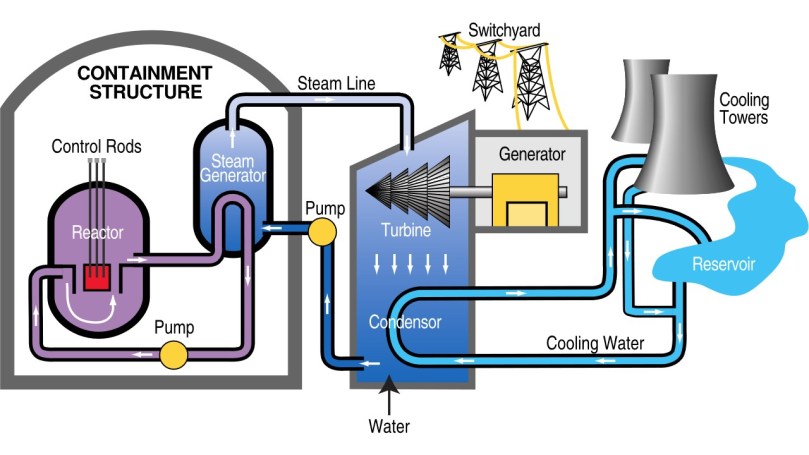
The advantage of the PWR is that the steam does not come into contact with the reactor coolant, which is potentially contaminated by fission products. The BWR exchanges this advantage by being more simple.
Regardless, the reactor core – fissionable fuel wrapped in metal sheets (cladding) and arranged into assemblies where the reaction is controlled by the reactor coolant and control rods – is separate from the turbines and the cooling towers.
The cooling towers deal with the steam it spins the turbine. To condense the steam, it is passed over tubes containing cool water. The heat is transferred from the steam to the water, which is then sent out to the cooling towers to transmit that energy to the atmosphere.
The trope and public perception are that the large hyperboloid towers immediately indicate the existence of a nuclear plant. That’s simply not true. In fact, Duke Energy noted in 2013 that there are 250 cooling towers on plants across the United States, and fewer than 100 of those belong to nuclear stations. For context, there are 94 commercial reactor units in the United States. That comprises 63 PWRs and 31 BWRs, and approximately 20% of the country’s electrical generating capacity. Some sites have multiple reactors.
Some towers are the hyperboloid style (which rely on natural draft to reject the excess heat) and some are forced air style (relying on fans to push air across the water to extract the excess heat).
Not all sites use cooling towers, either. Some pull the cooling water directly from nearby water sources and return it with a slight increase in temperature. Extensive studies are performed to ensure that the temperature increase does not negatively impact the environment, including wildlife. In order to protect the aquatic life in the water source, the use of cooling towers for new power plants larger than 100 megawatts (MW) was mandated by the Clean Water Act of 1972.
Since these heat sinks, be they cooling towers or bodies of water, are separated from the reactor coolant by several layers of metal, the probability of contaminating those heat sinks with fission products is very small.

Hyperboloid Cooling Towers
Focusing on the hyperboloid towers, their operation is pretty simple. The distinctive shape comes from rotating a hyperbola – a graph that looks like two infinite bows reflected on each other, reminiscent of an hourglass – around an axis. This shape presents high structural strength, minimum usage of material, and efficient upward convective air flow.
The heated water travels into the cooling tower and is sprayed from a set of nozzles. The hot mist drifts downward, giving up heat to air that is pulled in naturally through large vents at the bottom of the tower. The cooled water pools in a collection reservoir to be pumped back into the plant while the hot, moist air rises out through the top of the tower as a plume of steam.
Despite claims to the contrary, the exhaust is not smoke, does not carry fission products, and does not alter the weather (no matter what weathermen in large markets claim on Twitter).
Any losses to water inventory can be made up from external sources such as reservoirs, lakes, or local make up tanks.
The Science of Superman
The first thing that Superman & Lois got wrong was placing the reactor inside the cooling tower.
The reactor vessels in these light-water thermoelectric power plants are kept inside containment buildings with layers of protection between the public and the nuclear fuel. That’s a lot of metal and concrete designed to keep the public safe. The Superman & Lois power plant appears to have a single layer of metal between the fuel and the atmosphere, and at the bottom of the tower, any release of fission products would vent right out through the top. Right into the communities nearby.
Also consider that hyperboloid towers can be up to 200 meters (660 feet) tall and 100 meters (330 feet) in diameter. With the reactor we see on screen in mind, any bad actor has a nice size target to bomb.
The second thing that Superman & Lois got wrong has to do with Fukushima.
The dialogue clearly shows that the Fukushima Daiichi nuclear disaster happened in this fictional universe. In our reality, the 2011 Tōhoku earthquake and the ensuing tsunami led to a partial nuclear meltdown. The active reactors automatically shut down (as designed) upon detecting the earthquake. Because of the shutdowns and electrical grid supply problems, the emergency diesel generators automatically started (again, as designed) to keep circulating the coolant through the cores.
The reason to keep the coolant circulating after shutdown is residual decay heat. Even after fission has ceased, the fission products will continue to naturally decay and produce heat for several hours. In these reactors, that decay heat needs to be removed before it boils the coolant away. Water cools better than steam and air, and overheated fuel can melt the cladding, resulting in a meltdown.
Although the term is not officially defined International Atomic Energy Agency (IAEA) or by the United States Nuclear Regulatory Commission (NRC), that’s all a meltdown really is: At least one nuclear fuel element exceeds its melting point.
The Fukushima plant was designed to withstand earthquakes and tsunamis based on historic events. The 2011 earthquake and tsunami exceeded this design basis. It was the most powerful earthquake ever recorded in Japan, and the fourth most powerful earthquake in the world since modern record-keeping began in 1900. The waves swept over the seawall and the flooding caused the failure of the emergency generators and loss of power to the circulating pumps. The loss of decay heat removal led to three nuclear meltdowns, three hydrogen explosions, and the release of radioactive contamination.
In response to the Fukushima accident, the NRC issued order EA-12-049, requiring nuclear facilities to implement mitigation strategies (known in the industry as FLEX) for a beyond-design-basis external event using a three-phase approach. The first phase relies on installed equipment and resources to maintain or restore cooling capabilities. The second phase uses portable on-site equipment and consumables kept in storage for this purpose, and the third phase relies on off-site resources that are trucked or flown in to sustain those functions indefinitely.
Back to Superman & Lois, while a meltdown (and fission product release) was inferred by all the glowing orange magma, the operators clearly failed to implement the FLEX strategies to contain it. I can forgive the first phase since they mentioned that heat exchangers were “offline”, so obviously the installed equipment had failed. However, the second phase equipment is hooked up during the emergency and patches in around failed components. Unless the emergency equipment was sabotaged in some manner, it should have been able to supply water directly from the nearby lake/ocean to keep the core cooled.
Aside: It should also be noted that heat exchangers are passive components, so they can’t go offline. The pumps that supply water to the heat exchangers can go offline since they are powered active components. There is a fundamental difference. Further, there are a ton of heat exchangers in a nuclear power plant, so specificity matters in an emergency.
The third thing that Superman & Lois got wrong was thermodynamics.
Normal water freezes at 32°F (0°C) and salt water freezes at about 28.4°F (−2°C). Interior temperatures of the largest known iceberg in the North Atlantic were estimated between 5°F and −4°F (−15°C and −20°C), and that was for the equivalent of a 55-story building.
During a meltdown, the fuel assembly cladding deforms between 1,292°F and 1,652°F (700°C and 900°C). The cladding melts at 3,270°F (1,800°C) and the uranium oxide fuel melts between 4,890°F and 5,070°F (2,700°C and 2,800°C).
I know, that’s a lot of numbers. But, the point is that a 300-foot wide ice cube would likely have melted long before dropping those kind of temperatures to a reasonable level. In fact, it would have probably created an explosive steam cloud that would carry the already exposed fission products into the atmosphere.
There’s an even larger danger, however. In the event of a meltdown, a lava-like mass of fuel-containing material colloquially called corium is formed. Adding water to this mass, either by flooding or dropping it into a pool, can result in damage to containment and a spread of fission products. The reaction would cause a temperature spike and the production of a large amount of hydrogen. That immediate gas formation can result in a pressure spike inside the containment, and the steam explosion that I mentioned earlier could send projectiles and shrapnel flying. The same gas could also combust causing further pressure spikes.
Simply put, I don’t think Superman’s solution would have worked. In fact, it would have only made the problem worse.

Wrap-Up
I’ve been around science-fiction and fantasy long enough to understand creative license and suspension of disbelief. I also understand that the general television watching public is not going to dive into this level of detail about a program based on a comic book hero. It’s supposed to be fun escapism, right?
In the twenty-first century, there should be no excuse for scientifically lazy storytelling in this genre, particularly when the bar has been set so high by Marvel Studios in superhero entertainment and by other properties like Star Trek, Stargate, Battlestar Galactica, and The Expanse.
The problem could have been solved in so many other ways that would have maintained at least the illusion of technical integrity. Really, the crux of the matter is having a scientific advisor or consultant available. If IMDb is any indication, Superman & Lois hasn’t used that expertise. At a minimum, they haven’t credited their consultants.
It’s 2021. Geeks are smart. We’ve seen the potential in sharply written entertainment that doesn’t patronize us or insult our intellects. We’ve also seen the power of science and the rise of STEM education opportunities.
By tapping proven science-in-entertainment experts – André Bormanis, Dr. Erin Macdonald, Mika McKinnon, Dr. Kevin Grazier, Dr. Naren Shankar, and Dr. David Saltzberg come to mind right away – or other technical experts through a resource like The Science & Entertainment Exchange, producers and writers can avoid making scientific mistakes and fans worldwide can get smarter stories for their time and money.
It’s a return on investment in which everyone wins.
This post was inspired by Michael Bailey, Bethany Kesler, and Alison Richards, the hosts of The Superman & Lois Tapes, a weekly podcast about The CW’s television series Superman & Lois. Thanks to you, BAM Crew, for the spark and the read-through.
You can find their show and all things Superman on The Fortress of Baileytude Podcasting Network.
Special thanks also go to Gary Mitchel for his keen eye and advice in proofing this work.
This group of awesome people made sure that I didn’t get too technical for the average reader. Nuclear power can be complex, but the science and engineering concepts behind it are simple. One of my goals is to make all of it easier to understand.

Culture on My Mind is inspired by the weekly Can’t Let It Go segment on the NPR Politics Podcast where each host brings one thing to the table that they just can’t stop thinking about.
For more creativity with a critical eye, visit Creative Criticality.