
Timestamp #TW22: Something Borrowed

Torchwood: Something Borrowed
(1 episode, s02e09, 2008)
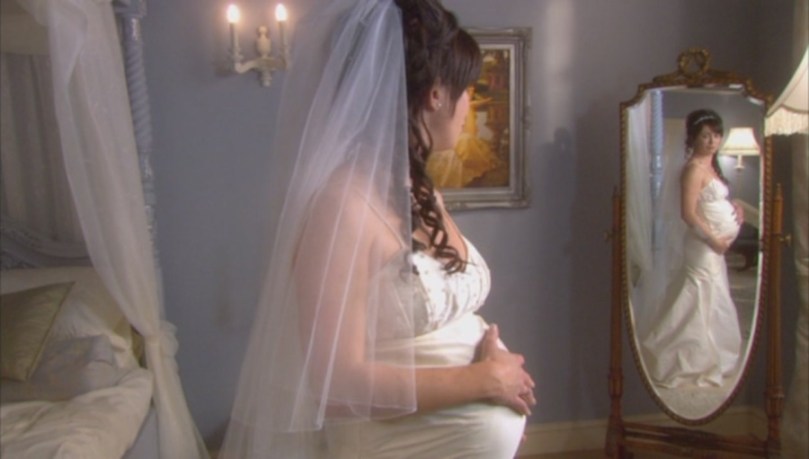
 

Something old, something new, something borrowed, something… goo?

Gwen is running late for her bachelorette (hen) party. She was in pursuit of a carnivorous shape-shifter when she was bitten on the arm. Jack shot the creature and Owen tended to her wounds before she went to celebrate.

When she wakes up the next morning, she’s suddenly pregnant. Almost full-term.

Surprise!

Jack and Owen assume that the shape-shifter passed its eggs along in the bite. They have a solution but it requires her to be down for several days. Unfortunately, today is her wedding day. She calls Rhys and tries to explain, putting Rhys into a tailspin.

As Rhys and Gwen try to come to a compromise, the team scrambles to keep the wedding on track while Owen performs a shape-shifter autopsy. Gwen tells Rhys that the wedding is all that matters today, but the question remains as to what to tell the families. They play like it was a planned surprise, but Gwen knows that, with their parents now planning for a grandchild, the news that she lost the child would be devastating.

Tosh arrives with Gwen’s new dress and gets hit on by the best man, but she handles herself like a pro. The women briefly discuss Tosh and Owen’s relationship before Tosh heads back downstairs. Meanwhile, Owen discovers a small problem: The shape-shifter is a Nostrovite, a species that mates for life and hunts in pairs. After fertilization, the female passes the eggs to the male for safekeeping and eventual impregnation. The dead alien’s mate is now hunting Gwen and is working her way through the wedding party.

The Nostrovite has also captured Tosh and best man “Banana Boat” in a black web. The rest of Torchwood Three dispatch to the wedding to tackle the problem.

Gwen continues to get ready for the wedding. To explain the pregnancy, she tells her father about Torchwood, but he doesn’t believe her. Gwen and Rhys get to the altar but Jack bursts in to stop the ceremony.

Owen and Ianto free Tosh and Banana, as well as finding the corpse the Nostrovite mangled earlier. One of the bridesmaids enters the room and, at the site of the corpse, runs away screaming. The bridesmaid tells everyone about the corpse so Jack orders Ianto to jam all of the phone lines.

Jack tells the assembled guests that he’s from Torchwood, surprising Gwen’s father and spooking the alien. Jack and Tosh give chase but lose her. The alien assumes Rhys’s mother’s form and takes Gwen’s mother hostage. Gwen distracts the alien long enough to ambush her, and after the Nostrovite flees, Gwen is rushed back to her room.

Owen, handicapped by his injured hand, briefs Rhys on how to use the singularity scalpel. Meanwhile, Gwen is ambushed by the Nostrovite in Jack’s form. Owen and Gwen empty their magazines into the creature, but it is seemingly unstoppable. Gwen and Rhys run for the stables while Owen faces the shape-shifter. He’s not very palatable in his undead state.

Rhys uses the singularity scalpel to extract the alien fetus. The Nostrovite bursts in and Rhys has a heroic moment, but he falls short as his chainsaw runs out of fuel. After a not-so-subtle curse word, Rhys gets covered in goo as Jack uses a BFG to end the threat.

Gwen and Rhys finally get married, alien goo and all. Owen and Tosh share the dance that she wanted as Jack wishes Gwen all the best on her honeymoon. As the guests fall asleep around them thanks to the wedding gift of Retcon, Jack offers the same to the newlyweds. Gwen states that there will be no secrets in their marriage.

The happy couple departs as Torchwood Three begins to clean up the mess. Later on, Jack returns to the Hub alone with a handful of confetti. He opens a box of photographs and reminisces over one in particular.

Jack was married once. The photo is from his wedding.


An enjoyable romp from start to finish, it only gets better by playing on character elements that have been building over this season, from Owen and Tosh’s relationship to Rhys and his distrust of Jack. Jack’s maudlin moment as he reflects on his interminable life is the icing on this (wedding) cake.

I also really love how Gwen acknowledges how the lies and omissions hurt her relationships, from the news of the spontaneous pregnancy to how she and Rhys plan to approach the next chapter in their lives together.

Stories that try to extract humor from unplanned pregnancies can often go wrong. This one struck me as well-crafted and engaging.


Rating: 4/5 – “Would you care for a jelly baby?”


UP NEXT – Torchwood: From Out of the Rain


The Timestamps Project is an adventure through the televised universe of Doctor Who, story by story, from the beginning of the franchise. For more reviews like this one, please visit the project’s page at Creative Criticality.



The Thing About Today – January 29

January 29, 2020
Day 29 of 366


January 29th is the twenty-ninth day of the year. It is locally celebrated as Kansas Day, commemorating the admission of the state to the country in 1861.

In the United States, it is “celebrated” as National Puzzle Day and National Corn Chip Day.


Historical items of note:

  • In 1737, Thomas Paine was born. He was the author of Common Sense and one of the Founding Fathers of the United States.
  • In 1834, President Andrew Jackson ordered the first use of federal soldiers to suppress a labor dispute.
  • In 1845, “The Raven” was published in The Evening Mirror in New York. This marked the first publication with the name of the author, Edgar Allan Poe.
  • In 1860, Anton Chekhov was born. The Russian playwright and short story writer is known for Chekhov’s Gun, the dramatic principle that requires that every element in a narrative be necessary and irreplaceable and that everything else be removed.
  • In 1863, a detachment of California Volunteers led by Colonel Patrick Edward Connor engaged the Shoshone at Bear River, Washington Territory. The altercation resulted in the deaths of hundreds of men, women, and children. It would become known as the Bear River Massacre.
  • In 1886, Karl Benz patented the first successful gasoline-driven automobile.
  • In 1907, Charles Curtis of Kansas became the first Native American U.S. Senator.
  • In 1940, actress and author Katharine Ross was born.
  • In 1945, Tom Selleck was born.
  • In 1959, Disney’s Sleeping Beauty premiered.
  • In 1964, Dr. Strangelove or: How I Learned to Stop Worrying and Love the Bomb premiered.
  • In 2006, a 39-cent stamp is released in the United States featuring Hattie McDaniel. She was depicted in the dress she wore in 1940 when she became the first African-American actress to accept an Academy Award.
  • In 2018, Black Panther premiered. Among several other accolades and records, it was the first superhero film to receive a Best Picture nomination and the first Marvel Cinematic Universe film to win an Academy Award.


In 1980, the Rubik’s Cube made its international debut at the Ideal Toy Company in Earl’s Court, London.

The cube was invented in 1974 by Hungarian sculptor and professor of architecture Ernő Rubik. After the 1980 sale to the Ideal Toy Company, it won the German Game of the Year special award for Best Puzzle.

The original cube had six faces, each covered by nine stickers. The stickers represented six solid colors –  white, red, blue, orange, green, and yellow – and early cubes didn’t have an established pattern so the position of each color varied from cube to cube. Modern versions have a standardized pattern – white is opposite yellow, blue is opposite green, and orange is opposite red, with the red, white, and blue arranged in that order in a clockwise arrangement – and have evolved from stickers to colored plastic panels to prevent peeling and fading.

In order to solve the puzzle, each of the cube faces must be a solid color. There are competitions and world records for various methods of solving the Rubik’s Cube, including speed-solving.

The cube was a cultural icon of the 1980s and still is popular to this day. It is the world’s top-selling puzzle game and best-selling toy.


The Thing About Today is an effort to look at each day of 2020 with respect to its historical context.

For more creativity with a critical eye, visit Creative Criticality.


The Thing About Today – January 28

January 28, 2020
Day 28 of 366


January 28th is the twenty-eighth day of the year. It is Data Privacy Day worldwide, an observation designed to raise awareness and promote privacy and data protection best practices.

In the United States, it is “celebrated” as National Blueberry Pancake Day, National Fun at Work Day, National Kazoo Day, and National Plan for Vacation Day. That last one is typically observed on the last Tuesday in January.


Historical items of note:

  • In 1573, the Articles of the Warsaw Confederation were signed, sanctioning freedom of religion in Poland.
  • In 1813, Jane Austen’s Pride and Prejudice is first published in the United Kingdom. Zombies would be added 196 years later.
  • In 1855, a locomotive on the Panama Canal Railway ran from the Atlantic Ocean to the Pacific Ocean for the first time.
  • In 1878, the Yale Daily News was published, becoming the first daily college newspaper in the United States.
  • In 1922, the Knickerbocker Storm occurred in Washington, DC. It was so named when the immense snowfall caused the roof of the Knickerbocker Theater collapsed and caused the city’s largest loss of life.
  • In 1936, actor, writer, and director Alan Alda was born.
  • In 1956, Elvis Presley made his first nationally televised appearance.
  • In 1965, the current design of the Flag of Canada was chosen by an act of Parliament.
  • In 1986, the Space Shuttle Challenger (mission STS-51-L) broke apart 73 seconds after liftoff. All seven astronauts on board were lost. I commemorated the thirtieth anniversary of the disaster in this post.


In 1958, The Lego company patented the design of its famous bricks.

Lego was born in 1932 when Ole Kirk Christiansen of Billund, Denmark started making toys in his workshop. The company was named in 1934 based on the Danish phrase leg godt, which means “play well”. The company started making plastic toys in 1947 and two years later started into the interlocking bricks game with their Automatic Binding Bricks.

The interlocking bricks were based on the Self-Locking Bricks line from Kiddicraft, which had been patented in the United Kingdom in 1939 and released eight years later. Lego received a Kiddicraft sample from their injection-molding machine supplier.

By 1951, the plastic toys were around half of Lego’s output. By 1954, they were on the way to becoming a toy system after Christiansen’s son, Godtfred, talked to an overseas buyer in his role as junior managing director. The big catch was the fact that the bricks were limited in locking ability and versatility, so over the modern brick design was developed over the next five years. The ABS polymer design was patented in 1958 and is still compatible with bricks released today.

From there, the company continued innovating. They made the Duplo line in 1969, a design for younger children that basically doubled the dimensions of the standard Lego bricks. Minifigures were introduced in 1978 and became a highly-collectible staple of the toyline.

Lego’s popularity has reached many forms of popular culture including books, films, video games, and art. The system has also been used as a teaching tool for science, technology, engineering, art, and mathematics. It also reached a major milestone in 1998 when it was one of the original inductees into the National Toy Hall of Fame at The Strong in Rochester, New York.


The Thing About Today is an effort to look at each day of 2020 with respect to its historical context.

For more creativity with a critical eye, visit Creative Criticality.


The Thing About Today – January 27

January 27, 2020
Day 27 of 366


January 27th is the twenty-seventh day of the year. It is the anniversary of the liberation of the remaining inmates at Auschwitz, including related commemorations.

In the United States, it is “celebrated” as National Chocolate Cake Day and National Bubble Wrap Appreciation Day. The latter is typically observed on the last Monday of January.


Historical items of note:

  • In 1302, Dante Alighieri was exiled from Florence.
  • In 1606, the trial of Guy Fawkes and other conspirators began. It ended with their execution on January 31st.
  • In 1785, the University of Georgia was founded, becoming the first public university in the United States.
  • In 1820, the Antarctic continent was discovered by a Russian expedition led by Fabian Gottlieb von Bellingshausen and Mikhail Petrovich Lazarev.
  • In 1825, the path for the forced relocation of Native American tribes was cleared by the approval of the Indian Territory in what is now Oklahoma. The relocation route became known as the “Trail of Tears”.
  • In 1832, English novelist, poet, and mathematician Lewis Carroll was born.
  • In 1880, Thomas Edison received a patent for his incandescent lamp.
  • In 1900, Admiral Hyman G. Rickover, the Father of the Nuclear Navy, was born.
  • In 1908, American journalist and publisher William Randolph Hearst, Jr. was born.
  • In 1921, actress Donna Reed was born.
  • In 1939, the Lockheed P-38 Lightning took flight for the first time.
  • In 1940, actor James Cromwell was born.
  • In 1943, the Eighth Air Force sortied ninety-one B-17s and B-24s to attack the U-boat construction yards at Wilhelmshaven, Germany. This marked the first American bombing attack on Germany.
  • In 1944, the 900-day Siege of Leningrad was lifted.
  • In 1956, actress Mimi Rogers was born.
  • In 1957, illustrator, director, producer, and screenwriter Frank Miller was born.
  • In 1965, actor Alan Cumming was born.
  • In 1967, astronauts Gus Grissom, Ed White, and Roger Chaffee were killed in the Apollo 1 fire at Kennedy Space Center. I commemorated the fiftieth anniversary of this tragedy in this post.
  • Also in 1967, the Soviet Union, the United States, and the United Kingdom signed the Outer Space Treaty in Washington, D.C. This banned deployment of nuclear weapons in space, and limited use of the Moon and other celestial bodies to peaceful purposes.
  • In 1970, the American movie rating system modified the “M” rating to “PG”.
  • In 1973, the Paris Peace Accords officially ended the Vietnam War.
  • In 1976, Laverne and Shirley premiered on ABC.
  • In 1979, actress Rosamund Pike was born.
  • In 2003, the first selections for the National Recording Registry were announced by the Library of Congress.


In 1945, the Soviet 322nd Rifle Division liberated the remaining inmates of the Auschwitz-Birkenau concentration camp. Auschwitz-Birkenau was a component of the larger Auschwitz complex that contained over 40 concentration and extermination camps during World War II. During the Nazi regime, the Auschwitz complex housed 1.3 million prisoners and murdered 1.1 million of them in the Holocaust.

At the time of the 1945 liberation, 7,500 prisoners and over 600 corpses we found. A collection of items were also found, including 837,000 women’s garments, 370,000 men’s suits, 44,000 pairs of shoes, and 7,000 kg of human hair. The Soviet war crimes commission estimated that these items belonged to 140,000 people.

Primo Levi, an Italian Jewish chemist who was in captivity during the liberation, noted the mood:

They did not greet us, nor did they smile; they seemed oppressed not only by compassion but by a confused restraint, which sealed their lips and bound their eyes to the funereal scene. It was that shame we knew so well, the shame that drowned us after the selections, and every time we had to watch, or submit to, some outrage: the shame the Germans did not know, that the just man experiences at another man’s crime; the feeling of guilt that such a crime should exist, that it should have been introduced irrevocably into the world of things that exist, and that his will for good should have proved too weak or null, and should not have availed in defence.

During the four years of the Holocaust (1941-1945), 6 million Jews and 11 million other victims of persecution were murdered by the Nazi regime and its collaborators.

To commemorate the liberation of Auschwitz-Birkenau and the tragedy of the Holocaust, the day was designated as International Holocaust Remembrance Day by United Nations General Assembly Resolution 60/7 on November 1, 2005 during the 42nd plenary session. The resolution came after a special session was held on January 24th to mark the 60th anniversary of the liberation.

Countries around the world also observe Holocaust memorial days on different days.

The intent is to both remember those who were massacred as well as educating future generations of the horrors of the Holocaust.

To reject, in whole or in part, any denial of the Holocaust as a historical event.

To condemn religious intolerance, incitement, harassment, or violence based on ethnicity or religious belief no matter where they occur.

To paraphrase Resolution 60/7: To honor the courage and dedication shown by the soldiers who liberated the concentration camps and reaffirm that the murder of one-third of the Jewish people, along with countless members of other minorities, will forever be a warning to all people of the dangers of hatred, bigotry, racism and prejudice.

In two words: Never again.


The Thing About Today is an effort to look at each day of 2020 with respect to its historical context.

For more creativity with a critical eye, visit Creative Criticality.


The Thing About Today – January 26

January 26, 2020
Day 26 of 366


January 26th is the twenty-sixth day of the year. It is Australia Day in Australia, marking the anniversary of the 1788 arrival of the British First Fleet Port Jackson, New South Wales. It also commemorates the raising of the Flag of Great Britain at Sydney Cove by Governor Arthur Phillip.

In the United States, it is “celebrated” as National Peanut Brittle Day, National Green Juice Day, and National Spouses Day.


Historical items of note:

  • In 1564, the Council of Trent established an official distinction between Roman Catholicism and Protestantism.
  • In 1837, Michigan was admitted as the twenty-sixth U.S. state.
  • In 1880, American general and Medal of Honor recipient Douglas MacArthur was born.
  • In 1911, Glenn Curtiss flew the first successful American seaplane.
  • In 1915, the Rocky Mountain National Park was established by the United States Congress.
  • In 1918, science fiction author Philip José Farmer was born.
  • In 1946, film critic and journalist Gene Siskel was born.
  • In 1954, groundbreaking commenced at the Disneyland park.
  • In 1955, guitarist and songwriter Eddie Van Halen was born.
  • In 1958, comedian and actress Ellen DeGeneres was born.
  • In 1961, John F. Kennedy appointed Janet G. Travell as Physician to the President, the first woman to hold the position.
  • In 1998, President Bill Clinton, on American television, denied having had “sexual relations” with former White House intern Monica Lewinsky.


In 1979, The Dukes of Hazzard premiered on CBS. Running for seven seasons from 1979 to 1985, the show was inspired by (and mostly lifted from) the 1975 action comedy Moonrunners.

Both the film and television series were narrated by The Balladeer, played by Waylon Jennings. They focused on the antics and adventures of two cousins – Bo and Luke Duke in the series, Bobby Lee and Grady in the film – who are being raised by their Uncle Jesse, the widowed, overall-clad moonshiner patriarch of the backwoods Southern family.

The county boss – Hogg in the series, Jake Rainey in the film – maintains a stranglehold on the area and bribes local sheriff Roscoe Coltrane. Duke cousin Daisy, whose trademark shorts became an icon of the decade, was unique to the series.

The big icon from the series was The General Lee, an orange 1969 Dodge Charger with the Confederate Battle Flag painted on the roof, which the Duke boys used to run moonshine and escape the reach of the law. An estimated 309 Chargers were used during the course of the show.

In Moonrunners, the car was named Traveller after General Lee’s horse. The car became a major source of controversy due to the Confederate flag, resulting in the series being pulled from syndication in 2015. Merchandise based on the series was also frozen as a result.

(I considered this a bit of an overreach given how the series, more often than not, innocently parodied the stereotypes of the deep American South rather than celebrated the culture’s legacy.)

The big controversy in the show was the introduction of Coy and Vance Duke in the fifth season. The show was consistently among the top-rated shows on the air, second only to the Dallas juggernaut at one point. With that success came huge profits in merchandising, prompting stars Tom Wopat and John Schneider to be concerned over royalties and their salaries. In the spring of 1982, with no resolution in sight, Wopat and Schneider refused to report to work. After significant delays, their positions were hastily replaced by Coy and Vance with the excuse that Bo and Luke had joined the NASCAR circuit. Ratings plummeted, Warner Bros. renegotiated, and the original Duke boys returned at the end of the season.

Catherine Bach (Daisy Duke) considered leaving the show in solidarity, but Wopat and Schneider convinced her to stay in order to keep the show alive in their absence.

The show had two made-for-TV reunion movies (1997’s The Dukes of Hazzard: Reunion! and 2000’s The Dukes of Hazzard: Hazzard in Hollywood), two spinoff series (Enos and The Dukes), and at least four video games.

An attempt was made to revive the franchise in the early 2000s with a theatrical film starring Johnny Knoxville, Seann William Scott, and Jessica Simpson. A direct-to-video prequel followed but flopped, killing the revival.

This show was a large part of my childhood, standing alongside car-centric series like Knight Rider, The A-Team, and The Fall Guy. Despite the controversy surrounding the Confederate flag, the series maintains a cult following among fans.


The Thing About Today is an effort to look at each day of 2020 with respect to its historical context.

For more creativity with a critical eye, visit Creative Criticality.


The Thing About Today – January 25

January 25, 2020
Day 25 of 366


January 25th is the twenty-fifth day of the year. It is Burns Night in Scotland, which is a celebration of poet Robert Burns.

It is also the Lunar New Year based on the Chinese lunisolar calendar. Today marks the beginning of the Year of the Rat.

In the United States, it is “celebrated” as National Florida Day, National Opposite Day, National Irish Coffee Day, and National Seed Swap Day. The last one is typically celebrated on the last Saturday of January.


Historical items of note:

  • In 1759, Scottish poet and songwriter Robert Burns was born. He brought “Auld Lang Syne” to the world.
  • In 1783, William Colgate, founder of Colgate-Palmolive, was born.
  • In 1858, a long-standing tradition was started at the wedding of Victoria (daughter of Queen Victoria) and Friedrich of Prussia: Felix Mendelssohn’s Wedding March was played and became immensely popular as a wedding processional.
  • In 1881, Thomas Edison and Alexander Graham Bell formed the Oriental Telephone Company.
  • In 1882, English novelist Virginia Woolf was born.
  • In 1909, Richard Strauss’s opera Elektra debuted at the Dresden State Opera.
  • In 1915, Alexander Graham Bell inaugurated the United States transcontinental telephone service by speaking from New York to Thomas Watson in San Francisco.
  • In 1931, actor Dean Jones was born.
  • In 1937, The Guiding Light debuted on NBC radio from Chicago. In 1952, it moved to CBS television and ran until September 18, 2009.
  • In 1943, director and filmmaker Tobe Hooper was born.
  • In 1945, the Battle of the Bulge ended in the Ardennes. The conflict ran for forty days, was the largest and bloodiest single battle fought by the United States in World War II, and was the third deadliest campaign in American history.
  • In 1947, Thomas Goldsmith Jr. filed a patent for the “Cathode Ray Tube Amusement Device”. It was the first-ever electronic game.
  • In 1961, President John F. Kennedy delivered the first live presidential television news conference.
  • In 1971, Charles Manson and three female members of the “Family” were found guilty of the 1969 Tate–LaBianca murders.
  • In 1981, singer-songwriter Alicia Keys was born.


In 1970, the film version of M*A*S*H premiered. Directed by Robert Altman and written by Ring Lardner Jr., it was based on MASH: A Novel About Three Army Doctors.

The dark comedy depicts the antics of the 4077th Mobile Army Surgical Hospital during the Korean War, though the subtext was really about the ongoing Vietnam War. The film starred Donald Sutherland, Tom Skerritt, and Elliott Gould, with Sally Kellerman, Robert Duvall, René Auberjonois, Gary Burghoff, Roger Bowen, Michael Murphy, and professional football player Fred Williamson in his film debut.

The film received five Academy Award nominations and won for Best Adapted Screenplay. It also inspired the landmark television series M*A*S*H, which ran from 1972 to 1983. While many of the characters made the leap from film to television, the only actor from the movie to make the transition was Gary Burghoff in his role of Walter “Radar” O’Reilly.

The original novel was written by H. Richard Hornberger (a former military surgeon) and W. C. Heinz (a former World War II war correspondent), under the pseudonym Richard Hooker. Hornberger, writing as Hooker, continued with M*A*S*H Goes to Maine, a novel focused on the post-war lives of the surgical team.

As the television series became increasingly popular, twelve novels were written by William E. Butterworth that took the M*A*S*H team around the world in the comical but unrealistic “M*A*S*H Goes to ______” series. In 1977, a third and final Hooker novel was published (M*A*S*H Mania) that ignored everything published after M*A*S*H Goes to Maine.

The television series ended after eleven seasons, wrapping up with the most-watched final episode in television history. Actors Harry Morgan, Jamie Farr, and William Christopher carried the torch for two seasons in AfterMASH, a series that followed Colonel Potter, Max Klinger, and Father Mulcahy after the war ended. A pilot for W*A*L*T*E*R, a series centered on Radar O’Reilly, was aired but not picked up for a series option.

The most successful spinoff of the franchise was Trapper John, MD, a medical drama centered on the character of Trapper John McIntyre. Even though the pilot episode shows a photograph of Wayne Rogers and Alan Alda, the series is more of a sequel to the film rather than the television series.

The franchise itself maintains immense popularity through continuous reruns and great success in home media sales.


The Thing About Today is an effort to look at each day of 2020 with respect to its historical context.

For more creativity with a critical eye, visit Creative Criticality.


Culture on My Mind – New Voyagers

Culture on My Mind
New Voyagers

January 24, 2020

This week, the thing that I can’t let go of are NASA’s latest astronaut graduates. On January 10, 2020, NASA held a ceremony for thirteen graduates, including six women and seven men chosen from 18,000 applicants. Two of the graduates are from the Canadian Space Agency.

Image credit: NASA

The new graduates may potentially be assigned on missions to the International Space Station, the Moon as part of the Artemis program, and eventually Mars in the mid-2030s. Including this class, NASA has 48 astronauts in their corps.

I have a soft spot for astronauts because of my love of science fiction and STEAM disciplines. As a kid, much like many from my generation, I wanted to be an astronaut. I have a lot of respect for anyone who makes it through and serves with honor.

The NASA press release listed the graduates and links to their official biographies. From that press release:

  • Kayla Barron, a U.S. Navy lieutenant, originally is from Richland, Washington. She graduated from the U.S. Naval Academy with a bachelor’s degree in systems engineering. A Gates Cambridge Scholar, Barron earned a master’s degree in nuclear engineering from the University of Cambridge in the United Kingdom. As a submarine warfare officer, Barron served aboard the USS Maine (SSBN 741), completing three strategic deterrent patrols. She came to NASA from the U.S. Naval Academy, where she was serving as the flag aide to the superintendent.
  • Zena Cardman calls Williamsburg, Virginia, home. She completed a bachelor’s degree in biology and a master’s degree in marine sciences at The University of North Carolina, Chapel Hill. Cardman was a National Science Foundation Graduate Research Fellow, working at The Pennsylvania State University. Her research focused on microorganisms in subsurface environments, ranging from caves to deep sea sediments. Her field experience includes multiple Antarctic expeditions, work aboard research vessels as both a scientist and crew member, and NASA analog missions in British Columbia, Idaho and Hawaii.
  • Raja Chari, a U.S. Air Force colonel, hails from Cedar Falls, Iowa. He graduated from the U.S. Air Force Academy with bachelor’s degrees in astronautical engineering and engineering science. He continued on to earn a master’s degree in aeronautics and astronautics from Massachusetts Institute of Technology (MIT) and graduated from the U.S. Naval Test Pilot School in Patuxent River, Maryland. Chari served as the commander of the 461st Flight Test Squadron and the director of the F-35 Integrated Test Force at Edwards Air Force Base (AFB) in California.
  • Matthew Dominick, a U.S. Navy lieutenant commander, was born and grew up in Wheat Ridge, Colorado. He earned a bachelor’s degree in electrical engineering from the University of San Diego and a master’s degree in systems engineering from the Naval Postgraduate School in Monterey, California. He also graduated from the U.S. Naval Test Pilot School. Dominick served on the USS Ronald Reagan as department head for Strike Fighter Squadron 115.
  • Bob Hines, a U.S. Air Force lieutenant colonel, attended high school in Mountaintop, Pennsylvania, but considers Harrisburg, Pennsylvania, his hometown. He has a bachelor’s degree in aerospace engineering from Boston University and a master’s degree in flight test engineering from the U.S. Air Force Test Pilot School at Edwards AFB. Hines served as a developmental test pilot on all models of the F-15 while earning a master’s in aerospace engineering from the University of Alabama. He has deployed in support of Operations Enduring Freedom and Iraqi Freedom. Prior to being selected as an astronaut, he was a Federal Aviation Administration flight test pilot and a NASA research pilot at Johnson.
  • Warren Hoburg originally is from Pittsburgh. He earned a bachelor’s degree in aeronautics and astronautics from MIT, and a doctorate in electrical engineering and computer science from the University of California, Berkeley. He is a commercial pilot, and spent several seasons serving on the Bay Area Mountain Rescue Unit and Yosemite Search and Rescue. Hoburg came to NASA from MIT, where he led a research group as an assistant professor of aeronautics and astronautics.
  • Dr. Jonny Kim, a U.S. Navy lieutenant, was born and grew up in Los Angeles. He enlisted in the U.S. Navy, then trained and operated as a Navy SEAL, completing more than 100 combat operations and earning a Silver Star and Bronze Star with Combat V. Afterward, he went on to complete a degree in mathematics at the University of San Diego and a doctorate of medicine at Harvard Medical School. Kim was a resident physician in emergency medicine at Massachusetts General Hospital in Boston.
  • Jasmin Moghbeli, a U.S. Marine Corps major, considers Baldwin, New York, her hometown. She earned a bachelor’s degree in aerospace engineering with information technology at MIT and a master’s degree in aerospace engineering from the Naval Postgraduate School. She also is a distinguished graduate of the U.S. Naval Test Pilot School. Moghbeli came to NASA from Yuma, Arizona, where she tested H-1 helicopters and served as the quality assurance and avionics officer for Marine Operational Test and Evaluation Squadron 1.
  • Loral O’Hara was born in Houston. She earned a bachelor’s degree in Aerospace Engineering at the University of Kansas and a master’s degree in Aeronautics and Astronautics from Purdue University. Prior to joining NASA, O’Hara was a Research Engineer at Woods Hole Oceanographic Institution in Woods Hole, Massachusetts, where she worked on the engineering, test, and operations of deep-ocean research submersibles and robots.
  • Dr. Francisco “Frank” Rubio, a U.S. Army lieutenant colonel, originally is from Miami. He earned a bachelor’s degree in international relations at the U.S. Military Academy at West Point, New York, and a doctorate of medicine from the Uniformed Services University of the Health Sciences in Bethesda, Maryland. Rubio has accumulated more than 1,100 hours as a Blackhawk helicopter pilot, including 600 hours of combat and imminent danger time. He was serving as a surgeon for the 3rd Battalion of the Army’s 10th Special Forces Group at Fort Carson, Colorado, before coming to NASA.
  • Jessica Watkins hails from Lafayette, Colorado. She graduated from Stanford University in Palo Alto, California, with a bachelor’s degree in geological and environmental sciences, then went on to earn a doctorate in geology from the University of California, Los Angeles. Watkins has worked at NASA’s Ames Research Center in Silicon Valley, California, and Jet Propulsion Laboratory in Pasadena, California, and was a postdoctoral fellow at the California Institute of Technology, where she collaborated on NASA’s Mars Science Laboratory rover, Curiosity.
  • Joshua Kutryka Royal Canadian Air Force lieutenant colonel, is from Beauvallon, Alberta. He has a bachelor’s degree in mechanical engineering, as well as master’s degrees in space studies, flight test engineering, and defense studies. Prior to joining CSA, Kutryk worked as an experimental test pilot and a fighter pilot in Cold Lake, Alberta, where he led the unit responsible for the operational flight-testing of fighter aircraft in Canada.
  • Jennifer Sidey-Gibbons hails from Calgary, Alberta. She holds an honors bachelor’s degree in mechanical engineering from McGill University in Montreal and a doctorate in engineering from the University of Cambridge. While at McGill, she conducted research on flame propagation in microgravity, in collaboration with CSA and the National Research Council Flight Research Laboratory. Prior to joining CSA, Sidey-Gibbons worked as an assistant professor in combustion in the Department of Engineering at Cambridge.

Bravo Zulu, astronauts.

cc-break

Culture on My Mind is inspired by the weekly Can’t Let It Go segment on the NPR Politics Podcast where each host brings one thing to the table that they just can’t stop thinking about.

For more creativity with a critical eye, visit Creative Criticality.

The Thing About Today – January 24

January 24, 2020
Day 24 of 366


January 24th is the twenty-fourth day of the year. It is Unification Day in Romania.

In the United States, it is “celebrated” as Beer Can Appreciation Day, National Compliment Day, and National Peanut Butter Day.


Historical items of note:

  • In 41 AD, Claudius was proclaimed Roman Emperor by the Praetorian Guard. This was after they assassinated the previous emperor, his nephew Caligula, thus ending the male line of Julii Caesares.
  • In 1848, James W. Marshall discovered gold at Sutter’s Mill near Sacramento, California. This marked the beginning of the California Gold Rush.
  • In 1862, Bucharest was declared as the capital of Romania.
  • Also in 1862, novelist Edith Wharton was born. In 1921, she was the first woman to win the Pulitzer Prize for Literature.
  • In 1908, the first Boy Scout troop was organized in England by Robert Baden-Powell.
  • In 1916, the Supreme Court of the United States decided in the case of Brushaber v. Union Pacific Railroad Co. that federal income tax was constitutional.
  • In 1917, actor Ernest Borgnine was born.
  • In 1927, Alfred Hitchcock made his directorial debut with The Pleasure Garden.
  • In 1933, the Twentieth Amendment to the United States Constitution was ratified. It changed the beginning and end of terms for all elected federal offices.
  • In 1940, John Ford’s The Grapes of Wrath was released. It was based on the classic novel of the same name.
  • In 1946, The United Nations General Assembly passed its first resolution, establishing the United Nations Atomic Energy Commission.
  • In 1947, American physicist and academic Michio Kaku was born.
  • In 1948, actor and singer Michael Des Barres was born.
  • In 1949, comedian John Belushi was born.
  • In 1967, actor, singer, and screenwriter Phil LaMarr was born.
  • In 1968, gymnast Mary Lou Retton was born.
  • In 1984, the Macintosh personal computer hit store shelves for the first time.
  • In 1989, serial killer Ted Bundy was executed by electric chair at Florida State Prison. He had over 30 known victims.


In 1944, science fiction screenwriter and author David Gerrold was born. Within days of seeing the premiere of the original Star Trek, he wrote a sixty-page outline for a two-part episode. The story was rejected, but producer Gene Coon recognized Gerrold’s talent and asked for more story premises. Among those submissions was “The Fuzzies”, which later became “A Fuzzy Thing Happened to Me…” before evolving into the iconic “The Trouble with Tribbles”. The “fuzzies” became tribbles due to the novels by H. Beam Piper that featured a creature of the same name.

“The Trouble with Tribbles” was nominated for Best Dramatic Presentation at the 1968 Hugo Awards. All of the nominees that year were Star Trek episodes, and the winner was “The City on the Edge of Forever”.

During his time with the original Star Trek, he also provided the story for “The Cloud Minders” (alongside Oliver Crawford) and provided an uncredited rewrite on “I, Mudd”. For Star Trek: The Animated Series, he penned “More Tribbles, More Troubles” and “Bem”. The latter was notable for featuring the first use of Captain Kirk’s middle name Tiberius.

In October 1986, Gerrold was brought onboard to help pre-production of Star Trek: The Next Generation with Robert Justman, Edward K. Milkis, and D.C. Fontana. Many of the changes that he had advocated for in his behind-the-scenes book The World of Star Trek were incorporated into the new show. He left the show near the end of the first season, partly because of the dispute over his script “Blood and Fire”, which was an allegory for the AIDS epidemic. After it was shelved by the Next Gen production team, Gerrold reworked the script into his original novel series Star Wolf as well as a two-part episode in the fan production Star Trek: New Voyages, which he also directed.

Gerrold wrote the novelization for “Encounter at Farpoint” and the original Star Trek novel The Galactic Whirlpool, which was based on his story outline for “Tomorrow Was Yesterday”. He also wrote several other works, including the War Against the Chtorr and Star Wolf series.


The Thing About Today is an effort to look at each day of 2020 with respect to its historical context.

For more creativity with a critical eye, visit Creative Criticality.


The Thing About Today – January 23

January 23, 2020
Day 23 of 366

January 23rd is the twenty-third day of the year. It is Bounty Day on the Pitcairn Islands, the destination of the HMS Bounty mutineers.

In the United States, it is “celebrated” as National Handwriting Day and National Pie Day, not to be confused with National Pi Day which happens on March 14.

Historical items of note:

  • In 1368, Zhu Yuanzhang was coronated as the Hongwu Emperor, thus starting the Ming dynasty rule over China for the next three centuries.
  • In 1570, James Stewart, the 1st Earl of Moray and regent for the infant King James VI of Scotland, was assassinated by firearm. This was the first recorded instance of such an event.
  • In 1571, the Royal Exchange opened in London.
  • In 1737, John Hancock was born. He was an American general, politician, first Governor of Massachusetts, and owner of the largest signature on the Declaration of Independence.
  • In 1846, slavery was abolished in Tunisia.
  • In 1849, Elizabeth Blackwell was awarded her M.D. by the Geneva Medical College in Geneva, New York. She was the first female doctor in the United States.
  • In 1909, the RMS Republic became the first ship to use the CQD distress signal after colliding with the SS Florida off the coast of Massachusetts. The Republic was a White Star Line passenger ship and it sank the next day. Six people died in the event.
  • In 1941, Charles Lindbergh testified before the United States Congress in support of a neutrality pact with Adolf Hitler. As an officer in the U.S. Army Air Corps Reserve and a Medal of Honor recipient, he was publicly rebuked by President Franklin Roosevelt for his actions, prompting Lindbergh to resign his commission. He later supported the war as a civilian flight consultant after the attack on Pearl Harbor but did not take up arms.
  • In 1943, actor Gil Gerard was born. He portrayed Buck Rogers in Buck Rogers in the 25th Century.
  • In 1944, actor Rutger Hauer was born.
  • In 1950, Richard Dean Anderson was born. His best-known roles are in MacGyver and the Stargate franchise.
  • In 1957, Walter Frederick Morrison sold the rights to his flying disc to the Wham-O toy company. It was later marketed as the Frisbee.
  • In 1975, Barney Miller premiered on ABC.
  • In 1960, the bathyscape USS Trieste broke depth records by descending to 35,797 feet (10,911 meters) in the Pacific Ocean.
  • In 1962, English composer David Arnold was born.
  • In 1964, the Twenty-Fourth Amendment to the Constitution of the United States was ratified. It prohibited the use of poll taxes in national elections.
  • Also in 1964, actress Mariska Hargitay was born.
  • In 1973, President Richard Nixon announced a peace accord with Vietnam.
  • In 1974, actress Tiffani Thiessen was born.
  • In 1977, Roots premiered on ABC.
  • In 1983, The A-Team premiered on NBC.
  • In 1986, the Rock and Roll Hall of Fame inducted its first members: Little Richard, Chuck Berry, James Brown, Ray Charles, Sam Cooke, Fats Domino, The Everly Brothers, Buddy Holly, Jerry Lee Lewis, and Elvis Presley.
  • In 1997, Madeline Albright became the first woman to serve as United States Secretary of State.
  • In 2002, American journalist Daniel Pearl was kidnapped in Karachi, Pakistan. He was later murdered by his captors.
  • In 2003, a very weak signal was detected from Pioneer 10. No usable data could be extracted from this final message.

In 1961, the United States Supreme Court ruled that cities and states had the right to censor films.

Wait… what?

To explain this, we need to go back to the 1950s when a Chicago ordinance required that, before being permitted to screen any film in the city, exhibitors submit the film to the police commissioner’s office and pay a license fee. If the film did not meet certain standards, the permit would be denied. A single appeal could be made to the Office of the Mayor, but the mayor’s decision was final.

On May 6, 1955, an exhibitor requested permission to screen Le blé en herbe (The Game of Love), a French film directed by Claude Autant-Lara (based on a novel by Collete) that depicted a sexual relationship between an adult woman and a teenage boy. Unsurprisingly, the police commissioner denied the permit due to indecent content, and the subsequent appeal to Mayor Richard Daley failed. So, the petitioner sued the city in federal court while alleging infringement of First Amendment and Fourteenth Amendment rights.

The case eventually reached the Supreme Court as Times Film Corporation v. City of Chicago, 355 U.S. 35 (1957), and the Court sided with Chicago by citing Alberts v. California from 1957 where Justice William J. Brennan Jr. stated that obscenity was “not within the area of constitutionally protected speech or press” and that the First Amendment was not intended to protect materials that were “utterly without redeeming social importance.”

The Times Film Corporation returned to the scene when they tried to screen Don Juan but refused to submit the film for examination. When the permit was denied, the corporation went back to court on terms of the First and Fourteenth Amendments. The Supreme Court eventually took up the case in Times Film Corporation v. City of Chicago, 365 U.S. 43 (1961), and ruled in a similar fashion as the previous case by a 5-4 decision.

Cities and states maintained their ability to censor films.

By 1973, the Court shifted toward a broader interpretation of the First Amendment. Marvin Miller, the owner/operator of a California-based adult film and book company, was arrested in 1971 for sending out brochures to advertise his wares. His case was eventually decided in Miller v. California, 413 U.S. 15 (1973), where the Supreme Court redefined its definition of obscenity from that of “utterly without socially redeeming value” to that which lacks “serious literary, artistic, political, or scientific value.”

As a result, while finding that the sale and distribution of obscene material was not protected under the First Amendment, the three-prong standard (the “Miller test”) was developed to determine if a work should be legitimately subject to state regulation:

  1. whether the average person, applying contemporary “community standards”, would find that the work, taken as a whole, appeals to the prurient interest;
  2. whether the work depicts or describes, in an offensive way, sexual conduct or excretory functions, as specifically defined by applicable state law; and
  3. whether the work, taken as a whole, lacks serious literary, artistic, political, or scientific value.

The Miller case provided states greater freedom in prosecuting obscenity cases and has spurred decades of discussion and litigation on the topic, but it also forced the Supreme Court to legally define the term, making it a landmark case on the topic.

The Thing About Today is an effort to look at each day of 2020 with respect to its historical context.

For more creativity with a critical eye, visit Creative Criticality.

Timestamp #TW21: A Day in the Death

Torchwood: A Day in the Death
(1 episode, s02e08, 2008)


“If there is even a tiny glimmer of light, then don’t you think that’s worth taking a chance?”

Owen Harper, still a walking dead man, meets a woman on the edge of a building. Maggie Hopley wants to jump to her death, and Owen relates the story of the last three days to her. He tells her about being dead.

Following the events of Reset and Dead Man Walking, Jack relieves Owen of his duties and places him in the care of Martha Jones for study. Owen is reluctant, but he eventually relents despite the frustration under the surface. A quick pep talk from Ianto buoys him up enough to start the medical exams.

The team meets about a man named Henry Parker who hasn’t left his home since the 1980s. While the team deploys with their assignments, Owen is left without a task. As Martha continues her examination, Owen inadvertently cuts his hand open with a scalpel. Martha sews it closed, but since it can’t heal on its own, it will have to be restitched every week. Owen is upset about the fragility of his immortality.

Without a substantial job to do, Owen heads home. Television doesn’t hold his interest, so he dials up some music on his iPod and removes everything from his house that he no longer needs. After that, boredom sets in. At some point, Tosh makes a house call and tries to tell him about her day, but Owen tunes her out.

Owen asks why she bothered coming around. She wants to help him, and she reminds him that she loves him. Owen angrily replies that he’s broken, breaking his own finger as evidence. He storms out and runs to the Cardiff canal where he jumps into the water and sinks to the bottom.

He spends thirty-six minutes underwater. He doesn’t drown despite his best efforts. He emerges to find Jack watching him.

The Torchwood team wants to retrieve the alien device that Henry Parker has, but they can’t go in with all of the sensors on Parker’s property. Owen volunteers since he is able to defeat them. The team helps Owen sneak into the house by diverting guards while he disables the site’s electrical generator. He gets past the internal security guard and locates Henry Parker, a bedridden man who has suffered three heart attacks and relies on the object to keep him alive. Owen tells him that the device doesn’t have any life-sustaining properties. Instead, it’s building up energy like a bomb.

The men have a discussion on the nature of life and death. Owen, still a medical doctor, tends to Parker as he convinces the dying man to surrender the device. After giving the object away, Parker goes into cardiac arrest and dies. Owen tries CPR, but since he has no breath, the effort is wasted.

The device’s energy output skyrockets. Owen says his farewells as he offers to absorb the object’s energy.

Owen returns to headquarters and bids farewell to Martha Jones – “Thank you for everything.” – as she returns to her job at UNIT. She makes the rounds, giving Jack a kiss as he offers her a job when she’s done with UNIT, before walking into the darkness.

Later, Owen and Tosh share a moment: Owen is scared of the darkness that is death, and Tosh offers to stand by his side. As he walks home, he comes back to the framing story.

Maggie wants to jump because her husband died on their wedding day. Today is the anniversary of their wedding and she believed that it would all get better. It never did. Owen’s story captures her attention, especially when he pulls the device out of a bag. He explains that it is a reply from alien life to mankind’s broadcasts into the deep dark of space.

It is proof of life among the stars. It is hope.


There is a good character story here, particularly with the typically self-centered Owen breaking out of his element to save a single person. I’d like to believe that he takes time out for Maggie because either he’s truly good at heart or he’s trying to make up for losing Henry Parker.

Perhaps both.

We have to overlook the narrative shortcuts here about the talking dead. The act of speaking requires airflow over vibrating vocal folds in the larynx, so Owen would be able to perform rescue breaths without issue. It’s the same talking dead narrative shortcut that applied in Buffy the Vampire Slayer and Angel when discussing talking vampires, so it’s easy to hand-wave away.

We get some touches from the past in this episode. First, flashes of Owen’s life come strictly from our time with him, specifically Everything Changes, Ghost Machine, Out of Time, Meat, and Reset. Second, Henry Parker was played by Richard Beiers, who we last saw as the Chief Caretaker in Paradise Towers.

The story is touching, but it moves a bit too quickly to maintain the narrative punch needed to sell Owen’s predicament. It feels rushed and less cohesive than the rest of this trilogy of episodes. Still fun, but not as good as it should have been.


Rating: 3/5 – “Reverse the polarity of the neutron flow.”


UP NEXT – Torchwood: Something Borrowed


The Timestamps Project is an adventure through the televised universe of Doctor Who, story by story, from the beginning of the franchise. For more reviews like this one, please visit the project’s page at Creative Criticality.
