
Culture on My Mind – Book Review: “Player Choice” by Jeff Deck

Culture on My Mind

Culture on My Mind
Book Review: “Player Choice” by Jeff Deck
April 17, 2015

Jeff Deck, co-author of The Great Typo Hunt, recently reached out to me to promote his new novel Player Choice. He provided me a copy in exchange for an honest review.

It’s 2040. With neural implants, people can play games in an immersive virtual reality known as the aether space. Game designer Glen Cullather has a plan for the most ambitious aether game ever imagined: a fantasy epic that gives players the freedom to do anything.

But Glen’s own life is fragmenting into alternate realities. He can’t tell whether his aether game idea has succeeded, or failed miserably. And Freya Janoske is either his biggest rival, or his most intimate partner. Glen must figure out what’s real and what’s, well, fantasy—for his own survival.

Player Choice is a fast-paced gaming sci-fi adventure that dares to ask: What happens when unreality becomes our reality?

The protagonist, Glen Cullather, is a successful game programmer. He lives in a world not too far from our current reality where technology dominates everyday life, from interactive semi-sentient digital assistants to fully-capable AIs who can run entire companies. Gaming is immersive in shades of today’s Oculus Rift and Star Trek’s holodeck technology, and Glen is on his way to pitch a new experience called Novamundas to the company’s board of directors when his entire world goes sideways.

The story is quickly paced and the mystery around the reality of Glen’s situation is exciting. It kept me engaged and drawn back to the pages, as did the cognitive exercise of what else this universe could explore. The characters were diverse and colorful, and the social message was clear as the story drew to a close, warning readers of the potential pitfalls from over-reliance on tech and limited decision making.

Novamundas is built on the philosophy of providing choice to the players by trying to make them think beyond the hack-and-slash that dominates the gaming scene, even to the point of making violent problem-solving in the virtual world a chore rather than a quick means to drive the game’s story.

This is in contrast to the game’s creator, who is limited by his own tortured past: Glen’s own agency is limited by mental trauma that he hasn’t worked through, which leaves him as man who treats women and himself poorly. For that reason, I had a hard time identifying with Glen. It was necessary for the hero to be a flawed character, but he was not a hero that I could cheer for.

Similarly, Freya Janoske was hard to identify with because of how she was filtered through Glen’s experiences. Since this story is told entirely from Glen’s point of view, every interaction is laced with his prejudices and biases. Again, it’s a great way to tell Glen’s story, but it also becomes difficult to develop a sympathetic relationship for supporting characters when every interaction before the final three chapters is completely subjective.

The second half of the story is dominated by the aether world of the game as Glen’s goals start to coalesce. The game itself is quite interesting, and the dynamics of emphasizing creativity over violence are intriguing, but the story is bogged down in the nuts and bolts of skills, attributes, and gaming mechanics. It made sense to me as a casual gamer, but the details and gamer lexicon might potentially derail the story’s flow for anyone not well-versed in the gaming world, which adds an accessibility hurdle to the moral message.

The pacing is more evident in the second part, especially once the characters realize the urgency of their situation. The actual core conflict and the goals of the antagonists – yes, bad guys with actual goals and moderately complex motivations! – was very fun to think about. Unfortunately, I think the pace hindered Glen’s character growth as he is forced to react quickly to each development and never gets a chance to really reflect on what he’s learned about himself or resolve his inner demons. The story actually ends at the beginnings of his healing process, which left me feeling like I’d been cheated out his complete arc.

What this story did do for me is make me think. From a morals, messages, and meanings standpoint, it leaves several avenues to explore in how a society exists in a world dominated by technology. While it’s far from being neatly wrapped with a big red bow, that aspect of science fiction exploring the human condition through allegory was refreshing.

Overall, I give Player Choice three and a half stars out of five. For Goodreads and Amazon, which don’t deal in halves, I’ll bump it to four.


cc-break

Culture on My Mind is inspired by the weekly Can’t Let It Go segment on the NPR Politics Podcast where each host brings one thing to the table that they just can’t stop thinking about.

For more creativity with a critical eye, visit Creative Criticality.
Timestamp #33: The Moonbase

Doctor Who: The Moonbase
(4 episodes, s04e23-e26, 1967)

Timestamp 033 The Moonbase


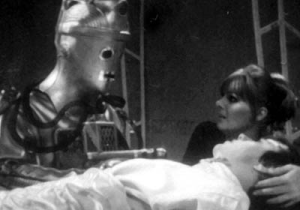
The Cybermen are back, and a bit better designed than their last appearance not so long ago.

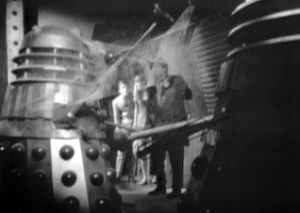
The story is about a weather control station on the moon that is being attacked by a mysterious virus. The virus, craftily hidden in their sugar supply, disables the staff of the moonbase so the Cybermen can essentially assimilate the most compatible of the infected and kill everyone on Earth with storms induced by the station’s control system. It’s pretty straightforward.

It turns out that the Doctor is an actual medical doctor who studied under Joseph Lister, and Jamie is safe because he didn’t use the sugar and has a head injury that disqualifies him from being transformed. Ben and Polly acted rather intelligently in fighting the Cybermen with a chemical attack to disable their control systems.

I noted some 1960s sexism: The making of coffee wasn’t an example, but “stay here, Polly, this is men’s work” certainly was. Luckily, Polly is a strong and independent woman… at least in most of her serials with the Doctor.

The Cybermen are a bit hard to understand in this serial. They have new voices, which are heavy treated with audio effects. Also, how do they know the Doctor’s new face? Between them and the Daleks, I’m beginning to think that the Doctor has an aura that every major antagonist recognizes over the face or physical features.

Meanwhile, the internal dialogue with the Doctor was distracting. It wasn’t terrible, but certainly not something I’m familiar with in the franchise.

The depressurization of the dome seemed a bit unrealistic, since the air rushes out, but no one is pulled with it and the coffee is still standing.

Finally, the jumping on the moon with bionic sound effects. Ugh.

Not a bad serial by any stretch, but not a top performer either.

Rating: 3/5 – “Reverse the polarity of the neutron flow.”


UP NEXT – Doctor Who: The Macra Terror


The Timestamps Project is an adventure through the televised universe of Doctor Who, story by story, from the beginning of the franchise. For more reviews like this one, please visit the project’s page at Creative Criticality.


Timestamp #32: The Underwater Menace

Doctor Who: The Underwater Menace
(4 episodes, s04e19-e22, 1967)

Timestamp 032 The Underwater Menace


Doctor Who meets Atlantis!

It’s good to see the companions having fun together. The chemistry is nice, and it shows how the cast is really clicking. The downside is that the modern day companions are picking on Jamie’s lack of knowledge about the TARDIS. It’s kind of mean of them.

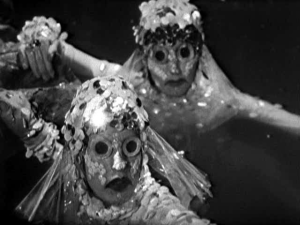
Nothing good happens in science fiction, fantasy, or horror from exploring a cave on your own, but of course Polly goes off looking around after the boys leave her behind, and of course hilarity ensues. It is a rather convenient way to separate the travelers from the TARDIS, as kidnapping them and taking them to the depths of the ocean puts a lot of distance between them.

The Doctor and his goofy hat have a clever ruse to save the companions, and luckily Zaroff has a good sense of humor about the diversion. Unfortunately, Dr. Z is also bat-dung crazy. Also, we keep seeing references (outside of each episode’s credits) to the Doctor as “Doctor Who”, this time in his note: “Vital secret will die with me. Dr. W.”

Professor Zaroff has promised to raise the city to keep working, but his plan is still incomplete… and will destroy the world. Zaroff’s insanity focuses the efforts not on the citizens and the consequences, but on his own glory as it is the ultimate achievement in science. His logic doesn’t make sense, which makes him more of a mad scientist than an evil one. He’s also quite the overactor – “Nothing in the world can stop me now!” – and left a few dental impressions in the scenery.

Ben gets a clever moment to play the god Amdo and save the Doctor and Ramo. The plan and chase was pretty exciting to kidnap Zaroff, and the plot to starve out the powers that be by cutting off the supply lines with striking slaves was intelligent. Of course, the “underwater” scenes are laughable by today’s standards, but I’m sure they were a spectacle in 1967. On the downside, Polly is uncharacteristically a whimpering “damsel in distress” in this serial.

The demise of Zaroff was a nice bit of writing, but the plan to get there was a stretch. I understand overloading the reactor to destroy it, but using it to degrade the walls? It takes a while for radiation to degrade stone/concrete walls, and the flux required to rapidly destroy walls would outright kill humans and the Doctor much faster. I waved it off as best I could as a plot conceit, but it was another indicator of how middle of the road this serial was.


Rating: 2/5 – “Mm? What’s that, my boy?”


UP NEXT – Doctor Who: The Moonbase


The Timestamps Project is an adventure through the televised universe of Doctor Who, story by story, from the beginning of the franchise. For more reviews like this one, please visit the project’s page at Creative Criticality.


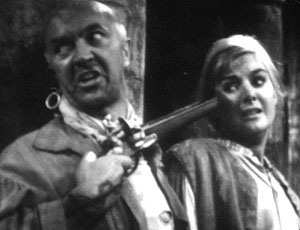
Timestamp #31: The Highlanders

Doctor Who: The Highlanders
(4 episodes, s04e15-e18, 1966-1967)

Timestamp 031 The Highlanders

In the Second Doctor’s second adventure, we get a pretty straightforward story about the Scottish Highlanders, and an introduction to a new companion.

Jamie is very resourceful, but the weakest of the companions at this point simply because he doesn’t know how all of this craziness works. I’m eager to see how he develops as he travels with the Doctor, and I hope that he doesn’t turn out like poor Katarina. He seems much less shallow than she did, so he’ll fare better.

This incarnation of the Doctor is quite devious, between the (terrible!) German accent (Doctor von Wer… Doctor (of) Who) and disguises (cross-dressing as an old woman and masquerading as a wounded solider with a hilarious mustache), this Doctor is truly a man of many faces.

Ben continues to be a strong character, and the Doctor still doesn’t like guns. The ending was a nice twist, with a fate better than death (story-wise, anyway) for Grey.

I waffled between a 3 and 4 as I watched, and I think it ends up as a high 3. So, optimistically…


Rating: 4/5 – “Would you care for a jelly baby?”


UP NEXT – Doctor Who: The Underwater Menace


The Timestamps Project is an adventure through the televised universe of Doctor Who, story by story, from the beginning of the franchise. For more reviews like this one, please visit the project’s page at Creative Criticality.


Timestamp #30: The Power of the Daleks

Doctor Who: The Power of the Daleks
(6 episodes, s04e09-e14, 1966)

Timestamp 030 The Power of the Daleks

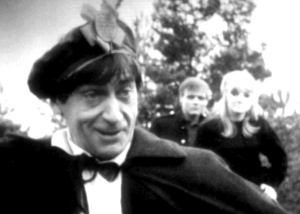
Hello, new Doctor! And welcome to the confusion. It’s really nice to see how the Doctor has to stabilize after such a traumatic event, presumably his first, in light of my experience with the series from the Ninth Doctor on. This new Doctor seems sinister at first, but beneath his sneaky and evasive face lurks a much more physical and clownish incarnation that is very observant.

The Doctor loves his recorder, which he seems to use as a crutch to ponder his next move. He also loves that goofy hat, which… I do not.

Meanwhile, what better way to introduce the new Doctor than with the Daleks? We also get our first look, however fleeting, at what lives inside the can. I’m really enjoying this slow build around the Daleks and their mythology. It was creepy to hear a Dalek proclaim, “I am your servant,” and it was good to see them expand into trickery beyond the normal “ex-TER-min-NATE” rolling wave of death. They actually act smart and dynamic in this serial instead of focused on a singular goal.

The Dalek does not obey the Doctor, but how does it know who he is? Can the Daleks sense him even though he looks different? There was also an inordinate amount of Dalek chanting in this serial.

Overall, a well-written straightforward, highly enjoyable adventure (partially spiced with a political thriller) to debut the Second Doctor, and one that doesn’t really need the obligatory +1 for a regeneration episode.

Some last notes: Nice reference to Asimov with the positronic brain, and somebody get that TARDIS a fresh coat of paint.


Rating: 5/5 – “Fantastic!”

UP NEXT – Doctor Who: The Highlanders


The Timestamps Project is an adventure through the televised universe of Doctor Who, story by story, from the beginning of the franchise. For more reviews like this one, please visit the project’s page at Creative Criticality.


Timestamp: First Doctor Summary

Doctor Who: First Doctor Summary

Timestamp First Doctor


Starting with the last two serials for William Hartnell, they were pretty strong. It was obvious that he was starting to falter in the role, but the stories and supporting cast were strong enough to keep the show rolling.

As for the First Doctor, I enjoyed his stories a lot more than I thought I would. Many places in fandom categorize Hartnell’s Doctor as a curmudgeonly grandfather who wants to do things his way, and his way alone. His character has a lot more depth than that simple stereotype, and while he is a grumpy man, he also has a stunning capacity to love and care for those who he respects. Behind that gruff nomadic scientist is a sympathetic character with a childlike curiosity about the entirety of time and space.

I also had some trepidation about watching the older episodes, especially since so many are reconstructions, but the skills in acting and production shone through beyond the grainy images and telesnaps. I had watched The Aztecs long before starting the Timestamps project, and was thoroughly disappointed. To be honest, I needed the background of the preceding serials, and this time I had it.

The First Doctor’s adventures are truly worth the investment to watch them. And that’s why it’s so hard to say goodbye. Even after two serials of hardship in the fourth series due to the actor’s declining health, his farewell was quite up front and sincere. In those final two words, “stay warm,” Hartnell emoted his heartbreak and his gratitude for such a wonderful experience.

I’m glad I took the time to truly appreciate it.


The Smugglers – 3
The Tenth Planet – 4

Series Four (First Doctor) Average Rating: 3.5


Series 1 – 3.5
Series 2 – 3.7
Series 3 – 3.1
Series 4 – 3.5

First Doctor’s Weighted Average Rating: 3.41


UP NEXT – Doctor Who: The Power of the Daleks


The Timestamps Project is an adventure through the televised universe of Doctor Who, story by story, from the beginning of the franchise. For more reviews like this one, please visit the project’s page at Creative Criticality.

Timestamp #29: The Tenth Planet

Doctor Who: The Tenth Planet
(4 episodes, s04e05-e08, 1966)

Timestamp 029 The Tenth Planet

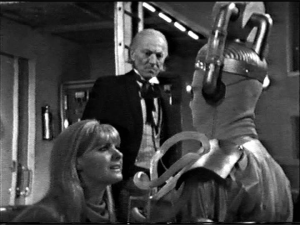
This serial had a slow lead up to an otherwise enjoyable story. It’s the introduction of the Cybermen! Wow, they have come a long way in costume and character design. The Cybermen were a bit hard to understand, and were certainly more individual than the later versions.

It was good to get the backstory on such a popular villain, and the story keeps rolling with excellent tension surrounding the stranded astronauts and assault in isolation. Cutler was the trope of the blood-thirsty military officer, which felt a little bonk-bonk on the head with the message. That in mind, I get Cutler having no problem killing the Cybermen, but what didn’t follow was Ben enabling Cutler to kill them. Ben was terribly upset about killing in self-defense mere moments earlier, but then hands Cutler the gun without hesitation.

The Doctor spontaneously collapses and remains out of commission for an episode of the serial. This leaves the companions to carry the story, both in and out of the serial. Hartnell was obviously having a hard time with this one, and luckily the companion actors and characters are both strong enough to keep the gears turning.

Remember the rules, though: It’s a regeneration episode, so it get an automatic +1 on the score. They’re always hard episodes to do.

Watching the First Doctor say goodbye was heart-breaking. The companions think he’s either worn out or going daft, but it felt a lot more like he was completely lucid in his final moments. Just in case this regeneration thing doesn’t work, “stay warm.”


Rating: 4/5 – “Would you care for a jelly baby?”


UP NEXT – First Doctor Summary


The Timestamps Project is an adventure through the televised universe of Doctor Who, story by story, from the beginning of the franchise. For more reviews like this one, please visit the project’s page at Creative Criticality.


Timestamp #28: The Smugglers

Doctor Who: The Smugglers
(4 episodes, s04e01-e04, 1966)

Timestamp 028 The Smugglers

It’s another new opening credits sequence on a nice cat-and-mouse game mixed with pirates and a mystery.

The Doctor seems surprised to see Ben and Polly, which puts a slight spin on my theory from The War Machines. That said, I don’t think he’s entirely upset about their arrival, as he gets over the anger quickly.

Polly is very bubbly and perky, and I like that Ben respectfully pokes at her by continuing to call her “Duchess” and “Ducks”. Their dynamic gets even more mixing as Polly gets mistaken for a boy during this story. It throws her further off her game while providing her a degree of power that she wouldn’t have as a woman in the era.

The reference to the Doctor as “Sawbones” (a slang term for a surgeon) is amusing, as is the play off of superstitions to break out of captivity. I can’t help but feel sorry for Tom and Jamaica for being so easily manipulated.


Rating: 3/5 – “Reverse the polarity of the neutron flow.”

UP NEXT – Doctor Who: The Tenth Planet


The Timestamps Project is an adventure through the televised universe of Doctor Who, story by story, from the beginning of the franchise. For more reviews like this one, please visit the project’s page at Creative Criticality.


My Only Hope for Star Wars: The Force Awakens

Culture on My Mind

Culture on My Mind
My Only Hope for Star Wars: The Force Awakens
February 11, 2015

Star-Wars-The-Force-Awakens

I sincerely have one hope for Star Wars: The Force Awakens.

I hope that it is good.

As silly as it sounds, I hope that is a good movie. Not just good in the it’s a movie with the original cast and has the words star and wars in the title so it has to be good sense, but rather the knock your socks off even if this is the first thing you’ve ever seen in the franchise and even Siskel and Ebert would have given this thing four thumbs up and more if they could find more hands sense.

My reasoning is pretty simple. There were sixteen years between Return of the Jedi and The Phantom Menace, and no matter how good the first prequel could have been, I don’t think it would have mattered. There was too much hype, and too many expectations among fans of the original trilogy. I grant that The Phantom Menace (and by extension the prequel trilogy as a whole) did not meet its true potential. It could have been more, and I fully acknowledge the faults. But, it was by no means as bad as the original trilogy fandom would have the world believe.

As The Phantom Menace and the rest of the prequels debuted, original trilogy fans took to the internet in droves to tear the films apart. Many of them waved their “I watched the first Star Wars (with no bloody Episode IV or A New Hope attached to it) in theaters so I know what makes a good Star Wars movie” privilege in the face of new fans. Critical reviews, both professional and otherwise, took the movie to task by addressing fandom, citing how real fans would disavow the new films, and how those who liked them should move out of their parents’ basement. The Red Letter Media reviews are particularly venomous, but are celebrated among the crowd dominated by bitterness even ten years after the last prequel debuted.

Of course, that’s after The Phantom Menace made $431 million domestically. That’s a lot of multiple viewings for a film that supposedly sucks so bad, but I digress.

Star Wars has become a generational fandom, and each new set of fans is usually kids: There was a set of fans who came to the franchise in 1977-1983, a set who came to it with the heyday of the novels in the late ’80s and early ’90s, a set that joined with the Special Editions and prequels (1997-2005), and a set that came of age with The Clone Wars. The Force Awakens will usher in a new generation of fans who will likely be kids as well.

I don’t want the prequel generation to develop the same bitterness about their fandom that their OT and novel era counterparts have.

Prequel fans deserve better than they have been offered. Sequel era fans deserve a fan community based on fun and love, not venom and hatred.

I’ve talked and written at length about how, first and foremost, fandom should be fun. No matter the franchise, this is all entertainment, not life and death matters. Being critical about the content and execution of the material is important, but being bonked on the head for the things that you love by self-instated gatekeepers is not fun.

Critical analysis and review should be limited to the material and never extended to the fandom. It is ironic that a fandom built around geeky exploits and adventures, a community that has long lamented and fought against bullying by others like the stereotypical “jocks,” should in turn bully their own for not walking the right way. I’ve fallen away from Star Wars fandom in recent years because of the way that older fans treat younger fans. Star Wars has lost part of the innocence and excitement that it once had, and not because George Lucas violated childhoods, but because time and again the fandom has forgotten Wheaton’s Law in their critiques.

I don’t want the prequel generation, the group that opened their eyes to the franchise with The Phantom Menace, the group that knows what it feels like to be bonked on the head continuously by older generations, to fall into that darkness. They need to remember that “real” Star Wars fans are anyone who loves the magic of Star Wars. They need to remember how it feels to be told that their opinion “can’t be trusted” based on what they like.

I’d like to think that my generation and the first generation of Star Wars fans can be brought back from the brink of bitterness, but I don’t hold much hope for it. I believe that many of them are beyond redemption for sacrificing their own for the honor of being right on the internet.

I want The Force Awakens to be so good that fans can look on it in admiration and joy, basking in the happiness and escape that fandom should embody. I want prequel fans to avoid the fate that befell the generations that came before. I want them to be critical without feeling the need to attack their own tribes. I want them to remember that it is okay to not like things.

I want them to remember what it means to be a fan and not a self-appointed savior of the franchise.

I want them to remember the feeling they felt when they heard the Star Wars theme in theaters for the first time.

I want them to remember what it means to be a Star Wars kid.

Most importantly, I want them to help new fans to find that moment as well.

cc-break

Culture on My Mind is inspired by the weekly Can’t Let It Go segment on the NPR Politics Podcast where each host brings one thing to the table that they just can’t stop thinking about.

For more creativity with a critical eye, visit Creative Criticality.
Timestamp Special #2: Daleks’ Invasion Earth 2150 A.D.

Daleks’ Invasion Earth 2150 A.D.
(1966)

Timestamp S02 Daleks Invasion Earth 2150 AD


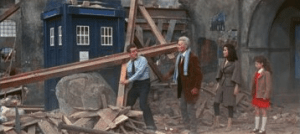
It’s seems to be a standard with the Peter Cushing Doctor’s stories to speed up the pacing while simultaneously upping the production budget. This story hits the key notes, but the faster pace removes a large amount of the tension. This is readily apparent in the sequence when the Dalek emerges from the river. That big reveal just isn’t as dramatic when it moves at a breakneck pace.

Production-wise, the Dalek ship had a good new look, and wasn’t too shabby for the era. The Robomen, however, look like rejects from an unholy union of CHiPs and THX 1138. Good lord, those get-ups were silly, but at least they get their three square meals of nutritious… jellybeans?

In character notes, the police officer Tom, who replaced Ian in the plot, was a major step up from his Cushing-era predecessor. It was nice to see Bernard Cribbins again, particularly in his first voyage in the police box before he joined David Tennant as Wilfred Mott. An equally fresh breath of air was Louise, the replacement for Barbara, who was much more engaging and intelligent than her predecessor.

On the downside: Dortmun, the wheelchair-bound scientist, died a very meaningless death in comparison to his television counterpart. There was no need for him to attack them or die since the van could have very easily outrun the Daleks, just as easily as it ran the blockade moments later.

Anyway, this rating won’t count toward anything since this isn’t an official Doctor.


Rating for The Dalek Invasion of Earth: 5/5
Rating for Daleks’ Invasion Earth 2150 A.D.: 3/5


While we’re on the subject, let’s talk about the Peter Cushing Doctor. I like Peter Cushing, but his Doctor would have been better served with original stories. When Hollywood tries reboots in the modern day, I try to divorce my brain from what came before and offer up the benefit of the doubt. However, these two projects were designed as a near reproduction of the two Hartnell stories, so it’s almost as if the producers are asking audiences to compare in hopes that they will find the bigger, flashier, and colorful exploits to be more engaging. Similar to Gus Van Sant’s shot-for-shot remake of the classic Psycho, these projects pretty much demanded to be compared to their source material.

Cushing’s Doctor isn’t Hartnell’s Doctor. He’s far less proactive, and far less analytical, but he’s superficially warmer and easier to relate to. He would have been a worthy successor on the actual show, but in near exact remakes, he was merely average.


Dr. Who and the Daleks – 3
Daleks’ Invasion Earth 2150 A.D. – 3

Cushing Doctor’s Weighted Average Rating: 3.00


Onward to Series Four.

UP NEXT – Doctor Who: The Smugglers


The Timestamps Project is an adventure through the televised universe of Doctor Who, story by story, from the beginning of the franchise. For more reviews like this one, please visit the project’s page at Creative Criticality.