
Timestamp #151: Dragonfire

Doctor Who: Dragonfire
(3 episodes, s24e12-e14, 1987)
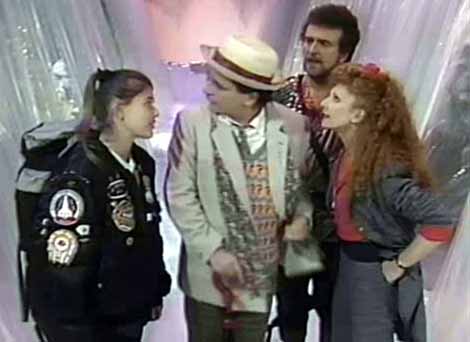
 

Iceworld: A vacation spot where cliffhangers are literal but dragons are not.

We get our introduction to this planetary freezer section through fog machines, plastic icicles, and frost burns. A group of conscripted men is being processed as foot soldiers for the villain Kane and his reign of terror. One of the men attacks a guard and shoots his way into the facility’s restricted zone. He stumbles, drops his weapon in a vat of liquid nitrogen, and dies at the hands of Kane. Quite literally, in fact, since one touch from the man can kill.

On the TARDIS, the Doctor and Mel approach the colony. They arrive at what could double as the local Costco – anyone who is familiar with that particular warehouse store understands the giant refrigerated rooms where you pay for the “pleasure” of freezing while hunting for good produce, milk, and eggs – and visit a diner where they find Sabalom Glitz. It’s a given that Glitz owes Kane money, but he gambled away his money and ends up with his ship impounded. A waitress named Ace (who uses her pseudonym as an exclamation of pleasure) tells Mel and Glitz of a dragon in the passages beneath Iceworld, and Mel puts the pieces together: The Doctor wanted to stop here to see the dragon.

Ace volunteers to tag along since she’s tired of her job. She calls the Doctor “Professor,” which the Time Lord doesn’t seem to mind. It’s endearing. So is her strong character.

Ace mentions the dragon’s treasure, which piques Glitz’s interest since he has a map that he won in the card game where he lost his shirt. Said card game was fixed by Kane to force Glitz to find the treasure so Kane could steal it. Glitz is old-fashioned (read: sexist) and won’t allow women on the journey, so Mel remains with Ace. The ladies are soon ejected from the diner – Ace gets fired for pouring a milkshake on a rude customer who totally deserved what she got – and retire to Ace’s quarters. Ace shares her story: She’s a student from Earth who was swept up in a time storm and deposited on Iceworld. The women gather up Ace’s homemade explosives and help dislodge an ice jam on the docks.

One of Kane’s lieutenants, Officer Belazs, asks Kane for Glitz’s ship. Kane denies her desire to leave and orders the ship destroyed. When Kane goes into a brief hibernation to recharge, she reverses the order without his knowledge before being dispatched to the ice jam disturbance. When she arrives, she arrests Mel and Ace. Kane takes a liking to Ace and offers her a place in his army, but she and Mel escape into the caverns instead. They encounter the dragon and Mel screams.

Goodness does she… you know.

The Doctor and Glitz explore the caverns and get separated. The Doctor, for reasons better left as an exercise for the blooper reels, climbs over a handrail and slowly slips toward his doom while dangling from his umbrella. Glitz saves the Doctor from death, but not from our eternal laughter at this literal cliffhanger, perhaps one of the worst in Doctor Who history.

The ladies discover that the dragon is not a real dragon since it shoots lasers from its eyes. They find the cliffhangering cliff and use a ladder in Ace’s bag of holding to follow the Doctor’s umbrella as a clue. Meanwhile, Kane dispatches his new soldiers – essentially ice zombies at this point – to deal with Glitz; the conscripted men from the opening are Glitz’s former crewmen whom he sold for seventeen crowns apiece. Belazs also overhears Glitz’s plan to hijack his own ship, a plan that the Doctor reluctantly supports. Glitz gets into the cockpit, but he’s ambushed by Belazs. The Doctor and Glitz learn her backstory and turn the tables, but the Doctor expresses remorse for her situation. They continue their quest.

In Kane’s restricted area, the sculptor who was working on an ice statue finishes his work and is rewarded with death. No one will be allowed to look upon the artwork for it’s supposedly too magnificent for the universe to behold. We, as viewers, are left to assume that it is significant to his backstory. (Spoiler: It is.) When Kane retreats to his chamber to cool off, Belazs and Officer Kracauer attempt to assassinate him and gain their freedom. The plot fails, although it does destroy the statue, and Kane kills both of the traitors in anger.

The Doctor and Glitz encounter the dragon, but it spares them after the Doctor stops Glitz from killing it. Elsewhere, Mel and Ace encounter the ice zombies, escaping after a brief battle while Ace wisely stops Mel from screaming. They bond over a cup of camp coffee and we find out that Ace’s real name is Dorothy, a name of which she’s not fond. They later reunite with the Doctor and Glitz and are saved from one of the zombified crewmen by the dragon. The creature trusts them and leads the explorers into a side cavern and shows them a holographic record. Kane is half of the Kane-Xana criminal organization that was headquartered on Proamon. When security forces found them, Xana – see above, re: ice sculpture – killed herself and Kane was exiled to the permanently frozen world. The Doctor deduces that the dragon, or rather the power source within the mechanical creature, is the treasure. Thanks to the tracker his musings are no secret to Kane, who plans to use the dragonfire crystal to leave the colony and his frozen prison.

The Doctor and the dragon research Proamon while Mel, Ace, and Glitz wait in the control cavern. Two of Kane’s officers ambush the dragon and eventually kill it, but when they attempt to remove the head they are killed by an energy discharge. In the upper levels, Kane dispatches his troops to drive everyone toward Glitz’s ship, the Nosferatu. Once everyone (save a little girl and her mother) are aboard, Kane destroys the ship.

We get it. He’s evil.

The Doctor, Mel, and Ace return to the TARDIS to consult the star charts. Ace goes to her quarters and is captured by Kane while the Doctor and Mel go after the dragon. They find the head and retrieve the crystal, but Kane demands an exchange for Ace. When Mel, Glitz, and the Doctor arrive, Kane confirms that the dragon was his jailer and that he has been on the colony for millennia. The Doctor surrenders the crystal and Kane uses it to power the hidden stardrive in the colony. Unfortunately for Kane, the Doctor confirms that Proamon is long dead after its star went supernova. Distraught, Kane opens a viewport and commits suicide by sunlight, Raiders of the Lost Ark-style.

With the threat over, Glitz takes command of the colony ship and Mel decides to stay in an effort to keep the rogue out of trouble. In her final act on the TARDIS, Mel puts in a good word for Ace. The Doctor offers her a space on the TARDIS and she accepts.


Kane’s motivations make little sense here. Sure, he wants to escape and exact revenge on his jailors, but his suicide doesn’t ring true. Sure, he’s a psychopath, but he was a careful and meticulous planner. Unless personal vengeance was so important to him, I would have thought that he’d scratch Proamon off the list with the supernova and go off to conquer another planet without his rap sheet hanging over his head. This plot glitch aside, I really liked him as a villain, even as a Doctor Who knockoff of Mr. Freeze.

Another part that doesn’t make a lot of sense is Mel’s final decision. So, yes, she and Glitz worked together in The Ultimate Foe, but Mel has expressed displeasure at every turn with the scoundrel’s actions, ranging from sexism and selling his crew into slavery all the way up to his illegal activities. I’d say that Glitz is a knockoff of Han Solo, but Solo was far more developed. The Leia/Han dynamic doesn’t work here and I don’t think Mel is strong enough to change Glitz, particularly since he now owns a portable freezer section with only two shoppers.

I won’t miss Mel much. From her timey-wimey intro in Terror of the Vervoids to this departure, she’s been a decent enough companion but, by far, nowhere near the best. A lot of that has to do with her role as a personality foil for the Doctor rather than as an assistant/companion. She was smart and strong-willed, but just not a great fit for the position.

I also won’t miss the dramatic screaming. Because – and this might be the last time that I can make this joke – goodness, can she scream.

So, with all of that heaped on this story, why did I actually like it?

First, we have Ace, who seems like she might be a pretty fun companion once she settles in. I do hope that the “Ace!” exclamation dies off soon because that’s going to get tiresome, but I’m looking forward to what she brings to the table.

Second, Sylvester McCoy continues to sell me with his portrayal of the Doctor. He has a latent darkness lurking behind his goofy exterior, reminding me of the Second and Fourth Doctors quite often.

Third, this story brought Doctor Who right back to its roots with tight shots, minimal bailing-wire-and-chewing-gum sets, and actors selling even the zaniest and loosest of plots with unwavering confidence. That point alone, hearkening back to the low-budget stageplay-style days of the black and white serials, deserves some credit.


Rating: 3/5 – “Reverse the polarity of the neutron flow.”


UP NEXT – Twenty-Fourth Series Summary


The Timestamps Project is an adventure through the televised universe of Doctor Who, story by story, from the beginning of the franchise. For more reviews like this one, please visit the project’s page at Creative Criticality.

Timestamp #150: Delta and the Bannermen

Doctor Who: Delta and the Bannermen
(3 episodes, s24e09-e11, 1987)


Not quite the Happiest Place on Earth, but Shangri-La nonetheless.

The story drops all of us right into the thick of things with a huge battle on an alien planet. On the high ground is a squad with extensive flags – appropriately known as the Bannermen – and on the losing side is what looks like a group of green toy army men. A woman in white named Delta runs with the last green survivor to a ship, and with his dying breath, he sends her off-planet with a glowing box. Gavrok, the leader of the Bannermen, pursues with gusto.

The opening was actually quite exciting.

The Doctor and Mel land the TARDIS at toll port G715. When they exit, they are met by the Tollmaster with a prize: As the ten billionth customers, they get free parking and a trip to Disneyland circa 1959 with a tour group of aliens disguised to look human. Just as they are ready to leave, Delta lands her ship at the toll port and seeks refuge on the tour bus. The tour bus leaves and, after witnessing the woman’s arrival, the Doctor follows in the TARDIS.

On Earth, a pair of American CIA agents drive up to a legitimate telephone box and call the White House. They are told to track a satellite that was freshly launched from Cape Canaveral. Unfortunately, the tour bus strikes the satellite and falls to Earth, but fortunately, the Doctor is able to use the TARDIS to control the descent and save all of the passengers. Instead of Disneyland, the tour group ends up at the Shangri-La holiday camp in Wales.

The camp’s leader, Burton, mistakes the extra-terrestrial tour group for one of his scheduled arrivals, so they end up with lodging until the bus is fixed. Mel ends up bunking with Delta, and the Doctor and Murray (the intergalactic tour guide) meet with the camp’s mechanic named Billy. Billy, of course, is lost when it comes to the alien bus engine but he does his best with the Doctor’s help. Meanwhile, they meet Rachel (call her Ray), a motorcycle-riding woman in a leather jacket who carries her own tools. They also accidentally break the crystal needed to fix the engine, so the Doctor decides to grow a new one, but the process will take twenty-four hours.

Back at the toll port, Gavrok finds out where the tour group went and then kills the Tollmaster in cold blood. On Earth, Mel and the Doctor discuss Delta as Billy shares lunch with the refugee. Later that night, they all attend the Get-To-Know-You social, dancing the night away to Billy’s singing talent. Sadly, Ray figures out during a performance of Why Do Fools Fall in Love that Billy is falling for Delta. The Doctor ends up consoling Ray in the linen storage room, which works in their favor as one of the tourists transmits Delta’s coordinates to Gavrok. The tourist discovers the Doctor and Ray, threatening to kill them. Back in their shared room, Delta and Mel watch as the mysterious glowing package starts to hatch, revealing one of the green aliens from the opening battle.

Of course, Mel screams. Goodness, can she scream.

The Doctor and Ray are inadvertently saved by Gavrok as the soldier activates a tracer that disintegrates the bounty hunter. The resulting blast knocks the Doctor and Ray unconscious. Billy arrives to see Delta cradling the green baby alien, and he spends the night to learn about Delta. The woman is a princess and the baby (now a painted human infant in a plush green onesie) is the last Chimeron. The pair leaves Mel to sleep and take a trip on the motorcycle.

The two CIA agents arrive nearby asking about the satellite, but the get a lesson on butterflies, metamorphosis, and beauty from a beekeeper. The moral is a bit heavy-handed and these characters are a waste in this story.

The Doctor and Ray recover just in time to see Delta and Billy driving away. They find Mel and decide to coordinate an evacuation. Mel and Murray gather the tourists while the Doctor convinces Burton of the emergency. The Doctor and Ray leave Mel and Murray in charge as they go in search of Delta. They find her and Billy at the lake, where Delta has been telling Billy of her plan to take the rapidly growing hatchling to safety before bringing her case against the Bannermen to the authorities. The whole group packs up and returns to the camp as the Bannermen land, encounter the CIA agents, and take them as prisoners. Shortly thereafter, the Bannermen find the camp and destroy the tour bus just as it is about to take off. Gavrok demands to know if Delta was aboard and Mel lies, but her deception is uncovered as the Doctor’s group approaches. They flee and Burton convinces an incensed Gavrok to use Mel as bait, saving her life.

The Doctor stashes Delta and the child at the nearby beekeeper’s home before returning to the camp and petitioning Gavrok for mercy. Mel and Burton are released, and the Doctor rides away with them. Gavrok shoots a flare, prompting the guards with the CIA agents to restrain them and pursue the Doctor. Ray frees the agents as the Bannerman guards tag the motorcycle with a homing beacon.

At the farm, Delta feeds the child with a special jelly. Billy swipes a sample while Delta is distracted by Ray’s return. The Doctor and his group return shortly thereafter. Back at the camp, Gavrok discovers the TARDIS and booby-traps it with a sonic cone, then trace the homing beacon to the beekeeper’s farm. As the scouts advance on the farm, the child evolves and warns Delta with a cry that shatters windows and eardrums. Delta kills one of the scouts and the group evacuates.

Gavrok lands in a field but comes up empty: The Doctor ditched the homing beacon to lead them astray. The surviving scout leads Gavrok’s army to the abandoned farm as the Doctor’s group arrives at the TARDIS. The Doctor hides everyone at the camp while he works on disarming the sonic trap, and the Bannermen stumble into a bee swarm trap.

Delta finds Billy eating the growth jelly in an attempt to become a Chimeron and leave with her. As the Bannermen arrive, the Doctor and Billy install a speaker on the roof, using it to transmit the child’s sonic alarm across the camp and disable the army. Gavrok stumbles in pain and falls into the sonic cone, dying instantly. The CIA agents restrain the rest of the Bannermen and the threat is over.

Billy packs a bag, now fully transformed into a Chimeron, and the trio flies off into the cosmos. Billy leaves his prize motorcycle with Ray, the Doctor receives a jar of 1928 hibiscus honey as a parting gift, the Americans find their satellite, and our travelers depart for their next adventure.


The positives outweigh the negatives in this story. We have the debut of the Seventh Doctor’s trademark question mark umbrella. We also have a very pleasant atmosphere of authenticity with the vintage music. Series composer Keff McCulloch did a wonderful job with twelve covers of era songs.

On the downside, the humor and light tone served double duty: It was a nice change but I found it to be a bit too much, throwing off the pacing just enough that the transitions from action to comedy and back were jarring instead of fluid. We also have the oddness with Billy stealing the super jelly and changing species on a whim, which made zero sense neither in the story nor against Delta’s character specifically.

All of that balances out to a high three, which gets rounded up.


Rating: 4/5 – “Would you care for a jelly baby?”


UP NEXT – Doctor Who: Dragonfire


The Timestamps Project is an adventure through the televised universe of Doctor Who, story by story, from the beginning of the franchise. For more reviews like this one, please visit the project’s page at Creative Criticality.
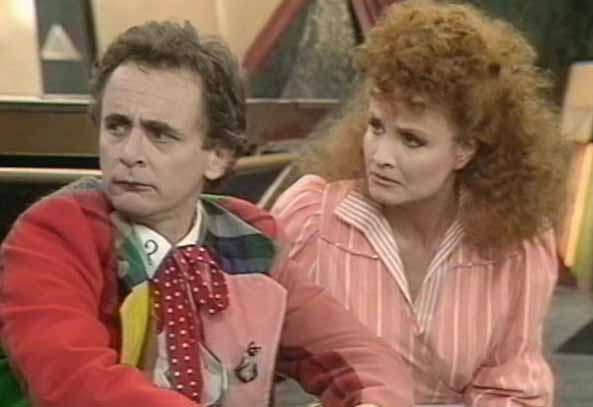
Timestamp #149: Paradise Towers

Doctor Who: Paradise Towers
(4 episodes, s24e05-e08, 1987)


“Nothing’s just rubbish if you have an inquiring mind.”

On one hand, we have the typical ’80s grunge-apocalypse sci-fi with a woman on the run. On the other hand, Mel and a swimming pool paradise. The TARDIS arrives at the former, though Mel and the Doctor would rather have the latter after jettisoning the time capsule’s swimming pool to solve a small leaking problem.

Caretaker 345/12 (subsection 3) – I’m going to call him “Dave” because his business pseudonym is far too complicated – reports that he’s investigating possible “wallscrawlers” on Potassium Street. He finds blood and a scrap of fabric similar to the clothes the woman was wearing. Meanwhile, the Doctor and Mel are accosted by a group called the Red Kangs. They are different than the Blue Kangs and the Yellow Kangs – the latter of which there exists only one, presumably the girl from the opening – and they love the Doctor but dislike Mel. The two lead Reds introduce themselves as Fire Escape and Bin Liner.

A Blue Kang follows Dave and reports via telephone that the Yellow Kangs are dead. To reinforce it, a cleaning robot drives by with a yellow-clad foot sticking out of the top. Moving back to the Red Kangs, the Doctor explains that he and Mel are visitors who have just arrived. Fire Escape tells him that there are no visitors by law and that the tower’s inhabitants consist of the Kangs, the old ones, the Caretakers, and another faction that Bin Liner doesn’t want her talking about. The concept of “boys” is completely foreign to the group. Mention of the pool in the sky earns the travelers a one-way ticket to captivity.

Elsewhere, Dave is killed by cleaning robots and the Chief Caretaker orders that all red wallscrawlers in Fountain of Happiness Square are apprehended. The Doctor is apprehended by the Caretakers and Mel ends up in the apartment of Tilda and Tabby, two women living in an ’80s sitcom. They identify as Rezzies and offer Mel tea and cakes.

The Doctor and his escorts, including the Deputy Chief Caretaker, rest for a moment. The Doctor examines the graffiti and interprets a Kang being attacked by an automaton. The Deputy Chief dismisses the idea, but they soon find themselves on the run from a cleaning robot matching the art on the walls.

Tilda and Tabby tell Mel of a great war in which the youth and elderly were sent to the Towers and those who could fight were never seen again, but their story is interrupted by Pex, a refugee from The Terminator, who apparently breaks down the apartment door on the regular in order to “put the world of Paradise Towers to rights.” Mel departs to continue her quest for the pool and Pex (“pecs”) joins her as a protector and guide.

The Doctor is brought before the Chief Caretaker, is mistaken as the original architect of Paradise Towers – someone who will restore the Towers to their utopian glory – and is ordered to be executed.

Seriously now… tell me straight… what in the world am I watching right now?

The Doctor’s execution is delayed as the Chief Caretaker investigates Dave’s death. Meanwhile, Pex shows off for Mel and the Red Kangs discover that No Exit, one of their own, has been “taken to the cleaners.” The Doctor muses over the cleaners as he awaits his fate, eventually securing a copy of the Caretaker rulebook and using it to work his way out of captivity.

What an excellent way to use the authoritarian blind obedience to his advantage.

Mel and the Doctor wander the Towers in search of one another. Mel learns that Pex’s memory of his past is faulty and the Doctor learns something from a particular piece of wall art. Back in the ’80s sitcom nightmare, Tilda and Tabby (who are dining on rats) are visited by Maddie with news of Dave’s death.

The Doctor breaks a telephone and gathers the money within before being chased by cleaning robots (whom he tricks into fighting each other) and falls into the Red Kang headquarters. Mel and Pex are similarly taken by the Blue Kangs. The Doctor uses his money to buy a soda from a vending machine, a move that startles the Reds before amazing them.

The Chief Caretaker (“Daddy”) visits a machine (“my pet”) and chastises it for consuming a Red Kang without his permission. The machine replies that it is hungry. Meanwhile, the Blues tell Mel that Pex is a coward – a deserter? – and Mel is allowed to leave him with the Blues.

That was a bit heartless, Mel.

Mel ends up back with Tilda and Tabby as the Chief Caretaker orders his army to teach the Kangs a lesson for their defiance. The ladies take Mel captive – Mel screams… goodness, does she scream – as the Caretakers begin their assault on the Red stronghold. The Doctor buys the Reds time as they escape the Caretakers, and Mel’s predicament gets more interesting as the ladies are eaten by the robot and Pex rescues our carrot-juice aficionado.

The Doctor is captured by the Caretakers and taken back to the Chief. The Chief interrogates the Doctor, but the Time Lord quickly turns the tables and uncovers the Chief’s involvement in the murders. The Q&A is interrupted by the Deputy who bears news of more deaths, prompting the Chief to leave. Soon enough, the Reds break in and rescue the Doctor, leaving the Caretakers bundled neatly on the floor. They end up back in the Red stronghold, sipping sodas and watching an infomercial on Paradise Towers. He draws the conclusion that the architect, Kroagnon, built Miracle City. The place would be the architect’s oasis, but he was forced out and those who moved in were killed. There was no evidence to link the architect to the murders, so he went free.

Mel and Pex decide to continue to the pool, noting that the basement is restricted to tenants on penalty of death, but they end up trapped in a wayward elevator and dumped into the lair of evil. They escape and end up on the pool deck. The Doctor follows similar logic end convinces both Blue and Red Kangs to accompany him to the basement. Once there, they witness the mastermind robot declare itself to be Kroagnon and encase the Chief in a container before attacking the Doctor. The Doctor and the Kangs escape, but after they leave the Chief is freed, but his mind is now that of Kroagnon. The hybrid goes on a killing spree.

Oh my, the Chief-Kroagnon’s performance is cringe-worthy.

On the pool deck, Pex and Mel rest for a moment, unaware of the cleaning robot hiding underwater. Mel goes in the water, gets attacked, and screams. (We all know how well she can scream!) Pex calls for help to an empty room, and Mel grabs his gun and disables the robot. Shortly afterward, the Doctor appears with his team, and the whole lot are met by the remaining Rezzies who petition for help.

The team hears the story of the hybrid’s crusade and they agree to help. They are surprised when the Deputy Chief arrives and asks to help them, bringing his knowledge of a secret stash of explosives. The Doctor formulates a plan to trap Kroagnon, including a lure to draw the hybrid out. Pex volunteers to help as the Rezzies and Kangs start destroying the cleaners.

Why the Kangs couldn’t aim well enough before now to kill the cleaners with a single shot is an exercise left to the viewer.

The Kangs give Pex gifts in appreciation, and Pex gives Mel his pistol before beginning his task. Pex brings the architect too soon, but he musters enough bravery to execute the plan and destroy Kroagnon by sacrificing himself. Fast-forwarding to the wrap-up, the Kangs memorialize Pex for his sacrifice and induct the Doctor in the newly united Kang faction. The travelers say their farewells and depart, revealing one last wallscrawl as the TARDIS vanishes from sight: Pex Lives.


This story seemed like a parody of Doctor Who. The idea is sound, with a utopia that has fallen into anarchy embodied through factions. They each have basic rules for survival, and all of them must unite under a single banner to defeat a common foe. The problem is in the execution, which was dreadful, laughable, and (dare I say it?) boring.

One thing that brings the serial up is the deep immersion into this microcosm. The Kang gang member names, the factions, and the entirety of the world is never fully explained, and we are expected to accompany the Doctor and Mel as they figure it out and defeat the enemy. The big downside is that it’s so immersive that trying to interpret the vernacular overwhelms the story.

The larger highlight is the Doctor. I love his zaniness and sense of exploration, and the rising undercurrent of darkness is a complex dimension that is both endearing and intriguing. He is the bright spot in this pile of rubbish.


Rating: 2/5 – “Mm? What’s that, my boy?”


UP NEXT – Doctor Who: Delta and the Bannermen


The Timestamps Project is an adventure through the televised universe of Doctor Who, story by story, from the beginning of the franchise. For more reviews like this one, please visit the project’s page at Creative Criticality.
Timestamp #148: Time and the Rani

Doctor Who: Time and the Rani
(4 episodes, s24e01-e04, 1987)


TARDIS under attack!

In a rare pre-credits sequence, a rather well-done for the era computer-generated TARDIS topples tail over teakettle, leaving the Sixth Doctor and Mel unconscious on the floor of the console room. On Lakertya, the planet below, a native watches the TARDIS hurtle to the ground in a rainbow of energy. Within moments, the doors open from the outside to reveal the Rani and her henchmen. The Rani orders that Mel is left behind as the creatures take a freshly regenerating Seventh Doctor to her laboratory.

Roll credits. Fancy computer generated credits. With a new theme and a winking Doctor.

I’m not adverse to them. I like them better than the dark theme from the Twenty-Third Series, but man, oh man, are they so very ’80s.

In the Rani’s lab, we see Albert Einstein being loaded into a stasis chamber by two Lakertyans. The Rani has kidnapped many genius scientists from Earth history, and now she has the Doctor to play with. The newly regenerated Time Lord snaps awake with a burst of energy and a babble of speech, eventually confronting the Rani. He threatens to smash some equipment with his umbrella, forcing the Rani’s hairy companion to shoot him with a laser web device.

Sylvester McCoy’s energy and acting are refreshing. I found myself grinning during this whole sequence.

One of the Lakertyans, Ikona, enters the TARDIS and retrieves the unconscious Mel. His female counterpart, scared off by the Rani’s anger, is soon killed in explosive fashion, but not before meeting Mel. Ikona warns Mel that if she runs, she will find more of the same explosive traps. He also believes that Mel is allied with the Rani and takes her for ransom. He drags her through the typical Doctor Who quarry, but she ends up rescuing him from a trap and earning her freedom. They continue to run, trying to evade the Tetraps (the Rani’s hairy foot-soldiers).

In the lab, the Rani drugs the Doctor so he won’t remember waking up before, and when he comes around again, she is (poorly) disguised as Mel. The Rani attempts to convince the Doctor to repair some broken equipment in (what she calls) his lab. He exhibits some Sixth Doctor tendencies and an ability to play the spoons, but the tech confounds him. The Rani convinces him to return to the TARDIS for some tools.

Upon returning to the TARDIS, the Doctor decides to change clothes. He tries on a Napoleon outfit, a British guard uniform, an arcane schoolteacher getup, the Fourth Doctor‘s burgundy attire with the wrong scarf, the Third Doctor‘s brown coat and ruffles, the Fifth Doctor‘s ensemble, and the Second Doctor‘s fur coat before settling on his trademark style.

Note: The suspenders should be underneath the sweater.

The Doctor nearly recognizes the Rani under her disguise, but after she slaps him he goes off to find the radiation wave meter.

Elsewhere, Mel runs from the Tetrap but trips one of the exploding bubble traps. The bubble bounces all across the landscape – understandably, Mel is screaming the entire time (and goodness, can she scream) – before safely landing in a lake. Ikona frees her and they continue to run, but they are soon ambushed. As Mel screams, Ikona finds a hidden rifle to defend them. They end up at the Rani’s tower.

The Doctor continues to work on the Rani’s equipment, but he is obsessed with what lies beyond a sealed door. Prior to this, the Rani had stated that the Lakertyans weren’t an advanced species, so the Doctor is puzzled when the Rani suggests that the Lakertyans can patch a broken mineral plate in the device. She leaves to find the necessary gear, locking the Doctor in the lab.

Mel and Ikona encounter Faroon, another Lakertyan, and they mourn the death of Sarn, the female Lakertyan… Faroon’s daughter. Faroon leaves deliver the bad news to Beyus, Sarn’s father, and Mel and Ikona follow. Ikona distracts the Tetrap guard long enough for Mel to sneak in. Meanwhile, the Tetrap guard mistakenly apprehends the Rani (who is still dressed like Mel).

Mel finds the lab and assaults the Doctor, unaware that the Time Lord has regenerated. After a brief altercation, they verify each other’s identities. Mel knows about regeneration, but she’s still astounded by the change. The pair are rescued from the lab by Faroon and Beyus and taken to the stasis chamber where they discover the sleeping scientists and a chamber set aside for the Doctor.

The Rani is freed and, after berating her minion, heads for her TARDIS. Her time capsule is a small pyramid, and the inside is futuristic and gorgeous. She fixes the mineral plate and returns to her lab, prompting the Doctor to send Mel with Faroon and Beyus. The Doctor uncovers the Rani’s ruse and discovers her plan: She is channeling the scientists’ minds into a single artificial brain in an attempt to harvest strange matter from a nearby asteroid.

Okay, given that only strange matter can affect strange matter, therefore requiring the brain to develop a lightweight substitute with the same qualities, why not just use the substitute for the nefarious scheme? Perhaps a difference in purity or something?

Anyway, the Doctor escapes and finds refuge in the pit where the Rani keeps the Tetraps. She searches the pit and departs, locking the grate behind her and leaving the Doctor surrounded by the beasts. Luckily, Beyus arrives to feed the Tetraps and helps the Doctor escape. Unable to find the Doctor inside the complex, the Rani extends her search outside. She returns as the Doctor sabotages her machinery, and she sounds the alarm as the Doctor escapes the facility. Meanwhile, Mel is captured by the Tetraps and taken to the Rani.

Goodness, can she scream.

The Doctor meets Ikona, and together they trick a Tetrap into one of the explosive traps. Ikona takes the Time Lord to the Center of Leisure where his people are kept happy and indolent despite their servitude. The Doctor doesn’t understand why Beyus told him to visit the center, but he does question the strange sphere in the center of the room. The device’s purpose is made clear as the Rani punishes the Lakertyans by releasing killer insects. As they run, Faroon tells the Doctor that Mel is being held hostage, and the ransom is the missing piece from the machine. The Doctor makes the trade, but the exchanged hostage is a hologram. The real Mel is pressed into service as Beyus’s assistant.

This section of the story was the weakest part and an unnecessary tangent.

The Doctor is captured as he and Ikona try to sneak back into the laboratory. The Doctor is loaded into his stasis chamber and his intelligence is networked into the artificial brain – Mel responds by screaming, because goodness, can she scream – but the Doctor’s inputs are nothing more than bad puns and nonsense. While the Rani sorts out the issues, she dispatches the army of Tetraps to exact “selective retribution” on the dissident Lakertyans. After she disconnects the Doctor, Mel and the Doctor trap her in the stasis chamber. Unfortunately, the Doctor’s intelligence provided the brain with the answer: Loyhargil.

The answer is the Holy Grail? Seriously, anagram it.

The explosion of the strange matter will create a shell of chronons (discrete particles of time?) around the planet, causing the brain to expand, fill the sphere, and become a Time Manipulator. Using that, the Rani can travel through time and alter history, adding order to the entropy of evolution throughout the universe. She also mentions that she alone will survive the supernova, a fact that upsets her Tetrap assistant. The Rani synthesizes her grail and heads for her TARDIS.

The Doctor and Mel escape the lab one more time to reunite with Ikona and help him spur the Lakertyans into full rebellion. The travelers then return to the lab and free the scientists, prompting Beyus to sacrifice his life to destroy the brain and delay the launch just long enough to miss the asteroid and foil the Rani’s plans. The Rani retreats to her TARDIS, but her escape is shortlived as the Tetraps, collectively stowed away in the time capsule, “invite” her to join them on their homeworld.

The Doctor and Mel return to their TARDIS, saying their farewells to the liberated Lakertyans and escorting the scientists aboard for their return home. The Lakertyans have learned that they must solve their own problems if they are to survive.


Starting with the story, it was average at best. Regeneration stories are often rough since they involve new actors (and sometimes new production teams), but this one seemed even more troubled than most. It wasn’t bad, but it just wasn’t good either. Continuity-wise, I really wish that the BBC could have made amends with Colin Baker, but I understand his reasoning for not returning. It’s obviously Sylvester McCoy with a dodgy wig behind the regeneration effect. That doesn’t bother me as much as the Rani’s random mole. I don’t recall seeing it in her previous appearance, and it was only visible for a short time here.

What buoyed this up for me was Sylvester McCoy’s energy and acting, which were refreshing. Because of that, I have high hopes for what’s to come.


Rating: 3/5 – “Reverse the polarity of the neutron flow.”


UP NEXT – Doctor Who: Paradise Towers


The Timestamps Project is an adventure through the televised universe of Doctor Who, story by story, from the beginning of the franchise. For more reviews like this one, please visit the project’s page at Creative Criticality.

Timestamp Special #6: A Fix with Sontarans

Doctor Who: A Fix with Sontarans
(1 episode, 1985)


It’s one last brief stop with Colin Baker before jumping back on the canon timeline.

Starting with a little bit of history, this is a segment of the popular British television show Jim’ll Fix It. The premise is that children write in with their wishes and Jimmy Saville, the show’s creator and host, finds a way to make those dreams come true. For this ten-minute spot, eight-year-old Gareth Jenkins wrote a letter asking to meet Colin Baker and visit the TARDIS. He also included a picture of him in a Sixth Doctor costume that his mother or grandmother made for him.

It’s been pretty evident during my reviews of the Sixth Doctor’s run that I wasn’t fond of the character – a fact that has earned me a certain amount of flak from fans, including those who think that I’m attacking Colin Baker instead of the character, which is far from reality – but my fan heart is warmed by this. I have a philosophy to not the criticize fans based on what they love, and I’m over the moon that young Mr. Jenkins idolized this Doctor so much.

In order to make Gareth’s dream come true, Jimmy Saville presented an adventure with two Doctor Who alumni. That’s pretty cool.

The story opens with the Doctor dancing around the TARDIS console in a valiant effort to tech the tech when an inadvertent button push teleports Tegan Jovanka into the console room. Tegan’s unimpressed with the Doctor’s new face and unhappy about the abduction, but she agrees to help remove two Sontarans and their vitrox bomb from the ship.

On a clever note, Tegan asks what a Sontaran is because she’s never met one.

The Doctor asks Tegan to push the blue button, but since there are so many of them, she accidentally activates the matter transfer stream again. This time the new passenger is a human boy named Gareth Jenkins. The boy is dressed exactly like the Doctor and offers to help in any way he can. Together, they set a trap as the Sontarans storm the console room.

Group Marshall Nathan (Turner? Am I reading too much into this?) demands introductions and is surprised to learn that Gareth is aboard. In the year 2001, their invasion of Earth is stopped by a brave and wise military leader of the same name, and the Sontarans decide that if they kill him now they can succeed later on. As they raise their weapons, Gareth springs the trap and the Sontarans literally melt to death.

Ew.

The Doctor asks Gareth how he knew where all of the controls were, and the boy answers, “Well, I’ve seen you fly the TARDIS on telly.” After that, Jimmy Saville appears on the scanner screen for a moment before boarding the TARDIS. The Doctor presents Gareth Jenkins with a Jim’ll Fix It medal for his participation, along with a bonus: A Sontaran meson gun.


It was heartwarming and fun, even if the Sixth Doctor was a little acidic with Tegan. That last bit makes sense since this episode was aired on 23 February 1985, right in the middle of the Twenty-Second Series.


As our journey with the Sixth Doctor comes to a close, we’ll rejoin the time stream on our next adventure.


Rating: 3/5 – “Reverse the polarity of the neutron flow.”


UP NEXT – Doctor Who: Time and the Rani


The Timestamps Project is an adventure through the televised universe of Doctor Who, story by story, from the beginning of the franchise. For more reviews like this one, please visit the project’s page at Creative Criticality.

 

Timestamp Special #5: Real Time

Doctor Who: Real Time
(6 episodes, 2002)

It seems appropriate to visit the one visual Big Finish Sixth Doctor tale after saying farewell to Colin Baker’s live-action television portrayal.

After a brief reprise of the Third Doctor‘s opening credits, we are reintroduced to the Cybermen as they search the rooms surrounding a large ball called the Chronosphere. Two humans emerge after the patrols pass and send a “doctor” (who was connected inside the sphere) to the past, potentially destroying their timeline.

On a starship called the Cassius, an officer named Kruger talks to Professor Osborne on the state of the planet below. Two teams have disappeared in two days, but their disappearance has stymied the search teams. During the debrief, the professor and his team are engulfed by a wave of temporal energy and disappear, exactly on schedule with the last two events. They also witness a Cyberman as they vanish.

On the planet, the TARDIS overlooks a camp and pyramid-shaped temple. Evelyn Smythe and a third survey team are digging into the mystery with the help of the Doctor (as requested by the authority called Central) because of the Cyberman sighting. Evelyn and Doctor Reece Goddard discuss the Doctor before settling in for a chat about the history of Cybermen.

Inside the temple, the survey team and the Doctor are studying the hieroglyphs printed on the walls of a large chamber. This version of the Sixth Doctor is more conservatively dressed and far less pompous, and he helps the team unlock a few secrets of the building’s architecture. Together, they decide to open a sealed door and examine the wall beyond. The team leader, Nicola Savage, is adamant and eager to find her missing colleagues, but the Doctor and the rest of the team are hesitant and cautious. As they argue, the door opens on its own accord and exposes an extra-dimensional space beyond. The Doctor warns the team not to mess with the membrane covering the entrance, but the scientists don’t listen and they Savage is pulled through. After the lights go out, half-converted Cybermen (including Savage) emerge and threaten to assimilate the rest of the team.

Evelyn and the administrative team in the camp muse about the subcutaneous bio-trackers that keep tabs on everyone on the survey team – except Evelyn, the Doctor, and the allergic Goddard – and how Savage’s signal has blipped off then on. Their discussion and debate are interrupted by the Doctor and the partial Cybermen. The Cybermen cannot recognize the Doctor in his sixth form until Evelyn inadvertently reveals him, and they demand that he follow them into the portal to meet the Cyber Controller and turn over the TARDIS. The portal itself leads to the Chronosphere chamber from the story’s opening.

The Doctor puzzles over Cyber Savage’s ultimatum: She plans to kill the survey team if the Doctor doesn’t comply, but the Doctor notes that the threat is impotent since he sees a handful of lives as insignificant against the survival of the universe. He also deduces that the Cyber Controller didn’t build the temple, but instead is using it after the previous occupants have long since gone.

Cyber Savage reveals a critical key to the audience: The Cyber Controller is interested in an heir to its power, and the Doctor (along with his knowledge of time travel) is the perfect candidate. That’s an interesting idea. Anyway, Administrator Isherwood offers to betray the Doctor by making a duplicate key, and the Cybermen agree with the plan. The Doctor doesn’t think it will work, and he confirms it by watching the Cybermen struggle with basic logic as they try to carry the TARDIS into the temple. They are usually more intuitive than that.

After consulting with the Cyber Controller, Cyber Savage provides the Doctor with the history of the situation and a demand to provide sanctuary from the impending temporal wave inside the TARDIS. The Doctor also figures out the plan to assimilate him and travel back to the origins of the temple. The Doctor confronts Isherwood over his plans for the TARDIS, then develops a plan to prevent the Cyber Controller from communicating with Cyber Savage. Evelyn and Goddard enter the ruins with scientist Carey, but there are two problems: First, Carey has an implant so he can be tracked; Second, Evelyn has potential knowledge of TARDIS operation. The Doctor has no choice but to go after them, but the Cybermen catch them first and take them to the Cyber Controller. Carey is assimilated in a most gruesome fashion, and Evelyn is faced with a future as the new Controller.

Cyber Savage stands in the Doctor’s way as he tries to pass through the portal, prompting the Doctor to debate her with empathy. Cyber Savage responds with force and logic, driving the Doctor to relent. Cyber Savage uses this to her advantage later by tricking the Doctor by manipulating his empathy for her prior humanity.

Meanwhile, Goddard confronts Isherwood and his plan to take time travel for his own uses. On the other side of the portal, Evelyn discusses empathy with the Cyber Controller and makes some headway through logic and reason.

The Doctor figures out Cyber Savage’s deception before she succeeds in securing the TARDIS, and the Time Lord uses the distraction to confront Goddard. The Cybermen have ignored him so far, and the Doctor wants to know why. Goddard is a Cyberman from the future (sort of), and his technology is based on Time Lord knowledge, which the Doctor will inevitably yield.

Nice twist!

In 1927, the Cybermen unleashed a virus on Earth that transformed humans into cybernetic hybrids. Goddard was one of the few who survived and joined a rebellion to reclaim the planet, and his research has brought him to this point. The ability to travel in time has allowed the Cybermen to completely conquer the universe and Goddard (who was the doctor in the time sphere) us trying to stop the origins of the Cyber-verse using a counter-virus.

The downside: This creates a time paradox.

The Doctor tries to stop Goddard, but the hybrid knocks him out. The scientists see this happen, but Cyber Savage cannot see Goddard. Unable to explain the event, Cyber Savage kills Renchard while torturing him for the truth and then takes Isherwood to the portal. Goddard and the Doctor follow, but the Doctor is ambushed by a Cyberman. Goddard kills it with the counter-virus and they proceed, but the transition through the portal destroys most of the counter-virus. Once through the portal, the Doctor makes a few changes to the hieroglyphs.

I love the point/counterpoint of the clashing moralities between the Doctor and Goddard.

As Evelyn’s assimilation begins, the Cyber Controller demonstrates to Ishwerwood how the portal negatively affects the organics under the cyber armor. The Controller finds the Doctor and begins to reason out the existence of Goddard, and a slip of the tongue from Isherwood leads to a change in the Cyberman algorithms, making the young scientist is visible to the enemy. The Cyber Controller finds the virus and questions the Doctor’s morality around it, calling back to Article Seven of the Time Lord Constitution and the laws against genocide.

Goddard assures the Cybermen that he will use the counter-virus even if the Doctor will not, and the Doctor negotiates with the Cyber Controller over the TARDIS as Cyber Savage analyzes the counter-virus. Cyber Savage finds that the counter-virus will only help them and sends Isherwood and Goddard for assimilation.

In the assimilation chamber, Evelyn’s transformation stops as the overseeing Cyberman has a human epiphany of emotions. After the Cyberman leaves, the Cyber Controller notes the irregularity and reactivates the chamber. The Cyberman engages Cyber Savage, and the Doctor and Goddard use the distraction to gain the upper hand. Goddard kills Cyber Savage, then delivers a coup de grâce to Isherwood as the former administrator shares a secret with him.

The Doctor finds Evelyn and frees her from the conversion chamber, but Goddard arrives and reveals the secret: Evelyn is carrying the original virus, engineered from the counter-virus and completing the paradox that the Doctor warned of. Goddard defeats the Cyber Controller and opens the faceplate, revealing Evelyn’s face beneath as the being dies and the temporal wave washes over them both.

The Doctor and Evelyn reach the TARDIS, the former unaware of the terrible burden the latter carries. Evelyn is weary and a deeply respectful Doctor takes care of her as he sets course for a cliffhanger: The TARDIS hurtles toward Charles Lindbergh‘s historic flight in 1927 and the birth of the Cyber-verse.

This was a decent story with some great twists, and it operated almost like the reconstructions of the First and Second Doctor‘s eras. The downsides are numerous, including far too many close-ups on random bits, such as the cat brooch (which emotes as the Doctor does) and Cyber Savage’s cyber-crotch. It was also far gorier than previous stories and maintained the Fifth and Sixth Doctor era tradition of large body counts.

That said, the big positive is a better representation of the Sixth Doctor himself. This Doctor shucked the cynicism and abusive attitude while maintaining his standoffishness. He has really grown up, and I would have liked to see this Doctor for a season on the actual show.

Next up, our journeys with the Sixth Doctor come to a close with another non-canon tale.

Rating: 4/5 – “Would you care for a jelly baby?”

UP NEXT – Doctor Who: A Fix with Sontarans

The Timestamps Project is an adventure through the televised universe of Doctor Who, story by story, from the beginning of the franchise. For more reviews like this one, please visit the project’s page at Creative Criticality.

Timestamp: Twenty-Third Series and Sixth Doctor Summary

Doctor Who: Twenty-Third Series and Sixth Doctor Summary
The Trial of a Time Lord


It was a decent defense against an indictment of the franchise.

After the Twenty-Second Series, it was hard to imagine where Doctor Who could go. It was presumably harder to fall further, but the loss of goodwill for the Sixth Doctor was hard to overcome. The Twenty-Third Series split that difference.

The Trial of a Time Lord started strong with a story that put both the Doctor and his performance on trial. In universe, it essentially sidelined the Doctor and made him face his own demons. In the meta sense, it served to analyze the John Nathan-Turner era and the Sixth Doctor’s abuses on the whole. By the time we reached the end though – as noted in The Ultimate Foe – the logic of the season arc fell apart.

Setting aside my problems with the treatment of the Artifacts of Rassilon and related ephemera, you have the High Council of Gallifrey committing muder (and potentially genocide) to hide their secrets. This is despite their previously established rules against meddling in affairs outside their borders. We also have the mind-bending plot of a later Doctor trying to kill one of his predecessors in order to survive, despite the Grandfather Paradox that is immediately presented if the Valeyard leaves the bubble of the Inquisitor’s space station.

I also noted how the Valeyard was a decent villain in the beginning, but was reduced to “Master Lite” in the end. The reintroduction of the Master in the final chapter de-fanged the Valeyard and highlighted the comparison between the two.

The good news is that this season was a recovery from the awfulness of its predecessor. The bad news is that it’s still not enough on the whole. The average was a 3.0 on a 5.0 scale, placing The Trial of a Time Lord as second to last ahead of the Twenty-Second Series, but just behind the three-way tie of the Twenty-First,  the Third, and the Nineteenth Series.


The Mysterious Planet – 4
Mindwarp – 3
Terror of the Vervoids – 3
The Ultimate Foe –  2

Series Twenty-Three Average Rating: 3.0/5


The Sixth Doctor was wasted potential.

I get what the showrunners were trying to do with the question of what happens if a regeneration goes bad, and while it was ambitious, it was hamstrung by The Twin Dilemma. If that story had started the Twenty-Second Series instead of ending the Twenty-First, maybe the idea of watching the Doctor’s inherent goodness overcoming a life-altering setback would have had legs. But if I was watching in real time in the 1980s, I might have quit there. I certainly would have after The Two Doctors, Timelash, Revelation of the Daleks, and Mindwarp.

Especially after Revelation of the Daleks.

I know that Peri is not well-liked as a companion, but the Sixth Doctor’s abusive attitude toward her was simply unacceptable. Capping it with a vicious exit in Mindwarp, coupled with a reaction from the Doctor that was completely against his opinion of her in the past, made me wonder just how far this era could fall. It seems that choking her in The Twin Dilemma was just the beginning.


Before we go any further – and the fact that I even have to clarify this baffles me – my criticisms are of the Sixth Doctor, not of Colin Baker himself. My less than stellar reviews of the entire Sixth Doctor era have garnered a bit of flak from some fans who think that I’m attacking the actor, and that is about as far from reality as it gets. From all accounts, Colin Baker is a wonderful man, and I would love to meet him and (yes, really) even thank him for his time on the show. The decline of the franchise, the character’s cynicism, and the antithetical scripts were not his fault. Colin Baker did the best he could with the vision he was presented, and the way that he was treated after the Twenty-Third Series was disgusting.

Before the Twenty-Third Series was transformed into the Trial of a Time Lord, it was supposed to be a series of six stories spread across thirteen to seventeen episodes: The Nightmare Fair would have brought back the Celestial Toymaker; Mission to Magnus would have been Sil’s return after Vengeance on Varos and the return of the Ice Warriors after eleven seasons of franchise hibernation; Yellow Fever and How to Cure It would have brought back the Autons, along with the Master and the Rani; The Hollows of Time would have reintroduced the Tractators; and The Ultimate Evil and The Children of January would have stood alone, presumably with new enemies to thwart.

After the Twenty-Third Series was transformed into a fourteen-part arc – let’s be honest, it was a gimmick to save the show after the near cancellation and eighteen-month hiatus following the Twenty-Second Series – the BBC fired Colin Baker in the middle of filming without his knowledge. They invited him back for a final four-part story to regenerate the Sixth Doctor into the Seventh, but (rightfully so) he declined. He counteroffered with another full season with a regeneration at the end, but the BBC turned him down.

I would have liked to see what Colin Baker’s vision for a more mature Sixth Doctor was, and I may go hunting for the available stories in the coming years. Just like with Season 6B, I have another rabbit hole to dive into, but I can’t afford to do it just yet. For this very reason, I will be exploring two other Sixth Doctor visual stories that sit outside of televised canon with Real Time and A Fix with Sontarans as Timestamps Specials before moving into the Twenty-Fourth Series.

But no, I’m not being critical of Colin Baker himself, just of the character he played and the situations presented during his run. To suggest otherwise is silly at best, and frankly borderline offensive.


Following tradition, if the First Doctor was a wise grandfather, the Second a sly jester, the Third a secret agent scientist, the Fourth an inquisitive idealist, and the Fifth Doctor was an honorable humanitarian, then the Sixth Doctor would fall as the squandered cynic.


It doesn’t bring me any joy to say it, either.


Series 21 (The Twin Dilemma) – 3.0
Series 22 – 2.5
Series 23 – 3.0

Sixth Doctor’s Weighted Average Rating: 2.73


Ranking (by score)
1 – Third (4.00)
2 – Second (3.67)
2 – Fourth (3.67)
4 – First (3.41)
5 – Fifth (3.20)
6 – Sixth (2.73)

Ranking (by character)
1 – Second Doctor
2 – Third Doctor
3 – Fourth Doctor
4 – First Doctor
5 – Fifth Doctor
6 – Sixth Doctor


As noted before, the project will detour here with Real Time and A Fix with Sontarans before jumping back into things with Time and the Rani.


UP NEXT – Doctor Who: Real Time


The Timestamps Project is an adventure through the televised universe of Doctor Who, story by story, from the beginning of the franchise. For more reviews like this one, please visit the project’s page at Creative Criticality.
Timestamp #147: The Ultimate Foe

Doctor Who: The Ultimate Foe
The Trial of a Time Lord, Parts XIII-XIV

(2 episodes, s23e13-e14, 1986)


It’s time for closing statements.

Picking up at the Doctor’s inadvertent admission of genocide, the Doctor charges that the Matrix has been tampered with so the Inquisitor calls upon the Keeper of the Matrix to testify. The Keeper denies the possibility on grounds that the Key of Rassilon is required to enter the database, and only senior Time Lords have access to the keys. Neither the Valeyard nor the Inquisitor is swayed.

Something sounded fishy here, so I waded back into the archives. The Invasion of Time calls out the Great Key of Rassilon, the literal key to ultimate Time Lord knowledge. So are all of these senior Time Lords holding Lesser Keys of Rassilon, and if so, what is the difference if they all lead to the same Matrix, arguably the source of all Time Lord knowledge?

Outside the station, two pods arrive and travel down the fancy corridor of light. They open to reveal Sabalom Glitz and Mel – though neither knows how they arrived at the station – and they barge into the courtroom to offer a defense for the Doctor. On cue, their mysterious benefactor is revealed as the Master, communicating to them from the depths of the Matrix.

First, this whole arc just got a lot more deus ex machina.

Second, it turns out that a Key of Rassilon can be duplicated. Looking back on The Invasion of Time and the (admittedly assumed) purpose of the Great Key and the “lesser” keys, this really makes me wonder about the Artifacts of Rassilon. Possession of the Sash, the Key, and the Rod could lead to absolute power and a Time Lord dictatorship, and if the keys are so easily duplicated then why hasn’t someone attempted a coup with a Gallifreyan 3-D printer?

The Time Lords in attendance do not recognize the Master (which is surprising given how often the High Council has interacted with the Master and/or sent the Doctor to stop him), but the Master seems to have a deep interest in the Valeyard and a strong desire to see him lose. The Inquisitor allows Glitz to testify and the rogue reveals that the mysterious box he was searching for contained secrets of the Time Lords. The sleepers – the inhabitants of Ravalox, then known as Earth – somehow gained access to the Matrix and were siphoning secrets into the box for later use, and the Gallifreyan High Council drew Earth out of orbit, initiated the fireball, and renamed the planet to protect the information.

Yikes. The Doctor’s enemy in this story is own people?

The Master reveals that the Valeyard was charged to tamper with the trial evidence in exchange for the rest of the Doctor’s regenerations. You see, the Valeyard is the Doctor… or rather the amalgamation of the Doctor’s darker impulses from somewhere between his twelfth and final incarnations.

The Doctor’s real enemy is himself.

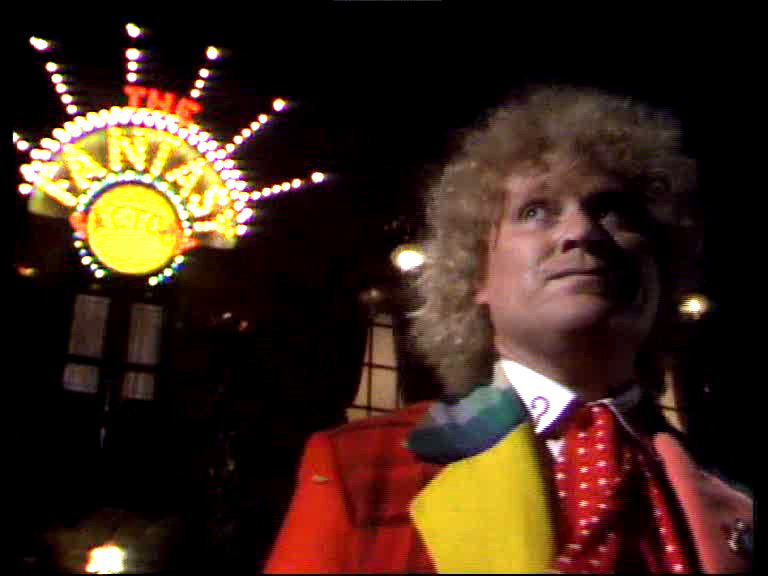
The Inquisitor agrees that the trial must consider this new evidence, and the Valeyard flees into the Matrix. The Doctor and Glitz pursue him, landing in a warped recreation of Victorian-era London. The Doctor is attacked by a rain barrel, but he is saved by Glitz. The rouge hands the Time Lord a note from the Master pointing them toward a place called The Fantasy Factory. As they approach, Glitz takes a harpoon to the chest.

The Matrix is a place where logic has no hold, and we’re back to The Deadly Assassin.

In the courtroom, the Master testifies to the court that everything they saw was true with minor adjustments to cast doubt on the Doctor. He also reveals that Peri’s fate in Mindwarp was a lie. She is serving as a queen at the side of King Yrcanos, thus providing a great sigh of relief from your humble reviewer. The Master hopes that the Valeyard and the Doctor will destroy each other and leave him free to pillage the universe, and he suggests that the High Council be made to answer for their crimes.

Reasonable.

In the Matrix, we find that the Valeyard’s attack didn’t roll high enough to defeat Glitz’s armor class, and the rogue is convinced to help the Doctor and escape the computer. They enter The Fantasy Factory and meet Mr. Popplewick, a rather stuffy bureaucrat who loves his red tape. The Doctor rushes past the front desk to the proprietor’s office only to find a more officious version of Popplewick. The procedure is sacrosanct!

Before the Doctor is allowed to proceed, he is forced to sign over his remaining regenerations to Mr. J. J. Chambers – the Valeyard – in the event of his “untimely” death. Within moments, he is whisked away to a bleak beach where hands attack from beneath the sand and draw him down, reminiscent of the quicksand traps that permeated much of ’80s television and film adventures. Glitz adopts the role of reliable sidekick and tries to rescue him, but the Doctor overcomes the trap by sheer willpower, pretty much invalidating any amount of physical peril going forward. After a round of taunting from the Valeyard, the evil Time Lord forces the Doctor and Glitz into a nearby hut with a cloud of nerve gas.

The twist: The hut is the Master’s TARDIS. The Master explains that the Valeyard has to be stopped because he has none of the Doctor’s morality, leaving him eviler, more powerful, and a huge threat. The Master tricks the Doctor by putting him in a catatonic state and leaving him as bait for the Valeyard. The Master’s Tissue Compression Eliminator proves useless against the Valeyard and the pair is forced to retreat. Meanwhile, Mel somehow arrives in the Matrix and escorts him out of the Matrix and back to the courtroom.

Mel testifies in the Doctor’s defense, offering footage from Terror of the Vervoids as evidence. The Inquisitor is not swayed, sentencing the Doctor to death. The Doctor accepts the verdict with surprising calm, and we find out that this is yet another Matrix illusion. Outside the Matrix, the real Mel is incensed, prompting her to steal the Key of Rassilon and enter the Matrix. She intercepts the Doctor, but he chides her because he knew it was a ruse based on her digital doppelgänger’s testimony. Together they enter the Fantasy Factory in pursuit of the Valeyard.

The Master charges Glitz, first via failed hypnosis then with a treasure chest, with finding the Ravalox Matrix box. Glitz finds the memory tapes and Mr. Popplewick while the Doctor discovers a list (in his own handwriting) of judges from his trial. Together, they force Popplewick to take them to the Valeyard, but Glitz trades the Doctor for the memory tapes, which he then passes to the Master.

The Doctor reveals Popplewick to be the Valeyard in disguise. He further discovers a maser device aimed at the courtroom, ready to kill the assembled Time Lords as a last resort. The list of names was a hit list. He dispatches Mel to evacuate the courtroom.

In the real world, Gallifrey is collapsing into chaos. The High Council has been deposed by a civilian revolt, and the Master takes the opportunity to seize control. The attempt is stymied when he loads the Ravalox drive into his TARDIS console and it freezes both the Master and Glitz in the Matrix.

Mel tries to evacuate the courtroom while the Doctor destroys the maser using a feedback loop. The surge strikes the Valeyard, knocking him down as the Fantasy Factory explodes. The Doctor returns to reality and learns of Peri’s true fate. The Inquisitor offers the presidency to the Doctor, but he declines, instead offering it to her. He also suggests that the Master should be punished but that Glitz can be reformed.

Leaving his fate up to the Time Lords means that the Master will be back. No doubt.

Mel and the Doctor depart with a quip, and the Doctor nearly abandons Mel at the hint of carrot juice in their future. Instead, they board the TARDIS and take off for points unknown. Meanwhile, the Inquisitor dissolves the court and orders the Keeper to repair and reinforce the Matrix.

Unbeknownst to anyone in attendance, the Keeper is the Valeyard in disguise.


As part of the Trial of a Time Lord arc, The Ultimate Foe provides a decent enough resolution, bolstered by the revelation that Peri survived and is living a good life. She did look a little sad, but I assume that it’s the weight of her role as leader. I can’t imagine that she actually missed the Sixth Doctor after all the abuse he has subjected her to, but she might miss the thrill of the adventure.

On its own, the story of The Ultimate Foe is fairly weak. The introduction of the Master weakens the power of the Valeyard and turns this “dark Doctor” into “Master Lite”. The disguises, the logical trickery, the drive to steal regenerations and kill the Doctor… all of it is just a rehash of the Master’s various machinations. The resolution also points out a massive plot hole: If the Sixth Doctor dies with regenerating, there can’t be a Twelfth Doctor or beyond. The Valeyard cannot exist unless he remains outside of time, and if he does stay outside of time then what is the point of all that power?

On a series continuity note, I did enjoy the call back to the Doctor’s dislike of the nickname “Doc”. We’ve seen it at least four times before: The Dalek Invasion of EarthThe Time Meddler, The Five Doctors, and The Twin Dilemma.

On a project note, this is the first time that an incarnation’s finale doesn’t get the regeneration handicap. This wasn’t intended as the final story for Colin Baker, and he doesn’t even begin the regeneration process in this story.


Rating: 2/5 – “Mm? What’s that, my boy?”


UP NEXT – Twenty-Third Series Summary


The Timestamps Project is an adventure through the televised universe of Doctor Who, story by story, from the beginning of the franchise. For more reviews like this one, please visit the project’s page at Creative Criticality.
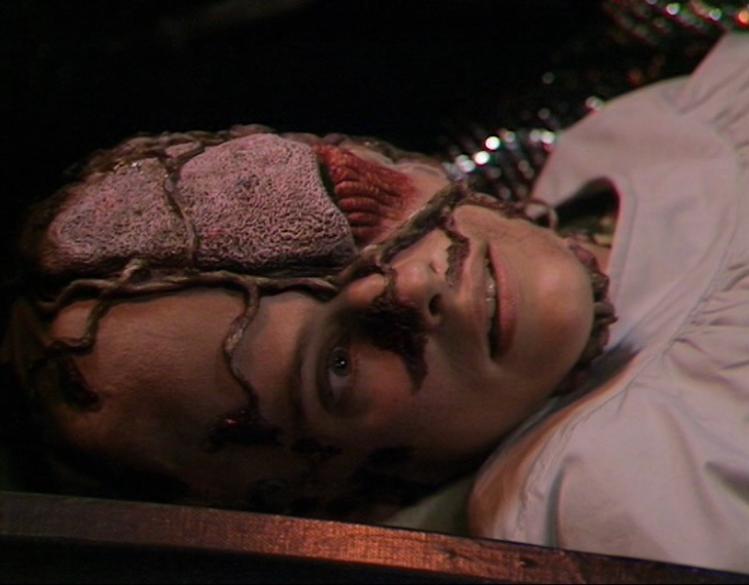
Timestamp #146: Terror of the Vervoids

Doctor Who: Terror of the Vervoids
The Trial of a Time Lord, Parts IX-XII

(4 episodes, s23e09-e12, 1986)


The Doctor is given a brief recess to mourn Peri’s death before being allowed the privilege of his own defense.

This episode of Time Lord Theater delves into the Doctor’s future. The dark introduction focuses on the mining planet Mogar in 2986 AD, galactic liner Hyperion III, a shipment of minerals, and murder.

As the passengers get checked in and settled on the cruise liner, an elderly man named Kimber spots someone he recognizes as an investigator named Hallett. The other passenger corrects him, stating that he is a mineralogist named Grenville, but Kimber puts on his conspiracy hat and his belief begins to spread like wildfire. A trio of scientists – Professor Sarah Lasky and her colleagues – are disturbed by this news. Nothing shady going on there, right?

On the TARDIS, the Doctor is working out with a companion named Mel.

Now, Mel’s very presence removes all of the dramatic tension surrounding the trial. If Mel comes from the Doctor’s future from this perspective, then it logically follows that he has a future after this trial! Ergo, he isn’t executed and is allowed to travel again.

Second, where does Mel come from? After the demise of Peri, Mel feels like a replacement to fill a quota.

The Time Lord gags down some carrot juice as their passage is detected by the cruise liner. They soon pick up a distress call from the cruise liner, sent by a mysterious figure who just incapacitated the communications officer, and they materialize in the cargo hold. Mel wants to rush into danger, but the Doctor is concerned since the distress call was sent directly to them. They are soon apprehended by security officers and taken before the ship’s captain, one Commodore Travers, whom the Doctor has met before on a previous (untelevised) adventure. Travers denies sending the distress call and is skeptical of the Doctor’s presence. He gives them quarters after refusing to let them leave the ship.

Something evil is brewing down in the cargo bay among the scientific experiments. Meanwhile, Mel develops a plan to solve the mystery: The Doctor will ask about while Mel investigates the passenger spaces. She ends up in the gymnasium and receives a secret message. She relays this message to the Doctor and they head to Cabin Six for the rendezvous. There they find a wrecked room, evidence of a fight, and the seeds used in the scientific experiments.

The room and missing boot belong to Grenville, who apparently has just been vaporized in the waste disposal unit. The Doctor presumes that their adventure is over, but Mel is not convinced. In the courtroom, the Doctor claims that the memories have been tampered with. The Valeyard points to it as more evidence that he is reckless and endangers companions needlessly, but the Doctor continues in hopes of proving him wrong.

Aside: Do you want some particularly pointed commentary on the John Nathan-Turner era of Doctor Who? Look no further than “Why it is that every time you appear on the scene, people begin to die?”


Returning to the episode already in progress…

Mel investigates the hydroponics center, the focus of the scientific experiments. The unfortunate communications officer is killed in a freak accident, something emerges from one of the alien pods, and Mel screams.

Goodness, does she scream.

The guards arrive on the scene and Mel is taken to Travers. After she leaves, the other guard is killed, but both corpses vanish. Travers summons the Doctor and interrogates Mel, and they all come to the conclusion that something nefarious is happening on the Hyperion III. The Doctor and Mel take the seeds they found to Professor Lasky, but she claims that the Time Lord stole them. After they sort out the circumstances, Mel and Lasky geek out over the seeds while the Doctor watches aghast.

In response to the deaths on board, Travers alters course to arrive on Earth 72 hours earlier. Unfortunately, this will take them closer to the Black Hole of Tartarus. The Mogarians protest, coupling the danger with the politics of mining their home bare.

In the courtroom, the Valeyard objects to the politics, but the Doctor points out that he’s missing the forest for the trees.


Returning to the episode already in progress…

One of the Morgarians collapses after having a beverage, and the Doctor removes the being’s faceplate (despite objections that oxygen will kill the alien) to reveal Grenville. Or rather, Hallett, proving Kimber right. Grenville’s death was staged to remove a threat to his cover story. The Doctor only knew that Grenville was not a Morgarian because the undercover alien did not use his translator to speak.

This event prompts the Doctor to take a more active role in matters. He and Mel investigate the trashed hydroponics center as the scientists conspire in the gymnasium. Meanwhile, poor Kimber is killed by one of the plant creatures in his cabin, and our travelers witness Lasky leaving an isolated room. The Doctor sets off the fire alarm to distract the guards, then he and Mel take a look in the quarantined cabin. We’ll just assume for the sake of fiction that smoke masks can also filter pathogens. They discover a human-plant hybrid, and Mel screams.

Goodness, does she scream.

The hybrid tells the Doctor to stop Lasky before the scientists arrive and usher the travelers out. The scientists are escorting the hybrid, one of the lab aides, back to Earth in order to help her after being infected by a freak accident. The discussion is interrupted by the guards, who apprehend the Doctor for setting off a false alarm.

The Doctor is taken to Travers and he explains what he found. Elsewhere, an attendant raises the alarm about Kimber’s disappearance and Mel finds evidence of plant interference in his cabin. The plant creatures are using the ventilation system to move around the ship and systematically kill each passenger. Mel discovers this and records their discussions, but is abducted shortly thereafter and dumped in a refuse container. Coincidentally, the Doctor comes in after this and finds the recording. He runs after the waste bins and stops Mel from being killed in the waste disposal unit, but the recording disappears in the interim.

The Doctor heads to hydroponics as Mel investigates the stewardess. In the courtroom, the trial stops as the Matrix shows the Doctor destroying the communications center, which the Doctor disputes. He’s trapped in a logical quandary: If he stops because the evidence has been tampered with, he gives up his right to defense, but if he continues then he’s subject to being incriminated by the faulty recordings.

Regardless, he chooses to continue.


Returning to the episode already in progress…

Mel is interrupted by one of the plant creatures, but she is able to hide in time. Down in hydroponics, scientist Bruchner rebels against Lasky and knocks her out. He steals a weapon and takes over the bridge, changing the ship’s course for the black hole in order to destroy the threat. The bridge has been flooded with marsh gas by the plant creatures, now known as Vervoids, but the Morgarians are able to brave the gas and the save the ship.

The victory is short-lived as they turn the tables and mutiny with security chief Rudge. The Doctor signals Mel and she is able to escape with a small group as the Doctor, Lasky, and Travers are taken to the ship’s lounge. Mel’s group is able to take the bridge back by killing the Morgarians with water, but the Vervoids are still tearing through the ship. Mel rescues the Doctor and crew from the lounge, and the Doctor is given permission to search bow to stern for the missing audio tape. Rudge escapes, but is soon taken by the Vervoids.

The Doctor finds the tape on the scientist Doland, but it has been wiped. The Doctor figured it would be, but confirms what he already suspected about Doland’s involvement in the rise of the Vervoid menace. The scientist’s confession is overheard by Travers and Doland is arrested. On the way to the brig, he is abducted by the Vervoids.

On the bridge, the Doctor discovers the Vervoid plot to kill all animal-kind and the assembled team of Lasky, Travers, and Mel conclude that cooperation with the plants is impossible. Back to the courtroom, the Doctor presents this as evidence that he wasn’t meddling but instead working on a direct request for help from Travers.


Returning to the episode already in progress…

The chemicals needed to create an herbicide have been taken by the Vervoids, and a direct appeal from Lasky fails. Mel and the Doctor escape into the ventilation ducts, stumbling across the corpses of everyone who has died so far. It’s effectively a compost heap. They return to the bridge and develop a plan to defeat the plants using vionesium, a rare metal from Mogar (and therefore, in the cargo hold) that can release extreme light and carbon dioxide. This will simulate a passage of time and accelerate the life cycle of the plants.

Because science?

The Doctor and Mel get the metal and deploy it – Mel screams… Goodness, does she scream – and the threat is ended as the Vervoids become leaves on the wind. With that, the travelers bid their farewells and depart.

In the courtroom, the Inquisitor recognizes that the Doctor saved the universe from a major threat. The Valeyard, on the other hand, spins the events to paint the Doctor as a genocidal maniac.

And the trial continues…


I liked the Doctor a bit more in this one since he was a bit more heroic and less abusive. Mel wasn’t terrible aside from the screaming. Aside from that, the story was average with a few science-fiction conceits to keep the plot rolling.

Aside from that whole timey-wimey lack of tension due to evidence of the Doctor’s future.

Bonus: Professor Lasky was played by Avenger and Bond Girl Honor Blackman. She is a powerful actress and a world treasure.


Rating: 3/5 – “Reverse the polarity of the neutron flow.”


UP NEXT – Doctor Who: The Ultimate Foe


The Timestamps Project is an adventure through the televised universe of Doctor Who, story by story, from the beginning of the franchise. For more reviews like this one, please visit the project’s page at Creative Criticality.
Timestamp #145: Mindwarp

Doctor Who: Mindwarp
The Trial of a Time Lord, Parts V-VIII

(4 episodes, s23e05-e08, 1986)


“May I remind you this is a court of law, not a debating society for maladjusted psychotic sociopaths.”

The trial continues as the Valeyard and the Doctor continue bashing heads. The Inquisitor scores the best burn and puts the squabbling children in their places before directing the proceedings to continue. The brown-nosing by the Valeyard – he addresses the Inquisitor as Sagacity, which is the state of being sagacious, or rather showing acute mental discernment and soundness of judgment – doesn’t hurt his case any, but it sure puts the Doctor on edge.

Today’s episode of Time Lord Theater is the adventure in which he was engaged just before being summoned to court. The setting is Thoros Beta, a pretty planet with pink oceans and pastel skies. As the TARDIS touches down just offshore, the Peri and the Doctor wade to the beach and start searching for the source of a weapon owned by the lecherous Warlord of Thordon, a man whom they just visited.

The travelers find a cave and explore it, finding a kelp monster that attacks Peri. In the struggle, the Doctor accidentally kills the beast, but the Valeyard makes the case that the Doctor’s actions were deliberate. A group of men arrives and, after accusing the Doctor of murdering the Raak, the leader asks if the travelers are part of Crozier’s group. The Doctor tries to play along, even though he faces inquiry for the Raak incident, and is invited back to the laboratory.

Crozier is a scientist who is conducting some kind of mental conditioning experiments. When the guards begin to question the Doctor, he and Peri apply the “skedaddle” test to the Raak’s corpse and flee. During their run, they find a chained man who has been altered to act and look like a wolf. They are nice to him and he relents, but they are forced to run further by the guards. They hide, and from the shadows, they observe Sil and two others of his species being carried by.

In the courtroom, the Valeyard asks if the Doctor relishes danger. When the Doctor deflects, the Valeyard points out that the Doctor courts it easily and places his companions into peril more often than not.


Returning to the episode already in progress…

The man in Crozier’s chair is King Yrcanos, a warrior who is resisting the attempting the tranquility conditioning. The Doctor and Peri sneak into the laboratory after Crozier and the guards leave to report the Raak’s death to Sil and company. We find out that Crozier’s experiments are designed to help Kiv, one of Sil’s species, overcome paralyzing headaches due to a rapidly expanding mutant brain. As the Doctor sabotages the lab equipment, Sil, Crozier, and the guards enter the room and confront the Time Lord. The Doctor is strapped into the machine, and Sil orders it to be used as a mind probe to extract the truth about the Raak’s death.

This is a lot of effort over this accident, but if it’s that critical to the experiment, I can see why.

King Yrcanos awakens in true Brian Blessed fashion, destroys the laboratory, and frees the travelers. Yrcanos outlines a plan to attack Sil and his followers, and a stunned Doctor agrees enthusiastically before collapsing. In the courtroom, the Doctor admits that he cannot remember anything after Crozier’s machine jolted his brain. The Valeyard doesn’t believe him but warns him that a nasty surprise is coming.

I don’t like this dark foreshadowing. I have a bad feeling about this.


Returning to the episode already in progress…

The king and his new companions go to where the new slaves are brought into the compound. Yrcanos tries to sneak attack the guards, but the scramble-brained Doctor fumbles his stealth roll and yells out, spoiling the surprise. Yrcanos flees, cursing the Doctor’s name, and Peri soon follows when the Doctor refuses to help her. Left with Sil and the guards, the Doctor sides with the reptilian rogue and claims that the odds were not on their sides for the attack.

In the courtroom, the Doctor protests, but the Valeyard retorts that the Matrix cannot lie.


Returning to the episode already in progress…

In the lab, the Doctor confirms that the Raak attacked first, setting Crozier on a path to fix the experiment. The Doctor lends a hand, and although Sil is skeptical, he is eager to save his people (who we find out are called the Mentors).

Elsewhere, Peri finds the heart of the operation before being discovered by the leader of the guards.  She runs and finds Matrona, leader of the servants, and she joins up rather than returning to captivity. As King Yrconas finds the wolf-man and frees him after recognizing him as one of his subjects, the servants are sent to Kiv’s chambers. As soon as Peri enters, the Doctor uncovers her ruse and denounces her as an enemy.

In the courtroom, the Doctor confirms that this was a ploy to gain the Mentors’ trust and allow the travelers to escape. The Inquisitor demands to see the interrogation tapes to corroborate his story.


Returning to the episode already in progress…

Peri is chained to the rocks by the sea. The Doctor tortures Peri and tells her that Crozier is planning to put Kiv’s brain in the Time Lord’s body. The whole thing, between the betrayal and the torture, is really uncomfortable. Crozier calls off the interrogation and orders them back inside. When they return, Yrcanos attacks the Doctor. Despite her reservations, Peri saves her friend, an act that angers the king.

In the courtroom, the Inquisitor offers (once again) a public defender for the Doctor’s case, but he refuses, reasoning that if the Time Lords want him dead, he cannot trust any of them to save him.


Returning to the episode already in progress…

The Doctor flees the scene and arrives at the lab. Crozier is trying to transplant Kiv into a new body that he found washed ashore, and the Doctor jumps in to assist. Meanwhile, Peri follows Yrconas to find pockets of resistance in Kiv’s organization. The three of them, Yrconas, Peri, and Dorf the wolfman take a rest, eat some flay fish, and plot while overcoming a spate of jealousy. They move on and are soon captured, but their captors are rebels against the Mentors. An army is raised and they go on the hunt, but they are eventually apprehended. When they try to escape, they are all shot down.

Luckily, they were only stunned, but for a moment in the courtroom, the Doctor truly thought that Peri was dead and that he was responsible.

Back in the lab, after a rather harrowing medical drama, Kiv is successfully transplanted, but there are complications. The brain is not quite compatible with the body of a fisherman, and the body is winning by taking over the memories. In order to save Kiv, they need to move his brain one more time. Crozier suggests Peri as a suitable candidate, but the Doctor shows his apprehension so Crozier sends him to the induction center to find a suitable candidate.

In their new cell, Peri expresses a desire to go back to her own time and be with people she loves. King Yrconas asks her about love, and Peri teaches him in her own magical way. Soon after, she is taken to the lab and sized up for the transplant.

The Doctor tricks the head guard and frees Yrconas and Dorf. The group follows the Doctor’s plan, taking over the induction center and setting their sights on the control center to free all of the slaves in the compound. A heartbreaking stray shot kills Dorf but the team takes the control room and destroys it.

As the Doctor rushes to save Peri, the Time Lords remove him from time and take him to the court, effectively catching us up on his timeline. Their reasoning is that he had unleashed chaos and set irreversible events into motion with Peri that would threaten the future of human evolution. They then show him what happened after he left Thoros Beta.

Kiv is transplanted into Peri’s body, effectively erasing her brain in the process. Yrcanos attacks the lab, but the Time Lords place him in a time bubble to await the perfect time to strike, basically turning him into an unwitting assassin. The Doctor chides the Inquisitor for this act of second-rate gods.

Kiv awakens in Peri’s body as the time bubble dissipates, and Yrcanos storms into the lab. He sees what has happened to the woman he has grown to love and he kills everyone in the room.

He killed everyone.

The Doctor is incensed – as am I at this point – but the Inquisitor and the Valeyard tell him that is was necessary to stop the pending disaster. The Doctor doesn’t believe them, and he vows to find out exactly why he is in this place outside of time.


Upsides: Brian Blessed was amazingly over the top, and it was glorious; Thomas Branch, the actor behind Dorf the wolfman sold the man’s best friend routine so well that my heart hurt when the character died.

Downside: I don’t like what they did to Peri in this story, between the Doctor’s perceived betrayal and her death. She has been abused so much during her travels with the Sixth Doctor (usually at his hand), and she deserved so much better.


Rating: 3/5 – “Reverse the polarity of the neutron flow.”


UP NEXT – Doctor Who: Terror of the Vervoids


The Timestamps Project is an adventure through the televised universe of Doctor Who, story by story, from the beginning of the franchise. For more reviews like this one, please visit the project’s page at Creative Criticality.