Timestamp #6: The Aztecs

Doctor Who: The Aztecs
(4 episodes, s01e25-e28, 1964)

Timestamp 006 The Aztecs

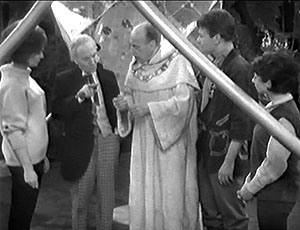
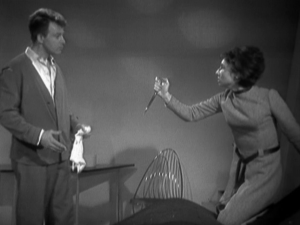
How delightful! This serial was great, with our heroes having to transition from being reactive to being proactive within the span of four episodes and unpredictable rapid-fire twists and turns. The TARDIS crew shows up, accidentally gets separated from the ship, and gets mistaken for a god and her assistants. As the main villain, Tlotoxl, the High Priest of Sacrifice, keeps throwing every twist and turn he can at the time-travellers in order to usurp the power mistakenly given to them by the other Aztecs.

The beauty of the serial is how the group is forced to shift from dodging Tlotoxl’s efforts to countering his machinations before he even makes a move. The smaller moments (the Doctor gets betrothed, Susan refuses to get married, and Ian fights warriors and discovers the path back to the ship) only add to the delicious point-counterpoint between Barbara and Tlotoxl.

Most importantly, this serial really starts to emphasize the points that I’m familiar with in the Doctor Who mythos. No matter what happens, the timeline must remain intact and certain fixed parts of history cannot be changed. The sacrifices must continue despite Barbara and Susan’s protests, and, amazingly enough, the story ends with a win-win for both the heroes and the villain.

This serial was an elegant dance. I had seen it once before, but within the context of the show, this time I actually experienced it.


Rating: 5/5 – “Fantastic!”


UP NEXT – Doctor Who: The Sensorites


The Timestamps Project is an adventure through the televised universe of Doctor Who, story by story, from the beginning of the franchise. For more reviews like this one, please visit the project’s page at Creative Criticality.

Timestamp #5: The Keys of Marinus

Doctor Who: The Keys of Marinus
(6 episodes, s01e21-e24, 1964)

Timestamp 005 The Keys of Marinus

This is a great serial that is a effectively a series of short stories linked by a common thread. The companions carry the story quite effectively for two episodes while William Hartnell took a much needed vacation. Hartnell’s energy after his return made what was a simplified courtroom/detective procedural sing where it could have otherwise fallen flat. I had some problems with the detective story, but there’s also not a lot of wiggle room for the writers in a somewhat slow-paced 20 minute presentation. These companions are smart, which is something I’m enjoying as this team comes together. The resolution of the arc once the group acquires all the keys was also quite brilliant.

I also give a tip of the hat to the production team for saving money on the TARDIS materialization/dematerialization by using a model. It may not look like much in today’s era, but it was quite well done for what they had available. I almost want a model TARDIS like that one.


Rating: 4/5 – “Would you care for a jelly baby?”


UP NEXT – Doctor Who: The Aztecs


The Timestamps Project is an adventure through the televised universe of Doctor Who, story by story, from the beginning of the franchise. For more reviews like this one, please visit the project’s page at Creative Criticality.

Timestamp #4: Marco Polo

Doctor Who: Marco Polo
(7 episodes, s01e14-e20, 1964)

Timestamp 004 Marco Polo

I watched the Loose Cannon reconstruct for this serial since all of the episodes are currently lost. It is a great story that ran a little long, but did have a decent ending. I particularly loved how the companions drove the story, even though it forced the Doctor into a much smaller role. It was also quite nice to remove the TARDIS from the characters so they couldn’t just jump in and fly away, although the ship does seem to be malfunctioning quite often. In An Unearthly Child, Susan points out that the chameleon circuit isn’t working. In The Daleks, we find out that the fluid link may possibly be a single point of failure for the ship. In The Edge of Destruction, a broken spring in a single switch causes an overload of the power source, nearly destroying the TARDIS. The fallout from that casualty drops the ship into Marco Polo without power, light, or heat. If I didn’t have the background from the Eccleston, Tennant, and Smith years, I’d be worried about how long the TARDIS can hold out.

Is the Doctor incompetent at operating the ship despite the adventures alluded to before the series began? Is the TARDIS intentionally causing some of these problems? Was it just a simple writing crutch in the beginning of the series?

I give Clara one thing: It does make for a more exciting journey.


Rating: 3/5 – “Reverse the polarity of the neutron flow.”


UP NEXT – Doctor Who: The Keys of Marinus


The Timestamps Project is an adventure through the televised universe of Doctor Who, story by story, from the beginning of the franchise. For more reviews like this one, please visit the project’s page at Creative Criticality.

Culture on My Mind – Earworm: Hardware Store

Culture on My Mind

Culture on My Mind
Earworm: Hardware Store
April 3, 2014

I have a small earworm that is making this week’s commutes a little easier. It shuffled up on my iPod during Monday evening’s drive, and I’ve used it for the last couple of days.

There is no official music video, and Weird Al refuses to play this song in concert due to the rapid-fire description of “all that stuff” in the store. Nevertheless, it’s a fun song.

They’ve got allen wrenches, gerbil feeders, toilet seats, electric heaters
Trash compactors, juice extractors, shower rods and water meters
Walkie-talkies, copper wires, safety goggles, radial tires
BB pellets, rubber mallets, fans and dehumidifiers
Picture hangers, paper cutters, waffle irons, window shutters
Paint removers, window louvers, masking tape and plastic gutters
Kitchen faucets, folding tables, weather stripping, jumper cables
Hooks and tackle, grout and Spackle, power foggers, spoons and ladles
Pesticides for fumigation, high-performance lubrication
Metal roofing, waterproofing, multi-purpose insulation
Air compressors, brass connectors, wrecking chisels, smoke detectors
Tire gauges, hamster cages, thermostats and bug deflectors
Trailer hitch demagnetizers, automatic circumcisers
Tennis rackets, angle brackets, Duracells and Energizers
Soffit panels, circuit breakers, vacuum cleaners, coffee makers
Calculators, generators, matching salt and pepper shakers

cc-break

Culture on My Mind is inspired by the weekly Can’t Let It Go segment on the NPR Politics Podcast where each host brings one thing to the table that they just can’t stop thinking about.

For more creativity with a critical eye, visit Creative Criticality.

Timestamp #3: The Edge of Destruction

Doctor Who: The Edge of Destruction
(2 episodes, s01e12-e13, 1964)

Timestamp 003 The Edge of Destruction

Aside from developing the mythology behind the TARDIS being a living machine and some nice moments at the end between the Doctor and Barbara, I really didn’t like this serial much. It did emphasize some of the inherent friction amongst the companions and the Doctor, and seems to have healed those rifts to make a more coherent team. The plot, and especially the ending, seemed rushed and almost pulled from thin air.

Rating: 2/5 – “Mm? What’s that, my boy?”

UP NEXT – Doctor Who: Marco Polo

The Timestamps Project is an adventure through the televised universe of Doctor Who, story by story, from the beginning of the franchise. For more reviews like this one, please visit the project’s page at Creative Criticality.

Timestamp #2: The Daleks

Doctor Who: The Daleks
(7 episodes, s01e05-e11, 1963-1964)

Timestamp 002 The Daleks

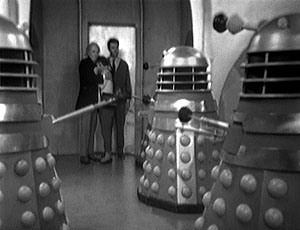
The Daleks is vastly better than the first serial. I simply loved how duplicitous the Doctor was with the fluid link, the tiny little piece of the TARDIS that drives the entire serial. This story can be broken down into two distinct parts, the first of which is the introduction of the Daleks and the escape of the TARDIS crew from their imprisonment. The second is the quest to save the Thals from being destroyed by the Daleks. The first is more engaging than the second and lays the groundwork for the Dalek mythology. What’s inside those metal machines? I’m glad they saved part of that mystery and didn’t try to show it with the show’s minimal budget. The second is still a good story with good characterizations, and while it is important to the overall serial, it does drag a little.


Rating: 4/5 – “Would you care for a jelly baby?”


UP NEXT – Doctor Who: The Edge of Destruction 


The Timestamps Project is an adventure through the televised universe of Doctor Who, story by story, from the beginning of the franchise. For more reviews like this one, please visit the project’s page at Creative Criticality.

Timestamp #1: An Unearthly Child

Doctor Who: An Unearthly Child
(4 episodes, s01e01-e04, 1963)

Timestamp 001 An Unearthly Child

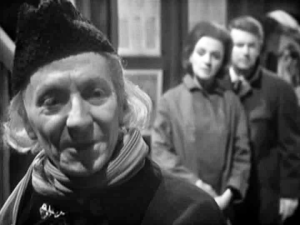
In short: I’m glad the show got better. The best part for me was the first episode, An Unearthly Child. The rest of the serial with the cavemen just didn’t grab me. There were some nice little character moments between the Doctor and Ian over leadership of the group, but the cavemen seemed very one-dimensional and dragged down the pacing. In particular, I enjoyed watching Ian deciding who should do what, but assuring the Doctor that he was still the leader.

My dislike of this serial is tempered by the leniency I offer to both pilot episodes and Doctor Who regeneration episodes. Pilots are always pretty tough, and regenerations episodes are even more tough because it’s the same show with a different face.


Rating: 3/5 – “Reverse the polarity of the neutron flow.”


UP NEXT – Doctor Who: The Daleks

The Timestamps Project is an adventure through the televised universe of Doctor Who, story by story, from the beginning of the franchise. For more reviews like this one, please visit the project’s page at Creative Criticality.

Resurrections and Introductions

Creative Criticality’s blog is back!

I’m resurrecting the WordPress site because I wanted a place for long form blogging, and also because I’ve decided to embark on an exciting journey. More to follow on the adventure in time and space in a minute, but first, the blog.


Creative Criticality has been around for a while, but in multiple formats. It was on LiveJournal for a while – that’s where a lot of the prior posts you’ll see in the Archives section come from – and has been on Tumblr and Facebook as well. The latter two still remain open, but LiveJournal will not. Between you, me, and the rest of the internet, I will not miss the DDOS attacks from Russia or the spam comments trying to sell me sex and drugs through shady websites.

As far as WordPress goes, I’m still learning. I appreciate any comments, tips, and tricks to make this thing sing a little better. Feel free to tell me to kill it with fire, but I can’t guarantee that I will.

Anything older than one year, including the old LiveJournal stuff, has had the comments locked. Anything older than 2013 is in the Archives.

Big thanks to Kevin Bachelder for gently nudging me in this direction. You’re right, it is better living in the future.

Next order of business: That adventure thing.


I’ve decided to finally watch Doctor Who from the beginning and document the journey. I’ve mentioned in certain circles that I came to the series in the later years starting with Christopher Eccleston’s run. I have watched certain episodes from the past, but the vast majority of the franchise is fresh territory for me. I find the concept quite exciting.

My reviews will be short, probably ranging from 50-200 words unless I really get on a roll. The episodes have been reviewed in-depth across various platforms by numerous people – including by Nathan Laws, one of the people who really inspired me to take a deeper look at the mythology of the Doctor – so I don’t plan on offering deep thematic musings and analysis. It might happen down the road at some point, but not right now.

I also credit John Drew and Gary Mitchel for the little nudges here and there. You’re good folk, and I appreciate it.

I plan to offer a link to each serial’s article on the TARDIS Data Core wiki, and I’ll also offer a “from the gut” rating of each serial.

1/5: “EXTERMINATE!”
2/5: “Mm? What’s that, my boy?”
3/5: “Reverse the polarity of the neutron flow.”
4/5: “Would you care for a jelly baby?”
5/5: “Fantastic!”

The one thing to note about the ratings is that a regeneration episode will have a star added to it. Regeneration episodes have the impossible task of trying to make you like a new main character right away while still trying to carry the story, and I felt it was necessary to compensate for that handicap.

I’ve decided to call it the Timestamps Project. Thanks to Gary for that name.


That’s it for now. Please feel free to leave any feedback in the comments. I’ll have the Timestamp for the first Doctor Who serial, An Unearthly Child, on the feed soon.

Culture on My Mind – Darth Maul and the Hollowness of Death

Culture on My Mind

Culture on My Mind
Darth Maul and the Hollowness of Death
October 14, 2011

Entertainment Weekly recently posted an exclusive video that announced the return of Darth Maul to the Star Wars universe.  For those who either missed or refused to watch the prequels, Maul was a Sith Lord—the same kind of baddie as Darth Vader—who used a double-bladed lightsaber.  His first on-screen appearance was in The Phantom Menace in 1999.

In that film, a three-way lightsaber duel ended with Qui-Gon Jinn impaled through the chest and Darth Maul toppling into a deep shaft, deftly cleft in twain by the blade of Obi-Wan Kenobi.  Last January, viewers of the cartoon series Star Wars: The Clone Wars were introduced to Maul’s brother Savage Oppress (pronounced in typical Star Wars ­style as sah-VAHJ OH-press), who was a proposed apprentice to help Count Dooku overthrow his master and take control of the Dark Side of the Force.  At the end of that trilogy of episodes, viewers were told that Darth Maul was out there in the incredibly vague somewhere in the galaxy, and Oppress had to go find him.

So, apparently this means that Darth Maul does indeed live and, by some miracle, survived being cut in half by a lightsaber and falling several stories.  Insert exasperated sigh here.

Supervising director Dave Filoni told Entertainment Weekly that it makes sense in terms of Star Wars lore:

Fans will note that there is precedent for this kind of resurrection. “The Dark Side of the Force is the pathway to many abilities some consider to be…unnatural,” Darth Sidious says in Revenge of the Sith. Sidious and his master found a way to use the Force to cheat death—that’s how he was able to keep Vader alive after that little swan dive into a lava field. Couldn’t Maul have picked up on some of that too? Says Filoni, “He’s suffered through a lot to keep himself alive and implemented the training of his master to do so.”

There’s also significant financial interest for Lucasfilm in this move.  The episode(s) pertaining to Darth Maul will be aired in early 2012, and, by a cosmic coincidence I’m sure, Star Wars: The Phantom Menace in 3-D is premiering February 10, 2012.  It goes without saying that I’m annoyed by publicity stunts written into entertainment to drive interest in a related property.  Anyone else remember the martial arts episode of Star Trek: Voyager called “Tsunkatse”?  WWE Wrestler Dwayne “The Rock” Johnson was a guest star, and both WWE and Voyager were on UPN.

This entire mess—and yes, I’m calling it a mess—brings Star Wars into the realm of pointless character resurrections to drive sales.  It also revives the eternal frustrations I have with Star Wars fandom.  Since Maul was by far one of the coolest and most bad-ass characters in the prequel trilogy, the news that he would return to the franchise was understandably received with fan praise.  At the same time, others started to look at how this affects the overall quality of the franchise and aired their opinions.  In response to critical fans, some blogs, including Star Wars Underworld, questioned the “fandom” of people with differing opinions.  While I appreciate a discussion on how they plan to resurrect a character and do it well, it’s certainly not the first time that the Star Wars social media sphere has played the card of questioning how someone can be a fan of something while being critical: the hosts of The ForceCast did it numerous times before I stopped listening to the podcast back in May.

While other subsets of science-fiction and fantasy fandom can somewhat easily accept both positive and negative criticism toward the franchise of their choice, some Star Wars fans tend to follow the line of reasoning that if “you’re not with with us, you’re against us.”  It’s all fun and games until you disagree with Uncle George and refuse to drink the blue milk, and I’ve already seen backlash from refusing to buy the Star Wars Blu-Rays and my decision not to support the 3-D re-releases.  Having intelligent discussions about the positives and negatives of a franchise is one thing, but I cannot support attacking each other for having differing opinions.

The bigger problem I have with this is an issue that has plagued comic book franchises for decades, and that is in the pointless death and resurrection of characters.  In real life, religious beliefs aside, death is pretty permanent.  In storytelling, death is a result of failure, the completion of a heroic journey, or the motivation to start that journey.  In a smaller subset, that death results in a significant change of character dynamics—such as regenerations in Doctor Who, or the evolution of Gandalf in Lord of the Rings or Obi-Wan Kenobi in Star Wars—but those deaths still carry the impact of the end of a journey and how it affects the characters around them.

Simply put, to reverse a death negates that impact and cheapens the victory for the winners.

In The Phantom Menace, Darth Maul’s death marked two important character changes:  First, it displayed Obi-Wan Kenobi’s maturity and readiness to be promoted from apprentice to Jedi Knight; second, it marked the beginnings of Anakin’s destined path.  The death of Darth Maul was a very important turning point for the Jedi themselves, as they discover that the Sith had indeed returned.

While I look forward to finding out how Filoni and company accomplish this feat, I am very skeptical about the Star Wars franchise as a whole at this point.  If Filoni proves me wrong and does this well, I will be quite amazed.  On the other hand, if this turns into yet another cheap comic book return—Superman wasn’t dead, after all, he was just resting—to sell tickets to yet another release of the Star Wars movies, then I’m done with The Clone Wars.  I have supported the show since it was announced, but for me, it would be that damaging, and since George Lucas has final approval on the show, the blame would lie solely with him.

Come 2012, we shall see.

cc-break

Culture on My Mind is inspired by the weekly Can’t Let It Go segment on the NPR Politics Podcast where each host brings one thing to the table that they just can’t stop thinking about.

For more creativity with a critical eye, visit Creative Criticality.

Culture on My Mind – My Thoughts on Lost

Culture on My Mind

Culture on My Mind
My Thoughts on Lost
October 12, 2011

One of the American television shows that I heard a ton about but never had time to watch was Lost.  My wife borrowed the season sets from her brother, but only made it as far as season three before life took over.  During that time where we weren’t watching, fan groups and some of my trusted friends were still abuzz about the series, so when the complete series boxset came available after the series finale in 2010, I knew that it was a series that I had to invest in.

For those who don’t know about Lost, this post will involve spoilers.  If you intend on watching the show and want to experience it without knowing what’s coming, you probably want to stop reading and come back afterward.

What is Lost?
Lost was billed as a drama series, and ran on the ABC network from September 22, 2004 to May 23, 2010 over six seasons.  The show is centered on the survivors of the crash of Oceanic 815, a commercial passenger jet traveling between Sydney, Australia and Los Angeles, California.  The crash occurred on a mysterious, unnamed tropical island somewhere in the South Pacific Ocean.  The show was told in episodes that primarily focused on the events on the island, with secondary stories that amplified events in the life of the central character for each episode.  Lost was the brainchild of Jeffrey Lieber, J. J. Abrams, Damon Lindelof, and Carlton Cuse.

When I say that Lost was a drama series, that classification is a very generic brush stroke to apply.  On its face, Lost was a character drama, but once I got invested, it was apparent that the show was part-drama, part-science fiction, part-fantasy, part-supernatural, part-hero quest, and part-mythological.  The blessing and the curse of the show was that the mythos brought up a plethora of questions that spanned all six seasons before being answered.  It was both frustrating and intriguing, and that was what I loved about it.

The frustration was amplified by the broad spectrum of cast members.  In the show, of the 324 people on Oceanic 815, 70 people and one dog survived, spread across three sections of the plane.  Season one focused on the survivors of the middle section, predominantly Doctor Jack Shephard, fugitive Kate Austen, con-man James “Sawyer” Ford, heroin-addict rock star Charlie Pace, former Iraqi soldier Sayid Jarrah, paraplegic John Locke, lottery winner Hugo “Hurley” Reyes, construction worker Michael Dawson and his son Walt, Korean couple Sun-Hwa and Jin-Soo Kwon, fueding siblings Boone Carlyle and Shannon Rutherford, and Claire Littleton, who is eight months pregnant.  As the show went on, some characters died, others were introduced—especially after the discovery of the tail section and the people who were on the island before the crash—and links between all of the characters are established from their lives before the show.

What starts as a simple show about people stranded on a desert island starts getting into the science fiction within the first few episodes with the introduction of a monster made entirely of smoke.  Characters also start seeing visions of dead friends and relatives, and eventually discover a mysterious hatch in the middle of the jungle.  Also woven throughout events of the show and the characters lives before the island are The Numbers:  4, 8, 15, 16, 23, and 42.

As the show went on, we discovered that the survivors were not alone.  First, there is the hostile seemingly primitive group known as The Others.  Second, there are the remnants of the mysterious Dharma Initiative.  Finally, there are the almost otherworldly inhabitants who have a greater purpose on the island.

Why I liked Lost
Anyone who knows me knows that I’m a sucker for epic mythology.  Lost had that in spades.

One of the major complaints I heard about the show was that it was a victim of meandering stories that eventually headed in a somewhat decent conclusion, and I think that was a benefit to watching this on the DVDs.  Watching without the waiting between seasons or over writers’ strikes helped me to see this more as a mini-series rather than a six-season series.

Seasons one, two, and three of the show were standard American seasons with 25, 24, and 23 episodes, respectively.  Season four was supposed to have 16 episodes before the Writers Guild of America went on strike, and eventually ended up with 14.  Season five went with 17 episodes, and season six ended the show with 18.  The latter three seasons capitalized on the fact that the showrunners limited themselves to six seasons, particularly after the storylines started to wallow in stagnation in the third season.  The ratings show how the show started to suffer in season three.

Lost had an overarching mythology that, once it finally got assembled, really kept me rolling.  All the talk of The Numbers and Jacob and The Man in Black really came to a head for me with the eighth episode of the last season, when the show finally explained why everything was so important.  Sure, The Numbers were retconned in to correspond with the remaining survivors of Oceanic 815 who were potential candidates to replace Jacob, the guardian of the island and protector of the world, but I didn’t care because it made sense to me.  Jacob was a man who was forced into a sacred role and immortality without a choice, and a mistake he made in the nascent days of his role unleashed a great evil that had one goal:  to take over the world.  To get there, the evil Man in Black has to kill his brother, which he cannot do directly.  The rest of it, from the button that has to be pushed every 108 minutes to prevent the destruction of the island to the quest to control the energy at the heart of the island speaks to me as the folly of man.

While a great deal of the show’s events relied on destiny and fate, that’s what myths depend on as well.  Epic fantasy and science fiction, driven by powers outside the control on man, be it God, the Force, or whatever you want to call it, depends greatly on the possibility that certain things are destined to occur.  In Lost, the candidates were destined to arrive and be tested on the island, and they were selected not because they were strong or smart, but because they were flawed.  Only a flawed person, one who recognized and was willing to improve their shortcomings, could fill the role of protecting the island.  More so, Jacob wanted his successor to choose to be the protector, not be pushed into it.  Jack chose to take the responsibility directly, and Hurley chose indirectly by his continuous empathy and caring for his fellow survivors.  Jack continually jockeyed for the leadership position with Sawyer and Locke, but everybody truly loved Hurley, and relied on him for support.

Religion and faith also played a major role from day one in the show, and I had no problem with the final resolution of the “sideways” storyline being nothing more than a waiting room for the Oceanic survivors before moving on to whatever lies beyond this life.  Simply put, it was a method for each person to resolve any unfinished emotional business in their lives and remember the most important thing they did in the living world.  Watching all of these people, who had fought each other while struggling to survive, come together with a common goal in mind moved me, and I thought the intent was beautiful.

But the thing that moved me even more was the poetic ending for Jack.  He ended his journey exactly where he started it, and I bawled like a baby when he collapsed on the ground and Vincent—the dog who always had a knack for progressing the storyline when it needed a motivational kick—laid down next to Jack to ensure his last moments were not spent alone.  I’m getting weepy even now as I put these words to the page.  When a television show or a movie has the power to move me to tears, it takes a special place in my life.  I can count on one hand the media that has accomplished that.

That was the effect that Lost had on me.  It wasn’t just a drama series about survivors on an island with sci-fi and fantasy elements tossed in.  When I partake of any story, but in particular science fiction, I look for how it applies to the human condition.  Science fiction has always been an examination of the human condition by use of metaphor, and Lost did that.  Each character was three-dimensional in my eyes, and character motivations were, for the most part, genuine.  What solidified the characters for me was not only that genuine flavor, but the fact that they could evolve in believable ways as the plot progressed.

I know that the writing wasn’t always stable, and that there were problems with retroactively adding new characters into old situations as if they’d always been there, but for me, what I gained from experiencing the series far outweighs those minor quibbles.

Lost is a series I will go back to again in its entirety, and is a series that I feel has made a profound impact on my life.

cc-break

Culture on My Mind is inspired by the weekly Can’t Let It Go segment on the NPR Politics Podcast where each host brings one thing to the table that they just can’t stop thinking about.

For more creativity with a critical eye, visit Creative Criticality.