Seven Days of Star Wars: Day Three – Attack of the Clones


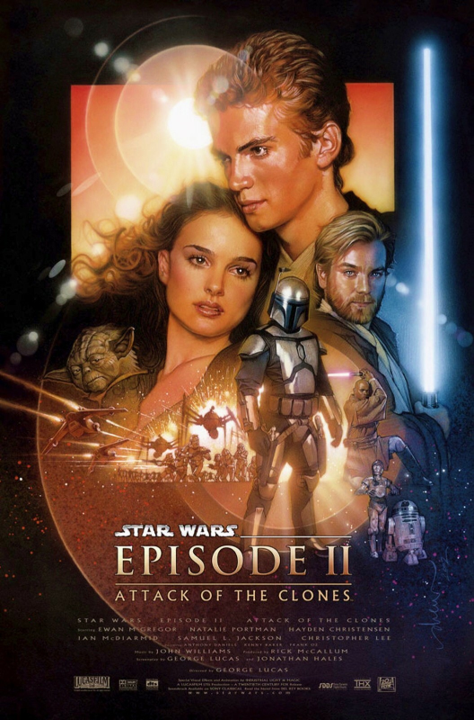
Star Wars: Episode II – Attack of the Clones
(PG, 142 minutes, 2002)

This is the third installment in a series of looks at each of the wide-released theatrical Star Wars films leading up to the premiere of Star Wars: The Force Awakens. This includes each of the films that comprise the saga’s story after the 2012 purchase of Lucasfilm by the Walt Disney Company and the April 2014 canon reset.

Day one examined 2008’s Star Wars: The Clone Wars. Day two looked at Star Wars: Revenge of the Sith. Today’s entry is for the second of the Prequel Trilogy, Star Wars: Episode II – Attack of the Clones, which is set 22 years before the events of Star Wars: A New Hope.

I was still in college when this came out, and it was a special trip to The Gateway in Salt Lake City with my future wife, my sister, and a friend of hers. It was one of the first times I was able to get advance tickets for a movie. While it was an exciting movie for the saga’s mythology, it has become my least favorite of the Prequel Trilogy.

The acting chemistry issues I discussed with Revenge of the Sith apply more heavily here. I get Anakin being a hormonal teenager, and I get the courtly love story elements, but it’s just Hayden Christensen and his lack of chemistry with Natalie Portman that grates on me.

The bigger issue I have with Attack of the Clones is the Jedi Order.

Anakin’s issues with attachment are noticed as early as the first reel when he and Obi-Wan are going to Padmé’s apartment. Anakin is obsessive – and actually downright creepy – about Padmé’s safety. Being near her, in his own words, is intoxicating. So, when the Order decided to send a Jedi with Padmé back to Naboo, they should have sent a completely different Knight. Send Anakin with Kenobi to investigate the assassin, or even place him on library duty while Kenobi’s away. As trite as it sounds, remove him from the temptations away from his oath to the Jedi Code.

If the Council thought it appropriate to send Anakin as a protector to further his independent study as a budding Knight, then it should have been painfully clear to Kenobi at the Battle of Geonosis that this attachment was a problem. Yes, the Clone Wars were beginning and every able-bodied Jedi was needed on the front lines – interpreted at this point as a defense of the Republic – but every effort should have been expended to keep Anakin separated from Padmé.

Even Yoda knew it was a problem. This wasn’t the Dark Side clouding things; this was arrogance and ignorance, and it pervades the entire film. The Jedi truly brought about their own downfall because of it, and it frustrates me because I’m watching intelligent people make stupid choices without recognizing just how stupid they are.

So, yes, I’m hard on the movie. But there are things to like about Attack of the Clones.

The Rumble in the Rain

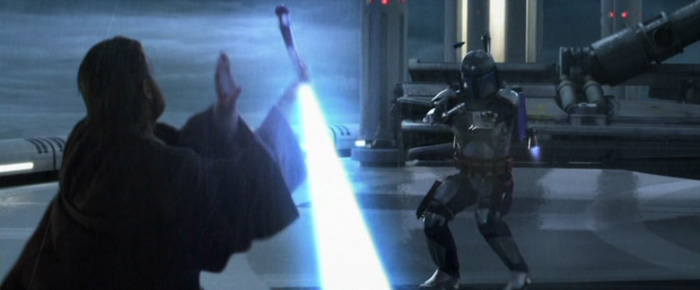
With a lot of the character drama being downright irritating, the action sequences pick up the tab, and one of the coolest sequences is the “Rumble in the Rain” on Kamino.
Attack_of_the_clones_2

We got a small taste of Jedi versus Mandalorian in Return of the Jedi, but this really showcases how badass both Jango Fett and Obi-Wan Kenobi were. It also comes up again when Kenobi tails Fett’s Slave I to Geonosis and they face off again in the planet’s rings.

Foreshadowing Vader

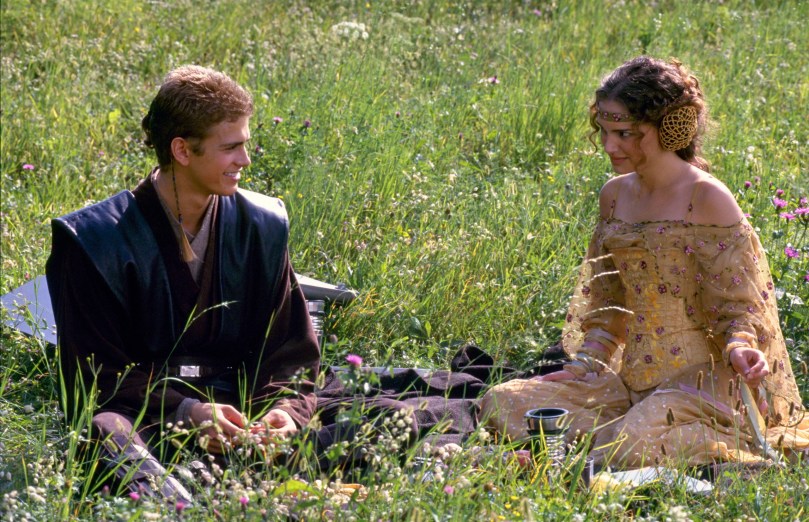
There are a few elements in Attack of the Clones that foreshadow Anakin’s descent into darkness. The first is his discussion with Padmé in the fields of Naboo about how politicians should be made to agree with the common good. While he is joking with Padmé, it feels like he actually believes it, at least in part.
Anakin-and-Padme

Another element is after Anakin’s dream on Naboo when he’s meditating on the lakefront. His stance echoes back to The Empire Strikes Back and Vader’s meditations on the Super Star Destroyer’s bridge.

Anakin Lake

super_destroyer_bridge

Finally, the obvious foreshadowing for Anakin’s fall to the Dark Side is his vengeance against the Tuskens after his mother dies. He walks straight down the path detailed by Yoda in The Phantom Menace – “Fear is the path of the Dark Side. Fear leads to anger. Anger leads to hate. Hate leads to suffering.” – and creates a disturbance so large in the Force that it even shakes the spirit of Qui-Gon Jinn. This leads Yoda to question and explore life after death, which is a key element of the Original Trilogy.

The Wedding

While the chemistry between Natalie Portman and Hayden Christensen gives me trouble, the wedding scene at the end of the movie is one of the most beautiful of the franchise.
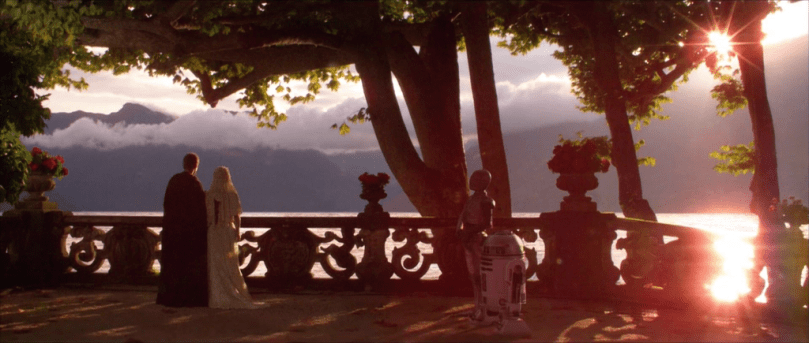
AOTC wedding

Natalie Portman’s costumes in Attack of the Clones were, for the most part, very elegant and elaborate. The wedding gown was a nice change of pace, and calls back to the peasant disguises that the character wore during the return flight to Naboo. The wedding dress maintains the elegance of the character, but delicately melds it with a simplicity that reflects the monastic Jedi robes of her husband. It also calls back to the concepts of courtly love by bringing in medieval and typically Arthurian elements.

The ceremony takes place in the same place where the pair were in hiding on Naboo, which is where they shared their first kiss, and the bright sunset behind them over the water is symbolic of the crucible yet to come.

The Battle of Geonosis and the Lightsaber Duel

The Battle of Geonosis finally delivers on the promise of stories set in the Golden Age of the Jedi Order by showing a lot of Jedi doing Jedi things. In this case, it’s a massive lightsaber battle, and it’s the moment where I sat up in my chair and really engaged until the end of the film.

On top of being a showcase of Jedi talent, The Battle of Geonosis is the start of the Clone Wars, which was only a whispered legend in the Original Trilogy. The movie shifts genres to a war epic, and while the CG effects are a bit dodgy, they are also a test bed for the technology that drives a lot of the blockbusters a decade and more later.
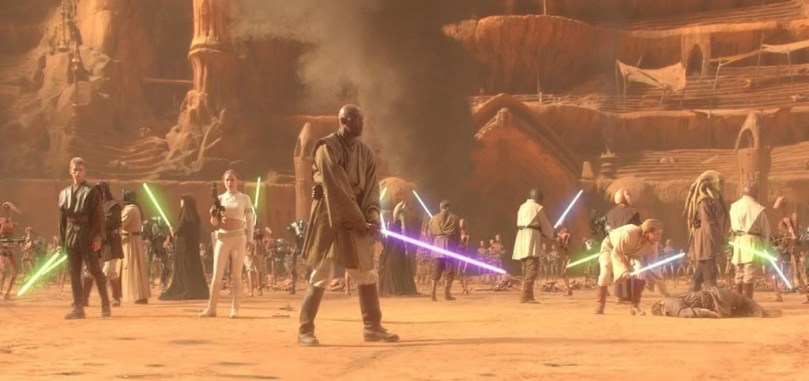
jedigeonosis

The feather in the cap of this sequence is the lightsaber duel with our heroes and the duplicitous Count Dooku. It was fantastic to watch Christopher Lee fencing with a lightsaber – the long shots were a double with Lee’s head digitally replaced, but all of the close up work was his alone – and watching him dispatch powerful Jedi like Kenobi and Skywalker was amazing. I did not expect what followed, but I cheered for the first time in the film when Yoda dropped his walking stick and ignited a lightsaber to battle Dooku, and it says a lot that the Sith Lord had to effectively cheat to escape.
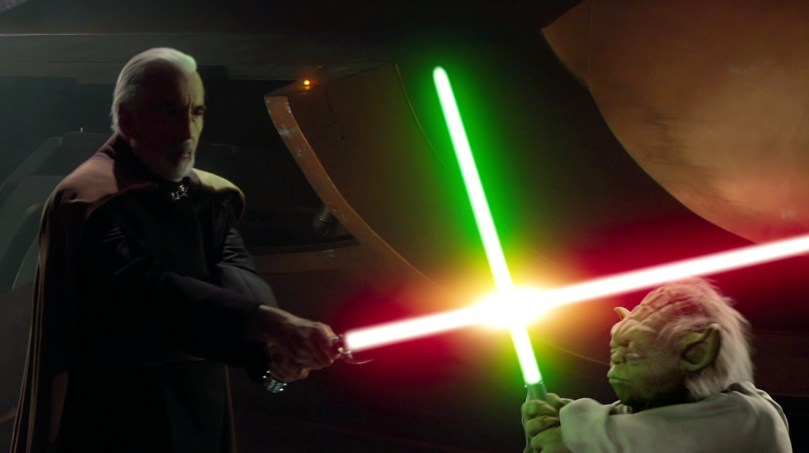
Dooku_vs_yoda

“Across the Stars”

The one part of the entire love story that I do really enjoy is the theme “Across the Stars”. The theme is both elegant and tragic, and feels inspired by the classical waltz music one would typically hear in a Victorian or Edwardian period piece such as Pride and Prejudice. The piece has a courtly innocence that is layered with the darkness yet to come from the forbidden love affair, and is one of the highlights when I watch this film.

star-wars-episode-2-attack-of-the-clones-poster

Tomorrow, I’ll finish off the Prequel Era with my favorite moments from 1999’s Star Wars: Episode I – The Phantom Menace.

My Rating: 7.0/10
IMDb rating: 6.7/10
cc-break

For more creativity with a critical eye, visit Creative Criticality.
Seven Days of Star Wars: Day Two – Revenge of the Sith


Star Wars: Revenge of the Sith
(PG-13, 140 minutes, 2005)

This is the second installment in a series of looks at each of the wide-released theatrical Star Wars films leading up to the premiere of Star Wars: The Force Awakens. This includes each of the films that comprise the saga’s story after the 2012 purchase of Lucasfilm by the Walt Disney Company and the April 2014 canon reset.

Day one examined the 2008 animated feature, Star Wars: The Clone Wars. For the second entry in the series, I’m looking back on the last of the Prequel Trilogy, Star Wars: Episode III – Revenge of the Sith, which is set 19 years before the events of the first Star Wars film.

I caught this in theaters on opening weekend, which was a bit difficult given the time and place. It was while I was still in the Navy, stationed at the submarine base in Connecticut, and preparing to leave in a couple of months for a deployment. It was easily my favorite of the Prequel Trilogy, and one of the most emotional. Also, of all of the novelizations, the adaptation by Matthew Stover is amazing and the best written of the Prequel Trilogy.

One issue I have with the film, the chemistry between Hayden Christensen (Anakin Skywalker) and Natalie Portman (Padmé Amidala), is minimized in comparison to Attack of the Clones, which is odd since the story tightly revolves around these two star-crossed lovers. Both of these actors are fine on their own, but their scenes together don’t sell me on the affection between their characters. The relationship is more of a courtly love instead of a modern love, and that follows since Star Wars is built on the trappings of knights and princesses. The mistresses are independent souls, and the lover tries to prove his worth through acts of bravery and nobility. It’s an awkward relationship built on innocence, impulse, and an idolatry of the very concept of love, but there’s also an element of chemistry missing from the acting side that makes me question their compatibility.

Christensen’s acting has also been a thorn in my side as far as interpretation. Back in April 2011, I wrote “Tragedy of the Heart” for ForceCast.net, in which I discuss the literary trope of the broken heart. Of the 1200 words in that essay, I get the most e-mail about how I interpreted Anakin’s reaction when Padmé reveals her pregnancy.

At the time of her death, Padmé had been experiencing a great degree of sorrow. First, toward the beginning of Revenge of the Sith, she had been trying to decide if she should tell Anakin about her pregnancy and seemed dismayed by his rather apathetic response to her news.

The feedback indicates that Christensen came across as being surprised or shocked followed by being thrilled at the news. From a certain point of view, I can see that, but the first thing I see in this scene every time I watch the movie is apathy. Maybe it’s because apathy and shock look similar on the surface, or maybe it’s because Christensen couldn’t sell me on it. I’m not entirely sure.

medical_center01

As far as Padmé is concerned, this film sets her back from the progress she made over the previous two installments. The once strong and proud Padmé Amidala who liberated her planet and fought in the Clone Wars takes a back seat to a stereotypical hormonal pregnant woman. No, really. She spends practically the entire film fawning over Anakin and moping about his emotional issues before dying in the final act. She was most powerful in the deleted scenes where she stands up against the tyranny of Palpatine’s machinations, but that doesn’t even make it to the film. What this story does to Padmé is inexcusable.

The last big thing that irks me about Revenge of the Sith is the birth of the twins. Since Star Wars deals significantly in mythological and literary elements – and, hey, I did write an essay about it – I can buy the death by a broken heart or loss of will, but not from the vocoder circuits of a medical droid.

Finally, the future of Star Wars in cinema needs more Alderaan. Simply gorgeous.

Alderaan_mountains

What about the things that I love about Revenge of the Sith?

The Battle of Coruscant

While the films skipped right over the Clone Wars in the three years between chapters, the climax of the epic confrontation was fantastic. The Star Wars main theme fades away into pounding taiko drums as two Jedi starfighters race across the hull of a Venator-class Star Destroyer, and swells into a very martial version of the Force Theme.

It reflects where the Jedi are at this point. They’re no longer the defenders of peace and justice, but are actively waging a war as generals on behalf of the Republic, and even though the name (and the theme) still mean something, it’s tainted by their aggression and loss of balance.

Spacebattle

While the George Lucas vision of Star Wars wasn’t so much about spaceships as it was a soap opera about family conflict, the opening siege of the Republic capital made a lot of sense to me as a major step toward the downfall of the Jedi.

Political Connotations

Even though Lucas denies it, Revenge of the Sith was timely in the sense of world politics. After the events of September 11, 2001, the world embarked on the Global War on Terror, and the United States passed broad and sweeping surveillance and security legislation with the USA PATRIOT Act. In the United States, public support was extensive, and speaking out against events or leadership was nearly heretical.

padme senate

Lines like “So this is how liberty dies—with thunderous applause” and “If you’re not with me, then you’re my enemy” brought the reality of the age directly to the silver screen and to the galaxy far, far away. In the tradition of science fiction acting as an existential metaphor, Revenge of the Sith reflected the human condition of the post-9/11 era and provided a warning of our possible future.

Individual science fiction stories may seem as trivial as ever to the blinder critics and philosophers of today — but the core of science fiction, its essence has become crucial to our salvation, if we are to be saved at all.”

—Isaac Asimov

George Lucas claims that he wrote the basic outlines for Revenge of the Sith in the 1970s during the Vietnam War era, and that President Nixon was an inspiration for those story elements, but historians have also readily compared the GWOT to the Vietnam War, so the parallels exist.

Order 66 and the Battle of the Heroes

It seems strange to count the Order 66 sequence among my favorite moments of the film, but it is a truly powerful turning point in the saga. The lightsaber battle between Sidious and four Jedi Masters is quick but terrifying as it brings the realization that the Jedi were never fully prepared for the retribution of the Sith. Anakin’s betrayal of Mace Windu is shocking and saddening, and while Hayden Christensen’s distraught acting before the christening of Darth Vader is still painful, the effects layered on Ian McDiarmid’s dialogue make it feel like he’s pulling from deep within the Dark Side of the Force.

From Commander Cody opening fire on Obi-Wan Kenobi’s Utapauan varactyl lizard – Boga’s scream as he falls from the cliffs to his death is heart-wrenching – to Anakin’s assault on the Jedi Temple, the first purge of the Jedi Order brings tears to my eyes every time.

Kenobi_Vader_Mustafar

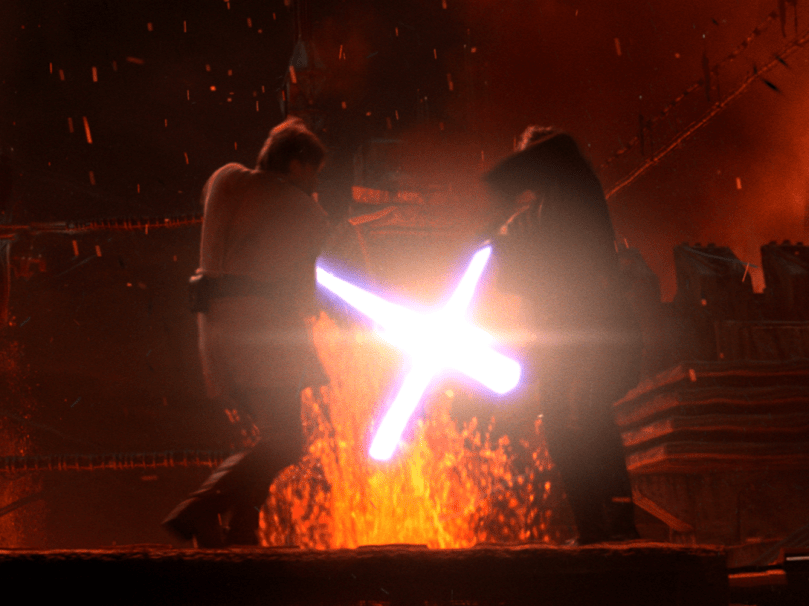
It culminates in the Battle of the Heroes where Anakin and Obi-Wan, equally matched in their skills and expert knowledge of one another, fight in a no-holds barred duel of Light and Dark.

Order 66 is the pivotal moment in this movie, and in the saga as a whole, that shows how far the Jedi have fallen and sets up the events of the original movies that are so beloved in pop culture.

Birth and Death

Vader birth

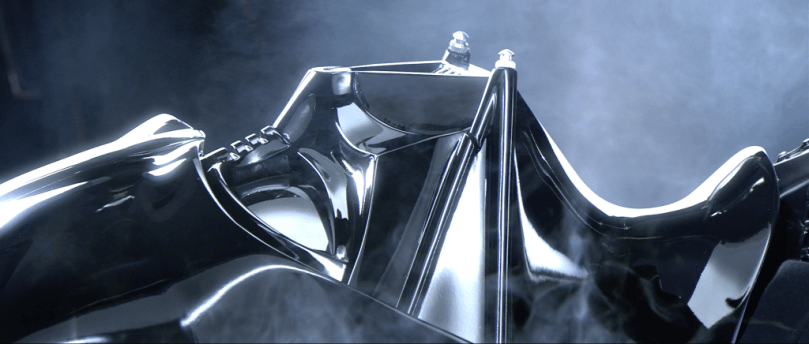
While the circumstances around Padmé’s death are somewhat problematic, the poetry between her end and Vader’s rebirth is elegant. While she is giving birth to Luke and Leia, the Emperor is enslaving the charred remains of Vader into his iconic armor. At the moment that Padmé dies, Vader rises. Her death signals his rebirth, but it also heralds the arrival of the new hope for the galaxy.

It also brings life to a fan theory that Sidious knew how to manipulate the knowledge of Darth Plagueis the Wise all along.

“A New Hope and End Credits”

Last but least is a bonus from the soundtrack. The movie’s end credits start and end with the Star Wars theme, which combines the “Rebel Fanfare” and “Luke’s Theme”. Between those bookends are “Princess Leia’s Theme” and “Battle of the Heroes”, which encapsulates the end state of the story in one of the strongest mediums of the franchise, the orchestral genius of John Williams.

The soundtrack version goes a little extra with an extended version of “The Throne Room” suite from A New Hope, which is basically the “Force Theme”. The extra music strikes me as the concert suite that never was for the Force, and reminds me that the mystical energy field exists outside of the battle between good and evil. It’s always there and always waiting for balance.

Tomorrow, I’ll continue walking back through time to 2002 and my favorite moments from Star Wars: Episode II – Attack of the Clones.

My Rating: 8.0/10
IMDb rating: 7.7/10
cc-break

For more creativity with a critical eye, visit Creative Criticality.

Seven Days of Star Wars: Day One – The Clone Wars


Star Wars: The Clone Wars
(PG, 98 minutes, 2008)

Today kicks off a series of looks at each of the wide-released theatrical Star Wars films leading up to the premiere of Star Wars: The Force Awakens. This includes each of the films that comprise the saga’s story after the 2012 purchase of Lucasfilm by the Walt Disney Company and the April 2014 canon reset.

For the first entry in the series, I’m looking back on the most recent theatrical release, Star Wars: The Clone Wars, which is set between Episodes II and III.

I caught this in theaters during first run, but not opening weekend, and I still regret selecting it above My Sister’s Keeper. The following television show was phenomenal, but the feature is something I’ve only seen twice. If you’re new to The Clone Wars, I recommend jumping into the series first. Come back to the movie after you have the first (and maybe second) season under your belt.

That’s not to say that the movie is terrible. On its own, Star Wars: The Clone Wars is a mediocre feature. The plot was fairly simple: The Republic and the Separatists are both vying for control over Hutt-controlled trade routes. In an attempt to gain an upper hand, Count Dooku kidnaps Jabba the Hutt’s son, which means that the Jedi are on the hook to recover the little Huttling.

The main problem with The Clone Wars feature presentation is that it wasn’t designed as a movie. The Rotta the Hutt story was originally three completed episodes (“Castle of Deception”, “Castle of Doom”, and “Castle of Salvation”), and the Battle of Christophsis story with the introduction of Ahsoka Tano was a completely separate episode. At a private screening, George Lucas suggested to director Dave Filoni (Avatar: The Last Airbender) that they should make them a feature. Sadly, it results in an uneven presentation with a lackluster story.

But, despite all of the negative points, there are some incredibly awesome things in Star Wars: The Clone Wars.

Ahsoka Tano

The Clone Wars was a dramatic shift for the saga which, to this point, had never discussed Anakin having an apprentice. While some segments of fandom rebelled – ironically, Ahsoka is well-received in fandom over seven years later – I enjoyed the reasoning within the story: After the events of Attack of the Clones, the Jedi Council wanted to help Anakin overcome his attachment issues as Tano became more independent, and that she would also teach him to espouse a greater sense of responsibility. Obi-Wan appeared to be instrumental in bringing this to the Council as well.

Rex_and_Ahsoka

This begins the development of one’s the Prequel Era’s most dynamic and interesting characters. While I still like the Prequel Era, many of the main characters are constrained by the original trilogy of films. From the Original Trilogy point of view, we know where Anakin, Obi-Wan, and Yoda end up, and we also know that the days of the Jedi are numbered. Ahsoka, on the other hand, was a wild card, and her character arc added greater interest to her comrades and a greater depth to the Prequel Trilogy overall.

Tom Kane’s Introductions

Thematically, The Clone Wars takes a page from newsreels of the World War II, Korean War, and Vietnam War eras. Similar to the short films that Disney and Pixar are running before their features today – the practice itself being a throwback to the golden age of cinema – features during those wars were preceded by news from the front headlined by a bombastic announcer.

The Clone Wars replaced the standard opening Star Wars crawl, which provided a slice of background for the adventure to come, with introductions by Tom Kane (also the voice of Yoda in the series) in a caricature of the newsreel announcer. I was in love with this idea from the first time I heard “A galaxy divided!

Kevin Kiner’s Score

Kevin Kiner did fantastic work with the score in both the movie and the follow-on series. He kept the music in the Star Wars flavor while also keeping it light (for a cartoon show) and unique. He also steered away from simply repeating the themes from the movies over and over again.

Going hand-in-hand with the introductions, he reworked the Star Wars main theme into a brass heavy patriotic march, which kept the feel of the newsreel style and provided the energy to launch into tales of Jedi at war.

Battle of Christophsis

Some of the greatest innovation in Star Wars comes from the battle sequences. Before August of 2008, I had never considered Walkers being able to scale a sheer cliff, but then the AT-TEs did it at Christophsis. My mind was blown at first, but then all I could say was, “Of course they can.”

ATTE_scale_cliff

Tomorrow, I’ll continue walking back through time to 2005 and my favorite moments from Star Wars: Episode III – Revenge of the Sith.

My Rating: 6.0/10
IMDb rating: 5.8/10
cc-break

For more creativity with a critical eye, visit Creative Criticality.

Timestamp #52: Doctor Who and the Silurians

Doctor Who and the Silurians
(7 episodes, s07e05-e011, 1970)

Timestamp 052 Doctor Who and the Silurians


Nothing good ever comes from spelunking in genre shows.

This serial focuses on a cyclotron proton accelerator being used to research atomic power for the country. It is having security, personnel, and scientific problems, and who else do you call in for such things than a paramilitary organization, a Ph.D., and a time traveling alien? The facility has been having major power drains, which have been covered up in an attempt to help a race known as the Silurians. These reptilians aren’t really aliens per se, since they were really the planet’s original inhabitants before the rise of humanity. People who have encountered the Silurians are either killed by fear or sent into a catatonic state. Additionally, their very presence seems to have affected the cyclotron’s staff, all of whom suffer from fear-based neuroses. The Silurians retreated into hibernation chambers when they saw a strange planet crashing toward the Earth – that “planet” turned out to be the Moon falling into its orbit – but couldn’t be revived again without a sufficient power source like the cyclotron.

The Doctor eventually encounters the leaders of Silurians and nearly brokers a peace that would allow them to be assimilated into the modern Earth population, but a younger impatient upstart kills the leader and unleashes a bacterial infection on the planet to kill humanity and leave the planet for the Silurians alone. They also plan on eliminating the Van Allen Belt and irradiating the planet. Go big or go home, eh?

The Doctor tricks the Silurians by overloading the reactor and threatening to irradiate the area for at least 25 years. He stops the overload after the Silurians leave, and the younger Silurian is killed in defending the Doctor. The rest are placed in hibernation, and the Doctor wants to study them and negotiate a peaceful resolution. The Brigadier instead destroys all of them, which (rightfully so) disgusts the Doctor.

This Doctor is much harder to judge emotionally based on his reactions. He seems shocked to see the Silurian, but instantly turns congenial. Is he good at playing shocked, or good at rapidly overcoming it? I also liked his new wheels: The canary yellow Edwardian roadster named Bessie, complete with registration of “WHO 1”. He also can’t find his sonic screwdriver, and I couldn’t quite figure out if he was using it to fix Bessie or if it was lost in the fallout from The War Games.

I wondered about the dinosaur that the Silurians kept in the cave network. Was it also kept in hibernation? I assume so, since it wouldn’t have survived so long without a food source, but then why did they pick that particular dinosaur? I’m imagining a family of Silurians running for the hibernation chambers, and one of the kids won’t leave without the family pet Dino.

The Doctor mentions that he’s “beginning to lose confidence for the first time in my life, and that covers several thousand years.” The Doctor’s age is a wildly contentious item in the mythology. Is that travel time given the other estimates of his biological age throughout the franchise, or is he calculating on a different solar period?

The Doctor developing the antidote really emphasizes his scientific knowledge, something lightly touched on in the first two iterations. He really has nothing else to do since he’s grounded and waiting for the plot to come to him.

In minor notes, the music is odd in this one. It’s too whimsical for the dramatic tale, and doesn’t seem to fit with the story at all. The Silurian makeup is pretty cool, but it’s also impressive how far they’ve come to Madame Vastra in the modern years. It’s also the first use of “neutron flow” catch phrase.

The ongoing question will be how the Doctor can trust the Brigadier from this point forward. The Brigadier committed genocide – admittedly, in defense of the planet – which obviously disgusted the Doctor. The Doctor is pretty much locked into indentured servitude until he can unlock the TARDIS, so he can’t not work with UNIT, but can he really trust UNIT and the Brigadier?


Rating: 4/5 – “Would you care for a jelly baby?”


UP NEXT – Doctor Who: The Ambassadors of Death


The Timestamps Project is an adventure through the televised universe of Doctor Who, story by story, from the beginning of the franchise. For more reviews like this one, please visit the project’s page at Creative Criticality.


Timestamp #51: Spearhead from Space

Doctor Who: Spearhead from Space
(4 episodes, s07e01-e04, 1970)

Timestamp 051 Spearhead from Space


It’s Doctor Who, now in color!

There’s a nice new opening to take advantage of that fact, although the projector sheet is pretty obvious. They also spoil the surprise of the Doctor’s new face in the opening credits, which is odd because they tease it for a good portion of the first episode. The budget has also obviously skyrocketed and the pace is a whole lot faster for what is looking more and more like a soft reboot of the series.

It’s really nice to see the Brigadier and UNIT again. He reminds the audience that we’ve met him twice before, and this is obviously his playground. He’s also dismayed because he doesn’t recognize the Doctor’s new face. We also get a new companion with Doctor Elizabeth Shaw. She’s really gruff with everyone except the Doctor, with whom she seems quite enamored. She’s quite an empowered woman, and certainly less of a damsel in distress than previous companions. She also demands respect by not putting up with the Doctor’s subterfuge when the Time Lord tricks her into retrieving the TARDIS key. Of course, he subsequently pulls a Millennium Falcon with the blue box. (No, it wouldn’t help if Liz got out and pushed.)

This story also cleanly brings Doctor Who into the era of the 1970s, which was the modern era for the production. You have civilians like the porter and the poacher acting exactly as they would in the time, which makes the show a fun little time capsule.

This Doctor kicks things off with a lot of heart – two, actually, as we establish that part of the mythos – and comedy. He acts crazy about his shoes as a ruse to get the TARDIS key he secreted away, and then he escapes in a wheelchair after almost being kidnapped, makes a break for the TARDIS, and gets shot. He should be more careful with this new body. I also laughed a lot about the clever sight gag with the doctor’s locker room sign (“Doctors Only”) and his escape from the hospital, during which he steals a rich doctor’s clothes and figures out how to steal a car. He really is a doctor of “pretty much everything.”

The plot isn’t half bad either. Meteorites crash to Earth, but they’re made of blinking and ringing plastic and draw Autons like ants. They’re impervious to gunfire (but the UNIT soldiers just keep slinging lead because that’s what they’re scripted to do) and are replacing key members of local leadership to (what else?) take over the world.

Channing, a character played to apathetic creepy perfection by Hugh Burden, is the avatar of the Nestene Consciousness, a force that has colonized planets like a virus across the universe and has now focused on Earth. The Doctor and crew stop them with a jury-rigged device, and after a brief technical difficulty and a battle with tentacles, the Doctor fries the Consciousness. Anyone for calamari?

The Doctor agrees to stay on with UNIT in exchange for facilities, technology to repair the TARDIS, Liz’s help with all of it, and a car. He also starts going by the pseudonym John Smith.

This serial hit the ground running, introduced a new Doctor, and made me like him right away. According to the rules of the Timestamps Project, regeneration episodes get an automatic +1 handicap, but this story certainly doesn’t need it.


Rating: 5/5 – “Fantastic!”


UP NEXT – Doctor Who and the Silurians


The Timestamps Project is an adventure through the televised universe of Doctor Who, story by story, from the beginning of the franchise. For more reviews like this one, please visit the project’s page at Creative Criticality.


Timestamp: Sixth Series and Second Doctor Summary

Doctor Who: Sixth Series and Second Doctor Summary

Timestamp Logo Second


This was a rough collection of serials. It stopped the rise of the Second Doctor over the fourth and fifth seasons, and took the lowest series average of the Second Doctor’s run. The episodes overall were mostly average with a couple of standouts on both sides of the spectrum.

It was a series that truly brought UNIT to the front of the stage and re-introduced Brigadier Lethbridge-Stewart, both of which will be big pieces of the show’s ensemble as it rolls on. It also brought some light to the background of the Doctor himself, including what species he is and why he’s out in the universe. It was also a series that brought an era of the franchise to a close as it showcased the last black and white episodes and the last reconstructed episodes, the latter of which makes me very happy after struggling with so many lost stories.


The Dominators – 3
The Mind Robber  – 3
The Invasion – 5
The Krotons – 2
The Seeds of Death – 4
The Space Pirates – 1
 The War Games – 5

Series Six Average Rating: 3.3/5


This serial also brings the end of the main run for Patrick Troughton as the Second Doctor. He was a Doctor of many faces, and he was far more comical than the First Doctor. He was also more devious, as his humor was often used as a means to disarm his opponents and make him look less threatening. I can see now where a lot of the influences for the Tenth, Eleventh, and Twelfth Doctors comes from.

I really fell in love with this Doctor, and that’s not to say that I didn’t like the First because that’s not true. Like I mentioned in the Fifth Series Summary, the Doctor’s incarnations seem to be developed around what the show needs to survive. Hartnell was a strong force even in the face of some mediocre stories, and that provided an anchor for an audience to rely on. In the Troughton years, the whimsical innocence masking a strong devious nature made the lead more relatable with the team, especially with Zoe and Jamie. Troughton made his fellow travelers into companions on the journey instead of wards that needed protection, and that pushed characters like Zoe and Jamie into stronger roles. That carried the Hartnell-era theme relating the viewers to the companions and transformed it into relating to the team overall.

That’s part of the reason that The War Games feels like a cheat in the end. It tore the team apart and erased years of development from the companions (only one for Zoe, but almost three for Jamie), in essence signaling the end of the show as it stood for the last six years. Maybe that was the point. What follows from this point is effectively a soft reboot of the show: It transitions from monochrome to color, starts airing shorter seasons, and even appears to increase production values and budgets.

What’s amazing is that it hurts so much over forty-six years later.


Series 4 – 3.6
Series 5 – 4.1
Series 6 – 3.3

Second Doctor’s Weighted Average Rating: 3.67


Ranking
1 – Second (3.67)
2 – First (3.41)


UP NEXT – Doctor Who: Spearhead from Space


The Timestamps Project is an adventure through the televised universe of Doctor Who, story by story, from the beginning of the franchise. For more reviews like this one, please visit the project’s page at Creative Criticality.

Culture on My Mind – Review: Star Wars Smuggler’s Bounty Premiere Box

Culture on My Mind

Culture on My Mind
Review: Star Wars Smuggler’s Bounty Premiere Box
November 22, 2015

Smugglers Box Nov 15 1

The subscription toy box by mail model is nothing new, but it is certainly an expanding one. Popularized by Loot Crate over the last few years, the concept is simple: In exchange for a periodic fee, a box will arrive filled with collectibles focused on a theme. What started as a monthly box of collectibles for geeks has expanded into regular boxes of toys for pets, health food aficionados, doomsday preppers, and even more kinky pleasures. Whatever you want, there’s probably a subscription box for it.

Now there is one for Star Wars fans.

Powered by Funko, the same company behind the adorable cartoonish vinyl bobble-head dolls with oversized noggins, Star Wars: Smuggler’s Bounty promises to deliver completely exclusive items, valued at double the subscription price of $25, with a guarantee of no filler. One of the things that prevented me from investing in Loot Crate or similar boxes were reviews from friends who were disappointed; the boxes tended to have one or two big ticket items like t-shirts or action figures surrounded by the detritus or miniature five-page comics, stickers, and generic paper bookmarks or postcards. Funko’s promise that the entire box would effectively be a big ticket purchase sold me on trying the first installment.

The premiere box, focused on the villainous First Order of The Force Awakens, was shipped via UPS and was transferred to the USPS for delivery, and it made no bones about what it was. It boldly stated on the outside that this was a box full of goods from a galaxy far, far away – or at least as far as the CollectorCorps.com headquarters in Dallas, Texas. The box was very durable and was sealed with a strip of packing tape.

Smugglers Box Nov 15 2

The front flap of the box pulled out and opened the top like a treasure chest, revealing two items attached to an intermediate platform. The first was an embroidered patch showcasing a TIE pilot from the new movie. The second was a collectible Kylo Ren trading pin. Both of these items looked like something of the same quality that is found at the Disney Parks.

Smugglers Box Nov 15 3

The platform folded up to reveal the depths of the bounty, including a simple badge lanyard and a navy blue Funko t-shirt with the First Order stormtrooper, along with two Funko Pop figures. A friend of mine who also signed up for the box received a Kylo Ren shirt instead, so they appear to be randomized around the First Order theme.

Smugglers Box Nov 15 4

I received the chrome-plated Captain Phasma and a pure black TIE pilot, and after looking at the back of the boxes, there is another TIE pilot with red stripes in the series. I wonder if it was randomly packed or if it will be an hard-to-find exclusive available later on.

After it was revealed to be in the box a month ago, the Captain Phasma figure was one of items I was anticipating most. The figures on store shelves are painted a metallic gray, which isn’t quite the same chrome effect we’ve seen on the character in the trailers. The chrome Phasma adds an extra (forgive me) pop to the figure.

The Star Wars Funko figures have all been on attached to a logo-branded pedestal, which is fairly unique in the brand. Other figures I’ve purchased stand alone, and the TIE pilot I received in this box is removable from its pedestal. I don’t know if this is a unique feature, or if it didn’t get a couple of dabs of glue before leaving the assembly line.

Smugglers Box Nov 15 5

By my estimation, Funko delivered on their promises of value and content. The figures go for around $10 in stores, and the t-shirt is of the same quality you’d find at sites like TeeFury for $10-15. Hot Topic sells the Funko Pop shirts for $20-25. The pin, patch, and lanyard all go for about $5 at Disney Parks, and while they are the low end items of the box, they certainly beat the socks off mini-comics and postcards.

In addition to the $25 every other month plan, Smuggler’s Bounty also offers a yearly plan for $150 (payable all at once) with an exclusive gift on the anniversary of subscription. The January box has already been announced with a Force Awakens Resistance theme and a focus on the spherical droid BB-8.

The Force is strong with this box, and I’m definitely willing to take home my share of the bounty once more.

cc-break

Culture on My Mind is inspired by the weekly Can’t Let It Go segment on the NPR Politics Podcast where each host brings one thing to the table that they just can’t stop thinking about.

For more creativity with a critical eye, visit Creative Criticality.

Timestamp #50: The War Games

Doctor Who: The War Games
(10 episodes, s06e35-e44, 1969)

Timestamp 050 The War Games


We’re back to a regeneration episode and we have nowhere to go but up after The Space Pirates.

The TARDIS arrives in a war zone with a really nice shot of the materialization reflected in a puddle. The war is similar to World War I in 1917, and the travelers find themselves in an artillery barrage, discovered by Lady Jennifer Buckingham, taken prisoner by Germans, and finally liberated by British and Lieutenant Jeremy Carstairs. Strangely, both Buckingham and Carstairs have gaps in their memories.

General Smythe, the area commander with mind control glasses, has a transmitter that may be alien in nature. He asks an unknown entity for more specimens and disappears from his office. When he gets back, he holds a kangaroo court-martial for the travelers, finds them all guilty, and sends the Doctor to be executed. At the firing squad, a surprise sniper saves the Doctor, and both he and Zoe escape.

Speaking of surprises, General Smythe has what appears to be a TARDIS. Wait… what?

Jamie, assumed to be a deserter from the Highlanders, gets placed under guard with a Redcoat prisoner who thinks it is 1745 instead of 1917. Though it’s not explicitly stated, this Redcoat was apparently abducted from the same foggy battle where Jamie originally left with the Doctor.

After some shenanigans, the traveling trio escape with Buckingham and Carstairs, travel through the mists, and encounter a phalanx of Roman soldiers. After coming to the conclusion that this strange world is a combination of zones segregated by crucial wars in Earth history, they escape back to the 1917 zone and try to get a map. With the map (and an amusing sequence at the Chateau) they head toward the blank triangle zone in the center of the matrix and get captured by the Germans, commanded by another officer (von Weich) with a mind-controlling eyepiece.

They escape from that predicament and roll on to the American Civil War zone, but get besieged by a Confederate soldier and have to take refuge in a barn. A TARDIS arrives, disgorges fresh Confederate troops, and then dematerializes with a curious Doctor and Zoe inside, leaving Jamie with Lady Buckingham to be ping-ponged between Union and Confederate troops, the latter of which are commanded by von Weich. That dude gets around.

It turns out that Smythe and von Weich are engaged in a tactical competition, supervised by someone known as the War Chief. The War Chief and his peers (Chief Scientist and Security Chief) are under the command of the War Lord, who is attempting to distill a superior warrior class by pitting humanity’s soldiers against each other which he can use to spread an era of peace by might throughout the universe. May the odds be ever in their favor. In a twist, the War Chief is neither human nor whatever species the other chiefs and War Lord belong to (which the wiki refers to as the War Lords), but is instead a Time Lord.

A Time Lord: The same species as the Monk, Susan, and the Doctor. Oh, boy.

It also turns out that the TARDISes being used by the War Lords aren’t actual TARDISes, but rather are SIDRATs. They have very limited lifespans, can be manipulated from the outside, and follow the ’60s sci-fi conceit of being almost like the hero vehicle but spelled backwards. The War Chief wants the Doctor to join his cause because he really needs a better vessel to complete the War Lord experiment, and the Doctor has just the thing, which we found out that the Doctor stole from his home planet because he was bored.

Meanwhile, the companions discover that there is a resistance force among the humans. These rebels cannot be reprogrammed by the War Lords, and in his passion to track them all down, the Security Chief flashes all of the known agents across Zoe’s pretty much eidetic memory. After she escapes from the War Lords, she and Jamie spearhead a campaign to assemble the resistance forces and assault the Central Command.

The separate story lines finally collide when everyone converges on Central Command and dismantles the whole shebang. In the process, the War Chief kills the Security Chief, and the War Lord kills the War Chief. I seriously expected the War Chief to regenerate, and since he disappeared from view so quickly, I’m almost expecting that thread to come back at some point.

So, in the end, the Doctor is left with a world full of humans stranded out of time and no remaining SIDRATs to take them all home. After a lot of hand-wringing, the Doctor decides to call upon his people for help… and then runs like hell. He’s been violating Time Lord law by interfering in time since he stole the TARDIS, and his reckoning has finally come. The Time Lords return all of the humans to their homes, take the War Lord into custody to stand trial for his crimes, and drag the Doctor kicking and screaming to their door.

The War Lord’s trial ends with an attempted escape and hostage situation, but the Doctor outwits the War Lord. The Time Lords find the War Lord and his posse guilty, and the punishment is complete removal from time as if they never existed. The Time Lords then try the Doctor for his crimes. Rightfully so, the Doctor is proud of his interferences and justifies his fight against evil.

As they decide his fate, the Time Lords allow the Doctor to say goodbye to his companions before they send them home. Zoe and Jamie are allowed to remember only the first time they met the Doctor, but nothing more. They accept that the Doctor will continue to fight against evil, but he cannot be allowed to travel any longer, so he is exiled to Earth without the ability to dematerialize the TARDIS. They will also force him to regenerate.

On the plus sides, Jamie and Zoe show fantastic character in driving the resistance solution. It was also really nice to see both John Smith and the sonic screwdriver make their returns. There was also a quote in there somewhere about the Time Lords being curators over their museum of time, which seems really interesting in light of certain events in The Day of the Doctor.

On the down side, the Mexican resistance leader, Arturo Villar, was a caricature in racism. The sexism makes sense with the era, but the actor is obviously a white dude with a Speedy Gonzales accent. It made my skin crawl.

Considering the goodbyes and the regeneration, I feel so incomplete. Zoe and Jamie, two of the most likeable companions in the series so far, had all of their development erased in single moment. Only the Doctor remembers how their travels influenced their lives, but the influence and resulting changes are gone forever. The lack of proper goodbye also extends to the Doctor, where the last we see of him is a swirl into darkness. The character of the Doctor continues on, but the Second Doctor just ends.

Remember when I said that regeneration episodes were tough? This one was especially so. By the Timestamps rules, regeneration stories get an automatic +1 on the rating to compensate, but this story didn’t need it.

I still feel cheated out of a proper goodbye.


Rating: 5/5 – “Fantastic!”


UP NEXT – Sixth Series and Second Doctor Summary


The Timestamps Project is an adventure through the televised universe of Doctor Who, story by story, from the beginning of the franchise. For more reviews like this one, please visit the project’s page at Creative Criticality.


Timestamp #49: The Space Pirates

Doctor Who: The Space Pirates
(6 episodes, s06e29-e34, 1969)

Timestamp 049 The Space Pirates


It’s the last reconstruction (yay!), but it’s a colossal let down (boo!).

Six torturous episodes short: Pirates are destroying Earth beacon stations for their argonite. Obviously, the Earth Space Corps wants to stop them, but can’t reason their way out of a paper bag. After a mess of a story that can’t decide if it’s a murder mystery, a heist thriller, or a western parody – and completely fails at reaching any of them – the good guys win and the bad guys lose.

Really, the western motif did not work for me at all, and I like westerns. Milo Clancey and the Old West-style accent were annoying, and that would be fine if it was the only acting problem in this one, but General Hermack’s character (portrayed by Jack May) makes the Shatner trope look Emmy-worthy.

The Earth Space Corps uniforms are absolutely ridiculous, as is their attitude on what makes a leader: “All this for an old man. You’re not taking any chances, are you?” gets a reply of “That is why I’m a general.” The Earth Space Corps isn’t worth a whole lot, is it?

At least the spacewalk scenes were convincing enough. They look like they were filmed with the actors suspended from wires in the studio’s ceiling with a rotated camera.

Final note: Recently, it seems that Jamie has been treating these adventures like some kind of pleasure cruise. If a place looks even vaguely inhospitable, he recommends immediately running away and going somewhere else. In his defense though, they would have been much safer during the station explosion had they hidden in the TARDIS instead of running through the station.

This was a badly executed parody of the western genre rather than a tip o’ the ten gallon toward it. I’m not keen to revisit it again.


Rating: 1/5 – “EXTERMINATE!”


UP NEXT – Doctor Who: The War Games


The Timestamps Project is an adventure through the televised universe of Doctor Who, story by story, from the beginning of the franchise. For more reviews like this one, please visit the project’s page at Creative Criticality.



Timestamp #48: The Seeds of Death

Doctor Who: The Seeds of Death
(6 episodes, s06e23-e28, 1969)

Timestamp 048 The Seeds of Death


In the near future, the TravelMat (T-Mat) has become the system to move things around in the future. Humans, supplies, evil alien fungal spores…

That last one is a major problem since the Moonbase, which operates as the hub for the planet’s T-Mat system, has been seized by the Ice Warriors. I’ll admit that this serial nearly lost my attention as soon as it unveiled the “base under siege” trope because over how overused it was in the last season. Luckily, this one works differently.

The TARDIS arrives in a space museum on Earth, the travelers get a convenient info dump in the T-Mat presentation, and then get confronted by Professor Eldred. He is upset that the travelers are trespassing, and is (conveniently) the only one who can pilot the rocket to the Moon after the T-Mat is cut off. His bitterness toward the T-Mat program, despite having an entire presentation dedicated to it in his museum, is based on how it ended space travel after planetary travel was made too convenient.

Commander Radnor and Miss Kelly, the upper leaders of the T-Mat program, come to solicit the professor’s help, but Eldred can’t make the flight due to his age. In his place, the Doctor, Zoe, and Jamie pilot the rocket.

Meanwhile, the Ice Warriors have the repaired the emergency cublicles on the Moonbase and trick Earth into sending repair crews to fix the entire system. Once it’s back up, they send the evil alien fungal spores to consume all of the oxygen, destroy the climate, and kill all the humans. The “base under siege” trope is broken by having the Doctor and crew moving back and forth between Earth and the moon to stop the threat. Thank the Maker!

After defeating the spores with a torrential rain storm (that’s a lot of soap bubbles and one clean countryside), the Doctor solves the problem by spoofing the Ice Warrior homing signal and sending the entire fleet into the sun. A bit extreme, but in this case it was probably the only solution.

The comical theme for this Doctor continues with a chase through the Moonbase that includes a passageway constructed of fun house mirrors. I get what they were trying for there, but the effect tore me away from the narrative and the drama. On the other hand, Zoe and Jamie get a chance to really shine when the Doctor is injured and the companions have to fight the invasion on their own.

Watching Patrick Troughton act like he was dying in all those bubbles was kind of humorous. I was still in the story at that point, but when I realized that he was essentially a kid at bath time at that point, I giggled.

When the Doctor is revived, he calls out for Victoria: Does he regret something about how her story played, or does he miss her? In my opinion, Zoe’s a much better companion.

Finally, on an engineering note, the T-Mat cubicle doors would be much more effective if they opened outward vice inward. Even better would be for them to slide open so they can be locked but not stand in the way of arrivals or loading.


Rating: 4/5 – “Would you care for a jelly baby?”


UP NEXT – Doctor Who: The Space Pirates


The Timestamps Project is an adventure through the televised universe of Doctor Who, story by story, from the beginning of the franchise. For more reviews like this one, please visit the project’s page at Creative Criticality.