
The Thing About Today – April 17

April 17, 2020
Day 108 of 366


April 17th is the 108th day of the year. It is World Hemophilia Day, commemorated in the quest to bring awareness to genetic bleeding disorders and raise funds for research.

In the United States, today is “celebrated” as National Crawfish Day, International Bat Appreciation Day, National Cheeseball Day, National Ellis Island Family History Day, National Haiku Poetry Day, and National Clean Out Your Medicine Cabinet Day. That last one is typically observed on the third Friday in April.

I appreciate bats. I also appreciate how they can eat up to 1,000 mosquitoes an hour.


Historical items of note:

  • In 1521, the trial of Martin Luther and his teachings began during the assembly of the Diet of Worms. He initially felt intimidated, so he asked for time to reflect and was granted one day.
  • In 1820, firefighter and inventor of the game of baseball Alexander Cartwright was born.
  • In 1907, the Ellis Island immigration center processed 11,747 people, a single-day record for them.
  • In 1942, David Bradley was born. He portrayed Walder Frey in Game of Thrones, Argus Filch in the Harry Potter films, and the First Doctor on Doctor Who.
  • In 1948, composer and producer Jan Hammer was born.
  • In 1949, twenty-six Irish counties officially left the British Commonwealth at midnight. A 21-gun salute on O’Connell Bridge in Dublin ushered in the Republic of Ireland.
  • In 1951, the Peak District became the United Kingdom’s first National Park.
  • In 1954, professional wrestler and actor Roddy Piper was born.
  • In 1959, actor Sean Bean was born. He dies a lot in cinema.
  • In 1961, a group of Cuban exiles financed and trained by the Central Intelligence Agency landed at the Bay of Pigs in Cuba with the aim of ousting Fidel Castro. Called the Bay of Pigs Invasion, it ultimately failed in its goal.
  • In 1967, actor Henry Ian Cusick was born.
  • In 1970, the ill-fated Apollo 13 spacecraft safely returned to Earth.
  • In 1972, actress Jennifer Garner was born.
  • In 1985, actress Rooney Mara was born.
  • In 2011, Marvel’s Thor premiered in Sydney, Australia.
  • In 2014, NASA’s Kepler space telescope confirmed the discovery of the first Earth-size planet in the habitable zone of another star.


In 2014, NASA’s Kepler space telescope confirmed the discovery of the first Earth-size planet in the habitable zone of another star.

Designated as Kepler-186f, the exoplanet orbits the red dwarf star Kepler-186, about 582 light-years from Earth. The Kepler space telescope detected it along with four additional planets orbiting much closer to the star.

Kepler-186f is about 11 percent larger in radius than Earth. Since atmospheric composition is unknown, conclusions cannot be made about its habitability, though studies have concluded that it may have seasons and a climate similar to our own planet.


The Thing About Today is an effort to look at each day of 2020 with respect to its historical context.

For more creativity with a critical eye, visit Creative Criticality.


Culture on My Mind – New Voyagers

Culture on My Mind
New Voyagers

January 24, 2020

This week, the thing that I can’t let go of are NASA’s latest astronaut graduates. On January 10, 2020, NASA held a ceremony for thirteen graduates, including six women and seven men chosen from 18,000 applicants. Two of the graduates are from the Canadian Space Agency.

Image credit: NASA

The new graduates may potentially be assigned on missions to the International Space Station, the Moon as part of the Artemis program, and eventually Mars in the mid-2030s. Including this class, NASA has 48 astronauts in their corps.

I have a soft spot for astronauts because of my love of science fiction and STEAM disciplines. As a kid, much like many from my generation, I wanted to be an astronaut. I have a lot of respect for anyone who makes it through and serves with honor.

The NASA press release listed the graduates and links to their official biographies. From that press release:

  • Kayla Barron, a U.S. Navy lieutenant, originally is from Richland, Washington. She graduated from the U.S. Naval Academy with a bachelor’s degree in systems engineering. A Gates Cambridge Scholar, Barron earned a master’s degree in nuclear engineering from the University of Cambridge in the United Kingdom. As a submarine warfare officer, Barron served aboard the USS Maine (SSBN 741), completing three strategic deterrent patrols. She came to NASA from the U.S. Naval Academy, where she was serving as the flag aide to the superintendent.
  • Zena Cardman calls Williamsburg, Virginia, home. She completed a bachelor’s degree in biology and a master’s degree in marine sciences at The University of North Carolina, Chapel Hill. Cardman was a National Science Foundation Graduate Research Fellow, working at The Pennsylvania State University. Her research focused on microorganisms in subsurface environments, ranging from caves to deep sea sediments. Her field experience includes multiple Antarctic expeditions, work aboard research vessels as both a scientist and crew member, and NASA analog missions in British Columbia, Idaho and Hawaii.
  • Raja Chari, a U.S. Air Force colonel, hails from Cedar Falls, Iowa. He graduated from the U.S. Air Force Academy with bachelor’s degrees in astronautical engineering and engineering science. He continued on to earn a master’s degree in aeronautics and astronautics from Massachusetts Institute of Technology (MIT) and graduated from the U.S. Naval Test Pilot School in Patuxent River, Maryland. Chari served as the commander of the 461st Flight Test Squadron and the director of the F-35 Integrated Test Force at Edwards Air Force Base (AFB) in California.
  • Matthew Dominick, a U.S. Navy lieutenant commander, was born and grew up in Wheat Ridge, Colorado. He earned a bachelor’s degree in electrical engineering from the University of San Diego and a master’s degree in systems engineering from the Naval Postgraduate School in Monterey, California. He also graduated from the U.S. Naval Test Pilot School. Dominick served on the USS Ronald Reagan as department head for Strike Fighter Squadron 115.
  • Bob Hines, a U.S. Air Force lieutenant colonel, attended high school in Mountaintop, Pennsylvania, but considers Harrisburg, Pennsylvania, his hometown. He has a bachelor’s degree in aerospace engineering from Boston University and a master’s degree in flight test engineering from the U.S. Air Force Test Pilot School at Edwards AFB. Hines served as a developmental test pilot on all models of the F-15 while earning a master’s in aerospace engineering from the University of Alabama. He has deployed in support of Operations Enduring Freedom and Iraqi Freedom. Prior to being selected as an astronaut, he was a Federal Aviation Administration flight test pilot and a NASA research pilot at Johnson.
  • Warren Hoburg originally is from Pittsburgh. He earned a bachelor’s degree in aeronautics and astronautics from MIT, and a doctorate in electrical engineering and computer science from the University of California, Berkeley. He is a commercial pilot, and spent several seasons serving on the Bay Area Mountain Rescue Unit and Yosemite Search and Rescue. Hoburg came to NASA from MIT, where he led a research group as an assistant professor of aeronautics and astronautics.
  • Dr. Jonny Kim, a U.S. Navy lieutenant, was born and grew up in Los Angeles. He enlisted in the U.S. Navy, then trained and operated as a Navy SEAL, completing more than 100 combat operations and earning a Silver Star and Bronze Star with Combat V. Afterward, he went on to complete a degree in mathematics at the University of San Diego and a doctorate of medicine at Harvard Medical School. Kim was a resident physician in emergency medicine at Massachusetts General Hospital in Boston.
  • Jasmin Moghbeli, a U.S. Marine Corps major, considers Baldwin, New York, her hometown. She earned a bachelor’s degree in aerospace engineering with information technology at MIT and a master’s degree in aerospace engineering from the Naval Postgraduate School. She also is a distinguished graduate of the U.S. Naval Test Pilot School. Moghbeli came to NASA from Yuma, Arizona, where she tested H-1 helicopters and served as the quality assurance and avionics officer for Marine Operational Test and Evaluation Squadron 1.
  • Loral O’Hara was born in Houston. She earned a bachelor’s degree in Aerospace Engineering at the University of Kansas and a master’s degree in Aeronautics and Astronautics from Purdue University. Prior to joining NASA, O’Hara was a Research Engineer at Woods Hole Oceanographic Institution in Woods Hole, Massachusetts, where she worked on the engineering, test, and operations of deep-ocean research submersibles and robots.
  • Dr. Francisco “Frank” Rubio, a U.S. Army lieutenant colonel, originally is from Miami. He earned a bachelor’s degree in international relations at the U.S. Military Academy at West Point, New York, and a doctorate of medicine from the Uniformed Services University of the Health Sciences in Bethesda, Maryland. Rubio has accumulated more than 1,100 hours as a Blackhawk helicopter pilot, including 600 hours of combat and imminent danger time. He was serving as a surgeon for the 3rd Battalion of the Army’s 10th Special Forces Group at Fort Carson, Colorado, before coming to NASA.
  • Jessica Watkins hails from Lafayette, Colorado. She graduated from Stanford University in Palo Alto, California, with a bachelor’s degree in geological and environmental sciences, then went on to earn a doctorate in geology from the University of California, Los Angeles. Watkins has worked at NASA’s Ames Research Center in Silicon Valley, California, and Jet Propulsion Laboratory in Pasadena, California, and was a postdoctoral fellow at the California Institute of Technology, where she collaborated on NASA’s Mars Science Laboratory rover, Curiosity.
  • Joshua Kutryka Royal Canadian Air Force lieutenant colonel, is from Beauvallon, Alberta. He has a bachelor’s degree in mechanical engineering, as well as master’s degrees in space studies, flight test engineering, and defense studies. Prior to joining CSA, Kutryk worked as an experimental test pilot and a fighter pilot in Cold Lake, Alberta, where he led the unit responsible for the operational flight-testing of fighter aircraft in Canada.
  • Jennifer Sidey-Gibbons hails from Calgary, Alberta. She holds an honors bachelor’s degree in mechanical engineering from McGill University in Montreal and a doctorate in engineering from the University of Cambridge. While at McGill, she conducted research on flame propagation in microgravity, in collaboration with CSA and the National Research Council Flight Research Laboratory. Prior to joining CSA, Sidey-Gibbons worked as an assistant professor in combustion in the Department of Engineering at Cambridge.

Bravo Zulu, astronauts.

cc-break

Culture on My Mind is inspired by the weekly Can’t Let It Go segment on the NPR Politics Podcast where each host brings one thing to the table that they just can’t stop thinking about.

For more creativity with a critical eye, visit Creative Criticality.

Culture on My Mind – We Came in Peace For All Mankind: Apollo 11 at Fifty


Culture on My Mind

Culture on My Mind
We Came in Peace For All Mankind: Apollo 11 at Fifty
July 20, 2019

caption
The crew of Apollo 11: Neil Armstrong, Michael Collins (Maj Gen, USAF), and Edwin Eugene “Buzz” Aldrin Jr. (Col, USAF)


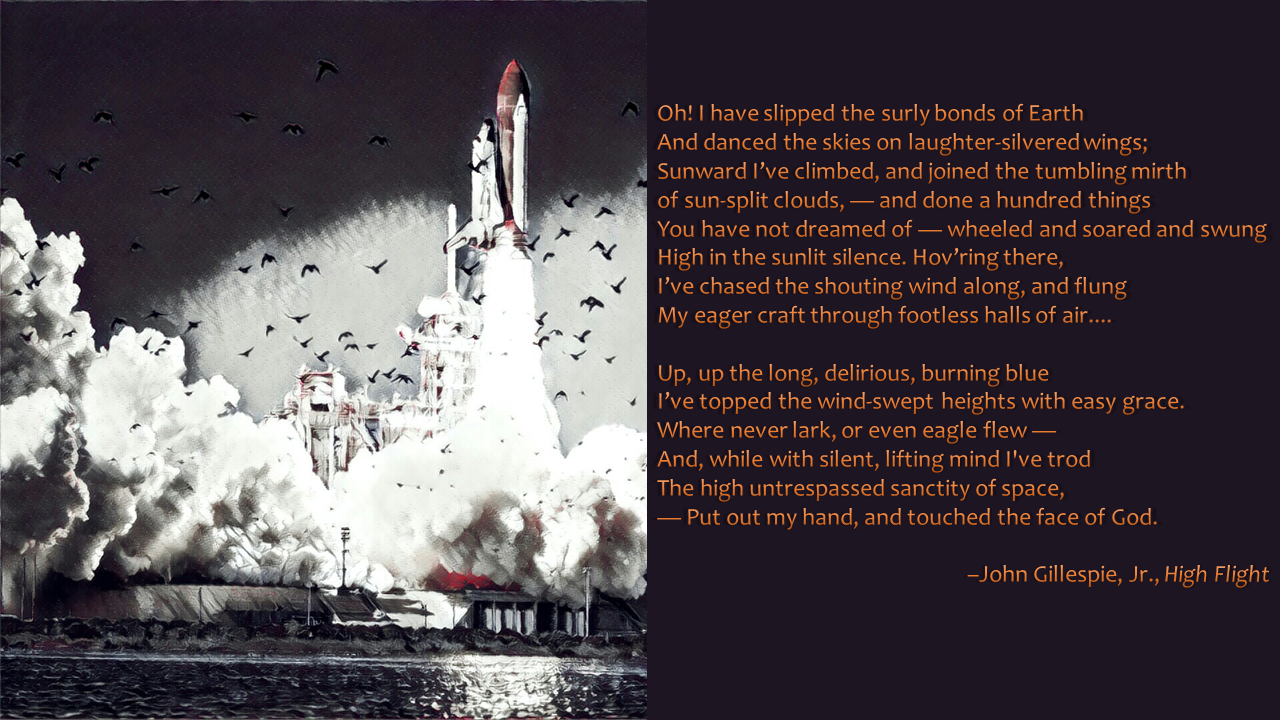
I grew up in the shuttle generation. I watched with innocent eyes and felt part of my childlike innocence dissolve when the Challenger accident occurred. Undaunted, I wanted to go up there, slip the surly bonds of Earth, and chase the shouting wind into the sunlit silence.

Part of chasing that dream was reading about the history of spaceflight, especially the Apollo missions. I was amazed by how, after years of research and experimentation, we could sling three men to the moon and back in just over a week. One week elbow to elbow going there and coming back, but ultimately limitless when on the lunar surface.

Fifty years ago today, three American astronauts reached the moon. Two of them became the first humans ever to explore its surface. Five more crews followed them, and their inspiration lives on even today, forty-seven years after Apollo 17 landed in Taurus-Littrow.

Everyone involved in the history of manned spaceflight is a hero to me, but Armstrong, Aldrin, and Collins stand out because of the milestone they reached and the impact they made.

Thank you, gentlemen. I hope we can continue to do your legacy proud in the future.


Apollo_1_patch

 
cc-break

Culture on My Mind is inspired by the weekly Can’t Let It Go segment on the NPR Politics Podcast where each host brings one thing to the table that they just can’t stop thinking about.

For more creativity with a critical eye, visit Creative Criticality.

Culture on My Mind – Fortnight Philosophy: January 30, 2017

Culture on My Mind

Culture on My Mind
Fortnight Philosophy
January 30, 2017

fortnight-01-30-2017

cc-break

Culture on My Mind is inspired by the weekly Can’t Let It Go segment on the NPR Politics Podcast where each host brings one thing to the table that they just can’t stop thinking about.

For more creativity with a critical eye, visit Creative Criticality.

Culture on My Mind – Ad Astra Per Aspera: Fifty Years

Culture on My Mind

Culture on My Mind
Ad Astra Per Aspera: Fifty Years
January 27, 2017

caption
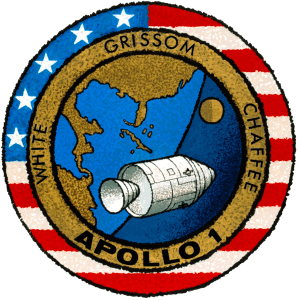
The crew of Apollo 1: Virgil “Gus” Grissom (Lt Col, USAF), Edward White II (Lt Col, USAF), and Roger B. Chaffee (LCDR, USN)

Fifty years ago today, tragedy struck the Apollo manned lunar landing program and claimed the lives of three brave explorers. Their memory lives on, but their spirit carries us higher.

Rest in peace, gentlemen.

Apollo_1_patch

cc-break

Culture on My Mind is inspired by the weekly Can’t Let It Go segment on the NPR Politics Podcast where each host brings one thing to the table that they just can’t stop thinking about.

For more creativity with a critical eye, visit Creative Criticality.
Culture on My Mind – Go at Throttle Up: Thirty Years

Culture on My Mind

Culture on My Mind
Go at Throttle Up: Thirty Years
January 28, 2016

Challenger_flight_51-l_crew

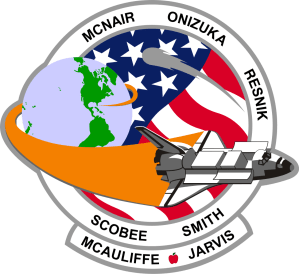
It’s been thirty years.

On January 28, 1986, I was a happy little five-year old watching the Space Shuttle Challenger launch into orbit. It was a special occasion because the first teacher was going into space, and it was inspiring. I don’t remember a whole lot from that day except cheering when the shuttle launched, being shocked when it disintegrated, and seeing my mother cry. That in itself was heartbreaking.

It was a confusing day, but it was that confusion that sparked my desire to study science because I wanted answers. That quest introduced me to Richard Feynman and made me realize that Morton-Thiokol and their rumbling rocket motor tests were essentially in my backyard.

That day also gave me dreams of being an astronaut. I never made it anywhere near being an astronaut, but I did get that physics degree.

Revisiting that day still hurts. To this day, I cannot hear the words “go at throttle up” without getting a lump in my throat.

Footage of the incident from CNN:

President Reagan’s address to the nation:

Godspeed, heroes of the Challenger. You’re still deeply missed.

STS-51-L

cc-break

Culture on My Mind is inspired by the weekly Can’t Let It Go segment on the NPR Politics Podcast where each host brings one thing to the table that they just can’t stop thinking about.

For more creativity with a critical eye, visit Creative Criticality.

Culture on My Mind – The Glory of Being a Nerd

Culture on My Mind

Culture on My Mind
The Glory of Being a Nerd
March 28, 2011

Last week, podcaster and Chicago radio producer Jimmy Mac covered the topic of being called a nerd on The ForceCast. His position was that the term nerd is derogatory and shouldn’t be used to describe fans of Star Wars. I couldn’t disagree more.

The crowd at Wikipedia have defined “nerd” as “a term that refers to a social perception of a person who avidly pursues intellectual activities, technical or scientific endeavors, esoteric knowledge, or other obscure interests, rather than engaging in more social or conventional activities.” That got me thinking. Based on that, why shouldn’t we embrace the term nerd?

My heroes have, for the most part, been largely from the scientific, engineering, and creative communities. Many of them come from the large group of scientists, engineers, and technicians who came together and put a man on the moon in the 1960s. Those same scientists and engineers saved three astronauts when Apollo 13 catastrophically failed en route to the second planned lunar landing.

Even today, the qualifications to be an astronaut include a bachelor’s degree in engineering, biological science, physical science or mathematics, as well as at least three years of related professional experience (graduate work or studies) and an advanced degree.

Wikipedia continues to explore the etymology of nerdom by describing the term’s origins with Dr. Seuss, Philip K. Dick, and students at the Massachusetts Institute of Technology (MIT). Dr. Seuss is legendary in his own right, Philip K. Dick developed the concept of Blade Runner and other science-fiction classics, and MIT is a hotbed of scientific and technological research that has produced at least 76 Nobel Laureates, 50 National Medal of Science recipients, and 35 MacArthur Fellows.

Albert Einstein singlehandedly expanded the understanding of our universe with his theories on relativity, progressing on centuries of scientific exploration from intellectual and esoteric thinkers before him. Science fiction as developed by Isaac Asimov (a scientist and writer), Gene Roddenberry (creator of Star Trek), and George Lucas (noted for his technical innovation) is derived from these advances and evolves with the technology explored by today’s science and engineering communities.  Without nerds, I doubt science fiction or Star Wars would exist in its current form.

In a world where some kids idolize movie stars and sports figures, I find great solace in celebrating great thinkers. Nerds – the intellectuals, the scientists, the engineers, those with obscure interests – aren’t considered cool because they don’t get the hot chicks, don’t slug baseballs over the wall 400 feet away, don’t score the winning touchdown, and don’t snort cocaine off a hooker’s butt like Charlie Sheen seems so fond to do. Despite those supposed shortcomings, nerds have very stable lives and help to save others every day. Nerds develop body armor to send to our soldiers, engineer seat belts and restraint systems to keep people safe in moving vehicles, and created pacemakers and artificial hearts to extend and improve quality of life.  Nerds may not be cool, but they’re much more useful to society, and the current resurgence in exploring nerd and geek culture is a tribute to that.

Any scientific advance, including those that allow us to explore this very topic, are due greatly to nerds. Nerds may not earn millions of dollars – Bill Gates and Steve Jobs notwithstanding – but the world owes them a debt that can never be repaid.

Money can’t buy happiness, unlike my constantly expanding knowledge of the universe around me. Nerds understand what makes the world go ‘round, and I am proud to be among their ranks.

cc-break

Culture on My Mind is inspired by the weekly Can’t Let It Go segment on the NPR Politics Podcast where each host brings one thing to the table that they just can’t stop thinking about.

For more creativity with a critical eye, visit Creative Criticality.