
Culture on My Mind – *batteries not included

Culture on My Mind

Culture on My Mind
*batteries not included
July 26, 2024

I’m thinking about Spielberg-style alien encounters.

One of the movies that resonates from my childhood is *batteries not included. It’s the story of Faye and Frank Riley, an elderly couple who manage an aging apartment building and attached café in the East Village. The building is targeted by an unscrupulous property developer named Lacey who will stop at nothing to finish his fancy skyscraper. Lacey hires a local criminal named Carlos and his small gang to bully the tenants into moving, leaving an artist named Mason, a pregnant woman named Maria, a retired boxer named Harry, and the Rileys to defend their home.

The alien encounter comes in when sentient spaceships arrive and start repairing things. The pair of “Fix-Its” eventually have children and a small adventure with an arsonist before the film’s big happy ending.

It’s a simple film with simple stories, and that’s what makes it charming. The building tenants are wholesome people trying to make ends meet. In light of the US economy in 1987 – it had slowed significantly after the longest peacetime expansion in the country’s history and crashed on Black Monday in October, causing $1.7 billon in worldwide losses – the story was easily relatable for my family. In fact, with the deus ex machina of the Fix-Its, it becomes a modern-day fairy tale. It represents the power of family and loyalty in the face of unchecked greed disguised as progress, and it shows how a little bit of pride in a neighborhood and its history can improve everyone’s lives.

The story was originally slated for Spielberg’s Amazing Stories television series, but Spielberg liked the idea so much that it was developed as a feature film produced by Amblin Entertainment (Spielberg, Kathleen Kennedy, and Frank Marshall) and Universal Pictures. It was co-written by director Matthew Robbins and Brad Bird. This was Bird’s first feature film, and he’d go on to The Iron Giant, The Incredibles, Ratatouille, Mission: Impossible – Ghost Protocol, and Tomorrowland.

The cast is great, including Hume Cronyn and Jessica Tandy in the lead roles, but my favorite character is Harry Noble. Frank McRae was a professional football player for the Chicago Bears, so he was built for this role as a retired boxer. Frank Riley’s character emphasizes Harry’s fighting past, but Frank McRae sells the silent pacifist who only raises his hands in defense. I love how he is the one who can stop, listen, and become a lighthouse for the Fix-Its with a pop culture quip.

The rest of the cast falls in behind McRae on my list, each showing strengths like love and loyalty as they become a chosen family. Even Carlos, who travels a redemption arc that ends on a down note, is a wonderful character.

Equally wonderful is the music. James Horner is one of my favorite film composers and his work on *batteries not included is fun and evocative of 1950s swing and jazz. It’s light and hopeful with enough darkness and sorrow where appropriate. 

The staging and prop work is another highlight. The exterior shots included a three-sided four-story façade surrounded by 50 truckloads of rubble. It was so authentic that the sanitation department picked up prop trash bags, customers stopped by to eat at the faux diner, and a business agent questioned the lack of a builder’s permit for the new construction.

The film had a mixed reception, earning $65.1 million on a $25 million budget. Siskel and Ebert were divided with the former calling it a comic book with “the best pages torn out” while the latter praised it.

I love it despite the low-budget approach. It’s not a deep film to be remembered in the annals of the best of all time, but it tells a story that means something. It’s comfort food cinema, and sometimes that’s all you need.

cc-break

Culture on My Mind is inspired by the weekly Can’t Let It Go segment on the NPR Politics Podcast where each host brings one thing to the table that they just can’t stop thinking about.

For more creativity with a critical eye, visit Creative Criticality.

Culture on My Mind – Ten Films of Vivid Memory

Culture on My Mind
Ten Films of Vivid Memory

April 10, 2020

This week’s “can’t let it go” is a Facebook meme.

Let’s face it, most of the “I’m bored so let’s make a list of things” Facebook memes are more than likely (often successful) attempts at social engineering. That data can be compiled over time by the right wrong people to hack accounts and spoof identities.

That said, one popped up on my radar courtesy of Zaki Hasan and Michael Bailey: “Saw this going around and thought it sounded fun. 10 films I vividly remember seeing in the theater pre-college.”

Since I’ve never been asked movie-specific questions as security thresholds, I feel comfortable putting mine out there for public consumption. I’m even going for a bit of extra credit because there are eleven titles encompassing ten experiences on this list.

Song of the South (1946)

People consider me strangely when I mention this movie memory. My family remembered this film well, and they took me to the 1986 re-release when I was young. I have little memory of the live-action sequences, but the songs and animated vignettes have stuck with me over the years, even considering the racial insensitivity of the presentation.

The movie is based on the Uncle Remus folktales as compiled by Joel Chandler Harris in 1881. He was a journalist in post-Reconstruction Atlanta, and he wrote the stories to represent the struggle in the Southern United States. He tried to do so by framing the stories in the plantation context, but he also wrote them in a dialect which was his interpretation of Deep South African-American language of the time.

Walt Disney wanted to produce a movie based on these tales, but since its Atlanta premiere at the Fox Theater in November 1946, it has been the subject of controversy for propagating racial stereotypes and representing plantation life as idyllic and glorious. Ironically, Atlanta was still segregated at the time of premiere.

Despite its financial success, it is one film of the Disney catalog that has never received a full release in the United States due to the controversy. However, it does live on at the Disney Parks as the animated characters and their stories are showcased on Splash Mountain.

It was during the 1986 re-release, which commemorated the film’s 40th anniversary and promoted the opening of Splash Mountain, that I saw it. I do want to see it again, nearly 35 years later with the eyes of a knowledgeable adult, but the only way I’ll be able to do so is via bootleg.

The Great Outdoors (1988) and Dragnet (1987)

My next two movie memories were a Dan Aykroyd double feature. When The Great Outdoors was released in 1988, the (now demolished) Davis Drive-In presented it alongside Dragnet.

I count this as my true introduction to comedy and satire, as well as my interest in drive-in movie theaters. My parents would often show me the pop culture of their childhoods, and the drive-in format was one such gem.

Starting just after dusk, the double feature led with The Great Outdoors, a John Hughes film about two families spending time on vacation in Wisconsin. It starred Dan Aykroyd, John Candy, Stephanie Faracy, and (in her feature film debut) Annette Bening.

From the ghost stories of a bear that was made bald by buckshot to the zany antics of both family and coming of age, this is one film memory that I cherish. The thread of sharing movie memories with my parents would come back ten years later.

The second half of the night was Dragnet, a parody and homage of the long-running police procedural series from radio and television. It starred both Aykroyd and Tom Hanks, as well as Harry Morgan and Alexandra Paul. I knew of Harry Morgan from re-runs of M*A*S*H, which was a staple in my childhood home, and the comedy stuck with me. My most vivid memory is Sgt. Friday’s foot being run over by the car, an act that my parents assured me was fake despite what the Looney Tunes cartoons said otherwise.

Jurassic Park (1993)

I didn’t go to the theater much as a kid. They were expensive trips for a family that didn’t have a lot of money, and most of the movies I saw as a kid were on television. So, it would be five years until the next movie that spurred a vivid cinematic memory, and it was a big one.

I grew up loving dinosaurs, and, behind the Star Wars trilogy, the child-centric films of Steven Spielberg were among my favorites. So it only seemed logical to see how the two would mesh.

Instead of going to the local megaplex, my parents took my sister and me to a classic theater in nearby Riverdale. The Cinedome 70 featured two domed auditoriums, both with 70-foot curved screens.

It was magnificent, from the majesty of the John Williams score to the amazing visuals and pulse-pounding drama. I lost track of time and was surprised when the credits rolled.

It was one of the first movies that prompted me to buy a special anniversary boxset. It’s one that I revisit quite often.

The Last Action Hero (1993)
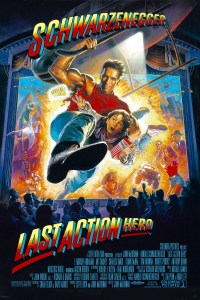
In the same month as Jurassic Park, my brother invited me to join him for a small birthday celebration. It included a movie that he was very excited about: The Last Action Hero starring Arnold Schwarzenegger.

I remember this experience in disjointed images, but the particular memory that stands out is how this film broke the fourth wall in a way that I had never experienced. Basically, teenager Danny loves the Jack Slater film series, and he ends up magically transported into one of them to have a little adventure.

This is another one that I need to revisit (27 years down the road) to really appreciate, but it stands out because of the time I got to spend with my brother doing something that he enjoyed. That was a rarity of its own in my younger days.

The Three Musketeers (1993)

Given that trips to the movies were a rare treat as a kid, I was overjoyed about winning sneak preview tickets to a new action film. Our local independent television station played the Disney Afternoon lineup every day, and to drive interest in their programming, they had a “kids’ club” with giveaways and contests.

Along with a He-Man Powersword roleplay toy, some foam quarterstaffs, and a Darkwing Duck action figure – none of which do I still possess, unfortunately – I won a pair of tickets to The Three Musketeers.

Starring Charlie Sheen, Kiefer Sutherland, Chris O’Donnell, Oliver Platt, Tim Curry, and Rebecca De Mornay, much of it went over my head on first viewing. The action was fun and the wit was quick, but it took later viewings to fully enjoy the scenery-chewing skill of Tim Curry and the underlying meaning of De Mornay’s “with a flick of my wrist, I could change your religion” repartee.

There are certainly better interpretations of this work by Alexandre Dumas, but this one has a level of cheesy lightheadedness and swashbuckling derring-do that provided a suitable introduction to sword and shield fantasy-adventure.

Besides, who can forget Bryan Adams, Rod Stewart, and Sting teaming with Michael Kamen on “All For Love”? Pure ’90s cheese!

8 Seconds (1994)
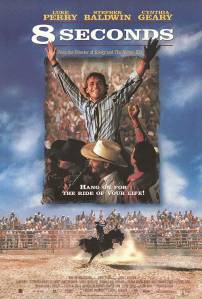
When I was a boy, I had dreams of being a rodeo bull rider. My father was a bull rider and a rodeo clown, and my mother was a barrel racer, and while I was growing up, they offered professional photography for local circuits.

I grew up in the shadow of amazing athletes like Charlie Sampson (the first African American cowboy to win a World Title in professional rodeo) and Brazilian bull riding legend Ariano Morães, and I even dabbled in the sport myself. I even had my own riding rope which I used on several occasions.

When 8 Seconds was released, my family eagerly went to the theater to see it. Starring Luke Perry, the movie is a biographical film about rodeo legend and bull riding champion Lane Frost. Frost was the 1987 World Champion of the Professional Rodeo Cowboys Association (PRCA) and the only rider to score qualified rides from the 1987 World Champion and 1990 ProRodeo Hall of Fame bull Red Rock.

He drew a Brahma bull named Takin’ Care of Business at the Cheyenne Frontier Days Rodeo in 1989. After scoring 91 points, he dismounted and landed in the dirt arena. The bull turned and hit him in the back with his horn, breaking several of his ribs and puncturing his heart and lungs. He died at the hospital at the age of 25.

The reception in our audience that night was one of respect for Frost’s legacy and a humbling of some of the younger cocky cowboys who thought themselves invincible. I personally carried that same respect and sense of caution, eventually giving up my dream after cowboys that I personally knew died doing what they loved.

The Star Wars Trilogy: Special Edition (1997)
Star Wars: Episode IV — A New Hope
Star Wars: Episode V — The Empire Strikes Back
Star Wars: Episode VI — Return of the Jedi

This one seems like a no-brainer, but it was a milestone in my life and fandom.

Like so many in my generation, I grew up on pan-and-scan VHS versions of the Star Wars trilogy. The trailer for the special edition releases tapped into the spirit of that ethos, starting with a tiny screen before showing an X-Wing blasting out of its confines to a full theatrical presentation. It was the perfect commercial to sell the idea of seeing these films again for the first time.

The opportunity to see three of my favorite and most influential movies on the big screen was too good to pass up. The Special Editions were my first experience with Star Wars in theaters. More than that, it was my opportunity to pay my parents back for introducing me to those films. I saved up the money to buy opening night tickets for each of the films for the family, and those presentations were heaven for me.

I had seen each of them on worn-out videotapes so many times, but I was enthralled in that January theater. So entranced, in fact, that when Luke fired his proton torpedoes and the Death Star exploded, I cheered. When I realized what I had just done, I found my parents staring at me with grins on their faces.

I know that they’re critiqued now for being too shiny and modernized, but the Special Editions will always hold a place in my heart.

From a certain point of view, they were my step into a much larger universe.

I have written about these films before as part of the Seven Days of Star Wars series in 2015:

Star Wars: Episode I — The Phantom Menace (1999)
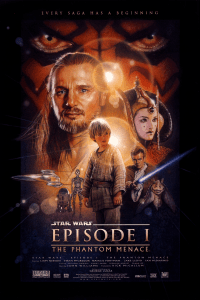
Following on the heels of the Special Editions and my love of the expanded universe of novels and comics, I was overjoyed to see new stories in the Star Wars universe.

It was once again an opening night event for the family and me, and I really enjoyed what I saw with Jedi Knights defending the Republic and paving the way for the trilogy that was a cornerstone of my childhood.

I know that others had buyer’s remorse when it came to this movie and the other two prequels, but I did not. I saw it three or four times on my limited income and found my fandom blossoming from the experience.

There are warts, to be sure, but I had a deep appreciation for what this film represented on the cusp of a new chapter in my life.

I have written about this film before as part of the Seven Days of Star Wars series in 2015: Day Four – The Phantom Menace.

cc-break

Culture on My Mind is inspired by the weekly Can’t Let It Go segment on the NPR Politics Podcast where each host brings one thing to the table that they just can’t stop thinking about.

For more creativity with a critical eye, visit Creative Criticality.

Culture on My Mind – Moving Pictures in Isolation

Culture on My Mind
Moving Pictures in Isolation

March 20, 2020

This week’s “can’t let it go” is really just an update on the movie scene.

Box Office Mojo posted a quick note on Tuesday about the state of cinema during the COVID-19 pandemic. It was the same day that AMC and Regal announced that all of their United States theaters would be closed for six to twelve weeks, encompassing over 1,200 locations overall. As a result, several films have been either postponed or removed from the upcoming slates. Today’s post is an attempt to capture some of those for you.

  • No Time to Die (James Bond #25) has been postponed to November 25, 2020.
  • My Spy has been postponed to April 17, 2020.
  • Peter Rabbit 2: The Runaway has been postponed to August 7, 2020.
  • A Quiet Place Part II has been removed from the schedule.
  • F9 (Fast and Furious 9) has been postponed to April 2, 2021.
  • Mulan has been removed from the schedule.
  • The New Mutants has been removed from the schedule (which is the latest in a series of moves for this once-Fox-now-Disney Marvel film)
  • Antlers has been removed from the schedule.
  • Black Widow has been removed from the schedule.
  • The Personal History of David Copperfield has been removed from the schedule.
  • The Woman in the Window has been removed from the schedule.
  • Antebellum has been removed from the schedule.
  • Run has been removed from the schedule.
  • Minions: The Rise of Gru has been removed from the schedule.

Because of the theater closures, studios are trying to recoup some of their investments while stoking goodwill with audiences. To that end, Universal has announced that they are making recent releases like The HuntThe Invisible Man, and Emma available On Demand.

Meanwhile, Disney has announced that Pixar’s Onward will be available for immediate digital download and for streaming on their Disney+ platform by April 3rd. This is in addition to the early digital release of Star Wars: The Rise of Skywalker and the early streaming release of Frozen 2 on Disney+.

Universal’s Trolls World Tour is still scheduled for release on April 10th, but Universal has added an On Demand option for that film as well.

What will be particularly interesting is how these moves affect the film industry going forward, both in how the release schedule gets sorted out and how studios treat their titles with respect to digital availability.

It’s also interesting to me that drive-in theaters are increasing in popularity with the COVID-19 pandemic according to the Los Angeles Times, especially since they had recently been considered a dead cinema format. Social distancing has some benefits beyond killing off the virus.

As a special note, I hope you all stay safe and healthy out there. I know that physical isolation can take a toll, and I hope that you can take some time to touch base with loved ones through video, chat, email, or phone. I also hope you can find time to care for yourselves during these stressful times.
cc-break

Culture on My Mind is inspired by the weekly Can’t Let It Go segment on the NPR Politics Podcast where each host brings one thing to the table that they just can’t stop thinking about.

For more creativity with a critical eye, visit Creative Criticality.

Culture on My Mind – Darth Maul and the Hollowness of Death

Culture on My Mind

Culture on My Mind
Darth Maul and the Hollowness of Death
October 14, 2011

Entertainment Weekly recently posted an exclusive video that announced the return of Darth Maul to the Star Wars universe.  For those who either missed or refused to watch the prequels, Maul was a Sith Lord—the same kind of baddie as Darth Vader—who used a double-bladed lightsaber.  His first on-screen appearance was in The Phantom Menace in 1999.

In that film, a three-way lightsaber duel ended with Qui-Gon Jinn impaled through the chest and Darth Maul toppling into a deep shaft, deftly cleft in twain by the blade of Obi-Wan Kenobi.  Last January, viewers of the cartoon series Star Wars: The Clone Wars were introduced to Maul’s brother Savage Oppress (pronounced in typical Star Wars ­style as sah-VAHJ OH-press), who was a proposed apprentice to help Count Dooku overthrow his master and take control of the Dark Side of the Force.  At the end of that trilogy of episodes, viewers were told that Darth Maul was out there in the incredibly vague somewhere in the galaxy, and Oppress had to go find him.

So, apparently this means that Darth Maul does indeed live and, by some miracle, survived being cut in half by a lightsaber and falling several stories.  Insert exasperated sigh here.

Supervising director Dave Filoni told Entertainment Weekly that it makes sense in terms of Star Wars lore:

Fans will note that there is precedent for this kind of resurrection. “The Dark Side of the Force is the pathway to many abilities some consider to be…unnatural,” Darth Sidious says in Revenge of the Sith. Sidious and his master found a way to use the Force to cheat death—that’s how he was able to keep Vader alive after that little swan dive into a lava field. Couldn’t Maul have picked up on some of that too? Says Filoni, “He’s suffered through a lot to keep himself alive and implemented the training of his master to do so.”

There’s also significant financial interest for Lucasfilm in this move.  The episode(s) pertaining to Darth Maul will be aired in early 2012, and, by a cosmic coincidence I’m sure, Star Wars: The Phantom Menace in 3-D is premiering February 10, 2012.  It goes without saying that I’m annoyed by publicity stunts written into entertainment to drive interest in a related property.  Anyone else remember the martial arts episode of Star Trek: Voyager called “Tsunkatse”?  WWE Wrestler Dwayne “The Rock” Johnson was a guest star, and both WWE and Voyager were on UPN.

This entire mess—and yes, I’m calling it a mess—brings Star Wars into the realm of pointless character resurrections to drive sales.  It also revives the eternal frustrations I have with Star Wars fandom.  Since Maul was by far one of the coolest and most bad-ass characters in the prequel trilogy, the news that he would return to the franchise was understandably received with fan praise.  At the same time, others started to look at how this affects the overall quality of the franchise and aired their opinions.  In response to critical fans, some blogs, including Star Wars Underworld, questioned the “fandom” of people with differing opinions.  While I appreciate a discussion on how they plan to resurrect a character and do it well, it’s certainly not the first time that the Star Wars social media sphere has played the card of questioning how someone can be a fan of something while being critical: the hosts of The ForceCast did it numerous times before I stopped listening to the podcast back in May.

While other subsets of science-fiction and fantasy fandom can somewhat easily accept both positive and negative criticism toward the franchise of their choice, some Star Wars fans tend to follow the line of reasoning that if “you’re not with with us, you’re against us.”  It’s all fun and games until you disagree with Uncle George and refuse to drink the blue milk, and I’ve already seen backlash from refusing to buy the Star Wars Blu-Rays and my decision not to support the 3-D re-releases.  Having intelligent discussions about the positives and negatives of a franchise is one thing, but I cannot support attacking each other for having differing opinions.

The bigger problem I have with this is an issue that has plagued comic book franchises for decades, and that is in the pointless death and resurrection of characters.  In real life, religious beliefs aside, death is pretty permanent.  In storytelling, death is a result of failure, the completion of a heroic journey, or the motivation to start that journey.  In a smaller subset, that death results in a significant change of character dynamics—such as regenerations in Doctor Who, or the evolution of Gandalf in Lord of the Rings or Obi-Wan Kenobi in Star Wars—but those deaths still carry the impact of the end of a journey and how it affects the characters around them.

Simply put, to reverse a death negates that impact and cheapens the victory for the winners.

In The Phantom Menace, Darth Maul’s death marked two important character changes:  First, it displayed Obi-Wan Kenobi’s maturity and readiness to be promoted from apprentice to Jedi Knight; second, it marked the beginnings of Anakin’s destined path.  The death of Darth Maul was a very important turning point for the Jedi themselves, as they discover that the Sith had indeed returned.

While I look forward to finding out how Filoni and company accomplish this feat, I am very skeptical about the Star Wars franchise as a whole at this point.  If Filoni proves me wrong and does this well, I will be quite amazed.  On the other hand, if this turns into yet another cheap comic book return—Superman wasn’t dead, after all, he was just resting—to sell tickets to yet another release of the Star Wars movies, then I’m done with The Clone Wars.  I have supported the show since it was announced, but for me, it would be that damaging, and since George Lucas has final approval on the show, the blame would lie solely with him.

Come 2012, we shall see.

cc-break

Culture on My Mind is inspired by the weekly Can’t Let It Go segment on the NPR Politics Podcast where each host brings one thing to the table that they just can’t stop thinking about.

For more creativity with a critical eye, visit Creative Criticality.

Culture on My Mind – My Thoughts on Lost

Culture on My Mind

Culture on My Mind
My Thoughts on Lost
October 12, 2011

One of the American television shows that I heard a ton about but never had time to watch was Lost.  My wife borrowed the season sets from her brother, but only made it as far as season three before life took over.  During that time where we weren’t watching, fan groups and some of my trusted friends were still abuzz about the series, so when the complete series boxset came available after the series finale in 2010, I knew that it was a series that I had to invest in.

For those who don’t know about Lost, this post will involve spoilers.  If you intend on watching the show and want to experience it without knowing what’s coming, you probably want to stop reading and come back afterward.

What is Lost?
Lost was billed as a drama series, and ran on the ABC network from September 22, 2004 to May 23, 2010 over six seasons.  The show is centered on the survivors of the crash of Oceanic 815, a commercial passenger jet traveling between Sydney, Australia and Los Angeles, California.  The crash occurred on a mysterious, unnamed tropical island somewhere in the South Pacific Ocean.  The show was told in episodes that primarily focused on the events on the island, with secondary stories that amplified events in the life of the central character for each episode.  Lost was the brainchild of Jeffrey Lieber, J. J. Abrams, Damon Lindelof, and Carlton Cuse.

When I say that Lost was a drama series, that classification is a very generic brush stroke to apply.  On its face, Lost was a character drama, but once I got invested, it was apparent that the show was part-drama, part-science fiction, part-fantasy, part-supernatural, part-hero quest, and part-mythological.  The blessing and the curse of the show was that the mythos brought up a plethora of questions that spanned all six seasons before being answered.  It was both frustrating and intriguing, and that was what I loved about it.

The frustration was amplified by the broad spectrum of cast members.  In the show, of the 324 people on Oceanic 815, 70 people and one dog survived, spread across three sections of the plane.  Season one focused on the survivors of the middle section, predominantly Doctor Jack Shephard, fugitive Kate Austen, con-man James “Sawyer” Ford, heroin-addict rock star Charlie Pace, former Iraqi soldier Sayid Jarrah, paraplegic John Locke, lottery winner Hugo “Hurley” Reyes, construction worker Michael Dawson and his son Walt, Korean couple Sun-Hwa and Jin-Soo Kwon, fueding siblings Boone Carlyle and Shannon Rutherford, and Claire Littleton, who is eight months pregnant.  As the show went on, some characters died, others were introduced—especially after the discovery of the tail section and the people who were on the island before the crash—and links between all of the characters are established from their lives before the show.

What starts as a simple show about people stranded on a desert island starts getting into the science fiction within the first few episodes with the introduction of a monster made entirely of smoke.  Characters also start seeing visions of dead friends and relatives, and eventually discover a mysterious hatch in the middle of the jungle.  Also woven throughout events of the show and the characters lives before the island are The Numbers:  4, 8, 15, 16, 23, and 42.

As the show went on, we discovered that the survivors were not alone.  First, there is the hostile seemingly primitive group known as The Others.  Second, there are the remnants of the mysterious Dharma Initiative.  Finally, there are the almost otherworldly inhabitants who have a greater purpose on the island.

Why I liked Lost
Anyone who knows me knows that I’m a sucker for epic mythology.  Lost had that in spades.

One of the major complaints I heard about the show was that it was a victim of meandering stories that eventually headed in a somewhat decent conclusion, and I think that was a benefit to watching this on the DVDs.  Watching without the waiting between seasons or over writers’ strikes helped me to see this more as a mini-series rather than a six-season series.

Seasons one, two, and three of the show were standard American seasons with 25, 24, and 23 episodes, respectively.  Season four was supposed to have 16 episodes before the Writers Guild of America went on strike, and eventually ended up with 14.  Season five went with 17 episodes, and season six ended the show with 18.  The latter three seasons capitalized on the fact that the showrunners limited themselves to six seasons, particularly after the storylines started to wallow in stagnation in the third season.  The ratings show how the show started to suffer in season three.

Lost had an overarching mythology that, once it finally got assembled, really kept me rolling.  All the talk of The Numbers and Jacob and The Man in Black really came to a head for me with the eighth episode of the last season, when the show finally explained why everything was so important.  Sure, The Numbers were retconned in to correspond with the remaining survivors of Oceanic 815 who were potential candidates to replace Jacob, the guardian of the island and protector of the world, but I didn’t care because it made sense to me.  Jacob was a man who was forced into a sacred role and immortality without a choice, and a mistake he made in the nascent days of his role unleashed a great evil that had one goal:  to take over the world.  To get there, the evil Man in Black has to kill his brother, which he cannot do directly.  The rest of it, from the button that has to be pushed every 108 minutes to prevent the destruction of the island to the quest to control the energy at the heart of the island speaks to me as the folly of man.

While a great deal of the show’s events relied on destiny and fate, that’s what myths depend on as well.  Epic fantasy and science fiction, driven by powers outside the control on man, be it God, the Force, or whatever you want to call it, depends greatly on the possibility that certain things are destined to occur.  In Lost, the candidates were destined to arrive and be tested on the island, and they were selected not because they were strong or smart, but because they were flawed.  Only a flawed person, one who recognized and was willing to improve their shortcomings, could fill the role of protecting the island.  More so, Jacob wanted his successor to choose to be the protector, not be pushed into it.  Jack chose to take the responsibility directly, and Hurley chose indirectly by his continuous empathy and caring for his fellow survivors.  Jack continually jockeyed for the leadership position with Sawyer and Locke, but everybody truly loved Hurley, and relied on him for support.

Religion and faith also played a major role from day one in the show, and I had no problem with the final resolution of the “sideways” storyline being nothing more than a waiting room for the Oceanic survivors before moving on to whatever lies beyond this life.  Simply put, it was a method for each person to resolve any unfinished emotional business in their lives and remember the most important thing they did in the living world.  Watching all of these people, who had fought each other while struggling to survive, come together with a common goal in mind moved me, and I thought the intent was beautiful.

But the thing that moved me even more was the poetic ending for Jack.  He ended his journey exactly where he started it, and I bawled like a baby when he collapsed on the ground and Vincent—the dog who always had a knack for progressing the storyline when it needed a motivational kick—laid down next to Jack to ensure his last moments were not spent alone.  I’m getting weepy even now as I put these words to the page.  When a television show or a movie has the power to move me to tears, it takes a special place in my life.  I can count on one hand the media that has accomplished that.

That was the effect that Lost had on me.  It wasn’t just a drama series about survivors on an island with sci-fi and fantasy elements tossed in.  When I partake of any story, but in particular science fiction, I look for how it applies to the human condition.  Science fiction has always been an examination of the human condition by use of metaphor, and Lost did that.  Each character was three-dimensional in my eyes, and character motivations were, for the most part, genuine.  What solidified the characters for me was not only that genuine flavor, but the fact that they could evolve in believable ways as the plot progressed.

I know that the writing wasn’t always stable, and that there were problems with retroactively adding new characters into old situations as if they’d always been there, but for me, what I gained from experiencing the series far outweighs those minor quibbles.

Lost is a series I will go back to again in its entirety, and is a series that I feel has made a profound impact on my life.

cc-break

Culture on My Mind is inspired by the weekly Can’t Let It Go segment on the NPR Politics Podcast where each host brings one thing to the table that they just can’t stop thinking about.

For more creativity with a critical eye, visit Creative Criticality.