
Timestamp #62: The Sea Devils

Doctor Who: The Sea Devils
(6 episodes, s09e09-e14, 1972)
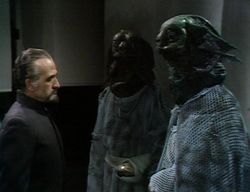
Timestamp 062 The Sea Devils


The Master returns to Doctor Who, scheming and plotting from his island prison cell. The Doctor and Jo pay him a visit, and the Master claims to be rehabilitated, but he refuses to reveal where he parked his TARDIS, so the Doctor is skeptical.

Adding to the Doctor’s uneasy feeling is a recent rash of ship sinkings in the area and Colonel Trenchard, the very odd prison warden who (unbeknownst to the Doctor) is working with the Master to defeat some unknown enemy agents. The Doctor goes to the nearby naval base and enlists the help of the base commander. He and Jo head to the nearby sea fort to investigate, but are stranded as the Sea Devils destroy their boat. The Sea Devils give chase inside the fort, where the Doctor and Jo find a single half-mad survivor before calling for help and escaping.

According to the Doctor, these Sea Devils are related to the Silurians: They are adapted to living underwater, and they share the same motivations as their cave-dwelling cousins.

Trenchard sets the Master free, and he goes to the naval base in the guise of a Navy commander. He steals some sonar equipment, assaults a Chief Petty Officer, and escapes after being spotted by Jo. When the Doctor and Jo return to the prison, the Master is back in his cell as if nothing ever happened. The Doctor sends Jo to inform UNIT as the Master escapes and a random swordfight breaks out. Trenchard arrests the Doctor, and the Master explains his evil plan to take over the world with the Sea Devils.

Meanwhile, the Sea Devils take over a rather spacious submarine. Who knows why at this point, but they do.

The Doctor escapes with Jo’s help and they run for the beach, but are soon trapped among the Master, the colonel’s troops, a minefield, and a Sea Devil summoned by the Master. The Master’s plan goes south as the fearful soldiers attack the Sea Devil, the Sea Devil kills the soldiers, the Doctor and Jo run for the minefield, the Sea Devil enters the minefield, the Doctor triggers a mine to scare the Sea Devil back to the ocean, the colonel questions the Master about the creature who slaughtered his men, and the Master sends a handful of them to attack the prison and kill Trenchard.

Take a moment here to breathe as the secret service Sea Devils take their luxury submarine somewhere. Who knows where are this point, but they do.

The Doctor and Jo go back to the naval base, and the Doctor takes a diving bell to the foundation of the sea fort to investigate. The Sea Devils abduct him and take him to their leader, with whom the Doctor almost brokers peace, but is interrupted by the arrival the Master. Further complicating matters are Parliamentary Private Secretary Walker, a sexist, pompous, arrogant ass who arrives to “solve” the missing ship problem with his depth charges.

The Doctor escapes from the sea devils, rescues the submarine crew, and they all break free from the underwater base in a moment of okay, sure that had me setting aside my background in undersea warfare. At least they wrapped up the dangling plot thread about that stolen sub. Not to be dissuaded, the Master and the Sea Devils take over the naval base, and the Master tries to convince the Doctor to help him revive all of the Sea Devils around the world. The Doctor sabotages the machine, which incapacitates the Sea Devils so the sailors can escape. The Doctor fixes the “mistake” just as the sailors stage an assault to retake the island, but the Master runs with the machine and the Doctor gives chase. They end up back in the waiting fins of the Sea Devils, who are now tired of all of these Time Lord shenanigans. The Doctor sabotages the machine by reversing the polarity of the neutron flow (huzzah!), which creates a bomb that the Master unknowingly activates. The Doctor uses his sonic screwdriver to open the cell, and he and the Master escape. The Sea Devil base explodes, but the Master works his mental magic to escape in a hovercraft.

All of that in six episodes, which normally poses a problem for me, but this story was so well paced that it didn’t matter. Each thirty-minute block just flew by.

Despite the pace, there were a couple of down notes. First, the third episode must have been a bit short since they repeated the whole swordfight from the previous episode. It wouldn’t have been a problem if I wasn’t watching these in rapid succession, but when the episodes are back-to-back, long repeated story points shred the pacing. Second, it’s becoming standard operating procedure for the Master that his eyes are too big for his metaphorical stomach. His plans always double back on him, usually because he’s trying to wield too much power. Don’t get me wrong, it makes sense with the megalomaniacal bag full of cats that is the Master, but it’s become predictable. Especially after an entire season of stories with that common thread.

On the plus side: First, the writers did their homework with all of the naval trappings. Even though the submarine was the standard Hollywood-style hotel underwater, it was still okay with me in practice. Second, Roger Delgado is deliciously evil and melodramatic in this serial, and while Series Eight was decent with his portrayals, for some reason this serial really worked for me. Last, I loved how the Doctor used the sonic screwdriver as a tool to navigate the minefield, set off one of the charges to scare the Sea Devil, and escape from a jail cell. The prop also has a totally ’70s sci-fi vibe, and I adore it.

This fast-paced and fairly tightly written serial shook out to a high 4 when I was done, and I have no problem rounding that up.


Rating: 5/5 – “Fantastic!”


UP NEXT – Doctor Who: The Mutants


The Timestamps Project is an adventure through the televised universe of Doctor Who, story by story, from the beginning of the franchise. For more reviews like this one, please visit the project’s page at Creative Criticality.


Timestamp #61: The Curse of Peladon

Doctor Who: The Curse of Peladon
(4 episodes, s09e05-e08, 1972)

Timestamp 061 The Curse of Peladon


This was a surprising hit for me, and it’s mostly due to Princess Jo Grant.

The King of Peladon wants to join the Galactic Federation, but one of his advisors, the High Priest Hepesh, believes that an ancient curse is trying to stop this assault on their culture’s sanctity. The king’s other advisor, Chancellor Torbis, is killed by the embodiment of that curse, a creature called the Aggedor. This nearly derails the conference that is scheduled to happen now-ish since the delegates are afraid of conflict, which sounds an awful lot like another Federation we know, but they agree to wait for the delegate from Earth to arrive.

Enter The Doctor. The previously immobile TARDIS (conveniently) arrives on a cliff with the Doctor and Jo, who are out for a little spin around time and space before Jo goes on a date with Mike Yates. There’s one small problem, however, since the stormy cliffs of Peladon are not the UNIT base. In a decent bit of model work, the TARDIS goes over a cliff, (conveniently) trapping our heroes, and they begin to climb toward the citadel on the rocks above them.

When the pair arrive, they assume the role of the Earth delegation, and meet the other members of the quorum: The high-pitched Alpha Centauri delegate, the impressively operated shrunken-head-in-a-jar Arcutran delegate, and a pair of Ice Warriors.

Wait. Ice Warriors?!

There’s a nice moment of empowerment for Jo where she becomes a princess to avoid execution – only men of rank and women of noble lineage may enter the throne room – and she grabs that role and runs. Meanwhile, the Doctor saves all of the delegates from a crushing fate after a statue falls with a little help from the king’s mute champion Grun and his friend gravity. Grun is a pawn in the plot to derail the king’s vision, and Hepesh is engineering it by working the whole curse angle. But who is the mastermind? It must be the Ice Warriors, right?

Well, actually, no. And that’s the beauty of this story.

The Doctor believes that the bad guys are the Ice Warriors. He’s run into them twice before, and they’ve been formidable foes each time. This go-round, there’s even circumstantial evidence pointing toward their complicity after the Arcturan delegate’s life support pod is sabotaged, but they claim to have given up war in favor of peace and self-defense. After a bout in the Thunderdome with Grun, the Doctor believes the Ice Warriors when they save him from being shot by the Arcturan, who was working with Hepesh all along. If Peladon fails to join the Federation, Hepesh can rule the planet (even through a figurehead like the king) and sell the valuable mineral rights to Arcturus.

The Doctor locates and hypnotizes the Aggedor with a spinning mirror and a lullaby, and then leads it to the throne room to expose the reality of the curse to the king. The throne room is occupied by Hepesh and his loyal soldiers who have just staged a coup, but the Aggedor attacks the man who kept it captive, and the threat is defeated.

Jo comes clean to the king about her lineage and refuses his offer to be his consort. Jo and the Doctor hightail it off Peladon when the real Earth delegate arrives (bearing humorous gifts of a “Doctor who?” gag), and the Doctor realizes just how convenient is was that they arrived in the right spot at the right time to stop this exact plot.

Time Lords, man. Puppet-string-pulling, meddling-in-time-and-space-without-leaving-their-ivory-tower Time Lords.

I can’t say much more on this one. I liked seeing David Troughton again, especially in a bigger role than either The War Games or The Enemy of the World offered him. I also adored Jo in this story, as she has become a better companion with the re-introduction of traveling in the TARDIS. She really carried this serial.

I also really loved that the Ice Warriors weren’t the bad guys. It’s a good misdirection, and one that wouldn’t work with a higher profile baddie like the Cybermen or the Daleks.


Rating: 5/5 – “Fantastic!”


UP NEXT – Doctor Who: The Sea Devils


The Timestamps Project is an adventure through the televised universe of Doctor Who, story by story, from the beginning of the franchise. For more reviews like this one, please visit the project’s page at Creative Criticality.


Timestamp #60: Day of the Daleks

Doctor Who: Day of the Daleks
(4 episodes, s09e01-e04, 1972)

Timestamp 060 Day of the Daleks


The Daleks are back, and they seem to have recovered from the Second Doctor’s confrontation with the Emperor Dalek so long ago.

I really loved this story because of how it is framed. What starts as a simple UNIT investigation of a diplomat being stalked by strange ghost-like guerrillas ends up being much deeper than many of the stories from the last set.

Sir Reginald gets attacked by a strange human warrior with a gun who vanishes without a trace, almost like a ghost. Another guerrilla appears from thin air and is instantly attacked by an ape-like creature in an act of gorilla on guerrilla warfare. (Okay, that was a bit insensitive.) And then, as if we needed more conflict, the Daleks enter the stage, and even though they aren’t front and center in this story, they’re still menacing and sinister because they’re pulling all of the strings on all of these puppets.

All of this before we even get to the time travel, and I was riveted.

And then the creative team turned this exploration of the human condition up to eleven.

After spending a night at Sir Reginald’s house (and raiding his extensive wine cellar), the Doctor and Jo are attacked by the guerrillas and held hostage. Jo escapes and is inadvertently transported to the future. She innocently tells the Controller where to find the Doctor, and the Controller sends a team of Ogrons (the ape-like creatures) to kill the guerrillas. The guerrillas escape, the Doctor gives chase, a Dalek chases all of them, and the Doctor and the rebels end up in the future. After a series of political ping-pong events, the Doctor ends up in the care of the Controller, gets the down-low on what happened to the planet, and eventually sways the Controller’s attitudes on the peril of humanity and his role in a lineage of “Quislings“.

As events come together like a jigsaw puzzle, the Doctor discovers that these events are a predestination paradox started by one of the rebel guerrillas setting a Dalekanium bomb in an attempt to stop the future of enslavement and death from coming to pass. At that point, my jaw dropped.

This. Is. Doctor Who.

It’s hard to find highlights here because the whole story shines so brightly: I loved how the Doctor was so much more civil with the Brigadier than in past interactions, including their building trust and synergy (“do tell the Marines”); I adored the (hopefully budding) relationship between Sgt Benton and Jo; I enjoyed watching Jo finally expanding her horizons and learning to be a worthy companion for this Doctor.

The Doctor is still working on the TARDIS, and his new-found civility extends to Jo as he frankly tells her that he doesn’t want to be an intergalactic puppet for the Time Lords and their High Council. He’s moving beyond his childish temper tantrums and taking action with what appears to be a new sense of purpose. Ironically, it was the Time Lords who provided it by allowing the Doctor and Jo to travel in the TARDIS once again.

The quick (almost non-sequitur) time loop a the beginning was fascinating, especially since the recent incarnations of the Doctor are very cautious about crossing their own timelines. This thread is never mentioned again in the story and left me wondering why it was important.

On the downside for this serial, the Doctor uses a gun to kill an Ogron. Sure it was self-defense, but it was also way out of character.

I also questioned the role of the Ogrons. I mean, yes, they make great hired muscle, but isn’t it uncharacteristic for the xenophobic Daleks to even consider working with them? Or is this more of a “use them then lose them” plan like the alliance in The Daleks’ Master Plan? Speaking of the Daleks, they discovered the secret of  time travel for this story, but hadn’t they done this before?

On the new sound for the Dalek death rays, I don’t like it.

Finally, swinging back to the good things, it was nice to see that The Daleks don’t recognize the Doctor’s new face. They know that he has changed appearance before and use a mind analysis machine to determine if he is indeed the Doctor, but it took an extra step to establish that logic. Thank goodness.


Rating: 5/5 – “Fantastic!”


UP NEXT – Doctor Who: The Curse of Peladon


The Timestamps Project is an adventure through the televised universe of Doctor Who, story by story, from the beginning of the franchise. For more reviews like this one, please visit the project’s page at Creative Criticality.


Timestamp #59: The Dæmons

Doctor Who: The Dæmons
(5 episodes, s08e21-e25, 1971)

Timestamp 059 The Dæmons


It was a dark and stormy night, almost the setting for a Doctor Who Halloween Special, but aired in early summer.

Professor Horner and his team are excavating a site called Devil’s Hump, and they are surrounded by a series of events that are like magic. The local village witch, Olive Hawthorne, comes out to protest but is ignored, so she returns home and goes to visit the vicar, a new man named Mr. Magister, who is really the Master. Also, she’s immune to his hypnotic powers, unlike everyone else in the town.

Turns out, the Master is attempting to summon a demon. Well, a race of demons. Well, really an alien race that looks like demons that are kind of like scientists that run experiments on civilizations. They’ve been on the planet for 100,000 years, and when the experiments are deemed successful, they spark a technological revolution. When the experiments fail, you get Atlantis.

Anyway, this serial is an exercise in Arthur C. Clarke’s third law of prediction: “Any sufficiently advanced technology is indistinguishable from magic.” The Dæmons have been around for so long that they’ve been worked into our mythology, and when they appear/disappear, it requires a conversion between energy and matter. That energy release when they shrink resulted in a shield dome being constructed around the village. The Doctor helps UNIT cut a hole in it so they can keep the gargoyle Bok busy while the Doctor attends to the larger Dæmon named Azal. The Master and the Doctor negotiate with Azal as to who will serve it best, and it sides with the Master. Jo offers to sacrifice herself to prevent Azal from killing the Doctor, and that somehow short circuits Azal’s brain. Azal explodes, the Master is finally captured by UNIT, the Doctor and Jo dance around the maypole, la fin.

It was an interesting idea, but it felt poorly executed, and I think a lot of that is because of the sensitivity at the time regarding demons and the supernatural on the BBC. This story could be done now and not feel so awkward or ham-fisted, but I think the prevailing culture crippled the story’s potential.

There were some good points, like the realistic special effects (the helicopter shot, originally sourced from From Russia with Love, and the church explosion) and the continuing thread of the Master biting off more than he can chew, but then there were also some really bad points, such as the resolution. The threat was stopped by accident, and if Jo hadn’t been there, the Doctor would have failed to stop the Master from taking over the world. Similarly, the Master was captured by Sgt Benton’s good timing.

This story also has a few potential links to the future of Doctor Who. First, Bok is apparently made of stone. Are the Dæmons precursors or ancestors to the Weeping Angels? Second, the UNIT sergeant who builds the force field defeating contraption is named Osgood. Is he related to the current personal assistant at UNIT who saved the world? Both of them are scientists and they both wear thick-rimmed glasses.

The Master offered the villagers anything they wanted for the price of their servitude, and I heard echoes of Needful Things.

Finally, UNIT needs to stop shooting things. It hardly ever works.


Rating: 2/5 – “Mm? What’s that, my boy?”


UP NEXT – Series Eight Summary


The Timestamps Project is an adventure through the televised universe of Doctor Who, story by story, from the beginning of the franchise. For more reviews like this one, please visit the project’s page at Creative Criticality.


Timestamp #58: Colony in Space

Doctor Who: Colony in Space
(6 episodes, s08e15-e20, 1971)

Timestamp 058 Colony in Space


I really don’t like the Time Lords.

The Master is still mucking about in space and time, and the Time Lords reinstate the Doctor’s mobility to stop the next evil scheme. The Master has stolen the plans for a Doomsday Weapon, and only the Doctor can stop him from acquiring and using the device.

The TARDIS spontaneously dematerializes with the Doctor and Jo inside and travels to the planet Uxarieus, where a colony of humans has been established, but the colonists don’t trust the government back on Earth. In this future, the Earth government is a repressive bureaucracy that thrives on red tape. Meanwhile, the Interplanetary Mining Corporation (IMC) is trying to jump the colony’s claim and mine the planet for duralinium, which is needed on Earth. Since the colonists get in the way, the IMC is trying to scare them off. They call for an adjudicator to settle the issue, and it so happens that they send the Master.

And that’s the weak frame for the rest of the plot.

The story follows that there once was a powerful race of beings on the planet, but they developed the Doomsday Weapon – a device with the power to destroy a star – and then squirreled it away because nobody really needs that much power. The weapon’s presence led to the decline of the society, and they regressed to being primitives that hide in caves. When the Guardian, who leads the remnants of the ancient civilization, hears the tale of the Master and the Doctor, he destroys the weapon and his people to save the universe.

On the upside to this story, Jo visits the TARDIS, gets her “bigger on the inside” moment, and rapidly learns what it means to be a Doctor’s companion. From the story perspective, it was good to see that the writers didn’t rest on the trope of everyone in the party of evil completely believing in the thing that is evil: Caldwell was a great foil for the captain’s plans.

I also thought that the model work was great in this story, and I loved the IMC ship exterior.

Now, the list of negatives. First, the Time Lords, who are just playing games with the Doctor at this point. They reinstate his mobility to serve their needs because… what, they can’t simply pull the Master back by themselves? They can’t meddle in affairs of time and space, but they can send the Doctor, who they exiled as punishment for meddling in time and space?

No wonder he’s bitter about the exile. I would be too if they kept being hypocritical about everything.

The effects with the TARDIS were rather shoddy, from the *poof* materialization/dematerialization (it used to fade in and out) to the remnants of the Troughton-era control room (the roundel wallpaper was okay for the low-res black and white days, but with higher production values, the set deserves better).

This Doctor is a lot more physical, which is fine, but he’s a lot more prone to assaulting people. He uses his Venusian karate/aikido again here multiple times, and while the self-defense argument is on the table, he’s far more aggressive than his predecessors (and the successors with which I’m familiar). It feels like they’re trying to bring in the Bond fans, which almost matches up with the debut of Roger Moore in the famous role. I see a lot of similarities in Roger Moore’s Bond and Jon Pertwee’s Doctor.

Overall, a weak framing story, but a decent showdown with the Doctor, the Master, and a not-quite-dead-yet race of superior intelligence.


Rating: 3/5 – “Reverse the polarity of the neutron flow.”


UP NEXT – Doctor Who: The Dæmons


The Timestamps Project is an adventure through the televised universe of Doctor Who, story by story, from the beginning of the franchise. For more reviews like this one, please visit the project’s page at Creative Criticality.


Timestamp #57: The Claws of Axos

Doctor Who: The Claws of Axos
(4 episodes, s08e11-e14, 1971)

Timestamp 057 The Claws of Axos


It’s Doctor Who in color… again! The Claws of Axos is a short serial that is much more straightforward than The Mind of Evil, which hurts it a little in my opinion.

UNIT is undergoing an inspection from Horatio Chinn, a particularly detestable politician who is throwing a tantrum because he knows nothing about the Doctor, when they detect a spacecraft filled with spaghetti monsters. I’m kidding, of course, since the spacecraft is unique to the franchise and not a bad looking model. UNIT is also hosting Bill Filer, an American agent from an unknown agency, who is investigating the Master. Chinn, ever the diplomat, secures emergency powers and tries to shoot down the spacecraft, but it evades the effort. Strangely enough, Chinn could have been the hero of the tale had he succeeded.

The ship lands and spears a homeless drifter with a Jar Jar Binks-like tongue. UNIT arrives and, with the help of scientists from the nearby power facility, investigate the ship. Filer, after being ejected from the UNIT site by Chinn, arrives on his own, is captured, and discovers the Master is also in captivity.

The Doctor gets scanned by the living ship, and the aliens determine that he is a Time Lord. The Axons appear as humanoids in gold face paint and muted leopard-print leotards, and they claim that they ran out of fuel and need time to recharge and replenish. In exchange for temporary asylum on Earth, they offer a miracle substance called Axonite that can be anything you want it to be. Strangely, they never used it for fuel.

Jo explores the ship on her own after disobeying orders to stay put, and she hears Filer calling for help. She finds a spaghetti monster and screams, drawing the UNIT team to her, but the Axons dismiss her experiences as hallucinations due to the proximity to the power core. Filer and the Master take the opportunity to escape, but are recaptured, and Filer is sent to be cloned.

Chinn calls the Prime Minister for special powers to accept the Axonite, places the UNIT team under military arrest for interfering with his authori-TAH, and sets to distributing the Axonite around the globe. Unfortunately, as the Doctor discovers, the Axonite is the means that the Axons (or really, just Axos, a single consciousness with multiple avatars) plans to use to consume the planet’s energy.

The Master negotiates with Axos for release, and gets his laser gun but not his TARDIS. He steals the Doctor’s TARDIS, has it delivered to the power plant, and works on fixing it so he can escape. After discovering that Axos wants to time travel to expand its feeding base and that they can use the reactor’s power to do so, the Doctor works with the Master to repair the TARDIS under the premise that he’s abandoning Earth as a lost cause. Once operational, the Doctor materializes the TARDIS inside Axos, tricks them into linking their drives with his, and locks them in a permanent time loop. The Master escapes into his TARDIS when he discovers the plan, and all of Axos is materialized into the Doctor’s TARDIS. The Doctor boosts the TARDIS out of it, leaving Axos stranded in the loop, and the TARDIS returns to Earth with an annoyed Doctor on board. Even with the ability to dematerialize now restored, the Time Lords have ensured that it will always return to Earth.

I’m really starting to dislike the Time Lords. Sure, I get the justice for breaking their laws, including making sure that the Doctor doesn’t leave his exile by blocking his knowledge, changing the dematerialization codes, and disabling the circuitry in the TARDIS, but then they show up only long enough to warn the Doctor that the Master is coming and that he’s a bad dude. We know full well that they can stop renegade Time Lords with little effort, but they selectively choose not to interfere in this case.

The Master is definitely worse than the War Chief, yet the latter was brought to trial on Gallifrey for his meddling. In a similar vein, The Monk‘s activities have been outright ignored by the Time Lords.

In other short notes, Paul Grist does a decent job with an American accent, and there was a lot of fun with pyrotechnics in this serial. The Doctor seems to be stepping away from his previous reserve about his past by disclosing his knowledge of time travel to the power plant scientists.

This was an okay story with some great steps forward toward restoring the travel aspects of the show.


Rating: 3/5 – “Reverse the polarity of the neutron flow.”


UP NEXT – Doctor Who: Colony in Space


The Timestamps Project is an adventure through the televised universe of Doctor Who, story by story, from the beginning of the franchise. For more reviews like this one, please visit the project’s page at Creative Criticality.


Timestamp #56: The Mind of Evil

Doctor Who: The Mind of Evil
(6 episodes, s08e05-e10, 1971)

Timestamp 056 The Mind of Evil


The Doctor goes to prison, and the show goes back to black and white. Remind me to never lend the BBC my tape collection.

A new device, the Keller Machine, can apparently extract evil thoughts from the mind and rehabilitate prisoners. The Doctor, while attending a demonstration of the device, thinks himself above the primitive 1970s Earth, and feels vindicated after the demonstration yields one comatose prisoner named Barnham, and later, one dead medical student. Meanwhile, UNIT is running security for a world peace conference, and Captain Chin Lee of the Chinese delegation deceives UNIT to help the Master steal a nerve gas missile.

The machine is intelligent, and it feeds off of negative emotions like fear and aggression. It kills people by making them envision their greatest fears so it can feed, and the Master figures out that the machine will overpower both him and the prison, so he teams up with the Doctor to shut it down.  Starved for evil to feed on, the machine learns how to teleport directly to food sources, but it cannot function around Barnham since he completely devoid of negative emotion.

The Doctor offers to trade the missile for the Master’s dematerialization circuit, and knowing that he can’t allow the Master to roam free in time and space, he tries to trap the Master with Barnham and the mind parasite. The Master gets his circuit back in the ensuing chaos, escapes, and runs down Barnham. The Doctor sets the missile to self-destruct, taking the parasite with it.

This is twice now that the Master’s plans have threatened to overcome him: He goes big when he builds a plan to take over the world. The Doctor’s fear of his enemies is fascinating since he hardly shows it when he’s up against them. The Master’s greatest fear, the Doctor looming over him and laughing in victory, betrays his insecurity.

It’s also interesting how the Doctor is so cautious about exposing himself as a Time Lord, but he never misses an opportunity to denigrate the technology of the era in which he’s trapped. No wonder people dislike him so much.

This was a straightforward story with a couple of twists, and a good continuation of this season’s overarching theme of the Doctor and his nemesis.


Rating: 4/5 – “Would you care for a jelly baby?”


UP NEXT – Doctor Who: The Claws of Axos


The Timestamps Project is an adventure through the televised universe of Doctor Who, story by story, from the beginning of the franchise. For more reviews like this one, please visit the project’s page at Creative Criticality.


Timestamp #55: Terror of the Autons

Doctor Who: Terror of the Autons
(4 episodes, s08e01-e04, 1971)

Timestamp 055 Terror of the Autons


The Nestene and Autons are back. The normal title sequences are back. Liz Shaw is… not.

There are so many profanities, obscenities, expletives, and invectives I could throw out here; I guess Liz Shaw can now be the vice president of the Unceremoniously Canned Companions Club with Dodo as the president and founder. She was only around for four serials, but she deserved a lot better (especially as a strong female character) than to be written off in the off-season.

It’s infuriating!

The Doctor’s back as well, still in his fancy ruffles but with a toned down scarlet jacket. He’s still working on TARDIS and meets Jo Grant, the new assistant. Jo’s no Liz, but she’s very independent and has potential, and she did save the Doctor’s bacon from the mirror-universe-goatee-and-slicked-back-hair E-V-I-L that is the Master. I mean, if you’re gonna save the Doctor’s life, you get extra points for doing it against that guy.

The Master arrives in a TARDIS with a fully functional chameleon circuit, enthralls nearly everyone he meets like the vampires of legend, and steals a Nestene egg to invite the invasion force on down. The Doctor and his team investigate the strange signals from the radio telescope, and the Doctor gets a heads up from a random Time Lord. The Third Doctor’s run has been playing fast and loose with time travel vehicles, and this story is no exception: Time Lords can apparently travel without a TARDIS.

The Master takes the disguise of Colonel Masters and embeds himself in a local plastics factory. After killing the production manager with an inflatable plastic chair, he offs the factory’s retired owner with a demonic plastic doll activated by heat. The only way he could be more evil is by killing a puppy.

The Doctor follows the clues to the circus, but is captured by the Master’s hypnotized followers. Jo rescues him after smuggling away in Bessie, and the Doctor steals the dematerialization circuit from the Master’s TARDIS. One mob scene and thrilling Auton battle later, the escape with the Brigadier and Captain Yates. The dematerialization circuit is too new for the Doctor’s TARDIS, but the good news is that the Master is also stranded on Earth.

The Autons, disguised as cartoonish carnival figures, distribute plastic daffodils to the public as the disguised Master replaces the Doctor’s phone cable in his lab. The Doctor and the Brigadier find the plastic factory office to be abandoned with the exception of an Auton in the safe while Jo and Sergeant Benton dispatch the demon doll, and the Doctor gets wrapped up in a phone call. Okay, that phone cord bit was a good idea on paper, but quite silly in execution.

The daffodils attack Jo and try to asphyxiate her, and the Master arrives to confront the Doctor. He kidnaps the pair and places them in the bus that UNIT is about to bomb, but the Doctor communicates with Morse code through the brake lights on the bus and escapes. The Master starts to bring the Nestene invaders down to the planet, but suddenly understands that they will kill him as well. The Doctor and the Master work together to reverse the polarity of the signal and send the Nestene into deep space, and then the Master sacrifices his last follower to escape.

Let’s start with the negatives (aside from Liz’s canning), of which there are only two: There was a lot of blue-screening in this serial, which was probably reasonable for the era but got really distracting; The camera angles let us see a lot of the TARDIS interior, there’s no control room. Aside from the companion kerfuffle, my complaints are petty.

On the positives, this is a tight story told in four episodes that introduces a continuing conflict with a powerful enemy. I was riveted waiting to see how it resolved, and I want more.


Rating: 5/5 – “Fantastic!”


UP NEXT – Doctor Who: The Mind of Evil


The Timestamps Project is an adventure through the televised universe of Doctor Who, story by story, from the beginning of the franchise. For more reviews like this one, please visit the project’s page at Creative Criticality.