
Timestamp #7: The Sensorites

Doctor Who: The Sensorites
(6 episodes, s01e29-e34, 1964)
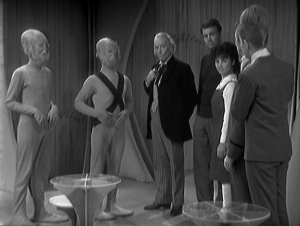
Timestamp 007 The Sensorites

This story is essentially a parable about fear, from humans losing complete control of their autonomy to the Sensorites being afraid of confrontation and the dark. The serial is driven by the Sensorites and their fear of losing their molybdenum (“moly-mol-minerals”; poor William Hartnell) resources through betrayal of their trust in human explorers.

There were some great character building blocks. Susan is developing telepathy, and I wonder if it’s something in the Time Lord DNA. If so, does the Doctor share that skill? I also really enjoyed seeing Susan spread her wings a bit in facing off with her grandfather and demanding some space to run. She’s growing up physically, and yearns to grow emotionally.

I liked that they established the Doctor’s apprehension with weapons. I also enjoyed seeing the origins of the Tenth Doctor’s description of Gallifrey, even though it isn’t called that yet.

Despite those positives, this serial really drags on, and the unfortunate thing about watching something that doesn’t entertain is that you start to really pay attention to all of the flaws. First is that this serial is almost like a blooper reel for the entire first series. There are so many production errors, and they’re very noticeable. The guest stars can’t help distract from the verbal stumbles from Hartnell and Carol Ann Ford because the guests were terrible and single-note.

The second major flaw is costuming. The alien costumes are terrible, even for the 1960s, but they do remind me of the Ood (from the Ninth, Tenth, and Eleventh Doctor eras) with the overall design, transmitters, and telepathy.

Third, I really had an issue with Susan and Ian making fun of the Sensorite “flip-flop” walking style. It flies in the face of the overall mythology I’ve come to expect from the later years, and seems uncharacteristic of characters who were earlier celebrating how much they’ve grown as people.

The writing problems didn’t stop there. I got hung-up with the way that Susan shows momentary interest in the spectrograph, and then rudely interrupts Ian as he’s explaining it. I also had a problem with the Sensorites not being able to tell one another apart by anything more than their rank insignia, but they have no problem making direct telepathic calls to one another or reading text on paper. The removal of the TARDIS lock to prevent the Doctor’s company from leaving also felt weak.

The “creature” in the aqueduct is never really explained. I can infer that the growling was man-made, and that the claw marks in the Doctor’s coat were from the spears, but it would have been nice to have it acknowledged.

I know that I’m beating up on this serial. There are a lot of great ideas and concepts here, but they’re lost in long, drawn-out delivery. It’s not terrible overall, but merely boring and exaggerated with a ton of squandered potential.

It didn’t help any that the Doctor’s anger at the end toward Ian is quite unexpected and makes no sense. Everyone agreed at the start that the voyage has been good for our heroes, but Ian is frustrated in not being able to steer their own course. I wonder if the Doctor is projecting his frustration with Susan’s growth onto Ian.

I certainly hope that The Reign of Terror rings out the first year of Doctor Who on a high note.


Rating: 2/5 – “Mm? What’s that, my boy?”


UP NEXT – Doctor Who: The Reign of Terror


The Timestamps Project is an adventure through the televised universe of Doctor Who, story by story, from the beginning of the franchise. For more reviews like this one, please visit the project’s page at Creative Criticality.

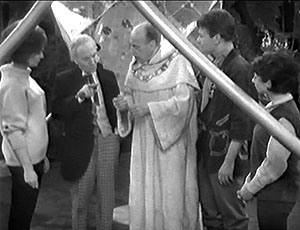
Timestamp #6: The Aztecs

Doctor Who: The Aztecs
(4 episodes, s01e25-e28, 1964)

Timestamp 006 The Aztecs

How delightful! This serial was great, with our heroes having to transition from being reactive to being proactive within the span of four episodes and unpredictable rapid-fire twists and turns. The TARDIS crew shows up, accidentally gets separated from the ship, and gets mistaken for a god and her assistants. As the main villain, Tlotoxl, the High Priest of Sacrifice, keeps throwing every twist and turn he can at the time-travellers in order to usurp the power mistakenly given to them by the other Aztecs.

The beauty of the serial is how the group is forced to shift from dodging Tlotoxl’s efforts to countering his machinations before he even makes a move. The smaller moments (the Doctor gets betrothed, Susan refuses to get married, and Ian fights warriors and discovers the path back to the ship) only add to the delicious point-counterpoint between Barbara and Tlotoxl.

Most importantly, this serial really starts to emphasize the points that I’m familiar with in the Doctor Who mythos. No matter what happens, the timeline must remain intact and certain fixed parts of history cannot be changed. The sacrifices must continue despite Barbara and Susan’s protests, and, amazingly enough, the story ends with a win-win for both the heroes and the villain.

This serial was an elegant dance. I had seen it once before, but within the context of the show, this time I actually experienced it.


Rating: 5/5 – “Fantastic!”


UP NEXT – Doctor Who: The Sensorites


The Timestamps Project is an adventure through the televised universe of Doctor Who, story by story, from the beginning of the franchise. For more reviews like this one, please visit the project’s page at Creative Criticality.

Timestamp #5: The Keys of Marinus

Doctor Who: The Keys of Marinus
(6 episodes, s01e21-e24, 1964)

Timestamp 005 The Keys of Marinus

This is a great serial that is a effectively a series of short stories linked by a common thread. The companions carry the story quite effectively for two episodes while William Hartnell took a much needed vacation. Hartnell’s energy after his return made what was a simplified courtroom/detective procedural sing where it could have otherwise fallen flat. I had some problems with the detective story, but there’s also not a lot of wiggle room for the writers in a somewhat slow-paced 20 minute presentation. These companions are smart, which is something I’m enjoying as this team comes together. The resolution of the arc once the group acquires all the keys was also quite brilliant.

I also give a tip of the hat to the production team for saving money on the TARDIS materialization/dematerialization by using a model. It may not look like much in today’s era, but it was quite well done for what they had available. I almost want a model TARDIS like that one.


Rating: 4/5 – “Would you care for a jelly baby?”


UP NEXT – Doctor Who: The Aztecs


The Timestamps Project is an adventure through the televised universe of Doctor Who, story by story, from the beginning of the franchise. For more reviews like this one, please visit the project’s page at Creative Criticality.

Timestamp #4: Marco Polo

Doctor Who: Marco Polo
(7 episodes, s01e14-e20, 1964)

Timestamp 004 Marco Polo

I watched the Loose Cannon reconstruct for this serial since all of the episodes are currently lost. It is a great story that ran a little long, but did have a decent ending. I particularly loved how the companions drove the story, even though it forced the Doctor into a much smaller role. It was also quite nice to remove the TARDIS from the characters so they couldn’t just jump in and fly away, although the ship does seem to be malfunctioning quite often. In An Unearthly Child, Susan points out that the chameleon circuit isn’t working. In The Daleks, we find out that the fluid link may possibly be a single point of failure for the ship. In The Edge of Destruction, a broken spring in a single switch causes an overload of the power source, nearly destroying the TARDIS. The fallout from that casualty drops the ship into Marco Polo without power, light, or heat. If I didn’t have the background from the Eccleston, Tennant, and Smith years, I’d be worried about how long the TARDIS can hold out.

Is the Doctor incompetent at operating the ship despite the adventures alluded to before the series began? Is the TARDIS intentionally causing some of these problems? Was it just a simple writing crutch in the beginning of the series?

I give Clara one thing: It does make for a more exciting journey.


Rating: 3/5 – “Reverse the polarity of the neutron flow.”


UP NEXT – Doctor Who: The Keys of Marinus


The Timestamps Project is an adventure through the televised universe of Doctor Who, story by story, from the beginning of the franchise. For more reviews like this one, please visit the project’s page at Creative Criticality.
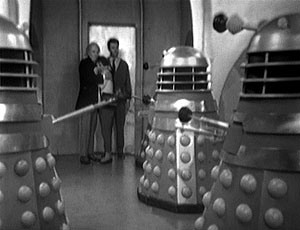
Timestamp #3: The Edge of Destruction

Doctor Who: The Edge of Destruction
(2 episodes, s01e12-e13, 1964)

Timestamp 003 The Edge of Destruction

Aside from developing the mythology behind the TARDIS being a living machine and some nice moments at the end between the Doctor and Barbara, I really didn’t like this serial much. It did emphasize some of the inherent friction amongst the companions and the Doctor, and seems to have healed those rifts to make a more coherent team. The plot, and especially the ending, seemed rushed and almost pulled from thin air.

Rating: 2/5 – “Mm? What’s that, my boy?”

UP NEXT – Doctor Who: Marco Polo

The Timestamps Project is an adventure through the televised universe of Doctor Who, story by story, from the beginning of the franchise. For more reviews like this one, please visit the project’s page at Creative Criticality.

Timestamp #2: The Daleks

Doctor Who: The Daleks
(7 episodes, s01e05-e11, 1963-1964)

Timestamp 002 The Daleks

The Daleks is vastly better than the first serial. I simply loved how duplicitous the Doctor was with the fluid link, the tiny little piece of the TARDIS that drives the entire serial. This story can be broken down into two distinct parts, the first of which is the introduction of the Daleks and the escape of the TARDIS crew from their imprisonment. The second is the quest to save the Thals from being destroyed by the Daleks. The first is more engaging than the second and lays the groundwork for the Dalek mythology. What’s inside those metal machines? I’m glad they saved part of that mystery and didn’t try to show it with the show’s minimal budget. The second is still a good story with good characterizations, and while it is important to the overall serial, it does drag a little.


Rating: 4/5 – “Would you care for a jelly baby?”


UP NEXT – Doctor Who: The Edge of Destruction 


The Timestamps Project is an adventure through the televised universe of Doctor Who, story by story, from the beginning of the franchise. For more reviews like this one, please visit the project’s page at Creative Criticality.

Timestamp #1: An Unearthly Child

Doctor Who: An Unearthly Child
(4 episodes, s01e01-e04, 1963)

Timestamp 001 An Unearthly Child

In short: I’m glad the show got better. The best part for me was the first episode, An Unearthly Child. The rest of the serial with the cavemen just didn’t grab me. There were some nice little character moments between the Doctor and Ian over leadership of the group, but the cavemen seemed very one-dimensional and dragged down the pacing. In particular, I enjoyed watching Ian deciding who should do what, but assuring the Doctor that he was still the leader.

My dislike of this serial is tempered by the leniency I offer to both pilot episodes and Doctor Who regeneration episodes. Pilots are always pretty tough, and regenerations episodes are even more tough because it’s the same show with a different face.


Rating: 3/5 – “Reverse the polarity of the neutron flow.”


UP NEXT – Doctor Who: The Daleks

The Timestamps Project is an adventure through the televised universe of Doctor Who, story by story, from the beginning of the franchise. For more reviews like this one, please visit the project’s page at Creative Criticality.