Timestamp: Third Series Summary

Doctor Who: Third Series Summary

Timestamp Logo First


I really enjoyed the third series, though it was not as strong as the first two. The Daleks got a wonderful serial that went on a bit long, and it finished strong with three good stories that I felt started to bring the show into a good stride. There are some less exciting adventures, like The Massacre of St. Bartholomew’s Eve and The Celestial Toymaker, which brought the score down a bit, but overall I’m still enjoying the First Doctor a lot more than I thought I would.

It will be sad to seem him go with only two serials to go. Before I start into Series Four, however, I plan to visit the Peter Cushing big screen interpretation one last time with the remake of Series Two’s The Dalek Invasion of Earth.


Galaxy 4 – 3
Mission to the Unknown  – 4
The Myth Makers – 3
The Daleks’ Master Plan – 4
The Massacre of St. Bartholomew’s Eve – 2
The Ark – 4
The Celestial Toymaker – 1
The Gunfighters – 3
The Savages – 4
The War Machines – 3

Series Three Average Rating: 3.1/5


UP NEXT – Special #2: Daleks’ Invasion Earth 2150 A.D.


The Timestamps Project is an adventure through the televised universe of Doctor Who, story by story, from the beginning of the franchise. For more reviews like this one, please visit the project’s page at Creative Criticality.

Timestamp #27: The War Machines

Doctor Who: The War Machines
(4 episodes, s03e42-e45, 1966)

Timestamp 027 The War Machines

Between this and The Gunfighters, there have been some new style choices for the opening titles. It feels like the producers are trying to find a fresh voice for the show. What really felt fresh with this serial was the return to the 20th century. The “out of order” sign was a clever touch, but the TARDIS is looking rather shoddy.

The story is a standard tech-run-amuck tale, with a globally-networked central intelligence computer named WOTAN that knows a lot about everything. I don’t recall that they explained how WOTAN knew so much about things beyond the 1960s or the planet Earth, and that was a little disappointing because it didn’t make a lot of sense.

It also didn’t know everything, as it referred to the titular Time Lord as “Doctor Who” instead of as “The Doctor.”

WOTAN goes full Skynet, building machines to destroy the human race. This was a dark serial, with a ruthless intelligence that kills in a binary fashion. WOTAN is very “you’re either with me, or you’re my enemy,” and is very fast with getting the parts ordered, shipped, and assembled for the war machines.

Another nit to pick is how a machine prevents mechanical and chemical reactions from occurring in a firearm. There was no explanation, which makes this a convenient cheat and hurts the writing. This is exemplified by the order, “Tell the men to hold their fire,” followed by a threat to continue firing if the machine doesn’t stand down. Sir Charles seemed a bit daft as a result of this shoddy writing as there is no gunfire: The guns and grenades aren’t working, remember? Click, click, click does not equal bang, bang, bang.

That said, I did like the resolution to the story in turning one of the war machines against WOTAN. It was good that intellect and cunning won over brute force.

I like Ben and Polly, which are obviously another swing at adding a fresh face to the show. They work well together, and are much stronger in carrying the story than many of the previous companions. It was also a clever ruse by the Doctor to determine if Polly and Ben want to travel with him: Drop the key and wait for them to bring it to him. I can see how it may not have been a ruse by the Doctor, but he’s not usually so lax about his TARDIS keys.

Finally, I have to address Dodo. She was far more conservative in this adventure, and I did like having WOTAN turn her against the Doctor in an effort to assimilate him. But, her departure was quite disappointing. I really enjoyed her presence in the TARDIS, and she has been one of my favorite companions so far. She deserved far better than to be written off in a line of dialogue. That really soured an otherwise enjoyable episode, as there wasn’t even a chance to say goodbye for the Doctor or the viewer.


Rating: 3/5 – “Reverse the polarity of the neutron flow.”

UP NEXT – Third Series Summary


The Timestamps Project is an adventure through the televised universe of Doctor Who, story by story, from the beginning of the franchise. For more reviews like this one, please visit the project’s page at Creative Criticality.


Timestamp #26: The Savages

Doctor Who: The Savages
(4 episodes, s03e38-e41, 1966)

Timestamp 026 The Savages

This serial kicks off with the Doctor pulling out his scientific tools again, and it’s good to see the him getting back to the exploits that we started Hartnell’s run with. What’s even more impressive is this story about class warfare and morality in the pursuit of utopia.

At first, I thought that the “savages” were supposed to be the cave-dwellers, but in truth the true savages are the technologically advanced upper class who power their entire lives with the life force of the lower class. It’s an allegory on progress, which depends on a certain amount of exploitation but requires a social conscience to prevent over-exploitation and unethical behavior. The story reminds me of countless Star Trek episodes, including the Next Generation pilot “Encounter at Farpoint“.

The cave dwellers and the light gun/mirror trick remind me Arthur C. Clarke’s Third Law: “Any sufficiently advanced technology is indistinguishable from magic.” It also plays into the continued deus ex machina of the Doctor and his travels.

Concerning both of those points, it was an great science fiction concept to place the Doctor in the vitality extractor. Would it extract only this incarnation’s life-force, or all twelve of his lives? It was also interesting that a life-energy transference would also bleed over some personality. The Doctor also never gets his energy back. Has this weakened him enough to prompt his regeneration in the near future?

Finally, Steven wasn’t my favorite companion, but this is a perfect ending for his voyage with the Doctor. His strong personality and morals will serve him well in negotiating a new civilization for both groups of savages.


Rating: 4/5 – “Would you care for a jelly baby?”


UP NEXT – Doctor Who: The War Machines


The Timestamps Project is an adventure through the televised universe of Doctor Who, story by story, from the beginning of the franchise. For more reviews like this one, please visit the project’s page at Creative Criticality.


Timestamp #25: The Gunfighters

Doctor Who: The Gunfighters
(4 episodes, s03e34-e37, 1966)

Timestamp 025 The Gunfighters

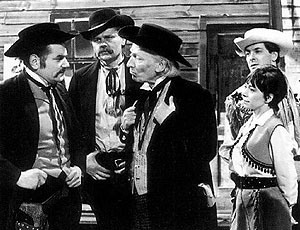
“Oh my dear Dodo, my dear Dodo. You know, you’re fast becoming a prey to every cliché-ridden convention in the American West.”

With the closing line, this serial openly nods to the satire that it just completed. It opens just like a 1950s Western, and plays off quite a few of the Western genre tropes, including using guns with unlimited ammunition (until the plot requires an empty revolver). Our heroes, two of which pull a complete Marty McFly with the costumes, are totally inept with guns. The Doctor, who fits right in with his normal costume, keeps getting handed guns in spite of his intense dislike of them.

“Doctor who?” Quite right. I loved the opening episode’s title, “A Holiday for the Doctor”, for its play on words around the mistaken identity that drove the plot.

On the downside, the serial’s special ballad was vastly overplayed. Even though it was supposed to compliment the narrative, it was annoying after the first half of the first episode.

Regardless, the parody was fun, and I feel that the intense dislike that this serial garners in fandom is a bit much. Episodes like this are nice breaks, but I don’t want them all the time.


Rating: 3/5 – “Reverse the polarity of the neutron flow.”


UP NEXT – Doctor Who: The Savages


The Timestamps Project is an adventure through the televised universe of Doctor Who, story by story, from the beginning of the franchise. For more reviews like this one, please visit the project’s page at Creative Criticality.


Timestamp #24: The Celestial Toymaker

Doctor Who: The Celestial Toymaker
(4 episodes, s03e30-e33, 1966)

Timestamp 024 The Celestial Toymaker

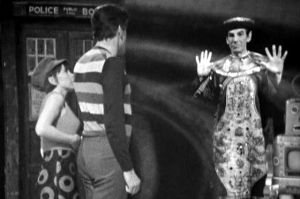
As I watched The Celestial Toymaker, I realized that this serial was probably better when it was originally aired. It seems to depend on visuals to carry the narrative as the companions work through puzzle after puzzle to escape from the Toymaker’s trap, and I tried to consider that as I watched the reconstructions.

The trap is pretty simple, as it is a series of challenges that test the heroes in wit and intelligence. If they win, they can leave, but if they lose, they stay with the Toymaker forever. In the end, even if the Toymaker didn’t cheat at every turn, he would have won if not for the Doctor’s cunning, and that leads me to an overarching question: “Why bother?”

In reality, this serial had no point except to show the sadism of the Toymaker, and that could have been condensed into two episodes at most. Sadly, this odd little story was rather tedious and boring.

This marks another serial that is less powerful due to the lack of the Doctor, who is conveniently struck both incorporeal and struck mute in an effort to send William Hartnell on vacation. Unfortunately, this leaves Steven and Dodo to carry the serial. Fortunately, Steven isn’t as annoying in this one, and Dodo is still adorable. These two just aren’t enough to propel a story, particularly when it isn’t especially strong to begin with.

Of note, it was fascinating to place this serial in its time with the racial slur buried in the “Eeny, meeny, miny, moe” nursery rhyme.

I tried to remain positive about this tale, but in the end, I’d rather never see it again.


Rating: 1/5 – “EXTERMINATE!”


UP NEXT – Doctor Who: The Gunfighters


The Timestamps Project is an adventure through the televised universe of Doctor Who, story by story, from the beginning of the franchise. For more reviews like this one, please visit the project’s page at Creative Criticality.


Timestamp #23: The Ark

Doctor Who: The Ark
(4 episodes, s03e26-e29, 1966)

Timestamp 023 The Ark


When we finally get introduced to the main story, it was with a prisoner being miniaturized for his crimes. All I could think was please, not another “Honey, I Shrunk the Doctor” serial. Thankfully, it wasn’t.

Dodo is impulsive and vibrant, and babbles like a brook. Indulging the obvious comparison, she’s no Susan, but she is a welcome contrast to the glum and dour Steven. She’s also a walking petri dish that ignites the conflict in this story by re-introducing the common cold to a group who solved that problem centuries ago. It’s understandable that the humans on the Ark react so energetically to this crisis, since it could likely kill them all and destroy everything that they have worked for. Thankfully, the Commander is more level-headed and fair than his interim replacement.

It’s an oddity of the era in which this show was made, but it caught me off-guard that the Doctor says “bless you” for Dodo’s sneeze. That saying derives from the outbreak of the bubonic plague in 590 AD. Pope Gregory I ordered unceasing prayer in hopes of divine intervention against the raging illness, so it became common for people to be offered a blessing for sneezing (“God bless you”) as an attempt to stop the disease’s progress. The Tenth Doctor once stated that he didn’t believe in any specific god, but had met many beings claiming to be gods. In story, is it just a quirk the Doctor has picked up from humans, an attempt to make Dodo feel more comfortable, a complete throwaway line, or something else?

This story has a common trope of an Ark to maintain the planetary status quo during calamity, though the miniaturization of the majority of the ship’s inhabitants is new to me within the playbook. The animals aren’t being used for food as evidenced by the rehydration process we see in the kitchens, so I wonder why they aren’t miniaturized for storage as well.

In a twist, 700 years later the friendly Monoids have become militant and taken over the ship. The problem I had with this idea was that the story didn’t sell me on the idea that the Monoids were slaves to the humans. They appeared to work hand-in-hand, and offered their help in building and flying the Ark. They didn’t appear to be subjugated in the first two episodes. As an aside, if they are supposed to be slaves in the first half of the story, that makes the makeup choices a little troublesome.

That said, I have a lot of respect for the actors portraying the Monoids. It can’t have been easy to spend all that time under hot studio lights in a black fabric sack with a Ping-Pong ball in their mouths.

It was nice to see bright and vibrant sets, even if the background paintings on the planet set are painfully obvious.

The Refusians were awfully convenient, but typical pulp sci-fi. Also, the puppet show in The Time of the Doctor makes more sense now that I know who the Monoids are.


Rating: 4/5 – “Would you care for a jelly baby?”

UP NEXT – Doctor Who: The Celestial Toymaker


The Timestamps Project is an adventure through the televised universe of Doctor Who, story by story, from the beginning of the franchise. For more reviews like this one, please visit the project’s page at Creative Criticality.

Timestamp #22: The Massacre of St. Bartholomew’s Eve

Doctor Who: The Massacre of St. Bartholomew’s Eve
(4 episodes, s03e22-e25, 1966)

Timestamp 022 The Massacre of St Bartholomews Eve

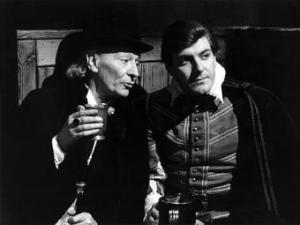
It’s a new adventure, this time in a straightforward story set in the middle of the rivalry between the Catholics and the Protestants. There are some nice twists that place Steven and the Doctor on opposing sides, but the absence of the Doctor and a lack of direction for Steven’s search make this serial difficult to watch.

Steven’s becoming a bit more tolerable in his role as companion, but his character isn’t strong enough to carry a serial on his own. I might be starting to identify with Steven though, as I felt his frustration as the Doctor wouldn’t explain his urgent need to leave.

The consistency was a bit difficult to reconcile as well, as the TARDIS is now back to landing in a new place instead of materializing, despite the Doctor’s recent admonitions to the contrary.

On the plus side, we get a new face with Dodo Chaplet. She seems spunky, and she might assuage some of the loneliness that is consuming the Doctor.

On the negative side, he’s already comparing her to Susan. Oh, God, he’s already comparing her to Susan.


Rating: 2/5 – “Mm? What’s that, my boy?”


UP NEXT – Doctor Who: The Ark


The Timestamps Project is an adventure through the televised universe of Doctor Who, story by story, from the beginning of the franchise. For more reviews like this one, please visit the project’s page at Creative Criticality.


Timestamp #21: The Daleks’ Master Plan

Doctor Who: The Daleks’ Master Plan
(12 episodes, s03e10-e21, 1965-1966)
Timestamp 021 The Daleks Master Plan

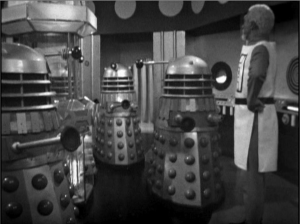
It’s a fantastic adventure with a lot of intriguing twists and turns that the Doctor and crew stumble into. It nicely capitalized on the thread started in Mission to the Unknown, even if it used the trope of missing an important message due to lack of attention. As a result, one special agent dies and the other almost does, and once again I issue the memo to the future to install annoying ringtones on the communication consoles. If in doubt, ask Nokia.

Meanwhile, Mavic Chen, the Guardian of the Solar System and unfortunate recipient of the yellowface treatment, sides with the Daleks over his own people after preaching about peace and harmony. Politicians never change, I suppose, however I did like how masterful he was in convincing his staff that otherwise faithful agents had betrayed the government.

I did like how Katarina, a girl from ancient Troy, was puzzled over modern medicine. Katarina’s motivations for remaining with the Doctor are unique: She believes that the Doctor is a god who can get her to heaven. It’s quite fitting, given the deus ex machina nature of the Doctor, and particularly chilling in the first-ever companion death in the series. It was an understandable move given how shallow Katarina’s character was, but I was just as shaken as the Doctor and I think it was because of the pure innocence Katarina embodied.

Actually stealing the key from the Doctor was an interesting way to keep TARDIS around, and while I appreciate the creativity in blocking the obvious solution to keeping our heroes out of trouble, I am growing a bit weary of it. The old switcheroo to get the Doctor into the meeting is creative, but how does no one notice the change in his gait or his feet?

I loved Sara Kingdom, a powerful take-charge female character, and her end was chilling as well. It’s a shame that the spin-off series that would have featured her never got off the ground. I also like the footprint effects for the invisible creature, which were impressive for a show of this era and budget.

The re-introduction of the Monk is a bit odd, and it seemed like filler to get the Daleks and Chen in position to chase the TARDIS. Luckily, the writers capitalized on the story point. He did have a suitable end, and as much as I want to see more of the Doctor’s people, I think I’m done with the Monk.

“The Feast of Steven” is an episode that should be excluded from this serial. It doesn’t add to the Dalek story, and the reconstruction doesn’t do it justice. I get what they were trying for since it was broadcast on Christmas Day, but it just doesn’t fit with the plot. On a minor note, the breaking of the fourth wall was a nice touch.

Also, Steven is still an idiot. Why, why, why(!), when he knows that there are Daleks around, would he call attention to himself by yelling for the Doctor? He’s ranking up there as my least favorite long-term companion.

A few minor notes: The cricket pitch scene was humorous, and reminded me of a similar scene in The Hitchhiker’s Guide to the Galaxy; The Doctor’s magic ring is a little too convenient for my tastes; and the final episode is a perfect conclusion to this epic story.

To wrap it up, I finally get the Daleks I know as they betray their allies in their true xenophobic and genocidal fashion.

Rating: 4/5  “Would you care for a jelly baby?”


UP NEXT – Doctor Who: The Massacre of St. Bartholomew’s Eve


The Timestamps Project is an adventure through the televised universe of Doctor Who, story by story, from the beginning of the franchise. For more reviews like this one, please visit the project’s page at Creative Criticality.




Timestamp #20: The Myth Makers

Doctor Who: The Myth Makers
(4 episodes, s03e06-e09, 1965)

Timestamp 020 The Myth Makers

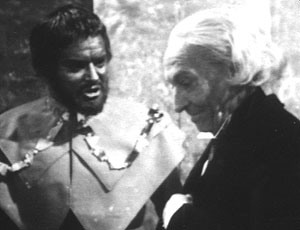
Doctor Who visits the Trojan war. The serial’s opening battle seems almost comical, but does a decent job of establishing the conflict among the plot’s characters. Looking back from 2014 to 1965, the Doctor pretending to be a god in order to more freely explore the setting is a clever meta nod to the deus ex machina that is Doctor Who. With his virtual immortality, changing faces, and supernatural abilities in comparison to the cultures he visits, The Doctor is, quite literally, a god in a machine.

The serial seems rather run of the mill, though the re-interpretation of the stories from myth are quite refreshing to see. It was a fairly clever ruse to rescue Vicki from the Trojans, and it was hard to watch her leave the TARDIS and the Doctor. I will certainly miss her wit and spunk. Her departure seemed rushed but still emotionally touching, and it will be interesting to see how the Doctor will respond. Unfortunately, this leaves us Steven (ugh) and the unknown (but quite limited) variable of Katarina as companions leading into the twelve-part master plan of the Doctor’s most powerful enemies.

As a side note but not a hit to the score for this review, the reconstruction’s music track is pretty bad. It sounds like a warped 45 RPM record, but there’s probably not much they can do about it since this serial is lost. It was distracting, but easy to work around.


Rating: 3/5  “Reverse the polarity of the neutron flow.”


UP NEXT – Doctor Who: The Daleks’ Master Plan


The Timestamps Project is an adventure through the televised universe of Doctor Who, story by story, from the beginning of the franchise. For more reviews like this one, please visit the project’s page at Creative Criticality.

Timestamp #19: Mission to the Unknown

Doctor Who: Mission to the Unknown
(1 episode, s03e05, 1965)

Timestamp 019 Mission to the Unknown

This is a nice interlude that shows the audience a slice of time and space around the Doctor Who mythos in a completely Doctor-less story. In fact, the Doctor passes by the planet at the end of Galaxy 4, totally unaware that this threat is rising to meet him in short order. This is the kind of interweaving mythology and storytelling that I dig.

This episode is pretty much James Bond meets Doctor Who with the Space Security Service and their license to kill. I really want to see the proposed series that this small entry was supposed to springboard, as it would be fun to see the Service as they hunt Daleks across the universe. Since the Doctor usually has trouble defeating them, I really want to know how a group of humans would tackle the Daleks.

By the end, the Daleks are assembling a coalition of the greatest powers across seven galaxies to defeat Earth. It will be interesting to see how this plays out in the twelve-part The Daleks’ Master Plan. The Daleks seem significantly less xenophobic in the early years, but that may just be a ploy in order to destroy everyone all at once.


Rating: 4/5 – “Would you care for a jelly baby?”


UP NEXT – Doctor Who: The Myth Makers


The Timestamps Project is an adventure through the televised universe of Doctor Who, story by story, from the beginning of the franchise. For more reviews like this one, please visit the project’s page at Creative Criticality.