
Timestamp #43: The Wheel in Space

Doctor Who: The Wheel in Space
(6 episodes, s05e34-e41, 1968)

Timestamp 043 The Wheel in Space


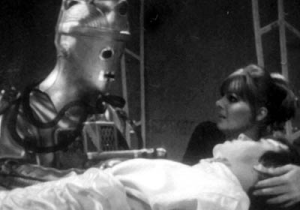
The Wheel in Space is still the basic “base under siege” story that was typical of the fifth series, but this one feels more unique.  First, the crew of the titular space station doesn’t believe in the Cyberman threat until it actually shows itself. Second, the antagonists partially control the escape route (the TARDIS is stranded on the rocket with the Cybermen) and are a bit more menacing in this story, finally bringing the boys in aluminum foil suits back to nearly the same threat level that they displayed in The Tenth Planet. There’s also the added twist of the impending meteor shower which adds dramatic pressure to the plot and prevents the protagonists from taking too much time or waiting for the enemy to make a move.

We also see a considerable amount of hand waving combined with smoke and mirrors in this serial. Classic Who fans complain about how the recent era (the “New Who” era) of the show treats the iconic sonic screwdriver like a magic wand – and the show runners even make fun of it themselves, as seen in the 50th anniversary special Day of the Doctor – but the “time vector generator” is a much more egregious example of a magic MacGuffin and overall problem solver. It acts as an improvised gun to destroy the robot on the rocket (wait, doesn’t the Doctor abhor using guns?), produces radio interference to signal the space station and save Jamie and the Doctor, supercharges the station’s X-ray laser to destroy the Cyberman spaceship, and controls the entire “bigger on the inside” element of the TARDIS itself. It’s less iconic than the sonic, and stretches the entire joke of the Second Doctor’s skill at pulling the right tool for the job from his pockets to a non-humorous extreme. That little metal bar feels overly convenient and considerably lazy scriptwise, and I kind of hope that we never see it again.

Okay, enough with that.

The motivations of the station crew are believable, and that helped sell me on this serial. They want to destroy the rocket because its erratic flight poses a collision danger to the station. They’re also skeptical of the Doctor and Jamie because the travelers are conspicuously unable to fit in with the current time, and act suspiciously at every move. even right down to the genesis of the Doctor’s long-term alias, John Smith. It’s also fascinating to see how the crew relates to Zoe, an astrophysicist relegated to librarian, which (ironically) is a role that the station couldn’t operate without. She feels underappreciated and completely enthralled with the mystery of the Doctor, so she joins the team as the new companion. She’s definitely quite smart and innocent, but somewhat shy and introverted, and I’m eager to see how she manages with the Doctor and Jamie.

Other positives on this serial include the TARDIS defense mechanism driven by Powerpoint slides of serene temptations, the decorations in the Cyberman control center that are giant lava lamps, and a callback to the infamous fluid link that keeps the TARDIS grounded after a power overload vaporizes the link’s mercury supply.

One minor downside was the Cybermen marching through space. That was rather silly.

This was a really good serial, but the convenience of the time vector generator really soured it for me. I settled on a 3.5 out of 5, but, as always, I’m looking forward and working with whole numbers.


Rating: 4/5 – “Would you care for a jelly baby?”


UP NEXT – Fifth Series Summary


The Timestamps Project is an adventure through the televised universe of Doctor Who, story by story, from the beginning of the franchise. For more reviews like this one, please visit the project’s page at Creative Criticality.



Timestamp #37: The Tomb of the Cybermen

Doctor Who: The Tomb of the Cybermen
(4 episodes, s05e01-e04, 1967)

Timestamp 037 The Tomb of the Cybermen

The fifth series starts right where the fourth left off with Victoria joining the crew.

The travelers arrive on the homeworld of the Cybermen to find an archaeology team researching the titular tomb. It’s a nice parallel to the previous serial, which briefly (re)visited the homeworld of the Daleks. As they explore, they unravel more of the enemy’s background. I had seen the cybermats before on the recent series episodes, so it’s good closure on my end to see where the mechanical caterpillars originate.

The team restores power to the complex and awakens the tomb, but the rocket ship is broken and the pilot is distrustful, so the team is stranded. Of course, the Doctor can leave anytime, but he chooses to remain, and the story continues with members of the exploration team belonging to the Brotherhood of Logicians, who want to add the Cybermen’s power to the Brotherhood’s intelligence.

I like the design of the Cybercontroller with the semi-transparent brain cavity, but those voices are still hard to understand at times. We also discover that these Cybermen are related to those from the assault on the moon base.  Once again, without explanation, they recognize the Doctor despite his new persona, but they do explain that the moon base attack was motivated by fear of becoming extinct thanks to the First Doctor’s actions toward Mondas.

An artifact of the 1960s are the stunt wires, which are plainly visible during the fight on my plasma screen, but were probably easily hidden on CRTs half a century ago.

The companions get some nice beats in this serial. First, Victoria reflects on her family and the terror of the Daleks with counsel from the Doctor. She’s very innocent, but very loyal. Jamie also gets to exploit his very well-developed relationship with the Doctor, especially in one exchange that made me guffaw. When discussing the minds of the cybermats:

“You might say they’ve had a complete metal breakdown.”

“Oooh.”

“Sorry.”

In another mythology-building moment, The Doctor advocates using a firearm to kill as he has no other choice, but then rejects it moments later when he enters the tomb to finish off the Cybermen. He also wraps up this serial with a refusal to make predictions about the end of the Cybermen, even though he was really really sure about the Daleks just days earlier. Spoiler alert, Doctor: They both come back.

I think Series Five has set a high bar with an excellent adventure.


Rating: 5/5 – “Fantastic!”

UP NEXT – Doctor Who: The Abominable Snowmen


The Timestamps Project is an adventure through the televised universe of Doctor Who, story by story, from the beginning of the franchise. For more reviews like this one, please visit the project’s page at Creative Criticality.

Timestamp #33: The Moonbase

Doctor Who: The Moonbase
(4 episodes, s04e23-e26, 1967)

Timestamp 033 The Moonbase


The Cybermen are back, and a bit better designed than their last appearance not so long ago.

The story is about a weather control station on the moon that is being attacked by a mysterious virus. The virus, craftily hidden in their sugar supply, disables the staff of the moonbase so the Cybermen can essentially assimilate the most compatible of the infected and kill everyone on Earth with storms induced by the station’s control system. It’s pretty straightforward.

It turns out that the Doctor is an actual medical doctor who studied under Joseph Lister, and Jamie is safe because he didn’t use the sugar and has a head injury that disqualifies him from being transformed. Ben and Polly acted rather intelligently in fighting the Cybermen with a chemical attack to disable their control systems.

I noted some 1960s sexism: The making of coffee wasn’t an example, but “stay here, Polly, this is men’s work” certainly was. Luckily, Polly is a strong and independent woman… at least in most of her serials with the Doctor.

The Cybermen are a bit hard to understand in this serial. They have new voices, which are heavy treated with audio effects. Also, how do they know the Doctor’s new face? Between them and the Daleks, I’m beginning to think that the Doctor has an aura that every major antagonist recognizes over the face or physical features.

Meanwhile, the internal dialogue with the Doctor was distracting. It wasn’t terrible, but certainly not something I’m familiar with in the franchise.

The depressurization of the dome seemed a bit unrealistic, since the air rushes out, but no one is pulled with it and the coffee is still standing.

Finally, the jumping on the moon with bionic sound effects. Ugh.

Not a bad serial by any stretch, but not a top performer either.

Rating: 3/5 – “Reverse the polarity of the neutron flow.”


UP NEXT – Doctor Who: The Macra Terror


The Timestamps Project is an adventure through the televised universe of Doctor Who, story by story, from the beginning of the franchise. For more reviews like this one, please visit the project’s page at Creative Criticality.


Timestamp #29: The Tenth Planet

Doctor Who: The Tenth Planet
(4 episodes, s04e05-e08, 1966)

Timestamp 029 The Tenth Planet

This serial had a slow lead up to an otherwise enjoyable story. It’s the introduction of the Cybermen! Wow, they have come a long way in costume and character design. The Cybermen were a bit hard to understand, and were certainly more individual than the later versions.

It was good to get the backstory on such a popular villain, and the story keeps rolling with excellent tension surrounding the stranded astronauts and assault in isolation. Cutler was the trope of the blood-thirsty military officer, which felt a little bonk-bonk on the head with the message. That in mind, I get Cutler having no problem killing the Cybermen, but what didn’t follow was Ben enabling Cutler to kill them. Ben was terribly upset about killing in self-defense mere moments earlier, but then hands Cutler the gun without hesitation.

The Doctor spontaneously collapses and remains out of commission for an episode of the serial. This leaves the companions to carry the story, both in and out of the serial. Hartnell was obviously having a hard time with this one, and luckily the companion actors and characters are both strong enough to keep the gears turning.

Remember the rules, though: It’s a regeneration episode, so it get an automatic +1 on the score. They’re always hard episodes to do.

Watching the First Doctor say goodbye was heart-breaking. The companions think he’s either worn out or going daft, but it felt a lot more like he was completely lucid in his final moments. Just in case this regeneration thing doesn’t work, “stay warm.”


Rating: 4/5 – “Would you care for a jelly baby?”


UP NEXT – First Doctor Summary


The Timestamps Project is an adventure through the televised universe of Doctor Who, story by story, from the beginning of the franchise. For more reviews like this one, please visit the project’s page at Creative Criticality.