

The Thing About Today – January 6

January 6, 2020
Day 6 of 366


January 6th is the sixth day of the year. It is observed as Epiphany (Three Kings’ Day) or Theophany in Western and Eastern Christianity, respectively.

In the United States, it is “celebrated” as National Bean Day, National Cuddle Up Day, National Shortbread Day, National Technology Day, and National Thank God It’s Monday Day. The last one typically falls on the first Monday in January.


Historical items of note:

  • In 1412, French martyr and saint Joan of Arc was born.
  • In 1540, King Henry VIII of England married Anne of Cleves.
  • In 1839, The Night of the Big Wind swept across Ireland. This was the most damaging storm in 300 years and damaged or destroyed more than twenty percent of the houses in Dublin.
  • In 1893, the Washington National Cathedral was chartered by Congress, signed by President Benjamin Harrison.
  • In 1903, Greek-American pianist and conductor Maurice Abravanel was born.
  • In 1912, New Mexico was admitted as the 47th U.S. state.
  • In 1925, John DeLorean, the American engineer and businessman who founded the DeLorean Motor Company, was born. The vehicles he produced had enough style to become a famous time machine.
  • In 1946, the first-ever general election was held in Vietnam.
  • In 1955, Rowan Atkinson was born. An English actor, producer, and screenwriter, Atkinson is probably best known for his roles in the Blackadder and Mr. Bean television series.
  • In 1969, American actor Norman Reedus was born.
  • In 1973, Schoolhouse Rock premiered on ABC.
  • In 1975, Wheel of Fortune premiered on NBC.
  • In 1982, English actor Eddie Redmayne was born.
  • In 1984, actress and comedian Kate McKinnon was born.


In 1941, President Franklin Roosevelt delivered the Four Freedoms speech during his State of the Union address. The speech was delivered eleven months before the surprise attack by Japanese forces on Pearl Harbor, the event that forced the United States to declare war on Japan during World War II.

The speech outlined four fundamental freedoms that people everywhere in the world should enjoy: Freedom of speech, freedom of worship, freedom from want, and freedom from fear. The first two freedoms were inspired by the First Amendment in the Bill of Rights, but the latter two freedoms went beyond the typical Constitutional values and bases. The basic human right to economic security was enshrined decades later as the human security paradigm in social sciences, and the freedom from fear was a key element of the United Nations which the president was establishing.

The Four Freedoms Speech was part of Roosevelt’s hope that the United States would abandon the isolationist policies that emerged from World War I. The speech also established the ideological basis for involvement in World War II, framed in terms of individual rights and liberties. It lived on for decades as a frame for remembrance of those lost in the war, as well as a staple for values central to American life and exceptionalism.

In the future days, which we seek to make secure, we look forward to a world founded upon four essential human freedoms.

The first is freedom of speech and expression—everywhere in the world.

The second is freedom of every person to worship God in his own way—everywhere in the world.

The third is freedom from want—which, translated into world terms, means economic understandings which will secure to every nation a healthy peacetime life for its inhabitants—everywhere in the world.

The fourth is freedom from fear—which, translated into world terms, means a world-wide reduction of armaments to such a point and in such a thorough fashion that no nation will be in a position to commit an act of physical aggression against any neighbor—anywhere in the world.

That is no vision of a distant millennium.

It is a definite basis for a kind of world attainable in our own time and generation.

That kind of world is the very antithesis of the so-called new order of tyranny which the dictators seek to create with the crash of a bomb.

Interestingly enough, while President Roosevelt declared that the Four Freedoms embodied “rights of men of every creed and every race, wherever they live,” he was also the leader who authorized Japanese-American and Italian-American internment camps during World War II. Racial segregation also continued in the United States for decades to follow.


The Thing About Today is an effort to look at each day of 2020 with respect to its historical context.

For more creativity with a critical eye, visit Creative Criticality.


The Thing About Today – January 5

January 5, 2020
Day 5 of 366


January 5th is the fifth day of the year. It is the twelfth of the Twelve Days of Christmas, National Bird Day in the United States, and Take Our Daughters and Sons to Work Day in Australia (or at least Sydney, Melbourne, and Brisbane).

In the United States, it is “celebrated” as National Bird Day, National Keto Day, National Screenwriters Day, and National Whipped Cream Day.


Historical items of note:

  • In 1874, Nobel Prize laureate, physiologist, and academic Joseph Erlanger was born.
  • In 1875, the Palais Garnier was inaugurated in Paris, France. It one of the most famous opera houses in the world and has inspired artwork and architecture around the world.
  • In 1914, actor and director George Reeves was born. He portrayed Superman on television during the 1950s.
  • In 1933, construction of the Golden Gate Bridge began in San Francisco Bay.
  • In 1941, 37-year-old pilot Amy Johnson disappeared after bailing out of her plane over the River Thames. She was the first woman to fly solo from London to Australia.
  • In 1945, cartoon character Pepe LePew debuted in “Odor-able Kitty”.
  • In 2005, the most massive and second-largest known dwarf planet in our solar system was discovered. It was named Eris after the Greek goddess of strife and discord.


In 1914, the Ford Motor Company made the (then) radical announcement that they would institute eight-hour workdays and a minimum daily wage of $5 in salary plus bonuses. The previous standard was nine-hour workdays and half that wage, and the new standards were contingent on workers maintaining certain “character standards.”

This wasn’t the first step toward an eight-hour workday, but it was a significant one. Workers had been lobbying for fair working hours in the United States since at least 1971 when Philadelphia carpenters went on strike to achieve a ten-hour workday. The history of the United States is littered with protests and strikes for fair labor practices, and even with Congressional action and a proclamation by President Ulysses Grant in 1868 and 1869, the eight-hour workday wasn’t a reality for many workers until 1937’s Fair Labor Standards Act as proposed under President Franklin Roosevelt’s New Deal.

The move by Ford in 1914 wasn’t popular within the industry, but when Ford’s productivity increased and their profit margin jumped from $30 million to $60 million in two years, most of Ford’s competitors followed suit. The die was cast.


The Thing About Today is an effort to look at each day of 2020 with respect to its historical context.

For more creativity with a critical eye, visit Creative Criticality.



The Thing About Today – January 4

January 4, 2020
Day 4 of 366


January 4th is the fourth day of the year. It is the eleventh of the Twelve Days of Christmas and the celebration of World Braille Day.

In the United States, it is “celebrated” as National Missouri Day, National Spaghetti Day, and National Trivia Day.


Historical items of note:

  • In 1643, English mathematician and physicist Isaac Newton was born.
  • In 1762, Great Britain declared war on Spain and entered the Seven Years’ War.
  • In 1785, Jacob Grimm was born. He was the eldest of the Brothers Grimm.
  • In 1809, Louis Braille was born. He invented the Braille language.
  • In 1853, Solomon Northrup regained his freedom after having been kidnapped and sold into slavery in the American South. His memoir, Twelve Years a Slave, became a national bestseller.
  • In 1896, Utah was admitted as the 45th U.S. state.
  • In 1903, Topsy the Elephant was killed by electrocution at Coney Island, New York. The gruesome spectacle was filmed by the Edison Manufacturing movie company and released later as the first animal death filmed in history.
  • In 1959, Luna 1 reached the vicinity of the Moon.
  • In 1963, Canadian comedian, actor, director, and producer Dave Foley was born.
  • In 1984, Night Court premiered on NBC.
  • In 2004, NASA rover Spirit landed on Mars.
  • In 2010, the Burj Khalifa opened in Dubai. It was the world’s tallest building upon opening and retains the record as of this writing.


In 1916, Lionel Newman was born. He was an American conductor, pianist, and film and television composer. A member of the famous musical Newman family – he was the brother of Alfred and Emil Newman, grandfather of Joey Newman, and uncle of Randy Newman, David Newman, Thomas Newman, and Maria Newman – his eleven Oscar nominations contributed to the family’s record as the most nominated Academy Award extended family (with 92 nominations in total). He won the Academy Award for Best Score of a Musical Picture for 1969’s Hello Dolly!

Newman was the youngest of seven boys in a family of ten children, born in New Haven, Connecticut to Russian-Jewish immigrant parents. He joined 20th Century Fox as a rehearsal pianist under his brother Alfred’s guidance, eventually moving to Musical Director for Television, vice president in charge of music for both television and feature films, and senior vice president of all music at Twentieth Century Fox Films.

His tenure with Fox spanned 46 years and over 200 films. He was the musical director for all of Marilyn Monroe’s films and the musical supervisor for the original Star Wars trilogy. He died in 1989, but his legacy continues on at the Twentieth Century Fox Music Department, which was dedicated as “The Lionel Newman Music Building” in 2013.


The Thing About Today is an effort to look at each day of 2020 with respect to its historical context.

For more creativity with a critical eye, visit Creative Criticality.


Culture on My Mind – The Call of the Wild

Culture on My Mind
The Call of the Wild

January 3, 2020

In this edition of Culture on My Mind, the thing that I can’t let go of is the late November 2019 trailer release for The Call of the Wild.

The Call of the Wild is a 1903 novel written by Jack London. Set in Yukon, Canada during the 1890s Klondike Gold Rush, the story is centered on a dog named Buck. Buck is a large and powerful St. Bernard-Scotch Collie mix, and he is stolen from his California home and sold into service as a sled dog. He becomes more and more feral in the harsh Yukon environment and is forced to fight to survive. By the end of his journey, Buck emerges as a leader in the wild and becomes a legend in his own right.

The novel has been adapted to film and television at least eight times, and a big-budget version directed by Chris Sanders (the creator and voice of Stitch, and the director of How to Train Your Dragon) and starring Harrison Ford, Dan Stevens, Omar Sy, Karen Gillan, and Bradley Whitford should look amazing.

Unfortunately, I’m too distracted by Buck.

Instead of using a live dog in the role supplemented by CGI special effects for dangerous stunts, 20th Century Fox and the creative team decided to use a totally computer-generated dog with cartoonish responses as the story’s lead. It’s particularly disappointing given the long history of family films that include trained animal actors in starring roles. Disney alone has at least 70 titles that fit the bill, including the Homeward Bound/Incredible Journey films, Old YellerWhite FangEight Below, 101 Dalmatians, and Benji the Hunted. Most recently, they released Togo for Disney+ and that film bridged CG and live-action quite nicely.

Even if Fox didn’t want to include Disney’s expertise – The Call of the Wild began development in 2017 and starting principal photography in late-September 2018, right in the middle of the negotiations for the Disney acquisition of 21st Century Fox – the talent and knowledge exists in the industry to make this film work with a live animal actor. Universal did it with two Babe films and three adaptations of W. Bruce Cameron’s work (A Dog’s PurposeA Dog’s Journey, and A Dog’s Way Home). Columbia Pictures (now part of Sony) brought us The Adventures of Milo and Otis. Warner Bros made Free Willy. Paramount did Charlotte’s Web.

Not to mention the entire Benji franchise, of which only one title was touched by Disney.

Frankly, a story like The Call of the Wild deserves better than being undermined by cartoonish CGI effects. It’s possible that the effects weren’t finalized by the November trailer release, but several scenes certainly played like the cartoon responses were part of the joke. I just expected more of a White Fang than something like this.

The Call of the Wild hits theaters on February 21, 2020.
cc-break

Culture on My Mind is inspired by the weekly Can’t Let It Go segment on the NPR Politics Podcast where each host brings one thing to the table that they just can’t stop thinking about.

For more creativity with a critical eye, visit Creative Criticality.

The Thing About Today – January 3

January 3, 2020
Day 3 of 366


January 3rd is the third day of the year. It is the tenth of the Twelve Days of Christmas.

In the United States, it is “celebrated” as National Chocolate Covered Cherry Day, National Drinking Straw Day, and National Fruitcake Toss Day.


Historical items of note:

  • In 1870, construction began on the Brooklyn Bridge.
  • In 1892, English writer, poet, and philologist J.R.R. Tolkien was born.
  • In 1933, Minnie D. Craig was elected as Speaker of the North Dakota House of Representatives. She was the first woman to hold a Speakership in the United States.
  • In 1937, American director, producer, and screenwriter Glen A. Larson was born. He would create or work on several Generation X television classics, including Battlestar Galactica.
  • In 1938, The March of Dimes was established by President Franklin D. Roosevelt as a foundation to fight polio.
  • In 1953, Dragnet starring Jack Webb premiered on NBC.
  • In 1959, Alaska was admitted as the 49th state in the United States.
  • In 1975, actress, writer, and mathematician Danica McKellar was born.
  • In 1977, Apple Computers was incorporated.
  • In 1993, Star Trek: Deep Space Nine premiered.
  • In 2000, the final daily edition of Peanuts was published.


In 1961, the Stationary Low-Power Reactor Number One (SL-1) nuclear accident occurred. The boiling water reactor was part of the Army Nuclear Power Program located at the Nuclear Reactor Testing Station near Idaho Falls, Idaho. The project was designed to create small nuclear power sources to provide electrical power and heat for remote facilities in the arctic.

The reactor was shutdown on December 21, 1960 for routine maintenance. Part of this maintenance was the installation of 44 wires to monitor neutron flux in the core. In preparation for a reactor restart on January 3, 1961, the main central control rod was to be manually withdrawn by a few inches to reconnect it to its drive mechanism. At 9:01pm, the rod was suddenly withdrawn too far.

Both boiling water and pressurized water reactors rely on the fission of nuclear fuel to produce neutrons. Those created directly after a fission event are called prompt (or fast) neutrons. Those created after the further decay of fission products are called delayed neutrons. Each of these neutrons can interact with the fuel to create more reactions, and each fission event generates heat with (eventually) generates power.

If enough fission events occur to make a reaction steady and self-sustaining, the reactor is called critical. Unlike what nearly every science-fiction property tells us, a critical reactor is a happy reactor. If the rate of fission events decreases, the reactor becomes subcritical. The reverse, an increase in fission events, causes the reactor to become supercritical.

These deviations from a critical state are controlled by reactivity. A positive reactivity event leads to supercriticality and a negative reactivity event pushes toward subcriticality. The withdrawal of a control rod, for example, increases the ability for neutrons to interact with fuel and is an insertion of positive reactivity.

If a significant number of prompt neutrons are created, the reactor becomes prompt critical and uncontrollable. It generates neutrons and power output at an exponential rate. This is what happened at SL-1.

The operators inadvertently pulled the control rod too far, and the rapid withdrawal inserted enough positive reactivity to make the reactor prompt critical. The reactor was rated for 3 megawatts, but in four milliseconds it generated 20 gigawatts of power. The fuel inside the core melted and vaporized, causing a slug of water to explosively propel the entire reactor vessel upward. The shield plugs were ejected from the top of the core, opening holes that sprayed radioactive water, fuel, and debris all over the room. The water knocked two of the operators to the floor, killing one on impact. One of the plugs struck the third operator in the groin and pinned him to the ceiling.

The entire event took approximately four seconds.

The operator that survived the event later succumbed to his wounds, however the radiation exposure from the accident would have killed all three even if they hadn’t suffered any physical trauma.

The event forced the Army to abandon the design. It also helped solidify the “one stuck rod” criterion in future designs to ensure that no single control rod withdrawal could lead to a similar accident. Essentially, a nuclear reactor must be able to maintain a shutdown state with the most reactive rod stuck at its maximum position.

Just like other major nuclear accidents, the event is used to train operators and engineers to this day.


The Thing About Today is an effort to look at each day of 2020 with respect to its historical context.

For more creativity with a critical eye, visit Creative Criticality.


The Thing About Today – January 2

January 2, 2020
Day 2 of 366


January 2nd is the second day of the year. It is the ninth of the Twelve Days of Christmas, Ancestry Day in Haiti, and Carnival Day in Saint Kitts and Nevis.

In the United States, it is “celebrated” as National Buffet Day, National Cream Puff Day, National Personal Trainer Awareness Day, and National Science Fiction Day.


Historical items of note:

  • In 1778, the State of Georgia was the fourth to ratify the United States Constitution.
  • In 1936, musician and actor Roger Miller was born.
  • In 1947, zoologist and author Jack Hanna was born.
  • In 1959, Luna 1 was launched by the Soviet Union. It was the first spacecraft to reach the vicinity of the Moon and to orbit the Sun.
  • In 2004, Stardust flew by Comet Wild 2, eventually returning to Earth with samples.


In 1959, the Soviet Union launched a spherical satellite called Luna 1. Powered by mercury-oxide batteries and silver-zinc accumulators, the launch was manually controlled via radio since engineers of the time did not trust automated systems. When one of the engine commands was sent too late, the rocket picked up an additional 175 meters per second. Instead of impacting the lunar surface as planned, the vehicle missed its target and inadvertently became the first spacecraft to leave geocentric orbit and enter an orbit around the sun.

As part of its experiments, the spacecraft released one kilogram of sodium gas in order to track the craft’s trajectory and analyze the behavior of gas in space. It also took readings of the lunar magnetic field and the radiation in the outer Van Allen belt. It also took the first-ever direct observations and measurements of solar wind.

A similar mission was launched by the American space program two months later. After Luna 1‘s battery was depleted, the spacecraft settled into a heliocentric orbit between Earth and Mars where it still orbits to this day.


The Thing About Today is an effort to look at each day of 2020 with respect to its historical context.

For more creativity with a critical eye, visit Creative Criticality.


Timestamp #TW18: Adam

Torchwood: Adam
(1 episode, s02e05, 2008)


A science-fiction staple trope hits Torchwood Three: Fake memories for everyone!

Gwen is late for work due to some morning frolicking with Rhys. Meanwhile, the Torchwood team is investigating a strange box with new team member Adam Smith. Gwen doesn’t recognize him since she’s been away, but after a brief touch on her shoulder, Gwen is fully onboard thanks to some false memories.

Adam does the same with Tosh, implanting some romantic memories after fiddling with his personnel file. Other changes include a playful Owen who is now wearing glasses and Jack seeing visions of a child in the containment cells. The cracks start to show when Gwen goes home but doesn’t recognize Rhys – Adam has never met the man, and his power tends to replace memories rather than merely inserting them – and calls in the team to deal with the supposed home intruder. Jack recognizes Rhys and, thanks to the engagement ring on her hand, Gwen is convinced enough to accompany her teammates back to the Hub.

Owen examines Gwen while Jack interviews Rhys to help jog her memory. Gwen returns home, and Jack keeps seeing visions of the kid. When Jack pursues a Weevil into the sewers, he finds a man who he recognizes as his father. Adam appears moments later and places a few more memories into Jack’s head while he probes the man’s past.

He thinks back to his childhood on the Boeshane Penninsula. His community was invaded by aliens, and Jack was given charge of his brother Gray when his father went back for his mother. In the confusion, Gray was lost, and Jack returned home to find his father dead. Jack is riddled with grief and guilt, and he storms away.

Owen and Tosh continue their investigation of the strange box. The box is made of wood, and Ianto offers to check his diary for any history of the artifact. Owen keeps flirting with Tosh, but she’s completely enamored with Adam. Owen professes his love for Tosh, but this only angers Tosh. Owen is devastated.

Rhys and Gwen go to a general store, and when the cashier ignores Rhys, he goes on a rant. Gwen laughs as some of her memories come back to her.

Ianto notes that his diary has no mention of Adam. When Ianto confronts the newest Torchwood member, Adam inserts false memories of Ianto as a serial killer. Adam relishes the thrill while Ianto is left crying on the floor. He then visits Tosh and leverages her fake memories of him to gauge her devotion to him. She claims that she would die to protect him.

Jack puzzles over why long-buried memories of his childhood trauma are surfacing now. He returns to the Hub to find Ianto begging to be incarcerated for his supposed crimes. Jack investigates, eventually finding the CCTV footage of Adam manipulating Ianto’s mind, and he finally uncovers the truth behind Adam’s touch.

Jack checks the records but can’t find a blood sample for Adam. The lights come up as the team arrives for the morning, complete with an apology bouquet from Owen to Tosh. Adam tries to bring the team in for a group hug, but Ianto rejects Adam’s touch. Jack confronts Adam by gunpoint and, despite Tosh’s protests, eventually sends the imposter to the cells. Adam claims that everything has changed the team for the better, but Jack is furious.

The team discusses the Adam situation as their real memories start to surface. Jack gives each team member a Retcon pill to wipe the last 48 hours – Adam’s existence – from their minds. Jack visits Adam one last time and Adam offers to revive a good memory for him. It’s a kindness born of an eternity spent floating in the Void: Jack recalls a day with his father and Gray. Adam can’t help himself, however, and inserts himself into the memory as means of survival. The memory is ruined and Jack takes the Retcon pill.

With no one left to remember him, Adam is destroyed.

The team wakes up sometime later, curious as to why the last 48 hours have vanished. All that remains is the bouquet and the mystery box that contained Adam’s essence. Jack figures out how to open the box, but all that it holds is sand.

Presumably from the memory of the Boeshane Penninsula.


The false memory and implanted memory trope is a staple of science-fiction. TV Tropes has a page dedicated to it, and the trope is everywhere. The saving grace is how Torchwood approached it with the show’s dark vision. In fact, Adam’s claim that his intervention has improved the team – gaslighting, anyone? – makes him a believable villain, and the writers hung a lampshade on his manipulation being a violation. Particularly with Tosh and the forced intimacy, which plays as an allegory for rape. Unfortunately, the recovery from that is never as simple as Torchwood‘s quick fix amnesia pill.

To that end, I enjoy the creepiness of this story, especially how it showed how vulnerable our heroes are despite their upfront strength. Guns and alien tech only discourage so much, you know? I also liked how the show keeps an eye on internal continuity: One of Ianto’s anchor memories was Lisa.


Rating: 4/5 – “Would you care for a jelly baby?”


UP NEXT – Torchwood: Reset


The Timestamps Project is an adventure through the televised universe of Doctor Who, story by story, from the beginning of the franchise. For more reviews like this one, please visit the project’s page at Creative Criticality.


The Thing About Today – January 1

January 1, 2020
Day 1 of 366


January 1st is the first day of the year. It is known as New Year’s Day for most of the world. It is the last day of Kwanzaa, the eighth of the Twelve Days of Christmas, and the second day of Hogmanay in Scotland.

In the United States, it is “celebrated” as National Bloody Mary Day and National Hangover Day.


Historical items of note:

  • In 1735, famous American silversmith, engraver, and revolutionary patriot Paul Revere was born.
  • In 1752, Betsy Ross was born. This famous seamstress was credited with designing the Flag of the United States.
  • In 1801, Giuseppe Piazzi discovered Ceres, the first and largest known object in the asteroid belt.
  • In 1808, the Act Prohibiting Importation of Slaves took effect in the United States.
  • In 1863, the Emancipation Proclamation, issued by US President Abraham Lincoln, took effect in territory claimed by the Confederate States of America. While the order legally freed Confederate slaves, the American Civil War would continue for two years.
  • In 1898, the City of Greater New York was created. The first four boroughs – Manhattan, Brooklyn, Queens, and The Bronx – were born out of land annexed from the surrounding counties. Staten Island would join them on January 25th.
  • In 1934, Alcatraz Island became a United States federal prison.
  • In 1983, the internet as we know it was born as the ARPANET adopted to the Internet Protocol.


It’s also celebrated in several countries around the world as Public Domain Day, an observance of when copyright protections expire and works enter the public domain. These copyright protections typically comprise the life of the author plus a certain number of years after their death as dictated by jurisdiction. After that period, the work becomes available to everyone without the need for prior authorization.

Notably, Australia’s restrictive copyright laws ensure that their first Public Domain Day won’t be until 2026. The United States was unable to celebrate between 1999 and 2018 due to the Copyright Term Extension Act of 1998.

The first federal copyright law in the United States was passed in 1790. A virtual copy of Great Britain’s Statute of Anne, it offered 14 years of protections for “maps, charts, and books” with one renewal if the copyright holder was still alive at the end of the first term. The Copyright Act of 1831 added protections for musical compositions and extended the first term to 28 years. The second term was extended to 28 years by the Copyright Act of 1909, resulting in a total of 56 years for each copyright.

The Copyright Act of 1976 dramatically changed things by changing the term of protection to the creator’s life plus 50 years after death, including current works not in the public domain. It also created a 75-year term for anonymous works, pseudonymous works, and works for hire from the point of publication. This act was also the first time that “fair use” was codified.

And then Disney got involved. Mickey Mouse, created in 1928, would be protected under the 1976 rules until 2003. The Copyright Term Extension Act (CTEA) of 1998, heavily lobbied for by The Walt Disney Company and sponsored by Sonny Bono, extended copyright protections to the life of the author plus 70 years. In the case of corporate authorship, the term was extended to 120 years after creation or 95 years after publication, whichever expires first. For works published before January 1, 1978, protections were extended to 95 years after publication.

Mickey was saved from the public domain until 2024, but the collateral damage was the advancement of pretty much anything else into public domain.

Consider works authored in 1920. They were protected by the 1909 Act and therefore enter the public domain on January 1, 1977. Works authored in 1921 were protected by the 1976 Act and would expire on January 1, 1997. Works from 1922 would expire on January 1, 1998.

The CTEA made it so that works authored in 1923 wouldn’t enter the public domain until January 1, 2019. The change to copyright froze the advancement of intellectual property into the public domain, resulting in the loss of some works to isolation behind unnecessary legal protections by owners who did nothing with them or were long since dead.

Thousands of works were finally released to the public last year.

This year, in general, works (including printed music) published in 1924 will enter the public domain. Audio recordings published outside of the United States are included, but those published in the United States are still under copyright until 2025 courtesy of the Music Modernization Act. Unpublished works whose authors died in 1949 will enter public domain as well.


Happy New Year!


The Thing About Today is an effort to look at each day of 2020 with respect to its historical context.

For more creativity with a critical eye, visit Creative Criticality.


Culture on My Mind – The 2019 LEGO Star Wars Advent Calendar

Culture on My Mind

Culture on My Mind
The 2015 LEGO Star Wars Advent Calendar
December 27, 2019

One of the holiday season traditions in my household is the LEGO Star Wars Advent Calendar. These boxes contain twenty-four unique small builds, many of which are abstract, along with exclusive mini-figures and whimsical winter-themed spins on Star Wars staples. Among my favorites over the years are the winter Chewbacca, the rebel pilot snowman, and the AT-AT and R2-D2 pair with reindeer antlers.

This year’s box spanned the Skywalker Saga through The Last Jedi. A couple of my favorites were the X-Wing build and the mynock, the latter being a unique approach to the advent calendar.

As you can see, the day-to-day images are posted on my Instagram account. Feel free to follow me there for whimsical observations, tons of pictures of my dogs, and this annual tradition.

I hope this holiday season finds you and yours well. Stay warm, stay safe, and see you next year.


cc-break

Culture on My Mind is inspired by the weekly Can’t Let It Go segment on the NPR Politics Podcast where each host brings one thing to the table that they just can’t stop thinking about.

For more creativity with a critical eye, visit Creative Criticality.
Timestamp #TW17: Meat

Torchwood: Meat
(1 episode, s02e04, 2008)


Relationships are tough, but in Torchwood they are tougher.

Rhys is driving down the road, singing along to an advertising jingle, when his phone rings. Responding to news of a car accident, he finds that one of his company lorries has overturned and the driver has died. As he talks with the police officer, he watches as the Torchwood SUV pulls up and Gwen gets out.

He had no idea who she actually worked for.

The delivery truck was carrying meat, all of which Torchwood Three confiscates and takes back to the Hub for analysis. Gwen recognizes the lorry as one from Rhys’s company, and as they depart, Rhys tries to follow the SUV but is blocked by the police.

Owen analyzes the meat and discovers that the stamp that marks the product as fit for human consumption is a fake. Tosh calls Rhys’s company, posing as the police, and finds that the meat comes from Harries & Harries. Owen figures that the meat is alien and has been on the market for some time, and the team discusses the case over pizza (from which they remove the meat toppings).

Owen asks to see Gwen and she heads home. He tries to get the truth out of her, but she doesn’t break. When she returns to work, Rhys follows and watches her meet with Jack near the Roald Dahl Plass entrance to the Hub. When Gwen and Jack head to the meat factory, Rhys follows and is subsequently discovered. Jack and Gwen notice Rhys being taken and assume that he’s involved.

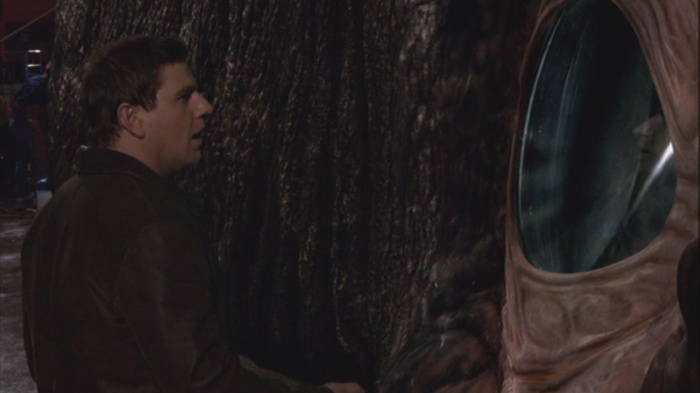
Rhys is taken inside the factory and questioned. He poses as a friendly face, suggesting that he could pick up where the former driver left off. While he’s inside, he discovers the source of the meat: An alien being that regenerates whenever someone slices a piece off of it.

It’s endless torture for the creature.

Rhys leaves the factory and returns home. Gwen’s not far behind him and they have a falling out over the whole affair. Gwen finally admits that she works for Torchwood, but Rhys doesn’t believe the scope of her career. So she shows him.

She takes him to the Hub and he sees everything from the invisible lift to Myfanwy the pterodactyl. He meets Jack, Owen, Tosh, and Ianto and learns what Torchwood does. He tells them what he saw in the warehouse, and after some conflict with Jack, reveals that he has applied to be the new delivery boy.

Jack calls for a team meeting, including Rhys.

Rhys provides the lay of the land, but Gwen is adamant that he doesn’t get involved. The plan ends involving stun guns, saving the alien, and sending it home through the Rift. Owen works on a model of what the creature looks like while Tosh brings him a sandwich. She hints at possibly starting a relationship with someone, but Owen is oblivious to her advances.

Rhys and Jack pick up the truck for the infiltration. While they drive, Jack explains why he picked Gwen for Torchwood. The team loads up in the back of the van and Rhys takes them to the warehouse. When Rhys tries to stage a distraction so the team can exit the van, he finds out that they’ve already gone.

Inside the warehouse, Jack, Gwen, and Tosh find the “cash cow” and discover that it is sentient, but their cover is soon blown and Ianto and Rhys are captured. They are taken by gunpoint to the creature, forcing Gwen to reveal herself. Tosh and Jack are also discovered, and Jack explains what the workers have on their hands. Ianto unties himself as Rhys is shot, and the ensuing fight prompts the creature to strain at its bindings.

Owen develops a sedative while the team dodges the out of control beast. Ianto apprehends the remaining workers as Owen realizes that sedatives won’t work, so he euthanizes the creature instead. Jack mourns for the loss as Owen tends to Rhys’s wounds.

Back at the Hub, Owen patches Rhys as Jack informs him that the workers have been given Retcon. The creature has been incinerated. Jack privately tells Gwen that Rhys will need to forget his adventure, and she requests to be the one to give him the Retcon.

She decides that she can’t do it. She gives Jack an impassioned speech and he relents, unwilling to fire her and lose her from the team.

He gives her the rest of the day off. Torchwood Three has a new team member.


Starting with the unnamed creature, the torture is heartbreaking. The howls and screams built instant sympathy, and the need to euthanize it was tragic. The actors completely sold all of it.

Noting, of course, that the creature wasn’t the point of the episode, it was great to see the team dealing with the repercussions of exposing their secret identity and not pushing the reset button less than an hour later. The Retconning of Rhys in Combat was troubling since it betrayed everything about a trusting relationship. This story builds an authentic yet complicated relationship for Rhys and Gwen, which makes them better characters overall.

On a final note, Jack’s flirtation has certainly amplified this season. This is the Jack that we all know and love.


Rating: 4/5 – “Would you care for a jelly baby?”


UP NEXT – Torchwood: Adam


The Timestamps Project is an adventure through the televised universe of Doctor Who, story by story, from the beginning of the franchise. For more reviews like this one, please visit the project’s page at Creative Criticality.