The Thing About Today – April 18

April 18, 2020
Day 109 of 366


April 18th is the 109th day of the year. It is Zimbabwe’s Independence Day, commemorating their independence from the United Kingdom in 1980.

In the United States, today is “celebrated” as National Animal Crackers Day, National Columnists’ Day, National Lineman Appreciation Day, National Auctioneers Day, and National Record Store Day. National Auctioneers Day is normally observed on the third Saturday in April. National Record Store Day changes annually.


Historical items of note:

  • In 1506, the cornerstone of the current St. Peter’s Basilica was laid.
  • In 1775, the British advancement by sea began in the American Revolutionary War. Paul Revere and other riders warned the countryside of the troop movements.
  • In 1882, English conductor Leopold Stokowski was born.
  • In 1897, the Greco-Turkish War was declared between Greece and the Ottoman Empire.
  • In 1909, Joan of Arc was beatified in Rome.
  • In 1912, the Cunard liner RMS Carpathia arrived in New York City with the 705 survivors from the RMS Titanic.
  • In 1930, it was a slow news day. So slow, in fact, that the BBC news announcer stated “there is no news” at the start of the 20:45 news bulletin and played music instead.
  • In 1946, the International Court of Justice held its inaugural meeting in The Hague, Netherlands.
  • Also in 1946, actress Hayley Mills was born.
  • In 1953, actor and comedian Rick Moranis was born.
  • In 1956, Eric Roberts was born. He portrayed the Master in the 1996 Doctor Who television movie.
  • In 1961, actress Jane Leeves was born.
  • In 1967, actress Maria Bello was born.
  • In 1969, writer, musician, and all-around good dude Keith R. A. DeCandido was born.
  • In 1971, David Tennant was born. Among many other roles, he was the Tenth Doctor in Doctor Who.
  • In 1976, actress Melissa Joan Hart was born.


In 1949, the keel for the aircraft carrier USS United States (CVA-58) was laid down at Newport News Drydock and Shipbuilding in Virginia. Construction was canceled five days later, resulting in the Revolt of the Admirals.

The United States was slated to be the lead ship of a new design of “supercarriers” as authorized on July 29, 1948, by President Harry Truman. Five ships were planned in the line of ships designed to support combat missions using the new jet aircraft, which were faster, larger, and significantly heavier than the aircraft the Essex and Midway-class carriers handled at the end of World War II. The carrier was designed to be “flush decked”, which meant no command island on the flat top deck.

The ship design was so versatile that the United States Air Force actually saw it as a threat to its strategic nuclear weapons delivery monopoly. Looking to cut the military budget, Secretary of Defense Louis A. Johnson accepted the Air Force’s argument about nuclear deterrence by means of large, long-range bombers and canceled the United States project five days after the keel was laid without consulting Congress.

Secretary of the Navy John Sullivan and a number of high-ranking admirals immediately resigned in protest. The United States Congress held an inquiry into Johnson’s decision, but during this “Revolt of the Admirals”, the Navy was unable to advance its case that large carriers would be essential to national defense.

Soon afterward, Johnson and Francis P. Matthews, the man he advanced to be the new Secretary of the Navy, set to punishing officers who publicly opposed them. Admiral Louis Denfeld was forced to resign as Chief of Naval Operations, and a number of other admirals and lesser ranks were punished.

The invasion of South Korea six months later resulted in an immediate need for a strong naval presence, and Matthews’ position as Secretary of the Navy and Johnson’s position as Secretary of Defense crumbled. They both resigned.


The Thing About Today is an effort to look at each day of 2020 with respect to its historical context.

For more creativity with a critical eye, visit Creative Criticality.


The Thing About Today – April 17

April 17, 2020
Day 108 of 366


April 17th is the 108th day of the year. It is World Hemophilia Day, commemorated in the quest to bring awareness to genetic bleeding disorders and raise funds for research.

In the United States, today is “celebrated” as National Crawfish Day, International Bat Appreciation Day, National Cheeseball Day, National Ellis Island Family History Day, National Haiku Poetry Day, and National Clean Out Your Medicine Cabinet Day. That last one is typically observed on the third Friday in April.

I appreciate bats. I also appreciate how they can eat up to 1,000 mosquitoes an hour.


Historical items of note:

  • In 1521, the trial of Martin Luther and his teachings began during the assembly of the Diet of Worms. He initially felt intimidated, so he asked for time to reflect and was granted one day.
  • In 1820, firefighter and inventor of the game of baseball Alexander Cartwright was born.
  • In 1907, the Ellis Island immigration center processed 11,747 people, a single-day record for them.
  • In 1942, David Bradley was born. He portrayed Walder Frey in Game of Thrones, Argus Filch in the Harry Potter films, and the First Doctor on Doctor Who.
  • In 1948, composer and producer Jan Hammer was born.
  • In 1949, twenty-six Irish counties officially left the British Commonwealth at midnight. A 21-gun salute on O’Connell Bridge in Dublin ushered in the Republic of Ireland.
  • In 1951, the Peak District became the United Kingdom’s first National Park.
  • In 1954, professional wrestler and actor Roddy Piper was born.
  • In 1959, actor Sean Bean was born. He dies a lot in cinema.
  • In 1961, a group of Cuban exiles financed and trained by the Central Intelligence Agency landed at the Bay of Pigs in Cuba with the aim of ousting Fidel Castro. Called the Bay of Pigs Invasion, it ultimately failed in its goal.
  • In 1967, actor Henry Ian Cusick was born.
  • In 1970, the ill-fated Apollo 13 spacecraft safely returned to Earth.
  • In 1972, actress Jennifer Garner was born.
  • In 1985, actress Rooney Mara was born.
  • In 2011, Marvel’s Thor premiered in Sydney, Australia.
  • In 2014, NASA’s Kepler space telescope confirmed the discovery of the first Earth-size planet in the habitable zone of another star.


In 2014, NASA’s Kepler space telescope confirmed the discovery of the first Earth-size planet in the habitable zone of another star.

Designated as Kepler-186f, the exoplanet orbits the red dwarf star Kepler-186, about 582 light-years from Earth. The Kepler space telescope detected it along with four additional planets orbiting much closer to the star.

Kepler-186f is about 11 percent larger in radius than Earth. Since atmospheric composition is unknown, conclusions cannot be made about its habitability, though studies have concluded that it may have seasons and a climate similar to our own planet.


The Thing About Today is an effort to look at each day of 2020 with respect to its historical context.

For more creativity with a critical eye, visit Creative Criticality.


The Thing About Today – April 16

April 16, 2020
Day 107 of 366


April 16th is the 107th day of the year. It is World Voice Day, a worldwide annual event that is devoted to the celebration of the phenomenon of voice. Voice is a critical aspect of effective and healthy communication, and the event brings global awareness to the need for preventing voice problems, rehabilitating the deviant or sick voice, training the artistic voice, and researching the function and application of voice.

In the United States, today is “celebrated” as National Bean Counter Day, National Eggs Benedict Day, National Healthcare Decisions Day, National Orchid Day, National Wear Your Pajamas to Work Day, Get to Know Your Customers Day, and National High Five Day. Get to Know Your Customers Day happens on the third Thursday of each quarter, and National High Five Day occurs on the third Thursday in April.

Maybe we should consider “air” hive fives instead?


Historical items of note:

  • In 1746, the Battle of Culloden was fought in Scotland between the French-supported Jacobites led by Charles Edward Stuart and the British Hanoverian forces commanded by William Augustus, Duke of Cumberland. The Jacobites suffered a bloody defeat, and after the battle, many highland traditions were banned and the Highlands of Scotland were cleared of inhabitants.
  • In 1818, the United States Senate ratified the Rush–Bagot Treaty, establishing the border with Canada.
  • In 1853, the Great Indian Peninsula Railway opened the first passenger rail in India. It went from Bori Bunder to Thane.
  • In 1867, inventor Wilbur Wright was born.
  • In 1889, English actor, director, producer, screenwriter, and composer Charlie Chaplin was born.
  • In 1908, Natural Bridges National Monument was established in Utah.
  • In 1912, Harriet Quimby became the first woman to fly an airplane across the English Channel.
  • In 1921, British actor, author, journalist, comedian, and broadcaster Peter Ustinov was born.
  • In 1924, composer Henry Mancini was born.
  • In 1943, Albert Hofmann accidentally discovered the hallucinogenic effects of the research drug LSD. He intentionally took the drug three days later.
  • In 1947, Bernard Baruch first applied the term “Cold War” to describe the relationship between the United States and the Soviet Union.
  • In 1952, voice actor, singer-songwriter, and comedian Billy West was born.
  • In 1954, actress Ellen Barkin was born.
  • In 1962, Walter Cronkite began to anchor the CBS Evening News.
  • In 1963, Dr. Martin Luther King Jr. penned his Letter from Birmingham Jail while incarcerated in Birmingham, Alabama for protesting against segregation.
  • In 1965, actor John Cryer was born. He currently plays one of the best televised Lux Luthors on Supergirl.
  • In 1972, Apollo 16 was launched with astronauts John Young, Charles Duke, and Ken Mattingly aboard.
  • In 1975, actor Sean Maher was born.
  • In 1982, actress and mixed martial artist Gina Carano was born.
  • In 1984, actress Claire Foy was born.


April 16th is Emancipation Day in Washington, DC, which is part of various year-round observances in many former European colonies in the Caribbean and areas of the United States to commemorate the emancipation of enslaved people of African descent.

In 1862, The District of Columbia Compensated Emancipation Act, a bill ending slavery in the District of Columbia, became law. Signed by President Abraham Lincoln, the Act freed about 3,100 slaves in the District of Columbia nine months before President Lincoln issued his broader Emancipation Proclamation. The Act is the only example of compensation by the United States federal government to former owners of emancipated slaves.

On January 4, 2005, Mayor Anthony A. Williams signed legislation making Emancipation Day an official public holiday in the District. When April 16th falls during a weekend, Emancipation Day is observed on the nearest weekday, sometimes affecting Tax Day by pushing that annual event to either the 17th or the 18th.


The Thing About Today is an effort to look at each day of 2020 with respect to its historical context.

For more creativity with a critical eye, visit Creative Criticality.


Timestamp #199: The Doctor’s Daughter

Doctor Who: The Doctor’s Daughter
(1 episode, s04e06, 2008)


It’s time to meet an impossible child.

The TARDIS topples wildly through time and space, tossing Martha and Donna about as the hand in a jar bubbles madly. As Donna learns about the hand’s origins and the time capsule comes to a halt, the team takes a look around before being captured. The Doctor’s hand is shoved into a device where a sample is taken.

His DNA is processed into a clone: The Doctor has a new daughter.

The humans are quickly overrun by an enemy called the Hath. The Doctor’s daughter blows up the tunnel, stopping the Hath advance, but not before Martha is taken by the beings. Donna chastises the Doctor’s daughter and the Doctor tries to find a way through, but the soldiers stop him at gunpoint. They’re headed to see the commander.

On the other side of the rubble, Martha offers medical assistance to a wounded Hath, gaining their trust through her compassion.

Donna and the Doctor find out that the daughter is pre-programmed with military knowledge and tactics, something that the Doctor calls a generated anomaly. From that, Donna offers the woman a name: Jenny.

Jenny likes it.

They arrive at a makeshift barracks, previously a theater, and meet General Cobb. Freedom of movement is restricted, but the Doctor wants to know more about the Hath. The general gives the team a quick briefing, although most of the history behind the place they call Messaline is lost to time. The general seeks something called the Source, a creation myth of sorts driven by a goddess. The Doctor uses his sonic screwdriver to uncover a hidden layer of tunnels on the map, and the general gives his troops marching orders to explore them. The Doctor, meanwhile, is imprisoned with Donna and Jenny for his pacifism.

Meanwhile, Martha is taken to the Hath headquarters. She analyzes the same map and, when the new layers emerge, fears that she has started a war.

In their cell, the Doctor schemes while Jenny finds similarity in his every move to that of a soldier. He alters Donna’s phone to contact Martha, and they figure out that both armies are marching on the same location.

It’s a massacre in the making at the temple of the Source.

The Doctor refuses to allow Jenny to travel with them, but Donna uses a stethoscope to show the Doctor that Jenny is his progeny, a potential Time Lord though the Doctor refuses to admit it. As the Doctor’s theme runs under his sadness, he talks of the war, his part in it, and the destruction of his people. Jenny says that his situation then is pretty much their situation now.

Martha plots a path over the treacherous, radiation filled surface as Jenny wiles her way out of the cell. The Doctor’s team sneaks through the human base and Martha emerges on the desolate surface. As they move, Donna takes note of the random numbers scattered around.

The Doctor, Donna, and Jenny come to a tunnel filled with deadly lasers. The Doctor disables the laser net as Jenny considers her programming, finally using her rifle as a distraction. Unfortunately, the lasers turn back on, so Jenny tumbles her way through without a burn.

On the surface, Martha falls into a pit and is saved by her Hath companion’s sacrifice. The act devastates her, but she presses on to a large tower in the darkness.

Talking while walking, the Doctor offers to take Jenny on the TARDIS with him. Overjoyed, Jenny rushes ahead and the Doctor talks to Donna about his history as a father and the pain of losing all it. Donna believes that Jenny will help him heal, but the Doctor is skeptical.

Martha and the Doctor’s team enter the tower at the same time, discovering that it is a spaceship. Strangely, it’s still powered and functional. The Hath and the humans are not far behind. The Doctor finds a mission log that explains how the commander died of sickness and the crew divided into factions.

Donna discovers that the numbers are dates and that the war is only seven days old. Of course, the cloning machines can create twenty generations in a day. Martha reunites with the travelers and they continue their search for the source, coming across a giant arboretum along the way.

At the center is the Source, the matrix that terraforms planets.

The warring factions arrive simultaneously, and the Doctor offers them peace with the promise of a new world. He declares the war over with a crash of the terraforming matrix, and the factions lay down their arms in reply.

Unfortunately, Cobb wants none of it and takes aim on the Doctor. Jenny steps in front of the bullet to save her father, dying in his arms.

He begs his companions to wait for her regeneration, but Martha warns that it won’t come. Once again, he is the last of the Time Lords.

The Doctor’s fury rises as he picks up the general’s gun and holds it to the man’s head before shaking it, angrily telling Cobb that he never would. He begs the factions to make that their driving force: A society where a man never would.

The planet terraforms around them as the new civilization memorializes Jenny. She was an endless paradox, one that the TARDIS brought the Doctor to meet only to first create. The travelers return to Earth and Martha bids her friends farewell. Donna, on the other hand, wants to travel with the Doctor forever.

Back on Messaline, Jenny exhales with a golden-green energy – regeneration or the Source? – before waking up, taking a ship, and blasting into the sky.

She has lots of running to do.


There are a lot of things to love here, and those elements keep this otherwise by-the-numbers run-and-gun plot from falling into the just average pile. The subtle use of the TARDIS translation circuits as Martha drove her side of the plot was a nice narrative touch. I also loved that Donna had to teach the Doctor to accept his daughter as more than an anomaly, helping him to heal and declaratively find something to live for. After all, there’s always something to live for.

The fun part was seeing Jenny’s evolution as her nature overrode her programming (can we call it her nurture?).  We don’t definitively know if the physical Time Lord traits carried over or not since Jenny’s resurrection wasn’t explicitly a regeneration – remember that not all Gallifreyans are granted regenerations – but if we consider recent events in Doctor Who lore, she might have had the power regardless.

I do love how this show keeps us guessing!

Finally, the Doctor’s adamance about warfare and destruction gave birth to this brilliant retort:

You need to get yourself a better dictionary. When you do, look up genocide. There’ll be a little picture of me there and the caption will read, “Over my dead body!”


Rating: 4/5 – “Would you care for a jelly baby?”


UP NEXT – Doctor Who: The Unicorn and the Wasp


The Timestamps Project is an adventure through the televised universe of Doctor Who, story by story, from the beginning of the franchise. For more reviews like this one, please visit the project’s page at Creative Criticality.


The Thing About Today – April 15

April 15, 2020
Day 106 of 366


April 15th is the 106th day of the year. It is Jackie Robinson Day in the United States, commemorating the day that the first black major league baseball player made his debut with the Brooklyn Dodgers and ended 80 years of color segregation in the league. If Major League Baseball was playing today, you would see the players and umpires all sporting the number 42 in Robinson’s honor.

Today is typically Tax Day in the United States, but thanks to the COVID-19 pandemic, you have until July 15th to file this year.

In the United States, today is “celebrated” as National Glazed Spiral Ham Day, National Rubber Eraser Day, National Take a Wild Guess Day, and National Titanic Remembrance Day.


Historical items of note:

  • In 1452, Italian painter, sculptor, and architect Leonardo da Vinci was born.
  • In 1469, Guru Nanak was born. He was the first Sikh guru.
  • In 1707, Swiss mathematician and physicist Leonhard Euler was born.
  • In 1736, the Kingdom of Corsica was founded.
  • In 1738, the Italian opera Serse by George Frideric Handel premiered in London, England.
  • In 1755, Samuel Johnson’s A Dictionary of the English Language was published in London.
  • In 1783, the preliminary articles of peace ending the American Revolutionary War were ratified.
  • In 1817, Thomas Hopkins Gallaudet and Laurent Clerc founded the American School for the Deaf. Established in Hartford, Connecticut, it was the first American school for deaf students.
  • In 1892, the General Electric Company was formed.
  • In 1912, the RMS Titanic sank in the North Atlantic Ocean at 2:20 a.m., two hours and forty minutes after hitting an iceberg. Only 710 of 2,227 passengers and crew on board survived.
  • In 1922, actor Michael Ansara was born.
  • In 1923, insulin became generally available for use by people with diabetes.
  • In 1924, Rand McNally published its first road atlas.
  • In 1933, actress Elizabeth Montgomery was born.
  • In 1947, Jackie Robinson debuted for the Brooklyn Dodgers, breaking baseball’s color line.
  • In 1948, composer Michael Kamen was born.
  • In 1955, Ray Kroc opened a McDonald’s restaurant in Des Plaines, Illinois, effective founding the franchise.
  • In 1959, English actress, comedian, author, activist and screenwriter Emma Thompson was born.
  • In 1960, Ella Baker led a conference at Shaw University in Raleigh, North Carolina that resulted in the creation of the Student Nonviolent Coordinating Committee. That group was one of the principal organizations of the civil rights movement in the 1960s.
  • In 1962, voice actor Tom Kane was born.
  • In 1990, actress Emma Watson was born.
  • In 1992, William Shatner, Leonard Nimoy, and DeForest Kelley were inducted into the National Association of Broadcasters Hall of Fame.
  • In 1997, actress Maisie Williams was born.
  • In 2019, the Notre Dame Cathedral fire was ignited, severely damaging the historic structure.


April 15th is observed as World Art Day, an international celebration of the fine arts which was declared by the International Association of Art (IAA) in order to promote awareness of creative activity worldwide.

The date was decided in honor of the birthday of Leonardo da Vinci, who was chosen as a symbol world peace, freedom of expression, tolerance, brotherhood, and multiculturalism as well as art’s importance to other fields.


The Thing About Today is an effort to look at each day of 2020 with respect to its historical context.

For more creativity with a critical eye, visit Creative Criticality.


The Thing About Today – April 14

April 14, 2020
Day 105 of 366


April 14th is the 105th day of the year. It would be the first day of Takayama Spring Festival in Takayama, Gifu, Japan.

In the United States, today is “celebrated” as National Dolphin Day, National Ex Spouse Day, National Gardening Day, National Pecan Day, National Reach as High as You Can Day, and Look up at the Sky Day.


Historical items of note:

  • In 43 BC, the Battle of Forum Gallorum occurred. Mark Antony, besieging Caesar’s assassin Decimus Brutus in Mutina, defeated the forces of the consul Pansa. He was then immediately defeated by the army of the other consul, Aulus Hirtius.
  • In 1561, a celestial phenomenon was reported over Nuremberg. It was described as an aerial battle.
  • In 1775, the first abolition society in North America was established. The Society for the Relief of Free Negroes Unlawfully Held in Bondage was organized in Philadelphia, Pennsylvania by Benjamin Franklin and Benjamin Rush.
  • In 1828, Noah Webster copyrighted the first edition of his dictionary.
  • In 1865, United States President Abraham Lincoln was shot in Ford’s Theatre by John Wilkes Booth. He died from his wounds the next day.
  • In 1894, the first-ever commercial motion picture house was opened in New York City using ten Kinetoscopes, a device for peep-show viewing of films.
  • In 1902, James Cash Penney opened his first store in Kemmerer, Wyoming.
  • In 1912, the British passenger liner RMS Titanic struck an iceberg in the North Atlantic. It sank overnight.
  • In 1929, television producer Gerry Anderson was born.
  • In 1939, The Grapes of Wrath, written by John Steinbeck, was first published.
  • In 1949, actor John Shea was born.
  • In 1958, the Soviet satellite Sputnik 2 fell from orbit after 162 days. It was the first spacecraft to carry a living animal, a dog named Laika, but she did not survive the journey.
  • Also in 1958, actor Peter Capaldi was born. He portrayed the Twelfth Doctor in Doctor Who.
  • In 1961, actor Robert Carlyle was born.
  • In 1968, actor Anthony Michael Hall was born.
  • In 1977, actress and producer Sarah Michelle Gellar was born.
  • In 1996, actress Abigal Breslin was born.
  • In 2003, the Human Genome Project was completed with 99% of the human genome sequenced to an accuracy of 99.99%.


April 14th is observed as Pan American Day, a holiday that commemorates the First International Conference of American States. That conference concluded on April 14, 1890, and created the International Union of American Republics, the forerunner to the Organization of American States (OAS). The OAS works toward solidarity and cooperation among states in the Western Hemisphere.

Inspired by the idea of a Panamerica, United States Secretary of State James G. Blane first developed the concept of an International Conference for the Western Hemisphere. The idea took nearly a decade to bear fruit, but the resulting conference covered a large variety of subjects from currency and banking to military and trade.

In 1931, President Herbert Hoover declared the first official National Pan American Day to be observed on April 14th. Before that proclamation, Pan American Day celebrations took place on various days throughout the year and across the country, including cultural events and festivals celebrating the Western Hemisphere and the whole of the North and South American continents.


The Thing About Today is an effort to look at each day of 2020 with respect to its historical context.

For more creativity with a critical eye, visit Creative Criticality.


The Thing About Today – April 13

April 13, 2020
Day 104 of 366


April 13th is the 104th day of the year. It is Teacher’s Day in Ecuador.

In the United States, today is “celebrated” as National Make Lunch Count Day, National Peach Cobbler Day, and National Scrabble Day.


Historical items of note:

  • In 1743, United States Founding Father Thomas Jefferson was born. He was the third President of the United States.
  • In 1870, the New York City Metropolitan Museum of Art was founded.
  • In 1892, Robert Watson-Watt was born. He was the Scottish engineer who invented radar.
  • In 1906, Samuel Beckett was born. He was an Irish novelist, poet, playwright, and Nobel Prize laureate.
  • In 1935, actor Lyle Waggoner was born.
  • In 1942, composer and conductor Bill Conti was born.
  • In 1943, the discovery of mass graves of Polish prisoners of war killed by Soviet forces in the Katyń Forest Massacre during World War II was announced. This caused a diplomatic rift between the Polish government-in-exile in London from the Soviet Union, which denied responsibility.
  • Also in 1943, the Jefferson Memorial was dedicated in Washington, D.C., on the 200th anniversary of President Thomas Jefferson’s birth.
  • In 1950, actor Ron Perlman was born.
  • In 1951, actor Peter Davison was born. He portrayed the Fifth Doctor in Doctor Who.
  • In 1953, Central Intelligence Agency director Allen Dulles launched the mind-control program Project MKUltra.
  • In 1960, the United States launched Transit 1-B, the world’s first satellite navigation system.
  • In 1964, at the Academy Awards, Sidney Poitier became the first African-American male to win the Best Actor award for the 1963 film Lilies of the Field.
  • In 1970, an oxygen tank aboard the Apollo 13 Service Module exploded, putting the crew in great danger and causing major damage to the Apollo command and service module Odyssey while en route to the Moon.
  • In 1972, the Battle of An Lộc began during the Vietnam War. The battle lasted 66 days.
  • In 1976, the United States Treasury Department reintroduced the two-dollar bill as a Federal Reserve Note on Thomas Jefferson’s 233rd birthday as part of the United States Bicentennial celebration.
  • In 1997, Tiger Woods became the youngest golfer to win the Masters Tournament.


In 1742, George Frideric Handel’s oratorio Messiah made its world-premiere in Dublin, Ireland.

Messiah (HWV 56) is an English-language oratorio with a scriptural text compiled by Charles Jennens from the King James Bible and the Coverdale Psalter, the version of the Psalms included with the Book of Common Prayer.

The text is an extended reflection on Jesus as the Messiah called Christ. Part I begins with prophecies by Isaiah and others before moving to the annunciation to the shepherds, the only “scene” taken from the Gospels. Part II concentrates on the Passion and ends with the “Hallelujah” chorus. Part III covers the resurrection of the dead and Christ’s glorification in heaven.

The initial composition was modest, but over time it has been adapted for larger and more powerful orchestras, particularly by Mozart.

After its Dublin premiere, it moved to London nearly a year later. The initial public reception was modest, but the oratorio gained popularity and has become one of the best-known and most frequently performed choral works in Western music.


The Thing About Today is an effort to look at each day of 2020 with respect to its historical context.

For more creativity with a critical eye, visit Creative Criticality.


The Thing About Today – April 12

April 12, 2020
Day 103 of 366


April 12th is the 103rd day of the year. It is Easter Sunday, a Christian holiday commemorating the resurrection of Jesus Christ on the third day following his crucifixion. It is the culmination of the Passion of Jesus, preceded by the 40-day Lenten period of fasting, prayer, and penance.

The holiday is also marked by the coloring and hunting of Easter eggs, the Easter Bunny, gift-giving, and biting the ears off of chocolate rabbits. It was on an Easter Sunday in the early ’90s that I received my first Star Wars novel, and my life hasn’t been the same since.

In the United States, today is “celebrated” as National For Twelves Day, National Big Wind Day, National Colorado Day, National Grilled Cheese Sandwich Day, and National Licorice Day.


Historical items of note:

  • In 1606, The Union Flag was adopted as the flag of English and Scottish ships.
  • In 1916, author Beverly Cleary was born.
  • In 1934, the strongest surface wind gust in the world (at the time) was measured at the summit of Mount Washington, New Hampshire. Wind speed was measured at 231 miles per hour, but has since been surpassed.
  • In 1936, actor Charles Napier was born.
  • In 1945, United States President Franklin D. Roosevelt died in office. Vice President Harry S. Truman became the thirty-third President of the United States upon succession.
  • In 1947, comedian and talk show host David Letterman was born.
  • In 1955, the polio vaccine, developed by Dr. Jonas Salk, was declared safe and effective.
  • In 1971, actress, director, and producer Shannen Doherty was born.
  • Also in 1971, actor Nicholas Brendon was born.
  • In 1979, actress Claire Daines was born.
  • Also in 1979, actress Jennifer Morrison was born.
  • In 1981, the first launch of the Space Shuttle Columbia occurred on mission STS-1.
  • In 1983, Harold Washington was elected as the first black mayor of Chicago.
  • In 1992, the Euro Disney Resort officially opened with its theme park Euro Disneyland. The resort and park names were later changed to Disneyland Paris.
  • In 1994, actress Saoirse Ronan was born.


In 1961, Soviet cosmonaut Yuri Gagarin became the first human to travel into outer space. He performed the first manned orbital flight, Vostok 1.

The flight consisted of a single orbit around the planet, spanning 108 minutes in total. Gagarin returned to the surface after ejecting from his capsule at 23,000 feet.

Gagarin was a Soviet Air Forces pilot who almost failed his initial flight training until his instructor provided him a cushion to help him see better from the cockpit. He expressed interest in the space program after the launch of Luna 3 in October 1959 and was selected in 1960.

In commemoration of his flight, the day is celebrated as Cosmonautics Day in Russia and as both Yuri’s Night and the International Day of Human Space Flight worldwide.


The Thing About Today is an effort to look at each day of 2020 with respect to its historical context.

For more creativity with a critical eye, visit Creative Criticality.


The Thing About Today – April 11

April 11, 2020
Day 102 of 366


April 11th is the 102nd day of the year. It is World Parkinson’s Day, observed in honor of Dr. James Parkinson, the English surgeon, apothecary, geologist, paleontologist, and political activist who first described the symptoms of Parkinson’s disease in his 1817 An Essay on the Shaking Palsy.

In the United States, today is “celebrated” as National Barber Shop Quartet Day, National Cheese Fondue Day, National Eight Track Tape Day, National Pet Day, and National Submarine Day.


Historical items of note:

  • In 1727, Johann Sebastian Bach’s St Matthew Passion BWV 244b premiered at the St. Thomas Church in Leipzig.
  • In 1755, Dr. James Parkinson was born.
  • In 1881, Spelman College was founded in Atlanta, Georgia as the Atlanta Baptist Female Seminary. It was designed as an institute of higher education for African-American women.
  • In 1940, author and screenwriter Thomas Harris was born. His most famous character is Hannibal Lecter.
  • In 1951, The Stone of Scone was found on the site of the altar of Arbroath Abbey. It was the stone upon which Scottish monarchs were traditionally crowned and had been taken by Scottish nationalist students from its place in Westminster Abbey.
  • In 1968, President Lyndon B. Johnson signed the Civil Rights Act of 1968, which prohibited discrimination in the sale, rental, and financing of housing.
  • In 1970, Apollo 13 was launched with astronauts James A. Lovell, Jr., John L. Swigert, Jr., and Fred W. Haise, Jr. aboard. It was meant to be the third manned mission to the lunar surface, but the mission was aborted when an oxygen tank in the service module failed two days into the mission.
  • In 1974, actress Tricia Helfer was born.
  • In 2012, The Avengers premiered in Los Angeles, marking a major milestone for Marvel Studios and superhero cinema.


In 1900, the United States Navy took possession of the first modern submarine, the USS Holland (SS-1).

The first military submarine of the United States fleet was the Turtle from 1775, but the Holland was the first modern commissioned submarine, purchased for $150,000. She was commissioned on October 12, 1900, with Lieutenant Harry H. Caldwell in command. She was propelled by a gasoline engine, an electric motor, and a 66-cell battery with a maximum speed of 6 knots.

The Holland was the fourth submarine to be owned by the Navy, preceded by Alligator, Intelligent Whale, and Plunger. That last one became the namesake for the second commissioned boat, USS Plunger (SS-2).

Most of Holland‘s service life was spent in experimentation and training. She was decommissioned on July 17, 1905, and sold as scrap for $100, but her legacy lives on as she started an unbroken chain of United States submarines that continues to this day. Her success was also instrumental in the founding of the Electric Boat Company, now known as the Electric Boat Division of General Dynamics Corporation.

As a result of the Navy’s purchase of the USS Holland, today is recognized as National Submarine Day by certain circles of veterans. In 1969, Senator Thomas J. Dodd of Connecticut introduced a bill to designate April 11th as National Submarine Day, but no record of a proclamation from President Richard Nixon has been found.


The Thing About Today is an effort to look at each day of 2020 with respect to its historical context.

For more creativity with a critical eye, visit Creative Criticality.


Culture on My Mind – Ten Films of Vivid Memory

Culture on My Mind
Ten Films of Vivid Memory

April 10, 2020

This week’s “can’t let it go” is a Facebook meme.

Let’s face it, most of the “I’m bored so let’s make a list of things” Facebook memes are more than likely (often successful) attempts at social engineering. That data can be compiled over time by the right wrong people to hack accounts and spoof identities.

That said, one popped up on my radar courtesy of Zaki Hasan and Michael Bailey: “Saw this going around and thought it sounded fun. 10 films I vividly remember seeing in the theater pre-college.”

Since I’ve never been asked movie-specific questions as security thresholds, I feel comfortable putting mine out there for public consumption. I’m even going for a bit of extra credit because there are eleven titles encompassing ten experiences on this list.

Song of the South (1946)
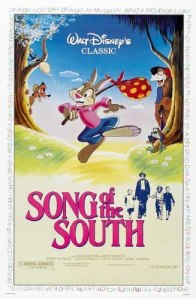
People consider me strangely when I mention this movie memory. My family remembered this film well, and they took me to the 1986 re-release when I was young. I have little memory of the live-action sequences, but the songs and animated vignettes have stuck with me over the years, even considering the racial insensitivity of the presentation.

The movie is based on the Uncle Remus folktales as compiled by Joel Chandler Harris in 1881. He was a journalist in post-Reconstruction Atlanta, and he wrote the stories to represent the struggle in the Southern United States. He tried to do so by framing the stories in the plantation context, but he also wrote them in a dialect which was his interpretation of Deep South African-American language of the time.

Walt Disney wanted to produce a movie based on these tales, but since its Atlanta premiere at the Fox Theater in November 1946, it has been the subject of controversy for propagating racial stereotypes and representing plantation life as idyllic and glorious. Ironically, Atlanta was still segregated at the time of premiere.

Despite its financial success, it is one film of the Disney catalog that has never received a full release in the United States due to the controversy. However, it does live on at the Disney Parks as the animated characters and their stories are showcased on Splash Mountain.

It was during the 1986 re-release, which commemorated the film’s 40th anniversary and promoted the opening of Splash Mountain, that I saw it. I do want to see it again, nearly 35 years later with the eyes of a knowledgeable adult, but the only way I’ll be able to do so is via bootleg.

The Great Outdoors (1988) and Dragnet (1987)
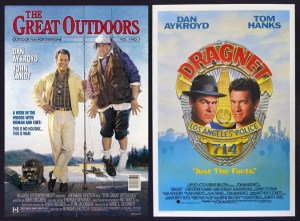
My next two movie memories were a Dan Aykroyd double feature. When The Great Outdoors was released in 1988, the (now demolished) Davis Drive-In presented it alongside Dragnet.

I count this as my true introduction to comedy and satire, as well as my interest in drive-in movie theaters. My parents would often show me the pop culture of their childhoods, and the drive-in format was one such gem.

Starting just after dusk, the double feature led with The Great Outdoors, a John Hughes film about two families spending time on vacation in Wisconsin. It starred Dan Aykroyd, John Candy, Stephanie Faracy, and (in her feature film debut) Annette Bening.

From the ghost stories of a bear that was made bald by buckshot to the zany antics of both family and coming of age, this is one film memory that I cherish. The thread of sharing movie memories with my parents would come back ten years later.

The second half of the night was Dragnet, a parody and homage of the long-running police procedural series from radio and television. It starred both Aykroyd and Tom Hanks, as well as Harry Morgan and Alexandra Paul. I knew of Harry Morgan from re-runs of M*A*S*H, which was a staple in my childhood home, and the comedy stuck with me. My most vivid memory is Sgt. Friday’s foot being run over by the car, an act that my parents assured me was fake despite what the Looney Tunes cartoons said otherwise.

Jurassic Park (1993)

I didn’t go to the theater much as a kid. They were expensive trips for a family that didn’t have a lot of money, and most of the movies I saw as a kid were on television. So, it would be five years until the next movie that spurred a vivid cinematic memory, and it was a big one.

I grew up loving dinosaurs, and, behind the Star Wars trilogy, the child-centric films of Steven Spielberg were among my favorites. So it only seemed logical to see how the two would mesh.

Instead of going to the local megaplex, my parents took my sister and me to a classic theater in nearby Riverdale. The Cinedome 70 featured two domed auditoriums, both with 70-foot curved screens.

It was magnificent, from the majesty of the John Williams score to the amazing visuals and pulse-pounding drama. I lost track of time and was surprised when the credits rolled.

It was one of the first movies that prompted me to buy a special anniversary boxset. It’s one that I revisit quite often.

The Last Action Hero (1993)

In the same month as Jurassic Park, my brother invited me to join him for a small birthday celebration. It included a movie that he was very excited about: The Last Action Hero starring Arnold Schwarzenegger.

I remember this experience in disjointed images, but the particular memory that stands out is how this film broke the fourth wall in a way that I had never experienced. Basically, teenager Danny loves the Jack Slater film series, and he ends up magically transported into one of them to have a little adventure.

This is another one that I need to revisit (27 years down the road) to really appreciate, but it stands out because of the time I got to spend with my brother doing something that he enjoyed. That was a rarity of its own in my younger days.

The Three Musketeers (1993)

Given that trips to the movies were a rare treat as a kid, I was overjoyed about winning sneak preview tickets to a new action film. Our local independent television station played the Disney Afternoon lineup every day, and to drive interest in their programming, they had a “kids’ club” with giveaways and contests.

Along with a He-Man Powersword roleplay toy, some foam quarterstaffs, and a Darkwing Duck action figure – none of which do I still possess, unfortunately – I won a pair of tickets to The Three Musketeers.

Starring Charlie Sheen, Kiefer Sutherland, Chris O’Donnell, Oliver Platt, Tim Curry, and Rebecca De Mornay, much of it went over my head on first viewing. The action was fun and the wit was quick, but it took later viewings to fully enjoy the scenery-chewing skill of Tim Curry and the underlying meaning of De Mornay’s “with a flick of my wrist, I could change your religion” repartee.

There are certainly better interpretations of this work by Alexandre Dumas, but this one has a level of cheesy lightheadedness and swashbuckling derring-do that provided a suitable introduction to sword and shield fantasy-adventure.

Besides, who can forget Bryan Adams, Rod Stewart, and Sting teaming with Michael Kamen on “All For Love”? Pure ’90s cheese!

8 Seconds (1994)

When I was a boy, I had dreams of being a rodeo bull rider. My father was a bull rider and a rodeo clown, and my mother was a barrel racer, and while I was growing up, they offered professional photography for local circuits.

I grew up in the shadow of amazing athletes like Charlie Sampson (the first African American cowboy to win a World Title in professional rodeo) and Brazilian bull riding legend Ariano Morães, and I even dabbled in the sport myself. I even had my own riding rope which I used on several occasions.

When 8 Seconds was released, my family eagerly went to the theater to see it. Starring Luke Perry, the movie is a biographical film about rodeo legend and bull riding champion Lane Frost. Frost was the 1987 World Champion of the Professional Rodeo Cowboys Association (PRCA) and the only rider to score qualified rides from the 1987 World Champion and 1990 ProRodeo Hall of Fame bull Red Rock.

He drew a Brahma bull named Takin’ Care of Business at the Cheyenne Frontier Days Rodeo in 1989. After scoring 91 points, he dismounted and landed in the dirt arena. The bull turned and hit him in the back with his horn, breaking several of his ribs and puncturing his heart and lungs. He died at the hospital at the age of 25.

The reception in our audience that night was one of respect for Frost’s legacy and a humbling of some of the younger cocky cowboys who thought themselves invincible. I personally carried that same respect and sense of caution, eventually giving up my dream after cowboys that I personally knew died doing what they loved.

The Star Wars Trilogy: Special Edition (1997)
Star Wars: Episode IV — A New Hope
Star Wars: Episode V — The Empire Strikes Back
Star Wars: Episode VI — Return of the Jedi

This one seems like a no-brainer, but it was a milestone in my life and fandom.

Like so many in my generation, I grew up on pan-and-scan VHS versions of the Star Wars trilogy. The trailer for the special edition releases tapped into the spirit of that ethos, starting with a tiny screen before showing an X-Wing blasting out of its confines to a full theatrical presentation. It was the perfect commercial to sell the idea of seeing these films again for the first time.

The opportunity to see three of my favorite and most influential movies on the big screen was too good to pass up. The Special Editions were my first experience with Star Wars in theaters. More than that, it was my opportunity to pay my parents back for introducing me to those films. I saved up the money to buy opening night tickets for each of the films for the family, and those presentations were heaven for me.

I had seen each of them on worn-out videotapes so many times, but I was enthralled in that January theater. So entranced, in fact, that when Luke fired his proton torpedoes and the Death Star exploded, I cheered. When I realized what I had just done, I found my parents staring at me with grins on their faces.

I know that they’re critiqued now for being too shiny and modernized, but the Special Editions will always hold a place in my heart.

From a certain point of view, they were my step into a much larger universe.

I have written about these films before as part of the Seven Days of Star Wars series in 2015:

Star Wars: Episode I — The Phantom Menace (1999)
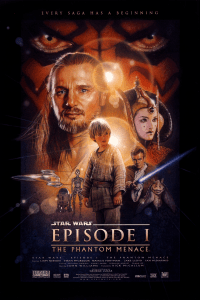
Following on the heels of the Special Editions and my love of the expanded universe of novels and comics, I was overjoyed to see new stories in the Star Wars universe.

It was once again an opening night event for the family and me, and I really enjoyed what I saw with Jedi Knights defending the Republic and paving the way for the trilogy that was a cornerstone of my childhood.

I know that others had buyer’s remorse when it came to this movie and the other two prequels, but I did not. I saw it three or four times on my limited income and found my fandom blossoming from the experience.

There are warts, to be sure, but I had a deep appreciation for what this film represented on the cusp of a new chapter in my life.

I have written about this film before as part of the Seven Days of Star Wars series in 2015: Day Four – The Phantom Menace.
cc-break

Culture on My Mind is inspired by the weekly Can’t Let It Go segment on the NPR Politics Podcast where each host brings one thing to the table that they just can’t stop thinking about.

For more creativity with a critical eye, visit Creative Criticality.