

The Thing About Today – April 26

April 26, 2020
Day 117 of 366


April 26th is the 117th day of the year. It is World Intellectual Property Day, established by the World Intellectual Property Organization (WIPO) to “raise awareness of how patents, copyright, trademarks and designs impact on daily life” and “to celebrate creativity, and the contribution made by creators and innovators to the development of societies across the globe.”

In the United States, today is “celebrated” as National Audubon Day, National Dissertation Day, National Help a Horse Day, National Kids and Pets Day, National Pretzel Day, National Richter Scale Day, National South Dakota Day, and National Pet Parents Day. That last one is typically observed on the last Sunday in April.


Historical items of note:

  • In 1564, playwright William Shakespeare was baptized in Stratford-upon-Avon, Warwickshire, England. His actual date of birth is unknown.
  • In 1803, thousands of meteor fragments fell from the skies of L’Aigle, France. The event convinced European scientists that meteors exist.
  • In 1865, Union cavalry troopers cornered and killed assassin John Wilkes Booth in Virginia.
  • In 1933, actress, singer, and producer Carol Burnett was born.
  • In 1954, Akira Kurosawa’s Seven Samurai was released.
  • In 1958, actor Giancarlo Esposito was born.
  • In 1962, NASA’s Ranger 4 spacecraft crasheed into the Moon.
  • In 1977, actor Tom Welling was born.
  • In 1979, actress Stana Katic was born.
  • In 1981, Dr. Michael R. Harrison of the University of California, San Francisco Medical Center performed the world’s first human open fetal surgery.


In 1986, a nuclear reactor accident occurred at the Chernobyl Nuclear Power Plant near Pripyat, Ukraine in the Soviet Union, creating the world’s worst nuclear disaster.

The accident started during a safety test on an RBMK-type nuclear reactor, which was commonly used throughout the Soviet Union. If you recall the discussion of the SL-1 accident on January 3rd, the common reactor type in the United States uses pressurized water as the moderator to help control neutron production, and as a result, power and heat generation. The RBMK-type reactor uses graphite as a moderator with moving water to cool the core, which was a contributing factor to the accident.

Other contributing factors included active removal of decay heat (the heat generated from the decay of fission products), positive void coefficient properties (an estimate of how much reactivity is added to the core when voids appear in the system), and instability at low power levels.

The test was a simulation of an electrical power outage. This test was being used to help develop a safety procedure to maintain reactor cooling water circulation until back-up electrical generators could provide power to the complex. The blackout duration was about one minute and had been identified as a potential safety problem that could cause the reactor core to overheat. The hope was that residual rotational energy in a turbine generator could provide enough power to last for that minute, but while three tests had been conducted, no solution had been found.

On the fourth attempt, there was an unexpected delay of ten hours. Unfortunately, that pushed the test to a later shift, and the oncoming operators were not prepared for the experiment.

During the planned decrease of reactor power in preparation for the electrical test, the power unexpectedly dropped to a near-zero level. In a pressurized water reactor like those operating in the United States, this would likely result in the reactor shutting itself down due to the inherent negative coefficient of reactivity. But the RBMK’s low-power imbalances limited the ability of the reactor to burn off xenon-135, a fission product that hinders the rise of reactor power.

To overcome the xenon, operators raised power by disconnecting most of the control rods from their automatic control systems. Even worse, they manually extracted most of the rods to their upper limits to maximize positive reactivity and overcome the xenon to increase power.

The operators were able to only partially restore the specified test power, but the instability risk was not evident in the operating instructions, so the operators proceeded with the test. The operation of the reactor at the low power level and high poisoning level was accompanied by unstable core temperatures and coolant flow. Several alarms were triggered, but they were ignored to preserve testing power levels.

The combined effect of actions to this point was an extremely unstable reactor configuration. Nearly all of the 211 control rods had been extracted manually, including all but 18 of the “fail-safe” manually operated rods of the minimum 28 that were supposed to remain fully inserted to control the reactor even in the event of a loss of coolant.

Upon test completion, the operators triggered a reactor shutdown, but circumstances caused an uncontrolled nuclear chain reaction. A large amount of energy was suddenly released, vaporizing superheated cooling water and rupturing the reactor core in a highly destructive steam explosion. The result was an open-air reactor core fire that released radioactive contamination in a large plume for about nine days. The fire gradually released about the same amount of contamination as the initial explosion, resulting in a 10-kilometer exclusion zone around Pripyat and the evacuation of 49,000 people. The exclusion zone was later expanded to 30 kilometers when an additional 68,000 people were evacuated.

The explosion killed two of the operating staff. During the emergency response that followed, 134 station staff and firemen were hospitalized for acute radiation exposure. Twenty-eight of them died in the days to months following the accident, and an estimated fourteen cancer deaths were related to the event.

To reduce the spread of radioactive contamination from the wreckage and protect it from weathering, a protective sarcophagus was built by December 1986. This also provided radiological protection for the remaining operational reactors at the site. The sarcophagus was further enclosed in 2017.

Site clean-up is scheduled for completion in 2065.

The Chernobyl disaster is considered the worst nuclear power plant accident in history, both in terms of cost and casualties. The combination of the initial emergency response and later environmental decontamination have involved half a million personnel and approximately $68 billion. The accident resulted in safety upgrades on all remaining Soviet-designed RBMK reactors – as of 2019, ten of them remained operational – and continues to be an in-depth training topic for operators in the United States to this day.


The Thing About Today is an effort to look at each day of 2020 with respect to its historical context.

For more creativity with a critical eye, visit Creative Criticality.


Culture on My Mind – Quarantine Con

Culture on My Mind
Quarantine Con

April 25, 2020

It’s been a while since time’s been slipping away during shelter-in-place, but some friends are finding ways to help fellow geeks pass the time. This week’s “can’t let it go” is a virtual convention panel.

Live from quarantine in their individual bunkers, three regulars from the Dragon Con American Sci-Fi Classics Track discussed movies from the year 2000! This time around, Classics Track co-directors Joe Crowe and Gary Mitchel are joined by author Michael G. Williams. They chatted about The Cell, X-Men, Mission to Mars, and haircuts.

Joe and Gary will be hosting more of these, so stay tuned to the YouTube channel and the group on Facebook. If you join in live, you can also leave comments and participate in the discussion using StreamYard connected through Facebook.

cc-break

Culture on My Mind is inspired by the weekly Can’t Let It Go segment on the NPR Politics Podcast where each host brings one thing to the table that they just can’t stop thinking about.

For more creativity with a critical eye, visit Creative Criticality.

The Thing About Today – April 25

April 25, 2020
Day 116 of 366


April 25th is the 116th day of the year. It is Parental Alienation Awareness Day, which brings awareness to the process of a child becoming estranged from a parent as the result of the psychological manipulation of another parent.

In the United States, today is “celebrated” as National Hug a Plumber Day, National Telephone Day, National Zucchini Bread Day, National Kiss of Hope Day, National Pool Opening Day, National Rebuilding Day, and National Sense of Smell Day. The last four are all typically observed on the last Saturday in April.


Historical items of note:

  • In 1792, highwayman Nicolas J. Pelletier became the first person executed by guillotine.
  • Also in 1792, “La Marseillaise” was composed by Claude Joseph Rouget de Lisle. It is the national anthem of France, and was composed after the declaration of war by France against Austria. The original title was “Chant de guerre pour l’Armée du Rhin” (“War Song for the Army of the Rhine”).
  • In 1859, British and French engineers broke ground for the Suez Canal.
  • In 1900, Austrian-Swiss-American physicist, academic, and Nobel Prize laureate Wolfgang Pauli was born.
  • In 1901, New York became the first U.S. state to require automobile license plates.
  • In 1908, journalist Edward R. Murrow was born.
  • In 1917, singer Ella Fitzgerald was born.
  • In 1945, the last German troops retreated from Finland’s soil in Lapland, thus ending the Lapland War and all military acts of World War II in Finland.
  • In 1946, actress Talia Shire was born.
  • In 1954, the first practical solar cell was publicly demonstrated by Bell Telephone Laboratories.
  • In 1959, the Saint Lawrence Seaway officially opened to shipping traffic, linking the North American Great Lakes and the Atlantic Ocean.
  • In 1960, the United States Navy submarine USS Triton (SSRN-586) completed the first submerged circumnavigation of the globe.
  • In 1961, Robert Noyce was granted a patent for an integrated circuit.
  • In 1964, actor, voice artist, comedian, and producer Hank Azaria was born.
  • In 1965, puppeteer and voice actor John Henson was born.
  • In 1969, actress and producer Renée Zellweger was born.
  • Also in 1969, actress Gina Torres was born.
  • In 1983, Pioneer 10 traveled beyond Pluto’s orbit.


Today was a big day in history, so I’m highlighting two events that I found interesting.


In 1945, United States and Soviet troops met in Torgau along the River Elbe, cutting the Wehrmacht of Nazi Germany in two.

The first contact between American and Soviet patrols occurred near Strehla, after First Lieutenant Albert Kotzebue, an American soldier, crossed the River Elbe in a boat with three men of an intelligence and reconnaissance platoon. On the east bank, they met forward elements of a Soviet Guards rifle regiment of the First Ukrainian Front, under the command of Lieutenant Colonel Alexander Gardiev.

The same day, another patrol under Second Lieutenant William Robertson with Frank Huff, James McDonnell and Paul Staub met a Soviet patrol commanded by Lieutenant Alexander Silvashko on the destroyed Elbe bridge of Torgau. The commanders of the 69th Infantry Division of the First Army and the 58th Guards Rifle Division of the 5th Guards Army met at Torgau, southwest of Berlin. They celebrated with the formal “Handshake of Torgau” between Robertson and Silvashko in front of photographers the following day.

The Soviet, American, and British governments released simultaneous statements that evening in London, Moscow, and Washington, reaffirming the determination of the three Allied powers to complete the destruction of the Third Reich. Known as Elbe Day and East Meets West Day, this event marked an important step toward the end of World War II. Elbe Day has never been an official holiday in any country, but in the years since 1945 the memory of this friendly encounter gained new significance in the context of the Cold War between the United States and the Soviet Union.


In 1953, James Watson, Francis Crick, Maurice Wilkins, Rosalind Franklin and colleagues published “Molecular Structure of Nucleic Acids: A Structure for Deoxyribose Nucleic Acid” describing the double helix structure of DNA.

In the United States, DNA Day was first celebrated on April 25, 2003. The proclamation of both the Senate and the House of Representatives only declared a one-time celebration, so for every year going forward, annual DNA Day celebrations were organized by the National Human Genome Research Institute (NHGRI).

April 25 has since been declared “International DNA Day” and “World DNA Day” by several groups.


The Thing About Today is an effort to look at each day of 2020 with respect to its historical context.

For more creativity with a critical eye, visit Creative Criticality.



The Thing About Today – April 24

April 24, 2020
Day 115 of 366


April 24th is the 115th day of the year. It is Fashion Revolution Day, a not-for-profit global movement that campaigns for systemic reform of the fashion industry with a focus on the need for greater transparency in the fashion supply chain.

It is also Arbor Day in the United States, which is typically observed on the last Friday of April.

In the United States, today is “celebrated” as National Pigs in a Blanket Day, National Teach Children To Save Day (which changes annually), National Arbor Day, and National Hairball Awareness Day (which is typically observed on the last Friday in April).


Historical items of note:

  • In 1183 BC, today marked the Fall of Troy (by traditional reckoning), which incurred the end of the legendary Trojan War. The date was given by the chief librarian of the Library of Alexandria, Eratosthenes of Cyrene, among others.
  • In 1800, the United States Library of Congress was established when President John Adams signed legislation to appropriate $5,000 for the purchase of “such books as may be necessary for the use of Congress”.
  • In 1885, the American sharpshooter Annie Oakley is hired by Nate Salsbury to be a part of Buffalo Bill’s Wild West.
  • In 1914, the Franck–Hertz experiment was presented to the German Physical Society. This pillar of quantum mechanics was the first electrical measurement to clearly show the quantum nature of atoms.
  • In 1930, actor, director, and producer Richard Donner was born.
  • In 1933, Nazi Germany began its persecution of Jehovah’s Witnesses by shutting down the Watch Tower Society office in Magdeburg.
  • In 1934, actress, singer, and dancer Shirley MacLaine was born.
  • In 1942, singer, actress, activist, and producer Barbra Streisand was born.
  • In 1964, actor Djimon Hounsou was born.
  • In 1967, Cosmonaut Vladimir Komarov died in Soyuz 1 when the craft’s parachute failed to open. He became the first human to die during a space mission.
  • In 1968, actress Stacy Haiduk was born.
  • In 1990, the Hubble Space Telescope was launched from the Space Shuttle Discovery during mission STS-31.


This year, April 24th is Arbor Day in the United States.

Arbor Day is a holiday on which people are encouraged to learn about and plant trees.

The first documented Arbor Day in the world was held in the Spanish village of Mondoñedo in 1594. The place remains today as Alameda de los Remedios, and it is still planted with lime and horse-chestnut trees. A humble granite marker and a bronze plate commemorate the event.

In 1805, the Spanish village of Villanueva de la Sierra held the first modern Arbor Day. The first American Arbor Day was in Nebraska City, Nebraska as organized by J. Sterling Morton on April 10, 1872, during which an estimated one million trees were planted.

The idea was globalized when Birdsey Northrop of Connecticut visited Japan in 1883 and delivered his Arbor Day and Village Improvement message. In that same year, the American Forestry Association made Northrop the Chairman of the committee to campaign for Arbor Day nationwide. He also brought his enthusiasm for Arbor Day to Australia, Canada, and Europe.

After lobbying efforts, President Theodore Roosevelt issued an “Arbor Day Proclamation to the School Children of the United States” on April 15, 1907. The proclamation concerned the importance of trees and that forestry deserved to be taught in United States schools.

Arbor Day is also celebrated around the world and across the various states in the country, many of them on different days. Despite the difference in dates, the concept has made a significant impact on the world.


The Thing About Today is an effort to look at each day of 2020 with respect to its historical context.

For more creativity with a critical eye, visit Creative Criticality.


The Thing About Today – April 23

April 23, 2020
Day 114 of 366


April 23rd is the 114th day of the year. It is National Sovereignty and Children’s Day in Turkey and Northern Cyprus, commemorating the foundation of the Grand National Assembly of Turkey on this date in 1920.

In the United States, today is “celebrated” as National Cherry Cheesecake Day, National Lost Dogs Awareness Day, National Picnic Day, National Take a Chance Day, National Talk Like Shakespeare Day, National Poem In Your Pocket Day (of which the date changes annually), and National Take Our Daughters and Sons to Work Day (typically observed on the fourth Thursday in April).


Historical items of note:

  • In 1343, St. George’s Night Uprising commenced in the Duchy of Estonia.
  • In 1348, the founding of the Order of the Garter by King Edward III was announced on St. George’s Day. (That’s today!)
  • In 1635, the Boston Latin School was founded in Boston, eventually recognized as the first public school in the United States (even though it was established before the country, but whatever).
  • In 1858, German physicist Max Planck was born.
  • In 1928, actress, singer, dancer, and diplomat Shirley Temple was born. She was Hollywood’s number one box-office draw as a child actress from 1935 to 1938. In adulthood, she was named United States ambassador to Ghana and to Czechoslovakia, and also served as Chief of Protocol of the United States.
  • In 1930, actor Alan Oppenheimer was born.
  • In 1936, singer-songwriter Roy Orbison was born.
  • In 1939, actor Lee Majors was born.
  • In 1977, English comedian, actor, producer, and screenwriter John Oliver was born.
  • Also in 1977, actor, comedian, and civil servant Kal Penn was born.
  • In 1985, Coca-Cola changed its formula and released New Coke. Universally recognized as (potentially) the worst decision in the history of mankind, the response was overwhelmingly negative. The original formula was back on the market in less than three months.
  • In 2005, the first-ever YouTube video was published. It was “Me at the zoo” by user “jawed”.


April 23rd is World Book Day. It is also also known as World Book and Copyright Day and International Day of the Book, and it is organized by the United Nations Educational, Scientific and Cultural Organization (UNESCO) to promote reading, publishing, and copyright.

The idea is credited to Valencian writer Vicente Clavel Andrés. He wanted to honor Miguel de Cervantes, best know for Don Quixote, on his birthdate (October 7th) and his death date (April 23). In 1995, UNESCO chose April 23rd, which is also the anniversary of the death of William Shakespeare and Inca Garcilaso de la Vega.

A bit of historical trivia: Shakespeare and Cervantes died on the same date (April 23, 1616), but not on the same day. In 1616, Spain used the Gregorian calendar and England used the Julian calendar, so Shakespeare actually died 10 days after Cervantes, dated as May 3rd on the Gregorian calendar.

Today is also Canada Book Day.


The Thing About Today is an effort to look at each day of 2020 with respect to its historical context.

For more creativity with a critical eye, visit Creative Criticality.
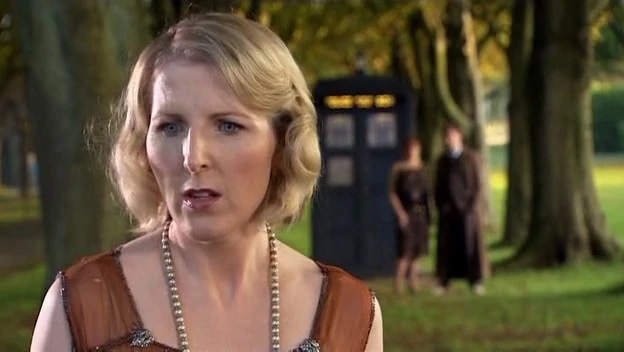


Timestamp #200: The Unicorn and the Wasp

Doctor Who: The Unicorn and the Wasp
(1 episode, s04e07, 2008)


The mystery meets the mystery writer.

The TARDIS materializes to the scent of mint and lemonade in the air. If the vintage car in the drive is any indication, it’s the 1920s and Donna’s excited to attend a party with Professor Peach, Reverend Golightly, and the butler Greeves. The Doctor produces his psychic paper, meaning that invitations are all taken care of.

Unfortunately, the party will be one short Professor Peach falls victim to the lead pipe in the library. The suspect is a giant wasp.

The Doctor and Donna are greeted at the party by Lady Clemency Eddison. They also meet Colonel Hugh Curbishley (Lady Eddison’s husband), their son Roger (who flirts with Davenport, a servant), Reverend Golightly, socialite Robina Redmond, Miss Chandrakala, and the famous mystery writer Agatha Christie.

It’s a regular game of Clue.

The Doctor notes the date of the newspaper: It’s the day of Agatha Christie’s disappearance. Her car will be found abandoned and she’ll resurface ten days later with no memory. Her husband has recently cheated on her, but she’s maintaining a stiff upper lip.

Meanwhile, Miss Chandrakala finds Professor Peach, and the Doctor stands in as a police officer with a plucky assistant to boot. The Doctor finds alien residue – Donna’s beside herself that Charles Dickens was actually surrounded by ghosts at Christmas – then teams up with Christie to question the guests while Donna looks about with a magnifying glass from the Doctor’s endless pockets.

Each of the guests has an extraordinary story of where they were at the time of the murder, but there are no alibis. Each is hiding something except for the reverend. The Doctor asks Christie about the paper she picked up from the murder scene, and together they discover the word “maiden” on it.

Upstairs, Donna finds an empty bedroom. Greeves informs her that Lady Eddison has kept the room shut for the last 40 years, after spending six months in it recovering from malaria following her return from India. Inside, Donna finds nothing but a teddy bear and a giant murderous wasp. She attacks it with the magnifying glass and the power of the sun, and the Doctor and Christie arrive to sample the stinger that it left behind.

Miss Chandrakala is murdered by a falling statue. When the Doctor, Donna, and Christie find her, the wasp attacks, but the Doctor cannot find it after it flies off. The guests convene in a sitting room and talk through the events with Christie, but she’s discouraged because she doesn’t know what’s going on. All they have is the clue in Miss Chandrakala’s dying words: “The poor little child…”

Later, she confides in Donna that she feels like the events are mocking her. They commune over lost loves before finding a box in a crushed flowerbed. The Doctor, Donna, and Christie examine the as Greeves brings refreshments, but the Doctor soon realizes that he’s been poisoned by cyanide. A short comedic scene later – complete with ginger beer, walnuts, anchovies, and a shocking kiss from Donna – and the Doctor has detoxed.

The cast gather for dinner, which the Doctor has laced with pepper to test each guest to see if they are the wasp. The lights go out, the wasp appears, and Roger is dead after being stung in the back. Greeves is cleared by being in plain sight during the murder, but Lady Eddison’s necklace (the “Firestone”, a priceless gem from India) is missing.

The Doctor encourages Christie to solve it, knowing that she has the ability. Christie works her way around the assembled guests, uncovering Robina as a thief known as the Unicorn. The Firestone is recovered, but the murderer is still at large.

Christie further (accidentally) uncovers that Colonel Curbishley has been faking his wheelchair-bound disability in order to keep his wife’s affections. She also discovers that Lady Eddison came home from India pregnant, with Miss Chandrakala as a maid and confidante, and had to seclude herself to hide the scandal and the shame.

But, as the Doctor discovers, her tryst was with a vespiform visitor from another world. The alien gave her the jewel and a child, who was taken to an orphanage, and whose identity was uncovered by Professor Peach since “maiden” led to “maiden name”. The Doctor works his way around the room, landing on the reverend who had recently thwarted a robbery in his church. He also notes that the reverend is forty years old, and pieces together that Golightly’s anger broke the genetic lock that kept him in human form. Golightly activated, and the jewel – a telepathic recorder – connected mother and son, including the works of Agatha Christie since Lady Eddison was reading her favorite, The Murder of Roger Ackroyd.

The reverend transforms in rage, and Christie leads the wasp away with the Firestone, believing that this whole thing is her fault. The Doctor and Donna pursue Christie to the nearby lake, realizing that the two are linked. Donna seizes the jewel and throws it into the lake. The wasp follows and drowns, and while the Doctor is aghast at its death, the three of them are relieved that the mystery is solved. Before the wasp dies, it releases Christie from the psychic connection, and the Doctor puts history in motion: The events of the night are erased from her mind and the mystery writer turns up ten days later Harrogate Hotel courtesy of the TARDIS.

The Doctor consoles Donna about the adventure, showing her that Agatha Christie’s memory lived on. She got married again, wrote about Miss Marple and Murder on the Orient Express (which Donna had mentioned during the night’s events), and even published a story about a giant wasp. The last one – Death in the Clouds, filed away after Cybermen and Carrionites – was reprinted in the year five billion, making Agatha Christie the most popular writer of all time.

Donna reminds the Doctor that Christie never thought that her work was any good. He replies simply:

Well, no one knows how they’re going to be remembered. All we can do is hope for the best. Maybe that’s what kept her writing. Same thing keeps me traveling.

With that, they fly onwards to the next adventure.


This story was a rapid-fire mystery, and the power of the acting mixed with the pace kept it entertaining throughout. Fenella Woolgar’s turn as Agatha Christie was well done, mixing her intellect and modesty about her craft with the pain and tragedy of her husband’s betrayal. I particularly liked Christie’s gradual awakening to the Doctor’s alien nature, best evidenced in the scenes where they interrogated the guests using each other’s strengths to unravel the mystery.

Combine that with the chemistry between Tennant and Tate bulldozing through a game of Clue and you have a rather entertaining (if not bloody) dinner party.

The final words that the Doctor uses to summarize his ethos remind me of quote from a recent episode of Outlander. While discussing last words and legacies, a certain character (whose identity I’ll not spoil for fans who haven’t seen the episode yet) said this:

I’d say let history forget my name, so long as my words and my deeds are remembered by those I love.

It doesn’t matter if anyone remembers my name so long as my life made an impact on the people who meant something to me.

Life lessons from the Doctor. Words and ideas to live by.


Rating: 4/5 – “Would you care for a jelly baby?”


UP NEXT – Doctor Who: Silence in the Library and Doctor Who: Forest of the Dead


The Timestamps Project is an adventure through the televised universe of Doctor Who, story by story, from the beginning of the franchise. For more reviews like this one, please visit the project’s page at Creative Criticality.


The Thing About Today – April 22

April 22, 2020
Day 113 of 366


April 22nd is the 113th day of the year. It is Earth Day.

In the United States, today is “celebrated” as National Girl Scout Leader’s Day, National Jelly Bean Day, National Administrative Professionals’ Day (typically the Wednesday of the last full week in April), and National Bookmobile Day (typically the Wednesday of National Library Week).


Historical items of note:

  • In 1724, German anthropologist, philosopher, and academic Immanuel Kant was born.
  • In 1864, the United States Congress passed the Coinage Act of 1864. This act changed the composition of the penny, authorized the minting of a two-cent coin, and allowed for the inscription In God We Trust to be placed on all coins minted as United States currency. The phrase replaced E Pluribus Unum as the national motto in 1956 as an attempt to distinguish the United States from the state atheism of the Soviet Union during the Cold War.
  • In 1904, physicist and academic J. Robert Oppenheimer was born. He is among those credited as the “father of the atomic bomb.”
  • In 1923, model and actress Bettie Page was born.
  • In 1926, actress and singer Charlotte Rae was born.
  • In 1930, the United Kingdom, Japan, and the United States signed the London Naval Treaty. This regulated submarine warfare and limited shipbuilding.
  • In 1937, actor and producer Jack Nicholson was born.
  • In 1950, musician Peter Frampton was born.
  • In 1959, actress Catherine Mary Stewart was born.
  • In 1966, actor Jeffrey Dean Morgan was born.
  • In 1972, increased American bombing in Vietnam prompted anti-war protests in Los Angeles, New York City, and San Francisco.
  • In 1977, optical fiber was first used to carry live telephone traffic.
  • In 1993, eighteen-year-old Stephen Lawrence was murdered in a racially motivated attack while waiting for a bus in Well Hall, Eltham, London.
  • In 2000, federal agents seized six-year-old Elián González from his relatives’ home in Miami during a pre-dawn raid.
  • In 2008, the United States Air Force retires the remaining F-117 Nighthawk aircraft in service.
  • In 2019, Avengers: Endgame premiered in Los Angeles, California.


In 1970, the first Earth Day was celebrated.

Earth Day annual event celebrated around the world on April 22 to demonstrate support for environmental protection. At a 1969 UNESCO Conference in San Francisco, peace activist John McConnell proposed a day to honor the Earth and the concept of peace. He originally wanted to be celebrated on March 21st, the vernal equinox in 1970, and it was later sanctioned in a proclamation written by McConnell and signed by Secretary General U Thant at the United Nations. A month later, United States Senator Gaylord Nelson of Wisconsin proposed the idea to hold a nationwide environmental teach-in on April 22nd. He hired young activist Denis Hayes to be the National Coordinator. Earth Day was born, and Nelson was awarded the Presidential Medal of Freedom for the effort.

The first Earth Day was focused on the United States. In 1990, Hayestook it international and organized events in 141 nations. In 2009, International Mother Earth Day was established by the General Assembly of the United Nations under a resolution introduced by The Plurinational State of Bolivia and endorsed by over 50 member states.


The Thing About Today is an effort to look at each day of 2020 with respect to its historical context.

For more creativity with a critical eye, visit Creative Criticality.


The Thing About Today – April 21

April 21, 2020
Day 112 of 366


April 21st is the 112th day of the year. It is National Tea Day in the United Kingdom.

In the United States, today is “celebrated” as National Chocolate Covered Cashews Day, National Kindergarten Day, National Yellow Bat Day, and National Library Workers Day. That last one is observed on the Tuesday of National Library Week.

Today is also the 94th birthday of Queen Elizabeth II. She is the longest-lived and longest-reigning British monarch, the longest-serving female head of state in world history, and the world’s oldest living monarch, longest-reigning current monarch, and oldest and longest-serving current head of state.


Historical items of note:

  • In 1615, the Wignacourt Aqueduct was inaugurated in Malta.
  • In 1816, Cornish-English novelist and poet Charlotte Brontë was born.
  • In 1918, German fighter ace Manfred von Richthofen, better known as “The Red Baron”, was shot down and killed over Vaux-sur-Somme in France.
  • In 1922, Scottish novelist and screenwriter Alistair MacLean was born.
  • In 1926, Her Majesty Elizabeth II, Queen of the United Kingdom and her other realms, was born.
  • In 1934, the “Surgeon’s Photograph”, the most famous photo allegedly showing the Loch Ness Monster, was published in the Daily Mail. In 1999, 65 years later, it was revealed to be a hoax.
  • In 1952, Secretary’s Day was first celebrated. It is now known as Administrative Professionals’ Day.
  • In 1958, actress Andie MacDowell was born.
  • In 1962, the Seattle World’s Fair (called the Century 21 Exposition) opened. It was the first World’s Fair in the United States since World War II.
  • In 1963, the first election of the Universal House of Justice was held, marking its establishment as the supreme governing institution of the Bahá’í Faith.
  • In 1979, actor James McAvoy was born.
  • In 1988, actor Robbie Amell was born.


In 2014, the city of Flint, Michigan switched its water source to the Flint River, beginning the Flint water crisis.

Prior to this, Flint used the treated Detroit Water and Sewerage Department water, which came from Lake Huron and the Detroit River. Officials failed to apply corrosion inhibitors to the new water supply, resulting in lead leaching from aging pipes into the water and exposing over 100,000 residents to extremely elevated levels of the heavy metal neurotoxin.

On January 5, 2016, Governor Rick Snyder (of whom related evidence exists regarding corruption and a cover-up) declared a state of emergency in the city, and President Barack Obama declared a federal state of emergency to authorize additional help from the Federal Emergency Management Agency and the Department of Homeland Security.

An extensive lead service line replacement effort began in 2016, and while officials assert that the water quality has returned to acceptable levels, residents are skeptical. As of April 2019, an estimated 2,500 lead service lines were still in place. Work continues, with an expected completion date of July 2020.

Overall, the continuing crisis has caused lead poisoning in up to 12,000 people. In addition, 15 people have died from Legionnaires disease, leading to criminal indictments against 15 people, five of whom have been charged with involuntary manslaughter.


The Thing About Today is an effort to look at each day of 2020 with respect to its historical context.

For more creativity with a critical eye, visit Creative Criticality.


The Thing About Today – April 20

April 20, 2020
Day 111 of 366


April 20th is the 111th day of the year. It is United Nations Chinese Language Day, established in 2010 in an effort to “celebrate multilingualism and cultural diversity as well as to promote equal use of all six of its official working languages throughout the organization”. April 20th was chosen as the date “to pay tribute to Cangjie, a mythical figure who is presumed to have invented Chinese characters about 5,000 years ago”.

In the United States, today is “celebrated” as National Cheddar Fries Day, National Lima Bean Respect Day, National Look Alike Day, and National Pineapple Upside Down Cake Day.


Historical items of note:

  • In 1534, Jacques Cartier began his first voyage to what is today the east coast of Canada, Newfoundland and Labrador.
  • In 1535, the sun dog phenomenon was observed over Stockholm. It was later depicted in the famous painting Vädersolstavlan, created by either Urban målare or Jacob Elbfas.
  • In 1657, freedom of religion was granted to the Jews of New Amsterdam, later called New York City.
  • In 1862, Louis Pasteur and Claude Bernard completed the experiment disproving the theory of spontaneous generation.
  • In 1902, Pierre and Marie Curie refined radium chloride.
  • In 1937, actor and activist George Takei was born.
  • In 1949, actress Veronica Cartwright was born.
  • Also in 1949, actress Jessica Lange was born.
  • In 1951, actress Louise Jameson was born.
  • In 1959, actor Clint Howard was born.
  • In 1964, actor and director Andy Serkis was born.
  • In 1999, the Columbine High School shooting occurred. Thirteen people were murdered and twenty-four were injured before the two gunmen, Eric Harris and Dylan Klebold, committed suicide.


In 1946, the League of Nations officially dissolved, transferring most of its power to the United Nations.

The League of Nations was the first worldwide intergovernmental organization whose principal mission was to maintain world peace. It was founded on January 10, 1920, following the Paris Peace Conference that ended World War I. President Woodrow Wilson won the Nobel Peace Prize in 1919 for his role as the leading architect of the League.

The League proved incapable of preventing aggression by the Axis powers in the 1930s. Its credibility was weakened since the United States never joined. The Soviet Union also damaged the League’s credibility by joining late and then being expelled after invading Finland.

The beginning of World War II proved that the League of Nations had failed in its mission. The United Nations picked up the cause when its charter took effect on October 24, 1945.


The Thing About Today is an effort to look at each day of 2020 with respect to its historical context.

For more creativity with a critical eye, visit Creative Criticality.


The Thing About Today – April 19

April 19, 2020
Day 110 of 366


April 19th is the 110th day of the year. It is Holocaust Remembrance Day in Poland.

In the United States, today is “celebrated” as National Amaretto Day, National Garlic Day, National Hanging Out Day, and National North Dakota Day.


Historical items of note:

  • In 1506, the Lisbon Massacre began. A crowd of Catholics, as well as foreign sailors who were anchored in the Tagus, persecuted, tortured, killed, and burnt at the stake hundreds of people who were accused of being Jews. That accusation was enough for the crowd to find the victims guilty of deicide and heresy. This was thirty years before the establishment of the Inquisition in Portugal and nine years after the Jews were forced to convert to Roman Catholicism under King Manuel I.
  • In 1713, Charles VI, Holy Roman Emperor, having no male heirs, issued the Pragmatic Sanction of 1713 to ensure that Habsburg lands and the Austrian throne would be inheritable by a female. His daughter and successor, Maria Theresa, would be born four years later.
  • In 1775, The American Revolutionary War began with an American victory in Concord during the battles of Lexington and Concord.
  • In 1782, John Adams secured the Dutch Republic’s recognition of the United States as an independent government. The house which he had purchased in The Hague, Netherlands became the first American embassy.
  • In 1818, French physicist Augustin Fresnel signed his preliminary “Note on the Theory of Diffraction”. The document ended with what we now call the Fresnel integrals.
  • In 1933, actress Jayne Mansfield was born.
  • In 1934, Shirley Temple appeared in her first movie, Stand Up & Cheer.
  • In 1935, actor and comedian Dudley Moore was born.
  • In 1946, actor Tim Curry was born.
  • In 1964, astrophysicist, astronomer, and academic Kim Weaver was born.
  • In 1968, actress Ashley Judd was born.
  • In 1971, Salyut 1 was launched. It was the first space station.
  • In 1979, actress Kate Hudson was born.
  • In 1981, actor Hayden Christensen was born.
  • In 1987, The Simpsons first appeared on television as a series of shorts on The Tracey Ullman Show. The first one was “Good Night”.


In 1995, the Alfred P. Murrah Federal Building in Oklahoma City, Oklahoma was bombed. 168 people were killed in the attack, including 19 children under the age of six.

The domestic terror attack was perpetrated by Timothy McVeigh and Terry Nichols. McVeigh parked a Ryder truck filled with fertilizer and explosives near the building and detonated it at approximately 9:00 am. They were motivated by the federal government’s standoffs at Ruby Ridge in Idaho (1992) and the Branch Davidian cult compound in Waco, Texas (1993), seeking revenge for those events.

The blast destroyed or damaged 324 buildings within a 4-block radius, and shattered glass in 258 nearby buildings. It created a 30-foot-wide and 8-foot-deep crater at the blast site, destroying one-third of the federal building.

After an extensive investigation, the bombers were tried and convicted in 1997. McVeigh was executed by lethal injection in June 2001 and Nichols was sentenced to life in prison. The United States Congress passes a series of laws, including a tightening of standards for habeas corpus and increased protection around federal buildings to deter future terrorist attacks.

On April 19, 2000, the Oklahoma City National Memorial was dedicated on the site of the Murrah Federal Building, commemorating the victims of the bombing. Remembrance services are held every year on April 19th, at the exact time of the explosion.


The Thing About Today is an effort to look at each day of 2020 with respect to its historical context.

For more creativity with a critical eye, visit Creative Criticality.