

Timestamp #37: The Tomb of the Cybermen

Doctor Who: The Tomb of the Cybermen
(4 episodes, s05e01-e04, 1967)

Timestamp 037 The Tomb of the Cybermen

The fifth series starts right where the fourth left off with Victoria joining the crew.

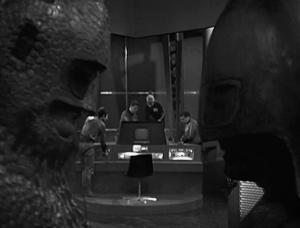
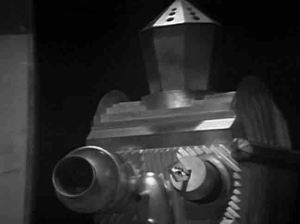
The travelers arrive on the homeworld of the Cybermen to find an archaeology team researching the titular tomb. It’s a nice parallel to the previous serial, which briefly (re)visited the homeworld of the Daleks. As they explore, they unravel more of the enemy’s background. I had seen the cybermats before on the recent series episodes, so it’s good closure on my end to see where the mechanical caterpillars originate.

The team restores power to the complex and awakens the tomb, but the rocket ship is broken and the pilot is distrustful, so the team is stranded. Of course, the Doctor can leave anytime, but he chooses to remain, and the story continues with members of the exploration team belonging to the Brotherhood of Logicians, who want to add the Cybermen’s power to the Brotherhood’s intelligence.

I like the design of the Cybercontroller with the semi-transparent brain cavity, but those voices are still hard to understand at times. We also discover that these Cybermen are related to those from the assault on the moon base.  Once again, without explanation, they recognize the Doctor despite his new persona, but they do explain that the moon base attack was motivated by fear of becoming extinct thanks to the First Doctor’s actions toward Mondas.

An artifact of the 1960s are the stunt wires, which are plainly visible during the fight on my plasma screen, but were probably easily hidden on CRTs half a century ago.

The companions get some nice beats in this serial. First, Victoria reflects on her family and the terror of the Daleks with counsel from the Doctor. She’s very innocent, but very loyal. Jamie also gets to exploit his very well-developed relationship with the Doctor, especially in one exchange that made me guffaw. When discussing the minds of the cybermats:

“You might say they’ve had a complete metal breakdown.”

“Oooh.”

“Sorry.”

In another mythology-building moment, The Doctor advocates using a firearm to kill as he has no other choice, but then rejects it moments later when he enters the tomb to finish off the Cybermen. He also wraps up this serial with a refusal to make predictions about the end of the Cybermen, even though he was really really sure about the Daleks just days earlier. Spoiler alert, Doctor: They both come back.

I think Series Five has set a high bar with an excellent adventure.


Rating: 5/5 – “Fantastic!”

UP NEXT – Doctor Who: The Abominable Snowmen


The Timestamps Project is an adventure through the televised universe of Doctor Who, story by story, from the beginning of the franchise. For more reviews like this one, please visit the project’s page at Creative Criticality.

Timestamp: Fourth Series Summary

Doctor Who: Fourth Series Summary

Timestamp Logo First


This only contains the reviews for the Second Doctor since the First Doctor episodes in the fourth series were average as part of the First Doctor’s summary.

I was really skeptical about this season after The Power of the Daleks and The Highlanders came out so strong, and then The Underwater Menace took a nose-dive. The gradual climb back to the 3 and 4 range with the final four serials was rough in some spots, but a welcome return to what I came to expect from the first three seasons.

Looking back, I shouldn’t have been worried: This season earned higher grades than all but one of the First Doctor’s years, and has been just about as even as I look back over the spreadsheet I’m using to keep track.

Yes, I’m using a spreadsheet. Yes, I’m a nerd. But you knew that, since I’m devoting the time to watch Doctor Who from the very beginning.

Anyway, this start for the Second Doctor is very promising as we head into the fifth season.


The Power of the Daleks – 5
The Highlanders  – 4
The Underwater Menace – 2
The Moonbase – 3
The Macra Terror – 3
The Faceless Ones – 4
The Evil of the Daleks – 4

Series Four (Second Doctor) Average Rating: 3.6/5


UP NEXT – Doctor Who: The Tomb of the Cybermen


The Timestamps Project is an adventure through the televised universe of Doctor Who, story by story, from the beginning of the franchise. For more reviews like this one, please visit the project’s page at Creative Criticality.

Culture on My Mind – Cleaning Up After the Storm: Reflections on Black Widow in the Age of Ultron

Culture on My Mind

Culture on My Mind
Cleaning Up After the Storm: Reflections on Black Widow in the Age of Ultron
May 14, 2015

scarlett

Natasha Romanoff, better known as Black Widow, is a strong female character and role model in Marvel’s Cinematic Universe.

Throughout the movies so far, she has held her own as an agent of SHIELD and as an Avenger. She has capably stopped threats both on a planetary and galactic scale, ranging from Justin Hammer’s robot army and HYDRA to Loki and the Chitauri. In the aftermath of Avengers: Age of Ultron, her status remains unchanged.

Both critics and audiences have responded phenomenally to the newest installment in the record-breaking franchise, but complaints have still arisen about how Black Widow has been treated by marketing and the film itself. Chief among those grievances is the phenomenon of “Mommy Widow,” a claim that writers and directors are betraying the character by spotlighting her maternal instincts.

In the film, Romanoff and Bruce Banner (human alter-ego to the Incredible Hulk) have developed a relationship. During a peaceful interlude at Hawkeye’s pastoral farmhouse, Romanoff and Banner are discussing their future together, and Banner laments that they can’t have the life that the archer does: a happy nuclear family. The roadblock, he claims, is the Hulk, which is always one angry moment away and, in all likelihood, is now a genetic curse.

To defend her position – a woman who is proactively seeking companionship instead of being the lustful target of the male gaze – Romanoff shares the details of the backstory the audience discovered minutes before thanks to the induced hallucinations of the Scarlet Witch’s mental sorcery.

Natasha became the assassin she is today in a place called the Red Room. In the flashback, we see that her training was intense (to say the least), and that part of that training was taking human life. Romanoff’s graduation ceremony was her own mutilation.

“You know what my final test was in the Red Room? They sterilized me, said it was one less thing to worry about. You think you’re the only monster on the team?”

Romanoff wasn’t calling herself a monster because she couldn’t have children. She simply wasn’t. The agency behind the Red Room, presumably the KGB, cut her apart in an effort to create the perfect killing machine. As seen in Iron Man 2 and The Avengers, Romanoff is trained to use her sexual allure as a weapon. One can assume that this makes KGB assassins similar to secret agents like James Bond, a man who is famous for having sex in every one of his nearly 25 films just to get to the target.

This is the origin of all that “red in the ledger” that Widow wants to erase. She’s not lamenting the loss of her motherhood, but rather the lack of free agency that chains her to her work. She considers herself a monster that was created the moment her freedom was taken away.

The “Mommy Widow” argument continues in a discussion of her role on the team. In Age of Ultron, she’s racing to the rescue and picks up Captain America’s discarded shield, stating, “I’m always picking up after you boys.”

That snarky line is more of a window to her role on the team than it seems. Since her debut in Iron Man 2, Romanoff has been saving the Avengers or delivering a critical hit in every film. In Iron Man 2, she pretty much single-handedly took out Justin Hammer’s guards and helped to shut down his robot army. In The Avengers, she brought Hawkeye back from his Loki-induced stupor and wielded the scepter to shut the Chitauri portal. In Captain America: The Winter Soldier, she literally guided Captain America to not only avoid capture by Hydra but was also instrumental in stopping their genocidal plan. She is, in every sense of the phrase, always picking up after the team. She’s the deal closer.

From the very beginning, Romanoff and Coulson have been the guardians of the Avenger Initiative. They were the front line, courting and babysitting Tony Stark, pushing the right buttons to incorporate Banner, investigating Thor’s arrival, and integrating Captain Rogers to the current era. In essence, they were the parents of the movement, always working for and reporting directly back to Fury. That is a huge amount of development for two characters who started out as secondary non-solo-film roles. They may not have major leading roles, but they are the heart of this universe, and continue to be in their respective roles as team leaders in different branches of SHIELD.

Part of that character development comes back to the relationship with Banner, a pairing that critics claim is Mommy Widow’s arrival at motherhood with a bouncing baby Hulk to nurture.

In The Avengers, it was plainly obvious that Romanoff had only met Banner on paper. She respected the man and outright feared the power of The Other Guy. She set up a typical martial sting operation, complete with a strike team, to take Banner down if necessary. Admittedly, that’s a 180-degree spin from where they stand in Age of Ultron.

However, the film clearly establishes that the Avengers haven’t just been sitting around waiting for the next movie premiere since we saw them last. They explicitly mention that it has been a long hunt for Loki’s scepter, and that means that the team has been working together for a significant time off-screen. The Avengers have developed a great sense of teamwork, as evidenced in the film’s opening gambit at the Hydra base, as well as a way to tame the Hulk when they need him to “Code Green” against a threat.

This wasn’t the only development that occurred off-screen: Stark built more suits after he “Clean Slated” his entire line in Iron Man 3, and overcame his PTSD from the Battle of New York; Rogers and Stark developed a new uniform for the captain, including a short-range retrieval system for the iconic shield; Stark Industries built at least one new model Quinjet (since SHIELD no longer has the capability) and a series of automated armor-bots; the world has come to resent the Avengers and the havoc they wreak; and Hawkeye had a family.

The Marvel Cinematic Universe is so vibrant and alive that it continues to breathe and evolve even though the cameras are off.

The fact that this team picked Romanoff, the character who feared the Hulk the most, to be his handler speaks volumes about her character and role on the team. It is reasonable that the Romanoff/Banner relationship has grown beyond Widow being petrified of the Big Guy because their lives have continued between the films. That makes Widow more than just a swooning love interest with mommy issues and even more than just an ass-kicking blunt instrument to deploy in battle.

Romanoff is three-dimensional, and therefore a truly strong, living and breathing female character instead of the typical comic book trope of a pair of absurdly large walking breasts in spandex waiting for a fridge to fall into.

Even without a solo film outing (which is no excuse for her not to have one), Natasha Romanoff’s status as a strong female character and respectable role model in Marvel’s Cinematic Universe remains intact and promises to remain that way for the foreseeable future.

Cross-published to RevolutionSF on May 13, 2015

cc-break

Culture on My Mind is inspired by the weekly Can’t Let It Go segment on the NPR Politics Podcast where each host brings one thing to the table that they just can’t stop thinking about.

For more creativity with a critical eye, visit Creative Criticality.

Culture on My Mind – Thoughts on Gotham

Culture on My Mind

Culture on My Mind
Thoughts on Gotham
May 11, 2015

I’m not the typical comic book property fan. I don’t care about canon from book to screen – I’m able to read, and if I wanted to experience the adventures in the pages, I’m more than capable of consuming them – but I do care about consistency within the story itself.

That’s where Gotham has failed. The first season of the show started with such promise, but the weaving plot threads stumbled along the way and betrayed that potential.

The pilot episode premiered back in September with a bang, introducing squeaky clean Lieutenant James Gordon to the gritty and grimy of Gotham City. His first case is the Wayne murders, and we get the clear dichotomy between lawful good Gordon and his partner (and embodiment of the city) Harvey Bullock. The further dynamics established with Oswald “Penguin” Cobblepot defying his employer, up and coming crime boss Fish Mooney (a new character to the Bat-Catalog), and the city’s officials being beholden to the Falcone and Maroni crime families intrigued me.

In the first couple of episodes, the threads were clearly established. I wanted this show, billed as an origin for Jim Gordon, to succeed.

Jim Gordon has always been a great supporting character in my opinion. He’s typically portrayed as a paragon of law whose methods of cleaning up Gotham won’t work, but he can’t violate his moral fiber to personally use methods that will work. Hence, he turns to the man who can do what the law cannot, and we get a vigilante called Batman.

With this in mind, I was excited for this show. Gotham’s Jim Gordon had everything stacked against him from the very beginning: The crime families are in a cold war, and everyone including the police are afraid to go against the status quo and either lose their power or bring that power down upon them. I wasn’t expecting him to clean up the city, since that’s Batman’s job in the next decade, but rather make enough of an impact (and survive long enough) to become the commissioner who enables Batman’s crusade.

The first quarter of the season led me to believe that the season arc would revolve around the mob cold war. Instead, it focused on a considerable deal more, including trying to establish origins for all of the Bat-Villains. Trying to develop all of those threads killed the momentum of the first season, especially in the middle third.

How would I have approached it?

The overarching story should have been about the mob cold war, culminating (as it partially did in the finale) with Fish Mooney having played both sides against each other and Cobblepot having played her, sought his revenge, and stolen her victory to become the new boss of organized crime. Falcone could survive and slink into retirement as he did, and Maroni could remain dead. The entire Dollmaker subplot could have been completely excised, as it just felt like filler to stretch the season and remove Fish from the playing field until the finale.

Under that umbrella, the first subplot could have been Gordon’s efforts to stem the corruption in the police force. I loved his defiance of the mayor and commissioner, and his outwitting them when they tried to silence him by demoting and reassigning him. I loved the commissioner’s attempt to discredit and/or remove Gordon’s threat to his power by setting the Ogre on the detective’s trail.

What I didn’t like was the Barbara Kean subplot.

If the writers follow the comics, which I don’t expect, Barbara is eventually supposed to marry Gordon and start a family with him. The problem is that they have removed any sympathy I have for the character by stripping away the promise of her being an emotional anchor and support for Gordon in a city that stands against him. If they wanted to make her more complex, the troubled backstory they provided sufficient complexity, and they could have removed Gordon’s support by sending Barbara off to work through her issues but still remain sympathetic to the audience and Gordon.

As it stands with this multiple personality/nonsensical drugged-by-the-Ogre-fugue-state storyline, if they choose to reunite them later it will feel artificial. She may or may not have killed her parents in cold blood. A lawful good character like Gordon wouldn’t settle for that. Even if she’s dead after attacking Leslie Thompkins, who should not have been counseling someone with a conflict of interest, she’s still not someone that Gordon would name his daughter after.

Also, where did Renee Montoya and Crispus Allen go? These two could have been fantastic allies to help rally behind Gordon as he stems the police department’s corruption. Instead, they are wasted. So is the subplot about the commissioner’s illegitimate daughter, which Gordon could have used to topple Commissioner Loeb after the Ogre storyline started.

This subplot could have been resolved with a power vacuum in the Mayor’s office after Gordon reveals the corruption and mob ties. District Attorney Harvey Dent, Montoya, and Allen stand with Gordon, and the next season is set up for a subplot with a now scared commissioner secretly teaming with Bullock to find a way to stop Gordon’s crusade. This also opens the door for the typical “Penguin runs for Mayor” storyline.

The second subplot could have been Bruce Wayne’s quest for the truth, which was actually one of my favorite parts of the season even though it was only tangentially related to Gordon’s story. Both he and Gordon know that Pepper was a scapegoat in the pilot, and the investigation could have been handed off to Wayne as Gordon got pulled into the first subplot’s machinations. The investigation could have proceeded pretty much the way that it did, but tightened up with less involvement from Gordon. Bruce earns his “world’s greatest detective” stripes by unraveling the secrets, digging into Wayne Enterprises, and going through the cloak-and-dagger that he and Selina Kyle performed. Sure, have Bruce discover the cave and how his father also fought against the corruption in his own corporate house. But Bruce Wayne’s story should be minimized in a series about Gordon’s origins, and as such, he should have been involved for about only 60 to 75 percent of the entire season’s episodes.

As this subplot ends, Wayne gains an ally against the corporation in Lucius Fox, he and Alfred grow much closer as he recovers from the trauma of the murder of his parents and discovers his new life’s calling, and Selina departs just as she did to join Fish Mooney (in a more meaningful capacity than the twenty minutes in the season finale) before slinking into the shadows after Fish’s death. This sets up a smaller subplot for Season Two where Bruce discovers his heritage, Wayne Enterprises potentially endorses Cobblepot for mayor, and Bruce and Alfred decide to travel abroad and start rallying allies against the corporation. Bring back Sean Pertwee from time to time, but leave Bruce to evolve into the cape and cowl. There are also opportunities for Falcone to return in a limited capacity to provide information (for a price) regarding the Wayne murders.

Finally, each season should focus on evolving one (and only one) Bat-Villain, with the Penguin and possibly (and minimally) Selina Kyle as common threads. The second season could start showing cracks in the good façade of Harvey Dent or perform a longer and more realistic slip into schizophrenia for Edward “Riddler” Nygma. Nygma was best when he was subtly creepy, and by the end of Season One, he lost that quality in the sudden 180 spin into complete supervillain mode, which also removed some of the magic in the series. Even better, remove the schizophrenia and simply make him completely sane and malevolently intelligent. Not every villain needs to have some kind of psychological break.

Overall, Gotham is a mess, but I don’t think it’s unsalvageable. I’ll be tuning in for the first part of Season Two, but I can’t guarantee much more beyond that if it doesn’t start pulling together. The show needs a clear roadmap for every season to help it reach the potential that I still see. The acting is great from many of the starring roles, and they deserve the chance to shine in a tight and coherent story.

cc-break

Culture on My Mind is inspired by the weekly Can’t Let It Go segment on the NPR Politics Podcast where each host brings one thing to the table that they just can’t stop thinking about.

For more creativity with a critical eye, visit Creative Criticality.

Timestamp #36: The Evil of the Daleks

Doctor Who: The Evil of the Daleks
(4 episodes, s04e37-e43, 1967)

Timestamp 036 The Evil of the Daleks


Grand Theft TARDIS.

Thematically, this one is about human greed and how easily the Daleks manipulate it. Human innovation inadvertently allows the Daleks to invade Earth to kidnap the Doctor and conquer humans by decoding the “Human Factor”. The Doctor forced to cooperate with the Daleks or lose the TARDIS forever.

I did like the trials with Jamie and Kemel as they attempt to rescue Victoria, and how they were used to decode the Human Factor. Jamie’s courage, mercy, instinct, and self-preservation assist the Doctor in turning the tables on his foes and overcoming the new electronic control the Daleks have over people. That brainwashing and (for lack of a better term) assimilation sheds some light on the Dalek agents from the newer episodes, which seemed to come from nowhere.

While I thought that the Factors were silly, it was neat to see the Daleks imprinted with the Human Factor to make them act like innocent children.

Of course, when the Daleks have what they want, they they return to Skaro and destroy the laboratory (and presumably the humans as well). Upon returning to the familiar tunnels and city, I wanted to know where the Thals were hiding. We do get to meet the Emperor Dalek (who was presumably hiding during The Daleks?) and Human Factor MacGuffin is its downfall.

Maxtible and his quest for the secret of alchemy made some sense from the Victorian time era, as did the desire to imprint all of humanity with the Dalek Factor (the Dark Side to the Human Factor’s Light?) once I got past the silliness of the Factors. The entire imprinting technique doesn’t work on the Doctor, because, well, he’s alien.

We get some more teases about what’s inside a Dalek can, and we get a new companion on the TARDIS. There was also an error in the serial reconstruction: The black domed Dalek confronts finds a clearly marked Alpha in the corridor, but the Dalek is referred to as Omega.

The big negative is right back to the problem of The Macra Terror: The Doctor’s actions precipitate what he presumes to be the “final end” of the entire Dalek species. We’re talking genocide for the second time in almost as many serials. That doesn’t seem like something he would do except as a last and final resort, and certainly not without significant remorse, and I can’t help but wonder if this is a hallmark of producer Innes Lloyd or something else.

Overall, this serial could have been an episode or two shorter, but it was still an enjoyable tale with a favorite (if sometimes uneven) enemy.


Rating: 4/5 – “Would you care for a jelly baby?”

UP NEXT – Fourth Series Summary


The Timestamps Project is an adventure through the televised universe of Doctor Who, story by story, from the beginning of the franchise. For more reviews like this one, please visit the project’s page at Creative Criticality.


Timestamp #35: The Faceless Ones

Doctor Who: The Faceless Ones
(4 episodes, s04e31-e36, 1967)

Timestamp 035 The Faceless Ones


First, following on from the last review: I love the new theme music as well. It actually sounds a lot better to me than the first arrangement.

This time, we get the Doctor versus the body-snatchers at the airport, and this would be fun to revisit in the post-9/11 era.

The TARDIS materializes right on the airport runway, Polly gets turned into a pod-person after witnessing a murder, and the Doctor and Jamie get the red tape run around. Ah, red tape… Doctor Leonard McCoy was right: The bureaucratic mentality is the only constant in the universe.

I really liked this one, with all of the intrigue and the politics as the travelers tried to solve the mystery. I loved our heroes hiding in the photo booth, especially with the Doctor cheesing it up for the camera. The Doctor maniacally pretending to have a bomb as a distraction reminded me of the modern Doctors. Jamie was especially fun to watch as he was so lost in the modern era, and yet ends up really propelling this story forward.

Of course, Ben and Polly are both captured and don’t appear in much of this serial as a means to facilitate their departure from the show in Doctor Who tradition. At least they get to say goodbye. More on that in a second.

On companions, I’m glad Samantha Briggs didn’t join the group as the production team wanted. I found her kind of irritating even though she saved everyone with her mirror. Jean Rock, on the other hand, would have been fantastic as a companion, and I’m glad to see after a little research, that we get to see Wanda Ventham (mother to Benedict Cumberbatch!) a few more times in Doctor Who.

I found the sexism in the discussion as Samantha decides to investigate the hangar to be excusable: Samantha says she “needs a man” to keep her safe, and Jamie agrees. Samantha doesn’t strike me as very empowered, and Jamie’s temporal basis makes him more prone to strength belonging to men over women. I don’t agree with the sexism, but I recognize that it fits with the time and characters.

There was some really nice humor from the Doctor after he was nearly frozen to death in the same room they’re searching: “Jamie, we’re getting warmer, which is a change from the last time I was here.” I also didn’t mind the common Doctor Who trope of shrinking people for long-term storage as I was engaged in the story.

Polly and Ben leave the TARDIS on the very day they started to travel. The Doctor’s envy is obvious as he can’t go home yet. Ben and Polly have been good companions, even with Polly’s unevenness of character. They were a breath of fresh air, and will be missed. This, of course, leave Jamie as the single companion on the TARDIS with the Doctor, and I don’t mind that arrangement as Jamie as shown to be very capable.

Overall, this was an enjoyable time.


Rating: 4/5 – “Would you care for a jelly baby?”

UP NEXT – Doctor Who: The Evil of the Daleks


The Timestamps Project is an adventure through the televised universe of Doctor Who, story by story, from the beginning of the franchise. For more reviews like this one, please visit the project’s page at Creative Criticality.


Timestamp #34: The Macra Terror

Doctor Who: The Macra Terror
(4 episodes, s04e27-e30, 1967)

Timestamp 034 The Macra Terror

First things first: I love the new opening with Patrick Troughton’s face in the vortex.

At first, I thought this was a Brave New World tale. It’s an R.E.M. dream of Shiny Happy People having fun, with tightly policed contentment and chemical treatments for those who don’t conform. Chew your soma, kids, because beatings will continue until morale improves.

This society is essentially a cult, with the blind faithful controlled by the Macra to mine the life-providing gas, and the Doctor is here to bring freedom to the enslaved humans. Of course, the travelers are introduced to the brainwashing so they can become part of the cult: Jamie does not succumb, Ben falls for it, Polly has to be convinced, and the Doctor continues to be his whimsical self. I simply adore his trips through the machines that first pressed his clothes, and then unintentionally messed them up again. This Doctor isn’t falling for it.

This Doctor also shows his scientific and mathematical brilliance in deriving the secret equation through examination of the evidence.

All of that said, I have negatives: The minor one is the music, which was really annoying. The major one was the resolution of  the story.

At its core, this story is really more about preserving freedom and abolishing slavery than it is about escape from possibility of death. Sure, freedom is essentially a moral positive and slavery is essentially a moral negative, but the result was the death of the captors instead of any kind of negotiation or compromise. The Doctor didn’t even try negotiation before stepping onto the path of killing the Macra for their crimes against the colony. Granted, such negotiations would have likely failed as they would with pretty much any dedicated cult leader, but I would have liked to see him try at the very least.

It just doesn’t seem like something the Doctor would do, and that knocked a decent story down to a semi-decent one at best.


Rating: 3/5 – “Reverse the polarity of the neutron flow.”

UP NEXT – Doctor Who: The Faceless Ones


The Timestamps Project is an adventure through the televised universe of Doctor Who, story by story, from the beginning of the franchise. For more reviews like this one, please visit the project’s page at Creative Criticality.


Culture on My Mind – Book Review: “Player Choice” by Jeff Deck

Culture on My Mind

Culture on My Mind
Book Review: “Player Choice” by Jeff Deck
April 17, 2015

Jeff Deck, co-author of The Great Typo Hunt, recently reached out to me to promote his new novel Player Choice. He provided me a copy in exchange for an honest review.

It’s 2040. With neural implants, people can play games in an immersive virtual reality known as the aether space. Game designer Glen Cullather has a plan for the most ambitious aether game ever imagined: a fantasy epic that gives players the freedom to do anything.

But Glen’s own life is fragmenting into alternate realities. He can’t tell whether his aether game idea has succeeded, or failed miserably. And Freya Janoske is either his biggest rival, or his most intimate partner. Glen must figure out what’s real and what’s, well, fantasy—for his own survival.

Player Choice is a fast-paced gaming sci-fi adventure that dares to ask: What happens when unreality becomes our reality?

The protagonist, Glen Cullather, is a successful game programmer. He lives in a world not too far from our current reality where technology dominates everyday life, from interactive semi-sentient digital assistants to fully-capable AIs who can run entire companies. Gaming is immersive in shades of today’s Oculus Rift and Star Trek’s holodeck technology, and Glen is on his way to pitch a new experience called Novamundas to the company’s board of directors when his entire world goes sideways.

The story is quickly paced and the mystery around the reality of Glen’s situation is exciting. It kept me engaged and drawn back to the pages, as did the cognitive exercise of what else this universe could explore. The characters were diverse and colorful, and the social message was clear as the story drew to a close, warning readers of the potential pitfalls from over-reliance on tech and limited decision making.

Novamundas is built on the philosophy of providing choice to the players by trying to make them think beyond the hack-and-slash that dominates the gaming scene, even to the point of making violent problem-solving in the virtual world a chore rather than a quick means to drive the game’s story.

This is in contrast to the game’s creator, who is limited by his own tortured past: Glen’s own agency is limited by mental trauma that he hasn’t worked through, which leaves him as man who treats women and himself poorly. For that reason, I had a hard time identifying with Glen. It was necessary for the hero to be a flawed character, but he was not a hero that I could cheer for.

Similarly, Freya Janoske was hard to identify with because of how she was filtered through Glen’s experiences. Since this story is told entirely from Glen’s point of view, every interaction is laced with his prejudices and biases. Again, it’s a great way to tell Glen’s story, but it also becomes difficult to develop a sympathetic relationship for supporting characters when every interaction before the final three chapters is completely subjective.

The second half of the story is dominated by the aether world of the game as Glen’s goals start to coalesce. The game itself is quite interesting, and the dynamics of emphasizing creativity over violence are intriguing, but the story is bogged down in the nuts and bolts of skills, attributes, and gaming mechanics. It made sense to me as a casual gamer, but the details and gamer lexicon might potentially derail the story’s flow for anyone not well-versed in the gaming world, which adds an accessibility hurdle to the moral message.

The pacing is more evident in the second part, especially once the characters realize the urgency of their situation. The actual core conflict and the goals of the antagonists – yes, bad guys with actual goals and moderately complex motivations! – was very fun to think about. Unfortunately, I think the pace hindered Glen’s character growth as he is forced to react quickly to each development and never gets a chance to really reflect on what he’s learned about himself or resolve his inner demons. The story actually ends at the beginnings of his healing process, which left me feeling like I’d been cheated out his complete arc.

What this story did do for me is make me think. From a morals, messages, and meanings standpoint, it leaves several avenues to explore in how a society exists in a world dominated by technology. While it’s far from being neatly wrapped with a big red bow, that aspect of science fiction exploring the human condition through allegory was refreshing.

Overall, I give Player Choice three and a half stars out of five. For Goodreads and Amazon, which don’t deal in halves, I’ll bump it to four.

cc-break

Culture on My Mind is inspired by the weekly Can’t Let It Go segment on the NPR Politics Podcast where each host brings one thing to the table that they just can’t stop thinking about.

For more creativity with a critical eye, visit Creative Criticality.

Timestamp #33: The Moonbase

Doctor Who: The Moonbase
(4 episodes, s04e23-e26, 1967)

Timestamp 033 The Moonbase


The Cybermen are back, and a bit better designed than their last appearance not so long ago.

The story is about a weather control station on the moon that is being attacked by a mysterious virus. The virus, craftily hidden in their sugar supply, disables the staff of the moonbase so the Cybermen can essentially assimilate the most compatible of the infected and kill everyone on Earth with storms induced by the station’s control system. It’s pretty straightforward.

It turns out that the Doctor is an actual medical doctor who studied under Joseph Lister, and Jamie is safe because he didn’t use the sugar and has a head injury that disqualifies him from being transformed. Ben and Polly acted rather intelligently in fighting the Cybermen with a chemical attack to disable their control systems.

I noted some 1960s sexism: The making of coffee wasn’t an example, but “stay here, Polly, this is men’s work” certainly was. Luckily, Polly is a strong and independent woman… at least in most of her serials with the Doctor.

The Cybermen are a bit hard to understand in this serial. They have new voices, which are heavy treated with audio effects. Also, how do they know the Doctor’s new face? Between them and the Daleks, I’m beginning to think that the Doctor has an aura that every major antagonist recognizes over the face or physical features.

Meanwhile, the internal dialogue with the Doctor was distracting. It wasn’t terrible, but certainly not something I’m familiar with in the franchise.

The depressurization of the dome seemed a bit unrealistic, since the air rushes out, but no one is pulled with it and the coffee is still standing.

Finally, the jumping on the moon with bionic sound effects. Ugh.

Not a bad serial by any stretch, but not a top performer either.

Rating: 3/5 – “Reverse the polarity of the neutron flow.”


UP NEXT – Doctor Who: The Macra Terror


The Timestamps Project is an adventure through the televised universe of Doctor Who, story by story, from the beginning of the franchise. For more reviews like this one, please visit the project’s page at Creative Criticality.


Timestamp #32: The Underwater Menace

Doctor Who: The Underwater Menace
(4 episodes, s04e19-e22, 1967)

Timestamp 032 The Underwater Menace


Doctor Who meets Atlantis!

It’s good to see the companions having fun together. The chemistry is nice, and it shows how the cast is really clicking. The downside is that the modern day companions are picking on Jamie’s lack of knowledge about the TARDIS. It’s kind of mean of them.

Nothing good happens in science fiction, fantasy, or horror from exploring a cave on your own, but of course Polly goes off looking around after the boys leave her behind, and of course hilarity ensues. It is a rather convenient way to separate the travelers from the TARDIS, as kidnapping them and taking them to the depths of the ocean puts a lot of distance between them.

The Doctor and his goofy hat have a clever ruse to save the companions, and luckily Zaroff has a good sense of humor about the diversion. Unfortunately, Dr. Z is also bat-dung crazy. Also, we keep seeing references (outside of each episode’s credits) to the Doctor as “Doctor Who”, this time in his note: “Vital secret will die with me. Dr. W.”

Professor Zaroff has promised to raise the city to keep working, but his plan is still incomplete… and will destroy the world. Zaroff’s insanity focuses the efforts not on the citizens and the consequences, but on his own glory as it is the ultimate achievement in science. His logic doesn’t make sense, which makes him more of a mad scientist than an evil one. He’s also quite the overactor – “Nothing in the world can stop me now!” – and left a few dental impressions in the scenery.

Ben gets a clever moment to play the god Amdo and save the Doctor and Ramo. The plan and chase was pretty exciting to kidnap Zaroff, and the plot to starve out the powers that be by cutting off the supply lines with striking slaves was intelligent. Of course, the “underwater” scenes are laughable by today’s standards, but I’m sure they were a spectacle in 1967. On the downside, Polly is uncharacteristically a whimpering “damsel in distress” in this serial.

The demise of Zaroff was a nice bit of writing, but the plan to get there was a stretch. I understand overloading the reactor to destroy it, but using it to degrade the walls? It takes a while for radiation to degrade stone/concrete walls, and the flux required to rapidly destroy walls would outright kill humans and the Doctor much faster. I waved it off as best I could as a plot conceit, but it was another indicator of how middle of the road this serial was.


Rating: 2/5 – “Mm? What’s that, my boy?”


UP NEXT – Doctor Who: The Moonbase


The Timestamps Project is an adventure through the televised universe of Doctor Who, story by story, from the beginning of the franchise. For more reviews like this one, please visit the project’s page at Creative Criticality.