
Timestamp #44: The Dominators

Doctor Who: The Dominators
(5 episodes, s06e01-e05, 1968)

Timestamp 044 The Dominators


With a setting like the Island of Death, how could this not be a Doctor Who tale?

The focus of this simplistic serial are the odd couple called the Dominators. Navigator Rago, who I shall refer to as Felix, wants to drill the planet for an energy source to fuel their fleet and would prefer to use the indigenous people as slave labor. Probationer Toba, who I refer to as Oscar, just wants to blow everything up. A century or so before the Doctor’s arrival on the island, the Dulcian society experimented with atomic weaponry. After seeing how badly it mucked up the works and made perfectly good real estate uninhabitable, they swore of warfare and became a planet of pacifists. By coincidence, a spaceship with two General Zod lookalikes and a handful of spiky-headed Quarks arrived and hoovered up all of the radiation on the island. If it weren’t for the slavery and death aspect, these guys could make killing in picking up after the galaxy. I mean, look at all of the plots so far from the Daleks and the Cybermen alone.

Meanwhile, a pleasure craft is headed to the Island of Death for an unsanctioned extreme vacation. I got distracted by their wardrobe, which is some kind of bath towel/drapery toga motif, and I’m guessing that they did too because they certainly weren’t watching the road. Crash, boom, bang, and now they’re stuck on the island. Moments later, they encounter the Quarks and… oh, well… the vacationers are dead. Mostly.

Putting the final pieces in play, the Doctor and the travelers arrive looking for a holiday. The Island of Death apparently used to be quite the vacation spot. They find a war museum and then encounter the a scientific team that explain the brief flirtation with nuclear weapons, and after splitting Zoe from Jamie and the Doctor, the latter two are captured by Oscar and Felix.

These Dominators are arrogant in their power. The Dulcians end up being well-built as slave workers (two hearts, even) but Jamie is not. The arrogance is in full display as they fail to examine the Doctor and assume that his physiology is identical to weak and frail human’s. Their mistake.

The other big highlight for me in the examination phase was the Doctor’s fantastic way of thinking: Is the point Dominators’ intelligence test to be more clever or stupid? Which is more highly prized in slave labor? They choose to play stupid and be less of a threat to their captors.

I’m still not sure what to make of Zoe. She seems less of a damsel-in-distress and a bit more intellectual than recent companions. She’s also a good community organizer and able to convince at least one of the Dulcans to fight. The Doctor certainly loves to tease her about her intellect.

The Dulcians are intellectually lazy. Ballan, the leader of the expedition, displayed poor reasoning skills in the analysis of the radiation, and acts like a typical person illiterate in the sciences by not asking questions with respect to his observations. If more people continued to ask questions instead of just accepting what their eyes tell them, the world would be a much better place.

The story comes to a climax as Jamie spearheads the resistance against the Dominators, and saves the day with his idea to tunnel through and catch the seed device to prevent the destruction of the planet. The Doctor has a somewhat bloodthirsty but innovative way to get the explosive seed device off the planet, and Oscar and Felix become background radiation.

Final notes: First, the Quarks were a bit difficult to understand with their over-processed voices. Second, the sonic screwdriver acting as a cutting torch continues to display that the new-Who series is not unique in using it as a convenient-to-the-plot multifunction tool. At least it wasn’t a time vector generator.

I liked this one, but not as the drama is was intended to be. Instead, it comes across as quite humorous with the odd couple aliens and the pacifist message that is so heavy-handed, it squashes the serial. All in all, a mediocre start to the sixth series.


Rating: 3/5 – “Reverse the polarity of the neutron flow.”


UP NEXT – Doctor Who: The Mind Robber


The Timestamps Project is an adventure through the televised universe of Doctor Who, story by story, from the beginning of the franchise. For more reviews like this one, please visit the project’s page at Creative Criticality.



Timestamp: Fifth Series Summary

Doctor Who: Fifth Series Summary

Timestamp Logo Second


I am of two minds with this series/season. Before I get there, I do realize that I’ve been using the terms series and season interchangeably. The TARDIS wiki that I use as the reference for Timestamps tends to call the classic years by season and the new years by series. Most BBC shows I’ve watched tended to use series regardless of production year, so I tend to use series more frequently. I may eventually settle on a standard, but I think it’s pretty clear what I’m talking about within the confines of Timestamps, especially since I hyperlink frequently.

On to Series Five…

Starting with the negative, the entire group of stories was in the “base under siege” style. From what I understand, this was a move to save money and time, especially since the show was constantly under the threat of cancellation. This set was also mostly reconstructions, and none of the stories were known to have survived the BBC’s tape purges until the 1990s when The Tomb of the Cybermen was unearthed. Between the repetitive storylines and the visuals of the reconstructions, it was difficult to be motivated to watch. I did, however, try to be fair by judging each story on its own merits rather than judging it against the feel of the series overall.

On a tangent, I do need to revisit The Enemy of the World and The Web of Fear at some point in the future since they have been recently discovered.

On the positive, this was one of the strongest set of performances in the show so far. The scores reflect that, with Fury from the Deep taking the low end with a middle of the line rating. When compared against the Second Doctor’s serials in the fourth series, it’s also a strong improvement. This series received the top average of any series so far.

The top score don’t necessarily mean that I like the Second Doctor more, though. Hartnell’s Doctor was very strong even when his stories were not, and in his curmudgeonly yet caring grandfatherly portrayal, he brought to the show what was needed to get it moving. Troughton’s Doctor has been a different take that keeps the undercurrent of grumpiness with a whimsy and childlike outlook that makes the lead character relatable in what was historically a children’s show. The First Doctor made audiences identify with the companions as they explored time and space, and the Second Doctor (so far) makes audiences identify with the team as a whole. Whether it was intentional or accidental, it is a beautiful formula that I have enjoyed watching develop.

I’m looking forward to watching it continue to grow as the sixth series starts, and I’m also looking forward to saying goodbye to the reconstructions as Timestamps enters the homestretch of the Second Doctor’s adventures.


The Tomb of the Cybermen – 5
The Abominable Snowmen – 4
The Ice Warriors – 4
The Enemy of the World – 5
The Web of Fear – 4
Fury from the Deep – 3
The Wheel in Space – 4

Series Five Average Rating: 4.1/5


UP NEXT – Doctor Who: The Dominators


The Timestamps Project is an adventure through the televised universe of Doctor Who, story by story, from the beginning of the franchise. For more reviews like this one, please visit the project’s page at Creative Criticality.
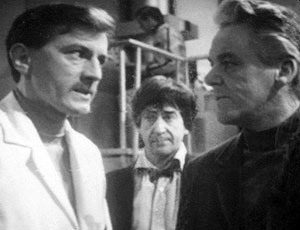
Timestamp #43: The Wheel in Space

Doctor Who: The Wheel in Space
(6 episodes, s05e34-e41, 1968)

Timestamp 043 The Wheel in Space


The Wheel in Space is still the basic “base under siege” story that was typical of the fifth series, but this one feels more unique.  First, the crew of the titular space station doesn’t believe in the Cyberman threat until it actually shows itself. Second, the antagonists partially control the escape route (the TARDIS is stranded on the rocket with the Cybermen) and are a bit more menacing in this story, finally bringing the boys in aluminum foil suits back to nearly the same threat level that they displayed in The Tenth Planet. There’s also the added twist of the impending meteor shower which adds dramatic pressure to the plot and prevents the protagonists from taking too much time or waiting for the enemy to make a move.

We also see a considerable amount of hand waving combined with smoke and mirrors in this serial. Classic Who fans complain about how the recent era (the “New Who” era) of the show treats the iconic sonic screwdriver like a magic wand – and the show runners even make fun of it themselves, as seen in the 50th anniversary special Day of the Doctor – but the “time vector generator” is a much more egregious example of a magic MacGuffin and overall problem solver. It acts as an improvised gun to destroy the robot on the rocket (wait, doesn’t the Doctor abhor using guns?), produces radio interference to signal the space station and save Jamie and the Doctor, supercharges the station’s X-ray laser to destroy the Cyberman spaceship, and controls the entire “bigger on the inside” element of the TARDIS itself. It’s less iconic than the sonic, and stretches the entire joke of the Second Doctor’s skill at pulling the right tool for the job from his pockets to a non-humorous extreme. That little metal bar feels overly convenient and considerably lazy scriptwise, and I kind of hope that we never see it again.

Okay, enough with that.

The motivations of the station crew are believable, and that helped sell me on this serial. They want to destroy the rocket because its erratic flight poses a collision danger to the station. They’re also skeptical of the Doctor and Jamie because the travelers are conspicuously unable to fit in with the current time, and act suspiciously at every move. even right down to the genesis of the Doctor’s long-term alias, John Smith. It’s also fascinating to see how the crew relates to Zoe, an astrophysicist relegated to librarian, which (ironically) is a role that the station couldn’t operate without. She feels underappreciated and completely enthralled with the mystery of the Doctor, so she joins the team as the new companion. She’s definitely quite smart and innocent, but somewhat shy and introverted, and I’m eager to see how she manages with the Doctor and Jamie.

Other positives on this serial include the TARDIS defense mechanism driven by Powerpoint slides of serene temptations, the decorations in the Cyberman control center that are giant lava lamps, and a callback to the infamous fluid link that keeps the TARDIS grounded after a power overload vaporizes the link’s mercury supply.

One minor downside was the Cybermen marching through space. That was rather silly.

This was a really good serial, but the convenience of the time vector generator really soured it for me. I settled on a 3.5 out of 5, but, as always, I’m looking forward and working with whole numbers.


Rating: 4/5 – “Would you care for a jelly baby?”


UP NEXT – Fifth Series Summary


The Timestamps Project is an adventure through the televised universe of Doctor Who, story by story, from the beginning of the franchise. For more reviews like this one, please visit the project’s page at Creative Criticality.


Timestamp #42: Fury from the Deep

Doctor Who: Fury from the Deep
(6 episodes, s05e29-e34, 1968)

Timestamp 042 Fury from the Deep


The TARDIS arrives in the middle of the ocean, and thankfully it floats. Of course, any danger of drowning in a time machine is casually tossed aside by the Doctor endangering his companions by smearing anomalous sea foam in their faces. How reckless, since that foam is the precursor to the titular fury from the deep.

The pumping station, which moves gas from the platforms in the ocean to the mainland is experiencing both a spy problem and a flow problem. The flow just messes with monthly efficiency ratings and causes the station’s supervisor, Robson, to act like a petulant child. The spy lets an invasive seaweed-and-foam entity into the base to – yawn – take over the base and eventually – yawn – the world.

I tried to judge this serial based on its own merits rather than against the problems of the entire fifth series. They’ve been enjoyable, but this season’s theme of defending the base under siege combined with longer serial formats that could have been seriously slimmed down is getting really hard to ignore. This story was an okay break from the alien of the week formula, but it’s still clichéd.

On the upside, we get a chance for Victoria to directly save the day before taking her leave of the TARDIS. She finally breaks the tradition of companions getting terrible send-offs with Victoria having a strong role in the story and getting a family and home in the end. On the downside, where did all of this concern about Victoria feeling unsafe come from? Before now, she hasn’t voiced much of this concern aside from her incessant screaming.

Other positives include the first use of the sonic screwdriver, actually using the TARDIS and its resources in the middle of a serial, and the excellent use of two of the creepiest looking men I’ve ever seen for the station’s killer spies.

A major drawback was Robson. I seriously wanted to feed him to the seaweed-foam-monster and leave him there. He’s a terrible supervisor.

This story was decent enough, but the real high point (and low point) was saying goodbye to Victoria. I wasn’t happy with her sudden change of heart in this story, but I am happy with her final resolution. I’m also ready to be done with the base siege story format.


Rating: 3/5 – “Reverse the polarity of the neutron flow.”


UP NEXT – Doctor Who: The Wheel in Space


The Timestamps Project is an adventure through the televised universe of Doctor Who, story by story, from the beginning of the franchise. For more reviews like this one, please visit the project’s page at Creative Criticality.
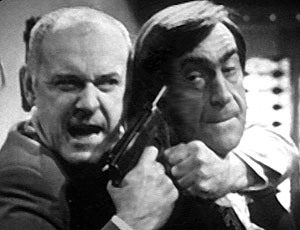
 

Timestamp #41: The Web of Fear

Doctor Who: The Web of Fear
(6 episodes, s05e23-e28, 1968)

Timestamp 041 The Web of Fear


Picking up right after the last serial, we get the return of Professor Travers, the Yeti, and the Great Intelligence. It’s been forty years and two serials since we last saw these guys, and the professor has provided a way for the Great Intelligence to return from being blown up and take over the world.  He kept a control sphere, reactivated it, and there you go.

The TARDIS gets trapped in a web, which is intriguing because it tells me that the Great Intelligence can intercept the ship’s random flight plans. Is it an analogue to a bow wake or propeller noise in the depths of time? It’s never explained. Regardless, the Doctor breaks them free and the TARDIS materializes in the London Underground. And now the cute little reference to London’s subway in The Snowmen makes more sense.

They explore, find it abandoned, and encounter some soldiers. Jamie and Victoria get apprehended by the soldiers, and the Doctor is waylaid by a couple of Yeti who prevent an explosion from destroying the subway tunnels by covering it in the same web that snared the TARDIS.

We get to meet up with Travers again – I absolutely love his revelation that holy crap these are the same people I met forty years and two serials ago – and get introduced to new players Anne (the professor’s daughter) and Colonel Lethbridge-Stewart (hey, I know that guy!).

It turns out that the Intelligence has a mole in the base, and a reporter known as Chorley really wants to get away from the whole situation. Victoria lets slip about the TARDIS, Chorley go in search of it, and the travelers chase after him. I’m presuming that it’s because they don’t want him to die because I assume that the TARDIS is locked. Of course, that’s only because the First Doctor made a habit of locking it when he left, but I don’t know for certain that the Second Doctor has that habit.

The actual plot gets explained by the Great Intelligence: It was impressed that The Doctor defeated it forty years and two serials ago, and instead of destroying such talent, the Intelligence wants to possess it. The Intelligence gives the Doctor twenty minutes to surrender, takes Victoria as incentive, and promises to leave once it has the Doctor’s intellect. Realizing that a full-frontal assault is futile after Colonel Lethbridge-Stewart loses all of his troops, the Doctor rigs a control sphere to control a single Yeti and leaves to meet the Intelligence face to figurative face.

Everyone comes together at the lair of the Intelligence, and the being speaks to everyone through the mole, the now lifeless body of Staff Sergeant Arnold. The Doctor submits to the mind absorption, but Jamie looses the controlled Yeti to disrupt the proceedings and free everyone. The Doctor is angry because he had reversed the headset to absorb the Intelligence, but now it’s free (free fallin’) in space and no longer connected to the Earth. Crisis abated… at least for another 44 years in our world, anyway.

I question the Doctor’s efforts in this one. The Great Intelligence is so immense and powerful, and I don’t know if the Doctor could handle that kind of download to his brain. I feel that 1) it would have killed him, or 2) it would have backfired and given the Intelligence a corporeal form. That’s one hell of a gamble.

It was fun to see the Yeti again, even if it was in a poorly done reconstruction. The reconstructions are starting to wear on me, and while I’m still enjoying the journey, I’m really looking forward to the coming seasons just to see the stories a bit more clearly.

I need to seek out the recently discovered film version (which is still missing episode three), but my enthusiasm to do so is a little less for this one. It was a good story overall, but really slow. It needed to be tightened up and streamlined to four or five episodes. Even with that complaint, it’s still a good missing link in the mythology and a good springboard for things to come, and I did enjoy it.


Rating: 4/5 – “Would you care for a jelly baby?”


UP NEXT – Doctor Who: Fury from the Deep


The Timestamps Project is an adventure through the televised universe of Doctor Who, story by story, from the beginning of the franchise. For more reviews like this one, please visit the project’s page at Creative Criticality.


Timestamp #40: The Enemy of the World

Doctor Who: The Enemy of the World
(6 episodes, s05e17-e22, 1967-68)

Timestamp 040 The Enemy of the World

This was one of the best in the season so far, especially that action-filled pulse-pounding opening sequence.

The TARDIS arrives (in stealth mode, nonetheless – no VROOP!) in a near future dominated by a rising world dictator named Salamander. The twist? The Doctor looks just like him. Despite all the confusion, The Doctor explains that he and his companions don’t know of current world events because they’ve been out of touch for a while… “on ice” if you will. That callback was a nice touch considering the theme of the first three serials in this series.

Since it’s the only way out from between the rock and a hard place, The Doctor agrees to impersonate Salamander. Patrick Troughton, an actor with whom I have no experience outside of Doctor Who, is amazing in this serial. He portrays three distinct characters in this – the Doctor, Salamander, and the fake Salamander – and his acting ability is superb.

Jamie stages an attempt to save Salamander to gain the dictator’s confidence, and as a result gets himself and Victoria hired onto Salamander’s staff. This introduces the crotchety chef, a character that I love, who provides a great humor break in the seriousness of this story.

Benik is deliciously mustache-twirlingly evil and creepy, even though it’s over the top, and the refugees hidden underground are another nice twist. The Doctor also understands the internet: “Strange isn’t it? People spend their time making nice things and other people come along and break them.”

This was an excellent political thriller with a small sci-fi twist, especially since the Doctor refuses to personally act against Salamander without concrete proof that the man is evil. It was a good break from the “defend the base from the invading alien” stories, even with an abrupt ending. Salamander meets a fitting end.

I watched the reconstructed version. It’s now a mission to watch this in the recently recovered full version.


Rating: 5/5 – “Fantastic!”


UP NEXT – Doctor Who: The Web of Fear


The Timestamps Project is an adventure through the televised universe of Doctor Who, story by story, from the beginning of the franchise. For more reviews like this one, please visit the project’s page at Creative Criticality.
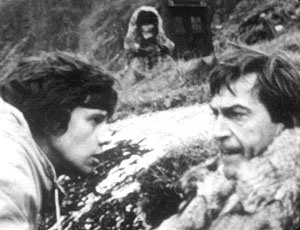


Timestamp #39: The Ice Warriors

Doctor Who: The Ice Warriors
(6 episodes, s05e11-e16, 1967)

Timestamp 039 The Ice Warriors


Traveling through time and space, and it’s like they never left. Except this time, the TARDIS is sideways.

Come to think of it, I’m a little surprised that the TARDIS doesn’t have its own gravity. I mean, sure it makes for great comedy to have the ship fall over and everyone topple, but it seems rather unsafe from the materialization aspect. Imagine that the ship lands, falls off a cliff, and the Doctor wastes a regeneration because he snapped his neck by crashing into the library wall at full speed.

Anyway… I digress.

It’s an ice age in the far future, and people are dependent on computers to such an extent that they can’t even make simple decisions on their own. It’s so bad that the team’s leader, Clent, makes the Doctor prove his qualifications after the Time Lord saves the base and their lives. Part of me wanted the Doctor to just walk away and let this civilization freeze. It seems that the Doctor is a better man than me.

This future came about because of artificial crops, which minimized the need for real plants. As they died off, less carbon dioxide was produced and the Earth’s heat was no longer retained. I’m going to stop here and quote another good doctor: “Now wait just a damn minute!”

It’s been a few years since my high school biology class, but I seem to remember plants consuming CO2 and producing O2. The science was a bit lacking in this episode. I understand that they corrected it in the novelization, which is technically canon, but I’m not pursuing the books or audio dramas at this point.

These humans have discovered something called an Ice Warrior. Long story short: It wakes up and explains that it hails from Mars and has been frozen for millennia, and he needs his warriors to decide whether to invade or leave. It forces Victoria to find a power pack and goes to thaw his compatriots. After Victoria is kidnapped, Jamie and Arden set out to rescue Victoria from the Ice Warriors, but they get ambushed and left for dead. Luckily, Jamie is rescued by scavengers.

The Doctor develops a plan to use ammonium sulfide to incapacitate the Ice Warriors – I loved how he tested the chemical dispenser, since he’s been so skeptical of this civilization, by having it create water – and ventures off to the Martian ship. Of course the humans protest because they can’t afford to lose anyone else, but the Doctor was right: He was superfluous at the base.

The Ice Warriors are fighting the scientists because they think the ionizer, which is used to melt the ice, is a weapon. They’ve decided to leave (good!), but first have to invade the base (bad!) to get fuel for their ship. That plan begins with trying to shatter the base’s protective dome with a sonic gun. After the Doctor incapacitates the Ice Warrior gunner with the ammonium sulfide mix, he and Victoria change some settings and make the sonic gun more likely to hurt the Ice Warriors.

I would have had sympathy for the Ice Warriors because they were trying to leave somewhat peacefully, but then they started being violent to get the fuel. I had no problem with their (probably not so) final fate. The computer can’t help because it’s built to preserve itself and the society, so it short circuits and the scavengers save the day by firing the ionizer at the ship and disintegrating it.

Victoria really did a good job in this episode of carrying her own. Sure, she was a bit of a damsel in distress, but she also was great in moving the plot. I especially loved how she couldn’t describe the specifics of the Ice Warrior ionic engine, not because she was stupid, but because she didn’t have the words based on her temporal reference. I can forgive the earlier scientific snafu for that brilliance.

I can also forgive the generated apathy for the humans. They were supposed to be frustrating in their dependence on a self-serving computer. What’s harder to forgive is the plot convenience of the Ice Warriors actually having enough fuel to start lifting off. That negates any intelligence I attributed to the Ice Warriors because they attacked for no reason. It’s also lazy plot continuity.

Overall, The Ice Warriors is a fun enough story, but the plot and scripting are all over the place. I’d give it a 3.5, but the scoring method is based on whole numbers, and I follow the trend of John and Paul at Cyborgs: A Bionic Podcast by being optimistic when in doubt.


Rating: 4/5 – “Would you care for a jelly baby?”


UP NEXT – Doctor Who: The Enemy of the World


The Timestamps Project is an adventure through the televised universe of Doctor Who, story by story, from the beginning of the franchise. For more reviews like this one, please visit the project’s page at Creative Criticality.


Timestamp #38: The Abominable Snowmen

Doctor Who: The Abominable Snowmen
(6 episodes, s05e05-e10, 1967)

Timestamp 038 The Abominable Snowmen


The Doctor is excited to be back in Tibet, has a Holy Ghanta to return to the local monastery, and the adventure begins with murder. The Doctor’s warm furry coat gets him confused with the real monster of the week, the Yeti, who is actually pretty convincing for the 1960s. Meanwhile, the local monks are battling the Yeti, who is a robot being controlled by Padmasambhava, the High Lama of the monastery, who is himself being controlled by The Great Intelligence.

The Great Intelligence… wait, I know that one! This nemesis has something for the cold, doesn’t it?

It’s a pretty simple story from there: The Great Intelligence wants to take over the world and our heroes unlock the puzzle to stop it. Cue the big explosion at the end to wrap it all up. Victoria continues to grow on me with her desire to explore and strength of character. Jamie is still doing his thing as the vocal compass of the team.

Overall, it’s a good story and an entertaining time.

Rating: 4/5 – “Would you care for a jelly baby?”


UP NEXT – Doctor Who: The Ice Warriors


The Timestamps Project is an adventure through the televised universe of Doctor Who, story by story, from the beginning of the franchise. For more reviews like this one, please visit the project’s page at Creative Criticality.



Timestamp #37: The Tomb of the Cybermen

Doctor Who: The Tomb of the Cybermen
(4 episodes, s05e01-e04, 1967)

Timestamp 037 The Tomb of the Cybermen

The fifth series starts right where the fourth left off with Victoria joining the crew.

The travelers arrive on the homeworld of the Cybermen to find an archaeology team researching the titular tomb. It’s a nice parallel to the previous serial, which briefly (re)visited the homeworld of the Daleks. As they explore, they unravel more of the enemy’s background. I had seen the cybermats before on the recent series episodes, so it’s good closure on my end to see where the mechanical caterpillars originate.

The team restores power to the complex and awakens the tomb, but the rocket ship is broken and the pilot is distrustful, so the team is stranded. Of course, the Doctor can leave anytime, but he chooses to remain, and the story continues with members of the exploration team belonging to the Brotherhood of Logicians, who want to add the Cybermen’s power to the Brotherhood’s intelligence.

I like the design of the Cybercontroller with the semi-transparent brain cavity, but those voices are still hard to understand at times. We also discover that these Cybermen are related to those from the assault on the moon base.  Once again, without explanation, they recognize the Doctor despite his new persona, but they do explain that the moon base attack was motivated by fear of becoming extinct thanks to the First Doctor’s actions toward Mondas.

An artifact of the 1960s are the stunt wires, which are plainly visible during the fight on my plasma screen, but were probably easily hidden on CRTs half a century ago.

The companions get some nice beats in this serial. First, Victoria reflects on her family and the terror of the Daleks with counsel from the Doctor. She’s very innocent, but very loyal. Jamie also gets to exploit his very well-developed relationship with the Doctor, especially in one exchange that made me guffaw. When discussing the minds of the cybermats:

“You might say they’ve had a complete metal breakdown.”

“Oooh.”

“Sorry.”

In another mythology-building moment, The Doctor advocates using a firearm to kill as he has no other choice, but then rejects it moments later when he enters the tomb to finish off the Cybermen. He also wraps up this serial with a refusal to make predictions about the end of the Cybermen, even though he was really really sure about the Daleks just days earlier. Spoiler alert, Doctor: They both come back.

I think Series Five has set a high bar with an excellent adventure.


Rating: 5/5 – “Fantastic!”

UP NEXT – Doctor Who: The Abominable Snowmen


The Timestamps Project is an adventure through the televised universe of Doctor Who, story by story, from the beginning of the franchise. For more reviews like this one, please visit the project’s page at Creative Criticality.

Timestamp: Fourth Series Summary

Doctor Who: Fourth Series Summary

Timestamp Logo First


This only contains the reviews for the Second Doctor since the First Doctor episodes in the fourth series were average as part of the First Doctor’s summary.

I was really skeptical about this season after The Power of the Daleks and The Highlanders came out so strong, and then The Underwater Menace took a nose-dive. The gradual climb back to the 3 and 4 range with the final four serials was rough in some spots, but a welcome return to what I came to expect from the first three seasons.

Looking back, I shouldn’t have been worried: This season earned higher grades than all but one of the First Doctor’s years, and has been just about as even as I look back over the spreadsheet I’m using to keep track.

Yes, I’m using a spreadsheet. Yes, I’m a nerd. But you knew that, since I’m devoting the time to watch Doctor Who from the very beginning.

Anyway, this start for the Second Doctor is very promising as we head into the fifth season.


The Power of the Daleks – 5
The Highlanders  – 4
The Underwater Menace – 2
The Moonbase – 3
The Macra Terror – 3
The Faceless Ones – 4
The Evil of the Daleks – 4

Series Four (Second Doctor) Average Rating: 3.6/5


UP NEXT – Doctor Who: The Tomb of the Cybermen


The Timestamps Project is an adventure through the televised universe of Doctor Who, story by story, from the beginning of the franchise. For more reviews like this one, please visit the project’s page at Creative Criticality.