
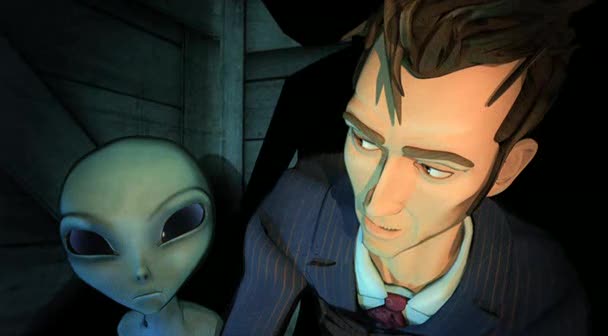
Timestamp #208: Dreamland

Doctor Who: Dreamland
(Animated Special, 2009)
“Always count your steps, Seruba Velak. You never know when you might need to escape in a box.”

One ship is pursued across the sky by two others. In a hail of laser fire, it crashes into the New Mexico desert, outside Roswell, on June 13, 1947.

Eleven years later, the Doctor arrives at a diner in Dry Springs, Nevada. He meets Cassie Rice, a customer named Jimmy, and a mysterious artifact that lights up under sonic screwdriver. While Cassie and Jimmy marvel over the technology, a man in a black suit arrives and demands it. He assaults them for it, and they make haste for the ranch where Jimmy works.

When they arrive, they find a large Viperox battle drone which has been eating the cattle. A helicopter arrives with soldiers on board, and after they blow up the Viperox, they tell the Doctor that he’s wanted at Area 51.

Also known as Dreamland.

Accompanied by Jimmy and Cassie, the Doctor is taken below ground to meet Colonel Stark. He tells them that he plans to wipe their minds, straps them to some operating tables, taunts them for a few minutes, and turns on the amnesia gas. The Doctor wriggles free, turns off the gas, and helps his companions escape through the ventilation shafts.

As alarms echo through the facility, the trio takes flight, ending up in Lab 51. Inside the lab, they discover an alien behind a glass partition. Force to run again, the team takes a lift to a hangar where they are immediately captured.

The Doctor’s entourage are shepherded toward the alien craft that crashed in Roswell. Using his sonic screwdriver, the Doctor hijacks the ship and takes it for a spin. Pursued by Air Force fighters, he crashes the ship in the desert. They take refuge in a ghost town called Solitude.

Meanwhile, Colonel Stark is confronted by a Viperox named Lord Azlok, demanding that he not disappoint the Viperox forces. Azlok is also very interested in the Doctor and his skills.

The Doctor and his companions find a Viperox that pulls Jimmy underground. Lord Azlok interrogates Jimmy and meets the Doctor, whom he pegs as an alien because of his two heartbeats. Cassie frees Jimmy and stages a diversion, and although the Doctor is upset that he didn’t figure out the master plan, they discover it soon enough. Lord Azlok brought the Viperox Queen to Earth, and she’s laying eggs Aliens-style to hatch an invasion force.

The trio runs again, this time taking an Indiana Jones and the Temple of Doom mining cart ride into the blinding desert. There, they meet four men in black suits. The head Man in Black, Mr. Dread, demands the the ionic fusion bar from the diner. When the Doctor stalls, the MiBs reveal themselves as robots. They are saved by Jimmy’s grandfather, Night Eagle, and a hail of arrows.

Night Eagle reveals that he found another of the gray aliens from the crashed ship and kept him safe. Rivesh Mantilax wants to go home, but first he needs to find Seruba Velak, his wife and the alien in the base. His wife was an ambassador who was trying to build an alliance against the Viperox, but was attacked by hired mercenaries.

Colonel Stark arrives and takes everyone into custody. Back at Area 51, the Doctor discovers that Stark has allied with Azlok. They watch as the gray aliens are reunited, then discuss how Rivesh was developing a genetic weapon to destroy the Viperox. Joined by Mr. Dread, Stark reveals his plan to use the ionic fusion bar as a weapon to destroy the Soviet Union.

The Doctor uses his sonic screwdriver to disable Mr. Dread, then runs to the roof with the alien weapon. On the edge of the roof, held at gunpoint by Stark, the Doctor pleads for the colonel’s help. Stark listens to reason, but his plan to arrest Azlok is interrupted by the Viperox leader himself and the promise to tear Earth to shreds.

Down below, Cassie finds Rivesh has been critically injured by Azlok. Once freed, Seruba says that she can save her husband, but only with her ship. Stark takes the group to the Area 51 Vault where all of the ship’s contents were stored in the final scene of Raiders of the Lost Ark. While the Doctor and Seruba start searching, he sends Cassie and Jimmy to retrieve the TARDIS.

As the sun sets, the Viperox emerge from the desert and start their rampage while Seruba finds the component and the Doctor finds a swarm of hungry Skorpius Flies.

Stark deploys his army against the Viperox while Seruba and the Doctor play hide-and-go-seek with the flies. The army is no match for the invasion, and as Stark’s operations center is overrun by Azlok, the Doctor is reunited with the TARDIS. Jimmy, Cassie, and Seruba step aboard and they travel to Rivesh’s side. Once Rivesh is revived, the Doctor asks him to activate the device but to stop before destroying the Viperox. The Doctor connects the device into the TARDIS console and it broadcasts a signal that drives the Viperox off the planet entirely.

The Doctor let them live because, one day, they are destined to evolve into something better.

The Doctor entrusts the device to Colonel Stark for the protection of Earth. They bid farewell to Seruba and Rivesh, and the Doctor takes off as Cassie and Jimmy hold hands.


Admittedly, it is a function of its form, but this story moved like a squirrel binging energy drinks. This piece was originally planned as seven six-minute episodes for the BBC’s Red Button service. As a result, we got a story that has a plot climax every five or six minutes.

It was kind of tiring.

I could point out the technical inaccuracies, but the fact that this was a cartoon developed for a charity event gives the writers a considerable amount of grace in my eyes. Some of the errors are animation shortcuts, others concern United States history, but overall they are inconsequential to the plot on the whole.

So, I’ll revel in the character and cast lists.

Like, the return of Georgia Moffett – daughter of Peter Davison and wife of David Tennant – who we last heard (and saw) in The Doctor’s Daughter and who I really enjoy seeing/hearing on the show.

Or Lisa Bowerman as Seruba Velak. Big Finish fans know Lisa Bowerman as Bernice Summerfield, and classic era fans might remember her as Karra from Survival.

Or the first Native American companion (however briefly) in Doctor Who, Jimmy Stalkingwolf, portrayed by Canadian born English actor and singer Tim Howar. It would have been nice to a Native American actor in either this role or Night Eagle’s role, but I’ll take this advancement as progress. I mean, we’ve come quite the distance from An Unearthly Child when the First Doctor referred to “Red Indians” as having “savage minds”.

Or… How about Doctor Who getting David Warner as Lord Azlok. Emmy-award winning film, television, and theatre actor David Warner from The OmenTime After TimeTime BanditsTronTitanicStar Trek V: The Final FrontierStar Trek VI: The Undiscovered CountryStar Trek: The Next Generation, and so much more.

I mean… wow. Just, wow.

Of course, we first heard of Dreamland from Prisoner of the Judoon, which is where we first saw the ship designs seen in this tale. We get plenty of continuity from the Doctor abhorring salutes (previously The Sontaran Stratagem and Planet of the Dead) and outright despising the nickname “Doc” (referencing The Time MeddlerThe Five DoctorsThe Twin DilemmaThe Ultimate Foe, and more I’m sure).

I also enjoyed seeing Doctor Who outright embrace the Roswell mythos, from the “grays” of typical close encounter accounts to the legendary Men in Black.

Production-wise, this marked the first six-part story on television since The Armageddon Factor and the first six-part story produced since Shada, which was finally completed in 2017 (but not yet reviewed in that form on this site… although there’s always hope).

But, all of that awesomeness considered, I keep coming back to that over-caffeinated squirrel of story pacing. Like I said, it was tiring, and it really pulled me away from the adventure because I was trying to keep up with what was going on with otherwise thinly developed characters.

And that is truly a shame for a tale with so many other groundbreaking elements.

Rating: 3/5 – “Reverse the polarity of the neutron flow.


UP NEXT – Doctor Who: The End of Time

cc-break

The Timestamps Project is an adventure through the televised universe of Doctor Who, story by story, from the beginning of the franchise. For more reviews like this one, please visit the project’s page at Creative Criticality.

The Thing About Today – November 18

November 18, 2020
Day 323 of 366

November 18th is the 323rd day of the year. It is Independence Day in Morocco as they celebrate their separation from France and Spain in 1956. It’s also Proclamation Day of the Republic of Latvia as they celebrate their independence from Russia in 1918.

In the United States, today is “celebrated” as National Princess Day, National Vichyssoise Day, Mickey Mouse’s Birthday, and National Educational Support Professionals Day (which is typically on the Wednesday of American Education Week).

Historical items of note:

  • In 1626, the new St Peter’s Basilica was consecrated.
  • In 1787, French physicist and photographer Louis Daguerre was born. He developed the daguerreotype, the first publicly available photographic process.
  • In 1810, botanist and academic Asa Gray was born. He is considered the most important American botanist of the 19th century.
  • In 1863, King Christian IX of Denmark signed the November constitution that declared Schleswig to be part of Denmark. This was seen by the German Confederation as a violation of the London Protocol and led to the German–Danish war of 1864.
  • In 1865, Mark Twain’s short story “The Celebrated Jumping Frog of Calaveras County” was published in the New York Saturday Press.
  • In 1883, American and Canadian railroads instituted five standard continental time zones, ending the confusion of thousands of local times.
  • In 1923, astronaut Alan Shepard was born.
  • In 1928, the animated short Steamboat Willie was released. It was the first fully synchronized sound cartoon, directed by Walt Disney and Ub Iwerks, and featured the third appearances of cartoon characters Mickey Mouse and Minnie Mouse. This is considered by the Disney corporation to be Mickey’s birthday.
  • In 1939, Canadian novelist, poet, and critic Margaret Atwood was born.
  • In 1942, actress Linda Evans was born.
  • In 1946, author Alan Dean Foster was born.
  • In 1953, English author and illustrator Alan Moore was born.
  • In 1955, composer and conductor Carter Burwell was born.
  • In 1960, actress Elizabeth Perkins was born.
  • In 1961, Scottish screenwriter and producer Steven Moffat was born.
  • In 1963, the first push-button telephone went into service.
  • In 1994, Star Trek: Generations premiered.
  • In 1996, Star Trek: First Contact premiered.
  • In 2003, the Massachusetts Supreme Judicial Court ruled 4-3 in Goodridge v. Department of Public Health that the state’s ban on same-sex marriage was unconstitutional and gave the state legislature 180 days to change the law making Massachusetts the first state in the United States to grant marriage rights to same-sex couples.
  • In 2013, NASA launched the MAVEN probe to Mars.

Since November 18th is National Vichyssoise Day, I wanted to find out what a Vichyssoise was.

Turns out that it’s a soup. Specifically, a thick soup made of boiled and puréed leeks, onions, potatoes, cream, and chicken stock. It is traditionally served cold but it can also be eaten hot.

Recipes were common by the 19th century in France, and the recipes are often named “Potage Parmentier” or “Potage à la Parmentier” after Antoine-Augustin Parmentier, the French nutritionist and scholar who popularized the use of potatoes in France in the 18th century.

The origins of the name Vichyssoise are a subject of debate among culinary historians. One version of the story is that Louis XV of France was afraid of being poisoned, so he had so many servants taste the potato leek soup that, by the time he tried it, the soup was cold, and since he enjoyed it that way it became a cold soup. Julia Child, on the other hand, called it “an American invention”. As such, the origin of the soup is questionable.

Louis Diat, a French chef at the Ritz-Carlton in New York City is most often credited with its reinvention. He grew up in Montmarault in the Allier department near the spa resort town of Vichy.

The Thing About Today is an effort to look at each day of 2020 with respect to its historical context.

For more creativity with a critical eye, visit Creative Criticality.

The Thing About Today – November 17

November 17, 2020
Day 322 of 366

November 17th is the 322nd day of the year. It is World Prematurity Day, an observance to raise awareness of preterm birth and the concerns of preterm babies and their families worldwide. Approximately 15 million babies are born preterm each year, accounting for about one in 10 of all babies born worldwide.

In the United States, today is “celebrated” as National Baklava Day, National Take A Hike Day, and National Homemade Bread Day.

Historical items of note:

  • In 1558, the Elizabethan Era began as Queen Mary I of England died and was succeeded by her half-sister Elizabeth I of England.
  • In 1603, English explorer, writer, and courtier Sir Walter Raleigh went on trial for treason for his involvement in the Main Plot against Queen Elizabeth’s successor, King James I.
  • In 1800, the United States Congress held its first session in Washington, D.C.
  • In 1820, Captain Nathaniel Palmer became the first American to see Antarctica. The Palmer Peninsula was later named after him.
  • In 1839, Oberto, Giuseppe Verdi’s first opera, opened at the Teatro alla Scala in Milan, Italy.
  • This day in 1858 marks the modified Julian Day zero. The Modified Julian Date (MJD) was introduced by the Smithsonian Astrophysical Observatory in 1957 to record the orbit of Sputnik 1 with modern technology.
  • Also in 1858, the city of Denver, Colorado is founded.
  • In 1876, Pyotr Ilyich Tchaikovsky’s “Slavonic March” was given its premiere performance in Moscow, Russia.
  • In 1894, H. H. Holmes, one of the first modern serial killers, was arrested in Boston, Massachusetts.
  • In 1938, Canadian singer-songwriter and guitarist Gordon Lightfoot was born.
  • In 1942, director, producer, screenwriter, and actor Martin Scorsese was born.
  • In 1943, model and actress Lauren Hutton was born.
  • In 1944, actor, director, and producer Danny DeVito was born.
  • Also in 1944, Canadian-American screenwriter and producer Lorne Michaels was born. He created Saturday Night Live.
  • In 1947, scientists John Bardeen and Walter Houser Brattain observed the basic principles of the transistor, a key element for the electronics revolution of the 20th century.
  • In 1951, actor Stephen Root was born.
  • In 1958, actress and singer Mary Elizabeth Mastrantonio was born.
  • In 1962, President John F. Kennedy dedicated Washington Dulles International Airport, which serves the Washington, D.C., region.
  • In 1966, French actress, director, and screenwriter Sophie Marceau was born.
  • In 1970, the Soviet Union landed Lunokhod 1 on Mare Imbrium (Sea of Rains) on the Moon. This was the first roving remote-controlled robot to land on another world and was released by the orbiting Luna 17 spacecraft.
  • In 1973, United States President Richard Nixon famously told 400 Associated Press managing editors “I am not a crook” in Orlando, Florida.
  • In 1978, the Star Wars Holiday Special aired on CBS. It received negative reception from critics, fans, and even Star Wars creator George Lucas, but it so much fun with which to torture friends and family.
  • This date in 2019 is to where the first known case of COVID-19 was traced. It stemmed from a 55-year-old man who had visited a market in Wuhan, Hubei Province, China.

November 17th is International Students’ Day.

This observance of the student community commemorates the Czech universities which were stormed by Nazis in 1939 and the students who were subsequently killed and sent to concentration camps. The date commemorates the anniversary of the 1939 Nazi storming of the University of Prague after demonstrations against the German occupation of Czechoslovakia and the killings of Jan Opletal and worker Václav Sedláček. The Nazis rounded up the students, murdered nine student leaders, and sent over 1,200 students to concentration camps, mainly Sachsenhausen. They subsequently closed all Czech universities and colleges. By this time Czechoslovakia no longer existed, as it had been divided into the Protectorate of Bohemia and Moravia and the Slovak Republic under a fascist puppet government.

It is a nonpolitical celebration of the multiculturalism of universities worldwide and of their international students.

The Thing About Today is an effort to look at each day of 2020 with respect to its historical context.

For more creativity with a critical eye, visit Creative Criticality.

The Thing About Today – November 16

November 16, 2020
Day 321 of 366

November 16th is the 321st day of the year. It is Statia Day in the Caribbean island of Sint Eustatius, a special municipality of the Kingdom of the Netherlands. It celebrates the “First Salute”, when Sint Eustatius (known locally as Statia) became the first country to recognize the United States.

In the United States, today is “celebrated” as National Fast Food Day, National Button Day, and National Indiana Day.

Historical items of note:

  • In 1836, Kalākaua of Hawaii, the last king and penultimate monarch of the Kingdom of Hawaiʻi, was born.
  • In 1852, the English astronomer John Russell Hind discovered the asteroid 22 Kalliope.
  • In 1855, David Livingstone became the first European to see the Victoria Falls in what is now Zambia-Zimbabwe.
  • In 1904, English engineer John Ambrose Fleming received a patent for the thermionic valve (vacuum tube).
  • In 1907, actor, singer, director, producer, and screenwriter Burgess Meredith was born.
  • In 1914, the Federal Reserve Bank of the United States officially opened.
  • In 1920, Qantas, Australia’s national airline, was founded as Queensland and Northern Territory Aerial Services Limited.
  • In 1933, the United States and the Soviet Union established formal diplomatic relations.
  • In 1938, LSD was first synthesized by Albert Hofmann from ergotamine at the Sandoz Laboratories in Basel.
  • In 1945, UNESCO was founded.
  • In 1952, Japanese video game designer Shigeru Miyamoto was born. A video game designer, producer, and game director at Nintendo, he serves as one of its representative directors. He is the creator of some of the most acclaimed and best-selling game franchises of all time, including Mario and The Legend of Zelda.
  • In 1958, actress Marg Helgenberger was born.
  • In 1962, Canadian writer and artist Darwyn Cooke was born.
  • In 1964, Canadian singer-songwriter and pianist Diana Krall was born.
  • In 1965, the Soviet Union launched the Venera 3 space probe toward Venus, which was the first spacecraft to reach the surface of another planet.
  • Also in 1965, Walt Disney launched Epcot Center. EPCOT stands for Experimental Prototype Community of Tomorrow.
  • In 1970, actress Martha Plimpton was born.
  • In 1973, NASA launched Skylab 4 with a crew of three astronauts  – Gerald P. Carr, Edward G. Gibson, and William R. Pogue  – from Cape Canaveral, Florida for an 84-day mission.
  • In 1974, the Arecibo message was broadcast from the Arecibo Radio Telescope in Puerto Rico. It was aimed at the current location of the globular star cluster Messier 13 some 25,000 light years away. The message will reach empty space by the time it finally arrives since the cluster will have changed position.
  • In 1976, Renee MacRae and her son Andrew disappeared from Inverness. The disappearance is currently Britain’s longest-running missing persons case.
  • In 1977, Australian singer-songwriter and actress Gigi Edgley was born.
  • Also in 1977, actress and singer Maggie Gyllenhaal was born.
  • In 1979, the first line of Bucharest Metro (Line M1) was opened from Timpuri Noi to Semănătoarea in Bucharest, Romania.
  • In 1990, pop group Milli Vanilli were stripped of their Grammy Award because the duo did not sing at all on the Girl You Know It’s True album. Session musicians had provided all the vocals.
  • In 1992, the Hoxne Hoard was discovered by metal detectorist Eric Lawes in Hoxne, Suffolk. The Hoxne Hoard is the largest hoard of late Roman silver and gold discovered in Britain, and the largest collection of gold and silver coins of the fourth and fifth centuries found anywhere within the Roman Empire. In 1993, the Treasure Valuation Committee valued the hoard at £1.75 million (roughly equivalent to £3.59 million or $4.74 million in 2019).

November 16th is the International Day for Tolerance.

The International Day for Tolerance is an annual observance day declared by UNESCO in 1995 to generate public awareness of the dangers of intolerance.

Every year various conferences and festivals are organized in the occasion of International Day for Tolerance. Among them, “Universal Tolerance Cartoon Festival” in Drammen, Norway which organized an International Cartoon Festival in 2013.

The day is observed in Bangladesh with Peace Summit. Peace Summit is organized by Preneur Lab and the EMK Center. The conference is a platform to talk and share on country’s challenges on issues like peace, tolerance, fake news, online safety, and hate.

The Thing About Today is an effort to look at each day of 2020 with respect to its historical context.

For more creativity with a critical eye, visit Creative Criticality.

The Thing About Today – November 15

November 15, 2020
Day 320 of 366

November 15th is the 320th day of the year. It is America Recycles Day in the United States, the only nationally recognized day dedicated to encouraging Americans to recycle and buy recycled products.

In the United States, today is “celebrated” as National Bundt (Pan) Day, National Philanthropy Day, National Clean Out Your Refrigerator Day, National Spicy Hermit Cookie Day, and National Raisin Bran Cereal Day.

Historical items of note:

  • In 1806, Lieutenant Zebulon Pike spotted a distant mountain peak while near the Colorado foothills of the Rocky Mountains. It would later be named Pikes Peak.
  • In 1887, painter and educator Georgia O’Keeffe was born.
  • In 1920, the first assembly of the League of Nations was held in Geneva, Switzerland.
  • In 1926, the NBC radio network opened with 24 stations.
  • In 1929, actor, singer, and producer Ed Asner was born.
  • In 1939, United States President Franklin D. Roosevelt laid the cornerstone of the Jefferson Memorial in Washington, DC.
  • In 1940, actor Sam Waterston was born.
  • In 1951, actress, singer, and producer Beverly D’Angelo was born.
  • In 1966, Gemini 12 completed the program’s final mission when it splashed down safely in the Atlantic Ocean.
  • In 1971, Intel released the world’s first commercial single-chip microprocessor, the 4004.
  • In 1981, actress Krysten Ritter was born.
  • In 1988, in the Soviet Union, the unmanned Shuttle Buran made its only space flight.
  • In 1991, actress Shailene Woodley was born.

November 15th is the Day of the Imprisoned Writer.

The Day of the Imprisoned Writer is an annual, international day intended to recognize and support writers who resist repression of the basic human right to freedom of expression and who stand up to attacks made against their right to impart information. It was started in 1981 by PEN International’s Writers in Prison Committee.

In addition to increasing the public’s awareness of persecuted writers in general, PEN uses the Day of the Imprisoned Writer to direct attention to several specific persecuted or imprisoned writers and their individual circumstances. Each of the selected writers is from a different part of the world, and each case represents circumstances of repression that occur when governments or other entities in power feel threatened by what writers have written. On this day, the general public is encouraged to take action, in the form of donations and letters of appeal, on behalf of the selected writers.

The day also serves to commemorate all of the writers killed since the previous year’s Day of the Imprisoned Writer. Between November 15, 2007 and November 15, 2008, at least 39 writers from around the world were killed in circumstances that appeared to be related to their professions.

The Thing About Today is an effort to look at each day of 2020 with respect to its historical context.

For more creativity with a critical eye, visit Creative Criticality.

The Thing About Today – November 14

November 14, 2020
Day 319 of 366

November 14th is the 319th day of the year. In Colombia, it is the Day of the Colombian Woman in honor of the anniversary of the death of national heroine Policarpa Salavarrieta. Also known as “La Pola”, she was a Neogranadine seamstress who spied for the Revolutionary Forces during the Spanish Reconquista of the Viceroyalty of New Granada. She was captured by Spanish Royalists and ultimately executed for high treason, but is considered a hero of Colombian independence. 

In the United States, today is “celebrated” as National Seat Belt Day, National Family PJ Day, National Pickle Day, and National Spicy Guacamole Day.

Historical items of note:

  • In 1770, James Bruce discovered what he believed to be the source of the Nile.
  • In 1840, French painter Claude Monet was born.
  • In 1851, Moby-Dick, a novel by Herman Melville, was published in the United States.
  • In 1886, Friedrich Soennecken first developed the hole puncher, a type of office tool capable of punching small holes in paper.
  • In 1889, pioneering female journalist Nellie Bly (the nom de plume of Elizabeth Cochrane) began a successful attempt to travel around the world in less than 80 days. She completed the trip in 72 days.
  • In 1900, composer, conductor, and educator Aaron Copeland was born.
  • In 1907, author, illustrator, and sculptor William Stieg was born. He created Shrek!, which inspired the film series of the same name.
  • In 1910, aviator Eugene Burton Ely performed the first takeoff from a ship in Hampton Roads, Virginia, taking off from a makeshift deck on the USS Birmingham (CS-2/CL-2) in a Curtiss pusher.
  • In 1920, Mary Greyeyes was born. She was the first First Nations woman to join the Canadian Armed Forces.
  • In 1922, the British Broadcasting Company began radio service in the United Kingdom.
  • In 1927, actor and screenwriter McLean Stevenson was born.
  • In 1933, astronaut Fred Haise was born.
  • In 1954, Greek-American pianist, composer, and producer Yanni was born.
  • In 1959, actor Paul McGann was born. He portrayed the Eighth Doctor on Doctor Who.
  • In 1960, Ruby Bridges became the first black child to attend an all-white elementary school in Louisiana.
  • In 1962, actress Laura San Giacomo was born.
  • In 1967, physicist Theodore Maiman was given a patent for his ruby laser systems, the world’s first laser.
  • In 1969, NASA launched Apollo 12, the second crewed mission to the surface of the Moon. It was crewed by astronauts Charles Conrad, Jr., Richard F. Gordon Jr., and Alan L. Bean.
  • In 1971, Mariner 9 entered orbit around Mars.
  • In 1979, Ukrainian-French model and actress Olga Kurylenko was born.
  • In 1988, Murphy Brown premiered on television.
  • In 1997, Disney’s Lion King set a Broadway record of $2,700,000 in daily sales.
  • In 2003, astronomers Michael E. Brown, Chad Trujillo, and David L. Rabinowitz discovered 90377 Sedna, a Trans-Neptunian object.
  • In 2006, the twenty-first James Bond film, Casino Royale, premiered in London.
  • In 2016, Disney’s Moana premiered.

November 14th is World Diabetes Day, a global awareness campaign focusing on diabetes mellitus.

Led by the International Diabetes Federation (IDF), each World Diabetes Day focuses on a theme related to diabetes. Type-2 diabetes is a largely preventable and treatable non-communicable disease that is rapidly increasing in numbers worldwide. Type 1 diabetes is not preventable but can be managed with insulin injections.

While the campaigns last the whole year, the day itself marks the birthday of Frederick Banting who, along with Charles Best and John James Rickard Macleod, first conceived the idea which led to the discovery of insulin in 1922.

The Thing About Today is an effort to look at each day of 2020 with respect to its historical context.

For more creativity with a critical eye, visit Creative Criticality.

The Thing About Today – November 13

November 13, 2020
Day 318 of 366

November 13th is the 318th day of the year. It is Sadie Hawkins Day in the United States, a folk event and pseudo-holiday originated by Al Capp’s classic hillbilly comic strip Li’l Abner. The comic strip inspired real-world Sadie Hawkins events, which are based on the premise that women ask men for a date or dancing.

In the United States, today is “celebrated” as National Indian Pudding Day and World Kindness Day.

Historical items of note:

  • In 1841, James Braid first witnessed a demonstration of animal magnetism, which leads to his study of the subject he eventually called hypnotism.
  • In 1850, Scottish novelist, poet, and essayist Robert Lewis Stevenson was born.
  • In 1851, the Denny Party landed at Alki Point before moving to the other side of Elliott Bay to what would become Seattle.
  • In 1927, the Holland Tunnel opened to traffic as the first Hudson River vehicle tunnel linking New Jersey to New York City.
  • In 1940, Walt Disney’s animated musical film Fantasia was first released on the first night of a roadshow at New York’s Broadway Theatre.
  • In 1948, actor John de Lancie was born.
  • In 1953, actress Tracy Scoggins was born.
  • In 1955, actress, comedian, and talk show host Whoopi Goldberg was born.
  • In 1956, the Supreme Court of the United States declared Alabama laws requiring segregated buses illegal, thus ending the Montgomery bus boycott.
  • In 1969, Scottish actor Gerard Butler was born.
  • In 1971, actor Noah Hathaway was born.
  • In 1974, Ronald DeFeo, Jr. murdered his entire family in Amityville, Long Island in the house that would become known as The Amityville Horror.
  • In 1982, the Vietnam Veterans Memorial was dedicated in Washington, D.C. after a march to its site by thousands of Vietnam War veterans.
  • In 1995, the seventeenth James Bond film, Goldeneye, was released.
  • In 2013, Hawaii legalized same sex marriage.

November 13th is World Kindness Day.

World Kindness Day was introduced in 1998 by the World Kindness Movement, a coalition of nations’ kindness NGOs. It is observed in many countries, including Canada, Australia, Nigeria and United Arab Emirates, and the United Kingdom. Notably, Singapore, Italy, and India also observe the day.

The purpose of World Kindness Day is to highlight good deeds in the community focusing on the positive power and the common thread of kindness which binds us. Kindness is a fundamental part of the human condition which bridges the divides of race, religion, politics, gender and zip codes.

The Thing About Today is an effort to look at each day of 2020 with respect to its historical context.

For more creativity with a critical eye, visit Creative Criticality.

The Thing About Today – November 12

November 12, 2020
Day 317 of 366

November 12th is the 317th day of the year. It is both Father’s Day and National Health Day in Indonesia.

In the United States, today is “celebrated” as National French Dip Day, National Pizza with the Works Except Anchovies Day, and National Chicken Soup for the Soul Day.

Historical items of note:

  • In 1439, Plymouth became the first town incorporated by the English Parliament.
  • In 1912, the frozen bodies of Robert Scott and his men were found on the Ross Ice Shelf in Antarctica.
  • In 1918, Austria became a republic. After the proclamation, a coup attempt by the communist Red Guard was defeated by the social-democratic Volkswehr.
  • In 1929, actress Grace Kelly was born. She was later known Princess Grace of Monaco.
  • In 1936, the San Francisco-Oakland Bay Bridge opened to traffic in California.
  • In 1943, actor, comedian and playwright Wallace Shawn was born.
  • In 1946, Walt Disney’s Song of the South premiered at the Fox Theater in Atlanta. Actor James Baskett was unable to attend the film’s premiere because he would not have been allowed to participate in any of the festivities. At that time, Atlanta was still a racially segregated city.
  • In 1954, Ellis Island ceased operations.
  • In 1956, comedian Rhonda Shear was born.
  • In 1958, actress Megan Mullally was born.
  • In 1969, independent investigative journalist Seymour Hersh broke the story of the My Lai Massacre.
  • In 1970, the Oregon Highway Division attempted to destroy a rotting beached Sperm whale with explosives, leading to the now infamous “exploding whale” incident.
  • In 1980, the NASA space probe Voyager I made its closest approach to Saturn and took the first images of its rings.
  • Also in 1980, Canadian actor, producer and singer Ryan Gosling was born.
  • In 1981, mission STS-2, utilizing the Space Shuttle Columbia, marked the first time a manned spacecraft was launched into space twice.
  • In 1982, actress Anne Hathaway was born.
  • In 2014, the Philae lander, deployed from the European Space Agency’s Rosetta probe, reached the surface of Comet 67P/Churyumov–Gerasimenko.
  • In 2019, the Walt Disney Company launched Disney+, their exclusive streaming service.

November 12th is World Pneumonia Day.

World Pneumonia Day provides an annual forum for the world to stand together and demand action in the fight against pneumonia. Pneumonia is a preventable and treatable disease that sickens 155 million children under 5 and kills 1.6 million each year. It is the top killer of children under 5, claiming more lives in this age group than AIDS, malaria, and measles combined. Yet most people are unaware of pneumonia’s overwhelming death toll. Because of this, pneumonia has been overshadowed as a priority on the global health agenda, and rarely receives coverage in the news media.

World Pneumonia Day helps to bring this health crisis to the public’s attention and encourages policy makers and grassroots organizers alike to combat the disease.

The Thing About Today is an effort to look at each day of 2020 with respect to its historical context.

For more creativity with a critical eye, visit Creative Criticality.

Timestamp: Sarah Jane Adventures Series Three Summary

Sarah Jane Adventures: Series Three Summary

Series Three slid down a notch.

The series started strong with Prisoner of the Judoon and had a high note with The Wedding of Sarah Jane Smith, but the rest of the series seemed to hit a middle of the road status quo in a year packed with Doctor Who universe productions.

It makes sense that something had to give. The main show was concerned with wrapping up David Tennant’s run as the Tenth Doctor and introducing his replacement. Meanwhile, Torchwood was running full steam with a well-received series in what might be considered the golden age of the modern era.

On the other hand, if something had to give in terms of quality, this show was a good choice. The core audience was children and the standards for that demographic are typically lower. It’s just a shame considering how high the quality had been for two series preceding.

Series Three comes in at an average of 3.3. That’s the lowest so far for The Sarah Jane Adventures. In comparison to Doctor Who, that’s on par with classic seasons Six, Fifteen, Seventeen, and Twenty, ranked in a four-way tie at twelfth overall.


Prisoner of the Judoon – 4
The Mad Woman in the Attic – 3
The Wedding of Sarah Jane Smith – 5
The Eternity Trap – 3
Mona Lisa’s Revenge – 2
The Gift – 3

Sarah Jane Adventures Series Three Average Rating: 3.3/5


The Timestamps Project is still proceeding in airdate order, so we’ll finish off the David Tennant era next with Dreamland and The End of Time, then move into the Eleventh Doctor’s era with Series Five, the fourth series of The Sarah Jane Adventures, and then the sixth series of Doctor Who.

UP NEXT – Doctor Who: Dreamland

cc-break

The Timestamps Project is an adventure through the televised universe of Doctor Who, story by story, from the beginning of the franchise. For more reviews like this one, please visit the project’s page at Creative Criticality.
The Thing About Today – November 11

November 11, 2020
Day 316 of 366

November 11th is the 316th day of the year. It is Lāčplēsis Day, a memorial day for soldiers who fought for the independence of Latvia. It marks the victory over the West Russian Volunteer Army, a joint Russian-German volunteer force led by the warlord Pavel Bermondt-Avalov, at the 1919 Battle of Riga during the Latvian War of Independence.

In the United States, today is “celebrated” as National Sundae Day.

Historical items of note:

  • In 1572, Tycho Brahe observed the supernova SN 1572.
  • In 1620, the Mayflower Compact was signed in what is now Provincetown Harbor near Cape Cod.
  • In 1675, Gottfried Leibniz demonstrated integral calculus for the first time to find the area under the graph of y = ƒ(x).
  • In 1864, Union General William Tecumseh Sherman began burning Atlanta to the ground in preparation for his march to the sea.
  • In 1885, American general George S. Patton was born.
  • In 1889, the State of Washington was admitted as the 42nd state of the United States.
  • In 1921, the Tomb of the Unknowns was dedicated by United States President Warren G. Harding at Arlington National Cemetery.
  • In 1922, novelist, short story writer, and essayist Kurt Vonnegut was born.
  • In 1926, the United States Numbered Highway System was established.
  • In 1930, patent number US1781541 was awarded to Albert Einstein and Leó Szilárd for their invention, the Einstein refrigerator. The device is an absorption refrigerator which has no moving parts, operates at constant pressure, and requires only a heat source to operate.
  • In 1934, the Shrine of Remembrance in was opened in Melbourne, Australia.
  • In 1962, Kuwait’s National Assembly ratified the Constitution of Kuwait.
  • Also in 1962, actress, director, and producer Demi Moore was born.
  • In 1964, actress Calista Flockhart was born.
  • In 1965, Southern Rhodesia’s Prime Minister Ian Smith unilaterally declared the colony independent as the unrecognized state of Rhodesia.
  • In 1966, NASA launched Gemini 12.
  • Also in 1966, Irish model and actress Alison Doody was born.
  • In 1967, Northern Irish video game designer David Doak was born.
  • In 1974, actor and producer Leonardo DiCaprio was born.
  • In 1992, the General Synod of the Church of England voted to allow women to become priests.
  • In 1993, a sculpture honoring women who served in the Vietnam War was dedicated at the Vietnam Veterans Memorial in Washington, D.C.
  • In 2004, the New Zealand Tomb of the Unknown Warrior was dedicated at the National War Memorial, Wellington.
  • In 2006, Queen Elizabeth II unveiled the New Zealand War Memorial in London, United Kingdom, commemorating the loss of soldiers from the New Zealand Army and the British Army.

November 11th marks several observances tied to the end of World War I.

Fighting on land, sea and air was ended by the Armistice of Compiègne, also known as the Armistice of 11 November 1918, signed at Le Francport near Compiègne in France at 5:45am. The armistice was meant to take effect at “the eleventh hour of the eleventh day of the eleventh month” in 1918, but shelling continued until nightfall. The armistice initially expired after a period of 36 days and had to be extended several times, and a formal peace agreement was only reached when the Treaty of Versailles was signed the following year.

That event is commemorated in an annual event called Armistice Day. It is a national holiday in France, and was declared a national holiday in many Allied nations, however, many Western countries and associated nations have since changed the name of the holiday. After World War II, member states of the Commonwealth of Nations adopted Remembrance Day, while the United States government opted for Veterans Day.

Remembrance Day, sometimes known informally as Poppy Day due to the tradition of the remembrance poppy, is a memorial day for the members of their armed forces who have died in the line of duty, and following a tradition inaugurated by King George V in 1919, the day is also marked by war remembrances in many non-Commonwealth countries.

Veterans Day is a United States federal holiday that honors military veterans. Specifically, persons who have served in the United States Armed Forces and were discharged under conditions other than dishonorable. Veterans Day is distinct from Memorial Day, the public holiday in May that honors and mourns the military personnel who have died while serving in the United States Armed Forces. It is also different than Armed Forces Day, which honors those currently serving in the United States military, and Women Veterans Day, which specifically honors women who have served.

November 11th also marks National Independence Day in Poland, commemorating the anniversary of the restoration of Poland’s sovereignty as the Second Polish Republic in 1918 from the German, Austro-Hungarian and Russian Empires. Following the partitions in the late 18th century, Poland ceased to exist for 123 years until the end of World War I, when the destruction of the neighboring powers allowed the country to reemerge.

One of the beautiful traditions related to Armistice Day and Remembrance Day (and, to a degree, both Veterans Day and Memorial Day) is Canadian Lieutenant-Colonel John McCrae’s poem “In Flanders Fields”. He was inspired to write it on May 3, 1915, after presiding over the funeral of friend and fellow soldier Lieutenant Alexis Helmer, who died in the Second Battle of Ypres.

According to legend, fellow soldiers retrieved the poem after McCrae, initially dissatisfied with his work, discarded it. “In Flanders Fields” was first published on December 8 of that year in the London magazine Punch.

It is one of the most quoted poems from the war. As a result of its immediate popularity, parts of the poem were used in efforts and appeals to recruit soldiers and raise money selling war bonds. Its references to the red poppies that grew over the graves of fallen soldiers resulted in the remembrance poppy becoming one of the world’s most recognized memorial symbols for soldiers who have died in conflict.

The poem and poppy are prominent Remembrance Day symbols throughout the Commonwealth of Nations, particularly in Canada, where “In Flanders Fields” is one of the nation’s best-known literary works.

In Flanders fields the poppies blow
Between the crosses, row on row,
  That mark our place; and in the sky
  The larks, still bravely singing, fly
Scarce heard amid the guns below.

We are the Dead. Short days ago
We lived, felt dawn, saw sunset glow,
  Loved and were loved, and now we lie
      In Flanders fields.

Take up our quarrel with the foe:
To you from failing hands we throw
  The torch; be yours to hold it high.
  If ye break faith with us who die
We shall not sleep, though poppies grow
      In Flanders fields.

The Thing About Today is an effort to look at each day of 2020 with respect to its historical context.

For more creativity with a critical eye, visit Creative Criticality.