Culture on My Mind – They’re Baaaack!

Culture on My Mind

Culture on My Mind
They’re Baaaack!
October 15, 2021

The Dragon Con American Sci-Fi Classics Track is back! After the shenanigans of a live-action Dragon Con and a little time off to recover – the analgesic creams seem to have done the trick – Joe and Gary have brought the atomic batteries to power and the YouTube turbines back up to speed.

On October 7th, they were joined by Kevin Cafferty, the Cadavers (namely, Nicole and Ryan), Beth van Dusen, and Michael Bailey to talk about horror sequels. To celebrate the spookiest time of the year, these brave explorers plumbed the depths of the Horror Hall of Fame to honor all the horror properties that came back for a second, a third, or even a 13th life. Only sequels needed apply, for reboots and re-imaginings were not welcome in this livestream.


Going forward, these Classic Track Quarantine Panels will be held once per fortnight. (That’s once every two weeks, he said with a wink). If you want to play along at home, pick up your internet-capable device and dial up the YouTube channel and/or the group on Facebook. If you join in live, you can also leave comments and participate in the discussion using StreamYard connected through Facebook, YouTube, and Twitch.

Join these fine folks on October 21st as they have more fun with Halloween, and keep every other Thursday open as the American Sci-Fi Classics Track explores the vast reaches of classic American science fiction.

The episode art each week is generously provided by the talented Sue Kisenwether. You can find her (among other places) on Women at Warp – A Roddenberry Star Trek Podcast.

cc-break

Culture on My Mind is inspired by the weekly Can’t Let It Go segment on the NPR Politics Podcast where each host brings one thing to the table that they just can’t stop thinking about.

For more creativity with a critical eye, visit Creative Criticality.

Timestamp #228: The Girl Who Waited

Doctor Who: The Girl Who Waited
(1 episode, s06e10, 2011)

Timestamp 228 The Girl Who Waited

A moral choice reveals the core of Amy and Rory’s relationship.

The Doctor takes Rory and Amy to Apalapucia, a resort planet voted the number two place to visit for an intergalactic traveler. They are there because everyone goes to the number one place, the Planet of the Coffee Shops.

When the team exits the TARDIS, they are presented with a set of doors. Amy returns to the TARDIS for her mobile phone while Rory and the Doctor examine the doors. Presented with two choices — Green Anchor or Red Waterfall — Rory chooses the green one to reveal a stark room with a magnifying glass in the middle. Amy, on the other hand, chooses the red button and ends up in a separate but equally decorated room.

The two rooms are connected by the magnifying glasses. The Doctor and Rory are visited by a Handbot while the Doctor realizes that time is being disrupted. In fact, the two rooms are running at different speeds, and Amy’s in running faster.

The Handbot analyzes Rory. Rory exits the room and tries to enter the Red Waterfall room, but Amy is not there. When he returns, the Handbot informs them that Apalapucia is under quarantine and this space is a “kindness facility” for victims of Chen-7, a one-day plague that affects beings with two hearts. This includes the native Apalapucians and, of course, Time Lords. It’s a one-day plague because victims die within one day of exposure.

The magnifying glass syncs the two time streams, allowing loved ones to watch the victims grow old in a single day rather than sitting by a deathbed. The Doctor removes the magnifying glass and uses it to lock on to Amy, but this also sounds an alarm in the facility. He tells Amy to go through the facility beyond, and while she’s immune to the plague, any intervention by the Handbots may kill her. The Doctor then gives Rory a set of glasses that act as a camera and uses the TARDIS to try breaking through to Amy’s temporal location.

Amy checks in to the Two Streams center and meets the Interface, her guide through within the facility. After reviewing the entertainment options at her disposal, she meets a Handbot that tries to rid her of the unauthorized bacteria in her body by injecting her with medicine. She refuses, then dodges the syringe projectiles before running from the squad of Handbots. She finally hides in a cage which blocks the Handbot sensors.

The TARDIS lands in the Red Waterfall area and Rory ventures out to find Amy. Meanwhile, Amy finds the entertainment hub and chooses the garden simulation, a perfect replica of the Shill Governor’s mansion on Shallana. She finds out that she was hiding in a vent for the temporal engines. When ambushed by two Handbots, she sets out to find the engines and leaves the Doctor a note.

Rory and the Doctor figure out that room houses thousands of overlapping time streams. As Rory marvels, he is surprised by a sword-wielding Amy. Sadly, she’s aged considerably, revealing that the Doctor landed 36 years too far forward in her time stream. In that time, she’s been dodging and defeating Handbots while she’s been waiting. She also built her own “sonic probe” from scratch.

She also hates the Doctor for abandoning her.

She leads Rory to her hiding place, complete with a literally-disarmed Handbot that she’s named “Rory”. She waits for the right time, then takes Rory to the garden. Via speakerphone, the Doctor figures out where the temporal engine’s regulator is located while Amy and Rory get reacquainted over a laugh. The Doctor tells her that there’s still time to fix everything.

Rory wanders off and encounters a Handbot, but Amy saves him before Rory can be inoculated. When the Doctor offers to rescue Amy, she refuses and returns to the engineering section. She doesn’t want to die by ceasing to exist. She offers to come in past-Amy’s place, but Rory and the Doctor refuse.

Frustrated, Rory says that he no longer wants to travel with the Doctor. When he throws the glasses, the Doctor detects past-Amy, and Rory uses that to allow future-Amy and past-Amy to talk through the magnifying glass.

As the the Amys talk, future-Amy remembers the real reason she was never rescued. It wasn’t because Rory and the Doctor left her behind, but because her future self refused to help them when it mattered. They discuss Rory and their mutual love of him, realizing that Amy needs to be saved for him. Future-Amy agrees to help her past self, but only if she gets to travel in the TARDIS alongside herself.

The reunion between Amy and Rory is touching.

The Doctor admits that the TARDIS could possibly sustain the paradox of the two Amys. To make this possible, the Amys need to share a thought so powerful that it can rip through time. While Rory makes the appropriate mechanical changes, the Amys think about their first kiss with Rory while they were dancing the Macarena. The gamble works and the new trio is formed, but the TARDIS doesn’t like the paradox at all and the link via the glasses is severed.

The trio battle a legion of Handbots before taking the long way around to the TARDIS. Unfortunately, past-Amy is stunned by one of the Handbots, forcing Rory to carry her while future-Amy covers them. Once past-Amy and Rory enter the TARDIS, the Doctor seals the door behind them to prevent future-Amy from entering.

The Doctor reveals that he lied. The paradox cannot be sustained, and Rory must choose which Amy to save. Rory is devastated, but future-Amy tells him through the door that, if he loves her, he shouldn’t let her in. Seeing Rory carry the younger Amy to the TARDIS made her realize just how much he truly loves her. She loved being Amy Pond in the TARDIS with Rory Williams.

Rory secures the door and apologizes. The choice tears him apart.

Future-Amy turns around to find herself surrounded by Handbots. She asks the Interface to show her a hologram of Earth. She remembers Rory as she is stunned and injected. The sound of the TARDIS engines comforts her as she disappears from existence.

Rory asks the Doctor if he always knew that the paradox wouldn’t work. The Doctor only replies that he promised to save her, which he did. When Amy wakes up, she asks about her future self. The Doctor leaves the Ponds to talk.


Here we have a mix of several different tropes from this era: Amy experiences versions of herself from different times (The Hungry EarthCold BloodThe Big Bang); is separated from Rory for what should be an unnaturally long period of time (The Big BangThe Doctor’s Wife); and (flipping the script from Amy’s Choice) is the target of a life/death choice between two versions.

We also see an element of the classic era here, namely The Massacre. Steven Taylor had an attachment to Anne Chaplet, a woman who was going to die unavoidably but whom he desperately wished to save. The First Doctor could not alter history, but lied to Steven to make them think it was possible. Steven was eventually finally forced to abandon Anne to her fate and was angry with the Doctor.

Finally, the scene between Rory and future-Amy through the TARDIS door reminded me of the tear-jerking farewell between the Tenth Doctor and Rose in Doomsday. I have no doubt that the parallel was intentional.

This kind of mind-bending temporal story is like catnip to me, and it was especially engaging because the Amys were able to reconcile their differences and fight together for survival. The question of how this became a real event if future-Amy never existed, however, is an exercise best left to the wibbly-wobbly nature of Doctor Who continuity: It just works.

A different question is raised here, which may be something to consider in the future: Amy claims to love Rory because of how much he loves her. She also says that she loved being Amy Pond in the TARDIS with Rory Williams.

So what happens to them if they stop traveling with the Doctor?

Rating: 5/5 – “Fantastic!”


UP NEXT – Doctor Who: The God Complex

cc-break

The Timestamps Project is an adventure through the televised universe of Doctor Who, story by story, from the beginning of the franchise. For more reviews like this one, please visit the project’s page at Creative Criticality.

Culture on My Mind – Behind the Scenes of Nautilus

Culture on My Mind

Culture on My Mind
Behind the Scenes of Nautilus
October 8, 2021

This week, the educational side of YouTube is on my mind. Specifically, I’m looking at a slice of submarine history with the Submarine Force Library and Museum in Groton, Connecticut.

The Submarine Force Library and Museum is home to the USS Nautilus (former SSN 571), the first nuclear-powered submarine in the world which now serves as a National Historic Landmark to educate visitors about the United States submarine force. The museum sits downstream from Naval Submarine Base New London on the Thames River, which is where I served for part of my submarine career. In normal times, it receives approximately 250,000 visitors per year.

The museum has a tour route through the forward compartment of the Nautilus, offering an in-person look at life on a nuclear submarine, including where sailors would eat, sleep, and work. In early 2021, Commander Brad Boyd presented a series of videos that go beyond the normal tour route and offer a substantial amount of historic and experience-based information.

I went through sub school with Brad and we served together at two duty stations. I was very pleased to see the news in 2018 when Brad took over as the Officer-in-Charge (OIC) of Historic Ship Nautilus, and this series was part of a larger effort to keep the museum in the public eye during the pandemic. It was a smart move during a tough time to run a public attraction.

Brad was recently relieved as OIC and sent on to his next duty station. I wish him and his family the best of luck. I know he’ll do well in the future.  

This series of eighteen videos represents a great way to learn about history and life in the Silent Service. 


Episode 1 – Nautilus Introduction and Overview


Episode 2 – Nautilus Torpedo Room


Episode 3 – Nautilus Wardroom


Episode 4 – Staterooms


Episode 5 – Operation Sunshine


Episode 6 – Attack Center


Episode 7 – Sonar, ESM, and Ship’s Office


Episode 8 – Control


Episode 9 – Radio & Interior Communications


Episode 10 – Crew’s Mess


Episode 11 – Storerooms and Battery


Episode 12 – Berthing and Chief’s Quarters


Episode 13 – Gallery and Storeroom


Episode 14 – Berthing


Episode 15 – Underneath the Superstructure


Episode 16 – Escape Trunk


Episode 17 – Sail


Episode 18 – Bridge


You can find the Submarine Force Museum on YouTube, Facebook, and their official site. If you’re ever in Groton, Connecticut, it’s also worth an in-person visit.

cc-break

Culture on My Mind is inspired by the weekly Can’t Let It Go segment on the NPR Politics Podcast where each host brings one thing to the table that they just can’t stop thinking about.

For more creativity with a critical eye, visit Creative Criticality.

Timestamp: Torchwood Series Four Summary

Torchwood: Miracle Day (Series Four) Summary

Timestamp Torchwood Miracle Day Logo

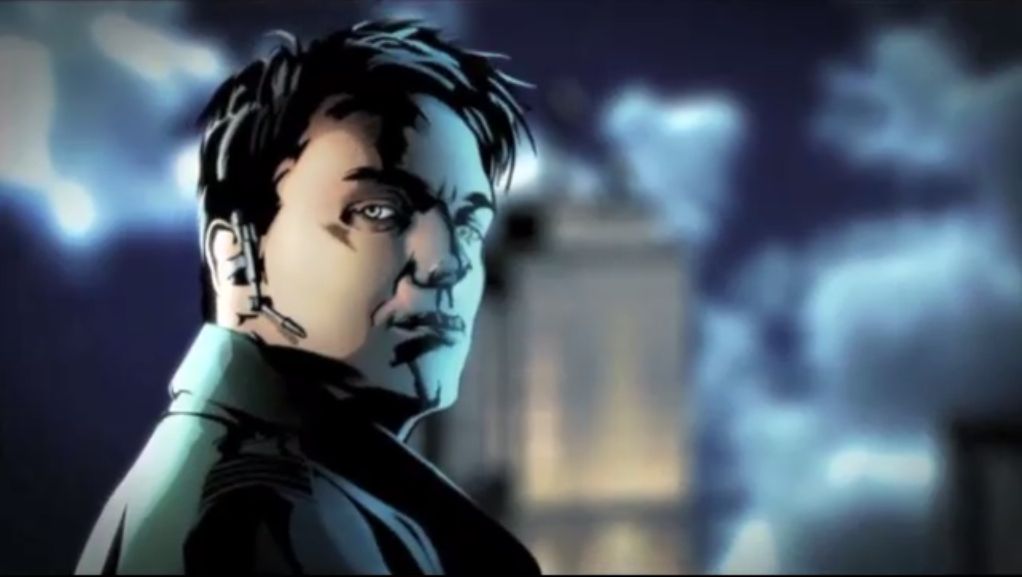
Torchwood‘s fourth series was a train wreck.

The concept was pretty interesting – a supernatural event that eliminates death, driven by shadow elements and political conspiracies, and an exploration of how it affects the world – but the execution cut the concept’s hamstrings.

One thread that ran throughout the discussions of these episodes was padding (or bloating). The series lacks a sense of forward motion, even in moments of action, which is something that the BBC knew how to do while balancing the drama that we’re used to in this property. Torchwood can be slow, but even those slow moments in previous series kept the audience ready for more. Miracle Day felt like it was chained to the deck.

Another thread that wove throughout the series centered on disturbing tropes. The first episode contains the Black Dude Dies First trope – which also extends in poorly-written media to pretty much any minority because of outdated assumptions that audiences wanted/needed white straight male protagonists to win the day – and only subverts it because of the Miracle. Then Rex experiences another terrible trope twice as the series progresses: Stuffed into the Fridge.

I pointed this out in The Blood Line, but it bears some further exploration in a series-wide analysis. Two major character deaths served to motivate Rex in the ten-episode arc. First was Vera Juarez in The Categories of Life, and while her death wasn’t motivated in universe as a strike against Rex – she was murdered by the manager of a death camp to keep things quiet – it did serve narratively as a motivator because Rex was present and filming as she was burned alive.

The second was far more obvious. Esther’s death in The Blood Line was purely intended to drive Rex’s actions, and it transformed her from a character that was timid and unsure at the start of the series to a bold woman who saved Jack’s magic blood and told Rex that she was (in no uncertain terms) accompanying him to the Blessing.

In The Blood Line‘s analysis, I stated that the wrong agent had died and suggested that Esther should have lived while Rex died. I said that with full understanding of the Black Dude Dies First trope, and my thought process regarding it is pretty clear: Miracle Day tried that trope and subverted it, and then the writers spent nine more episodes building Esther while keeping Rex exactly where he was at the start. I didn’t want Rex to die because he’s a minority, but rather because he wasn’t developed in the course of the story. If he had grown, that analysis would be different, but the writers chose to transform Esther into an object after investing so heavily into her as a character. They undid all of that good will with a single narrative choice.

And in a series of episodes like this, the writers and producers needed to preserve as much good will as possible.

Enough soap-boxing: It’s time to look at the numbers. We’ve been through this thrice now, so we’re familiar with the drill: We can’t make a direct comparison between Torchwood and Doctor Who, but we can look at the scores so far to get an idea of how it fits within the Timestamps Project’s scope.

Torchwood Series Four earned a 3.1 average. That’s way down in last place among Torchwood, and is equivalent to the classic Third, Nineteenth, and Twenty-First seasons. Out of thirty-three seasons of Doctor Who so far in the Timestamps Project, that’s a three-way tie for 28th place.

The New World – 5
Rendition – 4
Dead of Night – 4
Escape to L.A. – 2
The Categories of Life – 4
The Middle Men – 3
Immortal Sins – 3
End of the Road – 3
The Gathering – 2
The Blood Line – 2
Web of Lies – 2

Torchwood Series Four Average Rating: 3.1/5


Thus ends Torchwood. It’s the first of the spinoff series to end, so it’s the first opportunity to provide a whole series rating. Keep in mind that if Torchwood should return to screens, then this will change.

Series 1 – 3.8
Series 2 – 4.0
Children of Earth – 4.8
Miracle Day – 3.1

Torchwood Weighted Average Rating: 3.79/5.00

Would I recommend Torchwood as something to watch in the Doctor Who mythos? Absolutely, but the obvious caveat is that Miracle Day does not hold up to the series. As we’ve seen, it’s also darker, gritter, and far more adult than anything else in the overall franchise, so if the light and hopeful of the main series is more your style, this might be best avoided.


The Timestamps Project is proceeding in mostly chronological order. As such, the next block of episodes will cover what remains of Doctor Who‘s sixth series. After that, the final series of The Sarah Jane Adventures is on the docket before a straight shot through the seventh, eighth, and ninth series of Doctor Who takes us well into next year.

UP NEXT – Doctor Who: The Girl Who Waited
cc-break

The Timestamps Project is an adventure through the televised universe of Doctor Who, story by story, from the beginning of the franchise. For more reviews like this one, please visit the project’s page at Creative Criticality.

Culture on My Mind – The Physics of Bowling Balls

Culture on My Mind

Culture on My Mind
The Physics of Bowling Balls

October 1, 2021

This week, I have Veritasium on my mind. I love to go bowling even though I’m not particularly good at it. Bowling is fun and (before the pandemic) gives me a great opportunity to chat with friends in the time between throws.

I have seen a lot of these ball movements over the years, but I didn’t have enough information to understand why the physics worked like they did.

Veritasium did the work.

Happy Friday. See you again soon.

cc-break

Culture on My Mind is inspired by the weekly Can’t Let It Go segment on the NPR Politics Podcast where each host brings one thing to the table that they just can’t stop thinking about.

For more creativity with a critical eye, visit Creative Criticality.

Rabbit Rabbit – October 2021

Rabbit Rabbit
October 2021

Rabbit, rabbit!

Since at least 1909, a superstition has lived in North American and the United Kingdom that if a person says or repeats the word “rabbit” upon waking up on the first day of the month, good luck will follow for the remainder of that month.

Elements of the tradition exist in the United Kingdom, New England, and even in various First Nation cultures.

While I’m not necessarily endorsing the superstition, it provides a way to look in depth at each month of the year, from history and observances to miscellaneous trivia. The topic this month is October.

History

October is the tenth month of the year, but it used to be the eighth in the old calendar of Romulus.

Roman observances for October include one of three Mundus patet (October 5th), Meditrinalia (October 11th), Augustalia (October 12th), October Horse (October 15th), and Armilustrium (October 19th). None of these correspond to dates on the current Gregorian Calendar.

Anglo-Saxons also referred to October as Ƿinterfylleþ, because at this full moon (fylleþ) winter was supposed to begin.

Observances

October hosts a lot of month-long observances, including Black History Month in the United Kingdom, the Month of the Holy Rosary in the Catholic Church, Breast Cancer Awareness Month, Health Literacy Month, International Walk to School Month, Medical Ultrasound Awareness Month, Rett Syndrome Awareness Month, World Blindness Awareness Month, World Menopause Month, and Vegetarian Awareness Month.

The United States, in grand tradition, adds a slew of observances.

In general for the United States, October hosts American Archives Month, National Adopt a Shelter Dog Month, National Arts & Humanities Month, National Bullying Prevention Month, National Cyber Security Awareness Month, National Domestic Violence Awareness Month, Filipino American History Month, Italian-American Heritage and Culture Month, Polish American Heritage Month, and National Work and Family Month.

Then, they add a bunch of health-related observances, including American Pharmacist Month, Dwarfism/Little People/Short Stature/Skeletal Dysplasia Awareness, Eczema Awareness Month, National Dental Hygiene Month, National Healthy Lung Month, National Infertility Awareness Month, Liver Awareness Month, National Lupus Erythematosus Awareness Month, National Physical Therapy Month, National Spina Bifida Awareness Month, and Sudden Infant Death Syndrome Awareness Month

Oh, we’re not done yet.

They also have a few food-related observances, too: National Pizza Month, National Popcorn Poppin’ Month, National Pork Month, and National Seafood Month.

Finally, because I love it so, the month ends with Halloween. Get spoopy, friends.

Trivia

  • October’s birthstones are tourmaline (a stone of reconciliation, humanity, and grounding) and the opal (a stone of love, passion, desire, and eroticism).
  • The western zodiac signs of October are Libra (until October 22) and Scorpio (October 23 onwards).
  • The month’s birth flower is the calendula.
  • The French have been known to shorten octobre to 8bre for… reasons?

Rabbit Rabbit is a project designed to look at each month of the year with respect to history, observances, and more.

For more creativity with a critical eye, visit Creative Criticality.

Timestamp #TW42: Web of Lies

Torchwood: Web of Lies
(Motion Comic Special, 2011)

Timestamp TW42 Web of Lies

Just because you’re paranoid, it doesn’t mean they’re not out to get you.

Missing Day – 2007: The setting is Cardiff as Jack and Gwen chase a shadowy figure across the rooftops of the city. Gwen loses site of Jack for a moment, after which all that remains is a green gas. Jack is missing.

Miracle Day – 2011: In Los Angeles, Miles Mokri breaks a promise to his sister Holly that they’d celebrate her cancer remission. As Holly goes to a club without him, Miles is nearly abducted. He escapes, but ends up getting shot. When Holly leaves the club, she finds his abandoned cell phone and the paramedics. Luckily for the Mokris, the Miracle has begun. No one dies.

Miles had started to write about a conspiracy surrounding Miracle Day. Oddly, he started it one week ago.

Missing Day – 2007: Gwen storms into a nearby convenience store and plugs her computer into the power outlet. She starts tracking Jack and notes that he is moving incredibly fast around the world.

Miracle Day – 2011: The hospital is chaos. They need more room for all of the non-dying people, so Miles is sent home. Holly starts looking into the footage on her brother’s phone and discovers that there were three gunshots but only two wounds. She figures out that Miles knew his shooter, finds a mysterious phone number hidden in a sudoku puzzle, and makes arrangements to meet the shooter at the Ambassador Hotel High School.

Surrounded by the Soulless, Holly and Nick (Miles’s best friend) discuss how death is not the worst part of dying. Rather, that the pain and suffering before it far outweighs it. They are met at gunpoint my the mysterious shooter and taken to a nearby van. It turns out that the man is Joe Bradley, an FBI agent who was working with Miles after he presented evidence that the Miracle was being planned.

Agent Bradley didn’t shoot Miles, but instead caught him when he fell.

Missing Day – 2007: Gwen tracks Jack’s flight over Russia. As she pursues him, Jack wakes up to the muzzle of a gun. Jack quips about whether the gunman is trying to either intimidate or seduce him. The gunman takes aim, casting aside concerns that the bullets would puncture the hull because he’s working with practice range rounds. They won’t leave Jack’s body after he’s shot.

Miracle Day – 2011: Holly, Joe, and Nick are chased down by the men who tried to abduct Miles. During the ensuing car chase, Holly hacks Miles’s laptop and discovers information implicating Phi-Corp in the Miracle.

Missing Day – 2007: The kidnapper witnesses Jack’s resurrection in amazement, then decides to see just how much punishment Jack can take. He pushes Jack out of the plane, watching him fall 30,000 feet the the ground in Chernobyl. After recovering what parts of Jack’s body could be found, the kidnapper is impressed that Jack can survive pretty much anything.

Miracle Day – 2011: Holly finds out that Miles’s computer has an anti-hacking feature that allows access for only 15 seconds at a time. After three attempts, the hard drive will self-destruct. She finds information on Phi-Corp, documents about a flight form the United States to Kiev, an “Iron Wheel”, and satellite photos and plans for medical overflow camps and industrial ovens.

She also finds four photographs with coded letters for each person: S is Jack, complete with the word Torchwood on his photo; R is a red haired woman; Z is Jack’s kidnapper; and M is an executive in a suit. Another coded message from reveals that “Only S can die” and that the secret to the Miracle can be found on Coney Island.

On the way to Coney Island, Holly realizes that the third “gunshot” might have been a flash from a speed camera. Checking the footage, Holly finds that Nick himself fired the shots from a moving car.

Missing Day – 2007: At Chernobyl, Jack’s kidnapper has been taking X-ray images with an old MRI machine. He sees that Jack retains the shrapnel from each death but doesn’t suffer any pain from the remnants.

Miracle Day – 2011: The team arrives at Coney Island. After restoring power to the park, Holly reveals to Joe that she knows that Nick is the real shooter. Nick reveals that he has backup and Joe’s sidearm.

Missing Day – 2007: Gwen tracks Jack to Chernobyl but the kidnapper gets the upper hand with the MRI magnets and disarms Gwen. Jack reaches for an abandoned scalpel to free himself.

Miracle Day – 2011: Nick reveals that Miles had the key to the Miracle and Nick shot him so that Holly would solve the case. Nick also tells her that the Miracle has cured cancer, but stopping it might kill her. An automatic message from Miles to Holly reveals that the Miracle “begun under Vatican control.” She solves the clue about the “iron wheel” and leads everyone to the nearby Ferris wheel. As they ride it, Holly realizes that the map points to a specific location in the amusement park. She eventually escapes and follows the clues to a giant vat of blood. Nick catches up to her and explains that the blood belongs to an immortal man, one that is the only mortal being in the era of the Miracle.

Missing Day – 2007: Gwen is thrown into a van filled with packs of Jack’s blood. The kidnapper returns to stop Jack from reaching the scalpel, but Jack turns the tables by reaching the MRI switch. The magnet tears all of the shrapnel from Jack’s body and fires them through the kidnapper, killing the man.

Miracle Day – 2011: Holly decodes Miles’s “Vatican” clue, finding a gun under the vat. Holly shoots the bad guys, then reveals that Miles couldn’t make the choice to destroy the key or not. He left a laptop computer linked to the vat’s destruct mechanism, and Holly makes a tough choice. Even though it may kill Miles and her cancer may return, she needs to destroy the blood. Nick tries to stop her, but she shoots him one more time and he dies in the explosion.

Missing Day – 2007: Gwen frees Jack, but as she does, the mysterious green gas returns. Jack says that they must try and remember what happened here, but Gwen says whatever happens they’ll deal with it together. As they finally succumb to the gas, three men arrive to take them and the blood in the truck away. Back on the rooftop in Cardiff, Jack states that he feels like they’ve forgotten something very important. In a voice-over, Gwen reveals that they never did remember what happened on that “Missing Day”.

Miracle Day – 2011: In the aftermath of the Miracle’s end, Holly pours a glass of wine for Miles. Holly says that as the Miracle gave him time to heal, she felt like it was about time. As they banter back and forth, a pack of blood can be spotted at the back of the fridge. Could it belong to Jack?


We find out some interesting bits here, including that the Three Families had access to Retcon in 2007 (correlating to the time between Series One and Series Two). This series also suggests that other people may have been able to piece together the plan, but only when they brought it public did the Three Families move to silence them.

Other than that, this was an average side story with little to no consequence for Torchwood or Miracle Day overall. The only big thing would be that pack of Jack’s blood, and depending on Holly’s skills, that would last either 42 days or up to ten years if properly treated and frozen.

Regardless, it was good to see (or rather, hear) Eliza Dushku again. I’ve been a fan since her BuI’d like to see her in Doctor Who at some point.

Rating: 2/5 – “Mm? What’s that, my boy?”


UP NEXT – Torchwood: Miracle Day (Series Four) Summary

cc-break

The Timestamps Project is an adventure through the televised universe of Doctor Who, story by story, from the beginning of the franchise. For more reviews like this one, please visit the project’s page at Creative Criticality.

Timestamp #TW41: The Blood Line

Torchwood: The Blood Line
(1 episode, s04e10, 2011)

Timestamp TW41 The Blood Line

Everything changes… back.

Gwen stares out the window and relates a story about the day that her father was accused of thievery. Young Gwen offered to help pay back the money, but her dad taught her a lesson about impressions and honesty. He couldn’t stand being known as a dishonest man when he wasn’t. Gwen saw him as the nicest man in the world.

Today is the day that she kills him.

The two Torchwood teams prepare for the coming confrontation. Rex and Esther contact Director Shapiro for CIA assistance while keeping Jack, Gwen, and Oswald’s presence in Shanghai a secret. Unfortunately, that includes Charlotte, the mole in the agency. Meanwhile, The Mother plans to bomb the sites of The Blessing to keep it safe.

In Shanghai, Gwen locates the site but retreats to contact Jack when she gets whammied by the emotions surrounding it. Before they rendezvous with Gwen, Jack and Oswald have a heart-to-heart. Gwen takes a moment to call Rhys, who is working with Andy Davidson to gain access to the Cowbridge Overflow Camp so he can say a proper goodbye to Gwen’s father.

Across the planet, the CIA coordinates with the Argentinian army. Captain Federico Santos arrives with a detachment of soldiers, but a Three Families agent inside the detachment bombs the truck. The soldiers are all Category 1, the supply of Jack’s blood is destroyed, and Rex and Esther are presumed dead. Director Shapiro demands that they find the CIA mole immediately. Charlotte sets a bomb and leaves just as the trace is completed. The bomb makes everyone in the command center Category 1.

The two teams infiltrate their respective sites. Oswald objects to leaving a trail of Category 1 bodies and Gwen gets notification that Rhys has arrived at her father’s side. He only has ten minutes before the Category 1s are taken to the ovens. As Rhys comforts Gwen’s father, Andy comforts an unknown 15-year-old girl.

Jack, Gwen, and Oswald descend to the Blessing and are met by Jilly, The Mother, and three armed guards. Unfortunately for them, Jack has rigged Oswald with a suicide vest. Unfortunately for Torchwood, Rex and Esther have been captured and are being held at gunpoint by the Three Families. The standoff is stalemated when Jack presents his blood to the Blessing. He warns The Mother to be very, very careful with him.

Oswald, exposed to his very soul before the Blessing, almost loses himself in the reflection of his sin. Jack brings him back before he and Gwen muse about the origins of the Blessing. Jack muses about the Doctor, Silurians, the Racnoss, and huon energy before admitting that he has no idea where it came from. It projects a morphic field in symbiosis with the human race, but the Families fed Jack’s blood to the anomaly. The Blessing transformed the blood’s pattern into a gift for all humankind and the Families took advantage of the worldwide disruption in a form of eugenics.

In order to secure the plan, the Families drew Jack out of hiding and attempted to kill him. Jack threatens to bleed into it and reset the planet’s mortality, but the Families remind him that it has to be introduced from both sides simultaneously. As the standoff intensifies, Rex reveals that Esther transfused Jack’s blood into him. The destroyed blood was a ruse.

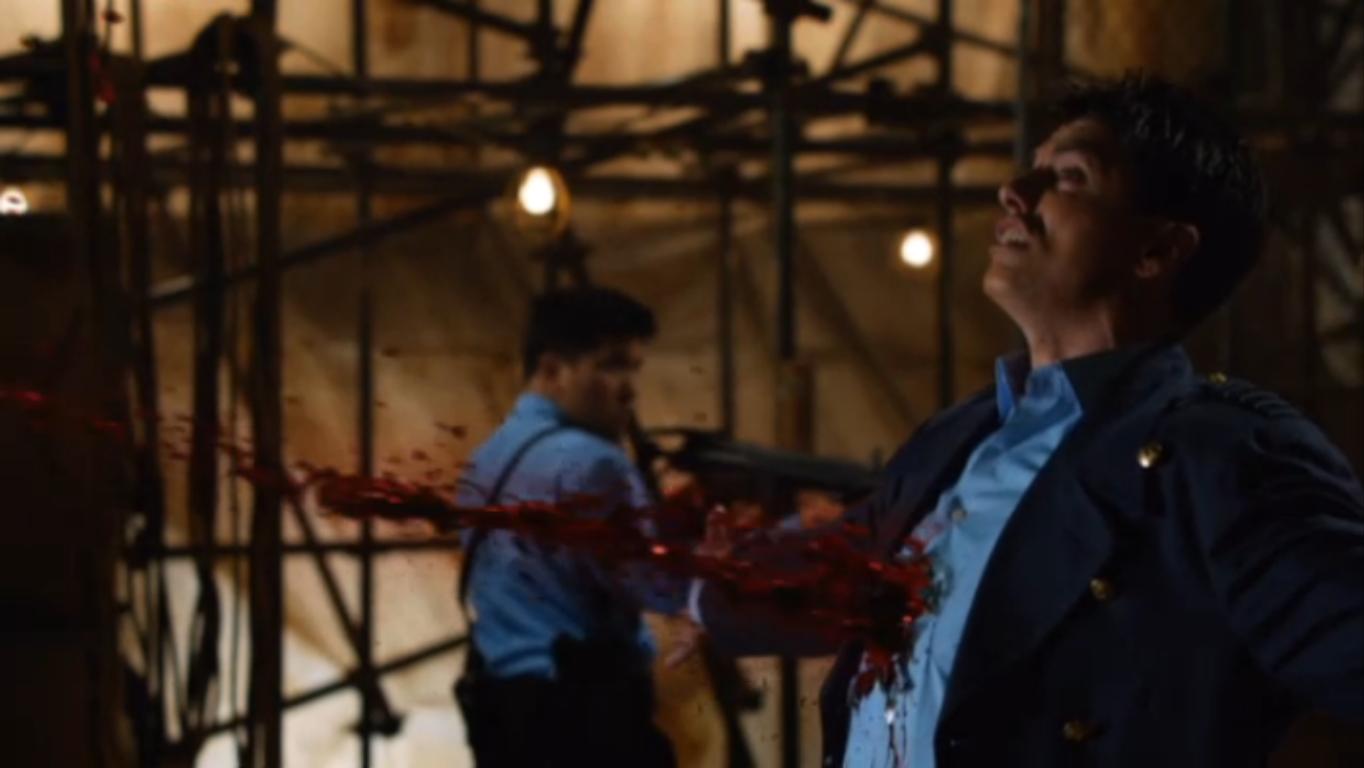
To stop the salvation of the world, the Families mortally wound Esther. As Rex descends into sorrow, Gwen talks him back off the ledge. Together, Rex and Jack drain themselves into the Blessing.

Death returns to the world in a single breath as every Category 1 says goodbye.

Both ends of the Blessing begin to tear themselves apart. Jack returns to life as his immortality is restored while Oswald and Rex eliminate the Families representatives and Gwen knocks Jilly out. Rex and Esther, both on the edge of death, are retrieved by Captain Santos. Jilly disappears into the explosion at Shanghai.

Several months later, Jilly is found by her contact in the Families and offered a place to restart her life in charge of Plan B. Elsewhere, the Torchwood team joins Charlotte and Rex at Esther’s funeral. Charlotte offers her condolences to Rex before leaving. Rex gets an update about the trace program that Shapiro was running and finds out that Charlotte was the mole. She shoots Rex and is gunned down by the other agents in attendance. Rex is declared dead.

And then comes back to life. His wounds, including the Miracle Day wound, all heal. He is now immortal.

Everyone is surprised, but none more so than Rex.


The production team killed the wrong person.

No, seriously. In terms of character growth over the ten episodes of Miracle Day, Esther moved leaps and bounds over Rex. By killing her off, they not only wasted that character development, they also committed the narrative sin of fridging her in order to motivate Rex.

That trope originates from the comics, specifically Green Lantern. In that story, the villain Major Force left the corpse of then-Green Lantern Kyle Rayner’s girlfriend, Alexandra DeWitt, literally stuffed into a refrigerator. The idea is to spur the hero into action by brutalizing someone that they care about. It was later named and shamed by comic book writer Gail Simone.

In this case, Esther was fridged in order to motivate Rex. It’s lazy writing that immediately devalues Esther as a character. No matter what happened with her to this point, her final intrinsic narrative value is a plot device to motivate a stereotypical action hero.

It’s also sad, because the story and characters could have been better served. Keep Rex as the vessel for Jack’s blood, an idea that came from Esther to begin with, and transfer the Gwen-shooting-Jack action to Esther instead. Let Rex die for the world and Esther come out with a completed growth arc that we watched happen over ten episodes of television. She could also end up with immortality, for all the good that it does Torchwood after this point, as a reward of sorts.

Other than that rather large elephant in the room, the finale was entertaining enough, if not a bit bloated (as was the rest of the Miracle Day season). The return of death to the world was emotionally stirring. Oswald was finally useful.

The cliffhanger itself is rather disappointing in the end given that this marks the end of Torchwood on television. In fact, Rex Matheson hasn’t appeared on television again to date. He’s been in two novels, one of which is a prequel, and an audio drama, but his parts in the post-Miracle Day universe appear to be sparse.

How disappointing.

It should have been Esther who survived the Miracle.

Rating: 2/5 – “Mm? What’s that, my boy?”


UP NEXT – Torchwood: Web of Lies

cc-break

The Timestamps Project is an adventure through the televised universe of Doctor Who, story by story, from the beginning of the franchise. For more reviews like this one, please visit the project’s page at Creative Criticality.

Timestamp #227: Night Terrors

Doctor Who: Night Terrors
(1 episode, s06e09, 2011)

Timestamp 227 Night Terrors

The Doctor makes a house call.

It’s nighttime and time for little George to go to bed. Unfortunately, he’s afraid to do so. His mom flips the lights five times to ward off evil and tells the boy to put his fears in his cupboard. He also whispers a plea to the heavens, “Please save me from the monsters,” before he heads to bed. While George’s parents worry that he needs a doctor, the plea reaches the psychic paper and the Doctor sets a course.

The TARDIS materializes on the street below and the Doctor and the Ponds head up to find George’s apartment. As the group splits up, they encounter several interesting characters including the elderly Mrs. Rossiter, landlord Jim Purcell, and a mother and her creepy twin daughters. Every one of them are suspicious and slam the door on their traveling visitors.

George overhears Rory joking about the monsters eating the kid, but the Doctor notices when George peeks through the window. The Doctor sends the Ponds on a wild goose chase while he goes to meet George alone. The Ponds end up in an elevator that plummets to the ground and spirits them away. Similarly, Mrs. Rossiter is taken away as she’s consumed by a garbage pile.

George’s father Alex mistakes the Doctor for a social worker. Alex insists that George is “scared to death of everything” and explains that they established the tradition of putting everything scary into the cupboard. When George startles at the sound of the elevator, he meets the Doctor. The Time Lord takes the opportunity to ask about the monsters.

The Ponds wake up in the dark. Rory thinks that they’re dead (or that they’ve time traveled) but they’re really in a dark and rather peculiar house. They find an electric lantern and a wooden pan designed to look like a copper one. They also find a giant glass eye in a drawer. As things get curiouser and curiouser, they get even more unnerved, especially by the strange giggling.

The Doctor tries to communicate with George, even to the point of opening the cupboard before a knock at the door interrupts them. Landlord Jim and his dog arrive to badger Alex about the money he owes, offering the Doctor the chance to use his sonic screwdriver. This both comforts George and allows the Doctor to scan the cupboard. What the Doctor finds in the scan rattles him. Jim leaves and Alex offers to open the cupboard, but the Doctor tells him to stop. George’s monsters are indeed real.

Alex is furious at the Doctor’s actions, but the Doctor is not swayed.

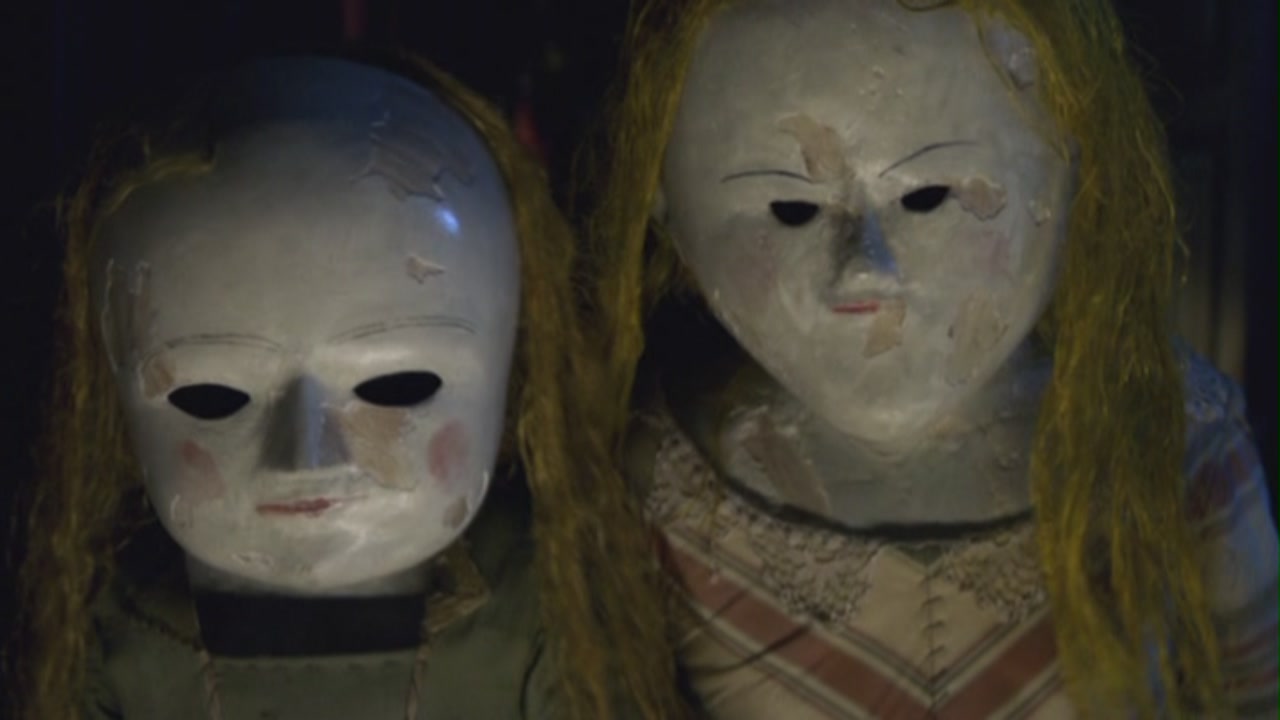
Meanwhile, Mrs. Rossiter is revealed to be alive in the mysterious house. The Ponds look for a way out but only seem to be getting closer to the eerie giggles. They open a door and find a child-like wooden doll with a large Funko Pop-like head. As they walk away, the doll creaks to life.

The Doctor finally decides to open the cupboard. When he does, he finds a host of items but nothing nefarious. At the same time, Landlord Jim is swallowed by his apartment floor. The Doctor has a bout of inspiration and quizzes Alex about George’s birth, but Alex can’t remember it. In fact, he blurts out that Claire can’t have children.

The answer lies with George.

The cupboard springs to life with bright lights, pulling the Doctor and Alex into the mysterious house. There, the Ponds watch as a creepy doll transforms Landlord Jim into a similar doll. The Doctor recognizes the house as a dollhouse, a psychic repository for all of George’s fears, and starts looking for a way out with Alex in tow. Luckily, Alex finds a pattern in the lights: They cycle on and off in fives.

Amy is captured and transformed by the dolls. The dolls also find the Doctor and Alex, but the sonic screwdriver is useless against wood. As he and Alex run, the Doctor realizes that George is a Tenza, an alien species that are like cuckoo birds. They find foster parents and adapt perfectly into what their parents want as their child, and George instinctively sought out Claire and Alex because they were unable to have kids. When something startled him, he started this subconscious cycle of fear.

The Doctor pleads with George to end the cycle, but he realizes that the fear is based on Alex’s rejection of George. When George calls for help and the dolls swarm him, Alex instinctively springs into action and promises to protect him. This breaks the cycle and releases the captives.

The Ponds arrive in the elevator, Mrs. Rossiter emerges from the trash pile, and Landlord Jim wakes up on the floor with his dog. As Claire arrives home from work, she finds Alex and George laughing and giggling with the Doctor. Claire is amazed at the change, but the Doctor asks her to trust him. The Time Lord reassures Alex that everything will be okay before reuniting with the Ponds and returning to the TARDIS.

As they set a course for their next destination, the time and place of the Doctor’s death appears on the monitors, accompanied by a nursery rhyme:

“Tick, tock, goes the clock, even for the Doctor…”


On the one hand, this was a fun little story with a neat twist. Unfortunately, that twist comes with one of the weakest but most often employed tools in the Steven Moffatt era’s arsenal: The Doctor being the smartest character in the room.

As I’ve said before, the story loses its power and magic when the answers are just handed to the audience, and this is no exception. There were no indications in the narrative that George was the source of the problem aside from the five-light pattern. There was also no introduction of the Tenza or any other “cuckoo bird” analogues, making the revelation about George simply something that the Doctor yanked from thin air (or any applicable orifice). The same can be said about the dollhouse setting.

In fact, I checked. The Tenza have never been mentioned before this story, and they have never been mentioned again to this point. (And, no, the mention of Sherpa Tenzing wasn’t relevant at all.)

It’s not smart storytelling. In fact, it’s lazy, sloppy, and irritating. Part of the fun in any mystery is the ability for the audience to solve it. Without the very basis to reach the revelation, the audience is merely along for the ride.

There were some minor bright spots. As a fan of Poltergeist, I liked the parallel when the Doctor and Alex are sucked into the cupboard. I also liked how George’s message on the psychic paper was so strong that it persisted and both Rory and the Doctor could read it.

I also liked the fanciful listing of the Doctor’s favorite childhood tales: The Emperor Dalek’s New Clothes (a play on Hans Christian Andersen’s The Emperor’s New Clothes), The Three Little Sontarans (a play on The Three Little Pigs), and Snow White and the Seven Keys to Doomsday (a play on Snow White and the Seven Dwarfs, the 1970s stageplay Doctor Who and the Daleks in Seven Keys to Doomsday, and the 2008 audio adaptation Seven Keys to Doomsday).

Note that The Emperor Dalek’s New Clothes contradicts the claims that the First Doctor didn’t know of the Daleks before The Daleks. Also note Rule #1: The Doctor lies.

But, in the end, these little nuggets of fun can’t override a terribly constructed story. Especially one that insults the audience by pulling the rug out from under them.

Rating: 2/5 – “Mm? What’s that, my boy?”


UP NEXT – Torchwood: The Blood Line

cc-break

The Timestamps Project is an adventure through the televised universe of Doctor Who, story by story, from the beginning of the franchise. For more reviews like this one, please visit the project’s page at Creative Criticality.

Debrief: Dragon Con 2021

Debrief: Dragon Con 2021
Atlanta, GA – September 2 through September 6, 2021

Just like that, Dragon Con 2021 is in the books! And, wow, it was a weird year.

Attendance was reported at 42,000 and you could definitely feel it. Thanks to the pandemic precautions – proof of vaccination or negative COVID-19 test along with a 100 percent masking requirement – and attendance caps (including limits on daily sales), the crowds were significantly thinner. Let me tell you, though, I could get used to an attendance cap at Dragon Con. Maybe 65,000 to 70,000 in normal times?

Despite the smaller crowds, we did a lot of good work this year for the Big Brothers Big Sisters of Metro Atlanta, raising $120,000 for that charity. That’s $10,000 more than we pulled together in 2019 with just over double the weekend crowd.

It was also a getaway that I really needed. With everything that’s been going on recently, I needed to see the geek family and get my mind orbiting around a lot of fun and creative things. I mean, let’s face it, I’ve missed these people.

It’s important to note that the Marriott and Hyatt were flooded with partiers at night who weren’t wearing face masks. It seemed that, once the sun went down, enforcement went out the window. Since I’m seeing several reports of attendees popping positive for COVID-19, panelists who refused to wear masks on panels, and vendors who went unmasked at their booths, I wholeheartedly recommend that everyone get tested for COVID-19 (both rapid and PCR if you can) and limit the spread as much as possible in the meantime.

There were a lot of naked respiratory orifices at Dragon Con 2021. Far. Too. Many.

Read More »