
Timestamp #200: The Unicorn and the Wasp

Doctor Who: The Unicorn and the Wasp
(1 episode, s04e07, 2008)
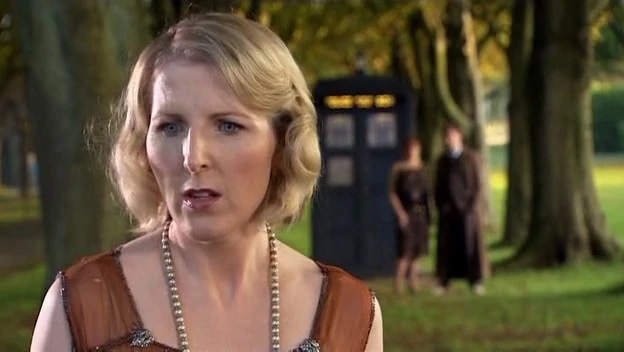
 

The mystery meets the mystery writer.

The TARDIS materializes to the scent of mint and lemonade in the air. If the vintage car in the drive is any indication, it’s the 1920s and Donna’s excited to attend a party with Professor Peach, Reverend Golightly, and the butler Greeves. The Doctor produces his psychic paper, meaning that invitations are all taken care of.

Unfortunately, the party will be one short Professor Peach falls victim to the lead pipe in the library. The suspect is a giant wasp.

The Doctor and Donna are greeted at the party by Lady Clemency Eddison. They also meet Colonel Hugh Curbishley (Lady Eddison’s husband), their son Roger (who flirts with Davenport, a servant), Reverend Golightly, socialite Robina Redmond, Miss Chandrakala, and the famous mystery writer Agatha Christie.

It’s a regular game of Clue.

The Doctor notes the date of the newspaper: It’s the day of Agatha Christie’s disappearance. Her car will be found abandoned and she’ll resurface ten days later with no memory. Her husband has recently cheated on her, but she’s maintaining a stiff upper lip.

Meanwhile, Miss Chandrakala finds Professor Peach, and the Doctor stands in as a police officer with a plucky assistant to boot. The Doctor finds alien residue – Donna’s beside herself that Charles Dickens was actually surrounded by ghosts at Christmas – then teams up with Christie to question the guests while Donna looks about with a magnifying glass from the Doctor’s endless pockets.

Each of the guests has an extraordinary story of where they were at the time of the murder, but there are no alibis. Each is hiding something except for the reverend. The Doctor asks Christie about the paper she picked up from the murder scene, and together they discover the word “maiden” on it.

Upstairs, Donna finds an empty bedroom. Greeves informs her that Lady Eddison has kept the room shut for the last 40 years, after spending six months in it recovering from malaria following her return from India. Inside, Donna finds nothing but a teddy bear and a giant murderous wasp. She attacks it with the magnifying glass and the power of the sun, and the Doctor and Christie arrive to sample the stinger that it left behind.

Miss Chandrakala is murdered by a falling statue. When the Doctor, Donna, and Christie find her, the wasp attacks, but the Doctor cannot find it after it flies off. The guests convene in a sitting room and talk through the events with Christie, but she’s discouraged because she doesn’t know what’s going on. All they have is the clue in Miss Chandrakala’s dying words: “The poor little child…”

Later, she confides in Donna that she feels like the events are mocking her. They commune over lost loves before finding a box in a crushed flowerbed. The Doctor, Donna, and Christie examine the as Greeves brings refreshments, but the Doctor soon realizes that he’s been poisoned by cyanide. A short comedic scene later – complete with ginger beer, walnuts, anchovies, and a shocking kiss from Donna – and the Doctor has detoxed.

The cast gather for dinner, which the Doctor has laced with pepper to test each guest to see if they are the wasp. The lights go out, the wasp appears, and Roger is dead after being stung in the back. Greeves is cleared by being in plain sight during the murder, but Lady Eddison’s necklace (the “Firestone”, a priceless gem from India) is missing.

The Doctor encourages Christie to solve it, knowing that she has the ability. Christie works her way around the assembled guests, uncovering Robina as a thief known as the Unicorn. The Firestone is recovered, but the murderer is still at large.

Christie further (accidentally) uncovers that Colonel Curbishley has been faking his wheelchair-bound disability in order to keep his wife’s affections. She also discovers that Lady Eddison came home from India pregnant, with Miss Chandrakala as a maid and confidante, and had to seclude herself to hide the scandal and the shame.

But, as the Doctor discovers, her tryst was with a vespiform visitor from another world. The alien gave her the jewel and a child, who was taken to an orphanage, and whose identity was uncovered by Professor Peach since “maiden” led to “maiden name”. The Doctor works his way around the room, landing on the reverend who had recently thwarted a robbery in his church. He also notes that the reverend is forty years old, and pieces together that Golightly’s anger broke the genetic lock that kept him in human form. Golightly activated, and the jewel – a telepathic recorder – connected mother and son, including the works of Agatha Christie since Lady Eddison was reading her favorite, The Murder of Roger Ackroyd.

The reverend transforms in rage, and Christie leads the wasp away with the Firestone, believing that this whole thing is her fault. The Doctor and Donna pursue Christie to the nearby lake, realizing that the two are linked. Donna seizes the jewel and throws it into the lake. The wasp follows and drowns, and while the Doctor is aghast at its death, the three of them are relieved that the mystery is solved. Before the wasp dies, it releases Christie from the psychic connection, and the Doctor puts history in motion: The events of the night are erased from her mind and the mystery writer turns up ten days later Harrogate Hotel courtesy of the TARDIS.

The Doctor consoles Donna about the adventure, showing her that Agatha Christie’s memory lived on. She got married again, wrote about Miss Marple and Murder on the Orient Express (which Donna had mentioned during the night’s events), and even published a story about a giant wasp. The last one – Death in the Clouds, filed away after Cybermen and Carrionites – was reprinted in the year five billion, making Agatha Christie the most popular writer of all time.

Donna reminds the Doctor that Christie never thought that her work was any good. He replies simply:

Well, no one knows how they’re going to be remembered. All we can do is hope for the best. Maybe that’s what kept her writing. Same thing keeps me traveling.

With that, they fly onwards to the next adventure.


This story was a rapid-fire mystery, and the power of the acting mixed with the pace kept it entertaining throughout. Fenella Woolgar’s turn as Agatha Christie was well done, mixing her intellect and modesty about her craft with the pain and tragedy of her husband’s betrayal. I particularly liked Christie’s gradual awakening to the Doctor’s alien nature, best evidenced in the scenes where they interrogated the guests using each other’s strengths to unravel the mystery.

Combine that with the chemistry between Tennant and Tate bulldozing through a game of Clue and you have a rather entertaining (if not bloody) dinner party.

The final words that the Doctor uses to summarize his ethos remind me of quote from a recent episode of Outlander. While discussing last words and legacies, a certain character (whose identity I’ll not spoil for fans who haven’t seen the episode yet) said this:

I’d say let history forget my name, so long as my words and my deeds are remembered by those I love.

It doesn’t matter if anyone remembers my name so long as my life made an impact on the people who meant something to me.

Life lessons from the Doctor. Words and ideas to live by.


Rating: 4/5 – “Would you care for a jelly baby?”


UP NEXT – Doctor Who: Silence in the Library and Doctor Who: Forest of the Dead


The Timestamps Project is an adventure through the televised universe of Doctor Who, story by story, from the beginning of the franchise. For more reviews like this one, please visit the project’s page at Creative Criticality.



The Thing About Today – April 22

April 22, 2020
Day 113 of 366


April 22nd is the 113th day of the year. It is Earth Day.

In the United States, today is “celebrated” as National Girl Scout Leader’s Day, National Jelly Bean Day, National Administrative Professionals’ Day (typically the Wednesday of the last full week in April), and National Bookmobile Day (typically the Wednesday of National Library Week).


Historical items of note:

  • In 1724, German anthropologist, philosopher, and academic Immanuel Kant was born.
  • In 1864, the United States Congress passed the Coinage Act of 1864. This act changed the composition of the penny, authorized the minting of a two-cent coin, and allowed for the inscription In God We Trust to be placed on all coins minted as United States currency. The phrase replaced E Pluribus Unum as the national motto in 1956 as an attempt to distinguish the United States from the state atheism of the Soviet Union during the Cold War.
  • In 1904, physicist and academic J. Robert Oppenheimer was born. He is among those credited as the “father of the atomic bomb.”
  • In 1923, model and actress Bettie Page was born.
  • In 1926, actress and singer Charlotte Rae was born.
  • In 1930, the United Kingdom, Japan, and the United States signed the London Naval Treaty. This regulated submarine warfare and limited shipbuilding.
  • In 1937, actor and producer Jack Nicholson was born.
  • In 1950, musician Peter Frampton was born.
  • In 1959, actress Catherine Mary Stewart was born.
  • In 1966, actor Jeffrey Dean Morgan was born.
  • In 1972, increased American bombing in Vietnam prompted anti-war protests in Los Angeles, New York City, and San Francisco.
  • In 1977, optical fiber was first used to carry live telephone traffic.
  • In 1993, eighteen-year-old Stephen Lawrence was murdered in a racially motivated attack while waiting for a bus in Well Hall, Eltham, London.
  • In 2000, federal agents seized six-year-old Elián González from his relatives’ home in Miami during a pre-dawn raid.
  • In 2008, the United States Air Force retires the remaining F-117 Nighthawk aircraft in service.
  • In 2019, Avengers: Endgame premiered in Los Angeles, California.


In 1970, the first Earth Day was celebrated.

Earth Day annual event celebrated around the world on April 22 to demonstrate support for environmental protection. At a 1969 UNESCO Conference in San Francisco, peace activist John McConnell proposed a day to honor the Earth and the concept of peace. He originally wanted to be celebrated on March 21st, the vernal equinox in 1970, and it was later sanctioned in a proclamation written by McConnell and signed by Secretary General U Thant at the United Nations. A month later, United States Senator Gaylord Nelson of Wisconsin proposed the idea to hold a nationwide environmental teach-in on April 22nd. He hired young activist Denis Hayes to be the National Coordinator. Earth Day was born, and Nelson was awarded the Presidential Medal of Freedom for the effort.

The first Earth Day was focused on the United States. In 1990, Hayestook it international and organized events in 141 nations. In 2009, International Mother Earth Day was established by the General Assembly of the United Nations under a resolution introduced by The Plurinational State of Bolivia and endorsed by over 50 member states.


The Thing About Today is an effort to look at each day of 2020 with respect to its historical context.

For more creativity with a critical eye, visit Creative Criticality.


The Thing About Today – April 21

April 21, 2020
Day 112 of 366


April 21st is the 112th day of the year. It is National Tea Day in the United Kingdom.

In the United States, today is “celebrated” as National Chocolate Covered Cashews Day, National Kindergarten Day, National Yellow Bat Day, and National Library Workers Day. That last one is observed on the Tuesday of National Library Week.

Today is also the 94th birthday of Queen Elizabeth II. She is the longest-lived and longest-reigning British monarch, the longest-serving female head of state in world history, and the world’s oldest living monarch, longest-reigning current monarch, and oldest and longest-serving current head of state.


Historical items of note:

  • In 1615, the Wignacourt Aqueduct was inaugurated in Malta.
  • In 1816, Cornish-English novelist and poet Charlotte Brontë was born.
  • In 1918, German fighter ace Manfred von Richthofen, better known as “The Red Baron”, was shot down and killed over Vaux-sur-Somme in France.
  • In 1922, Scottish novelist and screenwriter Alistair MacLean was born.
  • In 1926, Her Majesty Elizabeth II, Queen of the United Kingdom and her other realms, was born.
  • In 1934, the “Surgeon’s Photograph”, the most famous photo allegedly showing the Loch Ness Monster, was published in the Daily Mail. In 1999, 65 years later, it was revealed to be a hoax.
  • In 1952, Secretary’s Day was first celebrated. It is now known as Administrative Professionals’ Day.
  • In 1958, actress Andie MacDowell was born.
  • In 1962, the Seattle World’s Fair (called the Century 21 Exposition) opened. It was the first World’s Fair in the United States since World War II.
  • In 1963, the first election of the Universal House of Justice was held, marking its establishment as the supreme governing institution of the Bahá’í Faith.
  • In 1979, actor James McAvoy was born.
  • In 1988, actor Robbie Amell was born.


In 2014, the city of Flint, Michigan switched its water source to the Flint River, beginning the Flint water crisis.

Prior to this, Flint used the treated Detroit Water and Sewerage Department water, which came from Lake Huron and the Detroit River. Officials failed to apply corrosion inhibitors to the new water supply, resulting in lead leaching from aging pipes into the water and exposing over 100,000 residents to extremely elevated levels of the heavy metal neurotoxin.

On January 5, 2016, Governor Rick Snyder (of whom related evidence exists regarding corruption and a cover-up) declared a state of emergency in the city, and President Barack Obama declared a federal state of emergency to authorize additional help from the Federal Emergency Management Agency and the Department of Homeland Security.

An extensive lead service line replacement effort began in 2016, and while officials assert that the water quality has returned to acceptable levels, residents are skeptical. As of April 2019, an estimated 2,500 lead service lines were still in place. Work continues, with an expected completion date of July 2020.

Overall, the continuing crisis has caused lead poisoning in up to 12,000 people. In addition, 15 people have died from Legionnaires disease, leading to criminal indictments against 15 people, five of whom have been charged with involuntary manslaughter.


The Thing About Today is an effort to look at each day of 2020 with respect to its historical context.

For more creativity with a critical eye, visit Creative Criticality.


The Thing About Today – April 20

April 20, 2020
Day 111 of 366


April 20th is the 111th day of the year. It is United Nations Chinese Language Day, established in 2010 in an effort to “celebrate multilingualism and cultural diversity as well as to promote equal use of all six of its official working languages throughout the organization”. April 20th was chosen as the date “to pay tribute to Cangjie, a mythical figure who is presumed to have invented Chinese characters about 5,000 years ago”.

In the United States, today is “celebrated” as National Cheddar Fries Day, National Lima Bean Respect Day, National Look Alike Day, and National Pineapple Upside Down Cake Day.


Historical items of note:

  • In 1534, Jacques Cartier began his first voyage to what is today the east coast of Canada, Newfoundland and Labrador.
  • In 1535, the sun dog phenomenon was observed over Stockholm. It was later depicted in the famous painting Vädersolstavlan, created by either Urban målare or Jacob Elbfas.
  • In 1657, freedom of religion was granted to the Jews of New Amsterdam, later called New York City.
  • In 1862, Louis Pasteur and Claude Bernard completed the experiment disproving the theory of spontaneous generation.
  • In 1902, Pierre and Marie Curie refined radium chloride.
  • In 1937, actor and activist George Takei was born.
  • In 1949, actress Veronica Cartwright was born.
  • Also in 1949, actress Jessica Lange was born.
  • In 1951, actress Louise Jameson was born.
  • In 1959, actor Clint Howard was born.
  • In 1964, actor and director Andy Serkis was born.
  • In 1999, the Columbine High School shooting occurred. Thirteen people were murdered and twenty-four were injured before the two gunmen, Eric Harris and Dylan Klebold, committed suicide.


In 1946, the League of Nations officially dissolved, transferring most of its power to the United Nations.

The League of Nations was the first worldwide intergovernmental organization whose principal mission was to maintain world peace. It was founded on January 10, 1920, following the Paris Peace Conference that ended World War I. President Woodrow Wilson won the Nobel Peace Prize in 1919 for his role as the leading architect of the League.

The League proved incapable of preventing aggression by the Axis powers in the 1930s. Its credibility was weakened since the United States never joined. The Soviet Union also damaged the League’s credibility by joining late and then being expelled after invading Finland.

The beginning of World War II proved that the League of Nations had failed in its mission. The United Nations picked up the cause when its charter took effect on October 24, 1945.


The Thing About Today is an effort to look at each day of 2020 with respect to its historical context.

For more creativity with a critical eye, visit Creative Criticality.


The Thing About Today – April 19

April 19, 2020
Day 110 of 366


April 19th is the 110th day of the year. It is Holocaust Remembrance Day in Poland.

In the United States, today is “celebrated” as National Amaretto Day, National Garlic Day, National Hanging Out Day, and National North Dakota Day.


Historical items of note:

  • In 1506, the Lisbon Massacre began. A crowd of Catholics, as well as foreign sailors who were anchored in the Tagus, persecuted, tortured, killed, and burnt at the stake hundreds of people who were accused of being Jews. That accusation was enough for the crowd to find the victims guilty of deicide and heresy. This was thirty years before the establishment of the Inquisition in Portugal and nine years after the Jews were forced to convert to Roman Catholicism under King Manuel I.
  • In 1713, Charles VI, Holy Roman Emperor, having no male heirs, issued the Pragmatic Sanction of 1713 to ensure that Habsburg lands and the Austrian throne would be inheritable by a female. His daughter and successor, Maria Theresa, would be born four years later.
  • In 1775, The American Revolutionary War began with an American victory in Concord during the battles of Lexington and Concord.
  • In 1782, John Adams secured the Dutch Republic’s recognition of the United States as an independent government. The house which he had purchased in The Hague, Netherlands became the first American embassy.
  • In 1818, French physicist Augustin Fresnel signed his preliminary “Note on the Theory of Diffraction”. The document ended with what we now call the Fresnel integrals.
  • In 1933, actress Jayne Mansfield was born.
  • In 1934, Shirley Temple appeared in her first movie, Stand Up & Cheer.
  • In 1935, actor and comedian Dudley Moore was born.
  • In 1946, actor Tim Curry was born.
  • In 1964, astrophysicist, astronomer, and academic Kim Weaver was born.
  • In 1968, actress Ashley Judd was born.
  • In 1971, Salyut 1 was launched. It was the first space station.
  • In 1979, actress Kate Hudson was born.
  • In 1981, actor Hayden Christensen was born.
  • In 1987, The Simpsons first appeared on television as a series of shorts on The Tracey Ullman Show. The first one was “Good Night”.


In 1995, the Alfred P. Murrah Federal Building in Oklahoma City, Oklahoma was bombed. 168 people were killed in the attack, including 19 children under the age of six.

The domestic terror attack was perpetrated by Timothy McVeigh and Terry Nichols. McVeigh parked a Ryder truck filled with fertilizer and explosives near the building and detonated it at approximately 9:00 am. They were motivated by the federal government’s standoffs at Ruby Ridge in Idaho (1992) and the Branch Davidian cult compound in Waco, Texas (1993), seeking revenge for those events.

The blast destroyed or damaged 324 buildings within a 4-block radius, and shattered glass in 258 nearby buildings. It created a 30-foot-wide and 8-foot-deep crater at the blast site, destroying one-third of the federal building.

After an extensive investigation, the bombers were tried and convicted in 1997. McVeigh was executed by lethal injection in June 2001 and Nichols was sentenced to life in prison. The United States Congress passes a series of laws, including a tightening of standards for habeas corpus and increased protection around federal buildings to deter future terrorist attacks.

On April 19, 2000, the Oklahoma City National Memorial was dedicated on the site of the Murrah Federal Building, commemorating the victims of the bombing. Remembrance services are held every year on April 19th, at the exact time of the explosion.


The Thing About Today is an effort to look at each day of 2020 with respect to its historical context.

For more creativity with a critical eye, visit Creative Criticality.


The Thing About Today – April 18

April 18, 2020
Day 109 of 366


April 18th is the 109th day of the year. It is Zimbabwe’s Independence Day, commemorating their independence from the United Kingdom in 1980.

In the United States, today is “celebrated” as National Animal Crackers Day, National Columnists’ Day, National Lineman Appreciation Day, National Auctioneers Day, and National Record Store Day. National Auctioneers Day is normally observed on the third Saturday in April. National Record Store Day changes annually.


Historical items of note:

  • In 1506, the cornerstone of the current St. Peter’s Basilica was laid.
  • In 1775, the British advancement by sea began in the American Revolutionary War. Paul Revere and other riders warned the countryside of the troop movements.
  • In 1882, English conductor Leopold Stokowski was born.
  • In 1897, the Greco-Turkish War was declared between Greece and the Ottoman Empire.
  • In 1909, Joan of Arc was beatified in Rome.
  • In 1912, the Cunard liner RMS Carpathia arrived in New York City with the 705 survivors from the RMS Titanic.
  • In 1930, it was a slow news day. So slow, in fact, that the BBC news announcer stated “there is no news” at the start of the 20:45 news bulletin and played music instead.
  • In 1946, the International Court of Justice held its inaugural meeting in The Hague, Netherlands.
  • Also in 1946, actress Hayley Mills was born.
  • In 1953, actor and comedian Rick Moranis was born.
  • In 1956, Eric Roberts was born. He portrayed the Master in the 1996 Doctor Who television movie.
  • In 1961, actress Jane Leeves was born.
  • In 1967, actress Maria Bello was born.
  • In 1969, writer, musician, and all-around good dude Keith R. A. DeCandido was born.
  • In 1971, David Tennant was born. Among many other roles, he was the Tenth Doctor in Doctor Who.
  • In 1976, actress Melissa Joan Hart was born.


In 1949, the keel for the aircraft carrier USS United States (CVA-58) was laid down at Newport News Drydock and Shipbuilding in Virginia. Construction was canceled five days later, resulting in the Revolt of the Admirals.

The United States was slated to be the lead ship of a new design of “supercarriers” as authorized on July 29, 1948, by President Harry Truman. Five ships were planned in the line of ships designed to support combat missions using the new jet aircraft, which were faster, larger, and significantly heavier than the aircraft the Essex and Midway-class carriers handled at the end of World War II. The carrier was designed to be “flush decked”, which meant no command island on the flat top deck.

The ship design was so versatile that the United States Air Force actually saw it as a threat to its strategic nuclear weapons delivery monopoly. Looking to cut the military budget, Secretary of Defense Louis A. Johnson accepted the Air Force’s argument about nuclear deterrence by means of large, long-range bombers and canceled the United States project five days after the keel was laid without consulting Congress.

Secretary of the Navy John Sullivan and a number of high-ranking admirals immediately resigned in protest. The United States Congress held an inquiry into Johnson’s decision, but during this “Revolt of the Admirals”, the Navy was unable to advance its case that large carriers would be essential to national defense.

Soon afterward, Johnson and Francis P. Matthews, the man he advanced to be the new Secretary of the Navy, set to punishing officers who publicly opposed them. Admiral Louis Denfeld was forced to resign as Chief of Naval Operations, and a number of other admirals and lesser ranks were punished.

The invasion of South Korea six months later resulted in an immediate need for a strong naval presence, and Matthews’ position as Secretary of the Navy and Johnson’s position as Secretary of Defense crumbled. They both resigned.


The Thing About Today is an effort to look at each day of 2020 with respect to its historical context.

For more creativity with a critical eye, visit Creative Criticality.


The Thing About Today – April 17

April 17, 2020
Day 108 of 366


April 17th is the 108th day of the year. It is World Hemophilia Day, commemorated in the quest to bring awareness to genetic bleeding disorders and raise funds for research.

In the United States, today is “celebrated” as National Crawfish Day, International Bat Appreciation Day, National Cheeseball Day, National Ellis Island Family History Day, National Haiku Poetry Day, and National Clean Out Your Medicine Cabinet Day. That last one is typically observed on the third Friday in April.

I appreciate bats. I also appreciate how they can eat up to 1,000 mosquitoes an hour.


Historical items of note:

  • In 1521, the trial of Martin Luther and his teachings began during the assembly of the Diet of Worms. He initially felt intimidated, so he asked for time to reflect and was granted one day.
  • In 1820, firefighter and inventor of the game of baseball Alexander Cartwright was born.
  • In 1907, the Ellis Island immigration center processed 11,747 people, a single-day record for them.
  • In 1942, David Bradley was born. He portrayed Walder Frey in Game of Thrones, Argus Filch in the Harry Potter films, and the First Doctor on Doctor Who.
  • In 1948, composer and producer Jan Hammer was born.
  • In 1949, twenty-six Irish counties officially left the British Commonwealth at midnight. A 21-gun salute on O’Connell Bridge in Dublin ushered in the Republic of Ireland.
  • In 1951, the Peak District became the United Kingdom’s first National Park.
  • In 1954, professional wrestler and actor Roddy Piper was born.
  • In 1959, actor Sean Bean was born. He dies a lot in cinema.
  • In 1961, a group of Cuban exiles financed and trained by the Central Intelligence Agency landed at the Bay of Pigs in Cuba with the aim of ousting Fidel Castro. Called the Bay of Pigs Invasion, it ultimately failed in its goal.
  • In 1967, actor Henry Ian Cusick was born.
  • In 1970, the ill-fated Apollo 13 spacecraft safely returned to Earth.
  • In 1972, actress Jennifer Garner was born.
  • In 1985, actress Rooney Mara was born.
  • In 2011, Marvel’s Thor premiered in Sydney, Australia.
  • In 2014, NASA’s Kepler space telescope confirmed the discovery of the first Earth-size planet in the habitable zone of another star.


In 2014, NASA’s Kepler space telescope confirmed the discovery of the first Earth-size planet in the habitable zone of another star.

Designated as Kepler-186f, the exoplanet orbits the red dwarf star Kepler-186, about 582 light-years from Earth. The Kepler space telescope detected it along with four additional planets orbiting much closer to the star.

Kepler-186f is about 11 percent larger in radius than Earth. Since atmospheric composition is unknown, conclusions cannot be made about its habitability, though studies have concluded that it may have seasons and a climate similar to our own planet.


The Thing About Today is an effort to look at each day of 2020 with respect to its historical context.

For more creativity with a critical eye, visit Creative Criticality.


The Thing About Today – April 16

April 16, 2020
Day 107 of 366


April 16th is the 107th day of the year. It is World Voice Day, a worldwide annual event that is devoted to the celebration of the phenomenon of voice. Voice is a critical aspect of effective and healthy communication, and the event brings global awareness to the need for preventing voice problems, rehabilitating the deviant or sick voice, training the artistic voice, and researching the function and application of voice.

In the United States, today is “celebrated” as National Bean Counter Day, National Eggs Benedict Day, National Healthcare Decisions Day, National Orchid Day, National Wear Your Pajamas to Work Day, Get to Know Your Customers Day, and National High Five Day. Get to Know Your Customers Day happens on the third Thursday of each quarter, and National High Five Day occurs on the third Thursday in April.

Maybe we should consider “air” hive fives instead?


Historical items of note:

  • In 1746, the Battle of Culloden was fought in Scotland between the French-supported Jacobites led by Charles Edward Stuart and the British Hanoverian forces commanded by William Augustus, Duke of Cumberland. The Jacobites suffered a bloody defeat, and after the battle, many highland traditions were banned and the Highlands of Scotland were cleared of inhabitants.
  • In 1818, the United States Senate ratified the Rush–Bagot Treaty, establishing the border with Canada.
  • In 1853, the Great Indian Peninsula Railway opened the first passenger rail in India. It went from Bori Bunder to Thane.
  • In 1867, inventor Wilbur Wright was born.
  • In 1889, English actor, director, producer, screenwriter, and composer Charlie Chaplin was born.
  • In 1908, Natural Bridges National Monument was established in Utah.
  • In 1912, Harriet Quimby became the first woman to fly an airplane across the English Channel.
  • In 1921, British actor, author, journalist, comedian, and broadcaster Peter Ustinov was born.
  • In 1924, composer Henry Mancini was born.
  • In 1943, Albert Hofmann accidentally discovered the hallucinogenic effects of the research drug LSD. He intentionally took the drug three days later.
  • In 1947, Bernard Baruch first applied the term “Cold War” to describe the relationship between the United States and the Soviet Union.
  • In 1952, voice actor, singer-songwriter, and comedian Billy West was born.
  • In 1954, actress Ellen Barkin was born.
  • In 1962, Walter Cronkite began to anchor the CBS Evening News.
  • In 1963, Dr. Martin Luther King Jr. penned his Letter from Birmingham Jail while incarcerated in Birmingham, Alabama for protesting against segregation.
  • In 1965, actor John Cryer was born. He currently plays one of the best televised Lux Luthors on Supergirl.
  • In 1972, Apollo 16 was launched with astronauts John Young, Charles Duke, and Ken Mattingly aboard.
  • In 1975, actor Sean Maher was born.
  • In 1982, actress and mixed martial artist Gina Carano was born.
  • In 1984, actress Claire Foy was born.


April 16th is Emancipation Day in Washington, DC, which is part of various year-round observances in many former European colonies in the Caribbean and areas of the United States to commemorate the emancipation of enslaved people of African descent.

In 1862, The District of Columbia Compensated Emancipation Act, a bill ending slavery in the District of Columbia, became law. Signed by President Abraham Lincoln, the Act freed about 3,100 slaves in the District of Columbia nine months before President Lincoln issued his broader Emancipation Proclamation. The Act is the only example of compensation by the United States federal government to former owners of emancipated slaves.

On January 4, 2005, Mayor Anthony A. Williams signed legislation making Emancipation Day an official public holiday in the District. When April 16th falls during a weekend, Emancipation Day is observed on the nearest weekday, sometimes affecting Tax Day by pushing that annual event to either the 17th or the 18th.


The Thing About Today is an effort to look at each day of 2020 with respect to its historical context.

For more creativity with a critical eye, visit Creative Criticality.


Timestamp #199: The Doctor’s Daughter

Doctor Who: The Doctor’s Daughter
(1 episode, s04e06, 2008)


It’s time to meet an impossible child.

The TARDIS topples wildly through time and space, tossing Martha and Donna about as the hand in a jar bubbles madly. As Donna learns about the hand’s origins and the time capsule comes to a halt, the team takes a look around before being captured. The Doctor’s hand is shoved into a device where a sample is taken.

His DNA is processed into a clone: The Doctor has a new daughter.

The humans are quickly overrun by an enemy called the Hath. The Doctor’s daughter blows up the tunnel, stopping the Hath advance, but not before Martha is taken by the beings. Donna chastises the Doctor’s daughter and the Doctor tries to find a way through, but the soldiers stop him at gunpoint. They’re headed to see the commander.

On the other side of the rubble, Martha offers medical assistance to a wounded Hath, gaining their trust through her compassion.

Donna and the Doctor find out that the daughter is pre-programmed with military knowledge and tactics, something that the Doctor calls a generated anomaly. From that, Donna offers the woman a name: Jenny.

Jenny likes it.

They arrive at a makeshift barracks, previously a theater, and meet General Cobb. Freedom of movement is restricted, but the Doctor wants to know more about the Hath. The general gives the team a quick briefing, although most of the history behind the place they call Messaline is lost to time. The general seeks something called the Source, a creation myth of sorts driven by a goddess. The Doctor uses his sonic screwdriver to uncover a hidden layer of tunnels on the map, and the general gives his troops marching orders to explore them. The Doctor, meanwhile, is imprisoned with Donna and Jenny for his pacifism.

Meanwhile, Martha is taken to the Hath headquarters. She analyzes the same map and, when the new layers emerge, fears that she has started a war.

In their cell, the Doctor schemes while Jenny finds similarity in his every move to that of a soldier. He alters Donna’s phone to contact Martha, and they figure out that both armies are marching on the same location.

It’s a massacre in the making at the temple of the Source.

The Doctor refuses to allow Jenny to travel with them, but Donna uses a stethoscope to show the Doctor that Jenny is his progeny, a potential Time Lord though the Doctor refuses to admit it. As the Doctor’s theme runs under his sadness, he talks of the war, his part in it, and the destruction of his people. Jenny says that his situation then is pretty much their situation now.

Martha plots a path over the treacherous, radiation filled surface as Jenny wiles her way out of the cell. The Doctor’s team sneaks through the human base and Martha emerges on the desolate surface. As they move, Donna takes note of the random numbers scattered around.

The Doctor, Donna, and Jenny come to a tunnel filled with deadly lasers. The Doctor disables the laser net as Jenny considers her programming, finally using her rifle as a distraction. Unfortunately, the lasers turn back on, so Jenny tumbles her way through without a burn.

On the surface, Martha falls into a pit and is saved by her Hath companion’s sacrifice. The act devastates her, but she presses on to a large tower in the darkness.

Talking while walking, the Doctor offers to take Jenny on the TARDIS with him. Overjoyed, Jenny rushes ahead and the Doctor talks to Donna about his history as a father and the pain of losing all it. Donna believes that Jenny will help him heal, but the Doctor is skeptical.

Martha and the Doctor’s team enter the tower at the same time, discovering that it is a spaceship. Strangely, it’s still powered and functional. The Hath and the humans are not far behind. The Doctor finds a mission log that explains how the commander died of sickness and the crew divided into factions.

Donna discovers that the numbers are dates and that the war is only seven days old. Of course, the cloning machines can create twenty generations in a day. Martha reunites with the travelers and they continue their search for the source, coming across a giant arboretum along the way.

At the center is the Source, the matrix that terraforms planets.

The warring factions arrive simultaneously, and the Doctor offers them peace with the promise of a new world. He declares the war over with a crash of the terraforming matrix, and the factions lay down their arms in reply.

Unfortunately, Cobb wants none of it and takes aim on the Doctor. Jenny steps in front of the bullet to save her father, dying in his arms.

He begs his companions to wait for her regeneration, but Martha warns that it won’t come. Once again, he is the last of the Time Lords.

The Doctor’s fury rises as he picks up the general’s gun and holds it to the man’s head before shaking it, angrily telling Cobb that he never would. He begs the factions to make that their driving force: A society where a man never would.

The planet terraforms around them as the new civilization memorializes Jenny. She was an endless paradox, one that the TARDIS brought the Doctor to meet only to first create. The travelers return to Earth and Martha bids her friends farewell. Donna, on the other hand, wants to travel with the Doctor forever.

Back on Messaline, Jenny exhales with a golden-green energy – regeneration or the Source? – before waking up, taking a ship, and blasting into the sky.

She has lots of running to do.


There are a lot of things to love here, and those elements keep this otherwise by-the-numbers run-and-gun plot from falling into the just average pile. The subtle use of the TARDIS translation circuits as Martha drove her side of the plot was a nice narrative touch. I also loved that Donna had to teach the Doctor to accept his daughter as more than an anomaly, helping him to heal and declaratively find something to live for. After all, there’s always something to live for.

The fun part was seeing Jenny’s evolution as her nature overrode her programming (can we call it her nurture?).  We don’t definitively know if the physical Time Lord traits carried over or not since Jenny’s resurrection wasn’t explicitly a regeneration – remember that not all Gallifreyans are granted regenerations – but if we consider recent events in Doctor Who lore, she might have had the power regardless.

I do love how this show keeps us guessing!

Finally, the Doctor’s adamance about warfare and destruction gave birth to this brilliant retort:

You need to get yourself a better dictionary. When you do, look up genocide. There’ll be a little picture of me there and the caption will read, “Over my dead body!”


Rating: 4/5 – “Would you care for a jelly baby?”


UP NEXT – Doctor Who: The Unicorn and the Wasp


The Timestamps Project is an adventure through the televised universe of Doctor Who, story by story, from the beginning of the franchise. For more reviews like this one, please visit the project’s page at Creative Criticality.


The Thing About Today – April 15

April 15, 2020
Day 106 of 366


April 15th is the 106th day of the year. It is Jackie Robinson Day in the United States, commemorating the day that the first black major league baseball player made his debut with the Brooklyn Dodgers and ended 80 years of color segregation in the league. If Major League Baseball was playing today, you would see the players and umpires all sporting the number 42 in Robinson’s honor.

Today is typically Tax Day in the United States, but thanks to the COVID-19 pandemic, you have until July 15th to file this year.

In the United States, today is “celebrated” as National Glazed Spiral Ham Day, National Rubber Eraser Day, National Take a Wild Guess Day, and National Titanic Remembrance Day.


Historical items of note:

  • In 1452, Italian painter, sculptor, and architect Leonardo da Vinci was born.
  • In 1469, Guru Nanak was born. He was the first Sikh guru.
  • In 1707, Swiss mathematician and physicist Leonhard Euler was born.
  • In 1736, the Kingdom of Corsica was founded.
  • In 1738, the Italian opera Serse by George Frideric Handel premiered in London, England.
  • In 1755, Samuel Johnson’s A Dictionary of the English Language was published in London.
  • In 1783, the preliminary articles of peace ending the American Revolutionary War were ratified.
  • In 1817, Thomas Hopkins Gallaudet and Laurent Clerc founded the American School for the Deaf. Established in Hartford, Connecticut, it was the first American school for deaf students.
  • In 1892, the General Electric Company was formed.
  • In 1912, the RMS Titanic sank in the North Atlantic Ocean at 2:20 a.m., two hours and forty minutes after hitting an iceberg. Only 710 of 2,227 passengers and crew on board survived.
  • In 1922, actor Michael Ansara was born.
  • In 1923, insulin became generally available for use by people with diabetes.
  • In 1924, Rand McNally published its first road atlas.
  • In 1933, actress Elizabeth Montgomery was born.
  • In 1947, Jackie Robinson debuted for the Brooklyn Dodgers, breaking baseball’s color line.
  • In 1948, composer Michael Kamen was born.
  • In 1955, Ray Kroc opened a McDonald’s restaurant in Des Plaines, Illinois, effective founding the franchise.
  • In 1959, English actress, comedian, author, activist and screenwriter Emma Thompson was born.
  • In 1960, Ella Baker led a conference at Shaw University in Raleigh, North Carolina that resulted in the creation of the Student Nonviolent Coordinating Committee. That group was one of the principal organizations of the civil rights movement in the 1960s.
  • In 1962, voice actor Tom Kane was born.
  • In 1990, actress Emma Watson was born.
  • In 1992, William Shatner, Leonard Nimoy, and DeForest Kelley were inducted into the National Association of Broadcasters Hall of Fame.
  • In 1997, actress Maisie Williams was born.
  • In 2019, the Notre Dame Cathedral fire was ignited, severely damaging the historic structure.


April 15th is observed as World Art Day, an international celebration of the fine arts which was declared by the International Association of Art (IAA) in order to promote awareness of creative activity worldwide.

The date was decided in honor of the birthday of Leonardo da Vinci, who was chosen as a symbol world peace, freedom of expression, tolerance, brotherhood, and multiculturalism as well as art’s importance to other fields.


The Thing About Today is an effort to look at each day of 2020 with respect to its historical context.

For more creativity with a critical eye, visit Creative Criticality.