

Culture on My Mind – A Career in a Coffee Mug

Culture on My Mind

Culture on My Mind
A Career in a Coffee Mug
March 3, 2023

The Navy, Marine Corps, and Coast Guard have a tradition.

Well, okay, they have a lot of traditions. Trust me, as a Navy veteran, I know this all too well. But one of the fascinating ones among the senior enlisted and the mustangs (a commissioned officer who began their career as an enlisted service member) centers on their coffee mugs.

Coffee is life blood in the military. From long hours spent on watch to even longer hours spent performing collateral duties, the cups of caffeine can be just what you need to keep moving. Ships usually have a set of coffee mugs available for use in the coffee mess – the space authorized for preparing and dispensing coffee and assorted accoutrements – but Sailors, Marines, and Guardsmen also have their own personal mugs. The senior enlisted, known as non-commissioned officers (NCOs) in the Marine Corps and Chief Petty Officers (CPOs) in the Navy and Coast Guard, also tend to have special personal mugs. Some of those special mugs come with command iconography and such, leaving no doubt as to whose mug is whose.

The tradition has to do with the seasoning of those mugs. You see, NCOs and Chiefs typically take their coffee black and believe that not washing their mugs is good luck. The coffee stains on the inside of the mug build up over time, effectively telling the history of the mug and its owner. The more sludge in the mug, the more experience the owner has.

One example comes from the Naval Historical Foundation and Coast Guard Senior Chief Darcy Collins, as found on the Navy History Tumblr page.
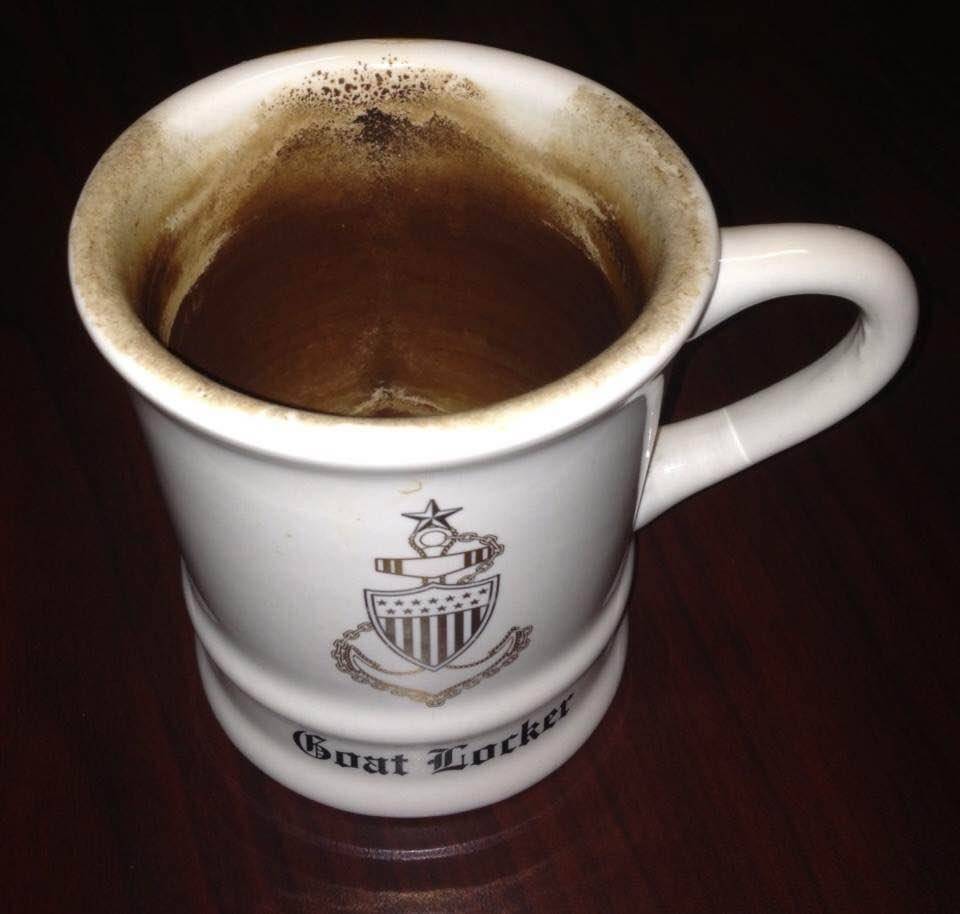
seasoned mug

Some studies suggest that the practice isn’t that unhealthy so long as you don’t share the mug with anyone and drink the coffee black with neither cream nor sugar. In fact, the Navy Times picked a few suggestions from the fleet for the perfect mug, including drinking coffee black, drinking the entire mug, and even seasoning it with leftover grounds like a cast-iron skillet.

The last suggestion on the list is the most important for any servicemember: Don’t wash the mug. Ever. If the owner washes it, the respect for them goes overboard. If a junior member washes it, even through ignorance or on a dare, there is no end to the harassment that they will endure at that command and beyond.

After all, the fleet talks and reputations have long lives.

I’ve seen my share of deeply seasoned mugs, but my personal mug only had minimal stains. I take my coffee with cream/milk and sugar, and I also prefer to drink from clean vessels. I’m a bit of a germaphobe that way.


cc-break

Culture on My Mind is inspired by the weekly Can’t Let It Go segment on the NPR Politics Podcast where each host brings one thing to the table that they just can’t stop thinking about.

For more creativity with a critical eye, visit Creative Criticality.

The Thing About Today – August 4

August 4, 2020
Day 217 of 366


August 4th is the 217th day of the year. It is Constitution Day in the Cook Islands, commemorating their self-governance from 1965.


In the United States, today is “celebrated” as National Chocolate Chip Cookie Day and National Night Out Day (which is typically observed on the first Tuesday in August.


Historical items of note:

  • In 1693, Dom Perignon supposedly invented champagne. It’s not clear whether he actually invented champagne, however, he has been credited as an innovator who developed the techniques used to perfect sparkling wine.
  • In 1821, The Saturday Evening Post was published for the first time as a weekly newspaper.
  • In 1863, Matica slovenská was established in Martin. It is Slovakia’s public-law cultural and scientific institution focusing on topics around the Slovak nation.
  • In 1900, Queen Elizabeth, The Queen Mother of the United Kingdom, was born.
  • In 1901, trumpet player and singer Louis Armstrong was born.
  • In 1942, actor Don S. Davis was born.
  • In 1944, a tip from a Dutch informer led the Gestapo to a sealed-off area in an Amsterdam warehouse. It was there that the found and arrested Jewish diarist Anne Frank, her family, and four others.
  • In 1961, lawyer and politician, 44th President of the United States, and Nobel Prize laureate Barack Obama was born.
  • In 1968, South Korean-American actor Daniel Dae Kim was born.
  • In 1975, actor Andy Hallett was born.
  • In 1977, United States President Jimmy Carter signed legislation creating the United States Department of Energy.
  • In 1981, actress Abigail Spencer was born.
  • In 1983, actress, producer, and screenwriter Greta Gerwig was born.
  • In 1987, the Federal Communications Commission rescinded the Fairness Doctrine, which had required radio and television stations to present controversial issues “fairly”.
  • In 2007, NASA launched the Phoenix spacecraft, which researched the history of water on Mars.


In 1790, a newly passed tariff act created the Revenue Cutter Service, the forerunner of the United States Coast Guard.

The organization was founded by then-Secretary of the Treasury Alexander Hamilton. The United States Congress, guided by Hamilton, authorized the building of a fleet of the first ten Revenue Service cutters. Immediately after the American Revolutionary War, the newly established United States was struggling to stay financially afloat and national income was desperately needed. A great deal of this income came from import tariffs, and because of rampant smuggling, the need was immediate for strong enforcement of tariff laws. Those ships represented the United States Government’s first official “armed force afloat” since the United States Navy wasn’t founded until 1798.

The United States Coast Guard received its present name through an act of Congress signed into law by President Woodrow Wilson on January 28, 1915. This act merged the Revenue Cutter Service with the U.S. Life-Saving Service, providing the nation with a single maritime service dedicated to saving life at sea and enforcing the nation’s maritime laws.

The Coast Guard began to maintain the country’s maritime aids to navigation, including operating lighthouses, when President Franklin Roosevelt announced plans to transfer the U.S. Lighthouse Service to the Coast Guard in May of 1939. Congress permanently transferred the Department of Commerce Bureau of Marine Inspection and Navigation to the Coast Guard in July 1946, thereby placing merchant marine licensing and merchant vessel safety under Coast Guard regulation.

After 177 years in the Treasury Department, the Coast Guard was transferred to the newly formed Department of Transportation effective April 1, 1967. As a result of the terrorist attacks of September 11, 2001, the U.S. Coast Guard was transferred to the new Department of Homeland Security in 2003.

August 4th is annually celebrated as Coast Guard Day to commemorate the birthday of the service.


The Thing About Today is an effort to look at each day of 2020 with respect to its historical context.

For more creativity with a critical eye, visit Creative Criticality.