
Culture on My Mind – Clone Stories After the Republic?

Culture on My Mind
Clone Stories After the Republic?

August 7, 2020

This “can’t let it go” deals with Star Wars storytelling potential.

On July 13th, a new animated series was announced on the official Star Wars website. Following a group of clone troopers that debuted in the final season of The Clone Wars, the new series – Star Wars: The Bad Batch – will follow “the elite and experimental clones of the Bad Batch as they find their way in a rapidly changing galaxy in the immediate aftermath of the Clone War.” The squad is comprised of a unique squad of clones who vary genetically from their brothers in the regular clone army, but these unique skills make them formidable in combat. The series will highlight daring mercenary missions as they try to survive in the smoldering remains of the Republic and the rise of the Galactic Empire.

It sounds exciting, and the team of Lucasfilm animation veterans Dave Filoni, Athena Portillo, Brad Rau, Jennifer Corbett, Carrie Beck, and Josh Rimes tells me that the series has both a great pedigree and chance of success. I’ll be watching when it premieres.

But the announcement also made me think about the possibilities for storytelling surrounding the clone army and the rise of the Empire. For seven seasons and twelve years, we’ve been companions to these soldiers as they waged war across the galaxy. We’ve grown to love members of a clone army, each of which was given individual personalities and character through the artistry of Dee Bradley Baker and the show’s writing staff.

We’ve laughed, we’ve cried, we’ve loved, and we’ve lost. The clones were built with a singular purpose – to be cannon fodder that won a war by sheer numbers – but they became individuals along the way, and they’re in a unique position as the Republic that they dedicated their short lives to falls around them.

The clones were built to be disposable. They just murdered the Jedi under pre-programmed orders from Emperor Palpatine. How does that make them feel? Where do they go from there?

From Star Wars: Rebels, we know that Rex, Wolffe, and Gregor felt remorse about their actions in service of the nascent Empire and joined the growing rebellion as a result. But those three had their control chips removed and had full knowledge of how the Emperor manipulated their actions.

We got a better look at the emotional aftermath with Grey, a clone who was troubled by his thoughtless execution of Order 66. As told in the Kanan: The Last Padawan comic series, Grey tried to atone for his actions in the Jedi Purge by sacrificing himself to save Caleb Dume, padawan to Depa Billaba, the Jedi Master that Grey murdered under the influence of Order 66. Caleb Dume would later become Kanan Jarrus in Star Wars: Rebels.

Millions of clones were birthed in the Kaminoan pods for the war, and we only have one story of remorse from a trooper that didn’t have his chip removed. Meanwhile, according to the United States Department of Veterans Affairs, anywhere between 10 to 30 percent of veterans have experienced post-traumatic stress disorder (PTSD) since the Vietnam War.

The clone troopers were also programmed with an accelerated lifespan, entering the war at what seems to be the equivalent of 18-20 years old but aging to their 50s or 60s in the span of a couple of decades. The clones would often talk about retirement after the war, but such speculation was cut short by commanders as “idle chatter”.

The potential here is amazing, and it would serve as a touching coda to the Clone War. It would also serve as a vital touchstone to our own global reality, which great science fiction often does as a metaphor for the human condition.

For example:

  • What happened to the clones who stayed on as stormtroopers?
  • What happened when they were forced to retire from Imperial service?
  • What happened when they were replaced by non-clone soldiers? Was there a conflict?
  • Did any clones feel anger about their pre-programmed lives or role as disposable assets?
  • Did any clones feel anger about the years that were stolen by nature of their genetics?
  • Did other clones feel remorse from Order 66?
  • Did any clones try to make amends for the slaughter of the Jedi? Maybe even running a galactic underground railroad for any survivors?
  • Did any clones try to secret away Jedi artifacts, lightsabers, or kyber crystals to preserve that history?
  • Did any clones try to make amends for the oppression spreading throughout the galaxy, such as freeing slaves?
  • Did any clones experience PTSD? How was that managed in the Empire?
  • Did any clones actually retire directly after the war? Were there benefits, or were they abandoned?
  • Did any clones try to leverage their skills as mercenaries, bounty hunters, or bodyguards?
  • Did any clones try to make the most of their remaining years, such as running for political office, opening a shipping company, or even becoming an entertainer?
  • Did any clones try to tell their stories for posterity?
  • Did any clones try to start families, biological or otherwise?
  • Did any clones return to Kamino to try to rescue, save, or adopt any remaining clone children before the facilities were shut down (as mentioned in Darth Vader: Dark Lord of the Sith)?
  • Were any clones (or their offspring) Force-sensitive? How did they manage that? On the run? As part of the Imperial Security Bureau to hunt down Force-sensitive children? As a Guardian of the Whills?
  • Did any clones, aside from Rex’s crew, join the rebellion or fight against the Empire?

That list is just scratching the surface.

We have millions of individual voices (thanks again, Dee Bradley Baker!) with the same face in a galactic pool of trillions upon trillions of citizens swamped in the uncertainty of political upheaval.

Lucasfilm, let’s tell their stories. Let’s do it in an anthology of some sort, be it prose or comics or even television. Let’s do in it a series of anthologies. Let’s do it with shares of the profits going to veteran support groups around the world.

Let us not forget this generation of our favorite animated heroes.

Star Wars: The Bad Batch will premiere on Disney+ in 2021.

cc-break

Culture on My Mind is inspired by the weekly Can’t Let It Go segment on the NPR Politics Podcast where each host brings one thing to the table that they just can’t stop thinking about.

For more creativity with a critical eye, visit Creative Criticality.
Culture on My Mind – Star Wars: The Clone Wars

Culture on My Mind
Star Wars: The Clone Wars

January 31, 2020

This week, Star Wars: The Clone Wars is on my mind.

Star Wars: The Clone Wars fills in the gap between the last two installments of the prequel trilogy. I had a few issues with both Attack of the Clones and Revenge of the Sith, but this series helped to smooth things a bit. It doesn’t make those two films perfect by any means, but it helps. It also gave me Ahsoka Tano, one of my favorite complex characters in the Star Wars mythos.

The show started with a theatrical release of the first few episodes in August 2008. On its own, that movie isn’t particularly good, but the series was phenomenal. It ran from 2008 to 2013 on Cartoon Network, then had a limited revival in 2014 on Netflix. Series supervising director Dave Filoni worked with George Lucas to understand the heart and soul of Star Wars, making this series one of the purest expressions of the franchise in the period between the prequel and sequel trilogies.

If you haven’t had the chance yet, I wholeheartedly recommend the series. If anything, start with the first season, then watch the theatrical movie before proceeding into the rest.

The show finally wraps up with the seventh season, which premieres on Disney+ on February 21, 2020.
cc-break

Culture on My Mind is inspired by the weekly Can’t Let It Go segment on the NPR Politics Podcast where each host brings one thing to the table that they just can’t stop thinking about.

For more creativity with a critical eye, visit Creative Criticality.
Seven Days of Star Wars: Day One – The Clone Wars


Star Wars: The Clone Wars
(PG, 98 minutes, 2008)

Today kicks off a series of looks at each of the wide-released theatrical Star Wars films leading up to the premiere of Star Wars: The Force Awakens. This includes each of the films that comprise the saga’s story after the 2012 purchase of Lucasfilm by the Walt Disney Company and the April 2014 canon reset.

For the first entry in the series, I’m looking back on the most recent theatrical release, Star Wars: The Clone Wars, which is set between Episodes II and III.

I caught this in theaters during first run, but not opening weekend, and I still regret selecting it above My Sister’s Keeper. The following television show was phenomenal, but the feature is something I’ve only seen twice. If you’re new to The Clone Wars, I recommend jumping into the series first. Come back to the movie after you have the first (and maybe second) season under your belt.

That’s not to say that the movie is terrible. On its own, Star Wars: The Clone Wars is a mediocre feature. The plot was fairly simple: The Republic and the Separatists are both vying for control over Hutt-controlled trade routes. In an attempt to gain an upper hand, Count Dooku kidnaps Jabba the Hutt’s son, which means that the Jedi are on the hook to recover the little Huttling.

The main problem with The Clone Wars feature presentation is that it wasn’t designed as a movie. The Rotta the Hutt story was originally three completed episodes (“Castle of Deception”, “Castle of Doom”, and “Castle of Salvation”), and the Battle of Christophsis story with the introduction of Ahsoka Tano was a completely separate episode. At a private screening, George Lucas suggested to director Dave Filoni (Avatar: The Last Airbender) that they should make them a feature. Sadly, it results in an uneven presentation with a lackluster story.

But, despite all of the negative points, there are some incredibly awesome things in Star Wars: The Clone Wars.

Ahsoka Tano

The Clone Wars was a dramatic shift for the saga which, to this point, had never discussed Anakin having an apprentice. While some segments of fandom rebelled – ironically, Ahsoka is well-received in fandom over seven years later – I enjoyed the reasoning within the story: After the events of Attack of the Clones, the Jedi Council wanted to help Anakin overcome his attachment issues as Tano became more independent, and that she would also teach him to espouse a greater sense of responsibility. Obi-Wan appeared to be instrumental in bringing this to the Council as well.

Rex_and_Ahsoka

This begins the development of one’s the Prequel Era’s most dynamic and interesting characters. While I still like the Prequel Era, many of the main characters are constrained by the original trilogy of films. From the Original Trilogy point of view, we know where Anakin, Obi-Wan, and Yoda end up, and we also know that the days of the Jedi are numbered. Ahsoka, on the other hand, was a wild card, and her character arc added greater interest to her comrades and a greater depth to the Prequel Trilogy overall.

Tom Kane’s Introductions

Thematically, The Clone Wars takes a page from newsreels of the World War II, Korean War, and Vietnam War eras. Similar to the short films that Disney and Pixar are running before their features today – the practice itself being a throwback to the golden age of cinema – features during those wars were preceded by news from the front headlined by a bombastic announcer.

The Clone Wars replaced the standard opening Star Wars crawl, which provided a slice of background for the adventure to come, with introductions by Tom Kane (also the voice of Yoda in the series) in a caricature of the newsreel announcer. I was in love with this idea from the first time I heard “A galaxy divided!

Kevin Kiner’s Score

Kevin Kiner did fantastic work with the score in both the movie and the follow-on series. He kept the music in the Star Wars flavor while also keeping it light (for a cartoon show) and unique. He also steered away from simply repeating the themes from the movies over and over again.

Going hand-in-hand with the introductions, he reworked the Star Wars main theme into a brass heavy patriotic march, which kept the feel of the newsreel style and provided the energy to launch into tales of Jedi at war.

Battle of Christophsis

Some of the greatest innovation in Star Wars comes from the battle sequences. Before August of 2008, I had never considered Walkers being able to scale a sheer cliff, but then the AT-TEs did it at Christophsis. My mind was blown at first, but then all I could say was, “Of course they can.”

ATTE_scale_cliff

Tomorrow, I’ll continue walking back through time to 2005 and my favorite moments from Star Wars: Episode III – Revenge of the Sith.

My Rating: 6.0/10
IMDb rating: 5.8/10
cc-break

For more creativity with a critical eye, visit Creative Criticality.

Culture on My Mind – Shelving the Star Wars Expanded Universe Makes Sense

Culture on My Mind

Culture on My Mind
Shelving the Star Wars Expanded Universe Makes Sense
May 4, 2014

I’ve been thinking about the recent shake-up in the Star Wars expanded universe, and it’s taken me some time to really sort out my thoughts both in relation to my emotions and good business sense. I agree with the decision, and believe that it makes sense to do it.

Part I – The Books and Me

It seems fitting that this decision was made public around this time of year. I was introduced to the post-Return of the Jedi adventures of Luke, Leia, Han, and Chewie on Easter Sunday of 1992. My parents surprised me with a paperback copy of the Star Wars Trilogy 10th anniversary omnibus, which combined the novelizations of each of the original films, along with a paperback copy of Timothy Zahn’s Heir to the Empire. They realized that I had a deep attachment to the original trilogy, which I had only seen on well-loved and rewind-worn pan-and-scan VHS tapes at that time, and they fed that passion with what they understood to be the continuing story. They were right on the money, as confirmed by the hardcover version’s inner jacket blurb.

The three Star Wars films form a spectacular saga of bold imaginations and high adventure. But the stories of its characters did not end there. Now for the first time, Lucasfilm Ltd., producer of the Star Wars movies, has authorized the continuation of this beloved story. In an astounding three-book cycle, Timothy Zahn continues the tale of Luke Skywalker, Princess Leia, Han Solo, and the other characters made world famous by Star Wars, as he brilliantly expands upon George Lucas’s stunning vision, “a long time ago in a galaxy far, far away.”

I rapidly devoured the original trilogy omnibus, and relished the differences between the novels and the films. Obi-Wan knew about ducks, Luke’s uncle Owen was really Kenobi’s brother, and Vader was created when Anakin and Obi-Wan battled on the edge of a volcano. It was a wealth of information that expanded beyond the cinematic journey, and it primed me for the more dedicated reading of the continuing saga. I say dedicated, but I don’t mean meticulous; I flew through Heir to the Empire and loved every minute. In June of 1992, I reserved a copy of the second book, Dark Force Rising, at my local library and flew through it as well. It was a long year until The Last Command was released, and after that epic conclusion, I satiated my desire for more Star Wars by reading Brian Daley’s The Han Solo Adventures, L. Neil Smith’s The Lando Calrissian Adventures, and Alan Dean Foster’s Splinter of the Mind’s Eye.

It didn’t matter to me how bad Splinter was because, by the Maker, I had new Star Wars in my hands. The Truce at Bakura, The Courtship of Princess Leia, and Kevin J. Anderson’s Jedi Academy trilogy started me down a path of buying the books and comic trade paperbacks when they came out and enjoying every one of them. My palette has matured a bit since then, and stories like The Crystal Star (ah, Waru) are hardly ever revisited by my eyes, but at the time, they were precious, precious gold.

Despite my love for the franchise, it became apparent to me that the universe was getting too large too fast. At that point, stories in what became the Star Wars Expanded Universe (SWEU) ranged from approximately 5,000 years before to around 20 years after A New Hope. One person at Lucasfilm, Leland Chee, was charged with keeping the chronology straight and smoothing over any conflicts amongst the novels, comics, video games, television series, and movies. He did an admirable job, and it’s one I don’t envy.

By 1994, Lucas Licensing had defined what made up Star Wars canon, and publicized it in issue 23 of Star Wars Insider, the fan club’s magazine.

Gospel, or canon as we refer to it, includes the screenplays, the films, the radio dramas and the novelizations. These works spin out of George Lucas’ original stories, the rest are written by other writers. However, between us, we’ve read everything, and much of it is taken into account in the overall continuity. The entire catalog of published works comprises a vast history—with many off-shoots, variations and tangents—like any other well-developed mythology.

To help sort out the chronology, multiple tiers were established between 1996 and 2000 to solve conflicts between stories. Anything that directly involved George Lucas, such as the films, their novels and radio adaptations, and statements from Lucas himself trumped everything. Under that were the television shows, followed by the combination of novels, comics, and games. As the prequel movies dawned and Lucasfilm started developing The Clone Wars television series, more and more continuity problem started to crop up and it was apparent that something had to give. In the time-honored tradition of the SWEU, George Lucas won.

Part II – The Dawn of a New Era

The decision on April 25th to essentially shelve everything except the six core films and The Clone Wars isn’t a big surprise. In fact, it’s been a long time coming. As much as George Lucas has changed his mind on sequel films – at first it was a twelve-film series, then nine, then six. As recently as May 2008, he told TotalFilm that, “There will definitely be no Episodes VII–IX” – he has been consistent since 2001 that his vision trumps everything else. During an interview on the official site in March 2008, he explained his point of view.

It’s a certain story about Anakin Skywalker and once Anakin Skywalker dies, that’s kind of the end of the story. There is no story about Luke Skywalker, I mean apart from the books. But there’s three worlds: There’s my world that I made up, there’s the licensing world that’s the books, the comics, all that kind of stuff, the games, which is their world, and then there’s the fans’ world, which is also very rich in imagination, but they don’t always mesh. All I’m in charge of is my world. I can’t be in charge of those other people’s world, because I can’t keep up with it.

Fans have been complaining that this move invalidates the established canon, but what really has been canon before now? The Thrawn trilogy was “authorized” as a continuation, and multimedia events like Shadows of the Empire and The Force Unleashed had some direction from George Lucas, but aside from that everything else seems to have been handled by a licensing department.

You know what else fits this pattern? The Star Trek novels. The Marvel Cinematic Universe. 1978’s Superman film. Any of the various DC and Marvel reboots. All of them violate the established “canon” of the material that came before, and yet they exist and are still enjoyed. Just like those examples, and countless other franchise tie-ins, the stories established by the SWEU still exist. Disney and Lucasfilm aren’t burning every copy they can find or raiding public libraries for toilet paper. In fact, the existing SWEU is being republished as the “Star Wars Legends” series to guarantee their availability for the future.

Star Wars fans can learn a very valuable lesson from Star Trek fans, as author Keith R. A. DeCandido explained in his comments on this whole affair.

Two of the most highly regarded Trek novels are Imzadi and Federation. The former novel was heavily contradicted by a TNG episode (“Second Chances”); the latter was totally nuked by the movie First Contact. Yet the two novels continue to be well regarded — and so does that episode and that movie, even though they contradict each other. If you think that contradictory versions of stories in the same universe ruins one of the contradictory ones, then you don’t understand how storytelling works.

I totally get the concept of having a huge personal investment in this franchise. I owned every novel in the series before the Navy lost half of my household goods shipment back in 2005. That incident hurt, but only because of the material loss. My consolation was that the books were still out there, and someone would be selling them when I was ready to rebuild.

More importantly, this move guarantees the future of the Star Wars franchise, which cost Disney over $4 billion. That’s one hell of an investment, and they needed a way to make it accessible to general audiences again, including the newest generation of children who haven’t experience the galaxy far, far away. As much as we cannot expect audiences to read every book between Return of the Jedi and Episode VII, we cannot expect scriptwriters and directors to limit their vision to decades of contradictory stories. Those limitations would only hinder the movie and hurt the investment.

Take the example of Disney’s other major acquisition, the Marvel franchise, and their approach to the Marvel Cinematic Universe. General audiences don’t need to read the comics to get the stories, and if they need to know something, it’s presented to them. If you haven’t had a chance to read the Bloomberg Businessweek article about the MCU, I highly recommend it. There are a lot of parallels between Marvel and Star Wars.

Before this announcement, I was optimistic but skeptical about the sequel movies. There was just too much story to dance around if the EU was left intact, and I wasn’t keen on the movies being cleverly wedged between chapters or pages of a novel just to make a timeline work. This move tells me that Disney is serious about their investment and the vision they want to bring to audiences. By making this story easily accessible to everyone, which means removing the stumbling block of the now Legends stories, Disney and Lucasfilm win. That means that Star Wars fans win.

Disney and Lucasfilm helped reignite the magic of my childhood. Warm up the Falcon, Chewie, and calculate the hyperspace jump to December 2015. I’m ready to believe again. Star Wars truly is forever.

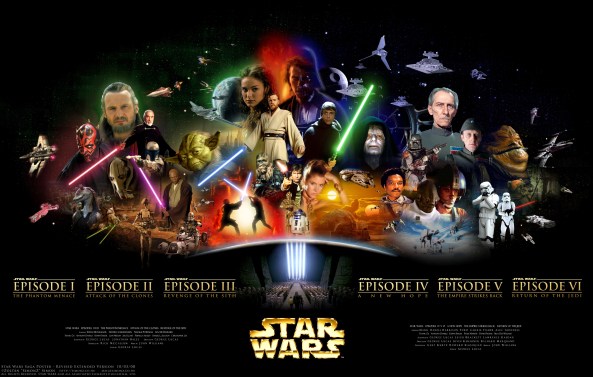
Star Wars Saga Poster by SimonZ

cc-break

Culture on My Mind is inspired by the weekly Can’t Let It Go segment on the NPR Politics Podcast where each host brings one thing to the table that they just can’t stop thinking about.

For more creativity with a critical eye, visit Creative Criticality.

Culture on My Mind – Darth Maul and the Hollowness of Death

Culture on My Mind

Culture on My Mind
Darth Maul and the Hollowness of Death
October 14, 2011

Entertainment Weekly recently posted an exclusive video that announced the return of Darth Maul to the Star Wars universe.  For those who either missed or refused to watch the prequels, Maul was a Sith Lord—the same kind of baddie as Darth Vader—who used a double-bladed lightsaber.  His first on-screen appearance was in The Phantom Menace in 1999.

In that film, a three-way lightsaber duel ended with Qui-Gon Jinn impaled through the chest and Darth Maul toppling into a deep shaft, deftly cleft in twain by the blade of Obi-Wan Kenobi.  Last January, viewers of the cartoon series Star Wars: The Clone Wars were introduced to Maul’s brother Savage Oppress (pronounced in typical Star Wars ­style as sah-VAHJ OH-press), who was a proposed apprentice to help Count Dooku overthrow his master and take control of the Dark Side of the Force.  At the end of that trilogy of episodes, viewers were told that Darth Maul was out there in the incredibly vague somewhere in the galaxy, and Oppress had to go find him.

So, apparently this means that Darth Maul does indeed live and, by some miracle, survived being cut in half by a lightsaber and falling several stories.  Insert exasperated sigh here.

Supervising director Dave Filoni told Entertainment Weekly that it makes sense in terms of Star Wars lore:

Fans will note that there is precedent for this kind of resurrection. “The Dark Side of the Force is the pathway to many abilities some consider to be…unnatural,” Darth Sidious says in Revenge of the Sith. Sidious and his master found a way to use the Force to cheat death—that’s how he was able to keep Vader alive after that little swan dive into a lava field. Couldn’t Maul have picked up on some of that too? Says Filoni, “He’s suffered through a lot to keep himself alive and implemented the training of his master to do so.”

There’s also significant financial interest for Lucasfilm in this move.  The episode(s) pertaining to Darth Maul will be aired in early 2012, and, by a cosmic coincidence I’m sure, Star Wars: The Phantom Menace in 3-D is premiering February 10, 2012.  It goes without saying that I’m annoyed by publicity stunts written into entertainment to drive interest in a related property.  Anyone else remember the martial arts episode of Star Trek: Voyager called “Tsunkatse”?  WWE Wrestler Dwayne “The Rock” Johnson was a guest star, and both WWE and Voyager were on UPN.

This entire mess—and yes, I’m calling it a mess—brings Star Wars into the realm of pointless character resurrections to drive sales.  It also revives the eternal frustrations I have with Star Wars fandom.  Since Maul was by far one of the coolest and most bad-ass characters in the prequel trilogy, the news that he would return to the franchise was understandably received with fan praise.  At the same time, others started to look at how this affects the overall quality of the franchise and aired their opinions.  In response to critical fans, some blogs, including Star Wars Underworld, questioned the “fandom” of people with differing opinions.  While I appreciate a discussion on how they plan to resurrect a character and do it well, it’s certainly not the first time that the Star Wars social media sphere has played the card of questioning how someone can be a fan of something while being critical: the hosts of The ForceCast did it numerous times before I stopped listening to the podcast back in May.

While other subsets of science-fiction and fantasy fandom can somewhat easily accept both positive and negative criticism toward the franchise of their choice, some Star Wars fans tend to follow the line of reasoning that if “you’re not with with us, you’re against us.”  It’s all fun and games until you disagree with Uncle George and refuse to drink the blue milk, and I’ve already seen backlash from refusing to buy the Star Wars Blu-Rays and my decision not to support the 3-D re-releases.  Having intelligent discussions about the positives and negatives of a franchise is one thing, but I cannot support attacking each other for having differing opinions.

The bigger problem I have with this is an issue that has plagued comic book franchises for decades, and that is in the pointless death and resurrection of characters.  In real life, religious beliefs aside, death is pretty permanent.  In storytelling, death is a result of failure, the completion of a heroic journey, or the motivation to start that journey.  In a smaller subset, that death results in a significant change of character dynamics—such as regenerations in Doctor Who, or the evolution of Gandalf in Lord of the Rings or Obi-Wan Kenobi in Star Wars—but those deaths still carry the impact of the end of a journey and how it affects the characters around them.

Simply put, to reverse a death negates that impact and cheapens the victory for the winners.

In The Phantom Menace, Darth Maul’s death marked two important character changes:  First, it displayed Obi-Wan Kenobi’s maturity and readiness to be promoted from apprentice to Jedi Knight; second, it marked the beginnings of Anakin’s destined path.  The death of Darth Maul was a very important turning point for the Jedi themselves, as they discover that the Sith had indeed returned.

While I look forward to finding out how Filoni and company accomplish this feat, I am very skeptical about the Star Wars franchise as a whole at this point.  If Filoni proves me wrong and does this well, I will be quite amazed.  On the other hand, if this turns into yet another cheap comic book return—Superman wasn’t dead, after all, he was just resting—to sell tickets to yet another release of the Star Wars movies, then I’m done with The Clone Wars.  I have supported the show since it was announced, but for me, it would be that damaging, and since George Lucas has final approval on the show, the blame would lie solely with him.

Come 2012, we shall see.

cc-break

Culture on My Mind is inspired by the weekly Can’t Let It Go segment on the NPR Politics Podcast where each host brings one thing to the table that they just can’t stop thinking about.

For more creativity with a critical eye, visit Creative Criticality.