
Timestamp #137: The Twin Dilemma

Doctor Who: The Twin Dilemma
(4 episodes, s21e21-e24, 1984)


He’s the Doctor, whether we like it or not.

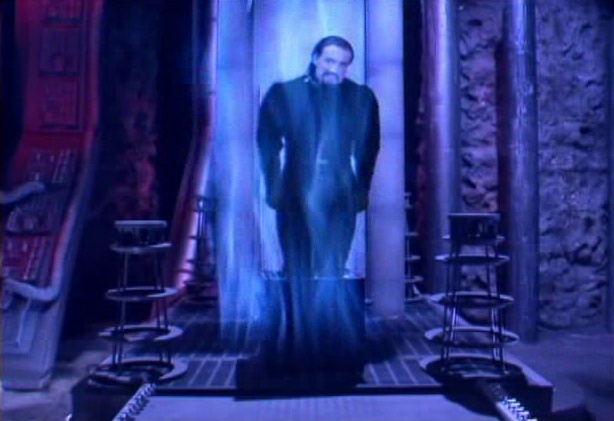
After some updated and more colorful credits, we find two twins are playing a game of space backgammon. They are named Romulus and Remus, which is a bit on the nose. The boys move on to a new strategy game when a stranger named Professor Edgeworth materializes before them. After a cryptic but friendly discussion, the trio vanishes.

On the TARDIS, the Sixth Doctor shows off his new looks after regeneration, but Peri is not impressed. This Doctor is more vain and arrogant, readily denouncing his predecessor’s “feckless charm.” Ouch! He goes into the wardrobe to change clothes and has a minor breakdown. He breaks out the Second Doctor‘s fur coat and the Third Doctor‘s maroon velvet jacket, both of which he rejects in favor of a garish technicolor number topped with a cat brooch for luck. Peri remains unimpressed, but she does take time enough to change clothes as well.

Edgeworth and the twins appear on a spacecraft staffed with goat-bird hybrid aliens. The goat-birds take the twins to another room as Edgeworth contacts his boss, a slug-like entity known as Mestor. Edgeworth is tasked with taking the boys to Titan III.

The Doctor, unimpressed with Peri’s style, sets course for a holiday planet called Fiesta 95. He wanted to go to the Eye of Orion but cannot remember the way. Adopting a less antagonistic tone, he asks Peri about her name (which is short for Perpugilliam, and must have been absolute hell for her in American public schools) and recites a poem about a peri (a beautiful fairy in Persian mythology that starts out evil until completing a penance to achieve paradise). He then goes crazy, accuses Peri of being an evil alien spy, and attempts to choke her to death. Peri defends herself with a mirror which, when the Doctor looks into it, causes the Time Lord to recoil.

Seriously, what the hell is wrong with him?

When the Doctor recovers, he doesn’t remember the incident at all. He also doesn’t believe Peri when she tells him what happened. When it finally clicks, he is distraught and decides to enter seclusion as a hermit on Titan III. When he touches the TARDIS controls, the time capsule goes just about as crazy as the Doctor but makes its way to the secluded planet. When the TARDIS shakes violently, the Doctor decides to investigate the cause.

The twins’ father returns home and reports their disappearance. The authorities are concerned about the twins being kidnapped by extraterrestrials and make it their top priority. Apparently, these kids are super important or something. On the ship, the kids attempt to escape by fiddling with the electronics and emitting an erratic signal. The authorities find the ship running under a fraudulent registry, and when they challenge it, the freighter jumps to warp speed (even though it’s not supposed to be designed for that). The jump destroys the authority ships in the process.

Edgeworth, the goat-birds, and the twins arrive on Titan III. Mestor contacts the professor, chews him out for his carelessness, and orders him to set the twins to whatever task they’re there to accomplish. Later on, Edgeworth chides the twins for not working fast enough. They aren’t allowed to use electronic means after the distress signal incident, so they’re working equations by hand. Edgeworth persuades them with tales of Jaconda and Mestor threatens their lives. As they work the mathematics, the twins soon realize that they’re meddling with enough power to destroy a planet.

Peri and the Doctor venture onto the asteroid and find the wreckage of one of the police ships. They find a survivor and the Doctor chastizes Peri for jumping to conclusions. They take the officer back to the TARDIS and Peri calls the Doctor out on his attitude. At that exact moment, the officer springs up and holds the Doctor at gunpoint, threatening to kill him for the destruction of the police squadron. Peri pleads with the officer, and he is soon disarmed after he passes out. The Doctor initially has no desire to provide aid, but Peri persuades him.

While discussing their situation, Peri and The Doctor spot Edgeworth’s building on the scanner. The Doctor coaxes Peri into exploring, even confusing her for Tegan at one point as his mind continues to sort itself out. This incarnation is far more bold and willing to rush headlong into the unknown with a foolhardy flourish. They infiltrate the bunker and are apprehended by the goat-birds, during which the Doctor pretends to be a meek pilgrim who uses Peri as a human shield. They are taken before Edgeworth, maintaining their guise as pilgrims until the Doctor recognizes the man behind the face. Edgeworth is Azmael, a renegade Time Lord whom the Doctor recognizes from an adventure in his fourth incarnation.

The Doctor discovers what Azmael has done and is disgusted. Azmael rejects the Doctor’s help and locks the travelers in the bunker before transmatting to his ship. As the Doctor sets to work in deciphering the lock combination, Peri discovers a time bomb ticking away. The Doctor repurposes a revitalizing modulator chamber as a device that will rewind the user ten seconds. Peri steps in and vanishes and the Doctor follows just as the bunker explodes. They both reappear in the TARDIS console room to find the injured police officer holding his freshly reassembled gun on them.

Okay, so both of these elements are really lazy storytelling. First, Peri hid the gun’s power pack in the wardrobe room, but Officer Lang just happens to change into the one tunic with the power pack in its pocket. That’s way too convenient. Second, the Doctor and Peri have been inside the bunker for much longer than ten seconds. Simply rewinding ten seconds isn’t enough to place them back in the TARDIS, which makes the improvised temporal teleporter a bit beyond normal suspension of disbelief.

On the upside, I did like the callback as the Doctor (who apparently believes in luck now) strokes the cat brooch to compensate for his guesswork and MacGyvering of the revitalizing modulator. On the downside, he’s still being abusive toward Peri by cursing her out for something beyond her control.

The Doctor sets course for Jaconda and then confers with Lang and Peri about the plot, swaying Lang to his side in the process. On Jaconda, Mestor executes a lower-class goat-bird for stealing to feed his family to prove to us that he’s a bad, bad character. Shortly thereafter, the TARDIS arrives in a Jocandan wasteland, which the Doctor eventually realizes is not the beautiful planet he once knew. He also recognizes that it is the work of giant gastropods, prompting him to return to the TARDIS to figure out his next course of action. Reluctantly, he is swayed to move the TARDIS to the palace and accompany Lang and Peri to rescue the twins.

After arriving on the planet, Azmael takes the twins on a tour of the palace, showing off the laboratory and the storeroom of gastropod eggs. Mestor enters and tries to persuade them that their actions are benevolent. Azmael asks Mestor to refrain from monitoring his thoughts and remove his guards. Mestor eventually agrees and departs, and Azmael details his plan to save Jaconda: The star system has three planets, and the two outer planets will become moons of Jaconda – picking up Jaconda’s atmosphere and ecosphere by timey-wimey plot means – and provide more places for the slugs to conquer.

As the travelers navigate the palace, the Doctor offers a Jacondan history lesson by way of pictograms. Shortly afterward, Lang gets stuck in a gastropod slime trail after two of the creatures pass. Of course, it’s a mere matter of plot convenience as no one got stuck in Mestor’s slime trail during the lab visit. The Doctor has another of his childish tantrums and blames Peri for the entire situation, storms off, stumbles into the lab, and attacks Azmael before coming to his senses. The twins reveal that Azmael wasn’t responsible for the bunker’s self-destruct, prompting the Doctor to learn more about the plot surrounding him.

Meanwhile, Lang breaks free and accompanies Peri to find the Doctor. The goat-birds attack Lang and leave him for dead before taking Peri to Mestor. Lang comes to, stumbles into the lab, and tells the story. When the Doctor realizes that Peri is likely going to die, he suddenly (and unconvincingly) grows a backbone of compassion for her.

Lucky for him, Mestor sees no reason to kill Peri. Unlucky for him, he is taken before Mestor.

The Doctor agrees to help Mestor while Azmael restores the twins’ hidden memories. Number-crunching commences, and Azmael reveals his plan to overcome the gravitational stresses by shifting the minor planets into different time zones. The Doctor points out that temporal displacement won’t stop the massive gravitational explosion, and that Mestor must know about the consequence.

Meanwhile, Mestor magically gains access to the TARDIS and sends his minions to do evil within.

The Doctor enters the gastropod hatchery and examines the eggs. He discovers that they are tough enough to survive the solar explosion, and will likely hatch under extreme heat spread throughout the universe through Mestor’s plan. This must be a Star Trek Abrams-style supernova or something.

The twins destroy their notes, keeping only the records in their photographic memories. Peri, Lang, and the twins head for the TARDIS while Azmael (who is on his last regeneration) and the Doctor confront Mestor. The Doctor tries to destroy Mestor with acid, but the slug is protected behind a force field. Meanwhile, Lang stymies an attempt to kidnap the twins. Mestor uses his last resort and projects himself into Azmael, intent on taking over the Time Lord’s body and mind. The Doctor uses a second vial of acid to destroy Mestor’s body while Azmael forces a regeneration to destroy Mestor’s mind.

The act of forcing a regeneration when none were left to him causes Azmael to die. Before he does, in perhaps the most emotionally driving moment of the story, he passes a crystal ring to the Doctor.

Lang removes the now liberated goat-birds from the TARDIS and he offers to remain and assist with rebuilding Jaconda. The Doctor gives him the ring as a badge of office and the travelers say goodbye, setting a course for Earth to take the twins home. Peri confronts the Doctor about his instability, but the Doctor retorts that he has finally stabilized and reminds her that he is an alien, so his methods can be foreign to her.

He is now the Doctor, whether she (or we) like it or not.


I know that regeneration stories are hard. Each incarnation of the Doctor is a unique interpretation of the character, and as such, it takes time for the actors and creative teams to settle into their respective voices. It’s why I give the +1 regeneration handicap, and it’s why I can abide by the (nearly meta) admonition from this new Doctor to give him time before making final judgments on his character.

It’s almost as if the creative team from 1984 could see the future. Keyboard warriors of genre fandoms across social media, take note: The Doctor has another lesson for you. One performance is not substantial enough to make a final decision on a character (or a show, for that matter).

That said, I can criticize this story’s Doctor. He is arrogant and rude, but well beyond what the Third Doctor brought to the table. This sixth incarnation takes being a pompous ass to a whole new level. I’m not a fan of this clownish blustering that downplays compassion, abuses his companions, and places them in mortal danger. I would willingly travel with each of the previous five, but I wouldn’t step foot in this Doctor’s TARDIS based on this story.

The story itself was found lacking, particularly with the sloppy writing and consistency errors that I noted earlier. Aside from the touching death of Azmael – which was a missed opportunity that could have revisited the Monk, the War Chief, the Hermit, Morbius, AndredDrax, Chronotis, or even Maxil (which would echo The Enemy of the World) – I didn’t find much to engage with beyond my anger with the Doctor.

I do find the speculative ramifications of Azmael’s death quite fascinating, particularly on how regeneration works near the end of the thirteen life limit. Apparently trying to break the limit on one’s own is far too taxing and doesn’t result in a full regeneration. I also liked the “Doc” callback, a running gag that has touched Tegan and Steven Taylor with another grumpy Time Lord.


Rating: 3/5 – “Reverse the polarity of the neutron flow.”


UP NEXT – Twenty-First Series and Fifth Doctor Summary


The Timestamps Project is an adventure through the televised universe of Doctor Who, story by story, from the beginning of the franchise. For more reviews like this one, please visit the project’s page at Creative Criticality.

Timestamp #136: The Caves of Androzani

Doctor Who: The Caves of Androzani
(4 episodes, s21e17-e20, 1984)


Davison deserved better.

The TARDIS arrives in a dry lake bed on Androzani Minor. After a small bout of exploration, Peri and the Doctor question the presence of motor vehicle tracks on an otherwise desolate planet and decide to follow them. While they travel, the Doctor muses about keeping diaries. While they explore the crystalline caves, Peri falls into a web-like substance that stings. Afterward, she asks the Doctor about his lapel celery, which turns purple when exposed to gases in the Praxis range.

Elsewhere, a monster attacks a group of soldiers. The travelers run into the soldiers, are mistaken for gunrunners and apprehended, and are taken to General Chellak. He believes that they are supplying arms to a group of android rebels and will not hear anything about their innocence. When Trau Morgus (CEO of the Sirius Conglomerate) on Androzani Major calls, the general tosses his prisoners into a closet. The communication is tense and tapped by a mysterious third party who thinks Peri is pretty. Morgus is disinterested in the travelers, unemotionally orders their execution, and engages in a little bit of fourth-wall breaking by staring straight into the camera. When more soldiers are attacked, the general orders his second, Major Salateen, to prepare the travelers for execution while he attends to the ambush. The entire squadron is decimated.

The Doctor apologizes to Peri for their predicament while tending to her web-induced rashes and watching the general as the dead squadron is returned to the base. He muses on the background of spectrox, the valuable material the humans are mining. On Androzani Major, Morgus hosts the president of the planet and reveals the nature of spectrox to the audience: It is a powerful drug produced by the bats of Androzani Minor that enhances youth and extends life. The meeting turns to the execution as the Doctor and Peri are lined up before a firing squad, and on the proper count, the Doctor and Peri are shot to death.

Except that they aren’t.

The mysterious eavesdropper, Sharaz Jek, swapped the prisoners for android duplicates. The general and major realize the deception, but cannot report it because it would end their careers. Jek also intends to keep the Doctor and Peri as unwilling companions. Jek owns a considerable share of the spectrox in the caves and can monitor troop movements. He has cost the general hundreds of troops and speculates that his inventory won’t be in jeopardy for another five years. He expects the people of Androzani Major to have rebelled against Morgus by then and wants nothing less than the CEO’s head at his feet. Meanwhile, on the surface, there are troubles among the gunrunners as they fight over failures and lack of pay.

Morgus receives word that one of his mines has exploded. Back in Jek’s caves, the Doctor meets the real Salateen (who was replaced months before) and discovers that the web they encountered earlier is a spectrox nest. Exposure is lethal, and the antidote (the milk of a queen bat) is difficult to find due to the mining operations.

So far, we have the following open threads: The spectrox war (androids vs. humans); spectrox toxaemia; the gun smugglers who are supplying Jek’s android army; a giant monster; and celery.

Stotz, the lead gunrunner, requests a meeting with Jek. Before Jek leaves, he talks to the Doctor and becomes enraged when Peri asks about his mask. The story behind it is gruesome and it hides the burn scars from an encounter with Morgus. After Jek leaves, the Doctor tries to sneak by the androids, which are programmed to kill humans on sight. The Doctor disables the android guards and takes Peri and Salateen back to the TARDIS for supplies. En route, they are ambushed and the Doctor is wounded by an android guard. Salateen saves Peri and abandons the Doctor.

The meeting between Jek and Stotz is less than productive. Stotz threatens to leave the operation, but Jek knows that he can get any number of people to wage his war with his supply of spectrox. Jek returns to his base and finds his captives missing. Meanwhile, the gunrunners meet up with the Doctor. The Time Lord hides and the gunrunners are attacked by another monster. The monster makes short work of the smugglers and the Doctor escapes. Stotz and the survivors find Jek, who reveals that the monster is a bat, and their tense confrontation is broken up by the Doctor. The smugglers are paid and the Doctor is taken captive and tortured for Peri’s location. When the Doctor reasons that Salateen and Peri have returned to Chellak’s base, the smugglers decide to take the Time Lord to the CEO on Androzani Major. It turns out that Morgus is playing both sides against each other. Fearing the president’s discovery of Morgus’s double dealings, the CEO assassinates him.

That combines two of our open threads: The spectrox war (androids vs. humans vs. Morgus and the gun smugglers); spectrox toxaemia; a giant monster; and celery.

Salateen and Peri arrive at Chellak’s base and expose the truth behind the major’s doppelgänger. Chellak develops a plan to remove the android from his ranks. and has no interest in Peri’s illness due to her affiliation with Jek. Salateen reveals the badges that keep humans safe from the androids and the nature of Jek’s wiretapping. The general is displeased, to say the least, but has an idea of how to turn the tide with this intel.

Chellak sends Android-Salateen on a recon mission, during which Jek finds out where Salateen and Peri are housed. Jek sneaks into the base and kidnaps Peri while the Doctor breaks free on the smuggler ship and returns it to (read: crashes it on) Androzani Minor. The Doctor runs from the smugglers and is able to get away as Stotz receives word that Morgus is on his way. The Doctor is only saved by a spontaneous mudburst that drives the smugglers away. When Morgus arrives, he orders Stotz to secure Jek’s supply of spectrox as a nest egg so he can escape the Androzani planets. His assistant has turned state’s evidence and usurped Morgus’s position. Stotz turns on his own crew, gunning them down, and joins Morgus on an expedition into the caves.

Salateen leads an assault misson on Jek’s base. As they come across an android, Salateen thinks that his buckle will identify him as a friendly, but the android opens fire and kills him. The assault team is pinned down but heroically press on. Chellak enters Jek’s base and fights the man, but is forced into the fatal mudburst inside the caverns. The Doctor arrives soon after and tries to revive Peri with the celery (supposedly a powerful restorative on Gallifrey), but is forced into the oxygen-deprived lower caverns after the bat milk. Jek provides him with one oxygen mask and looks after Peri until the Doctor returns.

While the Doctor retrieves the bat milk, Stotz and Morgus storm Jek’s lair. Jek kills Morgus, Stotz kills Jek, and Android-Salateen kills Stotz. The Doctor scoops up Peri and races to the TARDIS as the mudburst destroys Jek’s lair. Once inside, the Doctor dematerializes the TARDIS and gives her the milk before collapsing on the deck.

He says goodbye to Peri, unsure if he’s going to regenerate or not. He sees images of Tegan, Turlough, Kamelion, Nyssa, and Adric encouraging him to survive, and an image of the Master goading him into death. It is Adric — his only companion who died — that prompts him to live, and so he regenerates…

…into a rather brash man who claims to bring change, and not a moment too soon.


Where to begin?

This story has consistently been voted as the best in the history of the televised franchise. I don’t know what I missed. Starting with the spectrox war, I really enjoyed the idea of a conflict triangle, particularly when considered against the political atmospheres both now and in 1984. The big problem I have with the largest part of the story is that the narrative was so muddy and poorly paced. The conflict was unclear for most of the story, and while it had the benefit of placing us in the shoes of our heroes, the continued confusion quickly became frustrating.

This wasn’t helped by the acting. Morgus, the fulcrum of the conflict, came across as dull (was he reading his lines from cue cards?) and his incessant need to recap key plot points directly into the camera was distracting and unnerving. This was counterbalanced by Jek’s madness, which was plainly evident in the delightfully creepy portrayal, but the pacing sabotaged the atmosphere surrounding him by chopping up the interesting backstory with the lackluster Morgus and Chellak scenes. Among our heroes, Peri’s performance was still rocky despite it’s potential to become something more, but Peter Davison seemed off, almost as if he didn’t want to be involved anymore.

The spectrox toxaemia offered a good race-against-the-clock element to the story, and this time the frustration worked in the serial’s favor as each side has the potential to cure our heroes, but they refuse to do so because of how they view the Doctor’s allegiances. Politics in a nutshell, and while the plot devices of the inconvenient cure in the conveniently (and overly) hostile lower caves had merit, I felt that the execution was lazy.

Why? Because the Doctor could have gone after the cure at any time after being told about it and survived the story. In fact, it was his own curiosity that got him and Peri involved, and he had no reason to interfere in this conflict. Yes, there is an argument about combatting evil in even the smallest measures of good, but the body count in this story puts a giant thumb on that scale: Every male character in this serial dies, and there are only two survivors.

The red herring plot threads of the giant monster and the celery were annoying. Both of them were misdirections in an already muddled story.

All of that said, I did enjoy the boost in production value with this story, including the unique camera angles in the Doctor’s explosive run across the planetary surface.

I also plan to give the Sixth Doctor a chance to prove himself, but right now his introduction is far too cynical for my tastes.

The final score benefits greatly from the +1 regeneration handicap in this project, but it still doesn’t meet the “greatest story ever” expectations. Which is a letdown because Peter Davison deserved better.


Rating: 3/5 – “Reverse the polarity of the neutron flow.”


UP NEXT – Doctor Who: The Twin Dilemma


The Timestamps Project is an adventure through the televised universe of Doctor Who, story by story, from the beginning of the franchise. For more reviews like this one, please visit the project’s page at Creative Criticality.

Timestamp #135: Planet of Fire

Doctor Who: Planet of Fire
(4 episodes, s21e13-e16, 1984)


It’s a strange mashup between a primitive religion theme and an unstoppable menace.

Crossing a barren volcanic landscape, two men in tattered clothes offer up a distinctly Middle Eastern vibe. The cross cuts to two other men discussing matters of faith and pilgrimages in a pristine palace environment further that flavor. The two travelers crest the volcano and find nothing, confirming their belief that the god Logar is a myth. That’s a slightly different pilgrimage than I expected.

Meanwhile, an archaeological expedition led by Howard Foster is dredging the ocean in search of artifacts. They find one with strange triangular markings, which are shared on the younger of the two men in the palace. In fact, the Mark of Logar makes the man a Chosen One, and his queries into his role in society are met with the same answer that has plagued religious challenges since time eternal: TRADITION!

“One day, it will all be clear to you.” Uh-huh. Right.

The Doctor depressively obsesses over the Daleks when robotic screaming from the other room snaps him and Turlough into action. Kamelion has plugged into the TARDIS data banks. Turlough tries to disable the link and picks up a distress signal. Turlough disables the signal by tearing apart the relays in the console (and lies to the Doctor about his role in such). The TARDIS changes course to intercept the signal and the Doctor devises a method to triangulate the distress signal.

As the archaeologists pull into port on the island, we meet a woman named Peri (Howard Foster’s stepdaughter) who is planning to leave on a trip with friends to Morocco. After some tense back and forth, Howard relents and allows Peri to go. Howard unloads the boat but strands Peri as he ferries in the rest of the artifacts. Peri loads her clothes, Howard’s wallet, and the double-triangle artifact into a bag and attempts to swim for shore. Unfortunately, she doesn’t make it far before floundering.

Back on shore, the TARDIS arrives and the Doctor and Turlough examine the artifacts. Turlough returns to the TARDIS and overloads the console, preventing Kamelion from making contact with an unknown entity, presumably a place called Trion. Turlough then sees Peri on the scanner and rushes to her rescue, taking her back to the TARDIS and discovering the triangle-marked artifact. It turns out that Turlough conveniently has the same Chosen One mark on his arm.

After inadvertently stiffing a local restauranteur over a glass of water, the Doctor traces the distress signal back to the TARDIS – specifically, to the artifact – and questions Turlough about the data core inside the mysterious device. As the Doctor labors, Peri has dreams about Howard’s treachery, and Kamelion shapeshifts into Howard’s form. Under his control, the TARDIS dematerializes while Kamelion-Howard interacts with the travelers and Peri.

This whole time, the religious group has been debating over the prophecies of Logar and the revelations of the non-believers who hiked the volcano. The congregation receives a sign from their god. The TARDIS arrives, presumably fulfilling the prophecy of an outsider coming to their civilization. When the Doctor and Turlough explore the area, Kamelion changes again, this time triumphantly celebrating his control of the TARDIS as the Master.

That man has so many lives. He must be part cat.

Peri attempts to escape and fails, though the altercation forces Kamelion to overcome the thrall of the Master for a time. Kamelion uses the time to prepare a message for the Doctor. Unfortunately, the Master’s TARDIS arrives soon after, and the renegade Time Lord reasserts control over Kamelion and forces her (and Peri) to leave the Doctor’s TARDIS. A seismic event causes the Master’s TARDIS to topple, breaking the psychic link and providing Peri the window she needs to run.

Kamelion is unable to lift the Master’s TARDIS, so he returns to the Doctor’s TARDIS with the plan to materialize it inside the Master’s capsule. Luckily, Peri has stolen a component from the console. Kamelion-Master gives chase as Peri makes her way toward the Doctor and Turlough, who have just been sheltered by the non-believers. Kamelion-Master catches her, but Peri forces a standoff by dangling the circuit board over a cliff. She persuades Kamelion to re-emerge and uses the distraction to escape once again, but as the Master resumes control, he is mistaken as the prophesied outsider by the priest from the story’s opening.

The Doctor warns the non-believers that their hiding spot isn’t safe: It is in the same vent tunnels that the impending volcanic eruption will use to release its pressure and magma. The non-believers take the Doctor and Turlough to the congregation where Turlough recognizes the technology. It is from Trion, and potentially from his father’s ship. Turlough convinces Malkon, the Chosen One, to take him to the Place of Fire where Malkon was found. The triangular mark on Turlough’s arm is sufficient to sway Malkon.

Meanwhile, Kamelion-Master arrives and surprises the Doctor as Peri catches up to Turlough and briefs him on what has happened. In a rather tense and perilous sequence, Kamelion-Master orders the sacrifice of the entire congregation as leverage to get the circuit board back. Peri, Turlough, and Malkon arrive to save the Doctor, and while Malkon unsuccessfully stalls for time, Peri and Turlough turn off the flames at the source. Malkon tips off the Doctor and plays dead after being shot, prompting the Doctor to confront Kamelion-Master. The Doctor nearly succeeds in releasing the android from the Master, but Kamelion-Master has the Doctor and the non-believers locked away. When Peri rushes to the Doctor’s defense, Kamelion-Master takes her and the congregation to the Master’s TARDIS. Turlough arrives shortly thereafter, releases the Doctor and the non-believers, and reveals that Malkon may very well be his brother.

The congregation uprights the obvious styrofoam pillar and Kamelion-Master pulls Peri into the time capsule. The Doctor arrives and, after some persuasion of the believers by Turlough, attempts to stop the Master. Unfortunately, the Doctor’s TARDIS has been sabotaged and the Master escapes. Luckily, he hasn’t gone far: The pair arrive in the heart of the volcano and Kamelion-Master coerces Peri to cooperate on pain of death.

It’s a conspicuous dichotomy, but I do like the Master’s dark control room.

Kamelion-Master initiates another seismic event and Turlough loads all of the civilians into the TARDIS. The Doctor discusses Logar with the head priest, Timanov, and learns of the sacred blue flame within the volcano. When Kamelion-Master turns on that blue flame, the congregation takes it as a sign of mercy and retreats to their bunker for celebration. The Doctor grills Turlough for information, but the boy is silent and the Doctor settles for an analysis of the fire chamber. Meanwhile, Peri escapes from Kamelion-Master and takes refuge in the Master’s TARDIS. When she attempts to use the control box to disable Kamelion, she finds a miniature Master hiding within.

Huh?

Peri kicks the box in disgust and knocks it over. That disrupts the Master’s control over Kamelion and causes him to scurry like a rat for safety in the TARDIS console. There he taunts Peri and shorts the circuitry for the TARDIS door, prompting Peri to leave the capsule. He then figures out a way to restore his control over Kamelion.

The Doctor and Turlough discover that the blue flame is fueled by Numismaton gas, which has healing powers. They use it to mend Malkon’s wounds, then they devise a plan to save the people on the planet. Turlough was a Trion political prisoner, but he is willing to risk himself to call for a rescue ship. His captors used this planet as a prison for undesirables, covering their technological control of the volcano with legends and myths, but the pending eruption is too large for the tech to handle.

The Doctor reunites with Peri as he and Amyand (the lead non-believer) make their way to the Numismaton control room. He finds that the Master has already started an irreversible chain reaction, but he is able to slow it for a time. The Doctor swipes components for his own TARDIS, then discovers the Master’s condition inside the control box. It turns out that the Master accidentally shrunk himself and needs the flame to restore his former glory. Kamelion, back under the Master’s control, ambushes the team and forces them to leave.

Amyand dons a fire suit – effectively becoming Logar – and goes for help. Meanwhile, the Doctor conceives a plan to short-circuit Kamelion. The plan works, and Kamelion requests a coup de grâce to end his potential threat. Sadly, the Doctor complies and then continues his work. Amyand arrives at the bunker, convinces the congregation to leave, and gives Turlough the parts for the TARDIS. Once Turlough installs the parts, the TARDIS follows the Master’s TARDIS to the flame control room, but without Turlough onboard.

The blue flame ignites, restoring the Master to his proper form, but the normal flame returns shortly thereafter and (supposedly) destroys the Master. The Doctor and Peri seek refuge in the TARDIS as the eruption begins. It lands near Turlough, who has just received word that his exile is rescinded. Turlough doesn’t want to leave, but both he and the Doctor know that it’s for the best.

After a brief farewell, the Doctor offers Peri the chance to travel with him. After all, she still has three months left on her vacation.


Starting with the departures, I’m conflicted. I haven’t liked Turlough from his debut in Mawdryn Undead, and his selfless acts here didn’t ring true to me. It’s almost as if he resigned himself to his fate (and avoided any negative repercussions by pure chance) instead of surrendering himself because it was the right thing to do. He had nothing left to lose, and it seemed like he was using the Doctor as a convenient sanctuary.

Kamelion, on the other hand, was a wasted opportunity. I mean, look at him. The android was virtually unstoppable, and while I enjoyed the Terminator vibe I think that his heel turn and subsequent demise would have had much more meaning if he would have been involved in more than two stories. Otherwise, it’s merely a clearing of the decks before Peter Davison leaves in the next story.

In place of Turlough and Kamelion, the Doctor picks up Peri. I like her strong will and I hope the damsel-in-distress vibe dies off quickly as she settles in.


Other than that, this was a fairly strong story hampered by a contrived plot about the incredible shrinking Master. It was good to see him back, and the twist was a nice touch, but there had to be a better way to explain his stature than his foolish tinkering. I also noticed that I had to rewind periodically to sort out the characters because of their uniform costumes, genders, and ethnicities.


Next time, we say goodbye once again. It’s hard to believe that we’re already here.


Rating: 3/5 – “Reverse the polarity of the neutron flow.”


UP NEXT – Doctor Who: The Caves of Androzani


The Timestamps Project is an adventure through the televised universe of Doctor Who, story by story, from the beginning of the franchise. For more reviews like this one, please visit the project’s page at Creative Criticality.