
Culture on My Mind – The Mystery of the Missing Doctors

Culture on My Mind

Culture on My Mind
The Mystery of the Missing Doctors
October 14, 2019


Funko Pops are the Beanie Babies of the early twenty-first century.

I say that as a statement of fact, not as a slight or insult. Created in 1993, Beanie Babies were a fad collectible from the late 1990s. They weren’t toys in the normal sense, and are collected more for their trading value and the overall cuteness factor. I have several of them, most of them celebrating milestones in my life because they were inexpensive and heartfelt gifts from friends and family. I cherish them because of those intended purposes.

Funko Pops are very similar. They’re difficult to play with, but they serve as inexpensive gifts for the pop culture fiend in your life. The line spans thousands of characters over a wide variety of franchises and licenses. From a collecting perspective, while they’re certainly not as advanced and playable as standard action figures, they do provide an easy way to celebrate particular fandoms.

I don’t collect a lot of Funko Pops. I don’t have any problem with people who do.

My main point of contention is with the Funko company itself, or rather with how they treat licenses that they create for.


Here it comes: Oh, god, he’s going to talk about Doctor Who again, isn’t he?

Yes, I am.

The franchise hardly needs any introduction. It’s a cultural touchstone that has existed for 56 years with fourteen actors in the title role. There are a lot of collectibles on the market to celebrate this franchise, among them Funko Pops.

But I feel like Funko is doing fans of this show (and their product line) a disservice with their offerings.

Funko Pops based on Doctor Who started hitting shelves in 2015. Thirty distinct Pops were released that year, focused mostly on the revival era of the franchise. At this point, the show was between Series 8 (during which Peter Capaldi debuted as the Twelfth Doctor) and Series 9 (during which Jenna Coleman departed). The revival Doctors were highly represented and the classic era got some love as well. The modern companions were fairly well represented as were the monsters. The TARDIS herself got two releases.

Twelve of the figures – forty percent of the year’s figures – were exclusives to geeky stores (Hot Topic, Barnes & Noble, GameStop, ThinkGeek, FYE) and major conventions (San Diego Comic Con (SDCC) and New York Comic Con (NYCC)). The SDCC Twelfth Doctor in the spacesuit commands over $200 alone on the secondary market.

2015 (Thirty releases, twelve exclusives)

  • Ninth Doctor (x2)
  • Tenth Doctor (x4)
  • Eleventh Doctor (x3)
  • Twelfth Doctor (x3)
  • Fourth Doctor (x2)
  • Sarah Jane Smith (The Hand of Fear)
  • K-9
  • Rose Tyler
  • Jack Harkness (x2)
  • River Song
  • Weeping Angel
  • Dalek (x3)
  • Cyberman
  • Adipose (x2)
  • The Silence
  • TARDIS (x2)

The line slowed down considerably in 2016. Six figures were released and all of them but one were Doctors. Only one was exclusive.

2016 (Six releases, one exclusive)

  • Twelfth Doctor
  • Eleventh Doctor (x2)
  • Tenth Doctor
  • War Doctor
  • Davros

The following year brought a major shift in the line as only three figures were released, and all of them were exclusives.

2017 (Three releases, all exclusives)

  • Clara Oswald (SDCC, later Hot Topic)
  • Rory Williams (Hot Topic)
  • First Doctor (NYCC, later Barnes & Noble and Books-a-Million)

In 2018, Funko moved back to six releases. Half of the line was sent to exclusive markets, including to Emerald City Comic Con (ECCC).

2018 (Six releases, three exclusives)

  • Amy Pond (ECCC, later Hot Topic)
  • Thirteenth Doctor (SDCC, later BBC)
  • Vashta Nerada (NYCC, later Hot Topic)
  • Thirteenth Doctor
  • Clara Memorial TARDIS
  • Missy

Finally, 2019 brought five new figures, two of which were exclusives. This year’s lineup was exclusively targeted toward Series 11 of the revival era.

2019 (Five releases, two exclusives)

  • Thirteenth Doctor
  • Reconnaissance Dalek
  • The Kerblam Man
  • P’ting (SDCC)
  • Tzim-Sha (NYCC)

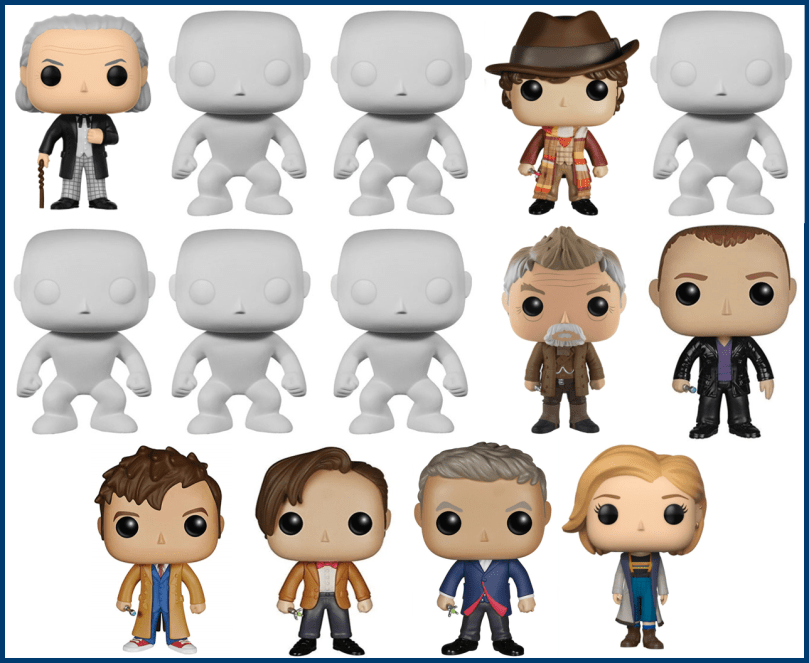
Funko has released 23 figures based on the Doctor, but only 8 Doctors overall. The product line is heavily weighted toward the revival era, with only two Doctors and two companions representing the first 42 years of the franchise’s existence. Technically, Davros could represent the lone enemy from the classic years, but he has also appeared in the revival era which blunts the impact of that figure’s representation.

The problem is that we are missing six Doctors for a complete lineup of the show’s regenerating hero.

Funko has had problems completing lines in the past: Back when they had the Star Trek license, they created Pops for The Original Series, The Next Generation, and Star Trek Beyond. They completed the Enterprise crew for Beyond, but fell short with Next Gen and The Original Series. Specifically, they left out Beverly Crusher and Katherine Pulaski (both women and doctors) and only Kirk, Spock, and Scotty made the cut from the original NCC-1701. The rest of the franchise – Deep Space NineVoyagerEnterprise, the other twelve movies – didn’t get any love at all.

It’s not the only franchise line to fall to the wayside, either.

It would be understandable if Funko didn’t have the money or resources to complete the Doctor Who line, but that doesn’t jive with how they treat other popular franchises. Consider the various chrome sets (Marvel, DC, Star Wars, etc), the flocked versions, the sparkly “Diamond” glitter versions, the Rainbow Batman set (commemorating Batman’s 75th anniversary and Detective Comics #241), the DC Comics Lantern figures (Wonder Woman, Superman, and others became members of various Lantern Corp for a spell, prompting new Funko Pop molds for collectors), and the new Star Wars Skywalker Saga sets (which are really just repainted leftovers).

It also doesn’t pass the smell test when considering how many are coming out this year alone – an entire Mortal Kombat line, Miami ViceThe Dark Crystal, more Star WarsFrozenOverwatch, and the list goes on – and how many are stacked up on store shelves in the meantime. Just like Beanie Babies, these things seemingly reproduce like tribbles.

The evidence is clear. After an impressive debut followed by lackluster follow-up and lack of representation for classic fans, it’s apparent that Funko is failing fans of Doctor Who.


So, what can they do to fix it?

The obvious solution is to create the figures, but given that the market is saturated and (subsequently) distribution is scattershot, big-box brick-and-mortar storefronts are not the best option. I wouldn’t recommend convention exclusives either, since that approach tends to overinflate the price for anyone who cannot make the trip to San Diego, New York, Seattle, or other major conventions. I got lucky when shopping for the First Doctor because I found one on eBay that was missing the NYCC sticker and had a dented box, but not everyone has that.

Funko has worked with widely accessible storefronts such as Hot Topic, GameStop, Entertainment Earth, and Amazon. One option is to sell the missing Doctors through one of those more focused retailers. Another option is to use the online Funko Shop to “pre-order” the figures and judge how many to make. Six months later, distribute the figures to the buyers with a few left over for stragglers (which can by sold via the first option).

If this proves profitable, it could open the way for more companions, more monsters, and more Doctor Who in the Funko line.

Either way, the hole in the collection is painfully obvious. Doctor Who shouldn’t go the way of Star Trek or other incomplete franchise lines. It is a cornerstone and gold standard for science fiction television, and each of the incarnations of the titular hero has a dedicated fan following.

Funko should respect that history and those fans. They should complete the timeline of the Doctor.
cc-break

Culture on My Mind is inspired by the weekly Can’t Let It Go segment on the NPR Politics Podcast where each host brings one thing to the table that they just can’t stop thinking about.

For more creativity with a critical eye, visit Creative Criticality.

Culture on My Mind – Toys, Collecting, and a Review of Hasbro Pulse

Culture on My Mind

Culture on My Mind
Toys, Collecting, and a Review of Hasbro Pulse
July 12, 2019

I don’t talk a lot about my toy collecting hobby except when I’m hanging out with Michael French and the RetroBlasting crew. I had quite a few toys as a kid, mostly consisting of small LEGO sets, die-cast and plastic military aircraft, and a plethora of Matchbox and Hot Wheels cars. I had a couple of playsets – specifically the 1979 Hot Wheels foldaway service center and the Racing Champions SkyBirds USS Enterprise aircraft carrier – but playsets were bulky and expensive, so most of my play time was emulating car jumps from ’80s television shows like The Dukes of Hazzard, Knight Rider, and The Fall Guy on the living room furniture.

I still have the Enterprise, though it is well-loved and the box is hanging together by a thread. I wish I still had the service center playset.

My sister and I got part of the first wave from the Teenage Mutant Ninja Turtles action figure line circa 1988, but we were limited to the four turtles, April, and Splinter. I remember the weapons being easy to lose and our enemies being invisible forces hiding around the couch. The Foot Clan are sort of ninjas after all, right?

My grandmother found two G.I. Joe figures in her neighborhood – a 1983 Blowtorch and a 1984 First Sergeant Duke, both stripped of accessories – and she kept them for me to play with at her house. I literally had no idea what they were until last year when I recognized them in Michael French’s collection. I also had a few vinyl toys like Gizmo from Gremlins, one of the small the LJN E.T. figurines, a Playmates Darkwing Duck figure that I won from a local TV station, and a whole bunch of things over the years that I know I’m forgetting about… but the point of this introduction is that I didn’t have access to a lot of action figures when I was growing up.

When Hasbro acquired the Star Wars license in the 1990s and released the new Power of the Force (POTF2) line, I spent a good portion of my salary as a part-time elementary school custodian on picking up everything with a 3.75″ figure in it. Part of it was the ignorant belief that these toys would be just like the vintage Star Wars line and be worth gazillions of dollars within the next twenty years. The other part was a self-taught course in budgeting, bargain hunting, and personal responsibility.

Long story short, I stopped collecting one of everything mint-on-card around the same time that Attack of the Clones came out. I finally picked up my collection from my parents a couple of years ago and started paring it down. The philosophy was simple: Those toys were doing no one any good inside giant Tupperware totes, so I needed to enjoy them or get rid of them.

I decided on both. I chose certain characters to keep for future display and the rest have been trickling onto eBay ever since. (Check the Tip Jar page for the link.)

To that end, I was pretty excited about the action figure news from Star Wars Celebration 2019. When they came available on Hasbro Pulse, the toy company’s online shopping portal, I jumped on the chance to order them.

Let’s take a minute here to talk about my experience with toy collecting and shopping.

Since 1995, I have enjoyed the toy hunt. It’s a sport that involves bouncing from store to store, walking the aisles, and hoping that the figures you want are dangling from the pegs. Before the internet was so widespread, it was a test of patience and luck amplified by magazines like ToyFare, which was Robot Chicken before Robot Chicken was Robot Chicken.

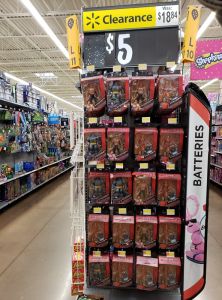
The biggest problem I have in the internet age is distribution. I watch the news about new Star Wars and Marvel releases, but I often have problems finding the figures after the published release dates for each wave. Some of them – usually the ones that I don’t want – have flooded the toy shelves, but others never materialize. To wit:

  • I bought the Black Series Captain Rex at Toylanta 2018 because it never arrived at the mass of Walmarts and Targets in my area. It was found en masse at Ross stores in the first quarter of 2019.
  • I found one of the Ahsoka Tano releases at my local Target. The rest were eBay and Amazon purchases.
  • The Black Series Qui-Gon Jinn only appeared at the ThinkGeek store that is nearly an hour away.
  • I finally found the Black Series Chirrut Îmwe and Baze Malbus at Five Below, a local discount store, well after Rogue One hit Blu-ray.
  • The Walgreens exclusives are hit and miss.
  • The GameStop exclusives are consistent and readily available. They also have new waves earlier than most, but they’re also more expensive.
  • In the week or two before the release of Spider-Man: Far From Home, I found zero Legends hero figures on store shelves.
  • Walmart’s Captain Marvel exclusive, the Binary Mode figure, never arrived at the five stores in my area. Instead, a friend and I both paid nearly double the shelf price to order them internationally.
  • Target’s Captain Marvel exclusive, the Starforce figure, materialized months after the movie premiered. A friend who works at Target later elaborated on the problem: The box of four figures all comes in under the same number. They don’t know until they open the box which figures are in the batch, or which box has the exclusive figure. This is determined at the manufacturer level, not the store level.

I think a lot of this has to do with supply and demand. Hasbro puts a lot of figures on shelves at once, and not all of them sell at the same rate. But, since a store cannot just order more of the high demand ones and less of the low demand ones, they’re hesitant to put more undesirable products on the shelf just to move an extra item or two.

For some reason, the DC Comics figures are usually on time and in the right proportions to minimize stock on clearance shelves. Figures for Shazam!, Aquaman, and the new Multiverse line are on shelves and moving at a decent pace. Very few of them even get to the clearance aisle.

The exceptions, of course, are the Multiverse figures from the time of Batman v. Superman: Dawn of Justice‘s theatrical release. Those things breed like roaches on the pegs, and not even a rock-bottom clearance sale could move them out of one South Carolina Walmart that I visited.

The McFarlane Toys Game of Thrones line is another shining example of success: There are very few left on the pegs, and I have seen none of them on clearance. The majority of the peg-warmers are Jon Snow figures. Arya Stark has (fittingly) vanished into the night and the Night King is a lonely spirit if you can find him.

It’s obvious that the problem is with Hasbro.

I’ll come back to that later, but it’s a problematic statement to make in some collecting circles. Michael French regularly and objectively makes points like these and many others, and with similar regularity, he gets attacked by collectors who think he’s just out to take down a major toy manufacturer. Except that critics have nothing to gain from making these arguments, and we’re certainly not competing for any kind of market share.

We’re not even in the same market space. Michael reviews toys and pop culture on YouTube, and I review pop culture in writing and podcasts.

But, I digress.

I was excited about four of the figures announced at Star Wars Celebration 2019 that were available on Pulse. My wife is ecstatic over astromech heroes, so the Black Series Chopper (from Star Wars Rebels) and the new dingy Vintage Collection R2-D2 were easy to say yes to. Ezra Bridger (Rebels) represents a large hole in my character collection from that fantastic series, and I am one of “those fans” who actually liked The Last Jedi, so the astral projection form of Luke Skywalker was nice to see. When they came available, I decided that it was a win-win: First, since the figure waves are unpredictable in stores, it guaranteed that they would come to my collection; Second, it offered me a chance to try Hasbro Pulse.

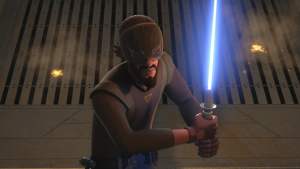
(Aside: The Star Wars Rebels Black Series line still has a huge hero hole with the absence of Zeb Orrelios. I’m also holding out for Ezra and Kanan from the later seasons. I think Kanan became a far better character after he lost his eyesight.)

I got notified that the figures were shipping, as promised, in the first week of July. The Black Series figures arrived first, followed by the Vintage Collection figures soon after.

There were quite a few advantages to using Hasbro Pulse. The pre-order system was easy to use, and they limit purchase quantities to prevent people from gaming the system and scalping fellow collectors.

(Of course, Hasbro is responsible for creating a scalper’s market with super limited releases like the Retro Collection, but again, I digress.)

Pulse’s prices on the six-inch figures are comparable to Target’s price points – that’s typically between Walmart and Walgreens/GameStop – but the 3.75″ figures are closer to the Walgreens/GameStop level. At some point, I was able to get free shipping based on my purchase total, but nothing on the site indicates what that threshold is. I’m assuming that it is around $50, but it should be more clearly marked on the site.

The shipping boxes were fairly well packed and protected, but that also opens the door for the downsides to the Pulse experience. The first is that each figure was shipped its own box, which seems quite wasteful in terms of cardboard, packing materials, and FedEx manpower. There are pictures in various collecting groups from people that bought entire waves of new figures and ended up with plenty of spare beds for a clowder of cats.

There’s also a question of quality control. I’m not a mint-on-card/mint-in-box collector, but I’d be upset if I was since the Crait Luke came with a bent and creased card. Unless it rolled off the line damaged, which is a serious QC problem from square one, then it was bent in shipping.

(One more aside: It wouldn’t surprise me if it was a quality control problem given how many figures my friend and co-host Gary Mitchel has found that are in the wrong boxes. Unless Director Krennic has been moonlighting as a Scarif Stormtrooper, there’s no excuse for finding that many mispackaged figures.)

Overall, using Hasbro Pulse was a good experience. If there is another must-have figure or two, then I’ll probably use them again. But I have to address the elephant in the room here: The service does nothing to incentivize Hasbro to fix their distribution models. The company still makes money by giving collectors a faster, guaranteed avenue for buying toys, and they make even more by offering a $50 per year “premium” plan that provides free continental shipping, access to promotions and contests, and select extras at conventions and more.

Hasbro Pulse doesn’t fix the problem of not having new figures on shelves, nor does it fix the problem of supply and demand for store shoppers.

Hasbro could easily have it both ways. When I talk to toy collectors about their childhoods, most of their original toys were bought by their parents. I believe that Hasbro could bring back that feeling for today’s kids by selling the mainstream 3.75″ lines on store shelves and putting their more collector-driven lines on Pulse.

Look at the quality, the lines, and the price points. With their limited articulation and lower prices, the smaller scale figures are meant to be played with. The smaller figures are more timely – the shelves are filled with 3.75″ scale toys for recent movies (Avengers: Endgame) and television shows (Star Wars: Resistance) – and more accessible for smaller hands. This scale is built for impulse purchases.

The Black Series and Marvel Legends lines are designed for collectors. They have more articulation and posing potential, they have better paint jobs (in general), and they command the higher $20 price point. Hasbro Pulse is the perfect venue for more collector-focused offerings.

This is basic marketing. Build a supply, serve the demand. I don’t know many kids or adults who are excited about a comic-accurate Malekith, Black Bolt, or Namor. If Hasbro still wants to sell a piece of the premium market on shelves, they could limit them to the characters that kids see on screens. People will want a Spider-Man toy after they leave Far From Home: Make it easy to get one.

Or, even better, figure out how other companies are doing it right. Build a supply, serve the demand. Basic marketing.

Look, I’m far from a “Hasbro Hater.” Being critical about the company doesn’t mean that I’m trying to destroy them or that I don’t appreciate what they currently do. It just means that I’m a frustrated pop culture fan and collector, and if my discussions with other toy fans are any indication, I’m not alone.

I want to find the figures I want without resorting to discount stores or online scalpers. I want an influential and nearly century-old toy company to be better.

I want the collecting hobby to be fun, not frustrating.
cc-break

Culture on My Mind is inspired by the weekly Can’t Let It Go segment on the NPR Politics Podcast where each host brings one thing to the table that they just can’t stop thinking about.

For more creativity with a critical eye, visit Creative Criticality.

Culture on My Mind – Shelving the Star Wars Expanded Universe Makes Sense

Culture on My Mind

Culture on My Mind
Shelving the Star Wars Expanded Universe Makes Sense
May 4, 2014

I’ve been thinking about the recent shake-up in the Star Wars expanded universe, and it’s taken me some time to really sort out my thoughts both in relation to my emotions and good business sense. I agree with the decision, and believe that it makes sense to do it.

Part I – The Books and Me

It seems fitting that this decision was made public around this time of year. I was introduced to the post-Return of the Jedi adventures of Luke, Leia, Han, and Chewie on Easter Sunday of 1992. My parents surprised me with a paperback copy of the Star Wars Trilogy 10th anniversary omnibus, which combined the novelizations of each of the original films, along with a paperback copy of Timothy Zahn’s Heir to the Empire. They realized that I had a deep attachment to the original trilogy, which I had only seen on well-loved and rewind-worn pan-and-scan VHS tapes at that time, and they fed that passion with what they understood to be the continuing story. They were right on the money, as confirmed by the hardcover version’s inner jacket blurb.

The three Star Wars films form a spectacular saga of bold imaginations and high adventure. But the stories of its characters did not end there. Now for the first time, Lucasfilm Ltd., producer of the Star Wars movies, has authorized the continuation of this beloved story. In an astounding three-book cycle, Timothy Zahn continues the tale of Luke Skywalker, Princess Leia, Han Solo, and the other characters made world famous by Star Wars, as he brilliantly expands upon George Lucas’s stunning vision, “a long time ago in a galaxy far, far away.”

I rapidly devoured the original trilogy omnibus, and relished the differences between the novels and the films. Obi-Wan knew about ducks, Luke’s uncle Owen was really Kenobi’s brother, and Vader was created when Anakin and Obi-Wan battled on the edge of a volcano. It was a wealth of information that expanded beyond the cinematic journey, and it primed me for the more dedicated reading of the continuing saga. I say dedicated, but I don’t mean meticulous; I flew through Heir to the Empire and loved every minute. In June of 1992, I reserved a copy of the second book, Dark Force Rising, at my local library and flew through it as well. It was a long year until The Last Command was released, and after that epic conclusion, I satiated my desire for more Star Wars by reading Brian Daley’s The Han Solo Adventures, L. Neil Smith’s The Lando Calrissian Adventures, and Alan Dean Foster’s Splinter of the Mind’s Eye.

It didn’t matter to me how bad Splinter was because, by the Maker, I had new Star Wars in my hands. The Truce at Bakura, The Courtship of Princess Leia, and Kevin J. Anderson’s Jedi Academy trilogy started me down a path of buying the books and comic trade paperbacks when they came out and enjoying every one of them. My palette has matured a bit since then, and stories like The Crystal Star (ah, Waru) are hardly ever revisited by my eyes, but at the time, they were precious, precious gold.

Despite my love for the franchise, it became apparent to me that the universe was getting too large too fast. At that point, stories in what became the Star Wars Expanded Universe (SWEU) ranged from approximately 5,000 years before to around 20 years after A New Hope. One person at Lucasfilm, Leland Chee, was charged with keeping the chronology straight and smoothing over any conflicts amongst the novels, comics, video games, television series, and movies. He did an admirable job, and it’s one I don’t envy.

By 1994, Lucas Licensing had defined what made up Star Wars canon, and publicized it in issue 23 of Star Wars Insider, the fan club’s magazine.

Gospel, or canon as we refer to it, includes the screenplays, the films, the radio dramas and the novelizations. These works spin out of George Lucas’ original stories, the rest are written by other writers. However, between us, we’ve read everything, and much of it is taken into account in the overall continuity. The entire catalog of published works comprises a vast history—with many off-shoots, variations and tangents—like any other well-developed mythology.

To help sort out the chronology, multiple tiers were established between 1996 and 2000 to solve conflicts between stories. Anything that directly involved George Lucas, such as the films, their novels and radio adaptations, and statements from Lucas himself trumped everything. Under that were the television shows, followed by the combination of novels, comics, and games. As the prequel movies dawned and Lucasfilm started developing The Clone Wars television series, more and more continuity problem started to crop up and it was apparent that something had to give. In the time-honored tradition of the SWEU, George Lucas won.

Part II – The Dawn of a New Era

The decision on April 25th to essentially shelve everything except the six core films and The Clone Wars isn’t a big surprise. In fact, it’s been a long time coming. As much as George Lucas has changed his mind on sequel films – at first it was a twelve-film series, then nine, then six. As recently as May 2008, he told TotalFilm that, “There will definitely be no Episodes VII–IX” – he has been consistent since 2001 that his vision trumps everything else. During an interview on the official site in March 2008, he explained his point of view.

It’s a certain story about Anakin Skywalker and once Anakin Skywalker dies, that’s kind of the end of the story. There is no story about Luke Skywalker, I mean apart from the books. But there’s three worlds: There’s my world that I made up, there’s the licensing world that’s the books, the comics, all that kind of stuff, the games, which is their world, and then there’s the fans’ world, which is also very rich in imagination, but they don’t always mesh. All I’m in charge of is my world. I can’t be in charge of those other people’s world, because I can’t keep up with it.

Fans have been complaining that this move invalidates the established canon, but what really has been canon before now? The Thrawn trilogy was “authorized” as a continuation, and multimedia events like Shadows of the Empire and The Force Unleashed had some direction from George Lucas, but aside from that everything else seems to have been handled by a licensing department.

You know what else fits this pattern? The Star Trek novels. The Marvel Cinematic Universe. 1978’s Superman film. Any of the various DC and Marvel reboots. All of them violate the established “canon” of the material that came before, and yet they exist and are still enjoyed. Just like those examples, and countless other franchise tie-ins, the stories established by the SWEU still exist. Disney and Lucasfilm aren’t burning every copy they can find or raiding public libraries for toilet paper. In fact, the existing SWEU is being republished as the “Star Wars Legends” series to guarantee their availability for the future.

Star Wars fans can learn a very valuable lesson from Star Trek fans, as author Keith R. A. DeCandido explained in his comments on this whole affair.

Two of the most highly regarded Trek novels are Imzadi and Federation. The former novel was heavily contradicted by a TNG episode (“Second Chances”); the latter was totally nuked by the movie First Contact. Yet the two novels continue to be well regarded — and so does that episode and that movie, even though they contradict each other. If you think that contradictory versions of stories in the same universe ruins one of the contradictory ones, then you don’t understand how storytelling works.

I totally get the concept of having a huge personal investment in this franchise. I owned every novel in the series before the Navy lost half of my household goods shipment back in 2005. That incident hurt, but only because of the material loss. My consolation was that the books were still out there, and someone would be selling them when I was ready to rebuild.

More importantly, this move guarantees the future of the Star Wars franchise, which cost Disney over $4 billion. That’s one hell of an investment, and they needed a way to make it accessible to general audiences again, including the newest generation of children who haven’t experience the galaxy far, far away. As much as we cannot expect audiences to read every book between Return of the Jedi and Episode VII, we cannot expect scriptwriters and directors to limit their vision to decades of contradictory stories. Those limitations would only hinder the movie and hurt the investment.

Take the example of Disney’s other major acquisition, the Marvel franchise, and their approach to the Marvel Cinematic Universe. General audiences don’t need to read the comics to get the stories, and if they need to know something, it’s presented to them. If you haven’t had a chance to read the Bloomberg Businessweek article about the MCU, I highly recommend it. There are a lot of parallels between Marvel and Star Wars.

Before this announcement, I was optimistic but skeptical about the sequel movies. There was just too much story to dance around if the EU was left intact, and I wasn’t keen on the movies being cleverly wedged between chapters or pages of a novel just to make a timeline work. This move tells me that Disney is serious about their investment and the vision they want to bring to audiences. By making this story easily accessible to everyone, which means removing the stumbling block of the now Legends stories, Disney and Lucasfilm win. That means that Star Wars fans win.

Disney and Lucasfilm helped reignite the magic of my childhood. Warm up the Falcon, Chewie, and calculate the hyperspace jump to December 2015. I’m ready to believe again. Star Wars truly is forever.

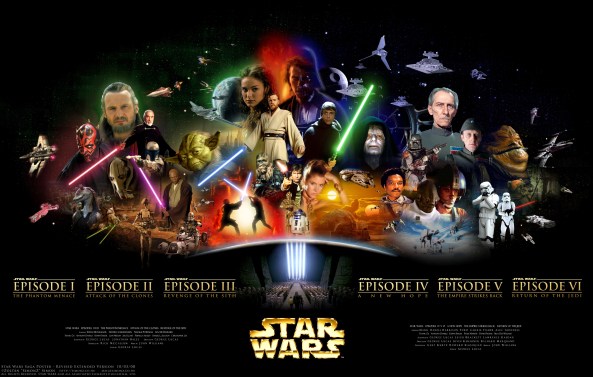
Star Wars Saga Poster by SimonZ

cc-break

Culture on My Mind is inspired by the weekly Can’t Let It Go segment on the NPR Politics Podcast where each host brings one thing to the table that they just can’t stop thinking about.

For more creativity with a critical eye, visit Creative Criticality.