Culture on My Mind Thoughts on Legends April 22, 2016
I’m sure you’ve seen the news. A group of Star Wars fans who want Lucasfilm to continue the Legends/Expanded Universe stories have purchased a billboard in San Francisco to raise awareness and place their demands in the public sphere. After multiple attempts at petitioning online and through letter-writing campaigns, this crowd-funded purchase was their next step. If the news reports are any indication, it got noticed. I know at least one Lucasfilm employee saw it.
Sincerely, congratulations on executing a successful crowd-funding campaign, although I believe that $5000 would gone a lot further as a group donation to Make-A-Wish or Force for Change, both of which are friends of the Star Wars brand. But, I digress.
I once had the greatest of respect for the Bring Back Legends petitioners. I still am a huge fan of the Legends/Expanded Universe stories because that is where I really dove into Star Wars after discovering the movies. I was there for Heir to the Empire – there should be a t-shirt for that – and for pretty much everything that followed, for better or for worse. I recognized how futile the overall campaign was in the post-buyout era, what with the marketing challenges and high potential for general audience confusion, but these guys were super passionate in their fandom.
They still are. That’s part of the problem.
Somewhere along the line, they started becoming aggressive toward fans and artists. They started harassing my friends and fellow fans, including threats of bodily harm, rape, and death. That aggression escalated when The Force Awakens premiered, resulting in some in this movement spoiling plot points on public sites until Lucasfilm relented. This actually caused some sites, including the official Star Wars Books page on Facebook, to shut down for a time because they couldn’t stop the flood.
The Legends movement became the face of ruining the Star Wars experience for all fans because it wasn’t the right canon.
Yeah, it’s the internet. No, it’s not right.
It wasn’t every Legends supporter, but this echoes GamerGate and the Mens Rights Activist movements (among countless others) in that a very vocal extremist minority has become the movement’s active voice. I’m sorry, but perception is reality, and right now, this movement is perceived as being a bunch of bullies.
I don’t stand for that in fandom. It has poisoned their efforts, and it has poisoned Star Wars fandom overall. It’s even driving away some of our best ambassadors.
As a Legends/EU fan, I share Chuck Wendig‘s sincere hope that the Legends movement gets some resolution. I firmly believe that more Star Wars work means more great mythology to enjoy, but I cannot find it in my heart to support the Legends movement because of this activity. They need to find a way to clean their house, excise the cancer, and make amends to fandom at large.
Star Wars is still forever, and it should be for everybody.
Culture on My Mind is inspired by the weekly Can’t Let It Go segment on the NPR Politics Podcast where each host brings one thing to the table that they just can’t stop thinking about.
Culture on My Mind Shelving the Star Wars Expanded Universe Makes Sense May 4, 2014
I’ve been thinking about the recent shake-up in the Star Wars expanded universe, and it’s taken me some time to really sort out my thoughts both in relation to my emotions and good business sense. I agree with the decision, and believe that it makes sense to do it.
Part I – The Books and Me
It seems fitting that this decision was made public around this time of year. I was introduced to the post-Return of the Jedi adventures of Luke, Leia, Han, and Chewie on Easter Sunday of 1992. My parents surprised me with a paperback copy of the Star Wars Trilogy 10th anniversary omnibus, which combined the novelizations of each of the original films, along with a paperback copy of Timothy Zahn’s Heir to the Empire. They realized that I had a deep attachment to the original trilogy, which I had only seen on well-loved and rewind-worn pan-and-scan VHS tapes at that time, and they fed that passion with what they understood to be the continuing story. They were right on the money, as confirmed by the hardcover version’s inner jacket blurb.
The three Star Wars films form a spectacular saga of bold imaginations and high adventure. But the stories of its characters did not end there. Now for the first time, Lucasfilm Ltd., producer of the Star Wars movies, has authorized the continuation of this beloved story. In an astounding three-book cycle, Timothy Zahn continues the tale of Luke Skywalker, Princess Leia, Han Solo, and the other characters made world famous by Star Wars, as he brilliantly expands upon George Lucas’s stunning vision, “a long time ago in a galaxy far, far away.”
I rapidly devoured the original trilogy omnibus, and relished the differences between the novels and the films. Obi-Wan knew about ducks, Luke’s uncle Owen was really Kenobi’s brother, and Vader was created when Anakin and Obi-Wan battled on the edge of a volcano. It was a wealth of information that expanded beyond the cinematic journey, and it primed me for the more dedicated reading of the continuing saga. I say dedicated, but I don’t mean meticulous; I flew through Heir to the Empire and loved every minute. In June of 1992, I reserved a copy of the second book, Dark Force Rising, at my local library and flew through it as well. It was a long year until The Last Command was released, and after that epic conclusion, I satiated my desire for more Star Wars by reading Brian Daley’s The Han Solo Adventures, L. Neil Smith’s The Lando Calrissian Adventures, and Alan Dean Foster’s Splinter of the Mind’s Eye.
It didn’t matter to me how bad Splinter was because, by the Maker, I had new Star Wars in my hands. The Truce at Bakura, The Courtship of Princess Leia, and Kevin J. Anderson’s Jedi Academy trilogy started me down a path of buying the books and comic trade paperbacks when they came out and enjoying every one of them. My palette has matured a bit since then, and stories like The Crystal Star (ah, Waru) are hardly ever revisited by my eyes, but at the time, they were precious, precious gold.
Despite my love for the franchise, it became apparent to me that the universe was getting too large too fast. At that point, stories in what became the Star Wars Expanded Universe (SWEU) ranged from approximately 5,000 years before to around 20 years after A New Hope. One person at Lucasfilm, Leland Chee, was charged with keeping the chronology straight and smoothing over any conflicts amongst the novels, comics, video games, television series, and movies. He did an admirable job, and it’s one I don’t envy.
By 1994, Lucas Licensing had defined what made up Star Wars canon, and publicized it in issue 23 of Star Wars Insider, the fan club’s magazine.
Gospel, or canon as we refer to it, includes the screenplays, the films, the radio dramas and the novelizations. These works spin out of George Lucas’ original stories, the rest are written by other writers. However, between us, we’ve read everything, and much of it is taken into account in the overall continuity. The entire catalog of published works comprises a vast history—with many off-shoots, variations and tangents—like any other well-developed mythology.
To help sort out the chronology, multiple tiers were established between 1996 and 2000 to solve conflicts between stories. Anything that directly involved George Lucas, such as the films, their novels and radio adaptations, and statements from Lucas himself trumped everything. Under that were the television shows, followed by the combination of novels, comics, and games. As the prequel movies dawned and Lucasfilm started developing The Clone Wars television series, more and more continuity problem started to crop up and it was apparent that something had to give. In the time-honored tradition of the SWEU, George Lucas won.
Part II – The Dawn of a New Era
The decision on April 25th to essentially shelve everything except the six core films and The Clone Wars isn’t a big surprise. In fact, it’s been a long time coming. As much as George Lucas has changed his mind on sequel films – at first it was a twelve-film series, then nine, then six. As recently as May 2008, he told TotalFilm that, “There will definitely be no Episodes VII–IX” – he has been consistent since 2001 that his vision trumps everything else. During an interview on the official site in March 2008, he explained his point of view.
It’s a certain story about Anakin Skywalker and once Anakin Skywalker dies, that’s kind of the end of the story. There is no story about Luke Skywalker, I mean apart from the books. But there’s three worlds: There’s my world that I made up, there’s the licensing world that’s the books, the comics, all that kind of stuff, the games, which is their world, and then there’s the fans’ world, which is also very rich in imagination, but they don’t always mesh. All I’m in charge of is my world. I can’t be in charge of those other people’s world, because I can’t keep up with it.
Fans have been complaining that this move invalidates the established canon, but what really has been canon before now? The Thrawn trilogy was “authorized” as a continuation, and multimedia events like Shadows of the Empire and The Force Unleashed had some direction from George Lucas, but aside from that everything else seems to have been handled by a licensing department.
You know what else fits this pattern? The Star Trek novels. The Marvel Cinematic Universe. 1978’s Superman film. Any of the various DC and Marvel reboots. All of them violate the established “canon” of the material that came before, and yet they exist and are still enjoyed. Just like those examples, and countless other franchise tie-ins, the stories established by the SWEU still exist. Disney and Lucasfilm aren’t burning every copy they can find or raiding public libraries for toilet paper. In fact, the existing SWEU is being republished as the “Star Wars Legends” series to guarantee their availability for the future.
Star Wars fans can learn a very valuable lesson from Star Trek fans, as author Keith R. A. DeCandido explained in his comments on this whole affair.
Two of the most highly regarded Trek novels are Imzadi and Federation. The former novel was heavily contradicted by a TNG episode (“Second Chances”); the latter was totally nuked by the movie First Contact. Yet the two novels continue to be well regarded — and so does that episode and that movie, even though they contradict each other. If you think that contradictory versions of stories in the same universe ruins one of the contradictory ones, then you don’t understand how storytelling works.
I totally get the concept of having a huge personal investment in this franchise. I owned every novel in the series before the Navy lost half of my household goods shipment back in 2005. That incident hurt, but only because of the material loss. My consolation was that the books were still out there, and someone would be selling them when I was ready to rebuild.
More importantly, this move guarantees the future of the Star Wars franchise, which cost Disney over $4 billion. That’s one hell of an investment, and they needed a way to make it accessible to general audiences again, including the newest generation of children who haven’t experience the galaxy far, far away. As much as we cannot expect audiences to read every book between Return of the Jedi and Episode VII, we cannot expect scriptwriters and directors to limit their vision to decades of contradictory stories. Those limitations would only hinder the movie and hurt the investment.
Take the example of Disney’s other major acquisition, the Marvel franchise, and their approach to the Marvel Cinematic Universe. General audiences don’t need to read the comics to get the stories, and if they need to know something, it’s presented to them. If you haven’t had a chance to read the Bloomberg Businessweek article about the MCU, I highly recommend it. There are a lot of parallels between Marvel and Star Wars.
Before this announcement, I was optimistic but skeptical about the sequel movies. There was just too much story to dance around if the EU was left intact, and I wasn’t keen on the movies being cleverly wedged between chapters or pages of a novel just to make a timeline work. This move tells me that Disney is serious about their investment and the vision they want to bring to audiences. By making this story easily accessible to everyone, which means removing the stumbling block of the now Legends stories, Disney and Lucasfilm win. That means that Star Wars fans win.
Disney and Lucasfilm helped reignite the magic of my childhood. Warm up the Falcon, Chewie, and calculate the hyperspace jump to December 2015. I’m ready to believe again. Star Wars truly is forever.
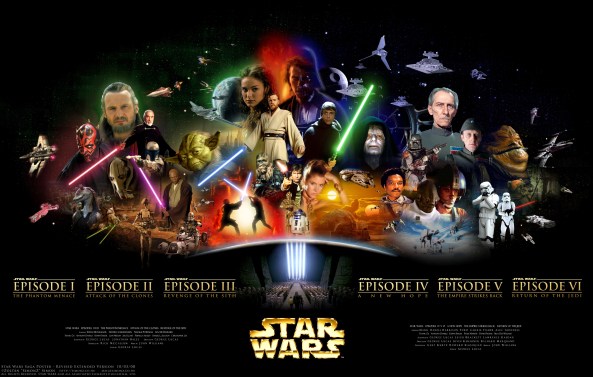
Star Wars Saga Poster by SimonZ
Culture on My Mind is inspired by the weekly Can’t Let It Go segment on the NPR Politics Podcast where each host brings one thing to the table that they just can’t stop thinking about.







 Creative Criticality