
Timestamp Special #2: Daleks’ Invasion Earth 2150 A.D.

Daleks’ Invasion Earth 2150 A.D.
(1966)

Timestamp S02 Daleks Invasion Earth 2150 AD


It’s seems to be a standard with the Peter Cushing Doctor’s stories to speed up the pacing while simultaneously upping the production budget. This story hits the key notes, but the faster pace removes a large amount of the tension. This is readily apparent in the sequence when the Dalek emerges from the river. That big reveal just isn’t as dramatic when it moves at a breakneck pace.

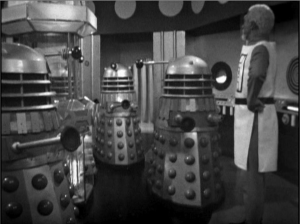
Production-wise, the Dalek ship had a good new look, and wasn’t too shabby for the era. The Robomen, however, look like rejects from an unholy union of CHiPs and THX 1138. Good lord, those get-ups were silly, but at least they get their three square meals of nutritious… jellybeans?

In character notes, the police officer Tom, who replaced Ian in the plot, was a major step up from his Cushing-era predecessor. It was nice to see Bernard Cribbins again, particularly in his first voyage in the police box before he joined David Tennant as Wilfred Mott. An equally fresh breath of air was Louise, the replacement for Barbara, who was much more engaging and intelligent than her predecessor.

On the downside: Dortmun, the wheelchair-bound scientist, died a very meaningless death in comparison to his television counterpart. There was no need for him to attack them or die since the van could have very easily outrun the Daleks, just as easily as it ran the blockade moments later.

Anyway, this rating won’t count toward anything since this isn’t an official Doctor.


Rating for The Dalek Invasion of Earth: 5/5
Rating for Daleks’ Invasion Earth 2150 A.D.: 3/5


While we’re on the subject, let’s talk about the Peter Cushing Doctor. I like Peter Cushing, but his Doctor would have been better served with original stories. When Hollywood tries reboots in the modern day, I try to divorce my brain from what came before and offer up the benefit of the doubt. However, these two projects were designed as a near reproduction of the two Hartnell stories, so it’s almost as if the producers are asking audiences to compare in hopes that they will find the bigger, flashier, and colorful exploits to be more engaging. Similar to Gus Van Sant’s shot-for-shot remake of the classic Psycho, these projects pretty much demanded to be compared to their source material.

Cushing’s Doctor isn’t Hartnell’s Doctor. He’s far less proactive, and far less analytical, but he’s superficially warmer and easier to relate to. He would have been a worthy successor on the actual show, but in near exact remakes, he was merely average.


Dr. Who and the Daleks – 3
Daleks’ Invasion Earth 2150 A.D. – 3

Cushing Doctor’s Weighted Average Rating: 3.00


Onward to Series Four.

UP NEXT – Doctor Who: The Smugglers


The Timestamps Project is an adventure through the televised universe of Doctor Who, story by story, from the beginning of the franchise. For more reviews like this one, please visit the project’s page at Creative Criticality.
Timestamp #21: The Daleks’ Master Plan

Doctor Who: The Daleks’ Master Plan
(12 episodes, s03e10-e21, 1965-1966)

Timestamp 021 The Daleks Master Plan

It’s a fantastic adventure with a lot of intriguing twists and turns that the Doctor and crew stumble into. It nicely capitalized on the thread started in Mission to the Unknown, even if it used the trope of missing an important message due to lack of attention. As a result, one special agent dies and the other almost does, and once again I issue the memo to the future to install annoying ringtones on the communication consoles. If in doubt, ask Nokia.

Meanwhile, Mavic Chen, the Guardian of the Solar System and unfortunate recipient of the yellowface treatment, sides with the Daleks over his own people after preaching about peace and harmony. Politicians never change, I suppose, however I did like how masterful he was in convincing his staff that otherwise faithful agents had betrayed the government.

I did like how Katarina, a girl from ancient Troy, was puzzled over modern medicine. Katarina’s motivations for remaining with the Doctor are unique: She believes that the Doctor is a god who can get her to heaven. It’s quite fitting, given the deus ex machina nature of the Doctor, and particularly chilling in the first-ever companion death in the series. It was an understandable move given how shallow Katarina’s character was, but I was just as shaken as the Doctor and I think it was because of the pure innocence Katarina embodied.

Actually stealing the key from the Doctor was an interesting way to keep TARDIS around, and while I appreciate the creativity in blocking the obvious solution to keeping our heroes out of trouble, I am growing a bit weary of it. The old switcheroo to get the Doctor into the meeting is creative, but how does no one notice the change in his gait or his feet?

I loved Sara Kingdom, a powerful take-charge female character, and her end was chilling as well. It’s a shame that the spin-off series that would have featured her never got off the ground. I also like the footprint effects for the invisible creature, which were impressive for a show of this era and budget.

The re-introduction of the Monk is a bit odd, and it seemed like filler to get the Daleks and Chen in position to chase the TARDIS. Luckily, the writers capitalized on the story point. He did have a suitable end, and as much as I want to see more of the Doctor’s people, I think I’m done with the Monk.

“The Feast of Steven” is an episode that should be excluded from this serial. It doesn’t add to the Dalek story, and the reconstruction doesn’t do it justice. I get what they were trying for since it was broadcast on Christmas Day, but it just doesn’t fit with the plot. On a minor note, the breaking of the fourth wall was a nice touch.

Also, Steven is still an idiot. Why, why, why(!), when he knows that there are Daleks around, would he call attention to himself by yelling for the Doctor? He’s ranking up there as my least favorite long-term companion.

A few minor notes: The cricket pitch scene was humorous, and reminded me of a similar scene in The Hitchhiker’s Guide to the Galaxy; The Doctor’s magic ring is a little too convenient for my tastes; and the final episode is a perfect conclusion to this epic story.

To wrap it up, I finally get the Daleks I know as they betray their allies in their true xenophobic and genocidal fashion.

Rating: 4/5  “Would you care for a jelly baby?”


UP NEXT – Doctor Who: The Massacre of St. Bartholomew’s Eve


The Timestamps Project is an adventure through the televised universe of Doctor Who, story by story, from the beginning of the franchise. For more reviews like this one, please visit the project’s page at Creative Criticality.


Timestamp #19: Mission to the Unknown

Doctor Who: Mission to the Unknown
(1 episode, s03e05, 1965)

Timestamp 019 Mission to the Unknown

This is a nice interlude that shows the audience a slice of time and space around the Doctor Who mythos in a completely Doctor-less story. In fact, the Doctor passes by the planet at the end of Galaxy 4, totally unaware that this threat is rising to meet him in short order. This is the kind of interweaving mythology and storytelling that I dig.

This episode is pretty much James Bond meets Doctor Who with the Space Security Service and their license to kill. I really want to see the proposed series that this small entry was supposed to springboard, as it would be fun to see the Service as they hunt Daleks across the universe. Since the Doctor usually has trouble defeating them, I really want to know how a group of humans would tackle the Daleks.

By the end, the Daleks are assembling a coalition of the greatest powers across seven galaxies to defeat Earth. It will be interesting to see how this plays out in the twelve-part The Daleks’ Master Plan. The Daleks seem significantly less xenophobic in the early years, but that may just be a ploy in order to destroy everyone all at once.


Rating: 4/5 – “Would you care for a jelly baby?”


UP NEXT – Doctor Who: The Myth Makers


The Timestamps Project is an adventure through the televised universe of Doctor Who, story by story, from the beginning of the franchise. For more reviews like this one, please visit the project’s page at Creative Criticality.


Timestamp Special #1: Dr. Who and the Daleks

Dr. Who and the Daleks
(1965)

Timestamp S01 Dr Who and the Daleks

It’s a very basic re-telling of The Daleks, but with a faster pace and a larger budget. In this version, Barbara and Susan are both granddaughters to the Doctor, who is a human inventor called Dr. Who in this interpretation. We never find out his first name, but his surname is Who. Ian Chesterton picks up the role of  comic (often slapstick) relief, giving this an air slightly less silly (and a bit more watchable) than 1967’s Casino Royale in comparison to the James Bond movie franchise.

The Thals are essentially goths with heavy eye shadow and blonde wigs to make them look alien, and the Daleks are… well… the Daleks. In color. With bigger head lamps that don’t actually sync very well with their voices. The Daleks also picked up some home decor tips from the 1960s and 70s, including lava lamps and some very James Bond-inspired control room sets.

It was really good to Peter Cushing in a role other than Grand Moff Tarkin from Star Wars, and this presentation has me on the lookout for other films of his.

Overall, with high production values but low story content, I grade this as an enjoyable interpretation, but with nowhere near the staying power of the source serial.

This rating won’t count toward anything since this isn’t an official Doctor. Onward to Series Three.


Rating for The Daleks: 4/5
Rating for Dr. Who and the Daleks: 3/5


UP NEXT – Doctor Who: Galaxy 4


The Timestamps Project is an adventure through the televised universe of Doctor Who, story by story, from the beginning of the franchise. For more reviews like this one, please visit the project’s page at Creative Criticality.

Timestamp #16: The Chase

Doctor Who: The Chase
(6 episodes, s02e30-e35, 1965)

Timestamp 016 The Chase

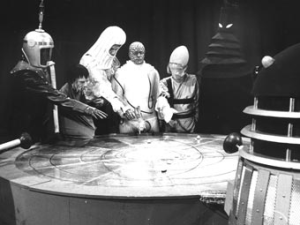
The serial has an interesting start with the whole Time-Space Visualizer bit, and it is a great plot device to start the whole “chase” part of The Chase, but they spent a lot of time on it. I did enjoy how The Beatles become “classical music” in the future.

My first thought when the TARDIS touched down on Aridius was, “welcome to Tatooine,” twin suns, desert, and all. The reveal with the Dalek rising from the sand is cool, but not as much as the one that emerged from the water in The Dalek Invasion of Earth. Overall, I quite liked the story with the Aridians. It struck me as kind of the reverse of the Atlantis myth. I also liked the birth of the TARDIS’s resistance to Dalek weapons, and the clever trap to escape Aridius.

The New York sequence was humorous, as was the Mary Celeste sequence. There are a lot of Dalek shells littered through history after this serial. I wonder if the BBC used various sets that they had available from other productions. This serial had a lot of various sets and it seems like it would be more expensive than the usual Doctor Who production.

The fabricated duplicate of the Doctor was interesting, and it did lead to a clever Doctor vs Doctor fight. The mutually assured destruction Dalek-Mechonoids face-off was also quite the sight.

I did get a little excited when the Doctor asked for his screwdriver. Alas, it was not a sonic version, but my I think my parents own a set just like it so it was a nice touchstone to my childhood. I also may have missed it, but I did wonder why our heroes even leave the ship until they had a solution to defeat the Daleks? Since the TARDIS is impervious to Dalek weapons, why not arrive, wait for the ship to recharge, then leave again?

Finally, this is where we say goodbye to Ian and Barbara. While it wasn’t as moving a farewell as Susan’s, it was still very touching to see them finally make it home. They seem very happy together, and it was touching to see the Doctor’s reaction to their departure. Under that gruff exterior, he really does care.


Rating: 4/5 – “Would you care for a jelly baby?”


UP NEXT – Doctor Who: The Time Meddler


The Timestamps Project is an adventure through the televised universe of Doctor Who, story by story, from the beginning of the franchise. For more reviews like this one, please visit the project’s page at Creative Criticality.


Timestamp #10: The Dalek Invasion of Earth

Doctor Who: The Dalek Invasion of Earth
(6 episodes, s02e04-e09, 1964)

Timestamp 010 The Dalek Invasion of Earth

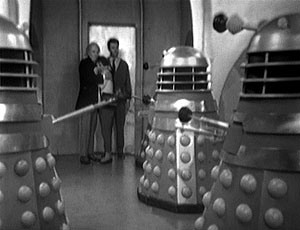
This was a great episode cover to cover, even with the dubious plot to steal an entire planet. Every one of the characters gets a chance to shine: The Doctor works through the puzzle in the Dalek jail cell, and helps Ian understand it as well; Barbara and Susan contribute to the fight at the Dalek saucer, which speaks volumes considering the lack of empowered women in 1960s science fiction; Barbara displays her intelligence and improv skills in stalling the Daleks by playing on their ignorance of human history; and Susan… oh, Susan.

Once again, Susan is yearning to grow, but is frustrated in trying to figure out how exactly to do so. David seems like a good mentor to help her find an identity and a place to thrive. The Doctor’s grudging respect for him points to this as well, and it was heart-wrenching to see him finally let his granddaughter go. It was interesting how much Susan grew on me in the short time she was on the show. After the credits rolled, I couldn’t press play to start the next serial because I felt like I needed time to say goodbye.

Even among the secondary characters, the development was great. Particularly, I point to the wheelchair-bound scientist’s sacrifice to test his Dalek killing grenade. It was very chilling, since he died in vain.

Some last notes on characters, it was good to see the Doctor back in his signature jacket. This episode also reinforced a couple of things with his character. First, he doesn’t kill unless under a direct threat, which will be interesting to track over this project. Second, he very clearly established that he prefers the name (title?) Doctor, and not the shortened form of Doc.

Finally, William Russell (Ian) sure does like testing the limits of the sets, doesn’t he? He keeps running headlong into set pieces that shouldn’t bend, but do under the power of his spirited no-holds-barred acting style.

Production-wise, this story has a lot of action and explosive effects. The location shoots make the story feel much more open, especially in the transit to the museum. The TARDIS looked rather beat up with the windows out of place. I loved seeing the Dalek coming out of the river at the end of the first episode. That innovative idea was so exciting to me, I can hardly imagine how kids felt when this serial first aired.

The one downside to me was the slyther. It is certainly an interesting creature, though it doesn’t make much sense that the Daleks would keep a pet given their desire to destroy everything not Dalek. But that is a minor quibble in this gem of an episode.


Rating: 5/5 – “Fantastic!”


UP NEXT – Doctor Who: The Rescue


The Timestamps Project is an adventure through the televised universe of Doctor Who, story by story, from the beginning of the franchise. For more reviews like this one, please visit the project’s page at Creative Criticality.

Timestamp #2: The Daleks

Doctor Who: The Daleks
(7 episodes, s01e05-e11, 1963-1964)

Timestamp 002 The Daleks

The Daleks is vastly better than the first serial. I simply loved how duplicitous the Doctor was with the fluid link, the tiny little piece of the TARDIS that drives the entire serial. This story can be broken down into two distinct parts, the first of which is the introduction of the Daleks and the escape of the TARDIS crew from their imprisonment. The second is the quest to save the Thals from being destroyed by the Daleks. The first is more engaging than the second and lays the groundwork for the Dalek mythology. What’s inside those metal machines? I’m glad they saved part of that mystery and didn’t try to show it with the show’s minimal budget. The second is still a good story with good characterizations, and while it is important to the overall serial, it does drag a little.


Rating: 4/5 – “Would you care for a jelly baby?”


UP NEXT – Doctor Who: The Edge of Destruction 


The Timestamps Project is an adventure through the televised universe of Doctor Who, story by story, from the beginning of the franchise. For more reviews like this one, please visit the project’s page at Creative Criticality.