
Culture on My Mind – Goodbye, Robin Williams

Culture on My Mind

Culture on My Mind
Goodbye, Robin Williams
August 13, 2014

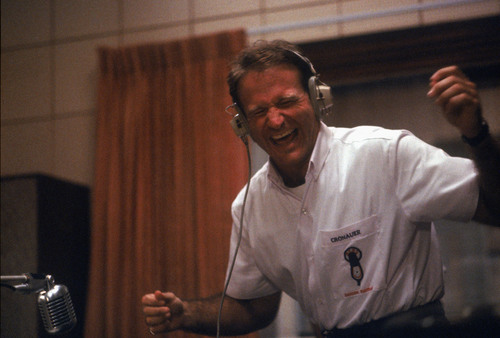
Good-Morning-Vietnam-robin-williams-25340806-500-338

Few celebrity deaths in recent times have hit me as hard that of Robin Williams. Unless I have met them in person, I usually see celebrities as people who entertain me for a living, but not as friends or family. It’s a nice touch to wave a greeting, shake hands, or even exchange a few words at a convention, but in general, they are strangers that I invite in for a few hours to make me laugh, cry, or think.

Robin Williams was different for me.

He made a mark with his unique style of original, lively, rapid-fire wit and delivery. His one-man stage shows were always fantastic – Live on Broadway had me in stitches for the entire duration – and his films were a centerpiece of my childhood’s cinematic awakening. He wasn’t family, but he was loved for the impacts he made on my life.

I first encountered him in Good Morning, Vietnam as he portrayed Airman Adrian Cronauer, a DJ for the Armed Force Radio Service. The film has always been my benchmark for his humor and zany voices, as well as his dramatic skills as the horrors of war caught up with Cronauer.

The second major slice of Williams in my life was in Disney’s Aladdin, where his mostly improvised on set lines were the lifeblood of one of my favorite entries from the Mouse House. The third biggest influence on my life from his catalog is the oft-maligned Hook, which grabbed me with the transition from Williams acting like a responsible adult to embracing the bang-a-rang child that is Peter Pan. Robin Williams made Hook work for me.

I adored his comedic turns in films like Happy Feet and Mrs. Doubtfire, and enjoyed his dramatic roles in Dead Poets Society and Good Will Hunting. I deeply enjoyed catching re-runs of Mork and Mindy, and even though his darker roles like One Hour Photo never clicked with me, I was glad to see him trying to break free of comedic typecasting.

Robin Williams made a major impact on both the industry and audiences, and the world is a much darker place without the light of his genius and wit. His death is both tragic and heartbreaking, and has come far too soon.

Godspeed, dearest genie, for you are free. You will be deeply missed.

May you rest in peace.

cc-break

Culture on My Mind is inspired by the weekly Can’t Let It Go segment on the NPR Politics Podcast where each host brings one thing to the table that they just can’t stop thinking about.

For more creativity with a critical eye, visit Creative Criticality.

Culture on My Mind – Protecting our Childhoods

Culture on My Mind

Culture on My Mind
Protecting our Childhoods
July 28, 2014
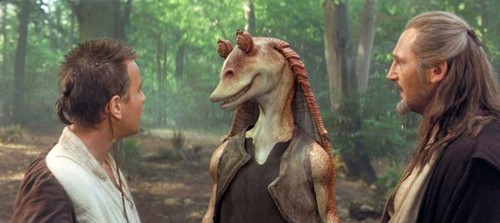
Jar-Jar-Binks-jar-jar-binks-25900310-500-223

If there’s one thing fans treasure, it’s the memories that their favorite franchises helped them develop. Science fiction is a metaphor for the human condition, and those memories have the power to develop fans into caring and productive members of society starting at childhood. It’s understandable how placing those personality building blocks into another creator’s hands can inspire immediate feelings of revulsion and fear, but it’s far less understandable how a reboot or reimagining is comparable to a violent personal violation.

Ferrell

Let’s presume for the moment that fans actually mean what they say in this case. Rape is a serious crime, and not simply through the books of law. Rape is a physical, mental, and emotional assault that has long-reaching effects in the victim’s life. Rape is a personal violation and an exercise of absolute power over the powerless.

The statistics on sexual assault are staggering. In the United States, another person is sexually assaulted every two minutes. One in six women are victims, as are one in thirty-three men. Sixty percent of sexual assaults are not reported to authorities, and a staggering ninety-seven percent of rapists will never spend a single day in jail for their crimes. Rape victims are three times more likely to suffer from depression, six times more likely to suffer from post-traumatic stress disorder (PTSD, the same disorder found in war veterans), and are four times more likely to contemplate suicide. The effects are so long-reaching that survivors of sexual assault who see references to rape are viscerally reminded of being helpless and powerless and completely at the mercy of a hostile (and often well-known or trusted) force.

There are cases of childhoods that were lived and survived around rape and incest. Those are real lives affected by real crimes, not the pettiness of a bad adaptation of a favorite Saturday morning cartoon. Using rape terminology to describe the latest attempts by Michael Bay, Will Ferrell, George Lucas, or J.J. Abrams to do their jobs trivializes the traumas of real rape victims, as if voluntarily watching the new Teenage Mutant Ninja Turtles adaptation matches in any way with being sexually assaulted.

Using rape terminology to describe feelings over a cherished franchise being revisited is disgusting and insensitive.

Next, let’s presume that when these fans say “rape,” they really mean “ruin.”

We live in an era of geek renaissance. Between the cultural awakening in the mainstream with The Big Bang Theory (one of the most popular panels at conventions) and the financial success of the Marvel Cinematic Universe, geek culture is being catered to with a golden tea set. It’s a digital era dominated by rebirth of cherished franchises once thought dead. Almost anything fans could want to revisit exists on physical or digital media, including BitTorrent. Linked childhood memories are only a click or two away.

Unless the evil creative of choice has a time machine (or fandom are collectively taking mind-altering drugs), both the memories and source material are safe. Quite honestly, the concern behind “ruining” a franchise or childhood memories is a hollow first-world problem dominated by a sense of narcissism and a false sense of ownership over entertainment productions.

As fans, we aren’t owed anything by creators. Hollywood and other entertainment venues are businesses, first and foremost, and those businesses have no contracts to make things exactly the way we want. Entertainment must appeal to the general audience first in order to earn a decent return on investment. If you don’t believe me, take a look at the domestic performances behind Pacific Rim, Sucker Punch, and Watchmen, all of which were niche films designed to attract genre fans and failed to meet their budgets.

Producers, writers, and directors have one job in their fields, and that is to make a generally accepted entertainment product that sells well. To that end, fans are consumers and nothing more, and are not even required to take in entertainment they don’t want to see. Everyone has the freedom to skip entertainment choices that don’t appeal to them.

The argument that modern creatives are ruining properties or memories is a false one. If childhood memories could be destroyed by a lackluster adaptation or vision, there are deeper problems with that childhood than entertainment choices. In that case, I recommend seeking help.

The worst part about either of the arguments about childhood memories being defiled is they both contribute to toxic cultural atmospheres. Both claims infer a personal assault, an act that never truly occurs against any of us, and transform a community based on enjoying, analyzing, and celebrating entertainment and its deeper meanings into a group of pessimists and cynics who tend to find the negative in every minute of film and paragraph of news.

The rape claims do even worse damage by trivializing the horrors of sexual assault and enhancing a culture that uses sexual assault as a punchline. In a community that decries racism, homophobia, and bullying, and is constantly haunted by the stigma of pedophilia and sexism, it is odd that we would so easily laugh off rape.

Science fiction and fantasy often speak of the need for tolerance and open-mindedness, and it is possible for genre fans to be critical of favorite properties without casting themselves as the victims in a fanciful morality play. Modern storytellers won’t have to destroy our childhoods because we are the ones betraying the lessons we claim to have learned.

Our community needs to return to the spirit of acceptance beneath the banner of celebration and wonder, and it needs to stop suffering from prejudice against new perspectives and ideas. We need to stop destroying ourselves in a misguided effort to protect ourselves. Only then will we truly have upheld the legacies of our childhoods.

cc-break

Culture on My Mind is inspired by the weekly Can’t Let It Go segment on the NPR Politics Podcast where each host brings one thing to the table that they just can’t stop thinking about.

For more creativity with a critical eye, visit Creative Criticality.

Culture on My Mind – A Mighty Lady Thor

Culture on My Mind

Culture on My Mind
A Mighty Lady Thor
July 21, 2014

You’re right, a female Thor is a publicity stunt.

It honestly couldn’t be any other way. Marvel is an entertainment company, and the way they make money is by drawing as many eyes to their product as possible. That requires publicity. Everything they do requires publicity. The same goes for every book you read, every television episode you watch, and every movie you see. Even the news pays this game, from your local hometown to global giants like CNN and Al Jazeera. Every last marketing effort is designed to provide a pleasing stimulus to your brain which entices you to spend your time and money with them alone.

Publicity stunts are business as usual in today’s era.

So, if we can’t complain about it being a publicity stunt, it must be some politically correct intrusion on comics fandom, right? Only if you discard the Asgardian superheroes Valkyrie and Sif, or even other strong female characters like Captain Marvel, Storm, Jean Grey, Black Widow, Rogue, Mystique, Peggy Carter, and so on. I firmly believe that comics fandom needs more strong and positive female role models, but to suggest that transferring Thor’s powers into a woman is done only to meet some abstract and non-existent diversity quotient is disingenuous and ignorant.

With those two excuses removed, it must be that Marvel is simply ruining this character’s long-standing tradition and legacy, right? Absolutely not. The pure and simple truth is that comics fandom should be fully embracing this experiment. Comic characters tend to exist for decades, and only because they continually get reinvented, for better or for worse. Batman, Superman, and Wonder Woman have undergone several rebirths and redesigns, and they’ve been around for 75 years. The reason that these characters have such longevity is because they stay socially relevant instead of trapped in time. If you want your heroes and myths to continue to exist, they need to evolve and experiment.

The old stories can only go so far before they become stale or stagnant. As a fan of these characters, I want to see them in new situations that haven’t been told before. I’d love to see more gender-swapped characters in our modern myths if only to experience their stories from a new point of view or in new situations that a new perspective provides.

I love the idea of a black Johnny Storm in a modern non-traditional family with a story not based on previous comics. I love the idea of Lex Luthor being a modern Facebook-style billionaire mogul. I love the idea putting the legacy of a light-hearted red-head teenager in the drama of the real world.

I simply love the idea of a woman being worthy to hold Mjolnir and the power of Thor. It means that Thor’s legacy proudly carries on and our modern myths continue to thrive.

THOR-001_cover

cc-break

Culture on My Mind is inspired by the weekly Can’t Let It Go segment on the NPR Politics Podcast where each host brings one thing to the table that they just can’t stop thinking about.

For more creativity with a critical eye, visit Creative Criticality.

Culture on My Mind – Page to Screen: “Sahara” by Clive Cussler

Culture on My Mind

Culture on My Mind
Page to Screen: “Sahara” by Clive Cussler
July 16, 2014

SAHARA

Clive Cussler hadn’t really popped up on my radar before a good friend of mine gave me his collection of novels. I knew that Cussler existed, and that he wrote adventure thrillers, but that’s as far as it went. When my friend piled his collection into my car, he told me that Cussler was what he grew up on and that they were fun but not terribly deep adventures. Before that moment, I had seen the movie version of Sahara, and was eager to read the original novel to see how well they both stacked up.

The premise of the story centers around a rapidly expanding contamination that is threatening the Sahara region and the world. In the book version, this contamination is a red algae bloom that is spreading across the ocean and will absorb the planet’s oxygen supply in short order. Protagonists Dirk Pitt and Al Giordino race to find the source of this algae, which they determine is coming from an underground river system in the Sahara and is being driven by a mad general and a businessman with a solar reactor. Meanwhile, secondary characters Eva Rojas and a UN scientific team are trace a disease stemming from the same contamination source as it ravages the Malian people. The two teams eventually come and chaos ensues. The book is far more complex than the film, and in general, the multiple threads detract from the story. The book deals with the CSS Texas, a buried political conspiracy from the late days of the American Civil War, the mystery of a missing aviator, the red algae, and the Mali illness in conjunction with a corrupt government. The algae/illness thread takes center stage, with Pitt and Giordino driving the story as they uncover the origins and try to stop it. The aviator and the Texas lines take a backseat and are added for spice, with the latter being resolved as a mind-bending (but ultimately hollow) afterthought.

The movie version also centers on Pitt and Giordino, but their motivation is the novel’s tertiary plotline of finding the long-lost American Civil War ironclad CSS Texas. Rojas and Frank Hopper (one of her teammates from the book) are tracking down the same illness, and the movie focuses on trying to resolve that thread while Pitt seeks out the ship. The movie is a straightforward action adventure film with Pitt (played by Matthew McConaughey) and Giordino (played by Steve Zahn) playing Indiana Jones and Sallah seeking treasure. The illness thread comes into play as the pair enter Mali during their search, and Rojas (played by Penélope Cruz) joins Pitt to resolve both plotlines in a rather explosive manner.

The downside to the book is Pitt’s superhero status. He always has the solution to the myriad of situations they land in, quite often making the cinematic James Bond an everyday citizen in comparison. The man is even injured by gunfire, beatings, and severe dehydration, yet always seems to spring back with minor detriment to his skills and abilities. In the movie, he’s still an action star, but he’s a bit more believable with McConaughey’s charm to interpret Pitt’s wit. In both versions, Giordino takes second seat to Pitt, but he’s a slightly better character as a gunslinger in the book rather than the comic relief in the movie. Eva Rojas is a damsel in distress in both instances, but is more empowered in the movie.

The movie drops the Civil War political conspiracy and the missing aviator threads, and also notably drops the book’s cameo by the author. Yes, Cussler wrote himself into the novel for a short period, and the character even shared his name. That moment, which cues the novel version of Pitt into the Texas story, nearly made me set the book down in disgust.

Overall, both versions of the story were fun, but nothing more significant than beach or popcorn fare. I have a soft spot for empty entertainment calories, so that’s not a big hit against either. The book takes a hit from secret agent Super Pitt, where the movie stumbles by changing Pitt’s motivations from ecology to treasure hunting. While the plot of the entire world being in peril is a bit extreme for a maritime ecologist, the movie version seems to be working for NUMA just for the scuba diving. Between the two versions, I prefer the film, although I will continue to read the Cussler novels to further explore Dirk Pitt’s adventures.

Novel rating: 3.0/5
Goodreads rating: 3.92/5

Movie rating: 6.0/10
IMDb rating: 6.0/10

cc-break

Culture on My Mind is inspired by the weekly Can’t Let It Go segment on the NPR Politics Podcast where each host brings one thing to the table that they just can’t stop thinking about.

For more creativity with a critical eye, visit Creative Criticality.
Culture on My Mind – Movie Review: Batman (1989)

Culture on My Mind

Culture on My Mind
Movie Review: Batman (1989)
July 11, 2014

Batman is, by far, my favorite on-screen comic book hero. Superman typically (and tragically) embodies the best in humanity, but Batman is a man with money, a sharp brain, and numerous flaws. This year marks the 75th anniversary of the character, and his 50th was celebrated on June 23rd, 1989 with a return to the silver screen in Tim Burton’s Batman.

Surprisingly, Batman was not my introduction to the character. My parents bought me the Hot Wheels version of the film’s Batmobile, but I didn’t get to experience Michael Keaton in the cowl until Batman Returns in 1992. After that, I was further introduced to the World’s Greatest Detective through re-runs of the 1966 Batman television series on the FX channel. Since they were such building blocks of my fandom, both the darker version of the knight and the Adam West version hold special places in my heart. 1989’s Batman is a fun blending of the two in an adventure that has influenced nearly every interpretation of the Dark Knight since.

The opening credits elegantly trace the Batman symbol under the moody Danny Elfman score, a move that would be repeated in another epic adventure movie called Stargate in 1994. The Danny Elfman theme is the one that echoes in my brain when I think of Batman, and pairs well with the movie’s gothic art-deco noir style. Tim Burton also pulls a clever bait-and-switch with the film’s opening by showing the audience a family leaving a theater and being held up, echoing the very incident that orphaned Bruce Wayne.

Michael Keaton’s defining turn as Bruce Wayne was controversial at the time, but I love his portrayal. His eccentric oddball millionaire contrasts against the sharp-witted reality of the his alter ego, and it sets the tone of the essential duality between Wayne and Batman. His gadgets are also fantastic, from the batarangs, grappling hooks, and utility belt to the Batmobile itself. The Keaton-era Batmobile is a gorgeous example of the ’80s mixed with the ’60s, from the fins and the exhaust flame to the recent addition of the shields.

Jack Nicholson stars in a role of duality as well, from his standard henchman of Jack Napier to his maniacal and creepy interpretation of the Joker. He takes Cesar Romero’s humorous yet short-tempered character and adds an edge of lethality, easily killing as an example of his insanity. The makeup is a nod to the 1960s, but feels a bit dated in the modern era.

In supporting roles, Robert Wuhl’s is deliciously over the top as journalist Alexander Knox, and he’s a good comic counter to Kim Basinger’s spin on photographer Vicky Vale. Vale should have been a much stronger feminist role rather than a swooning damsel in distress, but that is easily attributed to the era. Jack Palance was also over the top as Carl Grissom, but his scenery chewing became grating in his short scenes. Luckily, his character quickly departed. Additionally, I would have loved to see Billy Dee Williams as Two-Face, but alas.

The last, but perhaps the most major supporting role is that of Michael Gough as Alfred Pennyworth. Alfred, the Wayne Manor butler, is Bruce Wayne’s adoptive father and Batman’s conscience. In the rather controversial move of compromising Wayne’s secret identity by bringing Vale to the Batcave, Alfred is pushing Wayne and Batman onto a course that neither could do on their own in an attempt to provide a life for his son by reconciling the duality of the Dark Knight. Ironically, that duality is why the relationship with Vale couldn’t work. Gotham needs Batman, as does Wayne, and try as she might, Vale cannot identify with both the man and the bat.

In minor notes, I loved the Bob Kane nod with the bat-in-a-suit ink drawing. I also loved the parallels in the film as noted by Shua of the TechnoRetroDads Podcast when the hosts reviewed the film on its anniversary, particularly those that I need to find on another viewing. When Bruce Wayne is orphaned, he’s grapsing onto a popcorn container. Similarly, when he’s about to reveal his secret to Vale but is interrupted by the Joker, Vale seeks solace in a bowl of popcorn.

In retrospect, the campiness of this film against the darker tone helps bridge the gap between the 1960s Batman and the more modern incarnations, bringing the character full circle from its darker origins to the Nolan/Bale era of films. The movie is dated, but it’s still fun.

My Rating: 8/10
IMDb rating: 7.6/10

cc-break

Culture on My Mind is inspired by the weekly Can’t Let It Go segment on the NPR Politics Podcast where each host brings one thing to the table that they just can’t stop thinking about.

For more creativity with a critical eye, visit Creative Criticality.

Culture on My Mind – Movie Review: The Ultimate Gift (2006)

Culture on My Mind

Culture on My Mind
Movie Review: The Ultimate Gift (2006)
July 7, 2014

The Ultimate Gift is a dramatic family film based on the best-selling book of the same name by Jim Stovall. Drew Fuller (best known from Army Wives and Charmed) stars as Jason Stevens, a man who earns his inheritance in a most unusual but spiritually fulfilling manner.

The movie begins the passing of Jason’s rich grandfather, sublimely played by James Garner. The patriarch’s multi-billion dollar estate is up for grabs, and the family sharks start circling. Jason, who strongly resents the man because his father died while working for him when Jason was a child, believes that he won’t receive anything. Much to his surprise, his grandfather has a mystery inheritance package for Jason, but it requires him to complete twelve assignments within the span of a year. Each assignment focuses on a life lesson or gift designed to help shape Jason into the man that his grandfather believed he could become. These lessons are the gifts of work, money, friends, learning, problems, family, laughter, dreams, giving, gratitude, a day, and love.

Jason is guided through these quests by Mr. Hamilton and Miss Hastings, the family attorney and his secretary, who are portrayed by Bill Cobbs (Night at the Museum and Oz the Great and Powerful) and Lee Meriwether (Catwoman from Batman: The Movie). Garner, Cobbs, and Meriwether frame the major positive notes of this movie, punctuated by the overall message behind the story. For a Christian movie, it mostly stays away from the preachiness that I find tiresome in the genre, however when it hits those moments, the faith is turned on with the full power of a fire hose.

On his path, Jason meets a brash and outspoken girl named Emily, played by Abigail Breslin. I know Breslin best from Little Miss Sunshine and M. Night Shyamalan’s Signs, and I liked her in both, but it does pain me to say that I liked her better in the latter film than I did in this one. Her highlights in The Ultimate Gift are limited to witty rejoinders with variable delivery. She made me laugh on a couple of occasions, and she does decently portray a sense of innocence surrounding the Gift of a Day, but that was about it for her. Sadly, her talents were underutilized and marginalized in a story bogged down by its own moral weight.

The rest of the cast, including Ali Hillis as Emily’s mother Alexia, contribute to the painfully predictable and equally clichéd averageness of this film. The supporting characters nearly twirl their mustaches in attempting to look evil, and the resolution to Emily and Jason’s stories is telegraphed well ahead of time. The plot is cookie cutter with little deviation from the Jason’s growth, which harms the film when the story periodically reverses course on character development. In one scene, Jason understands what his quest means and embraces it, but in the very next scene he reverts to his former pig-headed petulance when he doesn’t get his way. Additionally, for a story that places so much priority on time – each of the gifts must be completed in a month’s time – the production team did very little to convey its passage. Jason is homeless for a month, yet appears freshly shaven during that time. In contrast, he is imprisoned for a segment of the movie, but grows an overblown Hollywood beard while still maintaining his haircut.

Ultimately, The Ultimate Gift has a decent message that bears repeating, but it needed to find an innovative way to tell it. What started as a clever method of doing so quickly reverted to sappy and overblown emotionalism that falls flat and fails to resonate.

At the box office, the film opened in limited release in March 2007 and earned $3.4 million. It has found new life as a sort of cult classic in the home entertainment market, and a sequel based on the follow-up novel, The Ultimate Life, will be released to DVD and Blu-Ray on December 10.

My rating: 4/10
IMDb rating: 7.4/10

cc-break

Culture on My Mind is inspired by the weekly Can’t Let It Go segment on the NPR Politics Podcast where each host brings one thing to the table that they just can’t stop thinking about.

For more creativity with a critical eye, visit Creative Criticality.

Culture on My Mind – Movie Review: Green Lantern (2011)

Culture on My Mind

Culture on My Mind
Movie Review: Green Lantern (2011)
July 5, 2014

Three years down the road, I finally took a couple of hours to watch the live-action cinematic debut of Green Lantern. I’m not particularly familiar with the character, having only seen the superhero in Green Lantern: First Flight, Green Lantern: Emerald Knights, and select episodes of the Justice League animated series.

Since the movie debuted in June of 2011, I have heard nothing but disdain and hatred for the film. From discussions with fans, I understand that fandom was buzzing with the hope that Green Lantern was the Iron Man of the DC Comics film universe. At this point, DC had primarily put Superman and Batman on the screen in multiple iterations, and had played with characters like Steel, Catwoman, and Supergirl, among others, but DC lacked any degree of cohesiveness or consistency with their cinematic properties. With Marvel’s Cinematic Universe Phase One dominating the playing field – Iron Man, The Incredible Hulk, Iron Man 2, and Thor were released, and Captain America: The First Avenger was right around the corner – the argument makes sense, as does the disappointment.

(As an aside, I own a copy of Supergirl, and while I enjoy the outright cheesy campiness, I recognize that it’s a poor movie. It was very difficult to stay engaged for the last act of the movie. I don’t have any desire to watch Steel or Catwoman.)

That said, I don’t think it was the huge atrocity that the geek community made it out to be.

In the scope of the movie, Ryan Reynolds sold me on this Hal Jordan, a cocky pilot who has to evolve into a man of galactic responsibility. His disbelief at finding Abin Sur, his child-like wonder at the power of the ring, and his astonishment at discovering an entire universe and peace-keeping force beyond the horizon of Earth felt genuine and sincere. The response from the government was also expected, although the facility that was used to examine the remains of Abin Sur was a bit farfetched even for a comic book movie.

Green Lantern‘s downfall for me was two-fold. First, the CGI costume did not work for me. It was a bold gamble, but it was plainly obvious that it was CGI, and made it seem like Reynolds’ head was floating in a bad 1980s blue screen environment while even the alien creatures were more believable than Reynolds’ costume and mask. The rest of the CG work was fantastic and believeable as Jordan’s power was limited only by his imagination, and I think that re-introducing Green Lantern in the Man of Steel franchise might be more manageable now that the studio has mastered a purely animated Superman cape. The second fault of the film was the busy and meandering plot. The movie starts on simple terms, but quickly escalates to Jordan fighting on multiple fronts with an infected Hector Hammond, his training and conflict with the Lantern Corps, and the galactic threat of Parallax. It was just too much to squeeze into a less-than-two-hour origin story, and perhaps was a bit too beholden to the previous origin stories.

Honestly, this seems to be a problem with DC properties in live action cinema. They seem to want too much too soon in an attempt to win everyone instead of just telling a simple understandable story with understandable characters. For me, the beauty of the Christopher Nolan-era films (Batman Begins, The Dark Knight, The Dark Knight Rises, and Man of Steel) was that the filmmakers and studio chose a direction and then committed to it, for better or for worse. Even within the Christopher Reeve and Michael Keaton eras of Superman and Batman, the fandom accepted “good” films lacked a degree of thematic consistency from the first to the second. If Superman Returns is considered, then the Superman line’s themes vary wildly.

(As another aside, I love the first two Reeve Superman films, the two Keaton Batman films, and Superman Returns. I find Superman III, Superman: The Quest for Peace, and Batman Forever a bit less enjoyable but still watchable, and Batman and Robin to be pretty much intolerable after one viewing in 1997. I’m considering revisiting all of them in the future.)

That half-hearted overly-busy approach to Green Lantern made it a watchable movie, but not a fantastic one. I want to see more of Hal Jordan (or even Jon Stewart), but I think the Green Lantern would be better served in the cinematic mindset of the Bale/Nolan Batman films. DC needs to be consistent and committed to a course instead of stumbling about the oceans hoping to find treasure.

My rating: 5.5/10
IMDb rating: 5.7/10

cc-break

Culture on My Mind is inspired by the weekly Can’t Let It Go segment on the NPR Politics Podcast where each host brings one thing to the table that they just can’t stop thinking about.

For more creativity with a critical eye, visit Creative Criticality.

Culture on My Mind – Book Review: “Gone Girl” by Gillian Flynn

Culture on My Mind

Culture on My Mind
Book Review: “Gone Girl” by Gillian Flynn
May 30, 2014

It’s the story that failed to capture me due to unremarkable and uninteresting characters.

Gone Girl is a tale of tepid unrepentant characters who torture themselves and everyone around them with overwhelming selfishness and bull-headed ignorance. The first-person point-of-view that alternates from chapter to chapter is a unique “he said, she said” style, and the brilliance of the scheming by the antagonist is a big highlight, but none of that can completely overcome the character problem.

The characters are all self-centered and lacking in both empathy and sympathy. More than that, the only characters that weren’t bathing in a toxic mixture of smugness and cynicism were the two detectives. By the time the plot twist that so many other readers are celebrating rolled around, I had lost all interest in the protagonist and his plight. After soldiering through the first half of the book, watching as Nick made stupid mistake after stupid mistake, outright ignoring advice to the contrary from even his most trusted friends and family, I couldn’t dredge up even the slightest amount of interest in his plight. I didn’t care if he made it out, dead, alive, or otherwise.

Does that mean that I celebrated the villain? Only in the depth of how deeply the chess game was framed. Other than that, the villain’s intended plot was derailed based on the most simple of events that emphasized how much the character was lacking in even the basic street smarts one could attain from watching a police procedural on television. The entirety of the protagonist-antagonist relationship is built upon trying to find the way out of an emotional hole by continuing to dig straight down. To drag in the overly clichéd pseudo-quote that haunts every corner of the internet, these people keep doing the same thing over and over, honestly and sincerely expecting a different result each time. They are well beyond insane.

Reading this book became the same exercise in patience and endurance that was reading Twilight. In both cases, popular opinion told me that it was great and wonderful, so I fought to the end looking for that treasure. Alas, I never found the wild goose.

At the end of the day, the big plot twist doesn’t justify a cavalcade of uninteresting and uncaring characters. I just don’t see the draw in this story, and it certainly won’t be enough to draw me to the theater, despite how much as I like Rosamund Pike, when the cinematic adaptation opens in October 2014.

cc-break

Culture on My Mind is inspired by the weekly Can’t Let It Go segment on the NPR Politics Podcast where each host brings one thing to the table that they just can’t stop thinking about.

For more creativity with a critical eye, visit Creative Criticality.

Culture on My Mind – Book Review: “A Children’s Illustrated History of Presidential Assassination” by Bryan Young

Culture on My Mind

Culture on My Mind
Book Review: “A Children’s Illustrated History of Presidential Assassination” by Bryan Young
May 7, 2014

An illustrated history of assassination seems like an odd topic for a children’s book. It seems even stranger when the topic becomes the assassination of the President of the United States. But, let’s face it: In the quest to explore the world around them, kids don’t come equipped with filters for social niceties. Topics that adults consider taboo, such as the death and murder – especially when it applies to the leader of one of the most power nations in the world – are often on a level playing field with the color wheel, multiplication tables, and the alphabet.

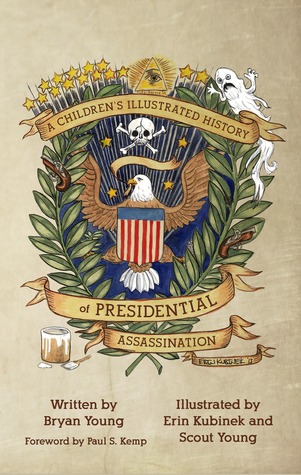
“A Children’s Illustrated History of Presidential Assassination” is a book geared toward those difficult discussions. Author Bryan Young simplifies the topic in prose that explains and educates without talking down or being condescending to the audience. Focusing on each of the presidents who was either assassinated or had an attempt made against them, his prose introduces each leader and places them in both an understandable political and historical context. Shying away from a simple list of names and dates, he makes each history lesson engaging and entertaining.

Accompanying the text are illustrations by two artists. Erin Kubinek provides detailed imagery with a simple and comic flair that illustrates key points while complimenting and enhancing the unfolding stories. Some of the drawings are a little gruesome, but that only helps the audience to understand how messy the topic truly is. The second artist is Scout Young, the author’s daughter, who adds a presidential portrait from the point of view of the book’s intended audience. Her drawings add a degree of whimsy to an interpretation of how she sees the topic, and as one of the inspirations for the book, it’s quite fitting to include her work as a touchstone for children and parents exploring of the darker sides of American history.

As a bonus, the book ends with a short story that provides a taste of the author’s fiction style. As a fan of Young’s “Lost at the Con,” both the short story and the history book were a wonderful display of his versatility and talent.

Bryan Young’s “A Children’s Illustrated History of Presidential Assassination” is a book I highly recommend.

A Children's Illustrated History of Presidential Assassination Cover

cc-break

Culture on My Mind is inspired by the weekly Can’t Let It Go segment on the NPR Politics Podcast where each host brings one thing to the table that they just can’t stop thinking about.

For more creativity with a critical eye, visit Creative Criticality.
Culture on My Mind – Veronica Mars

Culture on My Mind

Culture on My Mind
Veronica Mars
May 6, 2014

Call me ten years late to the party, but after a decade of hearing just how good Veronica Mars was as a series, I finally took the plunge.

I’ll patiently wait here for the inevitable “I told you so.”

Veronica Mars is a detective-style television series focused on the title character, elegantly played by Kristen Bell. The show is set in a fictional beach town named Neptune, which is an oligarchy in microcosm. Veronica is the teenage daughter of the town’s disgraced former sheriff, who was removed from office after accusing one of the town’s most prominent members of murdering his own daughter. Everyone in power (read: upper class) turns their backs on the Mars family, and Veronica’s mother eventually leaves the family. After he hung up his uniform and badge, Keith Mars opened his own private investigation firm, and Veronica has been learning the craft.

Thus begins the tale of a Gen-Y Nancy Drew who solves mysteries while surviving the artificial dramas of high school isolation.

Over three seasons, the homage to 1950s noir plays out as Veronica moves from high school to college, fighting corruption and crime as lives her life in social exile. The character development is top notch, spanning not only Veronica’s close circle of friends, but also among some of the rich snobs that castigated her family earlier. Watching them come to accept Veronica for her skills rather than her social status was nice, but even better was watching Veronica grow up and realize how closely linked consequences and actions truly are.

Seasons one and two are certainly the best of the three, and they dedicate an entire season to a single overarching mystery with smaller cases laced throughout. Fans typically look down on Season Three, which broke the season into several smaller mysteries with tenuous links between them, but I enjoyed it. The only things I didn’t like were the on-again-off-again relationship with Veronica and a certain character (no spoilers here) and the remixed title theme.

This series is far from clean cut, and not everyone gets a happy ending. That is especially true of the follow-up movie, which takes place nine years after the series finale. The movie did a great job of logically advancing the characters of Neptune while explaining exactly why it’s okay that we didn’t see their evolutions on screen. It also finishes off a great character arc for Veronica.

The only downside I found with the movie was with Navy uniforms. While not entirely a deal killer, I had a hard time pulling my eyes away from glaring errors that a few minutes on Wikipedia or with a consultant could have solved.

What I really want to see after watching the movie is a continued Veronica Mars television series. While I like the idea of Veronica on the silver screen, I think the small screen would work best in telling the ongoing stories. Perhaps, in this new era of distribution companies creating content, Rob Thomas would consider Netflix, Amazon, or Hulu as a platform instead of relying on a network. While he’s writing new content in follow-on novels, I really want to see more of this high-caliber work on a screen.

I guess that makes me a “marshmallow.”

cc-break

Culture on My Mind is inspired by the weekly Can’t Let It Go segment on the NPR Politics Podcast where each host brings one thing to the table that they just can’t stop thinking about.

For more creativity with a critical eye, visit Creative Criticality.