
Timestamp #70: The Time Warrior

Doctor Who: The Time Warrior
(4 episodes, s11e01-e04, 1973-74)

Timestamp 070 The Time Warrior


Welcome to Series Eleven and a serial chock full of firsts for the franchise. I really like the new title sequence and logo, which combines Star Trek-style warp speed rainbow star streak effects and 1970s psychedelic wormholes.

The story begins with a group of medieval warriors who are complaining about the poor stores in their seized castle, including sour wine and rancid meat, when they see a falling star. After a series of well-done effects for the crash, the raiders investigate and encounter a spaceship piloted by a Sontaran.

A Sontaran!

His name is Linx and his ship needs repair. After he claims Earth for the Sontaran Empire, the medieval warriors exchange their help for super weapons that would make them invincible. Flashing forward to the 20th century, the Doctor and the Brigadier investigate the disappearance of a dozen leading scientists and their hardware. Linx is the culprit, having kidnapped them through time so that they can repair his ship. True to his word, Linx has also provided Irongron, the lead human warrior, with a rifle.

During the investigation, the Doctor provides his name (once again) as Doctor John Smith, and we meet Sarah Jane Smith.

Sarah Jane!

Sarah Jane is a journalist posing as her aunt, a scientist. When another scientist, Professor Rubeish, goes missing, the Doctor traces him through time and Sarah Jane stows away on the TARDIS. When the Doctor sets his course for medieval times, Sarah Jane disrupts an archer who is trying to assassinate Irongron, and then gets captured by his forces.

I loved the Doctor’s quote: “A straight line may be the shortest distance between two points, but it is by no means the most interesting.”

The Doctor witnesses Linx removing his helmet and, you know, the Sontarans really haven’t changed that much over the years. Sarah Jane is brought before Irongron, who is in a poor mood. Linx arrives, interrogates Sarah Jane, and provides a robotic knight for Irongron’s exploits. Irongron tests it by pitting the assassin archer against the robot for sport, but the Doctor stops the machine with an arrow to its remote control. The archer escapes with Sarah Jane, and the Doctor breaks into Linx’s lab after Irongron calls the Sontaran away to diagnose the robot. The Doctor discovers the missing scientists, including Rubeish, who couldn’t be hypnotized like the others because he left his glasses in the future, but the Doctor is soon ambushed by Linx. Linx interrogates the Doctor, who discloses that he is a Time Lord from the planet Gallifrey.

Gallifrey!

Sarah Jane is taken to the Wessex Castle where she meets the lord who wants to defeat Irongron, and they all assume that the Doctor is behind the plot to kidnap the scientists. They develop a plan to kidnap the Doctor and stop the insanity. Back in the makeshift lab, Linx restrains the Doctor with a headset that provides a shock when he strays from his assigned task. Rubeish helps him to escape, but the Doctor encounters the human warriors and is nearly beheaded by Irongron. He is saved by the archer Hal and Sarah Jane, but they spirit him away to Wessex Castle. They confront him about his role in the affair, but he convinces them that he is the good guy.

Irongron attacks Wessex Castle and is nearly dissuaded by the dummies that impersonate a superior force, but Linx shows Irongron how to shoot the rifles and they discover the ruse. The Doctor and Sarah Jane drive the warriors back with chemical warfare. Irongron is angered by the failure, and Linx is angry with Irongron.

The Doctor and Sarah Jane lead an attack on Irongron’s castle, and they sneak in disguised as friars. They discover the scientists suffering from starvation and sleep deprivation. When Linx returns to the lab, the Doctor offers to help him fix his ship in exchange for the scientists’ lives. Linx attacks in response, and while the Sontaran is distracted by the weakened Doctor, Rubeish hits Linx right in the probic vent, his only weak spot, and knocks him out.

Irongron summons Linx, and the Doctor responds in the guise of an upgraded robot knight. He is soon defeated and captured, and subjected to a firing squad to offer Irongron’s men practice with their rifles. Sarah Jane sneaks into the kitchen and slips a knockout draught into the food, and then helps the Doctor escape the rogues and their poor aim. Rubeish removes the scientists’ trance and works to send them all back to their time.

At this point, it’s Linx versus everyone else: When Linx’s spacecraft lifts off, it will produce a shock wave that will level the castle, and the Doctor wants to save the innocents from that fate. Linx begins the power-up sequence on his craft as the guards fall prey to Sarah Jane’s culinary sabotage. The Doctor figures out how to send the scientists home and leaves Rubeish in charge as he faces off against Linx.

Only Irongron remains standing from the drugged stew. He bursts in to confront Linx, but the Sontaran kills him. Hal warns the rogues that the castle is about to be destroyed, and then arrives just in time to shoot Linx in the probic vent with an arrow. Linx dies, but falls on the activation button for his ship, and the castle is destroyed as the Doctor, Sarah Jane, and Hal escape.

Irongron is dead, his marauders are scattered, Wessex is safe, and the Doctor and his stowaway companion set course for home.

This was a fun episode with so many pieces of the mythology. Sarah Jane is an empowered and very spirited woman. She takes charge and fights hard, but is also willing to admit when she’s wrong. She’s a fantastic character right from the start. I’m eager to see how she develops as a companion.

Grading this one was easy.


Rating: 5/5 – “Fantastic!”


UP NEXT – Doctor Who: Invasion of the Dinosaurs


The Timestamps Project is an adventure through the televised universe of Doctor Who, story by story, from the beginning of the franchise. For more reviews like this one, please visit the project’s page at Creative Criticality.


Timestamp #69: The Green Death

Doctor Who: The Green Death
(6 episodes, s10e21-e26, 1973)

Timestamp 069 The Green Death


The Doctor and Jo battle corporate fat cats and green slime.

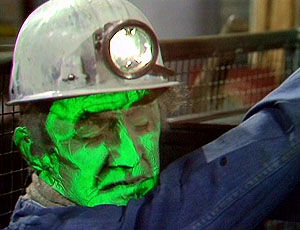
Starting with a closed mine, the workers are waiting for news, but jeer the official who brings them news of money for expansion. As the protest continues, a worker displays a green glow on his skin, and he dies as he sounds the alarm. Back at UNIT, the Doctor is working on the TARDIS as Jo eats breakfast and reads about the mine and Professor Clifford Jones, who has concerns about the corporation and its manipulation of worker health for profit.

In the exchange between our heroes, it seems that Jo is a bit off, but that she and the Doctor are more in sync than they have been. This exchange gets heated as the Brigadier tries to assign the Doctor to the mining case. The Doctor refuses because he wants to take Jo to Metebilis III, but Jo is far more interested in waging an environmentalist battle. The Brigadier and Jo head for the mine, and it’s obvious that the Doctor and Jo are diverging on their philosophical courses. As the Doctor heads to Metebilis III almost in rebellion against Jo’s interests, he is attacked just after landing.

Jo meets Professor Jones, and the man is a bit of an ass who gradually warms to his visitor. His research involves a new high protein fungus, and he’s upset because thousands of gallons of waste, almost like a liquid plastic sludge, are being pumped into the mine. The Brigadier, meanwhile, meets with the corporate executive at Global Chemicals, Mr. Stevens, and offers extra security in light of the protests. He also intends to investigate the mine as soon as the Doctor arrives. The Doctor returns from his trip amid a flurry of attacks and immediately sets out for the mines.

Mr. Stevens orders that no one should go into the mine, but his directive is made through a strange mental haze. In violation of that order, Jo accompanies a miner named Bert down inside the mine to help another infected man, and as the Doctor and the Brigadier arrive to investigate, the cage descends out of control. Bert takes a humorous opportunity to toss Jo around the cage, the Doctor saves them by jamming the mechanism, and Jo and Bert climb down the rest of the way. The miners can free the cage, but they are missing some equipment to to cut the cable. Even though Global Chemicals has the equipment, they claim not to, although a staffer named Mr. Elgin knows differently.

The mental haze from before takes a twist: Mr. Stevens is controlled by a strange disembodied voice which commands his to “process” Mr. Fell, one of the dissenting staff, and that staff member comes back as a near automaton. Resistance is apparently futile.

The Doctor’s investigation reveals that the lift was sabotaged, and he works with Professor Jones to sneak into Global Chemicals and steal the cutting equipment. He is detected by the voice, and intercepted by security guards who are dispatched with Venusian aikido. He is soon trapped by Stevens who, strangely, dismisses the incident after showing the Doctor the empty storage container where the cutting equipment should be. The Brigadier arrives with some cutting equipment that he rounded up by luck, the cable is cut, and the Doctor and a miner enter the shaft.

Bert and Jo explore the mine and find some of the green slime. Bert touches it and is incapacitated, so Jo goes on alone to find help as the Doctor finds Bert and the slime. The Doctor follows Jo, and they both encounter a group of maggots in a large pool of slime who attack as a cave-in begins. They use a mine cart to ford the slime, and climb a crevice to the surface inside the factory. Elgin saves the Doctor and Jo from drowning in the pipe as it fills with sludge, and Fell experiences a conflict between his conscience and the programming, which drives him to commit suicide.

The Brigadier tries to leverage a little government muscle to break open the mystery, but the Prime Minister shuts him down. Later on, the Doctor, Jo, the Brigadier, and Jones are relaxing with a high protein fungus dinner, but the mood is spoiled by word that Bert has died from his exposure. The egg that they retrieved from the shaft hatches, and a maggot creeps up to Jo. Mr. Hinks, the assistant to Stevens, is sent to retrieve the egg, but is attacked by the maggot instead. He quickly dies.

At this point, it’s obvious that Jo and Jones are falling in love. But what of Sgt Benton? Did it not work out with them? Whatever happened, it’s immaterial as she’s totally twitterpated with Jones and his trip to the Amazon, and totally uninterested in the large blue Crystal of Convenience – it later displays a +3 attribute for rolls against brainwashing – that the Doctor brought back from Metebilis III.

The analysis of the slime shows that it works as a virus that changes the victims, and UNIT has orders to seal the mine and limit the spread of the infection. This causes the maggots to escape to the surface, and since bullets and spray don’t work, the Doctor realizes that only a counter-virus will work. Back at Global Chemicals, the Brigadier has sent Captain Yates undercover to find evidence of wrongdoing within the company. That is a great move by the Brigadier, and it demonstrates just how much more dynamic he is in this story than in previous serials.

The Doctor is warned not to return to the corporate offices, so he is forced to don several successive costumes – a move that is very reminiscent of the Second Doctor in The Underwater Menace, The Enemy of the World, and The War Games, just to name a few – to move freely about the compound. Captain Yates provides the Doctor some intel, which the Time Lord follows to the top floor of the factory. The top floor reveals the mystery with a supercomputer called the BOSS, or Biomorphic Organizational Systems Supervisor. It appears that, once again, someone really wanted to spell SHIELD. The Doctor overwhelms the machine with the Liar’s Paradox, but is captured by Stevens who tries to brainwash the Doctor and fails.

On the lovebird front, Jo upsets Jones by accidentally ruining the slides for the slime analysis, so she sets off the find another sample. Her accident turns out to be a critical step toward the cure. He sets off after her and saves her from the grenade barrage that destroys the field of maggots, but he sustains a head injury.

Captain Yates is captured trying to rescue the Doctor. The Doctor escapes, but Yates is brainwashed by the BOSS. The Doctor and Sgt Benton save Jo and Jones, but Jones has been infected by the slime. The Doctor returns to the professor’s lab where he is ambushed by Yates, but the Doctor uses the crystal from Metebelis III to break the brainwashing. The Doctor sends him back in under the guise of still being brainwashed to thrown Stevens off the trail, but that doesn’t work as well as they had hoped. Benton returns to the lab with an empty maggot chrysalis, and they discover another maggot that ate the fungus and died. The Doctor then realizes that the fungus is a cure. They scatter samples all over the area and kill the maggots, but they are stalked by a giant dragonfly, the adult form of the creature. The Doctor defeats it with his overcoat.

Okay, those maggots are downright freaky, with their mouth filled with razor sharp teeth like a langolier.

Captain Yates escapes from the factory and passes word to the Brigadier and the Doctor that the computer is planning something at 4pm that afternoon. The Doctor discovers the cure with Jo’s help and administers it to Jones, and then goes to confront BOSS before the supercomputer links with the other supercomputers around the world. The Doctor reverses Stevens’s brainwashing with the crystal, and Stevens triggers the self-destruct, stopping BOSS permanently.

The voice actor for BOSS, John Dearth, obviously had a lot of fun in the sixth episode with his singing, and the Stevens/BOSS hybrid was a beautiful bit of acting. I was amazed by how well it was performed.

With the crisis stopped, Jo gets engaged to Jones and decides to join the professor on his travels. The professor’s research gets a major UN grant thanks to Jo’s uncle. The Doctor gives Jo the Metebelis crystal as a wedding gift and silently sneaks out with only Jo noticing.

Her days of traveling about time and space are done, and he drives off into the sunset, obviously heartbroken. That ending alone ratcheted up the score for this serial because of the sheer power in so little dialogue.

I’m going to miss Jo Jo.


Rating: 4/5 – “Would you care for a jelly baby?”


UP NEXT – Tenth Series Summary


The Timestamps Project is an adventure through the televised universe of Doctor Who, story by story, from the beginning of the franchise. For more reviews like this one, please visit the project’s page at Creative Criticality.


Timestamp #65: The Three Doctors

Doctor Who: The Three Doctors
(4 episodes, s10e01-e04, 1972-73)

Timestamp 065 The Three Doctors 2


Happy 10th anniversary, Doctor Who! Traditionally, you’d get something made of tin, but the Time Lords are feeling benevolent.

A Pandora’s box arrives in the form of a cosmic ray research module, and it’s hungry because it eats Mr Ollis, the warden of the bird sanctuary where the module crash-landed. Doctor Tyler arrives and takes the box to UNIT where the Doctor analyzes the data, and the Doctor trolls the Brigadier with a silicon rod to stir his tea. As the Doctor and Jo investigate the crash site, the module consumes Doctor Tyler, and a psychedelic cloud leaks out, menaces our heroes, and eats Bessie.

Someone needs a copy of Care and Feeding of Psychedelic Clouds for Dummies.

As if that’s not enough, several cyclopean crab creatures apparate and storm UNIT HQ. The Brigadier leaves Sgt Benton in charge of the lab and leaves to assess the situation, prompting the cloud to arrive and force the Doctor, Jo, and Benton to take refuge in the TARDIS. The TARDIS won’t dematerialize, so the Doctor plays his last resort card and calls the Time Lords.

The TARDIS has been redecorated again, and while I liked the wash basin roundels more, this is still a step up from the wallpaper that dominated the Troughton era. While I was observing that, Sgt Benton was having his “bigger on the inside” moment, which made me laugh.

The Time Lords determine that the attack is stemming from a black hole which bridges into a universe of anti-matter, but they can’t help because the same gateway is siphoning all of their power reserves. Despite the First Law of Time, which forbids the Doctor from doubling back on his own timeline (wait, what?), the Time Lords break the rules and send the Second Doctor to help the Third.

Oh, the irony.

The Second Doctor arrives, heralded by his trademark recorder, and followed by his dislike of the new décor. Sgt Benton is overjoyed, since the last time this saw this Doctor was during the Cyberman invasion. The two Doctors link together telepathically, but can’t get anything accomplished because the “dandy” and the “clown” can’t stop bickering, so the Time Lords call up the First Doctor to set them straight. He can’t come all the way in because of a plot-convenient time eddy that the council cannot overpower, but he passes the word that the black hole is a time breach and that they must cross it.

The Time Lords, by the way, call the First Doctor the “earliest Doctor”: Hartnell’s character was definitively the original.

The Third Doctor decides on a bad plan and rushes out of the TARDIS. Jo follows, and both are consumed. The Second Doctor sees that the cloud has been temporarily satiated, so he and Benton leave the TARDIS to investigate. The Brigadier meets the Second Doctor again, and he jumps to the conclusion that the Third Doctor has regenerated… er, degenerated… er, changed back into the Second Doctor. Bickering and hilarity ensue.

The Second Doctor deduce that the cloud is made of antimatter, and that it was sent by someone powerful since it hasn’t caused a matter-antimatter annihilation. He suggests confusing it with useless information, such as with a television. That’s right, Doctor Who went meta before meta was a thing. While the Second Doctor works that problem, the Third Doctor and Jo wake up on a barren world with the one-eyed crabs, pieces of the laboratory, and Bessie, and they use the car to track a set of footprints to their source.

Back on Earth, the Brigadier wants the Second Doctor to address the Security Council, calling him the Third Doctor’s assistant to sideline the whole regeneration question, much to the Second’s chagrin. The cloud gets the hunger pains again, and the Second Doctor, the Brigadier, and Benton take refuge in the TARDIS. The Brigadier’s “bigger on the inside” moment trumps Benton’s as he accuses the Doctor of building the contraption from UNIT materials and funds. As the Third Doctor and Jo find Doctor Tyler and are subdued by the crab monsters, the Second Doctor works with the First Doctor who suggests letting the cloud attack the TARDIS. When it does, the entire headquarters building is transported into the black hole, which leaves the Brigadier nearly apoplectic. He goes off to call in this new development as the Second Doctor and Benton find Mr. Ollis, and then get captured by the crabs.

We also note that the TARDIS is just a prop thanks to a camera angle that peers all the way inside.

And then we meet the architect of this whole thing: The legendary long lost Time Lord named Omega. He was the solar engineer who created the supernova that powers Time Lord civilization, but was supposedly killed in the resulting explosion. In reality, he was transported to the antimatter universe, where his will and thought turned the formless matter into physical form. It’s also his cage, since his will is the only thing maintaining reality, and he vowed revenge on the Time Lords who left him stranded. Omega deduces that the Second Doctor and the Third Doctor are the same Time Lord, and boy is he angry. He places them in a cell pending execution, and they continue bickering before the companions put them in their place. I loved that!

Omega has control of the singularity, which grants him immense power, and Jo considers that the Doctor must also have some potential in this universe. The two Doctor will a door into existence, they all escape the cell, the companions get lost and escape the palace, and the Doctors get discovered by Omega in the singularity chamber, where Omega challenges the Third Doctor to a mental Thunderdome. The Third Doctor is defeated, but the Second reasons with Omega using the imprisoned Time Lord’s freedom as leverage.

The Time Lords send the First Doctor into the black hole, reasoning that together they are powerful enough to defeat Omega. The Second Doctor laments his lost recorder (foreshadowing!), but deliberately angers Omega to challenge the villain’s self control. The two Doctors reason that if Omega can transport matter to Earth on the light stream, he could transmit himself as well, but Omega reveals that he is a prisoner of his own design. If tries to leave, he loses control over the construct, and if he stops controlling the construct, he cannot leave. He brought the Doctor(s) to become the new caretakers. As he prepares to leave, however, he discovers that he no longer exists in a form that can survive outside of the antimatter construct. Omega is powered only by his will to live, and that only works on this side of the mirror. He goes all Kylo Ren on everything since he does not want to live like that, and the Doctor run back to the TARDIS just in time to let all of the companions seek shelter.

The First Doctor is unable to fully appear in the antimatter universe since the Time Lords’ power is so badly compromised, but he links with his successors and formulate a plan. They ask Omega to bring the TARDIS to him, and then ask the companions to trust them implicitly. They promise to set Omega free only if he sends the companions home, and Omega counters that he cannot be freed, but will keep the Doctors as his companions. Each of the Doctors’ companions step into the light stream and go home.

As much as I tear into the Brigadier’s character, he did have a very touching moment as he saluted the Doctors. He truly believes it to be the last time that he shall see them.

The Doctors offer Omega the TARDIS’s force field generator as a means to escape, but he physically rejects it, and the Second Doctor’s recorder (which has been on the TARDIS inside the generator the entire time and not modified to exist in both universes) annihilates with the anti-matter in a supernova, breaking the bridge and returning everyone to their rightful places. Poetically, the act also restores power to the Time Lords, making it the second time that Omega has exchanged his life for their civilization.

In exchange for his help, the Time Lords forgive the Doctor of his crimes: After fifteen serials in exile, they return his knowledge of time travel and provide him with a new dematerialization circuit. Jo is elated, since the Doctor decides that he can’t leave Earth yet since he needs a new force field generator.

Thank the Maker, we get time travel again!

Overall, this was a great story, and it was fantastic to see Troughton back in action. His madcap style is a great contrast to Pertwee’s pompous prim and proper. It was also good to see how well the companions and Doctors all interacted, although it would have been nice to bring in some of the First and Second Doctor’s companions as well. Time and budget are always constraints, and it might have also muddied the plot a little.

One place where I’m torn is with Hartnell’s final performance. It was so good to see him in character again, but he was obviously very ill and not fully back to where he left the character thirty-six serials ago. Sadly, he died two years after this performance, his last as the Doctor and his final acting performance overall.


Rating: 5/5 – “Fantastic!”


UP NEXT – Doctor Who: Carnival of Monsters


The Timestamps Project is an adventure through the televised universe of Doctor Who, story by story, from the beginning of the franchise. For more reviews like this one, please visit the project’s page at Creative Criticality.


Timestamp #64: The Time Monster

Doctor Who: The Time Monster
(6 episodes, s09e21-e26, 1972)

Timestamp 064 The Time Monster


The Doctor has some weird dreams.

Foreshadowing events to come over the next three hours, he has a nightmare about the Master and trident-shaped crystal, which is (1) a bit on the nose symbolically since it comes from Atlantis, and (2) exactly what the Master happens to be holding in his guise of a science professor. Of course, this is the third time Doctor Who has tapped on the Atlantis mythos, and I’m sure it won’t be the last.

The Doctor is concerned about his nightmare, and he tells the Brigadier (who has been laying low since the Daleks waged gorilla on guerilla warfare) to alert UNIT to be on the lookout for the Master. The Brigadier does so sarcastically, and then reminds the Doctor that UNIT is obligated to attend the demonstration of TOMTIT – a project that demonstrates Transmission of Matter Through Interstitial Time and the Master’s desire to spell something silly – but since the Doctor and Jo are waiting for the Master to strike and Captain Yates has the duty, poor Sergeant Benton is ordered to cancel his leave and join the Brigadier at the Newton Institute.

What the Doctor doesn’t realize is that leave is one of the most precious commodities in the world to an enlisted man. I’m not saying that he should watch his back from this point forward, but maybe he should start carrying a rear-view mirror everywhere he goes.

Instead of requisitioning a rear-view mirror, the Doctor builds a time sensor – a TARDIS “sniffer-outer” – that starts going ballistic when the TOMTIT scientists start a rehearsal of the experiment. That Master gets angry that the team started early, but Dr. Ruth Ingram points out that the experiment overloaded its circuits during the teleportation, and the Master determines that the crystal is drawing energy from outside time itself. He decides to skip the traditional post-demonstration wine-and-dine when he sees UNIT arrive for the show.

The Doctor and Jo track the source of the temporal readings in Bessie, which now has a Super Pursuit Mode sans absurd transforming sentient Trans-Am, and we also start seeing the depths of the Doctor’s obsession with Venus. He has programmed the time sensor to read in Venusian miles, requiring a conversion table for each calculation. The sensor spikes as the Master, cleverly disguised in a radiation suit, begins the experiment which turns out to be a front to summon a being called Kronos.

The experiment creates bubbles of time dilation, and when the Doctor arrives, he is slowed down and Jo is frozen. Stuart, the research assistant, has aged sixty years due to radiation exposure as his own personal temporal reference has been accelerated. Dr. Ingram – call her Ruth – mentions Professor Thascalos, and the Doctor’s mastery of Greek uncovers the Master’s identity. The Brigadier orders support troops, the Doctor’s TARDIS, and an evacuation of non-essential personnel from the Institute, and the Doctor investigates the crystal at the heart of TOMTIT. Kronos is a fearsome member of the Chronovore race who live outside of and eat time, and the mythology is an interpretation of actual events. The crystal is the same one that summoned Kronos to Atlantis thousands of years ago, and the rest of it is located in the Vault of Poseidon, deep in the legendary city thousands of years in the past.

The Master’s TARDIS is disguised as a computer in the laboratory, and to get to it, he tricks Benton into leaving the laboratory. Benton sees through the ruse, but gets knocked out upon ambushing the Master. The Master summons an Atlantean priest named Krasis, and the priest possesses a holy seal that contains the secret of summoning Kronos. With all the keys in place, the Master summons Kronos. The mighty creature eats the institute’s director as Stuart de-ages and the Brigadier, Benton, and Ruth get trapped by the temporal field. Kronos proves to be uncontrollable, and the Master returns it to the crystal.

The Doctor makes a temporal jamming device, but it doesn’t last long. As Captain Yates and UNIT arrive, the Master summons opposition from the past in the form of a medieval knight, a squad of Roundheads, and a V1 bomb. The V1 takes out the convoy but everyone is okay, and as Ruth, Stuart, and Benton go to the lab to take on the Master, the Doctor and Jo take to the TARDIS.

The TARDIS has a new desktop – the wash basin roundels are a nice touch – and the Doctor develops a plan to materialize his TARDIS inside the Master’s TARDIS. This concept of a TARDIS inside a TARDIS boggles the mind, but it’s possible. Really tricky, but possible. If the calculations aren’t precise, a time ram will occur that will annihilate both of them.

Jo’s bravery and spunk motivate the Doctor, and the TARDIS lands. The two are linked as the Master’s TARDIS appears to materialize inside the Doctor’s. When he leaves, his TARDIS is inside the Master’s. They leave the Master’s and emerge into the Doctor’s. They are both inside each other, creating a time loop.

When the UNIT troops arrive – Krasis’s temporal ignorance is a fantastic alarm system – and the Master extends a time field to prevent them from interfering. The duo take off for Atlantis, and since the TARDISes are linked, the Doctor and Jo go with him. Meanwhile, Ruth, Stuart, and Benton are trapped in the lab, and they work to deactivate the time field and rescue the Brigadier’s squad. The plan backfires, and Benton gets turned into a baby.

After a sequence that helps develop the franchise’s basis for the TARDIS’s telepathy and language interpretation skills, the Doctor is forced to leave his TARDIS to confront the Master. The Master summons Kronos, which eats the Doctor (setting him adrift in the time vortex) before returning to the crystal. The Master then ejects the Doctor’s TARDIS into the time vortex. After the turbulence, Jo comes to and hears several whispers from the Doctor, but a single, strong voice comes through clearly via the TARDIS. The TARDIS and the Doctor work with Jo to rescue the Time Lord before setting course for Atlantis.

In the legendary lost city, King Dalios holds court, and rabble-rouser Hippias wishes for a return to the glory during the era of Kronos. Dalios attempts to dissuade them, but the Master interrupts him with a grand entry and claims to be an envoy of the gods. When Krasis claims to have seen Kronos, Dalios takes him and the Master into private conference. The Doctor arrives shortly thereafter, and Krasis attempts to kill him but Hippias intervenes. The Doctor and Jo are taken to Dalios instead.

The Master is dismissed after failing to place Dalios under his thrall, and he’s surprised to see the Doctor alive. The Doctor and “Jo Jo Grant” meet with Dalios, and the king sends Jo to meet with his queen, Galleia. Later on, Galleia meets with the Master, who offers him the crystal. Jo attempts to inform the king and the Doctor, but she is turned away. She pursues Hippias, who is tasked with retrieving the crystal for Galleia, but is captured by Krasis and locked in with the crystal’s guardian, the Minotaur.

The Doctor finds out about Jo and goes after her. Hippias tries to save Jo, but the Minotaur kills him, and the Doctor does his best olé by bullfighting the guardian into a wall. As the wall crumbles, the crystal chamber is exposed, and Krasis takes the Doctor and Jo to see the king. Unfortunately, the king has been deposed thanks to Galleia and replaced by the Master. He imprisons the Doctor and Jo, and after the Doctor relates a tale about the blackest day of his life. Behind his home on a mountain was a hermit (a monk, but not The Monk) who spent half his life under a tree. The hermit listened to the Doctor’s woes, and then pointed to a flower, which presented the Doctor a new perspective on life. Afterward, Dalios is imprisoned in the same cell, shares his vision of the Doctor saving Atlantis, and then dies.

Later on, Galleia addresses Atlantis and presents the Master as king, and he offers to summon Kronos. The Doctor reveals to Galleia that Dalios is dead, and she turns on the Master. Kronos is summoned and the Master orders it to destroy Atlantis. The Master escapes with the crystal, but Jo pursues him into his TARDIS. The Doctor chases after them in his TARDIS and threatens the Master with a time ram. The Master calls the Doctor’s bluff, and Jo initiates the time ram, catapulting both TARDISes into a featureless place. They are greeted by Kronos, who was released when the TARDISes collided. She grants the Doctor and Jo a reward for their assistance, and they ask to be returned home. She intends to keep the Master in torment and punishment, but the Doctor asks for leniency. Of course, the Master takes the opportunity to escape.

With the universe saved once again, the Doctor and Jo return to Cambridge as the time field is released and the TOMTIT device explodes. Everything is back to normal, the Brigadier acts as comic relief, and Benton returns to adult form in his vintage birthday suit.

The Doctor might really want to consider that rear view mirror.

This was a pretty good serial, but not quite up to the bar set by the rest of the season. It was certainly fun, but it’s kind of hard to follow The Mutants.

I appreciated that the writers hung a lampshade on the TOMTIT acronym: Almost every time it was mentioned, one of the companions would do a double take, and it’s understandable. The device looks nothing like a small bird or a biplane, and between this and the rather unfortunate shape of the time sensor, I think the creative team was having some fun with this one.

I also liked the symmetry of the Master and the Doctor simultaneously working the overload problem in separate locations. These frenemies (hey, the word’s been around since the 1950s) are really not that different if you strip away their motivations, and if the Master could get over his self-sabotaging need to have his plans overpower him, he’d be nearly unstoppable. I also liked how the Master didn’t engage the TARDIS’s chameleon circuit when he traveled to Atlantis. It added to the shock and awe of seeing a foreign object materialize from thin air.

I enjoyed the humor behind the Doctor showing up the Brigadier and his disdain of Bessie with the car’s super drive. I also liked seeing Dave “Darth Vader” Prowse in something other than Star Wars.

Overall, this was a great story that was perhaps a bit long, and even judged on its own merits is the weakest part of an otherwise spectacular season.


Rating: 4/5 – “Would you care for a jelly baby?”


UP NEXT – Ninth Series Summary


The Timestamps Project is an adventure through the televised universe of Doctor Who, story by story, from the beginning of the franchise. For more reviews like this one, please visit the project’s page at Creative Criticality.


Timestamp #60: Day of the Daleks

Doctor Who: Day of the Daleks
(4 episodes, s09e01-e04, 1972)

Timestamp 060 Day of the Daleks


The Daleks are back, and they seem to have recovered from the Second Doctor’s confrontation with the Emperor Dalek so long ago.

I really loved this story because of how it is framed. What starts as a simple UNIT investigation of a diplomat being stalked by strange ghost-like guerrillas ends up being much deeper than many of the stories from the last set.

Sir Reginald gets attacked by a strange human warrior with a gun who vanishes without a trace, almost like a ghost. Another guerrilla appears from thin air and is instantly attacked by an ape-like creature in an act of gorilla on guerrilla warfare. (Okay, that was a bit insensitive.) And then, as if we needed more conflict, the Daleks enter the stage, and even though they aren’t front and center in this story, they’re still menacing and sinister because they’re pulling all of the strings on all of these puppets.

All of this before we even get to the time travel, and I was riveted.

And then the creative team turned this exploration of the human condition up to eleven.

After spending a night at Sir Reginald’s house (and raiding his extensive wine cellar), the Doctor and Jo are attacked by the guerrillas and held hostage. Jo escapes and is inadvertently transported to the future. She innocently tells the Controller where to find the Doctor, and the Controller sends a team of Ogrons (the ape-like creatures) to kill the guerrillas. The guerrillas escape, the Doctor gives chase, a Dalek chases all of them, and the Doctor and the rebels end up in the future. After a series of political ping-pong events, the Doctor ends up in the care of the Controller, gets the down-low on what happened to the planet, and eventually sways the Controller’s attitudes on the peril of humanity and his role in a lineage of “Quislings“.

As events come together like a jigsaw puzzle, the Doctor discovers that these events are a predestination paradox started by one of the rebel guerrillas setting a Dalekanium bomb in an attempt to stop the future of enslavement and death from coming to pass. At that point, my jaw dropped.

This. Is. Doctor Who.

It’s hard to find highlights here because the whole story shines so brightly: I loved how the Doctor was so much more civil with the Brigadier than in past interactions, including their building trust and synergy (“do tell the Marines”); I adored the (hopefully budding) relationship between Sgt Benton and Jo; I enjoyed watching Jo finally expanding her horizons and learning to be a worthy companion for this Doctor.

The Doctor is still working on the TARDIS, and his new-found civility extends to Jo as he frankly tells her that he doesn’t want to be an intergalactic puppet for the Time Lords and their High Council. He’s moving beyond his childish temper tantrums and taking action with what appears to be a new sense of purpose. Ironically, it was the Time Lords who provided it by allowing the Doctor and Jo to travel in the TARDIS once again.

The quick (almost non-sequitur) time loop a the beginning was fascinating, especially since the recent incarnations of the Doctor are very cautious about crossing their own timelines. This thread is never mentioned again in the story and left me wondering why it was important.

On the downside for this serial, the Doctor uses a gun to kill an Ogron. Sure it was self-defense, but it was also way out of character.

I also questioned the role of the Ogrons. I mean, yes, they make great hired muscle, but isn’t it uncharacteristic for the xenophobic Daleks to even consider working with them? Or is this more of a “use them then lose them” plan like the alliance in The Daleks’ Master Plan? Speaking of the Daleks, they discovered the secret of  time travel for this story, but hadn’t they done this before?

On the new sound for the Dalek death rays, I don’t like it.

Finally, swinging back to the good things, it was nice to see that The Daleks don’t recognize the Doctor’s new face. They know that he has changed appearance before and use a mind analysis machine to determine if he is indeed the Doctor, but it took an extra step to establish that logic. Thank goodness.


Rating: 5/5 – “Fantastic!”


UP NEXT – Doctor Who: The Curse of Peladon


The Timestamps Project is an adventure through the televised universe of Doctor Who, story by story, from the beginning of the franchise. For more reviews like this one, please visit the project’s page at Creative Criticality.


Timestamp #59: The Dæmons

Doctor Who: The Dæmons
(5 episodes, s08e21-e25, 1971)

Timestamp 059 The Dæmons


It was a dark and stormy night, almost the setting for a Doctor Who Halloween Special, but aired in early summer.

Professor Horner and his team are excavating a site called Devil’s Hump, and they are surrounded by a series of events that are like magic. The local village witch, Olive Hawthorne, comes out to protest but is ignored, so she returns home and goes to visit the vicar, a new man named Mr. Magister, who is really the Master. Also, she’s immune to his hypnotic powers, unlike everyone else in the town.

Turns out, the Master is attempting to summon a demon. Well, a race of demons. Well, really an alien race that looks like demons that are kind of like scientists that run experiments on civilizations. They’ve been on the planet for 100,000 years, and when the experiments are deemed successful, they spark a technological revolution. When the experiments fail, you get Atlantis.

Anyway, this serial is an exercise in Arthur C. Clarke’s third law of prediction: “Any sufficiently advanced technology is indistinguishable from magic.” The Dæmons have been around for so long that they’ve been worked into our mythology, and when they appear/disappear, it requires a conversion between energy and matter. That energy release when they shrink resulted in a shield dome being constructed around the village. The Doctor helps UNIT cut a hole in it so they can keep the gargoyle Bok busy while the Doctor attends to the larger Dæmon named Azal. The Master and the Doctor negotiate with Azal as to who will serve it best, and it sides with the Master. Jo offers to sacrifice herself to prevent Azal from killing the Doctor, and that somehow short circuits Azal’s brain. Azal explodes, the Master is finally captured by UNIT, the Doctor and Jo dance around the maypole, la fin.

It was an interesting idea, but it felt poorly executed, and I think a lot of that is because of the sensitivity at the time regarding demons and the supernatural on the BBC. This story could be done now and not feel so awkward or ham-fisted, but I think the prevailing culture crippled the story’s potential.

There were some good points, like the realistic special effects (the helicopter shot, originally sourced from From Russia with Love, and the church explosion) and the continuing thread of the Master biting off more than he can chew, but then there were also some really bad points, such as the resolution. The threat was stopped by accident, and if Jo hadn’t been there, the Doctor would have failed to stop the Master from taking over the world. Similarly, the Master was captured by Sgt Benton’s good timing.

This story also has a few potential links to the future of Doctor Who. First, Bok is apparently made of stone. Are the Dæmons precursors or ancestors to the Weeping Angels? Second, the UNIT sergeant who builds the force field defeating contraption is named Osgood. Is he related to the current personal assistant at UNIT who saved the world? Both of them are scientists and they both wear thick-rimmed glasses.

The Master offered the villagers anything they wanted for the price of their servitude, and I heard echoes of Needful Things.

Finally, UNIT needs to stop shooting things. It hardly ever works.


Rating: 2/5 – “Mm? What’s that, my boy?”


UP NEXT – Series Eight Summary


The Timestamps Project is an adventure through the televised universe of Doctor Who, story by story, from the beginning of the franchise. For more reviews like this one, please visit the project’s page at Creative Criticality.


Timestamp #57: The Claws of Axos

Doctor Who: The Claws of Axos
(4 episodes, s08e11-e14, 1971)

Timestamp 057 The Claws of Axos


It’s Doctor Who in color… again! The Claws of Axos is a short serial that is much more straightforward than The Mind of Evil, which hurts it a little in my opinion.

UNIT is undergoing an inspection from Horatio Chinn, a particularly detestable politician who is throwing a tantrum because he knows nothing about the Doctor, when they detect a spacecraft filled with spaghetti monsters. I’m kidding, of course, since the spacecraft is unique to the franchise and not a bad looking model. UNIT is also hosting Bill Filer, an American agent from an unknown agency, who is investigating the Master. Chinn, ever the diplomat, secures emergency powers and tries to shoot down the spacecraft, but it evades the effort. Strangely enough, Chinn could have been the hero of the tale had he succeeded.

The ship lands and spears a homeless drifter with a Jar Jar Binks-like tongue. UNIT arrives and, with the help of scientists from the nearby power facility, investigate the ship. Filer, after being ejected from the UNIT site by Chinn, arrives on his own, is captured, and discovers the Master is also in captivity.

The Doctor gets scanned by the living ship, and the aliens determine that he is a Time Lord. The Axons appear as humanoids in gold face paint and muted leopard-print leotards, and they claim that they ran out of fuel and need time to recharge and replenish. In exchange for temporary asylum on Earth, they offer a miracle substance called Axonite that can be anything you want it to be. Strangely, they never used it for fuel.

Jo explores the ship on her own after disobeying orders to stay put, and she hears Filer calling for help. She finds a spaghetti monster and screams, drawing the UNIT team to her, but the Axons dismiss her experiences as hallucinations due to the proximity to the power core. Filer and the Master take the opportunity to escape, but are recaptured, and Filer is sent to be cloned.

Chinn calls the Prime Minister for special powers to accept the Axonite, places the UNIT team under military arrest for interfering with his authori-TAH, and sets to distributing the Axonite around the globe. Unfortunately, as the Doctor discovers, the Axonite is the means that the Axons (or really, just Axos, a single consciousness with multiple avatars) plans to use to consume the planet’s energy.

The Master negotiates with Axos for release, and gets his laser gun but not his TARDIS. He steals the Doctor’s TARDIS, has it delivered to the power plant, and works on fixing it so he can escape. After discovering that Axos wants to time travel to expand its feeding base and that they can use the reactor’s power to do so, the Doctor works with the Master to repair the TARDIS under the premise that he’s abandoning Earth as a lost cause. Once operational, the Doctor materializes the TARDIS inside Axos, tricks them into linking their drives with his, and locks them in a permanent time loop. The Master escapes into his TARDIS when he discovers the plan, and all of Axos is materialized into the Doctor’s TARDIS. The Doctor boosts the TARDIS out of it, leaving Axos stranded in the loop, and the TARDIS returns to Earth with an annoyed Doctor on board. Even with the ability to dematerialize now restored, the Time Lords have ensured that it will always return to Earth.

I’m really starting to dislike the Time Lords. Sure, I get the justice for breaking their laws, including making sure that the Doctor doesn’t leave his exile by blocking his knowledge, changing the dematerialization codes, and disabling the circuitry in the TARDIS, but then they show up only long enough to warn the Doctor that the Master is coming and that he’s a bad dude. We know full well that they can stop renegade Time Lords with little effort, but they selectively choose not to interfere in this case.

The Master is definitely worse than the War Chief, yet the latter was brought to trial on Gallifrey for his meddling. In a similar vein, The Monk‘s activities have been outright ignored by the Time Lords.

In other short notes, Paul Grist does a decent job with an American accent, and there was a lot of fun with pyrotechnics in this serial. The Doctor seems to be stepping away from his previous reserve about his past by disclosing his knowledge of time travel to the power plant scientists.

This was an okay story with some great steps forward toward restoring the travel aspects of the show.


Rating: 3/5 – “Reverse the polarity of the neutron flow.”


UP NEXT – Doctor Who: Colony in Space


The Timestamps Project is an adventure through the televised universe of Doctor Who, story by story, from the beginning of the franchise. For more reviews like this one, please visit the project’s page at Creative Criticality.


Timestamp #55: Terror of the Autons

Doctor Who: Terror of the Autons
(4 episodes, s08e01-e04, 1971)

Timestamp 055 Terror of the Autons


The Nestene and Autons are back. The normal title sequences are back. Liz Shaw is… not.

There are so many profanities, obscenities, expletives, and invectives I could throw out here; I guess Liz Shaw can now be the vice president of the Unceremoniously Canned Companions Club with Dodo as the president and founder. She was only around for four serials, but she deserved a lot better (especially as a strong female character) than to be written off in the off-season.

It’s infuriating!

The Doctor’s back as well, still in his fancy ruffles but with a toned down scarlet jacket. He’s still working on TARDIS and meets Jo Grant, the new assistant. Jo’s no Liz, but she’s very independent and has potential, and she did save the Doctor’s bacon from the mirror-universe-goatee-and-slicked-back-hair E-V-I-L that is the Master. I mean, if you’re gonna save the Doctor’s life, you get extra points for doing it against that guy.

The Master arrives in a TARDIS with a fully functional chameleon circuit, enthralls nearly everyone he meets like the vampires of legend, and steals a Nestene egg to invite the invasion force on down. The Doctor and his team investigate the strange signals from the radio telescope, and the Doctor gets a heads up from a random Time Lord. The Third Doctor’s run has been playing fast and loose with time travel vehicles, and this story is no exception: Time Lords can apparently travel without a TARDIS.

The Master takes the disguise of Colonel Masters and embeds himself in a local plastics factory. After killing the production manager with an inflatable plastic chair, he offs the factory’s retired owner with a demonic plastic doll activated by heat. The only way he could be more evil is by killing a puppy.

The Doctor follows the clues to the circus, but is captured by the Master’s hypnotized followers. Jo rescues him after smuggling away in Bessie, and the Doctor steals the dematerialization circuit from the Master’s TARDIS. One mob scene and thrilling Auton battle later, the escape with the Brigadier and Captain Yates. The dematerialization circuit is too new for the Doctor’s TARDIS, but the good news is that the Master is also stranded on Earth.

The Autons, disguised as cartoonish carnival figures, distribute plastic daffodils to the public as the disguised Master replaces the Doctor’s phone cable in his lab. The Doctor and the Brigadier find the plastic factory office to be abandoned with the exception of an Auton in the safe while Jo and Sergeant Benton dispatch the demon doll, and the Doctor gets wrapped up in a phone call. Okay, that phone cord bit was a good idea on paper, but quite silly in execution.

The daffodils attack Jo and try to asphyxiate her, and the Master arrives to confront the Doctor. He kidnaps the pair and places them in the bus that UNIT is about to bomb, but the Doctor communicates with Morse code through the brake lights on the bus and escapes. The Master starts to bring the Nestene invaders down to the planet, but suddenly understands that they will kill him as well. The Doctor and the Master work together to reverse the polarity of the signal and send the Nestene into deep space, and then the Master sacrifices his last follower to escape.

Let’s start with the negatives (aside from Liz’s canning), of which there are only two: There was a lot of blue-screening in this serial, which was probably reasonable for the era but got really distracting; The camera angles let us see a lot of the TARDIS interior, there’s no control room. Aside from the companion kerfuffle, my complaints are petty.

On the positives, this is a tight story told in four episodes that introduces a continuing conflict with a powerful enemy. I was riveted waiting to see how it resolved, and I want more.


Rating: 5/5 – “Fantastic!”


UP NEXT – Doctor Who: The Mind of Evil


The Timestamps Project is an adventure through the televised universe of Doctor Who, story by story, from the beginning of the franchise. For more reviews like this one, please visit the project’s page at Creative Criticality.


Timestamp #54: Inferno

Doctor Who: Inferno
(7 episodes, s07e19-e25, 1970)

Timestamp 054 Inferno


Time is the enemy this time around, and the weapon is the planet Earth.

Professor Stahlman, a rather arrogant child, is in charge of a nuclear powered drilling project in search of a previously untapped energy source. The project is experiencing problems, including a mysterious green goo that transforms people into some kind of emerald werewolves, so an expert is called in to help. This upsets Stahlman, who thinks that UNIT and the Doctor are already causing unnecessary interference and that Greg Sutton’s addition will only make things go slower. He even disables the computer, which provides safety guidance based on hard data, because it stands in his way.

The Doctor is using the same reactor to power experiments on the TARDIS console, which launches him into a dimensional void. Liz saves him by cutting the power, but he manipulates the situation as a goo-infected Stahlman increases the pressure to punch through the Earth’s crust and ends up on an alternate Earth that is a few hours ahead of his reality.

This alternate reality is fascist, with a UNIT analogue led by Section Leader Liz Shaw and Brigade Leader Lethbridge-Stewart. Stahlman is still a petulant ass, and the drilling is still on track. In this reality, the crust is breached and the green slime explodes from the site. Stahlman seals himself in the drill room and exposes the crew inside to the goo, and the planet is at the point of no return. This Earth is dead.

The alternate Earth team helps the Doctor to restore power to the console after a brief demonstration of its capabilities, and the Brigade Leader tries to hijack it to save their lives. In a really nice twist, Liz kills him to defend the Doctor. The Doctor travels back to his reality and stops the drilling just in time to save the planet from the inferno.

It took seven episodes to tell that story.

I liked the return of travelling to the franchise. I’m beginning to share the Doctor’s frustration at waiting for the story to come to him. His life at this point revolves around trying to restore his mobility, and while the threats on Earth are interesting and (for the most part) exciting, exploration is one of the key themes of the show.

I liked the main “mirror universe” characters and how well Nicholas Courtney and Caroline John played them. I also liked the escalation of the conflict between the Doctor and the Brigadier. The Doctor is very abrasive toward the Brigadier – this is a trait I think is somewhat justified given how much the Doctor dislikes everything that UNIT represents in terms of military force – but it also highlights how arrogant, bitter, and self-centered he is in this incarnation. It’s like the First Doctor has returned with a slightly more cheery attitude.

There was one brilliant pop culture moment (“What did you expect? Some kind of space rocket with Batman at the controls?”) and one missed moment that highlights another difference between the Doctors (Sutton repeatedly calls the Doctor “Doc”, which his first incarnation vehemently despised).

I truly loved how empowered Petra Williams, the personal assistant to Professor Stahlman, was. She’s not a typist, she’s not to be loaned out, and she challenges the otherwise untouchable professor.

The two things I wasn’t too keen on were the antagonist and the resulting conflict. The immediate enemy was the strange wolf creatures, which are mutated by the unspecified green ooze from inside the planet. The Doctor links this incident to the volcanic eruption at Krakatoa in 1883, but to what end? The planet is saved by stopping the drilling, but the true antagonist, time, remains in play at the end. Eventually, someone else will drill into the planet in search of the power, and this will all start again. The problem wasn’t solved. It was merely delayed.

Between that and the number of episodes to tell what is really a very simple story, the serial slid from good to mediocre in quick order.

On the other hand, we finally have a threat that UNIT can stop with their guns, so at least they’re finally useful in a fight.


Rating: 3/5 – “Reverse the polarity of the neutron flow.”


UP NEXT – Series Seven Summary


The Timestamps Project is an adventure through the televised universe of Doctor Who, story by story, from the beginning of the franchise. For more reviews like this one, please visit the project’s page at Creative Criticality.


Timestamp #53: The Ambassadors of Death

Doctor Who: The Ambassadors of Death
(7 episodes, s07e12-e18, 1970)

Timestamp 053 The Ambassadors of Death


I spent a good part of this serial trying to figure out if the aliens were the Ice Warriors again.

A recovery capsule attempts to rendezvous with a Mars capsule that has lost contact with Earth and the whole world knows because, a concept completely (and sadly) foreign to us today, the mission is being televised. Over that broadcast, the Doctor (who has somehow removed the TARDIS control console from the blue box and is playing some crazy plot-filler shenanigans with Liz Shaw and micro-trips to the future) hears a sound that he recognizes. He and Liz make haste to the mission control center to figure it out.

Mars: Check. Time Lord familiarity: Check. It could be the Ice Warriors…

The Doctor determines that this sound is an encrypted transmission, and the slightly different version that pings back is a reply message. It’s certainly not a deep conversation; if this were a texting relationship, it would be like “hey” followed by “what up (smiley emoticon)”. There are a couple of investigations around the source of the reply and the freshly landed recovery capsule and gun fights break out. Meanwhile, General Carrington, the head of the Space Security Department, pulls a Homeland Security Department move and extracts the astronauts before UNIT arrives. He has removed the astronauts because of radiation exposure, but the astronauts now feed on it. They also emit it like a virus, which could potentially spread like a plague. The astronauts are not the humans, but rather legitimate aliens, and a criminal named Reegan and a disgraced Cambridge professor named Lennox are tending to them. The aliens don’t have enough radiation to consume and are weakening.

So, not the Ice Warriors, but instead an attempt at domestic terrorism on a large scale by way of a government cover-up, right?

By way of a convenient communications device, the antagonists send the aliens on a raid of the space center. It fails, and the Doctor goes into space to investigate astronauts he believes are still in orbit. He dodges an assassination attempt, docks with the capsule, gets intercepted by an incoming alien saucer, and learns that the aliens on Earth are ambassadors to fulfill a peace treaty with humanity.

Not a domestic terror plot. I didn’t see that twist coming.

In a far too quick resolution for an already thinly stretched plot, it turns out that Carrington met the aliens when he piloted the previous Mars probe, and he signed the peace treaty to lure them to Earth and stop what he interpreted as an invasion. The Doctor takes the ambassadors to space center to stop the general’s plan and exchange the aliens for the missing astronauts. The day is saved. The end.

Can I have the Ice Warriors instead? Please?

No, really. I felt like this story was just all over the place and had no idea where it really wanted to go. Seven episodes is just far too long for that kind of song and dance. There were some fun moments with the Doctor being all scientific again, but there were also some real groaners in here. For one, the strange titles – Main titles, teaser footage, return to the titles for “The Ambassadors… OF DEATH!” with some really bad sound editing – were annoying. For two, the “transmigration” of an object? Ugh. Far too magical despite the Doctor’s magician outfit. For three, the convenience of magic side panels on the escape van. I love my Bond moments, and I get the license plates spinning to conceal the car, but the side panels should have been a more realistic change.

Speaking of Bond, what good is an “anti-thief” device on Bessie if it’s clearly labeled, required to be switched on to immobilize the thieves, and frees the perpetrators after a short time? A thief could just steal the car and not touch the switch. Achievement unlocked: Grand Theft Bessie – +30G.

Finally, the episodes shift in and out of black and white because of more missing master tapes. I don’t hold it against the episode since I survived the first six seasons of the show, but it seems that the BBC certainly has a hard time learning from their mistakes. Especially after what comes across as a significant investment in the show’s future with color, higher production values, and so on.

But, yeah, just like the plot, my attention for this one was touch and go. At the end, I was just happy to see it go.


Rating: 3/5 – “Reverse the polarity of the neutron flow.”


UP NEXT – Doctor Who: Inferno


The Timestamps Project is an adventure through the televised universe of Doctor Who, story by story, from the beginning of the franchise. For more reviews like this one, please visit the project’s page at Creative Criticality.