Culture on My Mind Star Trek at 60: Physical Appearances in the 24th Century January 15, 2026
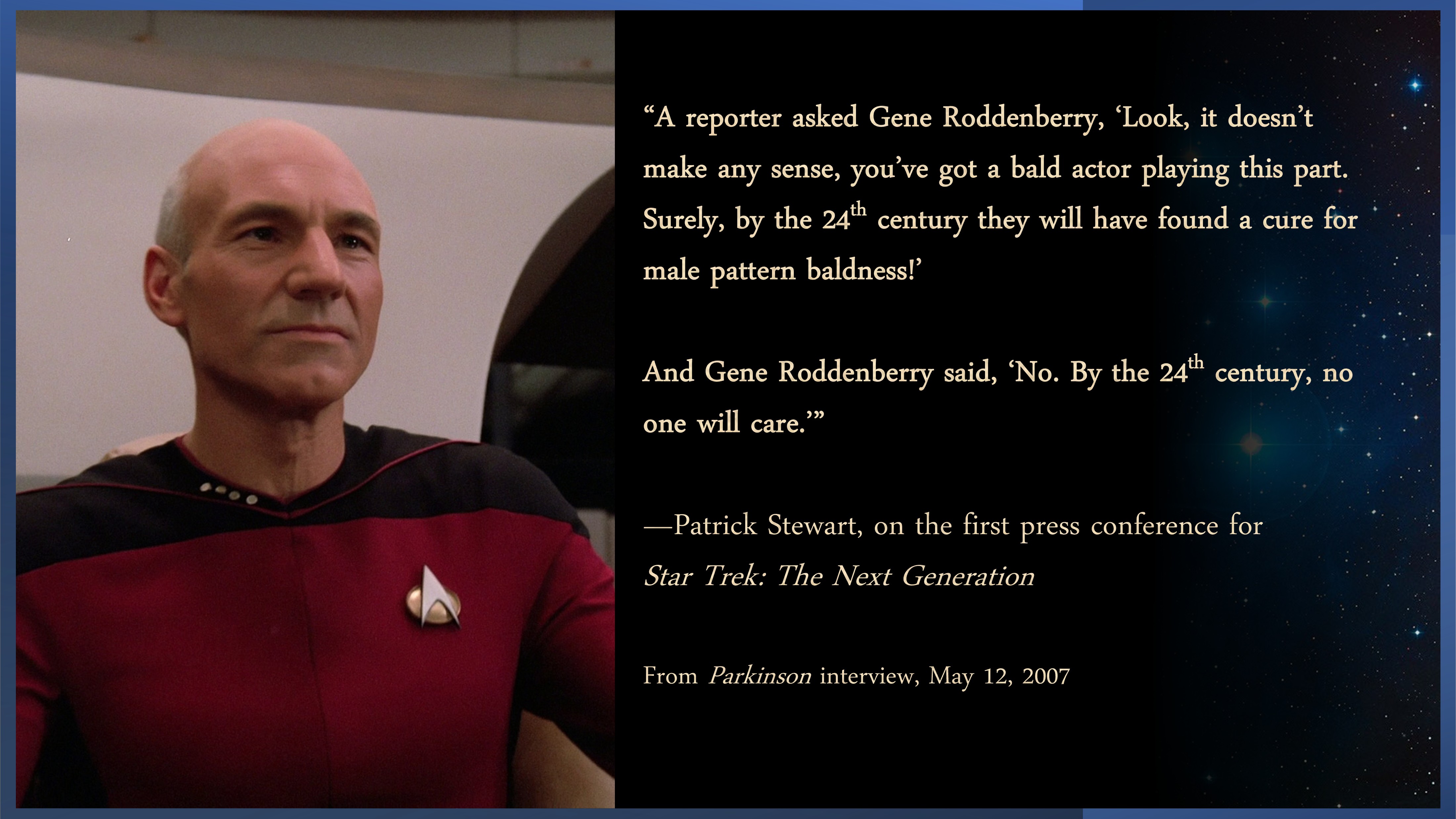
In May 2007, Patrick Stewart shared an anecdote about a bald man being cast as a Star Trek captain.
The interview clip can be found on the BBC’s YouTube channel.
Culture on My Mind is inspired by the weekly Can’t Let It Go segment on the NPR Politics Podcast where each host brings one thing to the table that they just can’t stop thinking about.
Culture on My Mind We Don’t Do Kings Here (Round Two) October 18, 2025
Today marks another series of demonstrations and protests across the United States. Known as the “No Kings” movement, it includes more than 1,500 cities and towns to oppose the current administration. This follows the first round of protests held on June 14th when millions of citizens took to the streets. Organizers of today’s events expect larger numbers in light of events over the last four months.
What follows here is pretty much exactly what I said in June. It all remains true and part of my country’s identity. I served this country honorably in the United States Navy. I come from a long family tradition of military service in support and defense of the United States Constitution and the ideals it represents. I know how important the right to protest is in this country, especially in redress of grievances against the government.
The right of peaceful assembly is inherently American.
The concept of monarchy in the United States is not popular. In the Revolutionary era, an estimated fifteen to twenty percent of colonists were Loyalists in support of the British crown. As the country entered the Confederation period, Alexander Hamilton (among others) recommended crowning an American monarch. Hamilton even stated in a lengthy speech before the Constitutional Convention of 1787 that the United States should be led by an elective monarch who ruled for life unless impeached. His proposal was rejected in favor of the four-year term system that has survived to the modern day (though term limits came about in 1951).
In a poll conducted by YouGov in 2021, a mere five percent of Americans thought a monarchy in the United States would be a good thing, while 69 percent said it would be a bad thing. Two years later, YouGov found twelve percent favored the idea while 63 percent opposed it.
The concept of “no kings” in America goes all the way back to the Declaration of Independence. Fed up with the tyranny of King George III, the Second Continental Congress unanimously voted to adopt and issue the document on July 4, 1776. Contrary to the current President’s interpretation, the document isn’t “a declaration of unity and love and respect”. On the contrary, the Declaration of Independence is a list of grievances. Quite literally, it is well-crafted breakup letter including a list of things the colonists hated about the monarchy.
Among those grievances – the very reasons why the Continental Congress decided to “dissolve the political bands” that connected them to Great Britain – we can see many parallels to the 45th and 47th presidential administrations:
The colonial assemblies passed various laws for self-governance and the common good, which the King refused to acknowledge;
The King used his arbitrary will (read: executive orders) in place of legislative process to establish policy over the consent of the people;
The King opposed immigration because it would give the colonies too much power;
The King interfered with and improperly influenced the judiciary;
The King established a variety of new offices that harassed citizens, spent the treasury for their own good, and lined their own pockets;
The King used the military for domestic enforcement and oppression;
The King held mock trials in lieu of legitimate justice, including removing the benefit of jury trials;
The King used trade to punish people and imposed additional taxes without consent (tariffs, which are taxes on consumers);
The King transported citizens “beyond the Seas to be tried for pretended offenses;”
The King “excited domestic insurrections among us;”
…and the list goes on.
We hold these truths to be self-evident, that all men are created equal, that they are endowed by their Creator with certain unalienable Rights, that among these are Life, Liberty and the pursuit of Happiness.
The Declaration states “That to secure these rights, Governments are instituted among Men, deriving their just powers from the consent of the governed.” The United States government under the Constitution was meant as a democratic republic. The power resides with the people, who elect representatives to govern on their behalf through free and fair elections. The government’s power is derived from the people, and elected officials are responsible to the people.
There is neither bloodline nor divine right to dictate who serves in government. The three separate and co-equal branches of government must operate together with checks and balances. One branch cannot ignore the another simply because it’s inconvenient to uphold the Constitution.
After all, those elected to represent and serve the people swear an oath:
I do solemnly swear (or affirm) that I will support and defend the Constitution of the United States against all enemies, foreign and domestic; that I will bear true faith and allegiance to the same; that I take this obligation freely, without any mental reservation or purpose of evasion; and that I will well and faithfully discharge the duties of the office on which I am about to enter. So help me God.
There is no absolute power in the United States.
There are no kings in America.
That is why the people march again today.
Culture on My Mind is inspired by the weekly Can’t Let It Go segment on the NPR Politics Podcast where each host brings one thing to the table that they just can’t stop thinking about.
Culture on My Mind We Don’t Do Kings Here June 14, 2025
Today marks a series of demonstrations and protests across the United States. Known as the “No Kings” movement, it includes more than 1,500 cities and towns to oppose the current administration.
The concept of monarchy in the United States is not popular. In the Revolutionary era, an estimated fifteen to twenty percent of colonists were Loyalists in support of the British crown. As the country entered the Confederation period, Alexander Hamilton (among others) recommended crowning an American monarch. Hamilton even stated in a lengthy speech before the Constitutional Convention of 1787 that the United States should be led by an elective monarch who ruled for life unless impeached. His proposal was rejected in favor of the four-year term system that has survived to the modern day (though term limits came about in 1951).
In a poll conducted by YouGov in 2021, a mere five percent of Americans thought a monarchy in the United States would be a good thing, while 69 percent said it would be a bad thing. Two years later, YouGov found twelve percent favored the idea while 63 percent opposed it.
The concept of “no kings” in America goes all the way back to the Declaration of Independence. Fed up with the tyranny of King George III, the Second Continental Congress unanimously voted to adopt and issue the document on July 4, 1776. Contrary to the current President’s interpretation, the document isn’t “a declaration of unity and love and respect”. On the contrary, the Declaration of Independence is a list of grievances. Quite literally, it is well-crafted breakup letter including a list of things the colonists hated about the monarchy.
Among those grievances – the very reasons why the Continental Congress decided to “dissolve the political bands” that connected them to Great Britain – we can see many parallels to the 45th and 47th presidential administrations:
The colonial assemblies passed various laws for self-governance and the common good, which the King refused to acknowledge;
The King used his arbitrary will (read: executive orders) in place of legislative process to establish policy over the consent of the people;
The King opposed immigration because it would give the colonies too much power;
The King interfered with and improperly influenced the judiciary;
The King established a variety of new offices that harassed citizens, spent the treasury for their own good, and lined their own pockets;
The King used the military for domestic enforcement and oppression;
The King held mock trials in lieu of legitimate justice, including removing the benefit of jury trials;
The King used trade to punish people and imposed additional taxes without consent (tariffs, which are taxes on consumers);
The King transported citizens “beyond the Seas to be tried for pretended offenses;”
The King “excited domestic insurrections among us;”
…and the list goes on.
We hold these truths to be self-evident, that all men are created equal, that they are endowed by their Creator with certain unalienable Rights, that among these are Life, Liberty and the pursuit of Happiness.
The Declaration states “That to secure these rights, Governments are instituted among Men, deriving their just powers from the consent of the governed.” The United States government under the Constitution was meant as a democratic republic. The power resides with the people, who elect representatives to govern on their behalf through free and fair elections. The government’s power is derived from the people, and elected officials are responsible to the people.
There is neither bloodline nor divine right to dictate who serves in government. The three separate and co-equal branches of government must operate together with checks and balances. One branch cannot ignore the another simply because it’s inconvenient to uphold the Constitution.
After all, those elected to represent and serve the people swear an oath:
I do solemnly swear (or affirm) that I will support and defend the Constitution of the United States against all enemies, foreign and domestic; that I will bear true faith and allegiance to the same; that I take this obligation freely, without any mental reservation or purpose of evasion; and that I will well and faithfully discharge the duties of the office on which I am about to enter. So help me God.
There is no absolute power.
There are no kings.
That is why the people march today.
Culture on My Mind is inspired by the weekly Can’t Let It Go segment on the NPR Politics Podcast where each host brings one thing to the table that they just can’t stop thinking about.
Culture on My Mind There’s a Reason… June 11, 2025
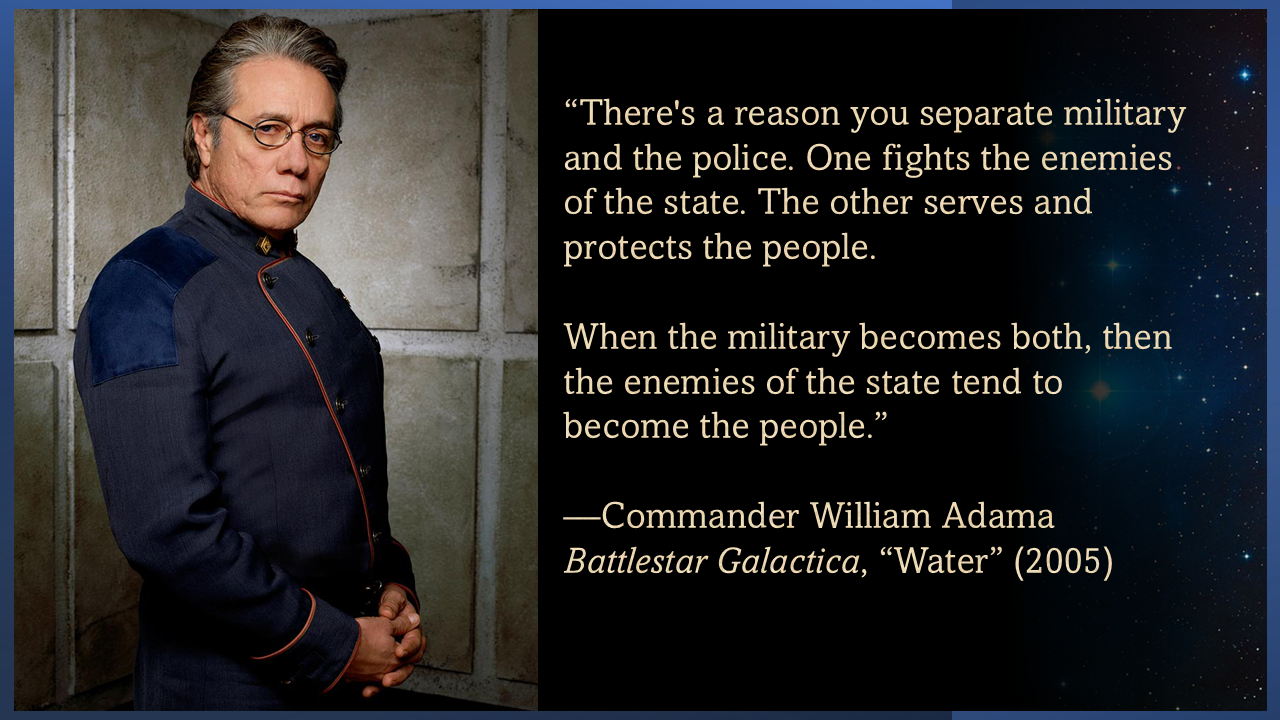
The reimagined Battlestar Galactica was written as a post-9/11 allegory. Over four seasons, it told the story of a group of refugees seeking asylum from violence, oppression, and genocide. Their beacon of freedom, democracy, and opportunity – the shining city on the hill – was Earth.
These words are still relevant twenty years after they were spoken on our television screens.
Culture on My Mind is inspired by the weekly Can’t Let It Go segment on the NPR Politics Podcast where each host brings one thing to the table that they just can’t stop thinking about.
Culture on My Mind When Compassion Becomes Resistance January 27, 2025
Let me make one final plea, Mr. President. Millions have put their trust in you, and as you told the nation yesterday, you have felt the providential hand of a loving God. In the name of our God, I ask you to have mercy upon the people in our country who are scared now. There are gay, lesbian, and transgender children in Democratic, Republican, and independent families, some who fear for their lives. The people who pick our crops and clean our office buildings, who labor in poultry farms and meatpacking plants, who wash the dishes after we eat in restaurants and work the night shifts in hospitals, they may not be citizens or have the proper documentation, but the vast majority of immigrants are not criminals. They pay taxes and are good neighbors. They are faithful members of our churches and mosques, synagogues, gurdwara, and temples.
I ask you to have mercy, Mr. President, on those in our communities whose children fear their parents will be taken away, and that you help those who are fleeing war zones and persecution in their own lands to find compassion and welcome here. Our God teaches us that we are to be merciful to the stranger, for we were all once strangers in this land. May God grant us the strength and courage to honor the dignity of every human being, to speak the truth to one another in love, and walk humbly with each other and our God, for the good of all people, the good of all people in this nation and the world. Amen.
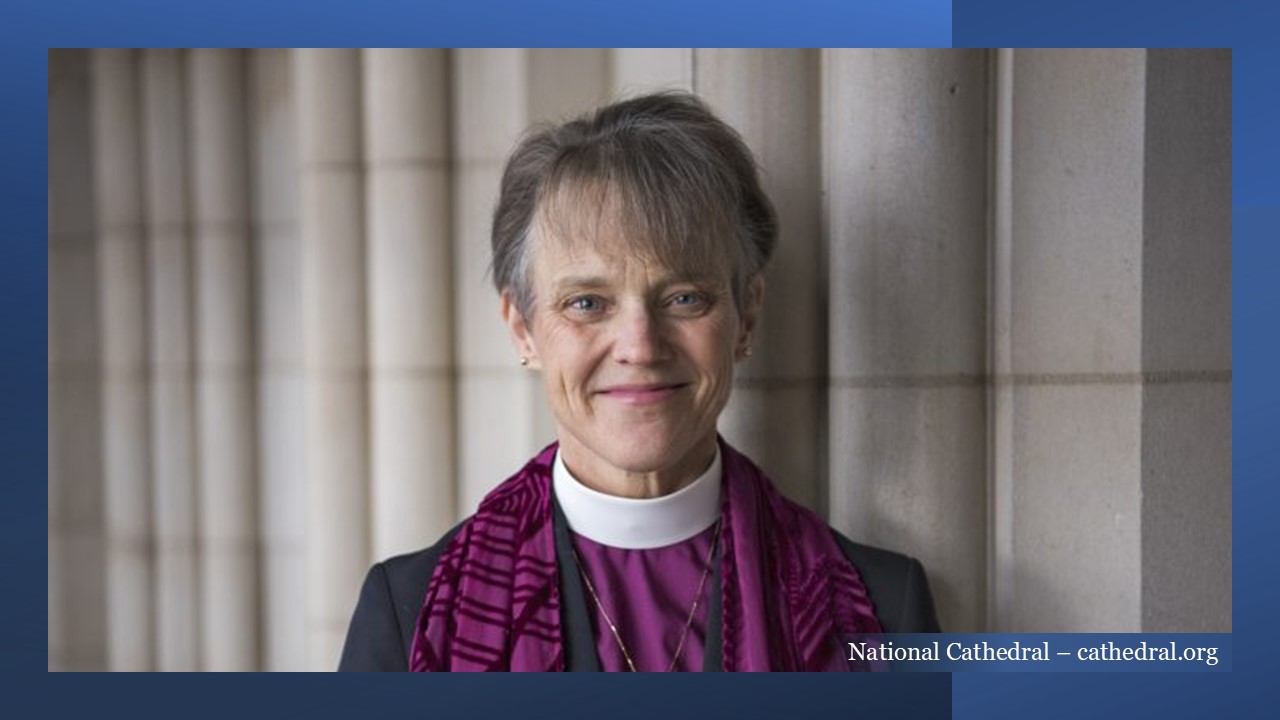
Bishop Budde is the first woman to be the Bishop of Washington. She has dedicated her life in service of her faith, the very same faith as (one assumes) most of her detractors. She stands by the philosophy of justice, peace, and respect for human dignity.
She exemplified this in the case of Matthew Shepard.
Matthew Shepard was a student at the University of Wyoming. Because he was gay, he was beaten, tortured, and left in the elements tied to a split-rail fence. He died from his injuries six days later. His murderers are serving two consecutive life sentences each.
The Matthew Shepard and James Byrd Jr. Hate Crimes Prevention Act was signed into law by President Obama in his honor, expanding hate crime legislation to include crimes motivated by a victim’s actual or perceived gender, sexual orientation, gender identity, or disability.
Bishop Budde came into the story when the Shepard family was looking for a place to memorialize their son. The family considered spreading Matthew’s ashes in Wyoming, but also wanted a place to visit and reflect upon his memory. Unfortunately, they also feared desecration of his final resting place after seeing protestors from the Westboro Baptist Church at his funeral.
Twenty years after Matthew’s death, they were offered a space at the National Cathedral, and the interment service was presided by Bishop Budde. His resting place acts as a monument to sanctuary and healing through compassion. As Bishop Budde told the New York Times, “We are doing our part to bring light out of that darkness and healing to those who have been so often hurt, and sometimes hurt in the name of the church.”
Her views on compassion and mercy continue to this day. To Time, she said: “The real people who are in danger are those who are fearful of being deported. The real people who are in danger are the young people who feel they cannot be themselves and be safe and who are prone to all kinds of both external attacks and suicidal responses to them. So I think we should keep our eyes on the people who are really vulnerable in our society.”
Love they neighbor as thyself. A directive for compassion and mercy and respect. One of the two commandments upon which should hang all law and prophets according to the New Testament, from the words of Jesus.
It is sad that, in this day and age, such compassion is needed as resistance against tyranny.
Culture on My Mind is inspired by the weekly Can’t Let It Go segment on the NPR Politics Podcast where each host brings one thing to the table that they just can’t stop thinking about.
Culture on My Mind Sacheen Littlefeather April 11, 2022
With the recent Oscars scandal on everyone’s mind, I decided to dig into a different time when the Academy was shaken up. This week, I’m thinking about Sacheen Littlefeather and her protest at the 45th Academy Awards.
Before talking about the actual protest, however, it’s important to think about the context. Between February 27 and May 8, 1973, approximately two hundred Ogala Lakota and followers of the American Indian Movement (known as AIM) seized and occupied the town of Wounded Knee, South Dakota, located on the Pine Ridge Indian Reservation.
The grievances were twofold. First, they were protesting the failure of the Ogala Sioux Civil Rights Organization to impeach tribal president Richard Wilson on charges of corruption and abuse of opponents. Second, they protested the United States government’s failure to fulfill treaties with Native American people. To that point, they demanded the reopening of treaty negotiations in the hopes of finding fair and equitable treatment of Native Americans.
The siege was a long time coming, fueled by decades of Native American mistreatment and misrepresentation by the United States. Symbolically, the site was chosen for its historic value, having been the same place where three hundred Lakota were massacred by the United States Army on December 29, 1890.
The siege lasted for 71 days and resulted in two deaths, several wounded, and one missing civil rights activist. The events buoyed Native Americans and supporters, motivating widespread public sympathy as the country became more aware of the injustices related to Native Americans. Among those supporters was Sacheen Littlefeather.
Born Marie Cruz, Sacheen Littlefeather was the daughter of a Native American (Apache and Yaqui) father and a European American mother. She found her voice as a Native American activist during the 19-month occupation of Alcatraz that began in 1969 and began to explore her heritage.
She contacted Marlon Brando, an AIM supporter, and established a relationship with the actor through his interest in Native American issues, including treatment in Hollywood.
Native Americans in Hollywood are typically fictitious stock characters and stereotypes. They are often portrayed across the range from violent barbarians to noble and peaceful savages, and they were often whitewashed in the heyday of the Western film genre by placing white actors in redface. Native Americans in Western films were often cast as a mysterious villainous horde, and it wasn’t until 1950’s Broken Arrow that Native Americans started being seen sympathetically in film. The tide turned in the 1990s toward explorations of the depth and complexity of Native tribes, but 1973 was a completely different story.
The favorite film at the 45th Academy Awards was The Godfather, tied with Cabaret at ten nominations, and Marlon Brando was expected to win the Best Actor award for his performance. He decided to boycott the ceremony and sent Sacheen Littlefeather in his place with a 15-page speech to explore their shared grievances. She arrived in an Apache buckskin dress minutes before the award was announced, accompanied by Brando’s secretary, Alice Marchak, and was told that she had 60 seconds to deliver the speech or she would be removed.
She ascended the stage, turned down the award with an upraised hand, and improvised.
Hello. My name is Sacheen Littlefeather. I’m Apache and I am president of the National Native American Affirmative Image Committee. I’m representing Marlon Brando this evening, and he has asked me to tell you in a very long speech which I cannot share with you presently, because of time, but I will be glad to share with the press afterwards, that he very regretfully cannot accept this very generous award. And the reasons for this being are the treatment of American Indians today by the film industry – excuse me…
At this point, she was interrupted by both boos and cheers from the assembled audience, but she carried on.
…and on television in movie re-runs, and also with recent happenings at Wounded Knee. I beg at this time that I have not intruded upon this evening, and that we will in the future, our hearts and our understandings will meet with love and generosity. Thank you on behalf of Marlon Brando.
According to an interview with The Guardian, she was almost forcibly removed by actor John Wayne, but he was restrained by six security guards. John Wayne made a career in the Western film genre as the stereotypical Hollywood cowboy and his racism, homophobia, misogyny, and disdain for social programs were well-known, especially from his 1971 interview with Playboy magazine.
In part:
With a lot of blacks, there’s quite a bit of resentment along with their dissent, and possibly rightfully so. But we can’t all of a sudden get down on our knees and turn everything over to the leadership of the blacks. I believe in white supremacy until the blacks are educated to a point of responsibility. […] I don’t feel we did wrong in taking this great country away from the Indians. Our so-called stealing of this country from them was just a matter of survival. There were great numbers of people who needed new land, and the Indians were selfishly trying to keep it for themselves.
Littlefeather’s speech did not go well with the industry or certain fans. Later that night, Littlefeather was mocked by both Raquel Welch and Clint Eastwood as they presented other awards, and her appearance prompted the Academy of Motion Picture Arts and Sciences to eliminate the use of proxy acceptance of awards in the future. Backstage after her presentation, people were making stereotypical Native American war cries and miming the tomahawk chop in mockery.
The media published several false stories in an attempt to discredit Littlefeather and her heritage, and when she visited Brando’s home after the ceremony, bullets were fired into his front door. But, with Brando’s 15-page speech shared with the New York Times, attention was focused back on Wounded Knee. The media blackout of the siege was lifted and the world’s eyes were opened.
Coretta Scott King called Littlefeather to thank her for the speech. She was also cited as the inspiration for Jada Pinkett Smith’s boycott of the 87th Academy Awards in 2014 for lack of diversity in nominations.
After the Oscars scandal, Littlefeather traveled the world and received a degree in health with a minor in Native American medicine. She spent her life involved in Native American activism, including co-founding the National American Indian Performing Arts Registry and the American Indian AIDS Institute of San Francisco.
Despite being the butt of racist and misogynist jokes to this day, she has lived up to the promise she made to herself that she would break barriers and live an interesting life.
In 2018, she announced that she had developed Stage 4 breast cancer. In a mid-2021 interview, she revealed that the disease had metastasized to her right lung and that she was terminally ill.
The Academy Awards are often nights of glitter and glamor, typically viewed as an opportunity for Hollywood to toot horns (or slap faces) in extravagant self-indulgence. But with millions of eyes and ears on the annual ceremonies, sometimes messages including climate change, equal pay, and voting rights take center stage. It’s a trend that I support given the spotlight and audience that these often well-educated celebrities command. They are far from mere monkeys paid to dance for our enjoyment.
In 1973, at what is known as the most controversial Oscars ceremony on record, the spotlight was placed on Native American rights. I hope history remembers Sacheen Littlefeather and her courage as she faced down an entire entertainment industry for what she believed in.
Culture on My Mind is inspired by the weekly Can’t Let It Go segment on the NPR Politics Podcast where each host brings one thing to the table that they just can’t stop thinking about.
Culture on My Mind The Overthrow of the Kingdom of Hawai’i March 7, 2022
An educational short from TED-Ed about the dark history of paradise is on my mind this week.
The history is apalling but not unique. This United States has a history of taking lands from native people simply because they want it.
The United States apologized for its role in the affair through United States Public Law 103-150 of 1993 (known as the “Apology Resolution”), which acknowledged two things:
First, that “the overthrow of the Kingdom of Hawaii occurred with the active participation of agents and citizens of the United States”, and
Second, “that the Native Hawaiian people never directly relinquished to the United States their claims to their inherent sovereignty as a people over their national lands, either through the Kingdom of Hawaii or through a plebiscite or referendum.”
This short video provides an overview through the two-year reign of Queen Liliʻuokalani.
In light of the recent spate of book banning and demands for greater oversight in public schools, there is an unattributed quote circulating the internet. The truth about studying history is very simple.
Studying history will sometimes make you uncomfortable. Studying history will sometimes make you feel deeply upset. Studying history will sometimes make you feel extremely angry. If studying history always makes you feel proud and happy, you probably aren’t studying history.
History is never clean and simple because people and nations will always do terrible things, and they will justify those atrocities in any way they can. You can be proud of your heritage and citizenship but knowledge and understanding of what built them to you are key to maintaining the rights and privileges you enjoy.
History is bloody and complicated. If studying history always makes you feel proud and happy, you’re likely studying propaganda.
Culture on My Mind is inspired by the weekly Can’t Let It Go segment on the NPR Politics Podcast where each host brings one thing to the table that they just can’t stop thinking about.
Culture on My Mind A Symbol, for Which it Stands June 23, 2015
The power of symbols is not lost on me, and I often find myself divided between two camps. On the one hand, symbols can carry a tremendous amount of weight and history. On the other, symbols can be repurposed and reclaimed to support anything.
The most obvious historical example is the swastika, which originally was a sign of luck across various cultures that became a symbol of oppression and hatred. Unfortunately, negative connotations often carry more weight than positives, easily rendering the positive meaning impotent. Now, the swastika is avoided in Western culture because of its connection to the Holocaust.
In the United States, the Confederate Battle Flag is a prevalent symbol south of the Mason-Dixon Line, and is used to rally southern pride. Developed during the American Civil War as a distinctive symbol (since the Confederate States of America’s official flag was confusingly similar to that of the United States), each star signified a member state in the new nation, and was indicative of the unified drive for states’ rights that sparked the rebellion. It has two visually similar cousins, the Second Confederate Navy Jack and the battle flag of the Army of Tennessee.
The battle flag of the Army of Tennessee, commonly displayed as the Confederate flag.
As it signified “states’ rights,” I supported the South’s continued use of the flag, even with the understanding that the Civil War was also partly driven by the topic of slavery. I had no concrete proof that slavery was the prime reason for the tensions, but was instead a secondary concern. Even in 1860, a year or so before the Civil War began, slavery was treated as a states’ rights issue; Southern Democrats endorsed the practice, Republicans denounced it, and Northern Democrats said democracy required the people to decide locally, state by state, territory by territory.
It should go without saying that I do not personally support slavery, but to understand the motivations of the time, I also need to consider the era. It wasn’t necessarily a moral issue, but rather a political one.
The Constitution of the Confederate States of America was adopted on March 11, 1861. Ten days later, Alexander Stephens, the vice president of the new nation, delivered a speech in Athens, Georgia that outlined the fundamental differences between the CSA and the USA. Among those differences was what he called the “immediate cause” of secession and rebellion: Slavery.
Our new government is founded upon exactly the opposite idea; its foundations are laid, its cornerstone rests, upon the great truth that the negro is not equal to the white man; that slavery subordination to the superior race is his natural and normal condition. This, our new government, is the first, in the history of the world, based upon this great physical, philosophical, and moral truth.
Deeper into the address, Stephens elaborates on this fundamental difference, lamenting that the United States was “attempting to make things equal which the Creator had made unequal.”
After applying the lens of modern society to this revelation, I had no choice but to step back from my support of the states’ rights argument: It’s plain as day that the core point of contention between the Blue and the Gray wasn’t state autonomy at all, but instead a policy of oppression and subjugation that we deplore in modern times. In fact, this nation fights against such policies and regimes in foreign countries all the time. Why is it any different when the conflict is here at home?
Historians often ignore this speech, and detractors suggest that it was only one speech by one man over a century ago, so it shouldn’t matter. The problem lies in the man who delivered the address. The Office of the Vice President was nearly identical between both the United States and the Confederate States, and therefore held the same authority when speaking with the power of the position. Consider if any sitting Vice President in the modern era made a similar speech about using executive or legislative policy to enable subjugation of a race. He or she would be castigated, repudiated, and likely forced to immediately resign.
The articles of secession provide further evidence: Four of the states issued additional declarations of cause that strongly defended slavery as a reason to secede. Those four states – Georgia, Mississippi, Texas, and South Carolina – were among the first seven to leave the Union. Texas and two other states – Alabama and Virginia, the fourth and eighth states to secede, respectively – mentioned slavery in their secession acts. Of the six states with slavery as a declared priority, five of them were among the seven state signatories to the Confederate Constitution. That’s a clear majority of the founders of the Confederacy.
It’s clear with respect to history that the Confederacy stood for racism to achieve states’ rights, and the ends cannot justify the means.
I certainly don’t suggest that anyone who uses the symbols of the Confederacy is a racist or supports slavery, but I do believe that the motivations of the past should be considered when voicing support. Boldly proclaiming that “the South shall rise again” takes on a whole new tone when the true aims of the defeated Confederate States are added to the mix.
I believe citizens and governments should honestly deliberate over state-sponsored use of Confederate symbols. These symbols have power and history, and as mentioned before, the negatives tend to outweigh the positives. States speak for their citizens, and should not wave the sins of the past over the families of the oppressed.
I don’t support a full ban of the symbols, as bans create an allure of mystery and taboo. We as a people need to learn from our history and mistakes, and never forget the past. To that end, I believe that the southern states should seriously consider removing the Stars and Bars from flagpoles, and to paraphrase Indiana Jones, place them where they belong – in a museum.
Culture on My Mind is inspired by the weekly Can’t Let It Go segment on the NPR Politics Podcast where each host brings one thing to the table that they just can’t stop thinking about.
Culture on My Mind Tuesday Morning September 10, 2010
It started like any other Tuesday. I had to be at the University of Utah in Salt Lake City by 7:30 for class, and that meant joining the fray with every other commuter who fought the non-stop rush of cars from Davis County to the capitol. Up early, showered, and fed, I ventured into the temperate September air along the Wasatch Front. The drive was uneventfully normal along the I-15 corridor as I hit 100 South and started east toward the campus, the Todd and Erin morning show playing on the radio.
At about 6:45, Todd and Erin returned from a song to some breaking news: a small twin-engine plane had just flown into the World Trade Center. While I was amazed, I wasn’t too terribly concerned, but I remember hoping that no one was hurt too badly. Minutes later, the story changed. It wasn’t a small Cessna-like plane… it was a commercial airliner.
I reached the university and waited a few minutes before walking to the Naval Sciences building to start my navigation class, but no further news came. When I got to the boxy two-story building, I checked my mailbox – every NROTC midshipman had one to deliver important messages from the battalion – and went upstairs to get ready for class. Once I crossed the threshold, I found the speculation in full gear. Our instructor gave permission to listen to the radio while we worked on our assignment, and that’s when we got the full details.
I remember the sense of fear I had, coupled with anger and frustration. I will admit that I was angry at all Muslims at that point, but that was before I fully understood the details about extremism and terrorism. I now understand, nine years later, that my anger was misdirected. I never acted on those emotions, and I am glad I didn’t. I also am happy that I was able to learn about another complexity in the human tapestry.
In the immediate aftermath, Americans were buoyed up as a single voice under the call to action based on revenge. For every question of “where were you when the world stopped turning,” there was a yell to kick some ass because it’s the “American way.” New legislation that was supposed to protect national security and make us more safe ended up biting back with illegal wiretaps and tracking of born and raised American citizens who had no intention of betraying the red, white, and blue. Now we stand divided amongst ourselves and listening to the screaming voices who still believe that all Muslims stand allied in favor of the actions of extremists.
The scenes nine years ago were certainly shocking and game-changing, but I firmly believe that we should stand together against those who would do us harm, not against a category of people who had no more to do with the attacks than I did. “Patriot Day,” which in my opinion needs to be re-named, should be a day of solemn reflection, not political grandstanding.
I honor those who sacrificed their health or lives in efforts to rescue the fallen. I honor those who sacrificed their lives to prevent United Flight 93 from impacting in Washington, DC. I honor those who were killed in the impacts of American Airlines Flight 11, American Airlines Flight 77, and United Airlines Flight 175. I honor those who died in the aftermath.
I honor those who fight to defend our freedom from those who would take it. I honor those who practice tolerance in the name of those freedoms in lieu of allowing hatred and bigotry to rule their actions. I honor those who rise above petty politics and divisive labels to ensure our freedom persists and help to heal our wounds.
I honor those who remind us that we are all members of the human race, despite our color, religion, sexuality, gender, or other factors are used to divide us.
Above all, I vow to never forget.
Culture on My Mind is inspired by the weekly Can’t Let It Go segment on the NPR Politics Podcast where each host brings one thing to the table that they just can’t stop thinking about.





 Creative Criticality