Culture on My Mind Star Trek at 60: Physical Appearances in the 24th Century January 15, 2026
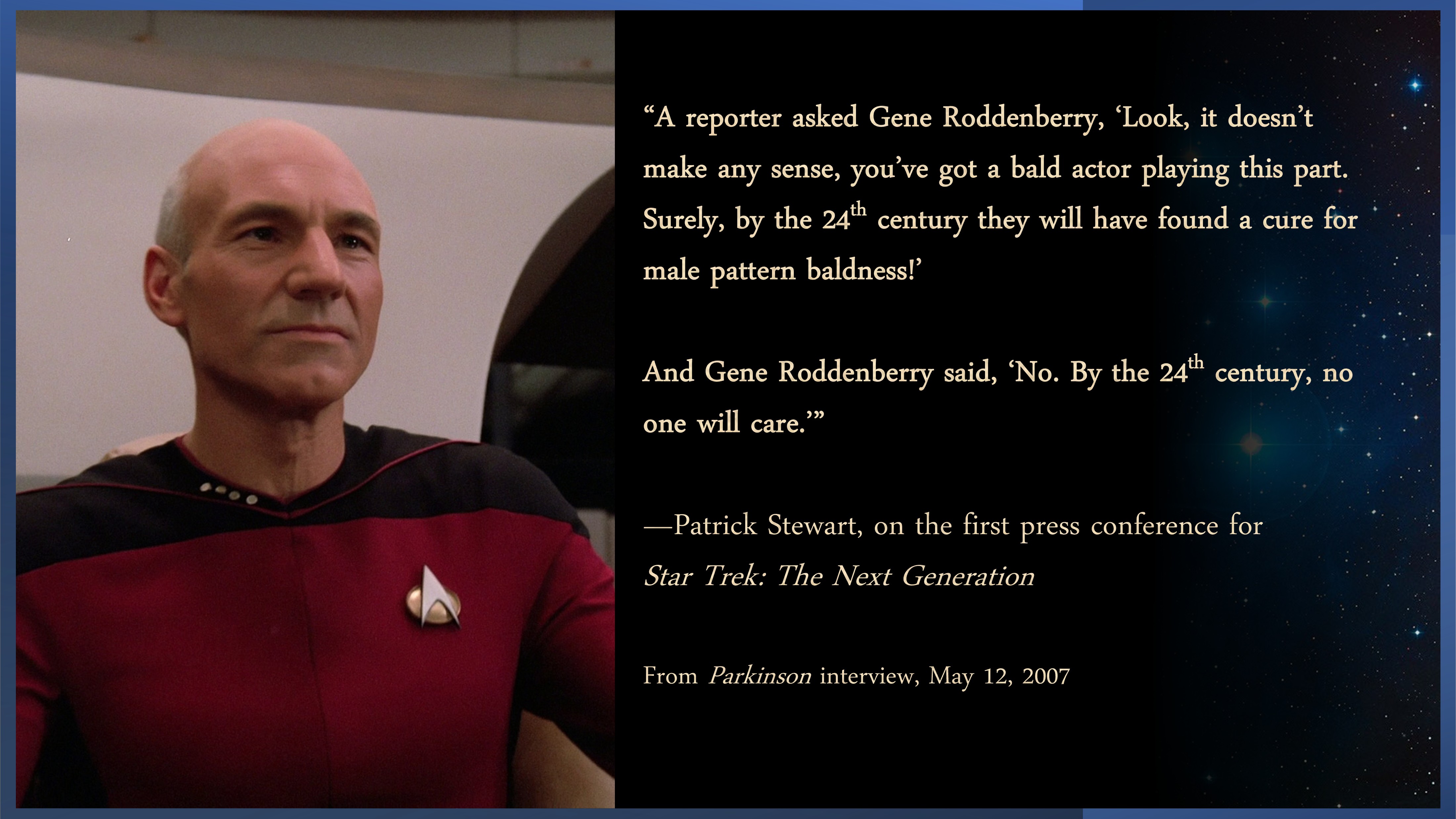
In May 2007, Patrick Stewart shared an anecdote about a bald man being cast as a Star Trek captain.
The interview clip can be found on the BBC’s YouTube channel.
Culture on My Mind is inspired by the weekly Can’t Let It Go segment on the NPR Politics Podcast where each host brings one thing to the table that they just can’t stop thinking about.
Culture on My Mind We Don’t Do Kings Here (Round Two) October 18, 2025
Today marks another series of demonstrations and protests across the United States. Known as the “No Kings” movement, it includes more than 1,500 cities and towns to oppose the current administration. This follows the first round of protests held on June 14th when millions of citizens took to the streets. Organizers of today’s events expect larger numbers in light of events over the last four months.
What follows here is pretty much exactly what I said in June. It all remains true and part of my country’s identity. I served this country honorably in the United States Navy. I come from a long family tradition of military service in support and defense of the United States Constitution and the ideals it represents. I know how important the right to protest is in this country, especially in redress of grievances against the government.
The right of peaceful assembly is inherently American.
The concept of monarchy in the United States is not popular. In the Revolutionary era, an estimated fifteen to twenty percent of colonists were Loyalists in support of the British crown. As the country entered the Confederation period, Alexander Hamilton (among others) recommended crowning an American monarch. Hamilton even stated in a lengthy speech before the Constitutional Convention of 1787 that the United States should be led by an elective monarch who ruled for life unless impeached. His proposal was rejected in favor of the four-year term system that has survived to the modern day (though term limits came about in 1951).
In a poll conducted by YouGov in 2021, a mere five percent of Americans thought a monarchy in the United States would be a good thing, while 69 percent said it would be a bad thing. Two years later, YouGov found twelve percent favored the idea while 63 percent opposed it.
The concept of “no kings” in America goes all the way back to the Declaration of Independence. Fed up with the tyranny of King George III, the Second Continental Congress unanimously voted to adopt and issue the document on July 4, 1776. Contrary to the current President’s interpretation, the document isn’t “a declaration of unity and love and respect”. On the contrary, the Declaration of Independence is a list of grievances. Quite literally, it is well-crafted breakup letter including a list of things the colonists hated about the monarchy.
Among those grievances – the very reasons why the Continental Congress decided to “dissolve the political bands” that connected them to Great Britain – we can see many parallels to the 45th and 47th presidential administrations:
The colonial assemblies passed various laws for self-governance and the common good, which the King refused to acknowledge;
The King used his arbitrary will (read: executive orders) in place of legislative process to establish policy over the consent of the people;
The King opposed immigration because it would give the colonies too much power;
The King interfered with and improperly influenced the judiciary;
The King established a variety of new offices that harassed citizens, spent the treasury for their own good, and lined their own pockets;
The King used the military for domestic enforcement and oppression;
The King held mock trials in lieu of legitimate justice, including removing the benefit of jury trials;
The King used trade to punish people and imposed additional taxes without consent (tariffs, which are taxes on consumers);
The King transported citizens “beyond the Seas to be tried for pretended offenses;”
The King “excited domestic insurrections among us;”
…and the list goes on.
We hold these truths to be self-evident, that all men are created equal, that they are endowed by their Creator with certain unalienable Rights, that among these are Life, Liberty and the pursuit of Happiness.
The Declaration states “That to secure these rights, Governments are instituted among Men, deriving their just powers from the consent of the governed.” The United States government under the Constitution was meant as a democratic republic. The power resides with the people, who elect representatives to govern on their behalf through free and fair elections. The government’s power is derived from the people, and elected officials are responsible to the people.
There is neither bloodline nor divine right to dictate who serves in government. The three separate and co-equal branches of government must operate together with checks and balances. One branch cannot ignore the another simply because it’s inconvenient to uphold the Constitution.
After all, those elected to represent and serve the people swear an oath:
I do solemnly swear (or affirm) that I will support and defend the Constitution of the United States against all enemies, foreign and domestic; that I will bear true faith and allegiance to the same; that I take this obligation freely, without any mental reservation or purpose of evasion; and that I will well and faithfully discharge the duties of the office on which I am about to enter. So help me God.
There is no absolute power in the United States.
There are no kings in America.
That is why the people march again today.
Culture on My Mind is inspired by the weekly Can’t Let It Go segment on the NPR Politics Podcast where each host brings one thing to the table that they just can’t stop thinking about.
Culture on My Mind We Don’t Do Kings Here June 14, 2025
Today marks a series of demonstrations and protests across the United States. Known as the “No Kings” movement, it includes more than 1,500 cities and towns to oppose the current administration.
The concept of monarchy in the United States is not popular. In the Revolutionary era, an estimated fifteen to twenty percent of colonists were Loyalists in support of the British crown. As the country entered the Confederation period, Alexander Hamilton (among others) recommended crowning an American monarch. Hamilton even stated in a lengthy speech before the Constitutional Convention of 1787 that the United States should be led by an elective monarch who ruled for life unless impeached. His proposal was rejected in favor of the four-year term system that has survived to the modern day (though term limits came about in 1951).
In a poll conducted by YouGov in 2021, a mere five percent of Americans thought a monarchy in the United States would be a good thing, while 69 percent said it would be a bad thing. Two years later, YouGov found twelve percent favored the idea while 63 percent opposed it.
The concept of “no kings” in America goes all the way back to the Declaration of Independence. Fed up with the tyranny of King George III, the Second Continental Congress unanimously voted to adopt and issue the document on July 4, 1776. Contrary to the current President’s interpretation, the document isn’t “a declaration of unity and love and respect”. On the contrary, the Declaration of Independence is a list of grievances. Quite literally, it is well-crafted breakup letter including a list of things the colonists hated about the monarchy.
Among those grievances – the very reasons why the Continental Congress decided to “dissolve the political bands” that connected them to Great Britain – we can see many parallels to the 45th and 47th presidential administrations:
The colonial assemblies passed various laws for self-governance and the common good, which the King refused to acknowledge;
The King used his arbitrary will (read: executive orders) in place of legislative process to establish policy over the consent of the people;
The King opposed immigration because it would give the colonies too much power;
The King interfered with and improperly influenced the judiciary;
The King established a variety of new offices that harassed citizens, spent the treasury for their own good, and lined their own pockets;
The King used the military for domestic enforcement and oppression;
The King held mock trials in lieu of legitimate justice, including removing the benefit of jury trials;
The King used trade to punish people and imposed additional taxes without consent (tariffs, which are taxes on consumers);
The King transported citizens “beyond the Seas to be tried for pretended offenses;”
The King “excited domestic insurrections among us;”
…and the list goes on.
We hold these truths to be self-evident, that all men are created equal, that they are endowed by their Creator with certain unalienable Rights, that among these are Life, Liberty and the pursuit of Happiness.
The Declaration states “That to secure these rights, Governments are instituted among Men, deriving their just powers from the consent of the governed.” The United States government under the Constitution was meant as a democratic republic. The power resides with the people, who elect representatives to govern on their behalf through free and fair elections. The government’s power is derived from the people, and elected officials are responsible to the people.
There is neither bloodline nor divine right to dictate who serves in government. The three separate and co-equal branches of government must operate together with checks and balances. One branch cannot ignore the another simply because it’s inconvenient to uphold the Constitution.
After all, those elected to represent and serve the people swear an oath:
I do solemnly swear (or affirm) that I will support and defend the Constitution of the United States against all enemies, foreign and domestic; that I will bear true faith and allegiance to the same; that I take this obligation freely, without any mental reservation or purpose of evasion; and that I will well and faithfully discharge the duties of the office on which I am about to enter. So help me God.
There is no absolute power.
There are no kings.
That is why the people march today.
Culture on My Mind is inspired by the weekly Can’t Let It Go segment on the NPR Politics Podcast where each host brings one thing to the table that they just can’t stop thinking about.
Culture on My Mind There’s a Reason… June 11, 2025
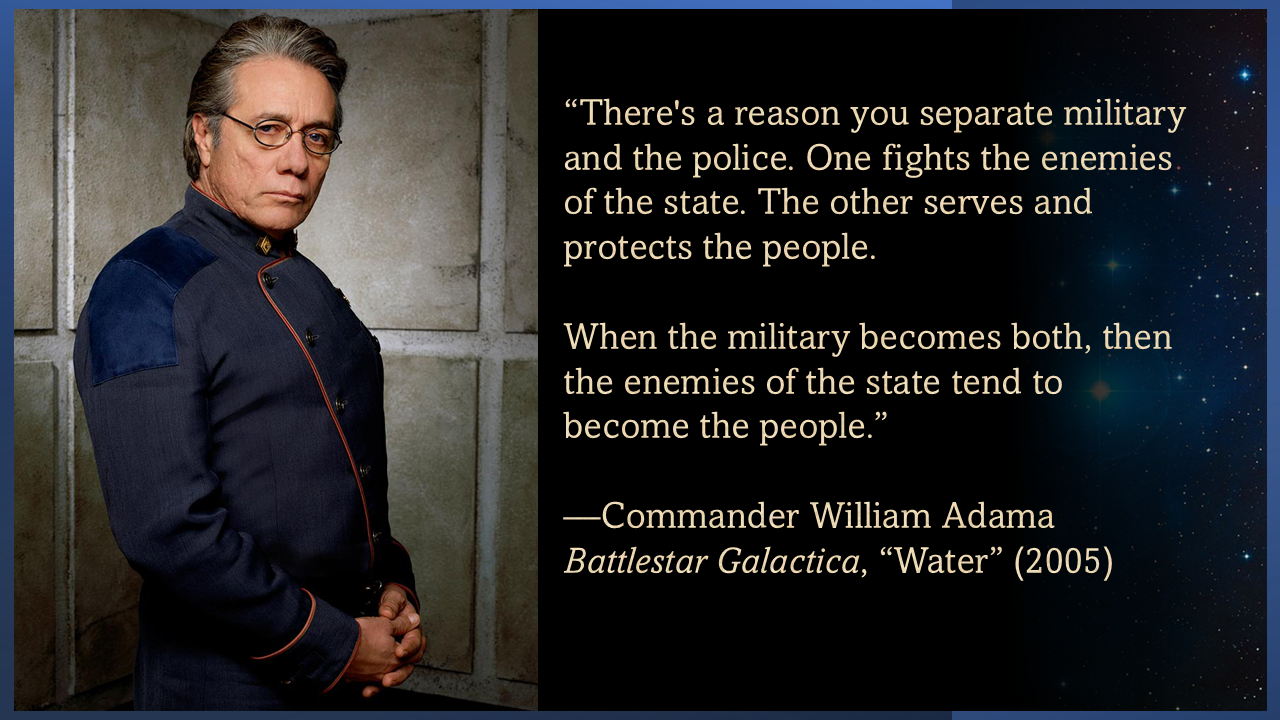
The reimagined Battlestar Galactica was written as a post-9/11 allegory. Over four seasons, it told the story of a group of refugees seeking asylum from violence, oppression, and genocide. Their beacon of freedom, democracy, and opportunity – the shining city on the hill – was Earth.
These words are still relevant twenty years after they were spoken on our television screens.
Culture on My Mind is inspired by the weekly Can’t Let It Go segment on the NPR Politics Podcast where each host brings one thing to the table that they just can’t stop thinking about.
Culture on My Mind When Compassion Becomes Resistance January 27, 2025
Let me make one final plea, Mr. President. Millions have put their trust in you, and as you told the nation yesterday, you have felt the providential hand of a loving God. In the name of our God, I ask you to have mercy upon the people in our country who are scared now. There are gay, lesbian, and transgender children in Democratic, Republican, and independent families, some who fear for their lives. The people who pick our crops and clean our office buildings, who labor in poultry farms and meatpacking plants, who wash the dishes after we eat in restaurants and work the night shifts in hospitals, they may not be citizens or have the proper documentation, but the vast majority of immigrants are not criminals. They pay taxes and are good neighbors. They are faithful members of our churches and mosques, synagogues, gurdwara, and temples.
I ask you to have mercy, Mr. President, on those in our communities whose children fear their parents will be taken away, and that you help those who are fleeing war zones and persecution in their own lands to find compassion and welcome here. Our God teaches us that we are to be merciful to the stranger, for we were all once strangers in this land. May God grant us the strength and courage to honor the dignity of every human being, to speak the truth to one another in love, and walk humbly with each other and our God, for the good of all people, the good of all people in this nation and the world. Amen.
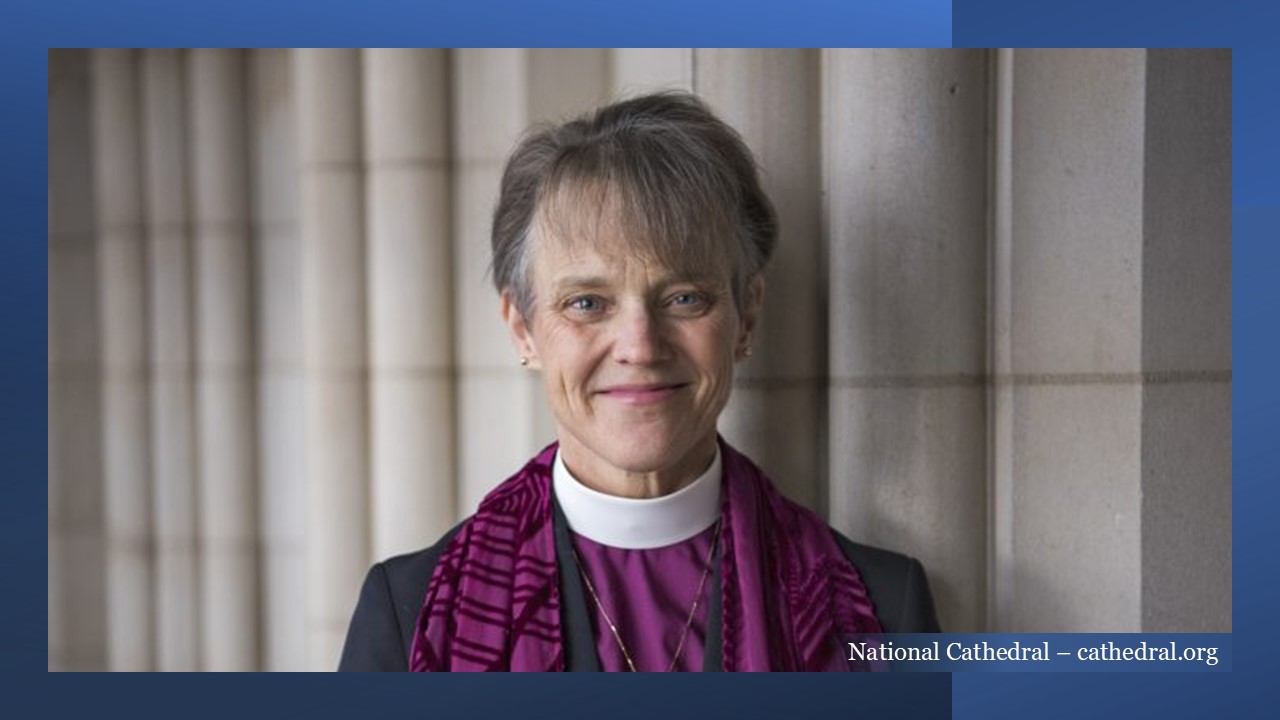
Bishop Budde is the first woman to be the Bishop of Washington. She has dedicated her life in service of her faith, the very same faith as (one assumes) most of her detractors. She stands by the philosophy of justice, peace, and respect for human dignity.
She exemplified this in the case of Matthew Shepard.
Matthew Shepard was a student at the University of Wyoming. Because he was gay, he was beaten, tortured, and left in the elements tied to a split-rail fence. He died from his injuries six days later. His murderers are serving two consecutive life sentences each.
The Matthew Shepard and James Byrd Jr. Hate Crimes Prevention Act was signed into law by President Obama in his honor, expanding hate crime legislation to include crimes motivated by a victim’s actual or perceived gender, sexual orientation, gender identity, or disability.
Bishop Budde came into the story when the Shepard family was looking for a place to memorialize their son. The family considered spreading Matthew’s ashes in Wyoming, but also wanted a place to visit and reflect upon his memory. Unfortunately, they also feared desecration of his final resting place after seeing protestors from the Westboro Baptist Church at his funeral.
Twenty years after Matthew’s death, they were offered a space at the National Cathedral, and the interment service was presided by Bishop Budde. His resting place acts as a monument to sanctuary and healing through compassion. As Bishop Budde told the New York Times, “We are doing our part to bring light out of that darkness and healing to those who have been so often hurt, and sometimes hurt in the name of the church.”
Her views on compassion and mercy continue to this day. To Time, she said: “The real people who are in danger are those who are fearful of being deported. The real people who are in danger are the young people who feel they cannot be themselves and be safe and who are prone to all kinds of both external attacks and suicidal responses to them. So I think we should keep our eyes on the people who are really vulnerable in our society.”
Love they neighbor as thyself. A directive for compassion and mercy and respect. One of the two commandments upon which should hang all law and prophets according to the New Testament, from the words of Jesus.
It is sad that, in this day and age, such compassion is needed as resistance against tyranny.
Culture on My Mind is inspired by the weekly Can’t Let It Go segment on the NPR Politics Podcast where each host brings one thing to the table that they just can’t stop thinking about.
Culture on My Mind Fortnight Philosophy October 23, 2017
Culture on My Mind is inspired by the weekly Can’t Let It Go segment on the NPR Politics Podcast where each host brings one thing to the table that they just can’t stop thinking about.
Culture on My Mind Fortnight Philosophy October 9, 2017
Culture on My Mind is inspired by the weekly Can’t Let It Go segment on the NPR Politics Podcast where each host brings one thing to the table that they just can’t stop thinking about.
Culture on My Mind is inspired by the weekly Can’t Let It Go segment on the NPR Politics Podcast where each host brings one thing to the table that they just can’t stop thinking about.
Culture on My Mind Fortnight Philosophy September 11, 2017
Culture on My Mind is inspired by the weekly Can’t Let It Go segment on the NPR Politics Podcast where each host brings one thing to the table that they just can’t stop thinking about.
Culture on My Mind Fortnight Philosophy August 28, 2017
Culture on My Mind is inspired by the weekly Can’t Let It Go segment on the NPR Politics Podcast where each host brings one thing to the table that they just can’t stop thinking about.








 Creative Criticality