In 1643, English mathematician and physicist Isaac Newton was born.
In 1762, Great Britain declared war on Spain and entered the Seven Years’ War.
In 1785, Jacob Grimm was born. He was the eldest of the Brothers Grimm.
In 1809, Louis Braille was born. He invented the Braille language.
In 1853, Solomon Northrup regained his freedom after having been kidnapped and sold into slavery in the American South. His memoir, Twelve Years a Slave, became a national bestseller.
In 1896, Utah was admitted as the 45th U.S. state.
In 1903, Topsy the Elephant was killed by electrocution at Coney Island, New York. The gruesome spectacle was filmed by the Edison Manufacturing movie company and released later as the first animal death filmed in history.
In 1963, Canadian comedian, actor, director, and producer Dave Foley was born.
In 1984, Night Court premiered on NBC.
In 2004, NASA rover Spirit landed on Mars.
In 2010, the Burj Khalifa opened in Dubai. It was the world’s tallest building upon opening and retains the record as of this writing.
In 1916, Lionel Newman was born. He was an American conductor, pianist, and film and television composer. A member of the famous musical Newman family – he was the brother of Alfred and Emil Newman, grandfather of Joey Newman, and uncle of Randy Newman, David Newman, Thomas Newman, and Maria Newman – his eleven Oscar nominations contributed to the family’s record as the most nominated Academy Award extended family (with 92 nominations in total). He won the Academy Award for Best Score of a Musical Picture for 1969’s Hello Dolly!
Newman was the youngest of seven boys in a family of ten children, born in New Haven, Connecticut to Russian-Jewish immigrant parents. He joined 20th Century Fox as a rehearsal pianist under his brother Alfred’s guidance, eventually moving to Musical Director for Television, vice president in charge of music for both television and feature films, and senior vice president of all music at Twentieth Century Fox Films.
His tenure with Fox spanned 46 years and over 200 films. He was the musical director for all of Marilyn Monroe’s films and the musical supervisor for the original Star Wars trilogy. He died in 1989, but his legacy continues on at the Twentieth Century Fox Music Department, which was dedicated as “The Lionel Newman Music Building” in 2013.
The Thing About Today is an effort to look at each day of 2020 with respect to its historical context.
Culture on My Mind The Call of the Wild
January 3, 2020
In this edition of Culture on My Mind, the thing that I can’t let go of is the late November 2019 trailer release for The Call of the Wild.
The Call of the Wild is a 1903 novel written by Jack London. Set in Yukon, Canada during the 1890s Klondike Gold Rush, the story is centered on a dog named Buck. Buck is a large and powerful St. Bernard-Scotch Collie mix, and he is stolen from his California home and sold into service as a sled dog. He becomes more and more feral in the harsh Yukon environment and is forced to fight to survive. By the end of his journey, Buck emerges as a leader in the wild and becomes a legend in his own right.
The novel has been adapted to film and television at least eight times, and a big-budget version directed by Chris Sanders (the creator and voice of Stitch, and the director of How to Train Your Dragon) and starring Harrison Ford, Dan Stevens, Omar Sy, Karen Gillan, and Bradley Whitford should look amazing.
Unfortunately, I’m too distracted by Buck.
Instead of using a live dog in the role supplemented by CGI special effects for dangerous stunts, 20th Century Fox and the creative team decided to use a totally computer-generated dog with cartoonish responses as the story’s lead. It’s particularly disappointing given the long history of family films that include trained animal actors in starring roles. Disney alone has at least 70 titles that fit the bill, including the Homeward Bound/Incredible Journey films, Old Yeller, White Fang, Eight Below, 101 Dalmatians, and Benji the Hunted. Most recently, they released Togo for Disney+ and that film bridged CG and live-action quite nicely.
Even if Fox didn’t want to include Disney’s expertise – The Call of the Wild began development in 2017 and starting principal photography in late-September 2018, right in the middle of the negotiations for the Disney acquisition of 21st Century Fox – the talent and knowledge exists in the industry to make this film work with a live animal actor. Universal did it with two Babe films and three adaptations of W. Bruce Cameron’s work (A Dog’s Purpose, A Dog’s Journey, and A Dog’s Way Home). Columbia Pictures (now part of Sony) brought us The Adventures of Milo and Otis. Warner Bros made Free Willy. Paramount did Charlotte’s Web.
Not to mention the entire Benji franchise, of which only one title was touched by Disney.
Frankly, a story like The Call of the Wild deserves better than being undermined by cartoonish CGI effects. It’s possible that the effects weren’t finalized by the November trailer release, but several scenes certainly played like the cartoon responses were part of the joke. I just expected more of a White Fang than something like this.
The Call of the Wild hits theaters on February 21, 2020.
Culture on My Mind is inspired by the weekly Can’t Let It Go segment on the NPR Politics Podcast where each host brings one thing to the table that they just can’t stop thinking about.
In 1870, construction began on the Brooklyn Bridge.
In 1892, English writer, poet, and philologist J.R.R. Tolkien was born.
In 1933, Minnie D. Craig was elected as Speaker of the North Dakota House of Representatives. She was the first woman to hold a Speakership in the United States.
In 1937, American director, producer, and screenwriter Glen A. Larson was born. He would create or work on several Generation X television classics, including Battlestar Galactica.
In 1938, The March of Dimes was established by President Franklin D. Roosevelt as a foundation to fight polio.
In 1953, Dragnet starring Jack Webb premiered on NBC.
In 1959, Alaska was admitted as the 49th state in the United States.
In 1975, actress, writer, and mathematician Danica McKellar was born.
In 1977, Apple Computers was incorporated.
In 1993, Star Trek: Deep Space Nine premiered.
In 2000, the final daily edition of Peanuts was published.
In 1961, the Stationary Low-Power Reactor Number One (SL-1) nuclear accident occurred. The boiling water reactor was part of the Army Nuclear Power Program located at the Nuclear Reactor Testing Station near Idaho Falls, Idaho. The project was designed to create small nuclear power sources to provide electrical power and heat for remote facilities in the arctic.
The reactor was shutdown on December 21, 1960 for routine maintenance. Part of this maintenance was the installation of 44 wires to monitor neutron flux in the core. In preparation for a reactor restart on January 3, 1961, the main central control rod was to be manually withdrawn by a few inches to reconnect it to its drive mechanism. At 9:01pm, the rod was suddenly withdrawn too far.
Both boiling water and pressurized water reactors rely on the fission of nuclear fuel to produce neutrons. Those created directly after a fission event are called prompt (or fast) neutrons. Those created after the further decay of fission products are called delayed neutrons. Each of these neutrons can interact with the fuel to create more reactions, and each fission event generates heat with (eventually) generates power.
If enough fission events occur to make a reaction steady and self-sustaining, the reactor is called critical. Unlike what nearly every science-fiction property tells us, a critical reactor is a happy reactor. If the rate of fission events decreases, the reactor becomes subcritical. The reverse, an increase in fission events, causes the reactor to become supercritical.
These deviations from a critical state are controlled by reactivity. A positive reactivity event leads to supercriticality and a negative reactivity event pushes toward subcriticality. The withdrawal of a control rod, for example, increases the ability for neutrons to interact with fuel and is an insertion of positive reactivity.
If a significant number of prompt neutrons are created, the reactor becomes prompt critical and uncontrollable. It generates neutrons and power output at an exponential rate. This is what happened at SL-1.
The operators inadvertently pulled the control rod too far, and the rapid withdrawal inserted enough positive reactivity to make the reactor prompt critical. The reactor was rated for 3 megawatts, but in four milliseconds it generated 20 gigawatts of power. The fuel inside the core melted and vaporized, causing a slug of water to explosively propel the entire reactor vessel upward. The shield plugs were ejected from the top of the core, opening holes that sprayed radioactive water, fuel, and debris all over the room. The water knocked two of the operators to the floor, killing one on impact. One of the plugs struck the third operator in the groin and pinned him to the ceiling.
The entire event took approximately four seconds.
The operator that survived the event later succumbed to his wounds, however the radiation exposure from the accident would have killed all three even if they hadn’t suffered any physical trauma.
The event forced the Army to abandon the design. It also helped solidify the “one stuck rod” criterion in future designs to ensure that no single control rod withdrawal could lead to a similar accident. Essentially, a nuclear reactor must be able to maintain a shutdown state with the most reactive rod stuck at its maximum position.
Just like other major nuclear accidents, the event is used to train operators and engineers to this day.
The Thing About Today is an effort to look at each day of 2020 with respect to its historical context.
January 2nd is the second day of the year. It is the ninth of the Twelve Days of Christmas, Ancestry Day in Haiti, and Carnival Day in Saint Kitts and Nevis.
In 1778, the State of Georgia was the fourth to ratify the United States Constitution.
In 1936, musician and actor Roger Miller was born.
In 1947, zoologist and author Jack Hanna was born.
In 1959, Luna 1 was launched by the Soviet Union. It was the first spacecraft to reach the vicinity of the Moon and to orbit the Sun.
In 2004, Stardust flew by Comet Wild 2, eventually returning to Earth with samples.
In 1959, the Soviet Union launched a spherical satellite called Luna 1. Powered by mercury-oxide batteries and silver-zinc accumulators, the launch was manually controlled via radio since engineers of the time did not trust automated systems. When one of the engine commands was sent too late, the rocket picked up an additional 175 meters per second. Instead of impacting the lunar surface as planned, the vehicle missed its target and inadvertently became the first spacecraft to leave geocentric orbit and enter an orbit around the sun.
As part of its experiments, the spacecraft released one kilogram of sodium gas in order to track the craft’s trajectory and analyze the behavior of gas in space. It also took readings of the lunar magnetic field and the radiation in the outer Van Allen belt. It also took the first-ever direct observations and measurements of solar wind.
A similar mission was launched by the American space program two months later. After Luna 1‘s battery was depleted, the spacecraft settled into a heliocentric orbit between Earth and Mars where it still orbits to this day.
The Thing About Today is an effort to look at each day of 2020 with respect to its historical context.
January 1st is the first day of the year. It is known as New Year’s Day for most of the world. It is the last day of Kwanzaa, the eighth of the Twelve Days of Christmas, and the second day of Hogmanay in Scotland.
In 1735, famous American silversmith, engraver, and revolutionary patriot Paul Revere was born.
In 1752, Betsy Ross was born. This famous seamstress was credited with designing the Flag of the United States.
In 1801, Giuseppe Piazzi discovered Ceres, the first and largest known object in the asteroid belt.
In 1808, the Act Prohibiting Importation of Slaves took effect in the United States.
In 1863, the Emancipation Proclamation, issued by US President Abraham Lincoln, took effect in territory claimed by the Confederate States of America. While the order legally freed Confederate slaves, the American Civil War would continue for two years.
In 1898, the City of Greater New York was created. The first four boroughs – Manhattan, Brooklyn, Queens, and The Bronx – were born out of land annexed from the surrounding counties. Staten Island would join them on January 25th.
In 1934, Alcatraz Island became a United States federal prison.
In 1983, the internet as we know it was born as the ARPANET adopted to the Internet Protocol.
It’s also celebrated in several countries around the world as Public Domain Day, an observance of when copyright protections expire and works enter the public domain. These copyright protections typically comprise the life of the author plus a certain number of years after their death as dictated by jurisdiction. After that period, the work becomes available to everyone without the need for prior authorization.
Notably, Australia’s restrictive copyright laws ensure that their first Public Domain Day won’t be until 2026. The United States was unable to celebrate between 1999 and 2018 due to the Copyright Term Extension Act of 1998.
The first federal copyright law in the United States was passed in 1790. A virtual copy of Great Britain’s Statute of Anne, it offered 14 years of protections for “maps, charts, and books” with one renewal if the copyright holder was still alive at the end of the first term. The Copyright Act of 1831 added protections for musical compositions and extended the first term to 28 years. The second term was extended to 28 years by the Copyright Act of 1909, resulting in a total of 56 years for each copyright.
The Copyright Act of 1976 dramatically changed things by changing the term of protection to the creator’s life plus 50 years after death, including current works not in the public domain. It also created a 75-year term for anonymous works, pseudonymous works, and works for hire from the point of publication. This act was also the first time that “fair use” was codified.
And then Disney got involved. Mickey Mouse, created in 1928, would be protected under the 1976 rules until 2003. The Copyright Term Extension Act (CTEA) of 1998, heavily lobbied for by The Walt Disney Company and sponsored by Sonny Bono, extended copyright protections to the life of the author plus 70 years. In the case of corporate authorship, the term was extended to 120 years after creation or 95 years after publication, whichever expires first. For works published before January 1, 1978, protections were extended to 95 years after publication.
Mickey was saved from the public domain until 2024, but the collateral damage was the advancement of pretty much anything else into public domain.
Consider works authored in 1920. They were protected by the 1909 Act and therefore enter the public domain on January 1, 1977. Works authored in 1921 were protected by the 1976 Act and would expire on January 1, 1997. Works from 1922 would expire on January 1, 1998.
The CTEA made it so that works authored in 1923 wouldn’t enter the public domain until January 1, 2019. The change to copyright froze the advancement of intellectual property into the public domain, resulting in the loss of some works to isolation behind unnecessary legal protections by owners who did nothing with them or were long since dead.
This year, in general, works (including printed music) published in 1924 will enter the public domain. Audio recordings published outside of the United States are included, but those published in the United States are still under copyright until 2025 courtesy of the Music Modernization Act. Unpublished works whose authors died in 1949 will enter public domain as well.
Happy New Year!
The Thing About Today is an effort to look at each day of 2020 with respect to its historical context.
Culture on My Mind All That Glitters: The Skywalker Saga Commemorative Figures November 8, 2019
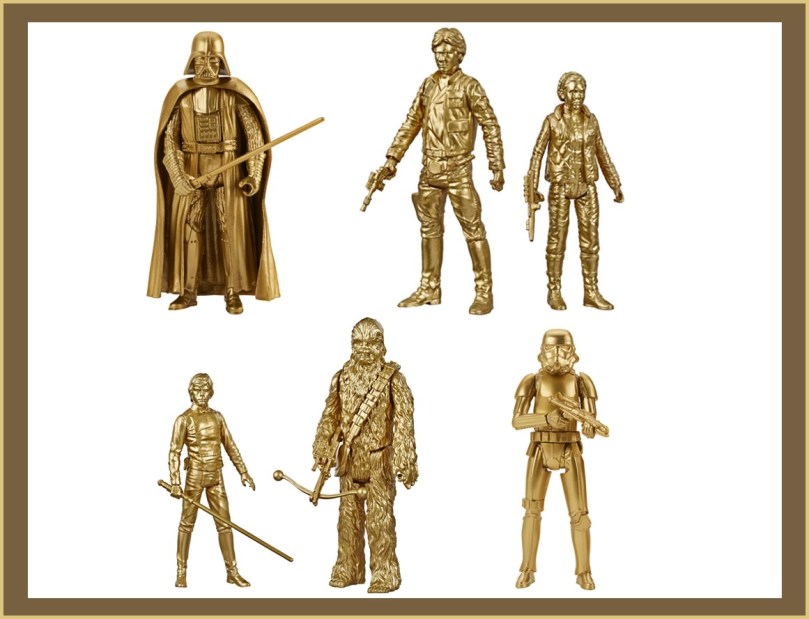
With the release of Star Wars: The Rise of Skywalker this December, the nine-episode Skywalker Saga is coming to a close. To celebrate that milestone, Hasbro announced a set of gold-painted 3.75″-scale action figures, released in two-packs (and one three-pack) to commemorate each film, and exclusive to Walmart stores at $14.99 for each pack.
The original trilogy is represented by Darth Vader and a stormtrooper, Han Solo and Princess Leia, and Luke Skywalker and Chewbacca. The prequels are represented by Yoda and Darth Maul, Mace Windu and Jango Fett, and Anakin Skywalker and Obi-Wan Kenobi. The sequel trilogy gets the expected players of Finn and Poe Dameron, Rey and Kylo Ren, and the trio of C-3PO, R2-D2, and BB-8.
It’s an admirable attempt by Hasbro, but it misses the mark because the figures aren’t particularly special. They’re just repaints of previous releases, many of which had been seen several times before and/or were exclusive to a single outlet.
Starting with the Prequel Era figures in the line—
The Skywalker Saga Yoda figure is the outlier. It was originally the Jedi Master Yoda from 2017’s The Last Jedi Collection. That sculpt was reworked slightly for later release in the 2019 Galaxy of Adventures line.
All told, these Prequel Era figures have appeared multiple times before:
Era of the Force Target 8-pack (2017) – 3
The Last Jedi Collection (2017) – 1
Rogue One Target 8-pack (2016) – 3
The Force Awakens Epic Battles (2015) – 5
The Force Awakens Collection (2015) – 1
Saga Legends Collection (2014) – 2
Saga Legends Collection (2013) – 4
For the Original Trilogy Era figures—
The Skywalker Saga Stormtrooper is a repaint of the 2016 Rogue One series Stormtrooper, which was an all-new sculpt. Collecting site Jedi Business (whose extensive database was immensely helpful in the development of this work) speculated that it was a repaint of the Mimban Stormtrooper (minus the cape) from the 2018 Solo: A Star Wars Story line, but the Mimban helmet sculpt was different. It is possible that the gold Stormtrooper combines the two figures into one for this release.
Along those same lines, both the gold Darth Vader figure and the gold Princess Leia figure are repaints Solo: A Star Wars Story line. Both Darth Vader and Hoth Leia were original sculpts for 2018.
The Skywalker Saga Han Solo figure originally comes from the 2015 Saga Legends series, and was an original sculpt for that line. The gold Luke Skywalker was also an original sculpt for 2017’s The Last Jedi collection. Luke was included in a Target-exclusive three-pack with Emperor Palpatine and an Imperial guard.
The gold Chewbacca is one of the most recent re-releases, coming from the Galaxy of Adventures line in 2018. That figure was minor reworking of the Chewbacca from The Last Jedi, which was original to that line.
Counting up previous appearances, it’s a far smaller list for the Original Trilogy Era figures:
Galaxy of Adventures Collection (2018) – 1
Solo: A Star Wars Story Collection (2018) – 2
The Last Jedi Collection (2017) – 1
Rogue One Collection (2016) – 1
Saga Legends Collection (2015) – 1
It’s interesting that the majority of this set comes from late-2017 and 2018 releases given that Hasbro posted significant losses for that year.
The Skywalker Saga Kylo Ren figure comes from either The Last Jedi or Solo: A Star Wars Movie. Similarly, the Skywalker Saga R2-D2 figure comes from either The Last Jedi or Galaxy of Adventures. In both cases, the latter figure is a rework of the former, but they are virtually identical. The gold R2-D2 does not appear to come with the booster rockets from either of these prior releases.
Since the Sequel Trilogy Era figures primarily stem from either The Force Awakens or The Last Jedi, there’s no need to tabulate them like the previous eras.
It’s evident that there is nothing new nor remarkable about this action figure line. It is a figurative warming up of the leftovers with a new presentation.
I’m trying to avoid the cynical opinion that it would be better to pick up each figure on the secondary market along with a can of gold spray paint. It might be easier given Walmart’s track record with toy exclusives. But, I digress.
While priced lower than current 3.75″ Star Wars figures – a new figure runs nearly $13 today – it’s apparent that the target audience is adults. These are meant for mint-on-card display or for unboxing and standing on a shelf. I can’t imagine a kid choosing a gold version of their favorite character over a more true-to-screen painted option.
Since these are geared more for adult collectors, Hasbro missed a – ahem – golden opportunity to engage the Black Series line and produce a truly remarkable tribute to the movie saga’s milestone. Think about it in terms of who is missing in this set and what holes currently exist in the Black Series line.
How would I have constructed this tribute to make it more meaningful while saving some production costs for Hasbro?
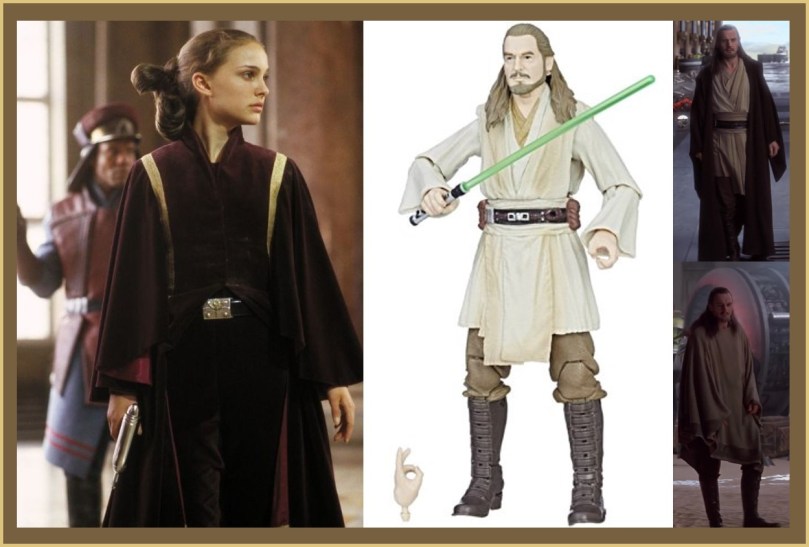
To start, where’s Padmé? For either The Phantom Menace or Attack of the Clones, I would have included her. As the mother of the Skywalker twins, it is a crime to not include her in this tribute to the Skywalker Saga. Additionally, she was at her best as an independent leader and fighter in the first two prequel films. Padmé has only been in the Black Series once and that was in her white bodysuit from the Geonosis scenes in Attack of the Clones. I would have considered including Padmé from the Battle of Naboo in The Phantom Menace.
To accompany Padmé, I would re-release the Black Series Qui-Gon Jinn from 2017, but I would include a soft-goods Jedi robe and poncho combination. Those elements would have been great additions to the original bare-bones release.
Moving to Attack of the Clones, Count Dooku is already rumored for a 2020 release, so just move that figure up in the pipeline. Yes, Darth Maul was far more flashy, but Count Dooku was more manipulative and engineered the Clone Wars. Plus, he was portrayed by the legendary Christopher Lee. To complete the pair, add in Yoda with a cleaner robe and reworked face from his first appearance in the Black Series line, lining him up with the climactic duel from the second prequel episode.
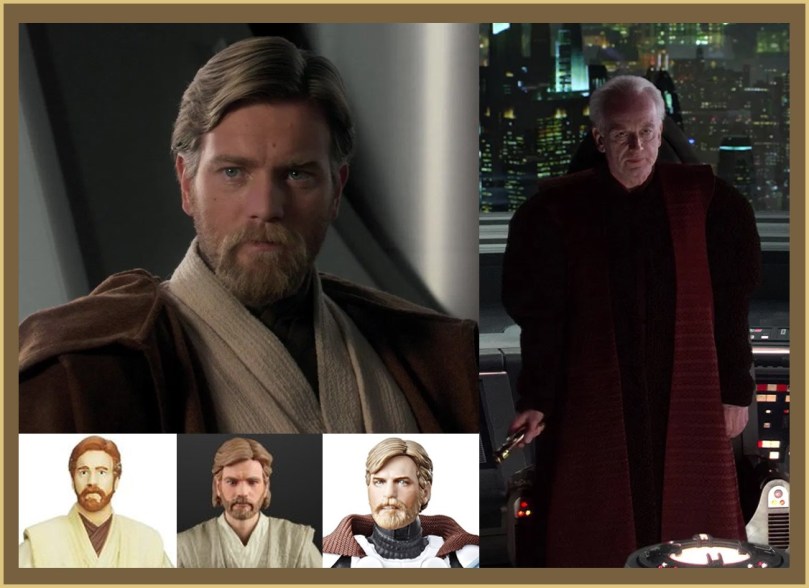
Revenge of the Sith is easy. Palpatine/Sidious has appearedtwice in the Black Series line, both from Return of the Jedi. It would be great to see a figure from the moment when Palpatine reveals himself as a Sith Lord just before executing Order 66. To offset the new figure, add in Obi-Wan Kenobi from the same film. That particular character has been releasedtwice in the Black Series, but it was the same figure each time. Not only did Hasbro neglect a soft-goods robe, but the face sculpt was terrible. Using the lessons learned with the recently released Clone Commander Kenobi and the upcoming Attack of the Clones Kenobi, Hasbro could easily correct the sculpt and offer a much better figure.
When looking at the Original Trilogy Era, things start getting tricky. Luke and Vader have been released several times, and both Han and Chewie aren’t as dynamic when it comes to wardrobe changes. This is where Hasbro has to get creative.
For A New Hope, I would use the 2017 Black Series Han Solo that included the optional black-gloved pilot hands. This time, I would also add the headset that he wears while piloting and fighting in the Millennium Falcon. I would also re-release the 2014 Chewbacca, but include a dejarik table if possible. This would be a large money-saving release for Hasbro so they could channel funds into new sculpts and remasters for this line.
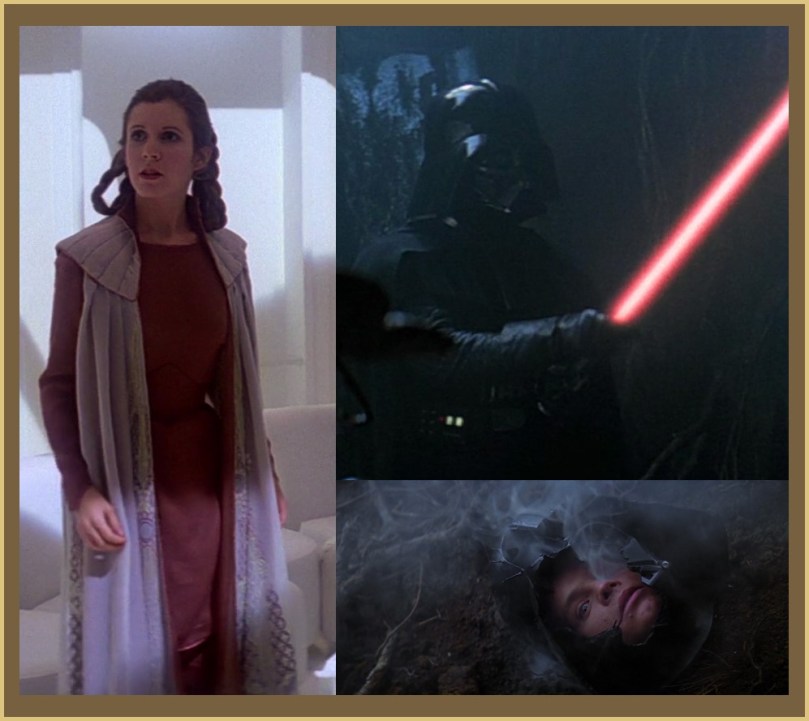
The Empire Strikes Back contains one of my favorite costumes in the Star Wars films, so I’m a little biased here. The Black Series needs Bespin Leia, burgundy and white gown, in soft goods. No question. Back that up with a slightly different Darth Vader than we’ve seen before by tapping into the Dagobah cave trial. Using previous releases, Hasbro could remaster Vader slightly to align the costume to the film. Then create a damaged helmet with Luke’s face as an alternate head, making the figure serve two purposes as either Vader or Force-vision Vader.
For Return of the Jedi, I would start with the forthcoming Luke Skywalker Jedi Knight figure. It’s a great update to the previous release with the addition of a soft-goods robe, but I certainly have issues with it. Primarily, it needs darker hair and robes, a better face sculpt, and an extra lightsaber hilt to clip to the waist.
To cap the original trilogy era, Hasbro could make a special effort for this commemorative set and include the Sebastian Shaw version of Anakin from the pre-Special Edition versions of Return of the Jedi. It’s a deep cut, but a good one. That character has appeared as an action figure three times – 1985, 1998, and 1999 – all of which were in the 3.75″ scale.
A really bad version of the Hayden Christensen Force ghost debuted in 2007.
The sequel trilogy era is much more difficult in terms of originality.
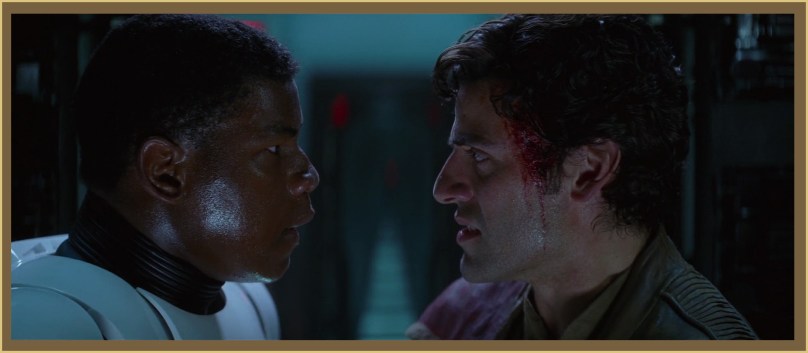
For The Force Awakens, I’d go with a remaster of Poe Dameron from the Escape from Destiny 2-pack. It captured his look from the opening sequences of the film, but it needs work on the face sculpt. For some reason, Hasbro can’t adequately capture Oscar Isaac’s features in plastic. I’d also add a re-release of Finn, either as FN-2187 or in Poe’s jacket from later in the film.
Still image from Star Wars: The Force Awakens.
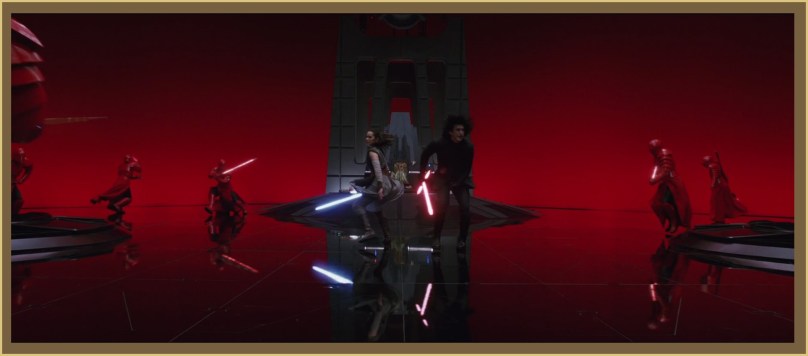
For The Last Jedi, that has to be a re-release of the Walmart-exclusive throne room Kylo Ren (with removable helmet and soft-goods cape) alongside the Crait Base Rey. Rey’s soft-goods clothing would need to be cleaned up quite a bit for this release, so that’s where I’d spend most of the time in remastering this one. Plus, you know, this duo will certainly make the Reylo shippers happy.
Anyone who follows me on social media already knows of my disdain for that couple.
Still image from Star Wars: The Last Jedi.
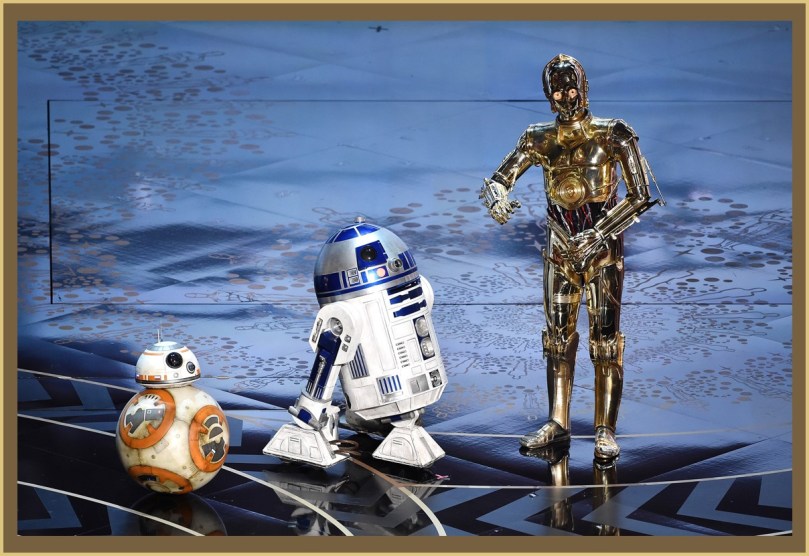
Finally, since we don’t officially know that much about The Rise of Skywalker, I’d follow Hasbro’s lead here with the three droids: C-3PO, R2-D2, and BB-8. I would avoid the “red arm” variant on Threepio, and I’d also use a clean version of BB-8.
Still image from the 2016 Oscars.
In summary:
The Phantom Menace: Padmé (Battle of Naboo) and Qui-Gon Jinn
Attack of the Clones: Count Dooku and Yoda
Revenge of the Sith: Darth Sidious and Obi-Wan Kenobi
A New Hope: Han Solo and Chewbacca
The Empire Strikes Back: Darth Vader (Cave Vision) and Bespin Leia
Return of the Jedi: Spirit of Anakin Skywalker and Jedi Knight Luke Skywalker
The Force Awakens: Finn and Poe Dameron
The Last Jedi: Rey and Kylo Ren
The Rise of Skywalker: C-3PO, R2-D2, BB-8
This lineup covers the spectrum of the saga from the origins of the Skywalker line to the potential end as the nine-episode arc closes.
Honorable mention ideas include a Yavin Throne Room 4-pack with Leia, Luke, Han, and Chewie and something with the twins from the end of Revenge of the Sith. The latter would introduce the Organas and the Lars, each with swaddled infants as accessories, but the new sculpts would drive the cost. The Throne Room set would also be cost-prohibitive.
As far as cost is considered, Black Series figures typically sell for $19.99 each, though Walmart often prices them between $15 and $18 each. With that and the cost savings from reusing existing figures in mind, Walmart and Hasbro could easily move these sets for around $30 per box.
Again, since the gold figures are obviously geared for adult collectors, I built this hypothetical model toward adult collectors.
Thought exercise aside, the point here is simple: Hasbro took the easy way out with a milestone commemorative action figure set. After 42 years and nine films – not even counting the piles of books, comics, games, films, and animated series – a major player in pop culture is coming to a close. The fans deserve so much more than leftover and poorly-selling figures with bad paint jobs.
This was Hasbro’s moment to prove that they respect the franchise and the community, but they fell back into the same old routine that promotes maligned distribution practices and overpriced products. They could have offered Star Wars fans something amazing. Instead, all they did was prove Shakespeare’s The Merchant of Venice right.
All that glitters is not gold.
(Once again, collecting site Jedi Business and its extensive database was immensely helpful in the development of this work. I am grateful for the Jedi Business team and their hard work in cataloging and reviewing modern Star Wars figures.)
Culture on My Mind is inspired by the weekly Can’t Let It Go segment on the NPR Politics Podcast where each host brings one thing to the table that they just can’t stop thinking about.
Culture on My Mind No Laughing Matter November 4, 2019
Humor has a time and place. It’s an art, not a science, and can be therapeutic at times. It also needs to be done carefully.
Concerning jokes about mental illness and seeking therapy, especially so. Let me explain where I come from.
I have talked before, though never at any particular length, about the 2005 collision at sea on the USS Philadelphia. One of the immediate repercussions was losing some members of the crew who would no longer voluntarily go to sea. The event was just too traumatizing and they were sent home to be reassigned. Once we got underway again, those crewmen were the butt of many jokes (never by me, at any measure) for the following weeks. They were denigrated as not “real men” for being unable to tough it out and do their jobs. They were seen as weak for seeking mental self-care and removing themselves from a high-stress situation.
That incident is far from isolated in the military, and definitely not linked to one generation or decade in time. The history of each service is rife with people who have experienced trauma – shell shock, battle fatigue, soldier’s heart, PTSD, etc – but don’t seek therapy or assistance because they fear that it makes them appear weak in one way or another. It has ended relationships, careers, and lives in far too many cases.
It’s endemic in our society. Only recently have I noticed a trend of people openly talking about therapy and mental self-care. Before then – and still today – it was hush-hush for fear of retaliation by family, friends, and employers.
The peer pressure to avoid the appearance of weakness for seeking help is totally real. I’ve been down that road myself, and I know many more who walked it over the years.
I mean, it’s been fourteen years for me and I’m starting to come to terms with it. Imagine those around you – who you interact with on a daily basis – who carry that burden all the time.
It’s why I cringe when I see comments from people (especially friends) that use treatment as a punchline. From telling people who don’t agree with a particular stance that they need mental help to dismissing an opinion as a result of “not taking meds,” it’s a potential manifestation of that pressure. Even if it’s not intentional.
Sometimes humor inflicts damage. That damage can override the ability to “just get over it” or take a joke. It can even also be deadly.
All I’m asking is that people be more careful with their words and more mindful of their actions. Don’t treat mental illness or treatment of it as a targeted punchline to simply shut someone up. Treat the topic with the seriousness it deserves and find another way to make the point.
Culture on My Mind is inspired by the weekly Can’t Let It Go segment on the NPR Politics Podcast where each host brings one thing to the table that they just can’t stop thinking about.
Culture on My Mind Creative Criticality Supports #TeamTrees November 1, 2019
There is a movement occurring on YouTube, and this time it’s both constructive and potentially world-changing.
Back in May 2019, YouTube content creator MrBeast (known in meatspace as Jimmy Donaldson) reached 20 million subscribers on his channel that is dedicated to pranks, stunts, and general tomfoolery. To be completely honest, I had never heard of MrBeast before last weekend since I prefer more educational, sci-fi genre, and current events-type channels to (let’s say) the stylings of PewDiePie. But, upon reaching 20 million subscribers, MrBeast asked his audience what he should do to celebrate, and they made their desires perfectly clear.
They asked him to plant 20 million trees. One for each of his milestone subscribers.
MrBeast teamed with former NASA engineer Mark Rober to start a tree-planting campaign, which is where I heard about it. Over several months, they secretly recruited friends on YouTube to develop the plan, eventually opening it to everyone. Every creator has a community of friends and followers, and if they all donate even one dollar per tree, they can all plant 20 million trees together by 2020.
My family is deeply linked to the environment. We spend a lot of time enjoying the natural world all around us through hiking, river rafting, and scuba diving adventures. We do what we can to help keep it safe through local litter pick-up days, our neighborhood’s adopt-a-highway program, donating to conservation causes, and supporting organizations and legislators who share our ecological values.
Creative Criticality and my family are on board with this effort.
The donations go to the Arbor Day Foundation through the #TeamTrees portal. The mission team chose the Arbor Day Foundation due to the organization’s 47-year longevity and professional knowledge in the field. The trees will be planted in a variety of forests and public lands starting in January 2020 and the project is scheduled for completion by December 2022.
Planting 20 million trees won’t save the planet by itself, but it is a step in the right direction.
You can help by going to https://teamtrees.org/ and donating what you can. You can also help by asking your favorite content creators to join the effort by rallying their audiences with videos and posts like this. Even talking about #TeamTrees in social media feeds helps boost the signal. The more people who come to the cause means a greater chance of success.
Thank you for consideration.
Don’t just take my word for it. Here are some videos from my YouTube subscription feed that brought #TeamTrees to my attention.
Mark Rober investigated companies that are using drones to plant trees via biomimetics.
Derek Muller from Veritasium examined the science of tree heights.
Destin Sandlin from Smarter Every Day took a look at long-leaf pines and the role of fire in helping them to grow.
Joe Hanson from It’s Okay to Be Smart on PBS examined the physics of photosynthesis and how it would change on other planets.
Alan Melikdjanian, known as Captain Disillusion, devoted a couple of minutes to rallying his followers to the cause.
Once again, you can help by visiting the #TeamTrees donation portal, asking your favorite content creators to join the cause, and telling your friends about the quest to plant 20 million trees.
Culture on My Mind is inspired by the weekly Can’t Let It Go segment on the NPR Politics Podcast where each host brings one thing to the table that they just can’t stop thinking about.
Culture on My Mind The Mystery of the Missing Doctors October 14, 2019
Funko Pops are the Beanie Babies of the early twenty-first century.
I say that as a statement of fact, not as a slight or insult. Created in 1993, Beanie Babies were a fad collectible from the late 1990s. They weren’t toys in the normal sense, and are collected more for their trading value and the overall cuteness factor. I have several of them, most of them celebrating milestones in my life because they were inexpensive and heartfelt gifts from friends and family. I cherish them because of those intended purposes.
Funko Pops are very similar. They’re difficult to play with, but they serve as inexpensive gifts for the pop culture fiend in your life. The line spans thousands of characters over a wide variety of franchises and licenses. From a collecting perspective, while they’re certainly not as advanced and playable as standard action figures, they do provide an easy way to celebrate particular fandoms.
I don’t collect a lot of Funko Pops. I don’t have any problem with people who do.
My main point of contention is with the Funko company itself, or rather with how they treat licenses that they create for.
Here it comes: Oh, god, he’s going to talk about Doctor Who again, isn’t he?
Yes, I am.
The franchise hardly needs any introduction. It’s a cultural touchstone that has existed for 56 years with fourteen actors in the title role. There are a lot of collectibles on the market to celebrate this franchise, among them Funko Pops.
But I feel like Funko is doing fans of this show (and their product line) a disservice with their offerings.
Funko Pops based on Doctor Who started hitting shelves in 2015. Thirty distinct Pops were released that year, focused mostly on the revival era of the franchise. At this point, the show was between Series 8 (during which Peter Capaldi debuted as the Twelfth Doctor) and Series 9 (during which Jenna Coleman departed). The revival Doctors were highly represented and the classic era got some love as well. The modern companions were fairly well represented as were the monsters. The TARDIS herself got two releases.
Twelve of the figures – forty percent of the year’s figures – were exclusives to geeky stores (Hot Topic, Barnes & Noble, GameStop, ThinkGeek, FYE) and major conventions (San Diego Comic Con (SDCC) and New York Comic Con (NYCC)). The SDCC Twelfth Doctor in the spacesuit commands over $200 alone on the secondary market.
The line slowed down considerably in 2016. Six figures were released and all of them but one were Doctors. Only one was exclusive.
2016 (Six releases, one exclusive)
Twelfth Doctor
Eleventh Doctor (x2)
Tenth Doctor
War Doctor
Davros
The following year brought a major shift in the line as only three figures were released, and all of them were exclusives.
2017 (Three releases, all exclusives)
Clara Oswald (SDCC, later Hot Topic)
Rory Williams (Hot Topic)
First Doctor (NYCC, later Barnes & Noble and Books-a-Million)
In 2018, Funko moved back to six releases. Half of the line was sent to exclusive markets, including to Emerald City Comic Con (ECCC).
2018 (Six releases, three exclusives)
Amy Pond (ECCC, later Hot Topic)
Thirteenth Doctor (SDCC, later BBC)
Vashta Nerada (NYCC, later Hot Topic)
Thirteenth Doctor
Clara Memorial TARDIS
Missy
Finally, 2019 brought five new figures, two of which were exclusives. This year’s lineup was exclusively targeted toward Series 11 of the revival era.
2019 (Five releases, two exclusives)
Thirteenth Doctor
Reconnaissance Dalek
The Kerblam Man
P’ting (SDCC)
Tzim-Sha (NYCC)
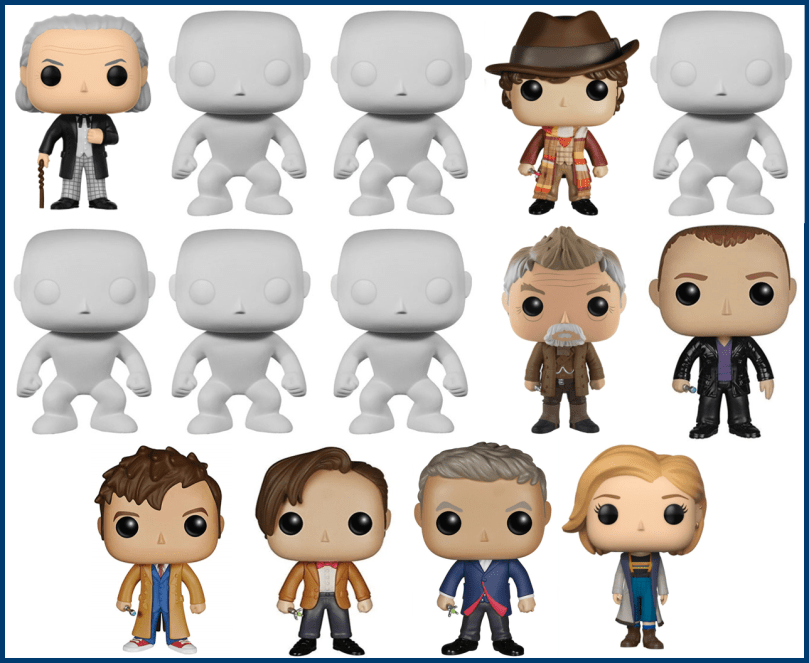
Funko has released 23 figures based on the Doctor, but only 8 Doctors overall. The product line is heavily weighted toward the revival era, with only two Doctors and two companions representing the first 42 years of the franchise’s existence. Technically, Davros could represent the lone enemy from the classic years, but he has also appeared in the revival era which blunts the impact of that figure’s representation.
The problem is that we are missing six Doctors for a complete lineup of the show’s regenerating hero.
Funko has had problems completing lines in the past: Back when they had the Star Trek license, they created Pops for The Original Series, The Next Generation, and Star Trek Beyond. They completed the Enterprise crew for Beyond, but fell short with Next Gen and The Original Series. Specifically, they left out Beverly Crusher and Katherine Pulaski (both women and doctors) and only Kirk, Spock, and Scotty made the cut from the original NCC-1701. The rest of the franchise – Deep Space Nine, Voyager, Enterprise, the other twelve movies – didn’t get any love at all.
It’s not the only franchise line to fall to the wayside, either.
It would be understandable if Funko didn’t have the money or resources to complete the Doctor Who line, but that doesn’t jive with how they treat other popular franchises. Consider the various chrome sets (Marvel, DC, Star Wars, etc), the flocked versions, the sparkly “Diamond” glitter versions, the Rainbow Batman set (commemorating Batman’s 75th anniversary and Detective Comics #241), the DC Comics Lantern figures (Wonder Woman, Superman, and others became members of various Lantern Corp for a spell, prompting new Funko Pop molds for collectors), and the new Star Wars Skywalker Saga sets (which are really just repainted leftovers).
It also doesn’t pass the smell test when considering how many are coming out this year alone – an entire Mortal Kombat line, Miami Vice, The Dark Crystal, more Star Wars, Frozen, Overwatch, and the list goes on – and how many are stacked up on store shelves in the meantime. Just like Beanie Babies, these things seemingly reproduce like tribbles.
The evidence is clear. After an impressive debut followed by lackluster follow-up and lack of representation for classic fans, it’s apparent that Funko is failing fans of Doctor Who.
So, what can they do to fix it?
The obvious solution is to create the figures, but given that the market is saturated and (subsequently) distribution is scattershot, big-box brick-and-mortar storefronts are not the best option. I wouldn’t recommend convention exclusives either, since that approach tends to overinflate the price for anyone who cannot make the trip to San Diego, New York, Seattle, or other major conventions. I got lucky when shopping for the First Doctor because I found one on eBay that was missing the NYCC sticker and had a dented box, but not everyone has that.
Funko has worked with widely accessible storefronts such as Hot Topic, GameStop, Entertainment Earth, and Amazon. One option is to sell the missing Doctors through one of those more focused retailers. Another option is to use the online Funko Shop to “pre-order” the figures and judge how many to make. Six months later, distribute the figures to the buyers with a few left over for stragglers (which can by sold via the first option).
If this proves profitable, it could open the way for more companions, more monsters, and more Doctor Who in the Funko line.
Either way, the hole in the collection is painfully obvious. Doctor Who shouldn’t go the way of Star Trek or other incomplete franchise lines. It is a cornerstone and gold standard for science fiction television, and each of the incarnations of the titular hero has a dedicated fan following.
Funko should respect that history and those fans. They should complete the timeline of the Doctor.
Culture on My Mind is inspired by the weekly Can’t Let It Go segment on the NPR Politics Podcast where each host brings one thing to the table that they just can’t stop thinking about.
Debrief: Dragon Con 2019 Atlanta, GA – August 29 through September 2, 2019
Dragon Con 2019 is in the books! I had a better time this year despite the larger crowd numbers. It’s hard to predict how the crowds are going to ebb and flow from year to year, but you could feel the 85,000 attendees like the pulse of the con this year.
We also did tons of good works this year for the Atlanta chapter of the American Heart Association. $110,000 is a lot of money, and I hope it goes a long way to helping a good charity with a good mission.Read More »













 Creative Criticality