
My Only Hope for Star Wars: The Force Awakens

Culture on My Mind

Culture on My Mind
My Only Hope for Star Wars: The Force Awakens
February 11, 2015

Star-Wars-The-Force-Awakens

I sincerely have one hope for Star Wars: The Force Awakens.

I hope that it is good.

As silly as it sounds, I hope that is a good movie. Not just good in the it’s a movie with the original cast and has the words star and wars in the title so it has to be good sense, but rather the knock your socks off even if this is the first thing you’ve ever seen in the franchise and even Siskel and Ebert would have given this thing four thumbs up and more if they could find more hands sense.

My reasoning is pretty simple. There were sixteen years between Return of the Jedi and The Phantom Menace, and no matter how good the first prequel could have been, I don’t think it would have mattered. There was too much hype, and too many expectations among fans of the original trilogy. I grant that The Phantom Menace (and by extension the prequel trilogy as a whole) did not meet its true potential. It could have been more, and I fully acknowledge the faults. But, it was by no means as bad as the original trilogy fandom would have the world believe.

As The Phantom Menace and the rest of the prequels debuted, original trilogy fans took to the internet in droves to tear the films apart. Many of them waved their “I watched the first Star Wars (with no bloody Episode IV or A New Hope attached to it) in theaters so I know what makes a good Star Wars movie” privilege in the face of new fans. Critical reviews, both professional and otherwise, took the movie to task by addressing fandom, citing how real fans would disavow the new films, and how those who liked them should move out of their parents’ basement. The Red Letter Media reviews are particularly venomous, but are celebrated among the crowd dominated by bitterness even ten years after the last prequel debuted.

Of course, that’s after The Phantom Menace made $431 million domestically. That’s a lot of multiple viewings for a film that supposedly sucks so bad, but I digress.

Star Wars has become a generational fandom, and each new set of fans is usually kids: There was a set of fans who came to the franchise in 1977-1983, a set who came to it with the heyday of the novels in the late ’80s and early ’90s, a set that joined with the Special Editions and prequels (1997-2005), and a set that came of age with The Clone Wars. The Force Awakens will usher in a new generation of fans who will likely be kids as well.

I don’t want the prequel generation to develop the same bitterness about their fandom that their OT and novel era counterparts have.

Prequel fans deserve better than they have been offered. Sequel era fans deserve a fan community based on fun and love, not venom and hatred.

I’ve talked and written at length about how, first and foremost, fandom should be fun. No matter the franchise, this is all entertainment, not life and death matters. Being critical about the content and execution of the material is important, but being bonked on the head for the things that you love by self-instated gatekeepers is not fun.

Critical analysis and review should be limited to the material and never extended to the fandom. It is ironic that a fandom built around geeky exploits and adventures, a community that has long lamented and fought against bullying by others like the stereotypical “jocks,” should in turn bully their own for not walking the right way. I’ve fallen away from Star Wars fandom in recent years because of the way that older fans treat younger fans. Star Wars has lost part of the innocence and excitement that it once had, and not because George Lucas violated childhoods, but because time and again the fandom has forgotten Wheaton’s Law in their critiques.

I don’t want the prequel generation, the group that opened their eyes to the franchise with The Phantom Menace, the group that knows what it feels like to be bonked on the head continuously by older generations, to fall into that darkness. They need to remember that “real” Star Wars fans are anyone who loves the magic of Star Wars. They need to remember how it feels to be told that their opinion “can’t be trusted” based on what they like.

I’d like to think that my generation and the first generation of Star Wars fans can be brought back from the brink of bitterness, but I don’t hold much hope for it. I believe that many of them are beyond redemption for sacrificing their own for the honor of being right on the internet.

I want The Force Awakens to be so good that fans can look on it in admiration and joy, basking in the happiness and escape that fandom should embody. I want prequel fans to avoid the fate that befell the generations that came before. I want them to be critical without feeling the need to attack their own tribes. I want them to remember that it is okay to not like things.

I want them to remember what it means to be a fan and not a self-appointed savior of the franchise.

I want them to remember the feeling they felt when they heard the Star Wars theme in theaters for the first time.

I want them to remember what it means to be a Star Wars kid.

Most importantly, I want them to help new fans to find that moment as well.

cc-break

Culture on My Mind is inspired by the weekly Can’t Let It Go segment on the NPR Politics Podcast where each host brings one thing to the table that they just can’t stop thinking about.

For more creativity with a critical eye, visit Creative Criticality.

Culture on My Mind – Shelving the Star Wars Expanded Universe Makes Sense

Culture on My Mind

Culture on My Mind
Shelving the Star Wars Expanded Universe Makes Sense
May 4, 2014

I’ve been thinking about the recent shake-up in the Star Wars expanded universe, and it’s taken me some time to really sort out my thoughts both in relation to my emotions and good business sense. I agree with the decision, and believe that it makes sense to do it.

Part I – The Books and Me

It seems fitting that this decision was made public around this time of year. I was introduced to the post-Return of the Jedi adventures of Luke, Leia, Han, and Chewie on Easter Sunday of 1992. My parents surprised me with a paperback copy of the Star Wars Trilogy 10th anniversary omnibus, which combined the novelizations of each of the original films, along with a paperback copy of Timothy Zahn’s Heir to the Empire. They realized that I had a deep attachment to the original trilogy, which I had only seen on well-loved and rewind-worn pan-and-scan VHS tapes at that time, and they fed that passion with what they understood to be the continuing story. They were right on the money, as confirmed by the hardcover version’s inner jacket blurb.

The three Star Wars films form a spectacular saga of bold imaginations and high adventure. But the stories of its characters did not end there. Now for the first time, Lucasfilm Ltd., producer of the Star Wars movies, has authorized the continuation of this beloved story. In an astounding three-book cycle, Timothy Zahn continues the tale of Luke Skywalker, Princess Leia, Han Solo, and the other characters made world famous by Star Wars, as he brilliantly expands upon George Lucas’s stunning vision, “a long time ago in a galaxy far, far away.”

I rapidly devoured the original trilogy omnibus, and relished the differences between the novels and the films. Obi-Wan knew about ducks, Luke’s uncle Owen was really Kenobi’s brother, and Vader was created when Anakin and Obi-Wan battled on the edge of a volcano. It was a wealth of information that expanded beyond the cinematic journey, and it primed me for the more dedicated reading of the continuing saga. I say dedicated, but I don’t mean meticulous; I flew through Heir to the Empire and loved every minute. In June of 1992, I reserved a copy of the second book, Dark Force Rising, at my local library and flew through it as well. It was a long year until The Last Command was released, and after that epic conclusion, I satiated my desire for more Star Wars by reading Brian Daley’s The Han Solo Adventures, L. Neil Smith’s The Lando Calrissian Adventures, and Alan Dean Foster’s Splinter of the Mind’s Eye.

It didn’t matter to me how bad Splinter was because, by the Maker, I had new Star Wars in my hands. The Truce at Bakura, The Courtship of Princess Leia, and Kevin J. Anderson’s Jedi Academy trilogy started me down a path of buying the books and comic trade paperbacks when they came out and enjoying every one of them. My palette has matured a bit since then, and stories like The Crystal Star (ah, Waru) are hardly ever revisited by my eyes, but at the time, they were precious, precious gold.

Despite my love for the franchise, it became apparent to me that the universe was getting too large too fast. At that point, stories in what became the Star Wars Expanded Universe (SWEU) ranged from approximately 5,000 years before to around 20 years after A New Hope. One person at Lucasfilm, Leland Chee, was charged with keeping the chronology straight and smoothing over any conflicts amongst the novels, comics, video games, television series, and movies. He did an admirable job, and it’s one I don’t envy.

By 1994, Lucas Licensing had defined what made up Star Wars canon, and publicized it in issue 23 of Star Wars Insider, the fan club’s magazine.

Gospel, or canon as we refer to it, includes the screenplays, the films, the radio dramas and the novelizations. These works spin out of George Lucas’ original stories, the rest are written by other writers. However, between us, we’ve read everything, and much of it is taken into account in the overall continuity. The entire catalog of published works comprises a vast history—with many off-shoots, variations and tangents—like any other well-developed mythology.

To help sort out the chronology, multiple tiers were established between 1996 and 2000 to solve conflicts between stories. Anything that directly involved George Lucas, such as the films, their novels and radio adaptations, and statements from Lucas himself trumped everything. Under that were the television shows, followed by the combination of novels, comics, and games. As the prequel movies dawned and Lucasfilm started developing The Clone Wars television series, more and more continuity problem started to crop up and it was apparent that something had to give. In the time-honored tradition of the SWEU, George Lucas won.

Part II – The Dawn of a New Era

The decision on April 25th to essentially shelve everything except the six core films and The Clone Wars isn’t a big surprise. In fact, it’s been a long time coming. As much as George Lucas has changed his mind on sequel films – at first it was a twelve-film series, then nine, then six. As recently as May 2008, he told TotalFilm that, “There will definitely be no Episodes VII–IX” – he has been consistent since 2001 that his vision trumps everything else. During an interview on the official site in March 2008, he explained his point of view.

It’s a certain story about Anakin Skywalker and once Anakin Skywalker dies, that’s kind of the end of the story. There is no story about Luke Skywalker, I mean apart from the books. But there’s three worlds: There’s my world that I made up, there’s the licensing world that’s the books, the comics, all that kind of stuff, the games, which is their world, and then there’s the fans’ world, which is also very rich in imagination, but they don’t always mesh. All I’m in charge of is my world. I can’t be in charge of those other people’s world, because I can’t keep up with it.

Fans have been complaining that this move invalidates the established canon, but what really has been canon before now? The Thrawn trilogy was “authorized” as a continuation, and multimedia events like Shadows of the Empire and The Force Unleashed had some direction from George Lucas, but aside from that everything else seems to have been handled by a licensing department.

You know what else fits this pattern? The Star Trek novels. The Marvel Cinematic Universe. 1978’s Superman film. Any of the various DC and Marvel reboots. All of them violate the established “canon” of the material that came before, and yet they exist and are still enjoyed. Just like those examples, and countless other franchise tie-ins, the stories established by the SWEU still exist. Disney and Lucasfilm aren’t burning every copy they can find or raiding public libraries for toilet paper. In fact, the existing SWEU is being republished as the “Star Wars Legends” series to guarantee their availability for the future.

Star Wars fans can learn a very valuable lesson from Star Trek fans, as author Keith R. A. DeCandido explained in his comments on this whole affair.

Two of the most highly regarded Trek novels are Imzadi and Federation. The former novel was heavily contradicted by a TNG episode (“Second Chances”); the latter was totally nuked by the movie First Contact. Yet the two novels continue to be well regarded — and so does that episode and that movie, even though they contradict each other. If you think that contradictory versions of stories in the same universe ruins one of the contradictory ones, then you don’t understand how storytelling works.

I totally get the concept of having a huge personal investment in this franchise. I owned every novel in the series before the Navy lost half of my household goods shipment back in 2005. That incident hurt, but only because of the material loss. My consolation was that the books were still out there, and someone would be selling them when I was ready to rebuild.

More importantly, this move guarantees the future of the Star Wars franchise, which cost Disney over $4 billion. That’s one hell of an investment, and they needed a way to make it accessible to general audiences again, including the newest generation of children who haven’t experience the galaxy far, far away. As much as we cannot expect audiences to read every book between Return of the Jedi and Episode VII, we cannot expect scriptwriters and directors to limit their vision to decades of contradictory stories. Those limitations would only hinder the movie and hurt the investment.

Take the example of Disney’s other major acquisition, the Marvel franchise, and their approach to the Marvel Cinematic Universe. General audiences don’t need to read the comics to get the stories, and if they need to know something, it’s presented to them. If you haven’t had a chance to read the Bloomberg Businessweek article about the MCU, I highly recommend it. There are a lot of parallels between Marvel and Star Wars.

Before this announcement, I was optimistic but skeptical about the sequel movies. There was just too much story to dance around if the EU was left intact, and I wasn’t keen on the movies being cleverly wedged between chapters or pages of a novel just to make a timeline work. This move tells me that Disney is serious about their investment and the vision they want to bring to audiences. By making this story easily accessible to everyone, which means removing the stumbling block of the now Legends stories, Disney and Lucasfilm win. That means that Star Wars fans win.

Disney and Lucasfilm helped reignite the magic of my childhood. Warm up the Falcon, Chewie, and calculate the hyperspace jump to December 2015. I’m ready to believe again. Star Wars truly is forever.

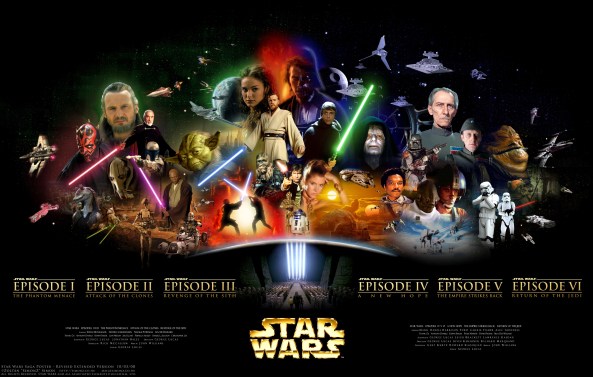
Star Wars Saga Poster by SimonZ

cc-break

Culture on My Mind is inspired by the weekly Can’t Let It Go segment on the NPR Politics Podcast where each host brings one thing to the table that they just can’t stop thinking about.

For more creativity with a critical eye, visit Creative Criticality.

Culture on My Mind – Star Wars Fandom and The ForceCast

Culture on My Mind

Culture on My Mind
Star Wars Fandom and The ForceCast
May 23, 2011

The debate over the Star Wars Expanded Universe is a tale of us versus them that’s been raging for some time, but only recently has it exploded within fandom. The Expanded Universe (EU) matters greatly to me for reasons I’ve previously discussed, but in particular because the novels were my major gateway into Star Wars fandom. Unfortunately, that segment of my fandom has fallen under attack from people I trusted.

The ForceCast has become the podcast where there is no fan left behind unless they disagree with your particular version of fandom, in which case they will publicly mock and shame you on their program.

That’s why I have no choice but to stop listening.

The ForceCast

If you haven’t heard my previous evangelism, The ForceCast is one of the best produced Star Wars podcasts on the internet.  The show is a usually weekly program for and by fans, and is the official podcast of TheForce.net and Rebelscum.com.  Despite my misgivings at times, I respect the great effort poured into the show by the hosts, the production, and the marketing.

The show expands beyond its weekly variety-style programming with dedicated podcasts about The Clone Wars, the EU, collecting, regular fandom episodes, and even Indiana Jones. The mission is “No Fan Left Behind,” and it usually shows, particularly when it comes to convention coverage.

The ForceCast has been there for me when I couldn’t go to conventions, and especially when I was deployed overseas for months at a stretch without internet access. I once handcrafted a map detailing — with all regard to operational security, of course — my travels with them and included it with a fan-made scrapbook that was presented to the hosts in appreciation of their hard work.

I’ve also been able to give back a couple of times with the ForceCast Editorial Series, where listeners are invited to write essays to explore aspects of fandom. Luckily, I’ve had two such essays published through them with great feedback from fellow fans. The first was about the lessons I’ve learned from George Lucas, and the second was a literary analysis of Padmé’s death in Revenge of the Sith.

In my personal “Dark Times”, Jason, Pete, and Jimmy, and all of the friends I’ve made worldwide through the community were my light in fandom. I just can’t say enough about the impact the majority of these wonderful people have made in my life.

The Nature of the EU

The Expanded Universe started benignly, but hasn’t always been puppy dogs and marshmallows. Surrounding the release of the original movies, publishers released novels and comics that have long since faded into a sense of obscurity because their storylines have been overridden by other stories, including the movies. As Star Wars grew in popularity, the EU exploded, and my fandom started to wane from oversaturation. The ForceCast helped by deflecting some of the attention from the EU and focusing on other aspects of the fanbase. While the majority of EU fans seem pretty low-key on the material, other fans developed a sort of blind allegiance to the stories and took umbrage when other elements of the Star Wars franchise negated parts of those stories, ranging from a paragraph to an entire chapter of a novel.

My opinion of the EU is that it’s too big and growing far too fast for some fans to keep track of. While I agree that it has a certain value, I find more value in the richness provided by the mythic story of Anakin Skywalker’s rise, fall, and redemption that is found in the six movies. That arc is the basis for everything we have at our fingertips, and it’s all thanks to the vision of George Lucas. While it can be claimed that his story is entirely derivative — honestly, it is — all the other stories in the Star Wars universe are derivative from that, and not all of them are golden nuggets that need preservation.

For some fans, it is enough to understand the six movie arc. For others, the inclusion of The Clone Wars adds something more. For an even smaller segment of fandom, the novels, comics, and games flesh out a universe rich with potential. What we need to remember is that the richness is due to people who were paid to tell a story, unique or otherwise, in the Star Wars galaxy with the understanding that they may be overruled at any point. That is standard with any tie-in media. Some of these people tried to tell simple stories and others like the infamous Karen Traviss tried to set-up elaborate seven course meals for the fans to savor over time. But at the end of the day, Star Wars belongs to one man, and if he wants to tell a different story, he is fully within his rights to tell that story regardless of what has come before.

Some fans don’t share that opinion and want something more.

The Petition of the 2000

In one episode of The Clone Wars, Jedi Master Even Piell was killed. The downside was that he played a major part in an EU novel set after Revenge of the Sith, and the episode negated both an entire chapter of the book, but also impinged on the protagonist’s motivations as a character. As a result, some fans wrote the Petition of the 2000, which politely asked George Lucas to consider the previously released Star Wars material before authorizing plot points in the ongoing animated series.

Initially, I was sympathetic to their cause because of my roots in the EU fandom. I couldn’t outright support their position because I believed that they were exercising a false sense of entitlement as fans over the creator who sparked the franchise. I cannot support telling a person how he should tell his story anymore than I support redacting Mark Twain’s work because cultural sensitivities have shifted. I don’t idolize Lucas like some sort of god, but I recognize his position as a creator and storyteller. Even in the act of asking him to bound his creations by the EU, the petitioners are asking him to stifle some degree of his efforts. By that measure, I consider the petition to be an embarrassment to me as a fan. I would be ashamed to have George Lucas read that petition and believe that it came from fandom as a whole.

I appreciated the fact that they asked in lieu of demanding a change, but I appreciate more the fact that George Lucas has said on record that the only stories that truly matter in the Star Wars franchise are his. The rest are filler for our entertainment alone, and we haven’t wasted time or money on these products if you have enjoyed them because that was their purpose. Lucasfilm is in the business of creating entertainment and making money on it, not building vast continuities spanning millennia and meticulously maintaining it because a group of 1,000 fans requested it. I see the very existence of a continuity checker like Leland Chee to be a concession to the fandom that Lucasfilm is trying, but I also see it as purely symbolic. They know at Lucasfilm who signs their paychecks, and if the continuity policies were really that strict, novels and games and comics would never contradict each other.

I don’t agree with some choices made in franchises like Harry Potter, Star Trek, Stargate, or others, but I don’t support telling the creators of these works how they should steer their properties. If I don’t like it enough, I jump off and go find something else to occupy my time. Life’s too short for that crap. I look at it like I see mythology: It’s all about the big picture, not the intricate details. There’s too much EU, and I am glad that some of it is being carved away. The very nature of working as a tie-in novelist is that your work may be superseded at any point. When you write for a franchise, you understand what is canon and what is not. The ground rules are clearly established. Avatar: The Last Airbender includes everything in-universe as canon, but series like Buffy the Vampire Slayer and Angel are only canon if on-screen, authorized by creator Joss Whedon, or written by the original writing staff. The random Buffy novel by Christie Golden is not canon, and she knew that when writing it. If you’re hired to write an Avatar project, you know going in that it’s going to be incorporated into canon. If you’re hired to write a Star Wars novel, you know that it can be overruled by a George Lucas decision.

At the end of the day, the only points I deeply care about are the ones concerned with the core mythos of Anakin Skywalker. Beyond that, they’re nice stories, but I’m not beholden to them.

The boys at The ForceCast took a slightly different approach by dissecting the argument and countering it point-by-point with Jimmy taking a more conservative approach and Jason taking his usual antagonistic stance when it comes to EU matters. The petition authors reacted by attacking the podcast hosts, exacting the “he hit me first” style of revenge. They also insulted Jason for not being well-read and having to look up certain words in the petition with a dictionary.

That’s where the petitioners lost all support from me. I never have agreed with Jason’s antagonism toward EU fans, but resorting to schoolyard bully tactics doesn’t prove the petition’s point. Quite the contrary, it dissuades me. The very structure of the “thought-out” reply from one fan to another was condescending, particularly in respect to a life-long fan. I don’t take well to people dragging another person’s intellect through the mud based on their differing views. Instead of explaining the nature of the movement in terms people can understand without resorting to a dictionary, the petitioners took to reducing two fans and their opinions to an observation on their supposed idol worship of George Lucas.

Don’t get me wrong: The ForceCast also shares part of the blame in this regard. Jason Swank seems to revel in building entertainment from spinning up fans by poking at sore points. In fact, this matter with the petition only emboldened him to become more antagonistic and condescending toward EU fans.

Overall, I believe that both sides are mired in their desire to maintain the status quo.

The Lessons of Star Trek

Star Trek got back to the basics in ’09 and if it’s truly going to be forever, the Star Wars Expanded Universe will have to as well.”

—Jason Swank (May 21, 2011 via the ForceCast Facebook page)

Star Trek started back as early as 1966 as the concept of a utopian society who learned to overcome their adversities venturing to the stars on a mission of exploration. After three seasons, the original series was cancelled but found new life in syndicated re-runs. It eventually spawned a short-lived animated series, six movies with the original series crew, and a spinoff with Star Trek: The Next Generation. After that, the franchise blossomed into four movies with the new crew and three more spinoff series.

The Next Generation started as an updated version of the original’s campy utopian fantasy, and in my opinion, after seven years it had hardly evolved beyond that. It followed Star Trek’s formula of social commentaries shrouded in science fiction, but stayed safely shy of really digging into modern topics. Deep Space Nine followed suit for the first two or three seasons, but eventually evolved into a series about war and religion, which made sense for the era in which it existed. Voyager and Enterprise reverted to the classic roots and made little to no effort to venture beyond what made the franchise so much money. While it made the classic fans happy, it didn’t bring in fresh faces. Star Trek wasn’t addressing concerns that modern science-fiction fans needed it to address. After Voyager, Enterprise, and the tenth movie Nemesis failed to expand beyond Trek’s initial charter but successfully displayed the doldrums of the writing staff, Paramount pulled the plug. For the first time in nearly twenty years, Star Trek was off the air.

Paramount fired everyone, from Rick Berman and Brannon Braga at the top to the web designers at the bottom. The franchise was dark for years until J. J. Abrams and his team rebooted it. They didn’t override what had come before, but rather reset the clock in an alternate universe and started over. They got back to the basics of what made Star Trek what it was. It was a mirror of the modern day, reflecting modern concerns on the screen with characters we knew. But, the reboot came with a price. Two major planets were destroyed (one in the original timeline, one in the new), supporting characters were killed, and character motivations were changed from where they started in the 1960s. The basics are there, but the formula is different.

Why am I mentioning this?

Because many think that the Star Wars EU is in those Voyager/Enterprise doldrums. Luke Skywalker is not the same character we saw on the silver screen, Chewbacca is dead, and the supporting cast is weary and dimensionless. The hero’s journey was completed long ago, yet people keep trying to find missions for him to complete. A story arc that could be condensed into tight trilogy or even a single large novel takes twelve or fifteen books to complete over a year or two of publication.

Maybe Star Wars needs to get back to basics, but we know such an action comes with a price. One possible offer was made, but at least one fan doesn’t want to pay.

The Death of Luke Skywalker

On May 16, a Star Wars EU fan named Tricia wrote an article entitled “Luke Skywalker Must Die” which summarized five reasons why she believed that the EU would benefit from killing off the poster child of Star Wars. Overall, I agreed with her main contention that the hero’s journey — the very backbone of the Star Wars films — has long since ended. Luke Skywalker has no real purpose in the EU aside from that of “Merlin Goes to Washington” as his character has become less hero and more politician and figurehead to a resurrected Jedi Order. Tricia’s blog post was incredibly well written and researched in my opinion, and presented her in the light of a very well-read woman. The ForceCast decided to cover this topic on their May 20 show, and included it in their teaser with the line, “EU kooks call for the death of Luke Skywalker”.

Consider a moment the use of the word “kook”. Merriam-Webster defines the term as “one whose ideas or actions are eccentric, fantastic, or insane” and cross-references to the word “screwball” among other synonyms. Also remember that Jimmy has championed a public crusade against defining members of fandom as “nerds”. Remember how embarrassed I was about the Petition of the 2000? This embarrasses me more.

As if the use of derogatory names against fellow fans wasn’t enough, The ForceCast’s official reaction was even worse. Jimmy took his normal conservative EU stance, and Jason picked us his antagonism with his usual fervor. Jason started with a blanket statement that none of the five reasons presented were good ones. While he has a right to that opinion, it became clear over the next forty-five minutes that, for lack of a better term, he just didn’t get Tricia’s argument at all.

He accused Tricia of threatening Mark Hamill when she mentioned the differences between reality and fiction, and if Jason was trying to be humorous, it wasn’t funny at all. As the ForceCast crew have discussed before, Star Wars transcends the fiction of the screen or the page and has a profound effect on everyday life. The ForceCast even runs a segment called “Star Wars in Pop Culture,” but Jason failed to realize that the death of a fictional character would spread ripples throughout the real world, even beyond the limited scope of selling more books. Such an act on behalf of Lucasfilm mirror the death of Chewbacca in Vector Prime, spurring both anger and critical thought beyond the confines of our little community, and would possibly make Star Wars more relevant than a quick nod on a sitcom. Instead of realizing that, Jason wants to call the 501st to protect Mark Hamill.

Jason suggests that perceived inability to adequately capture Luke’s character on the written page can be solved by simply finding new writers. Just, you know, pull them out of mid-air and hand them a contract because the current offering of science-fiction and fantasy novelists just don’t cut it. This solution is a cop-out, mostly because of the same reasons that other fictional epics cannot be translated to the movie screen, no matter how much we hope and pray that they can. Not all characters or plots can easily survive the transition between media, and it is possible that Luke Skywalker has some magic on the silver screen that can’t be captured on the page.

One other exchange captured my attention in its sheer audacity:

Jimmy: Because there is — and I think she brings this up later in her blog — there is this focus on Luke still, even though they’ve grown far away from the character of Luke Skywalker that we know from the films, there’s still this attention to him on all these novels that happen further and further away from the events of Return of the Jedi. If you kill him off, then that takes the focus off of his character and you could focus more on these secondary characters like Jaina Solo.

Jason: Who? What movie was she in?

Jimmy: Well, we’re talking about Star Wars Expanded Universe.

Jason: Well, we’re talking about Star Wars. [emphasis by Jason]

—Transcribed from The Weekly ForceCast for May 20, 2011 (time codes 1:29:35 to 1:30:18)

 Jason continues on to describe his irritation at fans putting aspects of the franchise into convenient little boxes, such as novels, video games, and so on. Jason lost a significant amount of my respect at this point with this contradictory argument. He wants a global overarching franchise view, but refuses to acknowledge anything beyond the films when confronted with it. He argues that Star Wars is Luke, Leia, Han, Chewie, Padmé, Anakin, and all the other film characters, but even George Lucas disagrees with him. The core of the Star Wars saga is the rise, fall, and redemption of Anakin Skywalker. The core of Star Wars is the epic tale of father and son and the ends each will go to in order to save each other.

The core of Star Wars is the hero’s journey. That’s why Lucas is so attached to Luke Skywalker.

Jason argues that Star Wars fandom extends beyond the “small group” that reads the novels, and I will agree to that with a caveat. I believe that the majority of Star Wars fans — people who enjoy Star Wars — stop at the films because that’s all they need of the franchise. I think the ones that get involved in the minutia of Star Wars fandom and the community, the ones that listen to The ForceCast and other Star Wars podcasts, and the ones that participate on discussion boards are those who we need to care about, and those are the ones who Jason is considering a splinter group.

True Fandom

I’ve been told by other ForceCast listeners that Jason’s vitriol is manufactured for the sake of entertainment and sparking discussion. There are few things I despise more than hate and vitriol for the sake of entertainment. Such tactics are disingenuous and build a core following that represents more of a lynch mob than a critical community. Even now, people on the ForceCast Facebook page are drawing a line between “EU kooks” and “true fans”.

On January 21, 2008, I asked on the ForceCast forums what comprised a Star Wars fan. Jimmy responded within an hour with the following:

“Mom, Dad, Son, Daughter, Brother, Sister, Aunt, Uncle, Cousin, Grandparent, In-Law, Teacher, Friend, Kid, Adult, Artist, PODCASTER, Doctor, Lawyer, Public Servant, Mailman, Truck Driver, Professional, Professor, Student, Filmmaker, Office Worker, Librarian, Musician, Salesman, Cabbie, Dentist, Technician, Pilot, Marketing Professional, Bus Driver, Construction Worker, Cop, Fireman, Service Clerk…

…YOU….ME…THEM…EVERYBODY….

These are the people who listen to The Force-Cast…These are the people who love Star Wars.

Universal and Undefinable.”

These are the people who Jimmy and several others after him define as fans, and I agree. There are no “true fans”, but I do see The ForceCast drawing a line in the Tatooine sand with respect to their mission. With the venom and vitriol directed toward fans of the EU by one show’s hosts, it’s quickly becoming the official statement of one of the most “influential members of Star Wars media” that EU fans are somehow less than any other fan. Ironic, considering their sponsorship by Audible, which includes many Star Wars EU titles that the hosts highlight on a weekly basis.

In my view, fandom is supposed to be fun. Fandom should be a place of sanctity from the world where I can discuss popular culture and passions without fear of reprisal or mockery. I don’t mind critical analysis, but when fandom adds the shackles of blind stereotyping and condescending critique, it becomes a weight instead of a freedom.

One example is a forty-something Star Trek fan named Rob who frequents the Blastr (formerly Sci-Fi Wire) site. Any mention of anything related to the Star Trek reboot gets his immediate condescension and troll flaming, even down to the point of offering people to come to his home in Washington, Indiana to get some sense beat into them. I don’t go there much anymore because I don’t need that amount of hate in my fandom. There are much better places to experience fandom than in an environment that fosters such negativity.

Jason has become more and more rude over recent episodes, but particularly when dealing with the EU. He was rude to Jimmy by cutting him off and stepping all over him after dominating the one-way discussion on the Luke article. Small moments of interrupting each other are acceptable when dealing with Skype, but this was downright rude.

The ForceCast also has problems with responding to feedback, and that doesn’t fly well with me as a podcaster or a fan. I have tried many times to explain my position and concerns directly to them on the channels they have established. I’ve sent e-mails. I’ve posted on their Facebook page. I’ve posted on their forums. I’ve posted to Twitter, both to the show account and their personal accounts.

I don’t need this degree of negativity or hostility toward the fandom.

The end result of this is that I will need to exercise my Star Wars fandom somewhere else. I’ll keep listening to The IndyCast because that show has been nothing but professional in all dealings, and I’ll keep frequenting the usual haunts because the majority of the listener base are good people. I’m not going to sever ties with the outstanding friends I have made just because the show that brought us together as a community is flagging.

I will come back if I have good reason to believe that The ForceCast has changed. After all they’ve done, I owe them that courtesy of seeing if they can recover.

That said, I honestly don’t expect any reply from them on or about this blog post, nor do I honestly expect anything to change.  Not when I consider how Jason has reacted in the past to those who ask him to stop the antagonism, condescension, and rude behavior. What I don’t understand is why it is even warranted.

So, here’s the bottom line: Fandom should be fun. For me, it currently is not. It’s time to change something before I lose the passion that brought me here to begin with.

cc-break

Culture on My Mind is inspired by the weekly Can’t Let It Go segment on the NPR Politics Podcast where each host brings one thing to the table that they just can’t stop thinking about.

For more creativity with a critical eye, visit Creative Criticality.

Culture on My Mind – Katie Lucas is Awesome, Reason 1138

Culture on My Mind

Culture on My Mind
Katie Lucas is Awesome, Reason 1138
May 11, 2011

The prequels have been made. They exist. There is literally nothing you can do or say to make them go away. They may not be your cup of tea, but let’s remember: YOU can choose not to watch them! You can pretend like they don’t even exist! But being angry about it forever is going to accomplish nothing. Neither is being disrespectful. My father has done absolutely nothing to earn disrespectful tirades and personal attacks. He is a good man. He is not an evil genius plotting to ruin your life. You are entitled to your own opinions–whatever they may be, but be respectful about it. He may have made three movies you personally didn’t care about, but he was also responsible for three movies that inspired you and millions of others. So, do him and I (sic) the courtesy of having a little goddamn respect.

—Katie Lucas (via Twitter, 4 May 2011)

cc-break

Culture on My Mind is inspired by the weekly Can’t Let It Go segment on the NPR Politics Podcast where each host brings one thing to the table that they just can’t stop thinking about.

For more creativity with a critical eye, visit Creative Criticality.

Culture on My Mind – The Glory of Being a Nerd

Culture on My Mind

Culture on My Mind
The Glory of Being a Nerd
March 28, 2011

Last week, podcaster and Chicago radio producer Jimmy Mac covered the topic of being called a nerd on The ForceCast. His position was that the term nerd is derogatory and shouldn’t be used to describe fans of Star Wars. I couldn’t disagree more.

The crowd at Wikipedia have defined “nerd” as “a term that refers to a social perception of a person who avidly pursues intellectual activities, technical or scientific endeavors, esoteric knowledge, or other obscure interests, rather than engaging in more social or conventional activities.” That got me thinking. Based on that, why shouldn’t we embrace the term nerd?

My heroes have, for the most part, been largely from the scientific, engineering, and creative communities. Many of them come from the large group of scientists, engineers, and technicians who came together and put a man on the moon in the 1960s. Those same scientists and engineers saved three astronauts when Apollo 13 catastrophically failed en route to the second planned lunar landing.

Even today, the qualifications to be an astronaut include a bachelor’s degree in engineering, biological science, physical science or mathematics, as well as at least three years of related professional experience (graduate work or studies) and an advanced degree.

Wikipedia continues to explore the etymology of nerdom by describing the term’s origins with Dr. Seuss, Philip K. Dick, and students at the Massachusetts Institute of Technology (MIT). Dr. Seuss is legendary in his own right, Philip K. Dick developed the concept of Blade Runner and other science-fiction classics, and MIT is a hotbed of scientific and technological research that has produced at least 76 Nobel Laureates, 50 National Medal of Science recipients, and 35 MacArthur Fellows.

Albert Einstein singlehandedly expanded the understanding of our universe with his theories on relativity, progressing on centuries of scientific exploration from intellectual and esoteric thinkers before him. Science fiction as developed by Isaac Asimov (a scientist and writer), Gene Roddenberry (creator of Star Trek), and George Lucas (noted for his technical innovation) is derived from these advances and evolves with the technology explored by today’s science and engineering communities.  Without nerds, I doubt science fiction or Star Wars would exist in its current form.

In a world where some kids idolize movie stars and sports figures, I find great solace in celebrating great thinkers. Nerds – the intellectuals, the scientists, the engineers, those with obscure interests – aren’t considered cool because they don’t get the hot chicks, don’t slug baseballs over the wall 400 feet away, don’t score the winning touchdown, and don’t snort cocaine off a hooker’s butt like Charlie Sheen seems so fond to do. Despite those supposed shortcomings, nerds have very stable lives and help to save others every day. Nerds develop body armor to send to our soldiers, engineer seat belts and restraint systems to keep people safe in moving vehicles, and created pacemakers and artificial hearts to extend and improve quality of life.  Nerds may not be cool, but they’re much more useful to society, and the current resurgence in exploring nerd and geek culture is a tribute to that.

Any scientific advance, including those that allow us to explore this very topic, are due greatly to nerds. Nerds may not earn millions of dollars – Bill Gates and Steve Jobs notwithstanding – but the world owes them a debt that can never be repaid.

Money can’t buy happiness, unlike my constantly expanding knowledge of the universe around me. Nerds understand what makes the world go ‘round, and I am proud to be among their ranks.

cc-break

Culture on My Mind is inspired by the weekly Can’t Let It Go segment on the NPR Politics Podcast where each host brings one thing to the table that they just can’t stop thinking about.

For more creativity with a critical eye, visit Creative Criticality.

Culture on My Mind – Why the Star Wars Expanded Universe Matters to Me

Culture on My Mind

Culture on My Mind
Why the Star Wars Expanded Universe Matters to Me
October 8, 2010

Whenever you hear people start talking about Star Wars, there are varying general degrees to which people enjoy the saga. Some people only recognize the original trilogy (A New Hope, The Empire Strikes Back, and Return of the Jedi), while some add in the prequel trilogy (The Phantom Menace, Attack of the Clones, and Revenge of the Sith). Some fans add in the new animated series The Clone Wars, which takes place in the years between episodes two and three. Finally, there are those that include what is known as the Expanded Universe (also known as the EU).

Not to get too deep into the nitty-gritty details, there has been so much material published regarding Star Wars, from the films to novels, comics, and games, that there are varying levels of what is considered canon or official story. There are five levels of canon that establish the continuity. In order of precedence, continuity is established by films and their novels, then television series, then the combination of novels, comics, and games. The second to last in precedence is material that “may not fit quite right” and can used or discarded as seen fit. Finally, there is a category called “Infinities,” which is essentially made of “what if” stories, such as Luke freezing to death on Hoth.

Why does the Expanded Universe matters to me? Well, I never saw the original versions of the classic trilogy in theaters. In fact, my first experience with Star Wars was sometime around 1986 when my parents went out and the babysitter who was watching my sister and I asked if I had ever seen it. When I told her no, she put the pan and scan VHS tape on, which I fell asleep to after watching R2-D2 and C-3PO bicker in the desert. In fact, I never seriously watched the entire trilogy until after Easter 1993, when my parents gave me a copy of the trilogy novelizations and the paperback of Heir to the Empire by Timothy Zahn, which was the novel that revived the Star Wars franchise after nearly a decade of silence.

Before that point, Star Wars was just an action movie trilogy with cheesy dialogue – let’s face it, the fans are responsible for elevating those classic stilted lines to pop culture status over the years – and great special effects. After reading Heir to the Empire and the novelizations of the films, I found a hunger I didn’t know existed, and I became a frequent patron of bookstores and public libraries in a search over the next decade for all of the Star Wars novels I could read. I also sought out the games and comics and even the extra cheesy Ewok TV-movies because the depth and detail that those sources could provide in addition to the films was, quite frankly, inspirational to me. I saw how the myth arc grew beyond what I experienced on a seventeen-inch television screen to the unlimited expanse of my imagination. More than that, reading Tim Zahn, Michael Stackpole, Aaron Allston, Kevin J. Anderson, and other various authors as they took on the heroes and villains of the galaxy far, far away was what gave me the writing bug. I cut my teeth by writing Star Wars fanfiction, which of course no one will ever see due to how truly, truly horrendous it is.

In 1997, I finally got to see the classic trilogy on the big screen with the release of the Special Editions. Yeah, Greedo shooting first is a terrible thing, but to me, those movies were magical. I relished the changes George Lucas made and just had fun. After all, that’s what those movies were to me in the first place. I even saw each of the prequels on opening night, with their computer-enhanced effects and corny dialogue. For me, it was the same magic, although I grant you at a lower quality.

So why do I care about this now? Recent events in the new cartoon series, The Clone Wars, have been in conflict with the novels, comics, and games that have come before. Of course, the animated series takes precedence on the continuity scale, since George Lucas is directly involved. He’s even mentioned that doesn’t pay attention to the Expanded Universe, which has led some people to the conclusion that the EU doesn’t really matter anymore. Some people have taken to publicly celebrating every time The Clone Wars supersedes previous works. In fact, certain podcasters in the Star Wars fan community have gone as far as to describe the authors of EU works as “hacks”.

That’s the most painful part. I mean, if New York Times #1 bestselling authors are now considered hacks – someone who writes low quality work for pay – then what must my fellow fans think of struggling wannabe fiction writers like me or other fans? It’s insulting and only serves to drive unnecessary wedges into the fandom. Fighting amongst ourselves within the community serves nothing more than to divide us. We would be better served to acknowledge that some people accept the entirety of Star Wars as it stands, where others build their own canon based on what they enjoy within the franchise.

The EU is important to me because it represents a source of inspiration and motivation, but more than that, it represents a time of drought from 1983 to 1999 when we didn’t have anything but the original trilogy to enjoy. Just because we live a time of great prosperity in the franchise doesn’t mean that the classics don’t have a place. Furthermore, it doesn’t mean that those who enjoy it are any less of fans than those who watch the films.

We are all fans, and Star Wars is forever, no matter how we enjoy it. Our responsibility is to respect our fellow fans and pass the magic on to future generations. Only then will it live on in our hearts and minds.

cc-break

Culture on My Mind is inspired by the weekly Can’t Let It Go segment on the NPR Politics Podcast where each host brings one thing to the table that they just can’t stop thinking about.

For more creativity with a critical eye, visit Creative Criticality.
Culture on My Mind – Star Wars, Comin’ Right Atcha!

Culture on My Mind

Culture on My Mind
Star Wars, Comin’ Right Atcha!
September 29, 2010

In case you missed it, the official site announced that the six live-action Star Wars films will be returning to your local theater, this time in 3-D starting in 2012.

My immediate response was one of apathy.  However, after a few hours of thought and sleep, I’ve slightly adjusted my position.

First, in the world of 3-D films, I’ve only been able to see the effect once or twice.  The first one that came to mind was during the stellar Space Station 3D IMAX film, which I caught last year.  In that documentary, there is a long shot along the axis of the International Space Station that looks out into the depths of space, and that shot stood out very well behind the 3-D glasses.  I remember taking off the glasses to look at the screen and get the full effect of what technology was doing.  Unfortunately, the only other time the effect returned was when the astronauts were demonstrating weightlessness with a ball, and that was intermittent for me.

The second time I saw a 3-D effect work was at the fun but intellectually vacuous 4-D “ride” based on A Bug’s Life at Disneyworld, and that was during the typical “coming right at you” moments.  I tried watching Up in 3-D, mostly because that was the only way our local theater presented it, but nothing ever looked three dimensional.  I know there were moments, because the audience was “ooh”-ing and “ahh”-ing at those points.

My second big concern is in the technology side.  If a movie is made in 3-D from the ground up, the effects tend to work better than if the movie is 2-D initially and rendered to 3-D later.  Unfortunately, the Star Wars saga was born in 2-D, which makes me apprehensive at the quality of the end 3-D result.

I think my problem with 3-D is because I know that it’s a visual trick.  In the sparse moments when I’ve forgotten where I am with a 3-D movie, the effects work, but if I’m thinking about the movie and the experience, all I see is a flat screen.  So, the next response is, “don’t think about it.”  Space Station 3D was a documentary about something I know quite a bit about, and honestly, was a significant chunk of eye candy.  Like I’ve already said, A Bug’s Life 4-D was low on substance, lasted about five minutes, and was broken up with the “fourth dimensional” effects of rumbling chairs and blowing air to represent things that happen to the viewer in the show.  Both instances involved distraction from thinking too much about the material presented on screen.  The problem is that I can’t switch off the analysis during Star Wars movies.  They’ve been a big part of my life since I was kid, and it’s hard to separate that.

Now, I don’t want to seem like I complete “Debby Downer” on this.  I am excited for the saga to get another big screen release for another generation of children, but if Lucasfilm uses the current 3-D technology, I won’t play.  I would love to see the films again with the theater experience, but I don’t want to sully that experience by filtering the imagery with 3-D glasses that don’t work for me.  Like any other visual filter, the glasses tend to remove a portion of the vibrancy that I expect on the silver screen.  Watching the 3-D films without the glasses is completely out of the question for obvious, headache inducing, reasons.

My opinion is tempered with the fact that George Lucas is an innovator.  If anyone can create a method for three-dimensional filmmaking that is revolutionary, it is Lucas, and to paraphrase Supreme Chancellor Palpatine, I’ll be watching the developments on this project with great interest.  If it looks like something I can enjoy, my butt will be in the seat for all six films.  Until then, I have no choice but to remain cautiously optimistic.

Either way, we all know what the end result will be:  A metric Bantha load of money deposited in the Lucasfilm coffers as fans either re-live or discover Star Wars again.

cc-break

Culture on My Mind is inspired by the weekly Can’t Let It Go segment on the NPR Politics Podcast where each host brings one thing to the table that they just can’t stop thinking about.

For more creativity with a critical eye, visit Creative Criticality.

Culture on My Mind – Jar Jar Binks

Culture on My Mind

Culture on My Mind
Jar Jar Binks
September 7, 2010

Originally submitted and posted on September 16, 2008 in response to the September 12, 2008 episode of The ForceCast

Jason, Pete, Jimmy, and the crew,

On the September 12 show, you asked for opinions about Jar Jar Binks, and I’d like to share mine with you.

In the movies, Jar Jar is portrayed as a bumbling idiot and an outcast in his society. He’s a klutz and responsible for making an annoyance of himself in Otoh Gunga in a vain attempt to fit in. Why do I love him? Because I personally identify with him. Jar Jar Binks in 1999 is me in 1999, when I was getting ready to graduate high school.

Jar Jar was in the wrong place at the wrong time, looking for breakfast when the Trade Federation invaded Naboo. He was confused by the goings-on around him, not sure why giant vehicles are plowing through his home, and not sure why some arrogant off-worlders are pushing him around. The thing is that Jar Jar Binks is pure of heart, even if he’s somewhat dim intellectually. He offers what he has, quite selflessly, and tries his best to help with the search for a hyperdrive and the Battle of Naboo, even if the tasks are well beyond his capabilities.

Later, as we know, he becomes a senator for Naboo, is bullied by Palpatine into declaring a state of emergency, and is the catalyst for the Clone Wars and the Purges. The reason he was selected by Palpatine is that he was a target of opportunity.

Star Wars fans don’t like him because he talks strangely, is somewhat slow, and not what we expect from the other street-smart characters in the saga. I identify with him because he is so willing to help out if given the chance, even if it is clumsily. I embrace the diversity that Jar Jar brings to the Saga’s table because he isn’t the same character as any random Jedi or smuggler.

To think that fans would shun this character because he is different than the norm saddens me, because wonder what they would think of any person who is clumsy, mentally challenged, but pure of heart. If they are willing to throw away the Gungans, or even one character for this, then do the fans have the grasp on diversity that we give them credit for?

While Jar Jar Binks is far from my favorite, I find him to be one of the strongest characters in the Star Wars universe. He may not have the Force, and he may not be good in a firefight, but he is like the focus of the Saga, Anakin Skywalker, in his purity of heart and passion to do the right thing.

I have grown and matured in many ways since the release of The Phantom Menace, but I still admire Jar Jar Binks for doing the best with what he had to offer the galaxy. He’s not a racist, and he’s not annoying; Jar Jar is a test of our acceptance for what others have to offer, which is the same lesson Qui-Gon tried to teach Obi-Wan. I hope we can learn the same lesson.

cc-break

Culture on My Mind is inspired by the weekly Can’t Let It Go segment on the NPR Politics Podcast where each host brings one thing to the table that they just can’t stop thinking about.

For more creativity with a critical eye, visit Creative Criticality.

Culture on My Mind – Celebration of an Idiotic Lifestyle

Culture on My Mind

Culture on My Mind
Celebration of an Idiotic Lifestyle
September 6, 2010

On February 4, 2009, famed movie critic Roger Ebert launched his rather scathing review of the movie Fanboys. For those who don’t know, Fanboys is a film about Star Wars fans by a Star Wars fan. If you’re thinking Trekkies, then do yourself a quick favor and watch the trailer.

Trekkies was a focus on Star Trek fandom, highlighting the really wacky things they do. When I saw that film, I didn’t feel happy that someone was examining Trek fans. In fact, I wanted to melt into my chair and disappear. Trekkies implied that every fan of Gene Roddenberry’s franchise was a Starfleet uniform wearing social introvert who still lived in their parents’ basements with about fifty cats. Need I remind you of Barbara Adams, the alternate juror for the 1996 Whitewater controversy who wore her Starfleet uniform to the trial?

Apparently, this prejudicial mindset carries over to all science-fiction fandoms.

To quote Ebert’s review:

A lot of fans are basically fans of fandom itself. It’s all about them. They have mastered the “Star Wars” or “Star Trek” universes or whatever, but their objects of veneration are useful mainly as a backdrop to their own devotion. Anyone who would camp out in a tent on the sidewalk for weeks in order to be first in line for a movie is more into camping on the sidewalk than movies.

Extreme fandom may serve as a security blanket for the socially inept, who use its extreme structure as a substitute for social skills. If you are Luke Skywalker and she is Princess Leia, you already know what to say to each other, which is so much safer than having to ad-lib it. Your fannish obsession is your beard. If you know absolutely all the trivia about your cubbyhole of pop culture, it saves you from having to know anything about anything else. That’s why it’s excruciatingly boring to talk to such people: They’re always asking you questions they know the answer to.

While I defend Ebert’s right to his opinion, I have to take issue with the content. My interpretation of his words is that being involved in fandom means that you are enabled to be a social introvert. Furthermore, it enables you to have shallow relationships built on nothing more than your love of a facet of popular culture. Forget trying to build anything meaningful in a relationship because you’re incapable of doing it.

Roger Ebert, you’re doing it wrong.

In fact, Ebert went on to state:

[Fanboys] is a celebration of an idiotic lifestyle, and I don’t think it knows it.

While it is true that some science-fiction fans have trouble distinguishing between fantasy and reality, I argue that the majority of Star Wars fans do not share that problem.

First, let’s take a look at the 501st Legion, an international fan-based organization dedicated to constructing and building screen-accurate villain costumes from the Star Wars universe. At first glance, with over 4200 active members in 40 countries, one might think that this is just a worldwide Trek-esque Starfleet uniform party. That’s why they need a second glance.

From their charter:

“…The Legion is a volunteer club formed for the express purpose of bringing together costume enthusiasts and giving them a collective identity within which to operate. The Legion’s aims are to celebrate the Star Wars movies through the wearing of costumes, to promote the quality and improvement of costumes and props, and most importantly to contribute to the local community through charity and volunteer work…”

The 501st proudly contributes to charity organizations, and maintains a list on their website of groups they’ve worked with. In fact, they are famous for working with the Make-A-Wish foundation and terminally ill children.

I wonder what part of putting a smile on a young cancer patient’s face as they get to “meet” Darth Vader is idiotic. Anyone want to answer that for me?

The 501st works other events, such as conventions, for free. All they ask is that any money offered for their work is donated to a charity in their name.

Next, I focus on an astromech droid. In 2005, Jerry Greene worked with the R2 Builder’s Group to fulfill a little girl’s wish. Her name was Katie Johnson, and she had brain cancer. Her wish was to have an R2-D2 with one caveat: she wanted it pink. Soon enough, R2-KT was born.

R2-KT exists to entertain children and raise awareness for pediatric cancer. Money raised in events with R2-KT goes to Make-A-Wish and the Children’s Cancer Fund. Building on the penchant for Star Wars fans to collect, R2-KT has been made into a Hasbro action figure and a coin, the proceeds again going to charity. As of the release of Star Wars: The Clone Wars, R2-KT also entered the official canon, which is Lucasfilm acknowledging the efforts of their fans by making an icon part of history.

Again, Roger Ebert:

“Fanboys” is an amiable but disjointed movie that identifies too closely with its heroes. Poking a little more fun at them would have been a great idea. They are tragically hurtling into a cultural dead end, mastering knowledge which has no purpose other than being mastered, and too smart to be wasting their time.
When a movie’s opening day finally comes, and fanboys leave their sidewalk tents for a mad dash into the theater, I wonder who retrieves their tents, sleeping bags, portable heaters and iPod speakers. Warning: Mom isn’t always going to be there to clean up after you.

I have news for you, Roger. It may be fun for you to poke fun at Star Wars fans as we tragically hurtle toward a cultural dead end, but rest assured that we are above that. Being a Star Wars fan is not about knowing how many midichlorians Anakin Skywalker has or how many parsecs – an astronomical unit of length – it takes to make the Kessel Run. Being a Star Wars fan is about embracing the spirit of George Lucas’s vision and running with it.

I am a naval submarine officer, a faithful husband, a physicist, an engineer, a struggling author, a writer for a podcast, an Eagle Scout, and a college graduate nearly twice over. I’m also a Star Wars fan and a proud science-fiction geek. Believe me when I tell you Star Wars isn’t a lifestyle, but merely a facet of one. It’s a common ground and a solid foundation to start building relationships that mean something beyond the fantasy of pop culture.

If you spent any time at all with Star Wars fans, you would understand that we’re not about running around in costume for the hell of it or endlessly spouting lines from the films. We have social relationships that run deeper than movie scripts, most of which are developed and maintained for life. We believe in friendships that are maintained not only for the purpose of having them, and we don’t knife each other in the back when it’s convenient, unlike other fandoms.

I only wish that people could understand it instead of cowering behind their fear of diversity.

cc-break

Culture on My Mind is inspired by the weekly Can’t Let It Go segment on the NPR Politics Podcast where each host brings one thing to the table that they just can’t stop thinking about.

For more creativity with a critical eye, visit Creative Criticality.