Culture on My Mind Leonard Nimoy (1931-2015) February 27, 2015
It’s difficult to fathom right now, but a legend is truly gone.
Leonard Nimoy, icon of the stage and screen, has died at the age of 83.
Similar to most fans of his work, I knew him best as the stoic Mr. Spock in the Star Trek franchise. In that role, Nimoy portrayed a half-human, half-Vulcan science officer who was (supposedly) devoid of emotions and driven purely by logic. Ironically, he was the lens through which the show could analyze the human condition. His character acted in concert and counterbalance with McCoy’s emotion and Kirk’s authority, and became an Aristotelian trifecta by embodying logos, punctuated by pathos and the ethos of expertise and (later) command. Spock was perhaps the most well-rounded and defined character in the franchise.
Mr. Spock helped me in my youth as a role model for my awkwardness and gracelessness in social situations. Spock was an outsider among the Enterprise crew, but was well-respected for being an expert in his field and was also a valued friend. He was my favorite original crew member.
Of course, Mr. Nimoy was more than Spock. Beyond Star Trek, he was an accomplished actor, both on screen and stage as well as off screen with his fantastic and easily recognizable voice. He also was a director, producer, writer, singer, poet, and photographer.
I had the chance to see him on a panel at Dragon*Con, and his candor and humor was admirable. He sparred quite well with William Shatner on that stage, and his passion for life was palpable.
He was a quick wit, a true artist, and a kind soul.
It’s easy to say that he will be missed. It’s hard to quantify just how much.
Culture on My Mind is inspired by the weekly Can’t Let It Go segment on the NPR Politics Podcast where each host brings one thing to the table that they just can’t stop thinking about.
Culture on My Mind Goodbye, Robin Williams August 13, 2014
Few celebrity deaths in recent times have hit me as hard that of Robin Williams. Unless I have met them in person, I usually see celebrities as people who entertain me for a living, but not as friends or family. It’s a nice touch to wave a greeting, shake hands, or even exchange a few words at a convention, but in general, they are strangers that I invite in for a few hours to make me laugh, cry, or think.
Robin Williams was different for me.
He made a mark with his unique style of original, lively, rapid-fire wit and delivery. His one-man stage shows were always fantastic – Live on Broadway had me in stitches for the entire duration – and his films were a centerpiece of my childhood’s cinematic awakening. He wasn’t family, but he was loved for the impacts he made on my life.
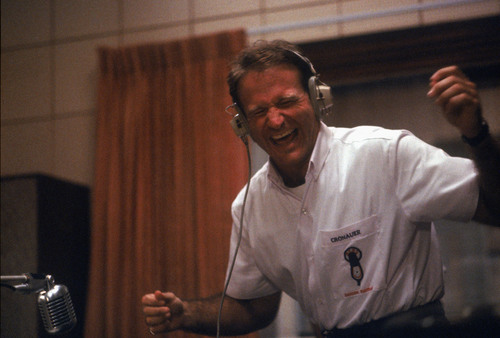
I first encountered him in Good Morning, Vietnam as he portrayed Airman Adrian Cronauer, a DJ for the Armed Force Radio Service. The film has always been my benchmark for his humor and zany voices, as well as his dramatic skills as the horrors of war caught up with Cronauer.
The second major slice of Williams in my life was in Disney’s Aladdin, where his mostly improvised on set lines were the lifeblood of one of my favorite entries from the Mouse House. The third biggest influence on my life from his catalog is the oft-maligned Hook, which grabbed me with the transition from Williams acting like a responsible adult to embracing the bang-a-rang child that is Peter Pan. Robin Williams made Hook work for me.
I adored his comedic turns in films like Happy Feet and Mrs. Doubtfire, and enjoyed his dramatic roles in Dead Poets Society and Good Will Hunting. I deeply enjoyed catching re-runs of Mork and Mindy, and even though his darker roles like One Hour Photo never clicked with me, I was glad to see him trying to break free of comedic typecasting.
Robin Williams made a major impact on both the industry and audiences, and the world is a much darker place without the light of his genius and wit. His death is both tragic and heartbreaking, and has come far too soon.
Godspeed, dearest genie, for you are free. You will be deeply missed.
May you rest in peace.
Culture on My Mind is inspired by the weekly Can’t Let It Go segment on the NPR Politics Podcast where each host brings one thing to the table that they just can’t stop thinking about.
Culture on My Mind Shelving the Star Wars Expanded Universe Makes Sense May 4, 2014
I’ve been thinking about the recent shake-up in the Star Wars expanded universe, and it’s taken me some time to really sort out my thoughts both in relation to my emotions and good business sense. I agree with the decision, and believe that it makes sense to do it.
Part I – The Books and Me
It seems fitting that this decision was made public around this time of year. I was introduced to the post-Return of the Jedi adventures of Luke, Leia, Han, and Chewie on Easter Sunday of 1992. My parents surprised me with a paperback copy of the Star Wars Trilogy 10th anniversary omnibus, which combined the novelizations of each of the original films, along with a paperback copy of Timothy Zahn’s Heir to the Empire. They realized that I had a deep attachment to the original trilogy, which I had only seen on well-loved and rewind-worn pan-and-scan VHS tapes at that time, and they fed that passion with what they understood to be the continuing story. They were right on the money, as confirmed by the hardcover version’s inner jacket blurb.
The three Star Wars films form a spectacular saga of bold imaginations and high adventure. But the stories of its characters did not end there. Now for the first time, Lucasfilm Ltd., producer of the Star Wars movies, has authorized the continuation of this beloved story. In an astounding three-book cycle, Timothy Zahn continues the tale of Luke Skywalker, Princess Leia, Han Solo, and the other characters made world famous by Star Wars, as he brilliantly expands upon George Lucas’s stunning vision, “a long time ago in a galaxy far, far away.”
I rapidly devoured the original trilogy omnibus, and relished the differences between the novels and the films. Obi-Wan knew about ducks, Luke’s uncle Owen was really Kenobi’s brother, and Vader was created when Anakin and Obi-Wan battled on the edge of a volcano. It was a wealth of information that expanded beyond the cinematic journey, and it primed me for the more dedicated reading of the continuing saga. I say dedicated, but I don’t mean meticulous; I flew through Heir to the Empire and loved every minute. In June of 1992, I reserved a copy of the second book, Dark Force Rising, at my local library and flew through it as well. It was a long year until The Last Command was released, and after that epic conclusion, I satiated my desire for more Star Wars by reading Brian Daley’s The Han Solo Adventures, L. Neil Smith’s The Lando Calrissian Adventures, and Alan Dean Foster’s Splinter of the Mind’s Eye.
It didn’t matter to me how bad Splinter was because, by the Maker, I had new Star Wars in my hands. The Truce at Bakura, The Courtship of Princess Leia, and Kevin J. Anderson’s Jedi Academy trilogy started me down a path of buying the books and comic trade paperbacks when they came out and enjoying every one of them. My palette has matured a bit since then, and stories like The Crystal Star (ah, Waru) are hardly ever revisited by my eyes, but at the time, they were precious, precious gold.
Despite my love for the franchise, it became apparent to me that the universe was getting too large too fast. At that point, stories in what became the Star Wars Expanded Universe (SWEU) ranged from approximately 5,000 years before to around 20 years after A New Hope. One person at Lucasfilm, Leland Chee, was charged with keeping the chronology straight and smoothing over any conflicts amongst the novels, comics, video games, television series, and movies. He did an admirable job, and it’s one I don’t envy.
By 1994, Lucas Licensing had defined what made up Star Wars canon, and publicized it in issue 23 of Star Wars Insider, the fan club’s magazine.
Gospel, or canon as we refer to it, includes the screenplays, the films, the radio dramas and the novelizations. These works spin out of George Lucas’ original stories, the rest are written by other writers. However, between us, we’ve read everything, and much of it is taken into account in the overall continuity. The entire catalog of published works comprises a vast history—with many off-shoots, variations and tangents—like any other well-developed mythology.
To help sort out the chronology, multiple tiers were established between 1996 and 2000 to solve conflicts between stories. Anything that directly involved George Lucas, such as the films, their novels and radio adaptations, and statements from Lucas himself trumped everything. Under that were the television shows, followed by the combination of novels, comics, and games. As the prequel movies dawned and Lucasfilm started developing The Clone Wars television series, more and more continuity problem started to crop up and it was apparent that something had to give. In the time-honored tradition of the SWEU, George Lucas won.
Part II – The Dawn of a New Era
The decision on April 25th to essentially shelve everything except the six core films and The Clone Wars isn’t a big surprise. In fact, it’s been a long time coming. As much as George Lucas has changed his mind on sequel films – at first it was a twelve-film series, then nine, then six. As recently as May 2008, he told TotalFilm that, “There will definitely be no Episodes VII–IX” – he has been consistent since 2001 that his vision trumps everything else. During an interview on the official site in March 2008, he explained his point of view.
It’s a certain story about Anakin Skywalker and once Anakin Skywalker dies, that’s kind of the end of the story. There is no story about Luke Skywalker, I mean apart from the books. But there’s three worlds: There’s my world that I made up, there’s the licensing world that’s the books, the comics, all that kind of stuff, the games, which is their world, and then there’s the fans’ world, which is also very rich in imagination, but they don’t always mesh. All I’m in charge of is my world. I can’t be in charge of those other people’s world, because I can’t keep up with it.
Fans have been complaining that this move invalidates the established canon, but what really has been canon before now? The Thrawn trilogy was “authorized” as a continuation, and multimedia events like Shadows of the Empire and The Force Unleashed had some direction from George Lucas, but aside from that everything else seems to have been handled by a licensing department.
You know what else fits this pattern? The Star Trek novels. The Marvel Cinematic Universe. 1978’s Superman film. Any of the various DC and Marvel reboots. All of them violate the established “canon” of the material that came before, and yet they exist and are still enjoyed. Just like those examples, and countless other franchise tie-ins, the stories established by the SWEU still exist. Disney and Lucasfilm aren’t burning every copy they can find or raiding public libraries for toilet paper. In fact, the existing SWEU is being republished as the “Star Wars Legends” series to guarantee their availability for the future.
Star Wars fans can learn a very valuable lesson from Star Trek fans, as author Keith R. A. DeCandido explained in his comments on this whole affair.
Two of the most highly regarded Trek novels are Imzadi and Federation. The former novel was heavily contradicted by a TNG episode (“Second Chances”); the latter was totally nuked by the movie First Contact. Yet the two novels continue to be well regarded — and so does that episode and that movie, even though they contradict each other. If you think that contradictory versions of stories in the same universe ruins one of the contradictory ones, then you don’t understand how storytelling works.
I totally get the concept of having a huge personal investment in this franchise. I owned every novel in the series before the Navy lost half of my household goods shipment back in 2005. That incident hurt, but only because of the material loss. My consolation was that the books were still out there, and someone would be selling them when I was ready to rebuild.
More importantly, this move guarantees the future of the Star Wars franchise, which cost Disney over $4 billion. That’s one hell of an investment, and they needed a way to make it accessible to general audiences again, including the newest generation of children who haven’t experience the galaxy far, far away. As much as we cannot expect audiences to read every book between Return of the Jedi and Episode VII, we cannot expect scriptwriters and directors to limit their vision to decades of contradictory stories. Those limitations would only hinder the movie and hurt the investment.
Take the example of Disney’s other major acquisition, the Marvel franchise, and their approach to the Marvel Cinematic Universe. General audiences don’t need to read the comics to get the stories, and if they need to know something, it’s presented to them. If you haven’t had a chance to read the Bloomberg Businessweek article about the MCU, I highly recommend it. There are a lot of parallels between Marvel and Star Wars.
Before this announcement, I was optimistic but skeptical about the sequel movies. There was just too much story to dance around if the EU was left intact, and I wasn’t keen on the movies being cleverly wedged between chapters or pages of a novel just to make a timeline work. This move tells me that Disney is serious about their investment and the vision they want to bring to audiences. By making this story easily accessible to everyone, which means removing the stumbling block of the now Legends stories, Disney and Lucasfilm win. That means that Star Wars fans win.
Disney and Lucasfilm helped reignite the magic of my childhood. Warm up the Falcon, Chewie, and calculate the hyperspace jump to December 2015. I’m ready to believe again. Star Wars truly is forever.
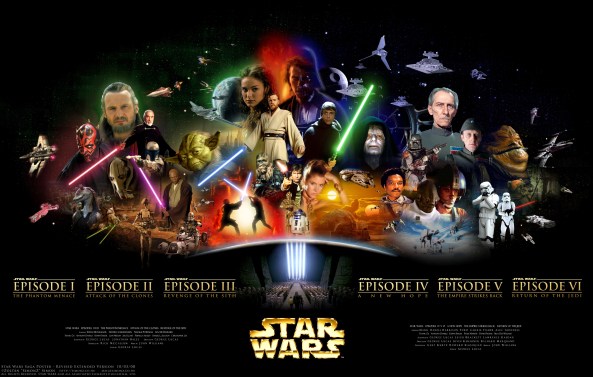
Star Wars Saga Poster by SimonZ
Culture on My Mind is inspired by the weekly Can’t Let It Go segment on the NPR Politics Podcast where each host brings one thing to the table that they just can’t stop thinking about.
Culture on My Mind Earworm: Hardware Store April 3, 2014
I have a small earworm that is making this week’s commutes a little easier. It shuffled up on my iPod during Monday evening’s drive, and I’ve used it for the last couple of days.
There is no official music video, and Weird Al refuses to play this song in concert due to the rapid-fire description of “all that stuff” in the store. Nevertheless, it’s a fun song.
They’ve got allen wrenches, gerbil feeders, toilet seats, electric heaters Trash compactors, juice extractors, shower rods and water meters Walkie-talkies, copper wires, safety goggles, radial tires BB pellets, rubber mallets, fans and dehumidifiers Picture hangers, paper cutters, waffle irons, window shutters Paint removers, window louvers, masking tape and plastic gutters Kitchen faucets, folding tables, weather stripping, jumper cables Hooks and tackle, grout and Spackle, power foggers, spoons and ladles Pesticides for fumigation, high-performance lubrication Metal roofing, waterproofing, multi-purpose insulation Air compressors, brass connectors, wrecking chisels, smoke detectors Tire gauges, hamster cages, thermostats and bug deflectors Trailer hitch demagnetizers, automatic circumcisers Tennis rackets, angle brackets, Duracells and Energizers Soffit panels, circuit breakers, vacuum cleaners, coffee makers Calculators, generators, matching salt and pepper shakers
Culture on My Mind is inspired by the weekly Can’t Let It Go segment on the NPR Politics Podcast where each host brings one thing to the table that they just can’t stop thinking about.
I’m resurrecting the WordPress site because I wanted a place for long form blogging, and also because I’ve decided to embark on an exciting journey. More to follow on the adventure in time and space in a minute, but first, the blog.
Creative Criticality has been around for a while, but in multiple formats. It was on LiveJournal for a while – that’s where a lot of the prior posts you’ll see in the Archives section come from – and has been on Tumblr and Facebook as well. The latter two still remain open, but LiveJournal will not. Between you, me, and the rest of the internet, I will not miss the DDOS attacks from Russia or the spam comments trying to sell me sex and drugs through shady websites.
As far as WordPress goes, I’m still learning. I appreciate any comments, tips, and tricks to make this thing sing a little better. Feel free to tell me to kill it with fire, but I can’t guarantee that I will.
Anything older than one year, including the old LiveJournal stuff, has had the comments locked. Anything older than 2013 is in the Archives.
Big thanks to Kevin Bachelder for gently nudging me in this direction. You’re right, it is better living in the future.
Next order of business: That adventure thing.
I’ve decided to finally watch Doctor Who from the beginning and document the journey. I’ve mentioned in certain circles that I came to the series in the later years starting with Christopher Eccleston’s run. I have watched certain episodes from the past, but the vast majority of the franchise is fresh territory for me. I find the concept quite exciting.
My reviews will be short, probably ranging from 50-200 words unless I really get on a roll. The episodes have been reviewed in-depth across various platforms by numerous people – including by Nathan Laws, one of the people who really inspired me to take a deeper look at the mythology of the Doctor – so I don’t plan on offering deep thematic musings and analysis. It might happen down the road at some point, but not right now.
I also credit John Drew and Gary Mitchel for the little nudges here and there. You’re good folk, and I appreciate it.
I plan to offer a link to each serial’s article on the TARDIS Data Core wiki, and I’ll also offer a “from the gut” rating of each serial.
1/5: “EXTERMINATE!”
2/5: “Mm? What’s that, my boy?”
3/5: “Reverse the polarity of the neutron flow.”
4/5: “Would you care for a jelly baby?”
5/5: “Fantastic!”
The one thing to note about the ratings is that a regeneration episode will have a star added to it. Regeneration episodes have the impossible task of trying to make you like a new main character right away while still trying to carry the story, and I felt it was necessary to compensate for that handicap.
I’ve decided to call it the Timestamps Project. Thanks to Gary for that name.
That’s it for now. Please feel free to leave any feedback in the comments. I’ll have the Timestamp for the first Doctor Who serial, An Unearthly Child, on the feed soon.
Culture on My Mind Phoenix Rising: In Which Tee and Pip are My First Steampunk June 10, 2011
Imagine the gritty world of Blade Runner, with all of its fantasy and science and punk vision of society. Now change the setting from a future Los Angeles to Victorian-era England. Now take the replicants and hovercars and weaponry and imagine if they were all powered by pressurized steam instead of electrons.
That’s the way I’ve been able to understand the subgenre of steampunk.
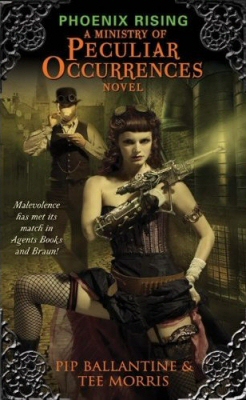
I’ve been curious for some time about the allure of this science-fiction/fantasy subgenre, from buzzing on the internet to the plethora of costumes at events like Dragon*Con. When authors and podcasting giants Pip Ballantine and Tee Morris released their new novel, Ministry of Peculiar Occurrences: Phoenix Rising, I decided to take the plunge into the world of cogs, corsets, and airships.
The story itself is rather simple and linear, but that’s not a bad thing. In fact, it’s quite refreshing for what is essentially a spy novel, complete with action, suspense, and a hearty degree of intellect. Modern espionage tales try to layer double-crosses and intrigue to the point that all those plot twists shroud the very essence of the plot. I never felt that Phoenix Rising was trying to mislead me or confuse me at any point.
The tale focuses on our two heroes, Wellington Books and Eliza Braun, both secret agents in a clandestine branch of the Monarchy that investigates the peculiar, be it the occult or the supernatural. I thought of it as Indiana Jones and the Torchwood Institute combined with Her Majesty’s Secret Service from the James Bond series.
Agent Books is the embodiment of Q, a master of gadgets and gizmos, working as a librarian—pardon me, Archivist—in the bowels of the Ministry. Agent Books doesn’t seek action or adventure because he finds it in the case files he meticulously organizes like clockwork, nine to five, Monday through Friday. He’s prim and proper head-to-toe, armed with a dry wit, and sips a lot of tea. On the surface, Wellington Books is a rather boring guy.
Books is balanced with the spirited Agent Braun from New Zealand, who is the James Bond of the story. Quite honestly, she starts the story as more of a Daniel Craig than a Sean Connery. She goes into action like she’s a one woman wrecking crew, armed to the teeth while wearing a bulletproof corset, and takes no prisoners. She loves her drinks and loves her job, but she’s scarred by the loss of her former partner and her methods get her in trouble with her boss.
Yes, ladies and gentlemen, the Crown’s fate rests in the hands of a renegade and a librarian.
The story revolves around a secret society that threatens the sanctity of the Empire. Eliza has firsthand knowledge of the case because it was what drove her former partner—with whom she was incredibly close—to become a permanent resident in the local asylum. After her scolding for the events of the first chapter, she’s relegated to the less action-packed Archives to learn about the other side of the Ministry from Agent Books. While there, she discovers that the case that claimed her partner is still unsolved and that both she and Books are linked to the happenings. The plot elegantly progresses from there.
The story shifts into high gear from the very beginning and stays there for 400 pages. Tee and Pip swap chapters, bouncing points-of-view from Books to Braun while including very deep character development and growth. The story is also presented in more of the proper British English format, keeping the U in “flavour” and really immersing readers in the Victorian setting. It also keeps the reader in the same mindset as the protagonists, discovering each clue as they do. The only breaks from that formula are the short chapters that expand on the antagonists and their shadowy machinations. These interludes also lay down hints and threads for potential sequels, which are rumored to be in production now.
For my first foray into steampunk, I’m very impressed. I’ll definitely be picking up the sequels as they arrive.
Ministry of Peculiar Occurrences: Phoenix Rising is available in bookstores everywhere in both physical and digital formats. This review is based on a personally-purchased copy.
Culture on My Mind is inspired by the weekly Can’t Let It Go segment on the NPR Politics Podcast where each host brings one thing to the table that they just can’t stop thinking about.
Now, I came to this idea of bliss because in Sanskrit, which is the great spiritual language of the world, there are three terms that represent the brink, the jumping-off place to the ocean of transcendence: Sat-Chit-Ananda. The word “Sat” means being. “Chit” means consciousness. “Ananda” means bliss or rapture. I thought, “I don’t know whether my consciousness is proper consciousness or not; I don’t know whether what I know of my being is my proper being or not; but I do know where my rapture is. So let me hang on to rapture, and that will bring me both my consciousness and my being.” I think it worked.
—Joseph Campbell
Culture on My Mind is inspired by the weekly Can’t Let It Go segment on the NPR Politics Podcast where each host brings one thing to the table that they just can’t stop thinking about.
Culture on My Mind Katie Lucas is Awesome, Reason 1138 May 11, 2011
The prequels have been made. They exist. There is literally nothing you can do or say to make them go away. They may not be your cup of tea, but let’s remember: YOU can choose not to watch them! You can pretend like they don’t even exist! But being angry about it forever is going to accomplish nothing. Neither is being disrespectful. My father has done absolutely nothing to earn disrespectful tirades and personal attacks. He is a good man. He is not an evil genius plotting to ruin your life. You are entitled to your own opinions–whatever they may be, but be respectful about it. He may have made three movies you personally didn’t care about, but he was also responsible for three movies that inspired you and millions of others. So, do him and I (sic) the courtesy of having a little goddamn respect.
Culture on My Mind is inspired by the weekly Can’t Let It Go segment on the NPR Politics Podcast where each host brings one thing to the table that they just can’t stop thinking about.





 Creative Criticality