

Timestamp #TW24: Adrift

Torchwood: Adrift
(1 episode, s02e11, 2008)


The Rift taketh and the Rift giveth away.

A young man is walking home from football practice along the Cardiff Bay Barrage when he vanishes in bright light and a gust of wind. Seven months later, Gwen and PC Andy Davidson are investigating the case. They catch up about the wedding and their relationship, and Davidson tells Gwen that this case is personal for him.

He shows her CCTV footage, hinting at the type of thing that Torchwood pays attention to. Gwen is intrigued when Jack appears on the footage as well. She checks with Tosh, discovers that the Rift was quiet, and gets nothing from Jack about the incident.

Andy is unimpressed with the effort.

Gwen visits Jonah Bevan’s mother who has been scanning crowd videos for her son’s face. Nikki Bevan refuses to give up hope and she asks Gwen to come to her support group meeting. Gwen returns home and apologizes for being late in more ways than one. The next morning, she gets a lead from Tosh about a negative Rift spike during the event, which she normally considers to be aftershocks.

She wonders, though, if the Rift could take material from our world instead of only depositing it.

Gwen and Andy go to Nikki’s support group meeting and are surprised at the number of people who attend. To say that there is a lot is an understatement. Gwen is overwhelmed but inspired by the scope and asks Tosh to help process the dates of disappearance against Rift activity.

Gwen makes considerable progress, correlating walls of missing person posters with Rift spikes. Unfortunately, Jack doesn’t know how to practically stop the disappearances when they cannot predict the Rift spikes. He shuts down her research project, but Gwen isn’t ready to give up.

Unfortunately, it starts to tear at her relationship with Rhys. She returns to the Hub, interrupting an encounter between Jack and Ianto to plead her case. Jack tells her no, but Ianto leaves her a GPS unit on her desk that she takes to Andy. The coordinates lead to a facility on Flat Holm, and Gwen leaves Andy on the pier as she contracts a boat to the island.

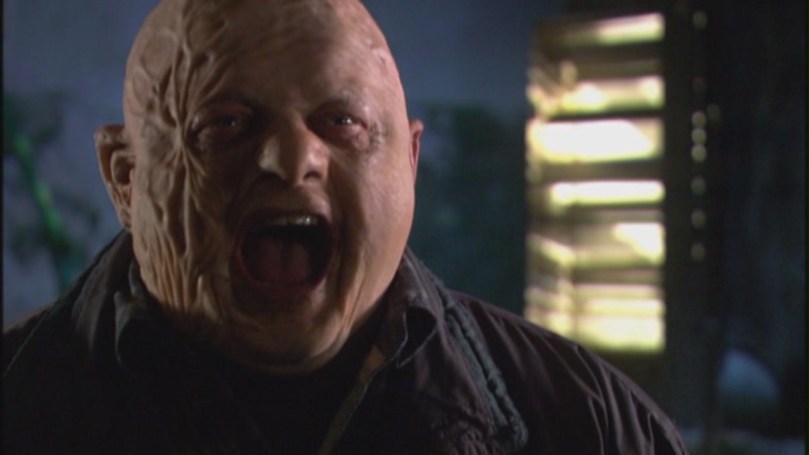
The facility houses seventeen victims of the Rift who have been taken and returned, but in the process have been aged and (in some cases) deformed. Gwen finds that Jack knew about all of it. She also finds Jonah, who was trapped on a burning planet for forty relative years. He was rescued and witnessed the burning of a solar system.

Jack tells Gwen that he set up this facility to house the victims and that before he took over Torchwood Three, the victims were locked away in the vaults and neglected. They cannot be fixed, only cared for. Gwen promises to bring Nikki to the facility, an action with which Jack vehemently disagrees. He eventually relents.

In order to reunite Nikki with Jonah, Gwen has to tell her about Torchwood and the Rift. Nikki meets her son and doesn’t recognize him at first, but they soon share memories that only Jonah would know. Nikki calms herself and finally sees beyond the scars to her son, but the reunion is shortlived. Jonah has a form of post-traumatic stress disorder that forces him to scream for twenty hours a day after he looked into a dark star and was driven insane.

The screams are so intense, so primal, that they drive everyone away. Nikki is devastated.

One week later, Nikki makes Gwen promise that she will never do this to anyone else. She says that it would have been better to remember her son as he once was, not as he survives now. Her hope has been extinguished.

Gwen tears down her research as Nikki disposes of her life of sorrowful searching. Gwen returns home and tries to make amends with Rhys, but ends up breaking down in his arms. They mend their bridges by discussing her experience.


The exploration of the darker side to Torchwood is fascinating, particularly since Jack serves two purposes here: First, he keeps this secret from nearly everyone in his employ, and, second, he takes on the role of the custodian of these lost souls when no one else will. Just when I think I have Jack figured out…

It’s especially heartbreaking given the ignorance of the victims’ families. They think that they want answers about their missing loved ones, but the truth of what the uncontrollable Rift does with them is beyond what they can bear.

The lingering question concerns the staff at the facility. Do they about Torchwood, or are they privy to just enough information to do their jobs?


Rating: 5/5 – “Fantastic!”


UP NEXT – Torchwood: Fragments


The Timestamps Project is an adventure through the televised universe of Doctor Who, story by story, from the beginning of the franchise. For more reviews like this one, please visit the project’s page at Creative Criticality.


The Thing About Today – February 12

February 12, 2020
Day 43 of 366


February 12th is the forty-third day of the year. It is National Freedom to Marry Day in the United States. It is also Red Hand Day, also known as the International Day Against the Use of Child Soldiers.

In the United States, it is “celebrated” as National Plum Pudding Day.


Historical items of note:

  • In 1502, Isabella I issued an edict outlawing Islam in the Crown of Castile in Spain. This forced virtually all of her Muslim subjects to convert to Christianity.
  • In 1809, Abraham Lincoln, the 16th President of the United States, was born.
  • In 1909, the National Association for the Advancement of Colored People (NAACP) was founded.
  • In 1915, actor Lorne Greene was born.
  • In 1924, George Gershwin’s Rhapsody in Blue received its premiere in a concert titled “An Experiment in Modern Music”. The concert was held at Aeolian Hall in New York, with Gershwin playing the piano with Paul Whiteman and his band.
  • In 1938, author and educator Judy Blume was born.
  • In 1945, actress Maud Adams was born.
  • In 1946, African American United States Army veteran Isaac Woodard was severely beaten by a South Carolina police officer. The incident, during which Woodard lost his vision in both eyes, galvanized the civil rights movement and partially inspired the Orson Welles film Touch of Evil.
  • In 1950, actor Michael Ironside was born.
  • In 1953, actress Joanna Kerns was born.
  • In 1963, construction began on the Gateway Arch in St. Louis, Missouri.
  • In 2001, the NEAR Shoemaker spacecraft touched down in the “saddle” region of 433 Eros, becoming the first spacecraft to land on an asteroid.
  • In 2004, the city of San Francisco began issuing marriage licenses to same-sex couples in response to a directive from Mayor Gavin Newsom.


In 1915, the first stone of the Lincoln Memorial was placed in Washington, D.C. This occurred on the 106th anniversary of Lincoln’s birth.

The architect for the memorial was Henry Bacon and the designer of the interior statue was Daniel Chester French. The statue was carved by the Piccirilli Brothers and the interior murals were painted by Jules Guerin. The overall design echoed a Greek Doric temple and contains inscriptions of the Gettysburg Address and the President’s second inaugural address. It has been the site of several famous speeches, including Martin Luther King Jr.’s “I Have a Dream” address.

It wasn’t the first public memorial to President Lincoln. That honor goes to a statue by Lot Flannery erected in front of the District of Columbia City Hall in 1968, three years after Lincoln’s assassination. Public demand for a fitting national memorial, ranging back to the time of Lincoln’s death, finally got traction when Congress took action in 1867. Courtesy of congressional chicanery, the project eventually settled on design and location by 1913.

The location was dedicated on February 12, 1914, and was completed on schedule. The memorial itself was dedicated on May 30, 1922, by William H. Taft, then Chief Justice of the United States, and presented to President Warren Harding. Lincoln’s only surviving son, 78-year-old Robert Todd Lincoln, was in attendance.

The Memorial was listed on the National Register of Historic Places on October 15, 1966. It is open to the public 24 hours a day and is visited by over seven million people per year.


The Thing About Today is an effort to look at each day of 2020 with respect to its historical context.

For more creativity with a critical eye, visit Creative Criticality.


The Thing About Today – February 11

February 11, 2020
Day 41 of 366


February 11th is the forty-second day of the year. It is National Foundation Day in Japan, commemorating the 660 BC foundation by Emperor Jimmu.

In the United States, it is “celebrated” as National Don’t Cry Over Spilled Milk Day, National Inventors’ Day, National Make a Friend Day, National Peppermint Patty Day, National Shut-In Visitation Day, and National White Shirt Day.


Historical items of note:

  • In 1790, The Religious Society of Friends, also known as Quakers, petitioned the United States Congress for the abolition of slavery.
  • In 1812, Massachusetts governor Elbridge Gerry was accused of unfair practices after signing a bill that created a partisan Boston district in the shape of a salamander. Thus, the term gerrymandering was born.
  • In 1847, Thomas Edison was born. He developed the lightbulb and the phonograph.
  • In 1936, actor Burt Reynolds was born.
  • In 1953, President Dwight D. Eisenhower denied all appeals for clemency for Julius and Ethel Rosenberg, the couple convicted of spying on the United States for the Soviet Union.
  • In 1961, actress Carey Lowell was born.
  • In 1969, actress and producer Jennifer Aniston was born.
  • In 1982, actress Natalie Dormer was born.
  • In 1983, “Weird Al” Yankovic completed recording of his first studio album.
  • Also in 1983, actress Nicki Clyne was born.
  • In 2001, a Dutch programmer launched the Anna Kournikova virus. Millions of emails were infected thanks to a trick photo of the tennis star.


In 1938, BBC Television produced a thirty-five-minute adaptation of a section of the play R.U.R., making it the world’s first-ever science fiction television program.

R.U.R., sometimes subtitled Rossumovi Univerzální Roboti or “Rossum’s Universal Robots”, was written by Karel Čapek. When it premiered on January 25, 1921, it introduced the word “robot” to the English language and the science fiction genre. In Czech, robota means forced labor, such as that of a serf on a master’s land. It is derived from rab, which translates to slave.

The play partly takes place in a factory that makes artificial people called roboti. These robots are manufactured from synthetic organic matter and are living creatures of artificial flesh and blood rather than the mechanical constructs we consider robots in the modern era. In fact, the roboti are closer to our modern definition of androids or replicants, can easily be mistaken for humans, and can think for themselves. They seem happy to work for humans at first, but a robot rebellion leads to the extinction of the human race.

Čapek later wrote in the same theme with War with the Newts, in which non-humans become a servant class in human society.

The parallels between Čapek’s work and both versions of Battlestar Galactica are striking.

The play quickly became influential and had been translated into thirty languages by 1923. It was later adapted into a radio play with Patrick Troughton for the BBC in 1941 and had several other adaptations over the years. Its legacy has also spawned several references in popular culture.

In the United States, the original manuscript is in the public domain and has been transcribed for Project Gutenberg.


The Thing About Today is an effort to look at each day of 2020 with respect to its historical context.

For more creativity with a critical eye, visit Creative Criticality.


The Thing About Today – February 10

February 10, 2020
Day 41 of 366


February 10th is the forty-first day of the year. It is National Memorial Day of the Exiles and Foibe in Italy. This year, it also coincides with the Jewish holiday of Tu BiShvat.

In the United States, it is “celebrated” as National Cream Cheese Brownie Day, National Home Warranty Day, National Umbrella Day, and National Clean Out Your Computer Day. The last one is typically observed on the second Monday in February.


Historical items of note:

  • In 1939, John Ford’s Stagecoach premiered in Miami.
  • Also in 1939, Peter Purves was born. He played Steven Taylor in Doctor Who.
  • In 1940, Tom and Jerry debuted with the make their debut with the short Puss Gets the Boot.
  • In 1967, the Twenty-Fifth Amendment to the United States Constitution was ratified. It deals with issues related to Presidential succession.
  • Also in 1967, actress, director, and producer Laura Dern was born.
  • In 1974, actress and director Elizabeth Banks was born.
  • In 1996, the IBM supercomputer Deep Blue defeated Garry Kasparov in chess for the first time.


In 1929, composer and conductor Jerry Goldsmith was born.

As a child, he studied under Italian composer Mario Castelnuovo-Tedesco, who also tutored composers and musicians like Henry Mancini, Nelson Riddle, Herman Stein, André Previn, Marty Paich, and John Williams. At the age of sixteen, Goldsmith saw Spellbound in theaters and was inspired by the music of Miklós Rózsa.

After graduating from the University of Southern California, he started his career at CBS as a clerk typist in the music department. He wrote scores for radio programs like CBS Radio WorkshopFrontier Gentleman, and Romance, later progressing to Climax!, Playhouse 90, and several episodes of the iconic anthology series The Twilight Zone. He also worked on Dr. Kildare and The Man from U.N.C.L.E.

He made his film debut on 1957’s Black Patch, and gained widespread recognition after scoring 1962’s Lonely Are the Brave, which came after a recommendation from Alfred Newman.

During the 1960s, Goldsmith nearly fifty titles, including Our Man FlintStagecoachIn Like FlintPlanet of the Apes, and The Blue Max. His score for The Blue Max is considered one of the best in his catalog, possibly inspiring later flight music like SupergirlStar Trek: The Motion PictureAir Force One, and Tora! Tora! Tora!

The 1970s brought Goldsmith to Patton, which used an echoplex to loop “call to war” triplets on the trumpet to reflect the famous general’s belief in reincarnation. The score earned Goldsmith an Oscar nomination for Best Original Score. During the decade, he also scored PapillonChinatownThe Wind and the LionThe Omen (and two sequels), Logan’s RunIslands in the StreamComaCapricorn OneThe Great Train Robbery, and The Boys from Brazil.

He also scored 1979’s Alien, using the orchestra and atypical instruments to invoke unease and terror. He also was responsible for establishing the musical path forward in the Star Trek franchise with the juggernaut’s first motion picture. This score introduced the thematic title theme that would carry forward from that point, as well as debuting Craig Huxley’s Blaster Beam instrument as a motif for the V’Ger entity. Goldsmith would return to Star Trek for four more films and the title theme for Star Trek: Voyager.

The 1980s continued Goldsmith’s success with Outland, The Secret of NIMHTwilight Zone: The MoviePoltergeist (and its sequel), the first three Rambo films, GremlinsSupergirlLegendHoosiersInnerspaceLeviathan, and The ‘Burbs. The 1990s added The Russia HouseTotal RecallGremlins 2: The New BatchSleeping with the EnemyForever YoungThe VanishingBasic InstinctRudyThe River WildCongoPowderMulan, and so much more.

He also composed a new theme for the Universal Studios opening logos, which debuted with The Lost World: Jurassic Park.

The 2000s brought Goldsmith’s illustrious career to a close with Hollow ManAlong Came a SpiderThe Sum of All Fears, and the Soarin’ attractions at the Disney theme parks. His final cinematic score was Looney Tunes: Back in Action, directed by his long-time collaborator Joe Dante.

Jerry Goldsmith has often been considered one of film music history’s most innovative and influential composers, receiving eighteen total Academy Award nominations. Despite being one the most nominated composers in Oscars history, he only won once. That was for The Omen from 1976.

He died in his home on July 21, 2004, from colon cancer at the age of 75.


The Thing About Today is an effort to look at each day of 2020 with respect to its historical context.

For more creativity with a critical eye, visit Creative Criticality.



The Thing About Today – February 9

February 9, 2020
Day 40 of 366


February 9th is the fortieth day of the year. It is St. Maroun’s Day in Lebanon.

In the United States, it is “celebrated” as National Bagel and Lox Day, National Pizza Day, and National Toothache Day. One of these things is not like the other…


Historical items of note:

  • In 1825, the United States House of Representatives elected John Qunicy Adams as the sixth President of the United States. This step was taken after no candidate received a majority of electoral votes in the US presidential election of 1824.
  • In 1870, President Ulysses S. Grant established the U.S. Weather Bureau by signing a joint resolution of Congress.
  • In 1895, William G. Morgan created a game called Mintonette. It was later renamed as volleyball.
  • In 1964, The Beatles made their first appearance on The Ed Sullivan Show, performing before a record audience of 73 million viewers.
  • In 1981, actor Tom Hiddleston was born.
  • In 1997, “The Itchy & Scratchy & Poochie Show” aired during the eighth season of The Simpsons. It was the show’s 167th episode and marked The Simpsons surpassing The Flintstones for the most episodes produced for a prime-time animated series.


In 1986, Halley’s Comet completed its most recent appearance in the inner solar system.

Comet Halley, officially 1P/Halley, has been observed and recorded since at least 240BC. Halley’s Comet was the first to be recognized as periodic, also known as short-period comets, which means that their orbital periods around the sun are less than 200 years. Halley’s Comet has a period of approximately 75 years.

This period was calculated in 1705 by Edmond Halley – friend, editor, and publisher to Sir Isaac Newton, who could not reconcile the physics of comets during his 1687 publication of Philosophiæ Naturalis Principia Mathematica – who used twenty-four cometary observations to determine that multiple sightings over time were really the same comet. He had personally observed the comet in September 1862 but was unable to verify the comet’s return since he died in 1742, sixteen years before the event in 1758.

During the 1986 orbit through the inner solar system, Halley’s Comet became the first comet to be observed in detail by spacecraft. This provided the first observational data on the structure, including the comet’s nucleus and how the coma and tail functioned. Due to the 75-year period between perihelion events, the return was a large pop culture event. I personally have a memento in a commemorative Matchbox Mercury Police Car.

The next predicted perihelion of Halley’s Comet is July 28, 2061.


The Thing About Today is an effort to look at each day of 2020 with respect to its historical context.

For more creativity with a critical eye, visit Creative Criticality.



The Thing About Today – February 8

February 8, 2020
Day 39 of 366


February 8th is the thirty-ninth day of the year. It is Prešeren Day is Slovenia, which commemorates the death of national poet France Prešeren in 1849.

In the United States, it is “celebrated” as National Boy Scouts Day, National Kite Flying Day, National Iowa Day, and Ice Cream for Breakfast Day. The last one is typically observed on the first Saturday in February.


Historical items of note:

  • In 1587, Mary, Queen of Scots, was executed on suspicion of having been involved in the Babington Plot to assassinate her cousin, Queen Elizabeth I.
  • In 1828, author, poet, and playwright Jules Verne was born.
  • In 1865, the State of Delaware refused to ratify the Thirteenth Amendment to the U.S. Constitution. Slavery was outlawed in the United States, including Delaware, when the Amendment was ratified in December 1865. The state finally ratified the Amendment on February 12, 1901, the ninety-second anniversary of the birth of Abraham Lincoln.
  • In 1879, Sandford Fleming first proposed adoption of Universal Standard Time at a meeting of the Royal Canadian Institute.
  • In 1882, Thomas Selfridge was born. As a First Lieutenant in the U.S. Army, he was the first person to die in an airplane crash and the first active duty member of the U.S. military to die in a crash while on duty. He was killed as a passenger in the Wright Flyer, on a demonstration flight piloted by Orville Wright.
  • In 1910, the Boy Scouts of America was incorporated by William D. Boyce.
  • In 1931, actor James Dean was born. He was the first actor to be posthumously nominated for the Academy Award for Best Actor.
  • In 1932, composer and musician John Williams was born.
  • In 1940, journalist Ted Koppel was born.
  • In 1955, author John Grisham was born.
  • Also in 1955, Ethan Phillips was born. He played Neelix in Star Trek: Voyager.
  • In 1961, DC Comics animation producer Bruce Timm was born.
  • In 1968, Planet of the Apes premiered in New York City.
  • In 1969, puppeteer and writer Mary Robinette Kowal was born.
  • In 1971, the NASDAQ stock market index opens for the first time. The name was initially an acronym for the National Association of Securities Dealers Automated Quotations.
  • In 1974, the crew of Skylab 4 returned to Earth. After completing their 84-day long mission, they were the last crew to visit the American Skylab space station.


In 1914, Bill Finger was born. He was the co-creator of Batman.

As an aspiring writer and part-time shoe salesman, he joined Bob Kane’s new studio in 1938 and took a job of ghostwriting Rusty and Clip Carson strips. In response to the success of Superman, the duo conceived the idea for Batman. Finger was responsible for most of the character’s iconic elements, including the cowl, the cape, and the alter ego.

Kane recalls creating the superhero’s vigilante side, but that Finger added the elements of the World’s Greatest Detective. Unfortunately, Bob Kane negotiated the contract to run the character’s stories without including Bill Finger.

Finger wrote many of the early Batman stories, including significant contributions to iconic characters like the Joker, Catwoman, and Robin, as well as elements such as the Batcave, Batmobile, and Gotham City. He also was credited for Ace the Bat-Hound, Bat-Mite, Clayface, Betty Kane (the original Bat-Girl), and so much more.

Finger also made a considerable impact in the worlds of Superman and Green Lantern. He also a screenwriter for both film and television, including the second season live-action Batman episodes “The Clock King’s Crazy Crimes / The Clock King Gets Crowned”, which aired October 12–13, 1966.

Because of the contract that Bob Kane signed nearly thirty years before, those television stories were Bill Finger’s first public credits for a Batman story.

He did not receive official credit on Batman stories or films until 2015, approximately forty years after his death.

He was posthumously inducted into the comic book industry’s Jack Kirby Hall of Fame in 1994 and the Will Eisner Comic Book Hall of Fame in 1999. The Bill Finger Award, established by Jerry Robinson in 2005 and presented annually at the San Diego Comic-Con to honor excellence in comic-book writing, is named for him.

He was the subject of a 2017 documentary film on Hulu called Batman & Bill.


The Thing About Today is an effort to look at each day of 2020 with respect to its historical context.

For more creativity with a critical eye, visit Creative Criticality.


Culture on My Mind – Film Music Podcasts

Culture on My Mind
Film Music Podcasts

February 7, 2020

This week’s “can’t let it go” item is a collection of podcasts about soundtrack music. I’m a big fan of film scores, and I have really fallen for four different podcasts about the history and construction of music.

The Soundtrack Show is billed as “a weekly look at the film scores and soundtracks for some of the most popular movies, TV Shows, Video Games and Theater pieces of all time.” It is hosted by David W. Collins, previously the lead sound designer and voice director at LucasArts. Collins studied theatre and music for both of his advanced degrees before working for LucasArts. While in the industry, he worked on a long list of LucasArts games and voiced roles in Star Wars: The Force Unleashed, Star Wars Battlefront: Renegade Squadron, Star Wars Battlefront: Elite Squadron, and several of the recent Star Wars films. He was also a host at three Star Wars Celebration events.

Using his knowledge of both music and story, Collins has dissected several of the Star Wars films as well as Ennio Morricone’s library, Back to the FutureGhostbustersPsycho, and more.

The Soundtrack Show is part of the iHeartRadio Network and can be found on Twitter and Facebook. David Collins can also be found on Twitter.

Art of the Score is billed as “an in-depth podcast series discussing the world of film scores.” It is hosted by musicians Andrew Pogson, Dan Golding, and Nicholas Buc.

Andrew Pogson is a twenty-year veteran of the music industry and is the Senior Manager of Special Projects for the Melbourne Symphony Orchestra. Dr. Dan Golding is a senior lecturer in Media and Communications at Swinburne University of Technology, host of Screen Sounds and co-host of the What is Music series for the Australian Broadcasting Corporation, composer of several soundtracks, and author of several pop culture books. Nicholas Buc is a composer, conductor, arranger, violinist, and pianist who studied at the University of Melbourne and New York University.

Their discussions get far more technical, discussing chords, meters, and instruments and how the overall music theory works alongside the rest of the film and story process.

Art of the Score can be found on Twitter and Facebook. The hosts can also be found on Twitter: Andrew Pogson, Dan Golding, and Nicholas Buc.

Settling the Score is billed as “an in-depth discussion of a classic film score: what makes it tick, how it serves the movie, and whether it’s, you know, any good. It’s a freewheeling, opinionated conversation with an analytical bent, richly illustrated with musical examples. No expertise required.” It is hosted by Jonathan Dinerstein (a writer for film and television in Hollywood) and Andy Boroson (a pianist and music director) who have been chatting together about movie music for twenty years.

Their friendship is reflected in the podcast discussion. They easily mix the technical elements with the view of two fans sharing opinions over beer or coffee. It is certainly a freeform analytical discussion with a low entry bar for the casual fan.

Settling the Score can be found on Twitter.

Score: The Podcast is an extension of 2016’s Score: A Film Music Documentary. It is hosted by Robert Kraft and Kenny Holmes along with the original film’s director Matt Schrader.

Robert Kraft is a songwriter, film composer, recording artist, and record producer who served as the President of Fox Music from 1994 to 2012. During that time, he supervised the music for over 300 films and dozens of television shows. Kenny Holmes is the award-winning producer, cinematographer, and editor who produced the original documentary. Matt Schrader is an Emmy Award-winning producer and the creator of the Blockbuster serialized podcast.

The focus of Score: The Podcast is interviewing film composers to understand their methods and inspirations. It does less with the technical side and more with the people involved in the craft.

Score: The Podcast can be found on Twitter and Facebook. The hosts can also be found on Twitter: Robert Kraft, Kenny Holmes, and Matt Schrader.

Also, if you haven’t listened to Blockbuster – the story of Steven Spielberg, George Lucas, and John Williams surrounding the birth of the 1970s blockbuster movie scene – you really should.

All of these podcasts can also be found on podcatcher services such as Apple, Google, and so on.
cc-break

Culture on My Mind is inspired by the weekly Can’t Let It Go segment on the NPR Politics Podcast where each host brings one thing to the table that they just can’t stop thinking about.

For more creativity with a critical eye, visit Creative Criticality.

The Thing About Today – February 7

February 7, 2020
Day 38 of 366


February 7th is the thirty-eighth day of the year. It is National Black HIV/AIDS Awareness Day in the United States. At some point in their lifetimes, it is estimated that 1 in 16 black men and 1 in 32 black women will be diagnosed with HIV infection.

In the United States, it is “celebrated” as National Fettucine Alfredo Day, National Periodic Table Day, National Send a Card to a Friend Day, Bubble Gum Day, and National Wear Red Day. The last two are typically observed on the first Friday in February.


Historical items of note:

  • In 1795, the Eleventh Amendment to the United States Constitution is ratified. It was the first amendment adopted outside of the Bill of Rights and restricts the ability of individuals to bring suit against states in federal court.
  • In 1812, English novelist Charles Dickens was born.
  • In 1867, novelist Laura Ingalls Wilder was born.
  • In 1873, Thomas Andrews was born. He was the Irish shipbuilder who designed the RMS Titanic.
  • In 1885, novelist and Nobel Prize laureate Sinclair Lewis was born.
  • In 1900, a Chinese immigrant in San Francisco fell ill to bubonic plague, marking the first plague epidemic in the continental United States.
  • In 1940, the second full-length animated Walt Disney film, Pinocchio, premiered.
  • In 1955, actor Miguel Ferrer was born.
  • In 1960, actor and produced James Spader was born.
  • In 1962, singer-songwriter Garth Brooks was born.
  • Also in 1962, comedian Eddie Izzard was born.
  • In 1974, Grenada gained independence from the United Kingdom.
  • In 1984, during the STS-41-B mission on Space Shuttle Challenger, astronauts Bruce McCandless II and Robert L. Stewart made the first untethered spacewalk using the Manned Maneuvering Unit (MMU).
  • In 1997, NeXT merged with Apple Computer, leading down the path to Mac OS X.
  • In 2013, the U.S. state of Mississippi officially certified the Thirteenth Amendment to the United States Constitution. Mississippi was the last state in the Union to approve the abolition of slavery, approximately 148 years after the amendment was formally adopted.


In 1908, swimmer and actor Clarence “Buster” Crabbe was born.

Crabbe attended the University of Southern California where he was the school’s first All-American swimmer in 1931. He competed in the 1928 Summer Olympics in Amsterdam where he won the bronze medal for the 1,500 meters freestyle. He returned to the Olympics in the 1932 Summer Games in Los Angeles and won the gold medal for the 400 meters freestyle. He won the medal by a tenth of a second.

He started his career in Hollywood in 1933 with Tarzan the Fearless. Over the span of approximately fifty years he starred in more than a hundred films. He portrayed the typical “jungle man” roles in King of the Jungle in 1933, Jungle Man in 1941, and King of the Congo in 1952. He was the first to portray Flash Gordon, doing so for Universal Pictures from 1936 to 1940. He was also Buck Rogers in the Universal serials.

During World War II, he had a draft deferral since he was a 34-year old married man. During the war, he made Army training films and portrayed Western folk heroes Billy the Kid and Billy Carson in thirty-six films.

After branching into television, Crabbe ventured into a business career during the 1950s and 1960s. He continued working in film from time to time, including a cameo appearance in 1979’s Buck Rogers in the 25th Century.

Buster Crabbe died in 1983, at the age of 75, from a heart attack at his Scottsdale, Arizona home.


The Thing About Today is an effort to look at each day of 2020 with respect to its historical context.

For more creativity with a critical eye, visit Creative Criticality.


The Thing About Today – February 6

February 6, 2020
Day 37 of 366


February 6th is the thirty-seventh day of the year. It is the United Nations-sponsored International Day of Zero Tolerance to Female Genital Mutilation.

In the United States, it is “celebrated” as National Frozen Yogurt Day and National Lame Duck Day.


Historical items of note:

  • In 60 AD, graffiti was left in Pompeii that identified this day as a dies Solis, or a Sunday. Thanks to this historic Banksy, it is the earliest date for which a day of the week is known. In modern parlance, this day would have been a Wednesday.
  • In 1665, Queen Anne of Great Britain was born. She was the last monarch of the House of Stuart.
  • In 1778, as part of the American Revolutionary War, the Treaty of Alliance and the Treaty of Amity and Commerce were signed in Paris by the United States and France. This signaled official recognition of the new republic.
  • In 1815, New Jersey granted the first American railroad charter to John Stevens, the American lawyer, engineer, and inventor who constructed the first U.S. steam locomotive, first steam-powered ferry, and first U.S. commercial ferry service from his estate in Hoboken.
  • In 1838, Sir Henry Irving was born. He was the first actor to be awarded a knighthood, and was one of the inspirations for the title character of Bram Stoker’s Dracula.
  • In 1895, American baseball player George Herman “Babe” Ruth Jr. was born. He was one of the first five inaugural members of the Baseball Hall of Fame.
  • In 1918, British women over the age of 30, who met minimum property qualifications, received the right to vote when Representation of the People Act 1918 was passed by Parliament.
  • In 1922, actor Patrick Macnee was born.
  • In 1939, actor and director Mike Farrell was born. He portrayed Captain B.J. Hunnicutt on M*A*S*H.
  • In 1940, journalist Tom Brokaw was born.
  • In 1945, singer-songwriter Bob Marley was born.
  • In 1951, the Canadian Army entered combat in the Korean War.
  • In 1952, Elizabeth II became Queen of the United Kingdom and her other Realms and Territories and Head of the Commonwealth upon the death of her father, George VI. At the exact moment of succession, she was in a treehouse at the Treetops Hotel in Kenya. She is the longest-lived and longest-reigning British monarch, as well as the world’s longest-serving female head of state, oldest living monarch, longest-reigning current monarch, and the oldest and longest-serving current head of state.
  • In 1959, Jack Kilby of Texas Instruments filed the first patent for an integrated circuit.
  • In 1966, singer-songwriter Rick Astley was born. He promises to never give you up, never let you down, and never run around and desert you.
  • In 1987, Justice Mary Gaudron became the first woman to be appointed to the High Court of Australia.
  • In 1998, Washington National Airport was renamed Ronald Reagan National Airport. This coincided with the actor and former U.S. President’s 87th birthday.


In 2018, SpaceX’s Falcon Heavy, a super heavy-lift launch vehicle, made its maiden flight.

SpaceX, formally the Space Exploration Technologies Corporation, is a private American aerospace and space manufacturing company founded by Elon Musk, the CEO of Tesla. The company’s goal is the reduction of space transportation costs to enable the colonization of Mars.

SpaceX put the first privately funded liquid-propellant rocket, the Falcon 1, in orbit in 2008. They were also the first private company to successfully launch, orbit, and recover a spacecraft (the Dragon in 2010), the first private company to send a spacecraft to the International Space Station (the Dragon in 2012), the first propulsive landing for an orbital rocket (the Falcon 9 in 2015), the first reuse of an orbital rocket (the Falcon 9 in 2017), and the first private company to launch an object into orbit around the sun.

That last one was the Falcon Heavy and its payload of a Tesla Roadster. The reusable Falcon Heavy – classified as a super heavy-lift launch vehicle due to its ability to lift more than 110,000 pounds of payload into low Earth orbit – was designed to be able to carry humans into space beyond low Earth orbit. It was unveiled at a news conference in April 2011 with an initial test flight expected for 2013. Partly due to the failure of the SpaceX CRS-7 in 2015, the maiden flight was delayed until February 2018. The goal of the maiden flight was to demonstrate the rocket’s capabilities while gathering telemetry throughout the flight.

The Tesla Roadster was chosen as a payload because it belonged to Elon Musk and had to be “something fun and without irreplaceable sentimental value”. A mannequin (in a SpaceX spacesuit)  named “Starman” sat in the driver’s seat, named in honor of David Bowie. The car’s sound system also played Bowie songs on a loop. The Roadster became the first consumer car sent into space, and it was inserted into a heliocentric orbit.

The mission also carried Arch Mission 1.2 – a crystal disk containing Isaac Asimov’s Foundation series of books – as well as a copy of Douglas Adams’ 1979 novel The Hitchhiker’s Guide to the Galaxy in the glovebox, a towel, a “Don’t Panic!” sign on the dashboard, a Hot Wheels miniature Roadster with a miniature Starman driver, a plaque bearing the names of the employees who worked on the project, and a message on the vehicle’s circuit board that read “Made on Earth by humans”.

A year after the successful demo flight, SpaceX had managed to sign five commercial contracts worth $500 million to $750 million. SpaceX launched the first commercial Falcon Heavy rocket in April 2019, and a third flight a few months later with the recovered side-boosters from the second flight.

SpaceX has flown 18 resupply missions to the International Space Station (ISS) under a partnership with NASA. NASA also awarded SpaceX a further development contract in 2011 to develop and demonstrate a human-rated Dragon spacecraft, which would be used to transport astronauts to the ISS and return them safely to Earth. SpaceX conducted the maiden launch of its Crew Dragon spacecraft on a NASA-required demonstration flight (christened Crew Dragon Demo-1) on March 2, 2019 and is set to launch its first crewed Crew Dragon in March 2020.

SpaceX is also hard at work on the Starship spacecraft, which is designed for use in crewed interplanetary spaceflight.


The Thing About Today is an effort to look at each day of 2020 with respect to its historical context.

For more creativity with a critical eye, visit Creative Criticality.


Timestamp #TW23: From Out of the Rain

Torchwood: From Out of the Rain
(1 episode, s02e10, 2008)


Have you heard the music?

At a local carnival, local residents attend a show, but the whole affair vanishes and leaves a single woman standing in the field alone. Flashing forward to the future, a man who is reviewing vintage film is haunted by the carnival worker on his screen. Meanwhile, Jack is being haunted by a carnival organ in his head.

Gwen, Owen, and Ianto take some time away to visit the Electro, a historic cinema in rainy Cardiff. The man who was reviewing vintage film rushes to the cinema to deliver his hard work. When that film is played, the mysterious man appears and the projector is locked on. Ianto also spots Jack in the footage.

The team leaves the theater just as Jack arrives in the SUV and Tosh experiences a glitch in the Hub computers. Ianto and Jack discuss the events, and Jack laments the death of the traveling show with the advent of the cinema. They interrogate the projectionist and confiscate the film before following a lead from Tosh to investigate a Rift spike.

Outside in the pouring rain, the mysterious showman and his accomplice approach a stranded woman and steal some kind of energy from her. Jack, Owen, Gwen, and Ianto arrive to find the woman partially desiccated and take her to the hospital.

The carnival duo attacks another target at a local diner. The woman is taken to the same hospital. The Torchwood team starts putting pieces together, noting that the bodies are alive but their life forces are taken elsewhere. They return to the Hub and review the film, during which Jack identifies the Night Travellers: A group that only performed at night and appeared by coming out of the rain. Their appearance was linked to strange happenings in the communities that they visited.

Ianto also notes that the mermaid woman (later called Pearl) and a man in a top hat (later called the Ghostmaker) are missing from the film. Playing the film has set them free in the world.

The team investigates multiple stories and superstitions to unravel the mystery. Meanwhile, the Ghostmaker and Pearl continue their attacks, gathering six “last breaths” into a silver flask. The Ghostmaker decides that he needs to release the rest of the troupe from the film.

Torchwood Three responds to the hospital to find the new victims. Jack’s mention of “they came from out of the rain” sparks a memory with the attending nurse of a woman in a nursing home. They visit the woman, Christina, and learn that she was the woman from the opening sequence. Her family was taken by the Night Travellers to be in their eternal audience.

The Ghostmaker and Pearl return to the projectionist’s flat and take his film, but not before the Torchwood team is notified. Jack and Ianto arrive but the carnival duo has already vanished, headed for the Electro. Jack determines that if the duo can be filmed again, they’ll be trapped once more.

The team converges on the Electro and finds the theater owners, the projectionist’s parents, in a frozen stupor. The carnival film begins to play on the screen, releasing the Night Travellers as Owen heads to the projection booth and Jack films their emergence. The Ghostmaker finds Owen to be useless since he is without breath, but that provides just enough distraction for Ianto to steal the flask. A chase ensues, during which Jack exposes the film and eliminates the carnival ghosts. Unfortunately, the Ghostmaker spills the contents of the flask. When all is said and done, only one breath remains.

All the other victims have died.

Jack uses the remaining breath to save the final victim, a little boy, before stowing the flask at the Hub. Ianto destroys the remaining film, but it proves impossible to destroy all of it since the Night Travellers were filmed in so many places over time.

A family buys some old film reels. Once opened, Jack hears the music once again.

The threat still lives on.


It’s an intriguing idea given cultural superstitions that film can steal or trap souls and the Ghostmaker sneaking around Cardiff and attacking random people is somewhat unnerving, but the big problem in this story is the lack of real menace. The Ghostmaker and Pearl move through the plot like clockwork only to stalk with gloom around a deserted swimming pool for a large chunk of the episode. The arrival of the remaining Night Travellers happens late in the game, and they are dispatched with ease.

It just doesn’t fit with the general tension and darkness of Torchwood.


Rating: 2/5 – “Mm? What’s that, my boy?”


UP NEXT – Torchwood: Adrift


The Timestamps Project is an adventure through the televised universe of Doctor Who, story by story, from the beginning of the franchise. For more reviews like this one, please visit the project’s page at Creative Criticality.