
The Thing About Today – June 22

June 22, 2020
Day 174 of 366


June 22nd is the 174th day of the year. In Belarus, it is the Day of Remembrance of the Victims of the Great Patriotic War. It is a solemn remembrance of all the victims of the Second World War, and a commemoration of the heroic last stand of Brest Fortress in 1941, on the very country and city in which the Eastern Front began. In Croatia, it is Anti-Fascist Struggle Day, which marks the beginning of the uprising of Croatian anti-fascist Partisans against German and Italian occupying forces that started with the forming of the First Sisak Partisan Detachment on June 22, 1941, near Sisak, Croatia.


In the United States, today is “celebrated” as National Chocolate Eclair Day and National HVAC Tech Day.


Historical items of note:

  • In 1633, the Holy Office in Rome forced Galileo Galilei to recant his view that the Sun, not the Earth, is the center of the Universe in the form he presented it in, after heated controversy.
  • In 1813, after learning of American plans for a surprise attack on Beaver Dams in Ontario, Laura Secord set out on a 30-kilometer journey on foot to warn British Lieutenant James FitzGibbon.
  • In 1839, Cherokee leaders Major Ridge, John Ridge, and Elias Boudinot were assassinated for signing the Treaty of New Echota. The treaty had resulted in the Trail of Tears.
  • In 1870, the United States Department of Justice was created by the United States Congress.
  • In 1936, singer-songwriter, guitarist, and actor Kris Kristofferson was born.
  • In 1942, the Pledge of Allegiance was formally adopted by the United States Congress. The words “under God” were not added until 1954.
  • In 1944, United States President Franklin D. Roosevelt signed into law the Servicemen’s Readjustment Act of 1944, commonly known as the G.I. Bill.
  • In 1947, author Octavia E. Butler was born.
  • In 1949, actress Meryl Streep was born.
  • Also in 1949, actress Lindsay Wagner was born.
  • Also in 1949, academic and politician Elizabeth Warren was born.
  • In 1953, singer-songwriter, producer, and actress Cyndi Lauper was born.
  • In 1956, actor, director, and screenwriter Tim Russ was born.
  • In 1958, actor, director, producer and writer Bruce Campbell was born.
  • In 1960, lawyer and environmentalist Erin Brockovich was born.
  • In 1969, the Cuyahoga River caught fire in Cleveland, Ohio, drawing national attention to water pollution, and spurring the passing of the Clean Water Act and the creation of the Environmental Protection Agency.
  • In 1971, actress and comedian Mary Lynn Rajskub was born.
  • In 1974, actor Donald Faison was born.
  • In 1977, The Rescuers premiered. It was the first Disney film to get a sequel.
  • In 1978, Charon, the first of Pluto’s satellites to be discovered, was first seen at the United States Naval Observatory by James W. Christy.
  • In 1990, Checkpoint Charlie was dismantled in Berlin.
  • In 2018, comedian John Oliver was blocked on Chinese social media after parodying Chinese leader Xi Jinping.


June 22nd is (unofficially) National Onion Rings Day in the United States.

An onion ring is an appetizer or side dish in the United States, Canada, United Kingdom, Ireland, Australia, New Zealand, South Africa, and some parts of Asia, mainland Europe, and Latin America. They are made by cutting an onion into rings, dipping them in batter or bread crumbs, and then deep-frying them until golden and crispy.

On the science side of the house, the cooking process decomposes the propanethial oxide in the onion into a sweet-smelling and sweet-tasting bispropenyl disulfide, removing the bite and creating an addictive dish.

The exact origins are unknown, but there are several possibilities:

  • A recipe called “Fried Onions with Parmesan Cheese” was included in John Mollard’s 1802 cookbook The Art of Cookery Made Easy and Refined. The recipe suggests cutting onions into 1/2 inch rings, dipping them into a batter made of flour, cream, salt, pepper, and Parmesan cheese then deep-frying them in boiling lard. It also recommends serving them with a sauce made of melted butter and mustard.
  • Some believe that a recipe for French Fried Onions (though not claiming to be the originator of the recipe) appeared in the Middletown NY Daily Times on January 13, 1910.
  • The Pig Stand restaurant chain, established in Oak Cliff, Texas in the early 1920s, is one of the claimants to the onion rings invention.
  • A recipe for deep-fried onion rings dipped in milk then dredged in flour appeared in a 1933 Crisco advertisement in The New York Times Magazine.  
  • In the 1960s, the A&W restaurant is credited with popularizing the onion rings in fast food restaurants.

Regardless of the origin, the tasty treat is best served hot and directly from the fryer with the sauce and spices of your choice.


The Thing About Today is an effort to look at each day of 2020 with respect to its historical context.

For more creativity with a critical eye, visit Creative Criticality.


The Thing About Today – June 21

June 21, 2020
Day 173 of 366


June 21st is the 173rd day of the year. It is Father’s Day in the United States, which occurs on the third Sunday in June.

In the United States, today is “celebrated” as National Peaches ‘N’ Cream Day, National Day of the Gong, Go Skateboarding Day, National Daylight Appreciation Day, National Selfie Day, National Arizona Day, and Turkey Lovers’ Day (which is typically observed on the third Sunday in June).

Turkey Lover’s Day and Father’s Day on the same day? Surely a coincidence.


Historical items of note:

  • In 1749, Halifax, Nova Scotia was founded.
  • In 1898, the United States captured Guam from Spain. The Capture of Guam was a bloodless engagement during the Spanish-American War. The United States Navy sent a single cruiser, USS Charleston (C-2), to capture the island of Guam. The Spanish garrison on the island had no knowledge of the war and no real ability to resist the American forces. They surrendered without resistance.
  • In 1905, French philosopher and author Jean-Paul Sartre was born.
  • In 1915, the United States Supreme Court decided Guinn v. United States, striking down Oklahoma grandfather clause legislation which had the effect of denying the right to vote to blacks.
  • In 1932, Argentinian pianist, composer, and conductor Lalo Schifrin was born. I think of him every time I hear the Mission: Impossible theme.
  • In 1944, director and producer Tony Scott was born.
  • In 1957, author and illustrator Berkeley Breathed was born. He created Bloom CountryOutland, and Opus. Bill the Cat says “Ack!”
  • In 1964, actor and director David Morrissey was born.
  • In 1965, director, producer, and screenwriter Lana Wachowski was born.
  • In 1978, the original production of Evita, the Tim Rice and Andrew Lloyd Webber musical based on the life of Eva Perón, opened at the Prince Edward Theatre in London.
  • Also in 1978, actress Erica Durance was born.
  • In 1979, actor Chris Pratt was born.
  • In 1989, the United States Supreme Court ruled in Texas v. Johnson that American flag-burning was a form of political protest protected by the First Amendment.
  • In 2000, Section 28 of the Local Government Act 1988, which outlawed the “promotion” of homosexuality in the United Kingdom, was repealed in Scotland with a 99 to 17 vote.
  • In 2006, Pluto’s newly discovered moons were officially named Nix and Hydra.


June 21st is World Humanist Day. The holiday is celebrated annually around the world at the June solstice and is used as a way of spreading awareness of Humanism as a philosophical life stance and means to effect change in the world.

Humanism is a philosophical stance that emphasizes the value and agency of human beings, both individually and collectively. The meaning has fluctuated over time, but generally, it refers to a perspective that affirms some notion of human freedom and progress. It views humans as solely responsible for the promotion and development of individuals and emphasizes a concern for man in relation to the world.

In modern times, the movements are typically non-religious and aligned with secularism, centered on human agency and using science rather than revelation from a supernatural source to understand the world.

The holiday developed during the 1980s as several chapters of the American Humanist Association (AHA) began to celebrate it. From the late 1980s to the early 1990s, the AHA and IHEU passed resolutions declaring World Humanist Day to be on the northern summer solstice.

It is seen as a time for Humanists to gather socially and promote the positive values of Humanism.


The Thing About Today is an effort to look at each day of 2020 with respect to its historical context.

For more creativity with a critical eye, visit Creative Criticality.



The Thing About Today – June 20

June 20, 2020
Day 172 of 366


June 20th is the 172nd day of the year. Today is the Summer Solstice in the Northern Hemisphere, marking the official first day of summer and the longest day of the year. It is also known as estival solstice or midsummer, and it occurs when one of the Earth’s poles has its maximum tilt toward the Sun.

In the United States, today is “celebrated” as National Kouign Amann Day, American Eagle Day, International Nystagmus Day, National Hike with a Geek Day, National Vanilla Milkshake Day, National Ice Cream Soda Day, Anne and Samantha Day (typically observed on the Solstice), and National Seashell Day (typically observed on the first day of summer).


Historical items of note:

  • In 451, Flavius Aetius battled Attila the Hun at the Battle of Chalons. After the battle, which was inconclusive, Attila retreated. This caused the Romans to interpret it as a victory.
  • In 1782, The United States Congress adopted the Great Seal of the United States.
  • In 1837, Queen Victoria succeeded to the British throne.
  • In 1840, Samuel Morse received the patent for the telegraph.
  • In 1877, Alexander Graham Bell installed the world’s first commercial telephone service in Hamilton, Ontario, Canada.
  • In 1909, actor Errol Flynn was born.
  • In 1928, actor and producer Martin Landau was born.
  • In 1931, actress Olympia Dukakis was born.
  • In 1940, actor John Mahoney was born.
  • In 1942, Polish political prisoner Kazimierz Piechowski and three others, dressed as members of the SS-Totenkopfverbände, stole an SS staff car and escaped from the Auschwitz concentration camp.
  • In 1943, the Detroit race riot broke out and continued for three days. It occurred in a period of dramatic population increase and social tensions associated with the military buildup of World War II as Detroit’s automotive industry was converted to the war effort. At the time, white commissions mistakenly attributed the cause of the riot to black people and youths, but the NAACP identified deeper causes including a shortage of affordable housing, discrimination in employment, lack of minority representation in the police, and white police brutality.
  • In 1947, actress Candy Clark was born.
  • In 1949, singer-songwriter, pianist, producer, and actor Lionel Richie was born.
  • In 1954, Israeli colonel, pilot, and astronaut Ilan Ramon was born. He was a space shuttle payload specialist on STS-107, the fatal mission of Space Shuttle Columbia, in which he and six other crew members were killed in a re-entry accident.
  • In 1963, following the Cuban Missile Crisis, the Soviet Union and the United States signed an agreement to establish the so-called “red telephone” link between Washington and Moscow.
  • In 1967, actress Nicole Kidman was born.
  • In 1975, the film Jaws was released in the United States. It became the highest-grossing film of that time, started the trend of films known as “summer blockbusters”, and generally made people afraid to go into the water.


June 20th is World Refugee Day, an international observance dedicated to raising awareness of the situation of refugees throughout the world.

On December 4, 2000, the United Nations General Assembly decided that this day in June would be celebrated as World Refugee Day. In the resolution, the General Assembly noted that 2001 marked the 50th anniversary of the 1951 Convention relating to the Status of Refugees.

Each year, the United Nations, United Nations Refugee Agency (UNHCR), and countless civic groups around the world host events in order to draw the public’s attention to the millions of refugees and Internally Displaced Persons worldwide who have been forced to flee their homes due to war, conflict, and persecution.

The annual commemoration is marked by a variety of events in more than 100 countries, involving government officials, humanitarian aid workers, celebrities, civilians, and the forcibly displaced themselves.


The Thing About Today is an effort to look at each day of 2020 with respect to its historical context.

For more creativity with a critical eye, visit Creative Criticality.


Culture on My Mind – Lessons from Short Circuit

Culture on My Mind
Lessons from Short Circuit

June 19, 2020

This week’s “can’t let it go” are a pair of favorite movies from my childhood.

I love the Short Circuit films.

Yeah, I said it. Both of the films are drenched in late ’80s cheese and dance around the lines between programming and life. I have no shame.

The first film, Short Circuit from 1986, focuses on a robot (designated Number 5) built for war that gets struck by lightning and develops a consciousness. Number 5 is voiced by Tim Blaney, who modern audiences would recognize as Frank the Pug from the Men in Black films and his puppeteering work over the last 35 years. The five war robots were programmed by two scientists, played by Steve Guttenberg and Fisher Stevens, and when Number 5 is struck by lightning, it inadvertently escapes the defense research facility and ends up in the care of Stephanie Speck, a food truck owner and animal lover played by Ally Sheedy.

The film also stars Austin Pendleton as the irritating president of the robotics corporation and G. W. Bailey doing what he does best as the head of security. It was directed by John Badham, who also brought us Saturday Night FeverDraculaBlue Thunder, and WarGames. Number 5 has a true sci-fi pedigree since he was designed by Syd Mead, the “visual futurist” famous for his work on Blade Runner and Tron.

Over the course of the film, Number 5 develops sentience and proves that he is alive, after which he chooses his own name: Johnny 5. It’s a fun and cute, but ultimately forgettable romp.

The sequel, Short Circuit 2, came out in 1988. Only Fisher Stevens and Tim Blaney made the jump to the second film, with a voice cameo from Ally Sheedy, and Kenneth Johnson – the TV sci-fi guy responsible for VThe Bionic WomanThe Incredible Hulk, and Alien Nation – picked up the directing duties.

The sequel finds the two original characters on the streets of New York City with a con-man (Michael McKean), a new love interest (Cynthia Gibb), and white-collar crime. This one is a bit more cringe-worthy in many aspects, but I enjoy the robot’s story and character a lot more, especially when he keeps two books (input) for special attention: Pinocchio and Frankenstein.

The film ends with the Be a Real Boy trope of granting the “other” American citizenship for their special efforts. It was the ’80s, gang, Cold War and all.

A third movie was developed by the studio, but there wasn’t enough interest.

All of the cheese and schmaltz aside, the biggest problem with these two films lies in cultural insensitivity. The sole human character that stars in both films – Ben Jabituya in Short Circuit, but Benjamin Jahveri in Short Circuit 2 – is a white man portraying an Indian man.

For background, the character was not intended to be Indian. Fisher Stevens initially had the role, but he was fired and replaced by Bronson Pinchot. When Perfect Strangers started, Pinchot left for the television and Stevens was rehired. When the character was changed to Indian descent, Stevens grew a beard, dyed his hair black, used contacts to change his eye color, and darken his skin with makeup.

In short, the film employed brownface to make the character work.

The effect was convincing among Indian moviegoers. As the urban legend goes, many believed that Fisher Stevens was actually Bollywood actor Javed Jaffrey. The resemblance is uncanny, particularly with the beard and round eyeglasses, but Jaffrey set the record straight soon after. Another fan who was confused, but for an entirely different reason, was comedian Aziz Ansari.

In 2015, Ansari published a piece in the New York Times discussing acting, race, and Hollywood. In it, he describes how he was amazed to see an Indian character as a film lead with a love interest.

Seeing an Indian character in a lead role had a powerful effect on me, but it was only as I got older that I realized what an anomaly it was. I rarely saw any Indians on TV or film, except for brief appearances as a cabdriver or a convenience store worker literally servicing white characters who were off to more interesting adventures. This made “Short Circuit 2” special. An Indian lead character? With a Caucasian love interest? In the 1980s? What’s going on here? A bold foray into diversity far ahead of its time?

Sadly, no.

He was devastated when he found out that Stevens used a culturally insensitive method to play a role. Brownface (and yellowface) are siblings to the practice of blackface, a practice that was popular in the 19th century. In the United States, it was used by white actors to portray blacks, and spread racial stereotypes that betrayed the true nature of slavery and society’s views on minorities. It was popular through the early 20th century, but has since become seen as offensive, disrespectful, and racist.

To that end, when Ansari found out the truth, he saw it as a mockery of his ethnicity. What amazed me, though, was how Ansari tracked down Stevens to talk with him about the role and the pain that it caused. The end result was something that we can all learn from.

After a long conversation, I can confirm Mr. Stevens is not a villain, but was, when he took the role, a well-intentioned if slightly misguided young actor who needed a job during a more culturally insensitive time.

It was 1987, Stevens needed work, and the world wasn’t nearly as culturally savvy as we are now. To his credit, as Ansari discovered, Stevens tried to make the portrayal as authentic as possible, including full immersion in the culture.

Through the discussion, Stevens grew to understand just how much the approach harmed the culture even though he put the work in to avoid playing his own minstrel show.

Go read the accounts by both Aziz Ansari and Fisher Stevens on their meeting. They’re quite enlightening.

The reason that I bring this up is because of my love for these films. I’m not Indian, but I understood where Ansari was coming from as I grew to understand the damage of blackface and similar practices. It threw my enjoyment of the movies into question. Does it make me a bad person to still love the film even though it contains these cultural misrepresentations?

Similarly, look at any of the classics that we still enjoy today, from Star Trek to the James Bond franchise. How do we square our fandom with the ideals that drove those shows, from subtle racism and jingoism to misogyny and beyond?

Ansari and Stevens came to the answer in their discussion, and it’s the same one that Sue Kisenwether, Gary Mitchel, Mike Faber and Michael Gordon, Michael Bailey, and so many others in our circles have talked about many times: It depends on the lenses that we use to analyze it. It’s okay to still enjoy classic Trek or Short Circuit as long we acknowledge the shortcomings of the time and how culture has evolved. We can still enjoy something, be critical of it, and acknowledge both the cultural impact and how we’ve evolved in the time since.

It wasn’t okay for Fisher Stevens to apply brownface for those films, but it was accepted. To that end, it is not acceptable now.

This is how we learn and grow as a human culture, and how we develop sensitivity and respect for each other.

Rumors have been about for a while about making another Short Circuit film, either as a sequel or a complete reboot. Aziz Ansari and Fisher Stevens agreed on how to make the character of Benjamin right going forward.

Without a doubt, the role should be played by someone of Indian descent.
cc-break

Culture on My Mind is inspired by the weekly Can’t Let It Go segment on the NPR Politics Podcast where each host brings one thing to the table that they just can’t stop thinking about.

For more creativity with a critical eye, visit Creative Criticality.

The Thing About Today – June 19

June 19, 2020
Day 171 of 366


June 19th is the 171st day of the year. It is World Sickle Cell Day, a day of awareness and information about the group of blood disorders that result in abnormalities in the oxygen-carrying protein hemoglobin found in red blood cells.

In the United States, today is “celebrated” as National FreeBSD Day, National Garfield the Cat DayNational Martini Day, National Watch Day, Wear BLUE Day (typically observed on the Friday before Father’s Day), National Take Back the Lunch Break Day (typically observed on the third Friday in June), and National Flip Flop Day (also typically observed on the third Friday in June).


Historical items of note:

  • In 1586, English colonists left Roanoke Island after failing to establish England’s first permanent settlement in North America.
  • In 1846, the first officially recorded and organized baseball game was played under Alexander Cartwright’s rules on Hoboken, New Jersey’s Elysian Fields. The New York Base Ball Club defeated the Knickerbockers by a score of 23–1. Cartwright served as umpire.
  • In 1862, the United States Congress prohibited slavery in United States territories, nullifying Dred Scott v. Sandford.
  • In 1903, baseball player Lou Gehrig was born.
  • In 1910, the first Father’s Day was celebrated in Spokane, Washington.
  • In 1915, publisher and agent Julius Schwartz was born.
  • In 1922, Danish physicist, academic, and Nobel Prize laureate Aage Bohr was born. He shared the Nobel Prize in Physics in 1975 with Ben Mottelson and James Rainwater “for the discovery of the connection between collective motion and particle motion in atomic nuclei and the development of the theory of the structure of the atomic nucleus based on this connection”.
  • In 1926, mathematician and inventor Erna Schneider Hoover was born. She invented a computerized telephone switching method that revolutionized modern communication.
  • In 1934, the Communications Act of 1934 established the United States’ Federal Communications Commission (FCC).
  • In 1962, singer-songwriter, dancer, actress, and presenter Paula Abdul was born.
  • In 1964, the Civil Rights Act of 1964 was approved after surviving an 83-day filibuster in the United States Senate.
  • In 1967, actress Mia Sara was born.
  • In 1978, actress Zoe Saldana was born.
  • In 1990, the current international law defending indigenous peoples, Indigenous and Tribal Peoples Convention, 1989, was ratified for the first time by Norway.
  • In 1992, Batman Returns premiered.
  • In 2015, Inside Out premiered.
  • In 2018, the 10 millionth United States Patent was issued.


In 1865, over two years after the Emancipation Proclamation, slaves in Galveston, Texas were finally informed of their freedom, establishing a holiday known as Juneteenth.

During the American Civil War, President Abraham Lincoln issued the preliminary Emancipation Proclamation on September 22, 1862. It was formally issued on January 1, 1863, declaring that all enslaved persons in the Confederate States of America in rebellion and not in Union hands were to be freed.

Planters and other slaveholders had migrated to the more geographically isolated Texas from eastern states to avoid the fighting, many of them bringing enslaved people with them. This increased the enslaved population of Texas by thousands, and by 1865, there were an estimated 250,000 enslaved people in the state.

News of General Robert E. Lee’s surrender, which happened on April 9, 1865, reached Texas later in the month. The western Army of the Trans-Mississippi did not surrender until June 2nd, and by June 18th, Union Army General Gordon Granger arrived at Galveston Island with 2,000 federal troops to occupy Texas on behalf of the federal government.

The following day, while standing on the balcony of Galveston’s Ashton Villa, General Granger read aloud the contents of “General Order No. 3”, announcing the total emancipation of those held as slaves:

The people of Texas are informed that, in accordance with a proclamation from the Executive of the United States, all slaves are free. This involves an absolute equality of personal rights and rights of property between former masters and slaves, and the connection heretofore existing between them becomes that between employer and hired labor. The freedmen are advised to remain quietly at their present homes and work for wages. They are informed that they will not be allowed to collect at military posts and that they will not be supported in idleness either there or elsewhere.

Even though the event is popularly thought of as “the end of slavery”, the Emancipation Proclamation did not apply to those enslaved in Union-held territory. Those slaves would not be freed until a proclamation several months later after the Thirteenth Amendment was ratified on December 6, 1865.

The freedom of formerly enslaved people in Texas was given legal status in a series of Texas Supreme Court decisions between 1868 and 1874.

June 19th is still officially celebrated as Juneteenth in Texas. Every state in the Union except South Dakota and Hawaii recognizes the event.

(Despite what he says, the sitting president did not make the holiday famous. It has nothing to do with him.)


The Thing About Today is an effort to look at each day of 2020 with respect to its historical context.

For more creativity with a critical eye, visit Creative Criticality.


The Thing About Today – June 18

June 18, 2020
Day 170 of 366


June 18th is the 170th day of the year. In the United Kingdom, it is Waterloo Day, commemorating the date of the famous battle between Napoleon Bonaparte and the combined forces of the Duke of Ellington and Field Marshal von Blücher in Belgium. Napoleon was defeated and forced to abdicate the throne of France for the second and last time.

In the United States, today is “celebrated” as National Go Fishing Day, National Splurge Day, and National Career Nurse Assistants Day.


Historical items of note:

  • In 1264, the Parliament of Ireland met at Castledermot in County Kildare, marking the first definitively known meeting of this Irish legislature.
  • In 1429, French forces under the leadership of Joan of Arc defeated the main English army under Sir John Fastolf at the Battle of Patay. This turned the tide of the Hundred Years’ War.
  • In 1812, the United States declaration of war upon the United Kingdom was signed by President James Madison, thus beginning the War of 1812.
  • In 1858, Charles Darwin received a paper from Alfred Russel Wallace that included nearly identical conclusions about evolution as Darwin’s own, prompting Darwin to publish his theory.
  • In 1873, Susan B. Anthony was fined $100 for attempting to vote in the 1872 presidential election.
  • In 1923, Checker Taxi put its first taxi on the streets.
  • In 1928, aviator Amelia Earhart became the first woman to fly in an aircraft across the Atlantic Ocean. During this flight, she was the passenger, Wilmer Stultz was the pilot, and Lou Gordon was the mechanic.
  • In 1940, Winston Churchill delivered his “Finest Hour” speech.
  • In 1942, journalist, critic, and screenwriter Roger Ebert was born.
  • Also in 1942, singer-songwriter and guitarist Paul McCartney was born.
  • In 1948, Columbia Records introduced the long-playing record album in a public demonstration at the Waldorf-Astoria Hotel in New York City.
  • In 1960, director and producer Barbara Broccoli was born.
  • In 1981, the Lockheed F-117 Nighthawk made its first flight. The Nighthawk was the first operational aircraft initially designed around stealth technology.
  • In 1983, Space Shuttle Challenger (STS-7) was launched, making astronaut Sally Ride the first American woman in space.
  • In 1991, actress Willa Holland was born.
  • In 2001, The Fast and the Furious premiered and started a film franchise about cars and family.
  • In 2005, David Tennant premiered on Doctor Who as the Tenth Doctor in “The Parting of the Ways”.


June 18th is Autistic Pride Day, recognizing the importance of autistic people and their role in bringing about positive changes in the broader society.

Autistic Pride Day was first celebrated in 2005 by Aspies for Freedom and it quickly became a global event. Autistic pride points out that autistic people have always been an important part of human culture and that being autistic is a form of neurodiversity. As with all forms of neurodiversity, most of the challenges autistic people face come from other people’s attitudes about autism and a lack of supports and accommodations (better known as ableism), rather than being essential to the autistic condition.

Autistic activists have contributed to a shift in attitudes away from the notion that autism is a deviation from the norm that must be treated or cured. Autistic self-advocacy organizations, which are led and run by autistics, are a key force in the movement for autistic acceptance and autistic pride.


The Thing About Today is an effort to look at each day of 2020 with respect to its historical context.

For more creativity with a critical eye, visit Creative Criticality.


Timestamp #SJA9: Secrets of the Stars

Sarah Jane Adventures: Secrets of the Stars
(2 episodes, s02e03, 2008)


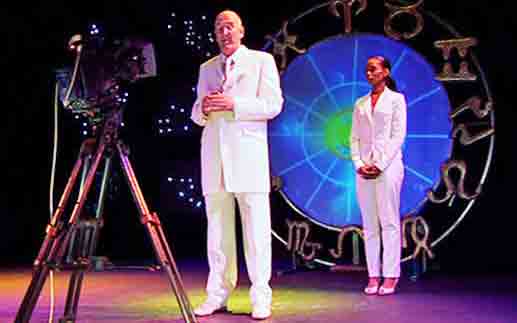
Luke’s horoscope says that he’ll save the world.

A woman named Cheryl is paying a regular visit to her astrologer, Martin Trueman, who has a change of heart when he realizes that Cheryl is burning her mortgage money to pay for his services. You see, he’s a con artist. While he explains himself, he stands in front of his window and is struck by a shooting star.

Suddenly, he’s found a new belief in astrology and lightning fingers.

Later, Rani, Clyde, and Luke attend an astrology seminar given by Trueman. They are joined by Rani’s parents and Sarah Jane as Cheryl asks each of them for their birthdays. Luke is troubled by this since he doesn’t have a true birthday. Meanwhile, Cheryl is confronted by her husband, but she rebuffs him.

Everyone takes their seats as the show begins. Luke thinks Trueman is a bit milky… or is it cheesy? Regardless, Trueman starts his seminar with a little showbiz, forcing each of the people he touched on his way in to stand and sit on command, including Clyde. He then starts focusing on people who dropped their birthdays in the box, which brings Rani to the spotlight.

Sarah Jane is skeptical throughout, but she’s soon called out. Trueman is able to discern the facts about her travels with the Doctor – including School Reunion and Journey’s End – and she is rattled. She tells Luke that Trueman is completely human, and as television host Lisa Trotter sets up an interview with Trueman on Paranormal Planet, the Bannerman Road Gang returns home to consult with Mr. Smith.

When Mr. Smith comes up empty, Sarah Jane visits with Trueman to figure out his trick. Before she leaves, she consoles Luke over his anxiety about birthdays and star signs. After all, she says, it’s not the day that they celebrate, it’s the person. Rani joins her for the surprise visit while Luke studies astrology on a universal scale.

Sarah Jane, Rani, and Trueman have a rather testy discussion. At the end, he threatens Sarah Jane that she shouldn’t stand in his way and demonstrates that he can shoot energy from his fingertips. As the ladies rush away, Trueman ambushes Clyde and enthralls him, forcing him to work against his friends.

Mr. Smith analyzes Rani’s burned jacket but cannot discern what was responsible. While Rani, Luke, and Sarah Jane brainstorm over the origins of the Ancient Lights, Mr. Smith pieces together that Trueman’s birth chart may hold the key.

Meanwhile, Trueman’s interview on Paranormal Planet is forcibly broadcast worldwide on every channel. He disables the host and production crew and addresses the world, and Sarah Jane specifically, as Clyde arrives and threatens to destroy his friends.

Sarah Jane is able to talk Clyde out of threatening them, allowing Luke to touch his shoulder and break the trance. Meanwhile, the thrall has extended to various neighbors on Bannerman Road who walk down the road in a haze. When the stars align and his power controls every person, Trueman will become king of Earth. To that end, the power extends around the world.

Sarah Jane theorizes that she was able to reach Clyde’s inherent goodness to override the programming. Luke and Rani also realize that if they block the transmission from the television studio, they’ll break the source of the power. But first, they’ll have to get past the enthralled circle that have joined hands to protect Trueman.

Clyde offers to pretend that he’s still enslaved as a member of the “inner circle” to get his friends past the blockade. As they breach the perimeter, Trueman sends Cheryl to find Clyde. She brings both Clyde and Sarah Jane to the stage where Trueman forces them to kneel before him. He explains that his ascension will pave the way for the Ancient Lights to take over Earth and the universe beyond.

Luke and Rani search for a way to interrupt the broadcast as the conjunction begins and a portal opens at the theater. As they try to switch off the main power, they find it shielded, and Rani’s sign comes up. Rani walks away in a trance and Luke (who has no sign) switches off the power.

But that doesn’t stop the power of the Ancient Lights.

Luke realizes the power he contains and breaks the inner circle, releasing the enchantment and stopping Trueman in his tracks. The conjunction passes, but Trueman refuses to give up his power. As the Ancient Lights depart, Trueman vaporizes into stardust and becomes one with them.

With the threat stopped, the Bannerman Road Gang returns home, leaving the neighborhood and the world grasping for the cause behind the event. Stuart and Cheryl are reunited, and the authorities begin what will be a fruitless search for Trueman.

Luke and Sarah decide, since Luke’s lack of a star sign and a birthday helped him to save the world, that today will be his birthday.


I’m a scientist and an engineer, but I have a soft spot for science fiction that mixes in the mysticism of astrology. Even with that in mind, this story was quite average with a superpowered omnipotent villain who enslaves the world in a quest for power and identity. There’s nothing new here. In fact, it’s the third story in a row to contain some degree of mind control as a plot point.

Even Sarah Jane says it: She knows how it feels to be possessed. As we’ve seen in Planet of the Spiders, The Masque of Mandragora, and The Hand of Fear.


Rating: 3/5 – “Reverse the polarity of the neutron flow.”


UP NEXT – Sarah Jane Adventures: The Mark of the Berserker


The Timestamps Project is an adventure through the televised universe of Doctor Who, story by story, from the beginning of the franchise. For more reviews like this one, please visit the project’s page at Creative Criticality.


The Thing About Today – June 17

June 17, 2020
Day 169 of 366


June 17th is the 169th day of the year. It was previously a day of remembrance for the East German uprising of 1953. It began as a strike by East Berlin construction workers on June 16th, which evolved into a widespread uprising against the communist German Democratic Republic government. It was violently suppressed by Soviet occupation forces (using tanks) and the military force of the Kasernierte Volkspolizei, but the strikes and protests continued into more than 500 towns and villages. All told, it involved more than one million people. It was an annual public holiday in West Germany (the Federal Republic of Germany) until reunification happened in 1990. After that, it was replaced by German Unity Day, which takes place on October 3rd.

In the United States, today is “celebrated” as Global Garbage Man Day, National Eat Your Vegetables Day, National Stewart’s Root Beer Day, National Apple Strudel Day, and National Cherry Tart Day.


Historical items of note:

  • In 1242, following the Disputation of Paris, twenty-four carriage loads of Jewish religious manuscripts were burnt in Paris. The Disputation of Paris, also known as the Trial of the Talmud, was an inquisition that followed the work of Nicholas Donin, a Jewish convert to Christianity. He translated the Talmud (a central text of the Jewish faith) and pressed 35 charges against it to Pope Gregory IX by quoting a series of allegedly blasphemous passages about Jesus, Mary, or Christianity. Four of the most distinguished rabbis in France defended the Talmud against Donin’s accusations.
  • In 1579, Sir Francis Drake claimed a land he called Nova Albion for England. It would later be known as California.
  • In 1631, Mumtaz Mahal died during childbirth. Her husband, Mughal emperor Shah Jahan I, would spend the next 17 years building her mausoleum, the Taj Mahal.
  • In 1637, French explorers Jacques Marquette and Louis Jolliet reached the Mississippi River and became the first Europeans to make a detailed account of its course.
  • In 1839, in the Kingdom of Hawaii, Kamehameha III issued the edict of toleration which provided Roman Catholics the freedom to worship in the Hawaiian Islands. The Hawaii Catholic Church and the Cathedral of Our Lady of Peace were established as a result.
  • In 1843, the Wairau Affray took place. It was the first serious clash of arms between Māori and British settlers in the New Zealand Wars.
  • In 1867, Irish-born American educator, publisher, and humanitarian John Robert Gregg was born.
  • Also in 1867, Australian poet and author Henry Lawson was born.
  • In 1882, Russian pianist, composer, and conductor Igor Stravinsky was born.
  • In 1885, the Statue of Liberty arrived in New York Harbor.
  • In 1898, the United States Navy Hospital Corps was established.
  • In 1943, singer-songwriter and producer Barry Manilow was born.
  • In 1944, Iceland declared independence from Denmark and became a republic.
  • In 1945, broadcaster and author Art Bell was born. He was the founder and the original host of the paranormal-themed radio program Coast to Coast AM.
  • In 1963, the United States Supreme Court ruled 8–1 in Abington School District v. Schempp against requiring the reciting of Bible verses and the Lord’s Prayer in public schools.
  • In 1972, five White House operatives were arrested for burgling the offices of the Democratic National Committee, in an attempt by some members of the Republican party to illegally wiretap the opposition. It would be known as the Watergate Scandal.
  • In 1982, actor Arthur Darvill was born.
  • Also in 1982, actor Jodie Whittaker was born. She is currently the Thirteenth Doctor on Doctor Who.
  • In 1985, Space Shuttle Discovery (STS-51-G) launched carrying Sultan bin Salman bin Abdulaziz Al Saud, the first Arab and first Muslim in space, as a payload specialist.
  • In 1987, with the death of the last individual of the species, the dusky seaside sparrow became extinct.
  • In 2015, nine African-Americans were killed in a mass shooting at Emanuel African Methodist Episcopal Church in Charleston, South Carolina. The gunman was a 21-year-old white supremacist who targeted the church because of its history and stature. The gunman’s adoration of the Confederate battle flag sparked a debate on the modern display of the symbol.


June 17th is the World Day to Combat Desertification and Drought.

The United Nations observance aims to raise awareness of the presence of desertification and drought, which transforms fertile drylands into arid deserts. The event highlights methods of preventing desertification and recovering from drought using a unique, novel emphasis each year that had not been developed previously.

The goal is “to protect the planet from degradation, including through sustainable consumption and production, sustainably managing its natural resources and taking urgent action on climate change, so that it can support the needs of the present and future generations.”


The Thing About Today is an effort to look at each day of 2020 with respect to its historical context.

For more creativity with a critical eye, visit Creative Criticality.


The Thing About Today – June 16

June 16, 2020
Day 168 of 366


June 16th is the 168th day of the year. It is the Day of the African Child, an observance started in 1991 by the Organisation of African Unity. It honors those who participated in the Soweto Uprising in 1976 and raises awareness of the continuing need for improvement of the education provided to African children.

In the United States, today is “celebrated” as National Fudge Day.


Historical items of note:

  • In 1829, Apache leader Geronimo was born.
  • In 1846, the Papal conclave elected Pope Pius IX, beginning the longest reign in the history of the papacy.
  • In 1858, Abraham Lincoln delivered his House Divided speech in Springfield, Illinois.
  • In 1902, geneticist, academic, and Nobel Prize laureate Barbara McClintock was born.
  • In 1903, Roald Amundsen left Oslo, Norway, to commence the first east-west navigation of the Northwest Passage.
  • In 1911, IBM (International Business Machines Corporation) was founded as the Computing-Tabulating-Recording Company in Endicott, New York.
  • In 1960, Alfred Hitchcock’s Psycho premiered.
  • In 1962, actor Arnold Vosloo was born.
  • In 1963, the Vostok 6 mission launched, making cosmonaut Valentina Tereshkova the first woman in space.
  • In 1972, the largest single-site hydroelectric power project in Canada was inaugurated at Churchill Falls Generating Station.
  • In 1977, the Oracle Corporation was incorporated in Redwood Shores, California, as Software Development Laboratories (SDL), by Larry Ellison, Bob Miner, and Ed Oates.
  • In 1978, actor Daniel Brühl was born.
  • In 1989, Ghostbusters II premiered.
  • In 2012, China successfully launched its Shenzhou 9 spacecraft, carrying three astronauts, including the first female Chinese astronaut Liu Yang, to the Tiangong-1 orbital module.
  • Also in 2012, the United States Air Force’s robotic Boeing X-37B spaceplane returned to Earth after a classified 469-day orbital mission.


June 16th is celebrated as Bloomsday, a commemoration of the life of Irish writer James Joyce.

In 1904, Joyce began a relationship with Nora Barnacle, his soon-to-be-wife, and subsequently uses the date to set the actions for his novel Ulysses. In Dublin, the day involves a range of cultural activities, including Ulysses readings and dramatizations, pub crawls, and other events. Some of the events are hosted by the James Joyce Centre, and enthusiasts often dress in Edwardian costume to celebrate. Hard-core devotees have even been known to hold marathon readings of the entire novel, some lasting up to 36 hours.

The day is named after the novel’s protagonist Leopold Bloom.


The Thing About Today is an effort to look at each day of 2020 with respect to its historical context.

For more creativity with a critical eye, visit Creative Criticality.


The Thing About Today – June 15

June 15, 2020
Day 167 of 366


June 15th is the 167th day of the year. It is National Beer Day in the United Kingdom, celebrated on the date in 1215 when the Magna Carta was sealed since it states in clause 35:

Let there be throughout our kingdom a single measure for wine and a single measure for ale and a single measure for corn, namely ‘the London quarter’

In the United States, today is “celebrated” as National Smile Power Day and Nature Photography Day.


Historical items of note:

  • In 1215, King John of England put his seal to Magna Carta. The Magna Carta Libertatum – in Medieval Latin, “Great Charter of Freedoms” – is a charter of rights drafted by the Archbishop of Canterbury to make peace between the unpopular King and a group of rebel barons, promising the protection of church rights, protection for the barons from illegal imprisonment, access to swift justice, and limitations on feudal payments to the Crown, to be implemented through a council of 25 barons. Neither side stood behind their commitments, and the charter was annulled by Pope Innocent III, leading to the First Barons’ War.
  • In 1648, Margaret Jones was hanged in Boston for witchcraft in the first such execution for the Massachusetts Bay Colony.
  • In 1667, the first human blood transfusion was administered by Dr. Jean-Baptiste Denys.
  • In 1752, Benjamin Franklin proved that lightning is electricity. This is the traditional date since the exact date is unknown.
  • In 1843, Norwegian pianist and composer Edvard Grieg was born.
  • In 1844, Charles Goodyear received a patent for vulcanization, a process to strengthen rubber.
  • In 1864, Arlington National Cemetery was established when 200 acres of the Arlington estate were officially set aside as a military cemetery by United States Secretary of War Edwin M. Stanton. The land had been the estate of Confederate general Robert E. Lee’s wife Mary Anna Custis Lee, a great-granddaughter of Martha Washington, before it was surrendered to the United States government near the start of the Civil War.
  • In 1877, Henry Ossian Flipper became the first African American cadet to graduate from the United States Military Academy.
  • In 1878, Eadweard Muybridge took a series of photographs to prove that all four feet of a horse leave the ground when it runs. The Horse in Motion became the basis of motion pictures.
  • In 1916, United States President Woodrow Wilson signed a bill incorporating the Boy Scouts of America, making them the only American youth organization with a federal charter.
  • In 1921, Bessie Coleman earned her pilot’s license, becoming the first female pilot of African-American descent.
  • In 1934, the United States Great Smoky Mountains National Park was founded.
  • In 1954, actor Jim Belushi was born.
  • In 1963, actress, director, and producer Helen Hunt was born.
  • In 1964, actress and producer Courteney Cox was born.
  • In 1973, actor and singer Neil Patrick Harris was born.
  • In 1983, Blackadder premiered on BBC1.
  • In 1994, The Lion King premiered.
  • In 2005, Batman Begins premiered.


June 15th is Global Wind Day.

The event was organized by WindEurope and GWEC (the Global Wind Energy Council). It celebrates wind energy and the exchanged of information about wind energy, its power, and the possibilities it holds to change the world.


The Thing About Today is an effort to look at each day of 2020 with respect to its historical context.

For more creativity with a critical eye, visit Creative Criticality.