

The Thing About Today – February 6

February 6, 2020
Day 37 of 366


February 6th is the thirty-seventh day of the year. It is the United Nations-sponsored International Day of Zero Tolerance to Female Genital Mutilation.

In the United States, it is “celebrated” as National Frozen Yogurt Day and National Lame Duck Day.


Historical items of note:

  • In 60 AD, graffiti was left in Pompeii that identified this day as a dies Solis, or a Sunday. Thanks to this historic Banksy, it is the earliest date for which a day of the week is known. In modern parlance, this day would have been a Wednesday.
  • In 1665, Queen Anne of Great Britain was born. She was the last monarch of the House of Stuart.
  • In 1778, as part of the American Revolutionary War, the Treaty of Alliance and the Treaty of Amity and Commerce were signed in Paris by the United States and France. This signaled official recognition of the new republic.
  • In 1815, New Jersey granted the first American railroad charter to John Stevens, the American lawyer, engineer, and inventor who constructed the first U.S. steam locomotive, first steam-powered ferry, and first U.S. commercial ferry service from his estate in Hoboken.
  • In 1838, Sir Henry Irving was born. He was the first actor to be awarded a knighthood, and was one of the inspirations for the title character of Bram Stoker’s Dracula.
  • In 1895, American baseball player George Herman “Babe” Ruth Jr. was born. He was one of the first five inaugural members of the Baseball Hall of Fame.
  • In 1918, British women over the age of 30, who met minimum property qualifications, received the right to vote when Representation of the People Act 1918 was passed by Parliament.
  • In 1922, actor Patrick Macnee was born.
  • In 1939, actor and director Mike Farrell was born. He portrayed Captain B.J. Hunnicutt on M*A*S*H.
  • In 1940, journalist Tom Brokaw was born.
  • In 1945, singer-songwriter Bob Marley was born.
  • In 1951, the Canadian Army entered combat in the Korean War.
  • In 1952, Elizabeth II became Queen of the United Kingdom and her other Realms and Territories and Head of the Commonwealth upon the death of her father, George VI. At the exact moment of succession, she was in a treehouse at the Treetops Hotel in Kenya. She is the longest-lived and longest-reigning British monarch, as well as the world’s longest-serving female head of state, oldest living monarch, longest-reigning current monarch, and the oldest and longest-serving current head of state.
  • In 1959, Jack Kilby of Texas Instruments filed the first patent for an integrated circuit.
  • In 1966, singer-songwriter Rick Astley was born. He promises to never give you up, never let you down, and never run around and desert you.
  • In 1987, Justice Mary Gaudron became the first woman to be appointed to the High Court of Australia.
  • In 1998, Washington National Airport was renamed Ronald Reagan National Airport. This coincided with the actor and former U.S. President’s 87th birthday.


In 2018, SpaceX’s Falcon Heavy, a super heavy-lift launch vehicle, made its maiden flight.

SpaceX, formally the Space Exploration Technologies Corporation, is a private American aerospace and space manufacturing company founded by Elon Musk, the CEO of Tesla. The company’s goal is the reduction of space transportation costs to enable the colonization of Mars.

SpaceX put the first privately funded liquid-propellant rocket, the Falcon 1, in orbit in 2008. They were also the first private company to successfully launch, orbit, and recover a spacecraft (the Dragon in 2010), the first private company to send a spacecraft to the International Space Station (the Dragon in 2012), the first propulsive landing for an orbital rocket (the Falcon 9 in 2015), the first reuse of an orbital rocket (the Falcon 9 in 2017), and the first private company to launch an object into orbit around the sun.

That last one was the Falcon Heavy and its payload of a Tesla Roadster. The reusable Falcon Heavy – classified as a super heavy-lift launch vehicle due to its ability to lift more than 110,000 pounds of payload into low Earth orbit – was designed to be able to carry humans into space beyond low Earth orbit. It was unveiled at a news conference in April 2011 with an initial test flight expected for 2013. Partly due to the failure of the SpaceX CRS-7 in 2015, the maiden flight was delayed until February 2018. The goal of the maiden flight was to demonstrate the rocket’s capabilities while gathering telemetry throughout the flight.

The Tesla Roadster was chosen as a payload because it belonged to Elon Musk and had to be “something fun and without irreplaceable sentimental value”. A mannequin (in a SpaceX spacesuit)  named “Starman” sat in the driver’s seat, named in honor of David Bowie. The car’s sound system also played Bowie songs on a loop. The Roadster became the first consumer car sent into space, and it was inserted into a heliocentric orbit.

The mission also carried Arch Mission 1.2 – a crystal disk containing Isaac Asimov’s Foundation series of books – as well as a copy of Douglas Adams’ 1979 novel The Hitchhiker’s Guide to the Galaxy in the glovebox, a towel, a “Don’t Panic!” sign on the dashboard, a Hot Wheels miniature Roadster with a miniature Starman driver, a plaque bearing the names of the employees who worked on the project, and a message on the vehicle’s circuit board that read “Made on Earth by humans”.

A year after the successful demo flight, SpaceX had managed to sign five commercial contracts worth $500 million to $750 million. SpaceX launched the first commercial Falcon Heavy rocket in April 2019, and a third flight a few months later with the recovered side-boosters from the second flight.

SpaceX has flown 18 resupply missions to the International Space Station (ISS) under a partnership with NASA. NASA also awarded SpaceX a further development contract in 2011 to develop and demonstrate a human-rated Dragon spacecraft, which would be used to transport astronauts to the ISS and return them safely to Earth. SpaceX conducted the maiden launch of its Crew Dragon spacecraft on a NASA-required demonstration flight (christened Crew Dragon Demo-1) on March 2, 2019 and is set to launch its first crewed Crew Dragon in March 2020.

SpaceX is also hard at work on the Starship spacecraft, which is designed for use in crewed interplanetary spaceflight.


The Thing About Today is an effort to look at each day of 2020 with respect to its historical context.

For more creativity with a critical eye, visit Creative Criticality.


Timestamp #TW23: From Out of the Rain

Torchwood: From Out of the Rain
(1 episode, s02e10, 2008)


Have you heard the music?

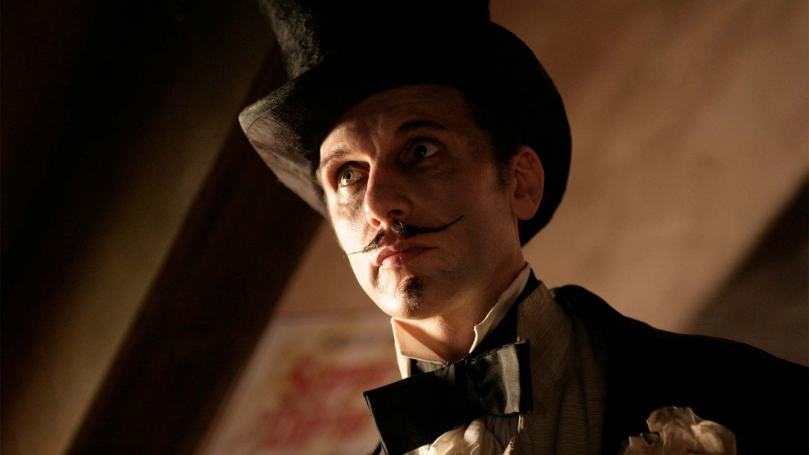
At a local carnival, local residents attend a show, but the whole affair vanishes and leaves a single woman standing in the field alone. Flashing forward to the future, a man who is reviewing vintage film is haunted by the carnival worker on his screen. Meanwhile, Jack is being haunted by a carnival organ in his head.

Gwen, Owen, and Ianto take some time away to visit the Electro, a historic cinema in rainy Cardiff. The man who was reviewing vintage film rushes to the cinema to deliver his hard work. When that film is played, the mysterious man appears and the projector is locked on. Ianto also spots Jack in the footage.

The team leaves the theater just as Jack arrives in the SUV and Tosh experiences a glitch in the Hub computers. Ianto and Jack discuss the events, and Jack laments the death of the traveling show with the advent of the cinema. They interrogate the projectionist and confiscate the film before following a lead from Tosh to investigate a Rift spike.

Outside in the pouring rain, the mysterious showman and his accomplice approach a stranded woman and steal some kind of energy from her. Jack, Owen, Gwen, and Ianto arrive to find the woman partially desiccated and take her to the hospital.

The carnival duo attacks another target at a local diner. The woman is taken to the same hospital. The Torchwood team starts putting pieces together, noting that the bodies are alive but their life forces are taken elsewhere. They return to the Hub and review the film, during which Jack identifies the Night Travellers: A group that only performed at night and appeared by coming out of the rain. Their appearance was linked to strange happenings in the communities that they visited.

Ianto also notes that the mermaid woman (later called Pearl) and a man in a top hat (later called the Ghostmaker) are missing from the film. Playing the film has set them free in the world.

The team investigates multiple stories and superstitions to unravel the mystery. Meanwhile, the Ghostmaker and Pearl continue their attacks, gathering six “last breaths” into a silver flask. The Ghostmaker decides that he needs to release the rest of the troupe from the film.

Torchwood Three responds to the hospital to find the new victims. Jack’s mention of “they came from out of the rain” sparks a memory with the attending nurse of a woman in a nursing home. They visit the woman, Christina, and learn that she was the woman from the opening sequence. Her family was taken by the Night Travellers to be in their eternal audience.

The Ghostmaker and Pearl return to the projectionist’s flat and take his film, but not before the Torchwood team is notified. Jack and Ianto arrive but the carnival duo has already vanished, headed for the Electro. Jack determines that if the duo can be filmed again, they’ll be trapped once more.

The team converges on the Electro and finds the theater owners, the projectionist’s parents, in a frozen stupor. The carnival film begins to play on the screen, releasing the Night Travellers as Owen heads to the projection booth and Jack films their emergence. The Ghostmaker finds Owen to be useless since he is without breath, but that provides just enough distraction for Ianto to steal the flask. A chase ensues, during which Jack exposes the film and eliminates the carnival ghosts. Unfortunately, the Ghostmaker spills the contents of the flask. When all is said and done, only one breath remains.

All the other victims have died.

Jack uses the remaining breath to save the final victim, a little boy, before stowing the flask at the Hub. Ianto destroys the remaining film, but it proves impossible to destroy all of it since the Night Travellers were filmed in so many places over time.

A family buys some old film reels. Once opened, Jack hears the music once again.

The threat still lives on.


It’s an intriguing idea given cultural superstitions that film can steal or trap souls and the Ghostmaker sneaking around Cardiff and attacking random people is somewhat unnerving, but the big problem in this story is the lack of real menace. The Ghostmaker and Pearl move through the plot like clockwork only to stalk with gloom around a deserted swimming pool for a large chunk of the episode. The arrival of the remaining Night Travellers happens late in the game, and they are dispatched with ease.

It just doesn’t fit with the general tension and darkness of Torchwood.


Rating: 2/5 – “Mm? What’s that, my boy?”


UP NEXT – Torchwood: Adrift


The Timestamps Project is an adventure through the televised universe of Doctor Who, story by story, from the beginning of the franchise. For more reviews like this one, please visit the project’s page at Creative Criticality.


The Thing About Today – February 5

February 5, 2020
Day 36 of 366


February 5th is the thirty-sixth day of the year. It is Constitution Day in Mexico and Crown Princess Mary’s birthday in Denmark.

In the United States, it is “celebrated” as National Shower with a Friend Day, National Weatherperson’s Day, World Nutella Day, and National Girls and Women in Sports Day. The last one is typically observed on the first Wednesday in February.

Shower with a Friend Day reminds me of one of my dad’s sayings during my childhood: “Save water and shower with a steady.”


Historical items of note:

  • In 62 AD, the towns of Pompeii and Herculaneum were severely damaged by strong earthquake. Some consider it a precursor event to the eruption of Mount Vesuvius which destroyed the same towns seventeen years later.
  • In 1807, the ship of the line HMS Blenheim and the frigate HMS Java disappeared off the coast of Rodrigues in the Indian Ocean.
  • In 1852, the New Hermitage Museum opened to the public in Saint Petersburg, Russia. It is one of the largest and oldest museums in the world.
  • In 1913, Greek military aviators Michael Moutoussis and Aristeidis Moraitinis performed the first naval air mission in history. The mission was flown with a Farman MF.7 hydroplane.
  • In 1917, the current constitution of Mexico was adopted. It established a federal republic with powers separated into independent executive, legislative, and judicial branches.
  • In 1918, Stephen W. Thompson shot down a German airplane during World War I. It was the first aerial victory by the United States military.
  • Also in 1918, the luxury liner SS Tuscania was torpedoed off the coast of Ireland by German U-boat UB-77. It was carrying 384 crew 2,013 United States Army personnel. About 210 troops and crew were lost in the attack, making the Tuscania the first ship carrying American troops to Europe to be torpedoed and sunk.
  • In 1919, Charlie Chaplin, Mary Pickford, Douglas Fairbanks, and D. W. Griffith launched United Artists.
  • In 1921, British film production designer Ken Adam was born.
  • In 1924, the Royal Greenwich Observatory began broadcasting the hourly time signals known as the Greenwich Time Signal or the “BBC Pips”.
  • In 1934, American baseball player Hank Aaron was born. He held the career home run record for thirty-three years, was awarded the Presidential Medal of Freedom in 2002, and holds front office roles with his home team, the Atlanta Braves.
  • In 1941, actor, producer, and screenwriter Stephen J. Cannell was born. His creations include The Rockford FilesThe A-TeamThe Greatest American Hero21 Jump Street, and The Commish.
  • In 1943, Nolan Bushnell was born. An American engineer and businessman, he founded Atari, Inc.
  • In 1944, the Captain America serial premiered. It was the most expensive serial that Republic Pictures ever made. It was also the first theatrical release connected to a Marvel character and would hold that status for more than 40 years.
  • In 1958, a hydrogen bomb known as the Tybee Bomb was lost by the United States Air Force off the coast of Savannah, Georgia. It was never recovered.
  • In 1971, astronauts Alan Shepard and Edgar Mitchell from the Apollo 14 mission successfully landed on the lunar surface.
  • In 1988, Manuel Noriega was indicted on drug smuggling and money laundering charges.


In 1940, Swiss painter, sculptor, and set designer H. R. Giger was born.

Giger was well-known for his stylistic images of humans and machines connected in biomechanical relationships. He was part of the special effects team for 1979’s Alien, which won an Academy Award for Best Achievement in Visual Effects.

His design for the titular xenomorphic alien was inspired by his painting Necronom IV. His books of paintings, particularly Necronomicon and Necronomicon II continued to propel his international recognition, as well as his frequent publication in Omni magazine. He was admitted to the Science Fiction and Fantasy Hall of Fame in 2013.

Giger’s work has been seen on several recording albums as well as several films. Aside from the Alien franchise, he worked on an unproduced version of DunePoltergeist IISpeciesFuture-KillTokyo: The Last Megalopolis, and an unused version of the Batmobile from Batman Forever. He also directed several films.

Giger died on May 12, 2014, after suffering injuries in a fall. His work is on permanent display at the H.R. Giger Museum at the Saint-Germain Castle in Gruyères, Switzerland, which he acquired in 1998.

On 11 July 2018, the asteroid 109712 Giger was named in his memory.


The Thing About Today is an effort to look at each day of 2020 with respect to its historical context.

For more creativity with a critical eye, visit Creative Criticality.


The Thing About Today – February 4

February 4, 2020
Day 35 of 366


February 4th is the thirty-fifth day of the year. It is World Cancer Day, a day to raise awareness of the disease and encourage its prevention, detection, and treatment.

In the United States, it is “celebrated” as National Create a Vacuum Day, National Hemp Day, National Homemade Soup Day, National Thank a Mail Carrier Day, and Safer Internet Day. The last one is typically observed on the first Tuesday in February.

National Soup Day, eh? Perhaps it is a good day to experiment with my Zuppa Toscana recipe, especially since today is the approximate midpoint of the season.


Historical items of note:

  • In 1454, during the Thirteen Years’ War, the Secret Council of the Prussian Confederation sent a formal act of disobedience to the Grand Master of the Teutonic Knights.
  • In 1703, all but one of the Forty-Seven Rōnin committed seppuku (ritual suicide) in Edo (now known as Tokyo) as recompense for avenging their master’s death. The forty-seventh rōnin, Terasaka Kichiemon, eventually returned from his mission and was pardoned by the shōgun.
  • In 1789, George Washington was unanimously elected as the first President of the United States by the U.S. Electoral College.
  • In 1846, the first Mormon pioneers began their exodus from Nauvoo, Illinois, westward towards Salt Lake Valley.
  • In 1861, delegates from six break-away U.S. states met in Montgomery, Alabama to form the Confederate States of America. Confederate Vice President Alexander H. Stephens would later describe the new republic’s ideology as being centrally based “upon the great truth that the negro is not equal to the white man; that slavery, subordination to the superior race, is his natural and normal condition.”
  • In 1902, pilot and explorer Charles Lindbergh was born.
  • In 1906, Clyde Tombaugh was born. He was the astronomer who discovered Pluto in 1930.
  • In 1920, voice actor Janet Waldo was born. Among other roles, she was Judy in The Jetsons and Josie in Josie and the Pussycats.
  • In 1940, George A. Romero, director of 1968’s Night of the Living Dead, was born.
  • In 1941, the United Service Organization (USO) was created to entertain American troops.
  • In 1948, Ceylon (later renamed Sri Lanka) became independent within the British Commonwealth.
  • In 1952, Jackie Robinson, the first African-American to play in Major League Baseball, became the vice president and director of personnel for Chock full o’Nuts. That made him the first African-American vice president of a major American corporation.
  • In 1970, Patton premiered in New York City. It won the Academy Award for Best Picture in 1971.
  • In 2004, Facebook was founded.


In 1913, American civil rights activist Rosa Parks was born. She was known for her pivotal role in the Montgomery bus boycott and has become known as the “the mother of the freedom movement”.

Around the turn of the 20th century, former Confederate states adopted new laws that disenfranchised black voters. Jim Crow laws also imposed racial segregation upon public facilities, retail stores, and public transportation in the American South. To that end, buses had separate seating sections for black customers and white customers, and whites took priority.

In 1932, Rosa married Montgomery barber Raymond Parks. At that time, the NAACP was collecting funds to support the defense of the Scottsboro Boys, a group of black men who were falsely accused of raping two white women. In 1943, Rosa Parks became active in the civil rights movement and joined the NAACP where she served as secretary until 1957. One day, she boarded a bus and paid the fare, but was forced to disembark by driver James F. Blake and enter the bus again using the back door per city rules. When she complied, Blake drove off and left her stranded in the rain.

Around 1944, she held a job at Maxwell Air Force Base, which was not segregated since it was federal property. She worked as a seamstress afterward, finally succeeding at being listed on voter rolls (on her third try due to heavy discrimination) in 1945.

On March 2, 1955, Claudette Colvin was arrested for failing to surrender her bus seat to a white man. Colvin was a student at Booker T. Washington High School and a member of the NAACP Youth Council, of which Parks was an advisor. Preceding this event, several others had attempted sit-in protests on buses, including Bayard Rustin, Irene Morgan, Lillie Mae Bradford, and Sarah Louise Keyes. Colvin was followed by Aurelia Browder, Susie McDonald, and Mary Louise Smith.

In August 1955, teenager Emmett Till was brutally murdered after reportedly flirting with a white woman in Mississippi. The murderers were acquitted, news that angered and saddened Parks.

All of that led to December 1, 1955. After working all day, Parks boarded the bus, paid her fare, and found an empty seat in the first row of the “colored” section. She did not notice that her driver was James Blake. As more passengers boarded, several white riders were left standing, so Blake moved the “colored” sign behind Parks and demanded that she surrender her seat.

Thinking of Emmett Till, Parks refused. She was arrested and charged with violation of the law.

On the night of her arrest, the Women’s Political Council printed and circulated a flyer through the black community. The following morning, the idea of boycotts started to circulate at a meeting led by Martin Luther King, Jr. Effectively, if the black community did not ride, the buses could not afford to operate. The Montgomery bus boycott began on December 5, 1955 with coordination and support throughout the black community. The boycott wasn’t resolved until December 20, 1956, and eventually led to a United States Supreme Court decision that declared the Alabama and Montgomery laws that segregated buses were unconstitutional.

After the boycott, Parks moved to Detroit and continued as an activist and organizer for the rest of her life. After retirement, she continued to insist that the struggle for justice was not over. She received national recognition, including the NAACP’s 1979 Spingarn Medal, the Presidential Medal of Freedom, the Congressional Gold Medal, and a posthumous statue in the United States Capitol’s National Statuary Hall. She was the first woman to lie in honor in the Capitol Rotunda after her death in 2005, becoming the third of only four Americans to ever receive this honor.

Rosa Parks’s life was so much more than the historical eye-blink that was that night on the bus. She was a strong woman who fought for the right in everything she did. She published her autobiography, Rosa Parks: My Story, in 1992. She also published a memoir about her faith, Quiet Strength, in 1995. You owe it to yourself to learn about this amazing woman’s entire life and legacy.

In her honor, four states observe Rosa Parks Day. Ohio and Oregon commemorate her bravery on December 1st, but California and Missouri pay their respects on February 4th, the anniversary of her birthday.


The Thing About Today is an effort to look at each day of 2020 with respect to its historical context.

For more creativity with a critical eye, visit Creative Criticality.


The Thing About Today – February 3

February 3, 2020
Day 34 of 366


February 3rd is the thirty-fourth day of the year. It is Setsubun in Japan, the day before the beginning of spring.

In the United States, it is “celebrated” as National Carrot Cake Day, National Missing Persons Day, National Women Physicians Day, and National Football Hangover Day. That last one is typically commemorated on the day after the “Big Game”. You know, the “Superb Owl.” The football championship event that was held yesterday at Hard Rock Stadium in Miami Gardens, Florida.

Don’t sue me, National Football League. </sarcasm>


Historical items of note:

  • In 1690, the colony of Massachusetts issued the first paper money in the Americas.
  • In 1783, Spain recognized the independence of the United States during the American Revolutionary War.
  • In 1809, German pianist, composer, and conductor Felix Mendelssohn was born.
  • In 1870, the Fifteenth Amendment to the United States Constitution was ratified, guaranteeing voting rights to male citizens regardless of race.
  • In 1894, American painter and illustrator Norman Rockwell was born.
  • In 1913, the Sixteenth Amendment to the United States Constitution was ratified, authorizing the Federal government to impose and collect an income tax.
  • In 1917, during World War I, the United States broke off diplomatic relations with Germany. This was two days after Germany declared a new policy of unrestricted submarine warfare.
  • In 1938, actor Victor Buono was born. He played King Tut on the 1966 Batman television series.
  • In 1956, actor and comedian Nathan Lane was born.
  • In 1961, the United States Air Force began Operation Looking Glass. For the next thirty years, a “Doomsday Plane” was always in the air with the capability of taking direct control of the United States’ bombers and missiles if the Strategic Air Command command post was lost.
  • In 1965, actress and producer Maura Tierney was born.
  • In 1966, the Soviet Union’s unmanned Luna 9 vehicle became the first spacecraft to make a soft landing on the Moon. It was also the first spacecraft to take pictures from the surface of the Moon.
  • In 1970, actor and screenwriter Warwick Davis was born. He’s appeared in Willow and pretty much every Star Wars film since 1983.
  • In 1994, Sergei Krikalev became the first Russian cosmonaut to fly aboard the Space Shuttle as mission STS-60 (Discovery) was launched.
  • In 1995, Eileen Collins became the first woman to pilot the Space Shuttle as mission STS-63 (Discovery) was launched.


Today is commemorated as The Day the Music Died.

In 1959, Buddy Holly and his band – consisting of Waylon Jennings, Tommy Allsup, and Carl Bunch – were on the “Winter Dance Party” tour in the American Midwest. They were joined by rising stars Ritchie Valens, J. P. “The Big Bopper” Richardson, and Dion and the Belmonts.

The long travel stretches between venues was a killer for the artists, including cases of flu and frostbite on the cold and uncomfortable tour buses. After their performance at the Surf Ballroom in Clear Lake, Iowa, Buddy Holly decided to charter a plane for the next leg of their journey. As fate played out, Richardson (afflicted with the flu) took Jennings’s seat on the plane and Valens won his seat after beating Allsup in a coin toss.

Soon after takeoff, radio contact was lost with the plane. When the plane did not reach Moorhead, Minnesota, it was reported missing. It was eventually found in a cornfield six miles northwest of the departure airport. The investigation revealed that poor weather conditions and pilot error contributed to the accident.

Buddy Holly, Ritchie Valens, J. P. “The Big Bopper” Richardson, and pilot Roger Peterson were killed in the crash.

Buddy Holly’s wife, María Elena, learned of her husband’s death via a television news report. They had been married for only six months, and she suffered a miscarriage shortly afterward. This led to the policy of not disclosing victims’ names until family members had been notified.

Fans make pilgrimages to Clear Lake, Iowa every year to pay their respects. An annual memorial concert is also held at the Surf Ballroom.

In 1971, Don McLean released his hit single “American Pie”, which was written in the late 1960s. It paid tribute to the artists and pilot, commemorated the loss of innocence of the early rock and roll generation, and served to exorcise his long-running grief over the accident.


The Thing About Today is an effort to look at each day of 2020 with respect to its historical context.

For more creativity with a critical eye, visit Creative Criticality.


The Thing About Today – February 2

February 2, 2020
Day 33 of 366


February 2nd is the thirty-third day of the year. It is Inventor’s Day in Thailand and World Wetlands Day.

In the United States, it is “celebrated” as National Heavenly Hash Day and National Tater Tot Day.


Historical items of note:

  • In 1645, the combined army of Scottish Royalist Highlanders and Confederate Irish troops under James Graham, Lord Montrose destroyed the pursuing forces of Archibald Campbell, 1st Marquess of Argyll during the Scottish Civil War. This would become known as the Battle of Inverlochy.
  • In 1653, New Amsterdam was incorporated. It would later become the City of New York.
  • In 1848, the Treaty of Guadalupe Hidalgo was signed, ending the two-year-long Mexican-American War.
  • In 1850, Brigham Young declared war on the Timpanogos Tribe at the Battle of Fort Utah. The Timpanogos people had initially tolerated the settlers, the remnants of the Nauvoo Legion, but after three Mormons murdered a Timpanogos man known as Old Bishop followed by a hard winter where the tribe took 50 cattle from the Mormons, the war was declared. The Mormons killed 100 Timpanogos people, including Chief Old Elk’s tribe and other tribes that had no hostile history with the Mormons.
  • In 1901, the funeral for Queen Victoria was held.
  • In 1913, Grand Central Station was opened in New York City.
  • In 1922, Ulysses by James Joyce was published.
  • In 1925, dog sleds transporting a much-needed diphtheria serum reached Nome, Alaska. The serum was transported 674 miles across the Alaska Territory by 20 mushers and 150 sled dogs in five and a half days. The lead dog on the final sled was the famous Balto, but the true hero was lead dog Togo who covered 260 miles. The serum run inspired the Iditarod race.
  • In 1940, Frank Sinatra made his first public appearance with the Tommy Dorsey Orchestra in Indianapolis.
  • In 1942, the Osvald Group organized the first, active event of anti-Nazi resistance in Norway. It was a protest against the inauguration of the traitor Vidkun Quisling.
  • In 1943, during World War II, the Battle of Stalingrad came to a close as Soviet troops accepted the surrender of German troops in the city.
  • In 1947, actress and producer Farrah Fawcett was born.
  • In 1949, actor and singer Brent Spiner was born.
  • In 1954, actress and businesswoman Christie Brinkley was born.
  • In 1955, President Dwight Eisenhower hosted the first presidential new conference on network television. It aired on ABC.
  • In 2005, the Government of Canada introduces the Civil Marriage Act. When this legislation became law on July 20, 2005, it legalized same-sex marriage in the country.


In 1887, Groundhog Day was first observed in Punxsutawney, Pennsylvania.

The tradition derives from a Pennsylvania Dutch superstition that if a groundhog or woodchuck emerges from its burrow on this day and sees its shadow due to clear weather, the animal will retreat to its den to weather six more weeks of winter. Conversely, if it doesn’t see its shadow because of cloudiness, spring will arrive early. The lore was brought from a German-speaking heritage where a badger is the prognosticator and may spring from a tradition where clear weather on the Christian holy day of Candlemas forbodes a prolonged winter.

There is no scientific basis for this superstition.

Punxsutawney, Pennsylvania houses the most famous weather-rodent in the world, named Punxsutawney Phil. Every year, top hat and tuxedo-clad members of the Inner Circle awaken Phil from his burrow on Gobbler’s Knob and “speak” to the groundhog through a “mystical” ancient acacia wood cane. The entire show depends on a light-hearted suspension of disbelief, including the mythology that Phil has lived to make these predictions since 1886, sustained by drinks of “groundhog punch” and “elixir of life”. In reality, groundhogs only live for about six years.

Other locations have similar celebrations and observations:

  • Quarryville, PA: The Slumbering Groundhog Lodge, which was formed in 1907, uses a stuffed woodchuck in their observation. It used to be a contending rival to Punxsutawney’s event.
  • Southeastern Pennsylvania: Several Groundhog Lodges (Grundsow Lodges) celebrate the holiday with fersommlinge, Pennsylvania Dutch social events in which food is served, speeches are made, and one or more g’spiel (plays or skits) are performed for entertainment. Only the Pennsylvania German dialect is spoken at the event and those who speak English pay a small penalty per word spoken.
  • Sun Prairie, WI: The self-proclaimed “Groundhog Capital of the World” in response to a slight in a 1952 Punxsutawney Spirit newspaper article that described the location as a “remote two cow village buried somewhere in the wilderness.”
  • New York: Staten Island Chuck is the official weather-forecasting woodchuck for New York City, and Dunkirk Dave is the local groundhog for Western New York. Dunkirk Dave is handled by Bob Will, a typewriter repairman who runs a rescue shelter for groundhogs.
  • Raleigh, NC: Sir Walter Wally headlines the annual event at the North Carolina Museum of Natural Sciences.
  • Washington, D.C.: Potomac Phil, another stuffed critter, is the focus of the Dupont Circle Groundhog Day event.
  • Liliburn, GA: General Beauregard Lee makes predictions for Butts County.
  • Irving, TX: The University of Dallas has boasted of hosting the second largest Groundhog celebration in the world.
  • Alaska: Groundhog Day has been replaced by Marmot Day, a celebration of the creature and Alaskan culture.
  • Wiarton, Ontario has Wiarton Willie, Nova Scotia has Shubenacadie Sam (the first Groundhog Day prediction in North America), and Quebec has Fred la marmotte of Val-d’Espoir.
  • Moscow, Saint Petersburg, and Samara, Russia all got in on the celebration as well in 2017.

Of course, the most popular representation of the celebration is 1993’s Groundhog Day, in which Bill Murray portrays a weatherman who visits Punxsutawney and ends up trapped in a time loop. The town was portrayed by Woodstock, Illinois in the film.


The Thing About Today is an effort to look at each day of 2020 with respect to its historical context.

For more creativity with a critical eye, visit Creative Criticality.


The Thing About Today – February 1

February 1, 2020
Day 32 of 366


February 1st is the thirty-second day of the year. It is celebrated as Imbolc, Imbolg, and Saint Brigid’s Day in Ireland and Scotland, as well as among certain neopagan groups. It is one of the four Gaelic seasonal festivals – joined with Beltane, Lughnasadh, and Samhain – and marks the beginning of spring between the winter solstice and the vernal equinox.

In the United States, it is “celebrated” as National Baked Alaska Day, National Get Up Day, National Serpent Day, and National Texas Day.


Historical items of note:

  • In 1884, the first volume of the Oxford English Dictionary was published. It covered topics from A to Ant.
  • In 1893, Thomas Edison finished construction of the first motion picture studio. It was the Black Maria, located in West Orange, New Jersey.
  • In 1896, Giacomo Puccini’s La bohème premiered in Turin at the Teatro Regio.
  • In 1918, Russia adopted the Gregorian calendar.
  • In 1924, the United Kingdom recognized the USSR.
  • In 1942, Voice of America began broadcasting. It was the official external radio and television service of the United States government and broadcasted programs aimed at areas controlled by the Axis powers.
  • Also in 1942, actress Bibi Besch was born.
  • In 1946, Elisabeth Sladen was born. She portrayed the iconic Sarah Jane Smith on Doctor Who.
  • In 1954, actor Billy Mumy was born.
  • In 1960, four black students staged the first of the Greensboro sit-ins at a lunch counter in Greensboro, North Carolina.
  • In 1964, The Beatles had their first number one hit in the United States: “I Want to Hold Your Hand”.
  • In 1968, Canada’s three military services – the Royal Canadian Navy, the Canadian Army, and the Royal Canadian Air Force – were unified into the Canadian Forces.
  • In 1998, Rear Admiral Lillian E. Fishburne became the first female African American to be promoted to rear admiral in the United States Navy.
  • In 2003, Space Shuttle Columbia disintegrated during atmospheric reentry during mission STS-107, killing all seven astronauts aboard.


In 1865, President Abraham Lincoln signed the Thirteenth Amendment to the United States Constitution. It was not ratified by the states until later, but at this point, the signed resolution passed by Congress made slavery illegal within the United States.

Section 1
Neither slavery nor involuntary servitude, except as a punishment for crime whereof the party shall have been duly convicted, shall exist within the United States, or any place subject to their jurisdiction.

Section 2
Congress shall have power to enforce this article by appropriate legislation

Major Richard Robert Wright Sr, a former slave and the first African American to serve as a U.S. Army paymaster, believed that there should be a day to celebrate the freedoms of all Americans. He began to formulate this plan and in 1947, one year after his death, Congress passed a bill to make National Freedom Day on February 1st. The official holiday proclamation was signed into law on June 30, 1948, by President Harry Truman.

National Freedom Day was the forerunner to Black History Month.

A precursor to Black History Month was celebrated as early as 1926 when historian Carter G. Woodson and the Association for the Study of Negro Life and History proclaimed the second week of February to be “Negro History Week”. This was chosen since it coincided with Abraham Lincoln’s and Frederick Douglass’s birthdays. The thought process boiled down to the concepts of recognition and importance, and while the first celebration was met with a lukewarm response, future celebrations generated a great deal of enthusiasm.

It prompted the creation of black history clubs, an increase in interest among teachers, and interest from progressive whites. It grew in popularity throughout the following decades, with mayors across the United States endorsing it as a holiday.

Black History Month was first proposed by black educators and the Black United Students at Kent State University in February 1969, with the first celebration in the following year. Six years later, Black History Month was being celebrated all across the country in educational institutions, centers of Black culture and community centers. President Gerald Ford recognized Black History Month during the celebration of the United States Bicentennial in 1976.

In the Bicentennial year of our Independence, we can review with admiration the impressive contributions of black Americans to our national life and culture.

One hundred years ago, to help highlight these achievements, Dr. Carter G. Woodson founded the Association for the Study of Afro-American Life and History. We are grateful to him today for his initiative, and we are richer for the work of his organization.

Freedom and the recognition of individual rights are what our Revolution was all about. They were ideals that inspired our fight for Independence: ideals that we have been striving to live up to ever since. Yet it took many years before ideals became a reality for black citizens.

The last quarter-century has finally witnessed significant strides in the full integration of black people into every area of national life. In celebrating Black History Month, we can take satisfaction from this recent progress in the realization of the ideals envisioned by our Founding Fathers. But, even more than this, we can seize the opportunity to honor the too-often neglected accomplishments of black Americans in every area of endeavor throughout our history.

I urge my fellow citizens to join me in tribute to Black History Month and the message of courage and perseverance it brings to all of us.


The Thing About Today is an effort to look at each day of 2020 with respect to its historical context.

For more creativity with a critical eye, visit Creative Criticality.